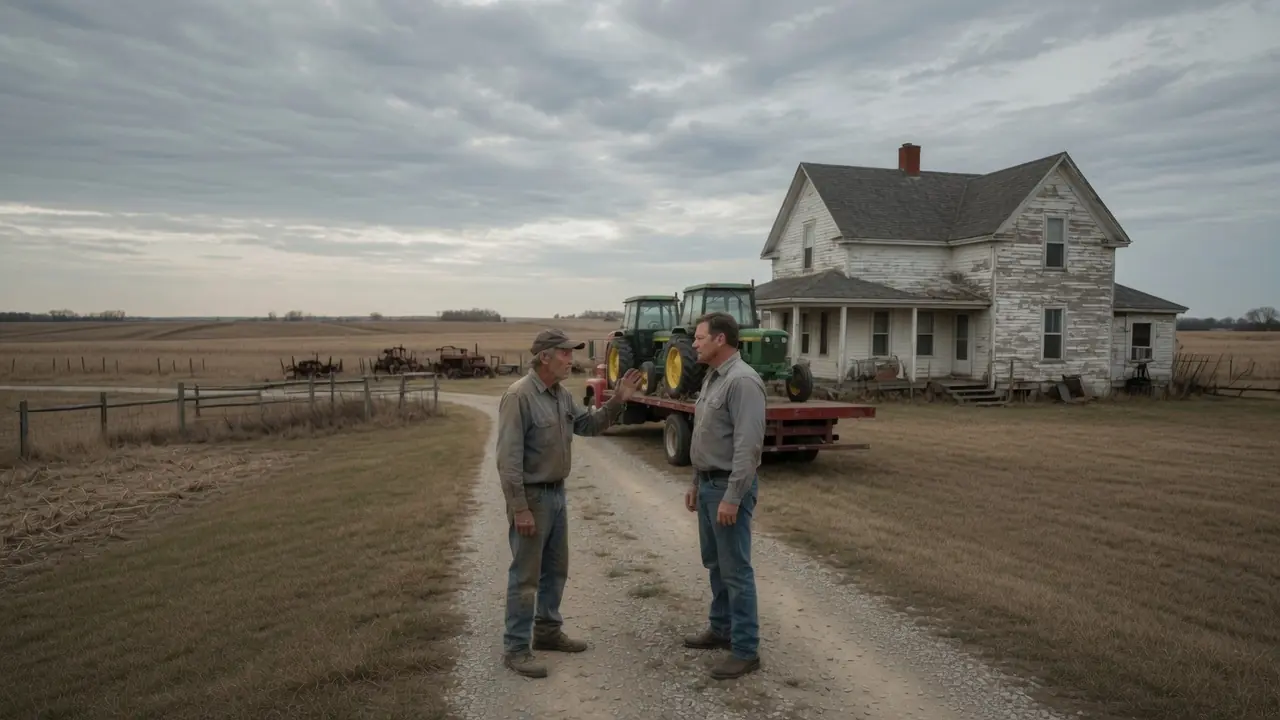
The red flatbed truck rolled slowly up the gravel driveway beneath a heavy Iowa sky, carrying two new green tractors that looked too bright for the old Dutton farm.
Warren Dutton stood beside the lane with one hand raised, not waving, not welcoming, but warning. At seventy-one, he had the bent shoulders of a man who had spent half a century pulling a living out of stubborn ground, but his eyes were still hard and clear. Across from him, his oldest son Robert stood near the delivery truck with his chest lifted, proud of the machines he had just brought home. Behind them, the white farmhouse sat quiet, the fields stretched flat and wide, and the wind pushed through last year’s dry weeds like it already knew trouble had arrived.
Robert smiled as the driver climbed down from the truck.
“Look at them, Dad,” he said, pointing toward the tractors. “That’s the future sitting right there.”
Warren did not look at the tractors first. He looked at his son. Robert was forty-one years old, broad-shouldered, confident, and still carrying the restless hunger that had made him push against his father since boyhood. He wore a clean gray work shirt and boots too polished for a man expecting to spend the day in mud.
“Future doesn’t come on credit,” Warren said.
Robert’s smile weakened.
The driver pretended to check his paperwork near the cab, though he was close enough to hear every word. Warren’s middle son Michael stood near the porch, quiet as always, hands in his jacket pockets. Thomas, the youngest, watched from beside an old John Deere 3010 parked near the shed, his expression unreadable. This was supposed to be a proud morning, but Warren had turned it into a reckoning before the tractors even touched the ground.
“Dad,” Robert said, forcing a laugh, “we’ve been through this.”
“No,” Warren answered. “You heard me talk. You didn’t hear me.”
Robert’s jaw tightened.
The new tractors gleamed on the flatbed, powerful, modern, and almost unreal beside the old equipment rusting near the fence line. Their tires were clean, their paint flawless, and their metal seemed to promise everything the farm had never been able to give easily. Faster planting, bigger acreage, fewer long days, more money. Robert saw progress, and he could not understand why his father kept seeing danger.
Warren stepped closer to him.
“Never finance tractors and equipment,” he said, each word slow enough to be carved into the gravel. “I don’t care what the banker told you. I don’t care what the dealer promised. The minute you owe money on iron, you are not farming for yourself anymore.”
Robert looked toward the flatbed and shook his head.
“That old rule will bury this farm behind everyone else,” he snapped. “Corn is high, land values are climbing, and every smart farmer in this county is modernizing. You want us to keep patching machines older than our children just because you survived the Depression and never trusted a bank again.”
Warren’s hand lowered, but his voice stayed steady.
“I survived because I never trusted a bank with my neck.”
Michael looked at the ground.
Robert took one step closer, anger burning through his confidence. “You think I don’t know numbers? That tractor payment is manageable. The banker said expansion pays for itself if you work the acres right. I can farm more ground in less time and make more than this place ever made under your cautious little rules.”
Warren’s mouth tightened.
“New paint won’t save you when corn prices fall.”
Robert gave the short, bitter laugh of a son who believed his father had become afraid of the world. “Then I’ll prove you wrong before harvest comes.”
The driver cleared his throat softly, still looking at the paperwork. Warren turned away first, not because he had lost the argument, but because he had said everything he could say. Robert signed the delivery papers with a hard flourish and watched the tractors roll down from the flatbed. To him, the sound of those engines starting was the sound of escape from old thinking.
To Warren, it sounded like chains being dragged across the farm.
That night, the family gathered in the machine shed.
The new tractors were parked outside Robert’s section of the property, shining even in fading light. Warren had already divided the farm among his three sons, giving each one a chance to stand on his own. Robert had taken his 160 acres and rented another 240 from a retiring neighbor. Michael had kept his 160 and financed a used tractor and planter. Thomas had taken his 160 acres, Warren’s old 3010, and a pile of implements most men would have sent to auction.
“Robert will make more than all of us this year,” Michael said quietly.
Thomas tightened a bolt on the planter tongue. “Maybe.”
“You don’t think so?”
“I think Dad knows what debt does.”
Michael leaned against the shed wall. “You can’t run a farm forever on fear.”
Thomas looked up. “No. But you can lose one on pride.”
The first year made Warren look foolish.
Robert’s new tractors performed exactly as promised. He planted faster, cultivated cleaner, harvested efficiently, and brought in strong yields while corn prices stayed high enough to make the payments look small. At the grain elevator, men slapped him on the back and asked about the machines. Robert smiled in a way that said the argument had already been settled.
Michael did well too.
His used equipment gave him enough improvement to feel modern without seeming reckless. He made his payments, fed his family, and told himself he had chosen the middle road. Thomas, meanwhile, kept working with Warren’s old 3010, rebuilding worn parts at night and spending less than either of his brothers. People said he was too cautious, but at harvest, he cleared more money than Michael because he owed nothing to anyone.
Robert bought a new pickup before Christmas.
He parked it beside the house where Warren could not miss it. When he came in for coffee one morning, he dropped the keys on the kitchen table with a grin. “That’s what expansion buys,” he said. Warren looked at the keys, then at his son, and did not answer.
The silence irritated Robert more than any lecture would have.
“You could admit you were wrong,” he said.
Warren stirred his coffee. “One good year doesn’t prove anything except that one year was good.”
Robert pushed back from the table. “You can’t stand seeing me succeed.”
Warren’s hand froze around the spoon.
“No,” he said softly. “I can’t stand seeing you mistake weather for wisdom.”
In 1975, the farm began to change its voice.
Corn prices slipped. Fuel cost more. Fertilizer bills rose. Robert still farmed more acres than his brothers, but the numbers did not shine the way they had before. His monthly equipment payments stayed the same while everything else became less predictable. At first, he blamed temporary conditions.
The hydraulic problem came in August.
The new tractor that had once felt invincible sat useless near the edge of a field while Robert waited for the dealer mechanic. The repair bill was larger than he expected, nearly enough to make his wife Ellen sit down when he told her. Robert put part of it on credit and told himself harvest would cover the rest. At supper, he barely spoke.
Ellen watched him across the table.
“Can we afford it?”
Robert’s fork stopped halfway to his mouth. “We can’t afford not to fix it.”
“That isn’t what I asked.”
His face hardened. “It’s one repair.”
But it was not one repair that worried him. It was the discovery that new iron could break like old iron, except old iron did not arrive with a payment book. That thought stayed with him all winter, though he refused to say it aloud. He still believed he could outrun the pressure if he worked harder.
Michael began feeling the squeeze in a quieter way.
His payments were smaller, but the farm was smaller too. There was less room for error, less room for a bad yield, less room for a repair that arrived at the wrong time. He began driving over to Thomas’s place after supper, standing in the shed while Thomas worked on old equipment with calm hands. Michael never asked directly if he had made a mistake, but Thomas could hear the question in every silence.
“You think I should sell the 4020?” Michael asked one night.
Thomas wiped grease from his fingers. “Do you sleep better with it or worse?”
Michael gave a tired smile. “That’s not a financial answer.”
“It’s the first financial answer.”
Michael looked at the old 3010. “Dad really got inside your head.”
Thomas shook his head. “No. He got inside the hard years before they got inside him.”
By 1976, Robert’s confidence had become irritation.
A wet season delayed planting, disease hurt yields, and the bigger operation that once made him proud became a bigger mouth to feed. He had more acres, more fuel, more fertilizer, more rent, and more debt. Every expense arrived before the crop money did, and every decision seemed tied to the machines he had bought. He could not scale down without making the tractors feel foolish, and he could not keep expanding without borrowing more.
Warren watched from a distance.
He did not gloat. That was not his way. He came by when asked, helped with repairs when Robert allowed it, and said little. Sometimes Robert wished his father would lecture him again, because anger was easier to face than restraint.
One afternoon, Robert found Warren standing near the new tractor, running one hand lightly along the hood.
“Admiring it?” Robert asked.
Warren turned. “Counting what it cost.”
Robert’s face flushed. “It earns.”
“So does a mule, if you don’t owe the bank for it.”
Robert kicked at the dirt. “You always have to make it sound like I’m stupid.”
“I don’t think you’re stupid,” Warren said. “I think you believed men who profit when you borrow.”
The words landed harder than Robert expected.
For the first time, he saw the dealer’s smile, the banker’s handshake, the easy approval of men who had nothing to lose if his payments became too heavy. He pushed the thought away because it made him feel trapped. Pride had carried him this far, and pride still had work to do.
Michael made his decision in 1979.
He came to Warren’s house on a cold evening and sat at the kitchen table where the three brothers had once eaten as boys. Thomas was there too, drinking coffee in silence. Robert was not. Michael took off his cap and turned it slowly in his hands.
“I’m selling out,” he said.
Warren looked at him for a long time. “Before the bank tells you to?”
Michael nodded. “Before I hate the farm.”
Thomas lowered his eyes.
Michael’s voice shook, though he tried to control it. “I can pay everything off and walk away with enough to start in town. I won’t lose the house. I won’t lose Ellen. I won’t spend the next ten years pretending one good year will fix five bad ones.”
Warren reached across the table and put one old hand over Michael’s cap.
“That’s not failure,” he said.
Michael looked up sharply.
“Leaving before debt eats you is not failure,” Warren continued. “It’s judgment.”
Michael sold his acres and bought into an implement dealership in town. Some neighbors said he quit too early. Others said he was smart. Michael stopped caring what they called it once he slept through a full night for the first time in years. He missed farming, but he did not miss waking up with a bank note sitting on his chest.
Robert refused to stop.
By 1980, his farm had become a treadmill. Crop prices were not high enough, input costs were punishing, and interest rates made every new operating loan feel like stepping into deeper water. The expensive tractor needed major engine work during a dry summer, and the dealer’s estimate was more than Robert had in cash. He went to the bank first, and the loan officer treated him like a number that no longer added up.
Then he went to Warren.
The old man was sitting in the living room near the window, his hands folded over a blanket on his knees. Age had made his body smaller, but not his gaze. Robert stood in the doorway like a boy again, ashamed and angry at the same time. For a moment, neither man spoke.
“I need five thousand dollars,” Robert said.
Warren closed his eyes for one breath.
“For the tractor?”
Robert nodded.
“I’ll lend it,” Warren said. “But only if you sell that tractor, pay down the equipment debt, and come back to farming what you can afford.”
Robert’s face changed. “I can’t sell it. I need it.”
“You don’t need it,” Warren said. “You want the life it promised you.”
Robert stepped into the room. “You want me to crawl backward while everyone else gets bigger?”
“I want you to survive.”
“I am surviving.”
Warren’s voice broke, only slightly. “No, son. You are making payments.”
Robert left without the money.
He found another lender, one who charged him interest that felt like punishment before the ink was dry. The tractor was repaired, the fields were worked, and everyone pretended the problem had been solved because the machine was running again. But Robert knew better. A farm could look alive from the road while dying in the ledger.
By spring of 1981, the bank letters began.
The first one was formal. The second one was firm. The third one no longer pretended patience existed. Robert carried the envelope in his shirt pocket all morning before opening it in the shed, standing beside the tractor that had once made him feel modern and powerful. Three months behind.
Ellen found him sitting on an overturned bucket.
“What does it say?”
He handed her the letter.
She read it once, then pressed her hand over her mouth. Robert expected blame, and maybe he deserved it, but she did not speak. That silence was worse. It was the silence of a woman who had warned him gently for years and was too tired to warn him again.
In June, the bank came for the equipment.
The repossession truck looked much like the delivery truck from 1973, except no one smiled this time. Robert stood in the yard with his hands hanging at his sides while the tractor, planter, plow, and wagons were loaded away. Warren was there too, leaning on a cane, his face carved with grief. Thomas stood near the shed, unable to look directly at his brother’s humiliation.
Robert did not cry until the tractor started up on the truck.
The engine sounded strong.
That was what broke him.
It still ran. It still worked. It had not failed as a machine. It had failed as a promise.
After the auction, the equipment sold for less than Robert owed.
The bank still wanted the balance. To cover it, Robert had to sell the land Warren had given him. Eight years after the flatbed first rolled up the driveway with the new tractors shining against the gray sky, Robert walked away from farming with almost nothing. His hands were still strong, his back still capable, but his operation was gone.
Thomas bought Robert’s acres from the bank when land prices weakened.
He paid cash.
No celebration followed.
He did not see it as a victory. It was his brother’s loss, his father’s heartbreak, and a warning made real. When the sale papers were signed, Thomas went home, sat alone in the machine shed, and looked at the old 3010 Warren had given him years before.
It was slower than Robert’s tractor had been.
Less comfortable too.
But it owed no one anything.
Warren died in 1983.
By then, the farm crisis had spread across the Midwest like a long storm. Neighbors lost land. Auctions became common. Men who had once bragged at grain elevators stood silent while their machinery sold under gavel and dust. The lesson Warren had carried from the Depression was no longer old-fashioned. It was everywhere.
At the funeral, Thomas stood in front of the church with his hands gripping the edge of the lectern.
Robert sat in the back pew beside Ellen, his face pale and older than his years. Michael sat near the aisle, no longer a farmer but still a son of the land. Thomas looked at them both before he spoke. His voice was quiet, but no one missed a word.
“My father told us never to finance tractors and equipment,” Thomas said.
The church stayed still.
“Two of us didn’t listen. One of us did. Robert lost his farm. Michael got out before debt took everything. I am still farming because I listened to a rule I did not fully understand until the world changed around it.”
Robert lowered his head.
Thomas swallowed hard. “Dad was not afraid of progress. He was afraid of losing the right to choose. Debt takes that right first, and everything else after.”
After the service, Robert stood near the church steps while people shook hands and murmured condolences. Thomas came to him, not knowing what to say. For years, the debt had stood between them like a machine too heavy to move. Now the machine was gone, but the damage remained.
Robert looked across the cemetery.
“I thought he wanted me small,” he said.
Thomas waited.
“But he wanted me free.”
The words broke something open.
Thomas put a hand on Robert’s shoulder, and Robert did not pull away. There was no easy repair for what had happened. No bushing to replace, no gasket to fit, no field to replant and try again in spring. But there was truth, and truth was at least a place to stand.
Years later, Thomas still farmed the Dutton land.
He owned 320 acres free and clear, then more when neighbors sold during hard times. He bought equipment used, paid cash, repaired what he could, and taught his children the same way Warren had taught him. The farm never became the biggest in the county. It became something better.
It became unowned by anyone else.
Robert moved into town and worked for a seed dealer. He was good at it, because failure had made him careful and honest in ways success never could have. When young farmers talked too eagerly about financing new equipment, Robert did not shame them. He simply told them what his father had told him, then told them what happened when he did not listen.
Some believed him.
Some smiled the way he had once smiled at Warren.
That smile always hurt.
Near the old machine shed, Warren’s 1957 John Deere 720 still ran for light work. It was slower, louder, and rougher than anything modern, but Thomas kept it maintained, and his son eventually learned to start it with the same patience Warren once had. The tractor had outlasted Robert’s financed machine by decades. It had no payment book, no lien, no banker’s claim, and no story of repossession attached to it.
One autumn evening, Thomas stood by the shed with his grown son as the old 720 idled.
The fields were harvested. The bins were not full enough to make anyone rich, but full enough to carry them into another year. His son looked toward the machine, then toward a dealer brochure lying folded on the workbench. New tractors were beautiful, powerful, and tempting, just as they had been in 1973.
Thomas saw the question forming before it was spoken.
“Dad,” his son said, “would financing ever make sense?”
Thomas looked across the fields that Warren had saved, Robert had lost, and the family had nearly broken trying to understand.
“Maybe for some men,” he said. “But before you sign for iron, ask yourself one thing.”
His son waited.
“If prices fall, if rain doesn’t come, if repairs hit, and if the banker stops smiling, can you still sleep?”
The younger man looked back at the old tractor.
Thomas placed one hand on the 720’s faded green hood. “Your grandfather used to say that a paid-for tractor earns even when it sits still. A financed one costs you money even while you sleep.”
The wind moved through the shed door.
For a moment, Thomas could almost see Warren standing in the gravel lane again, one hand raised toward the delivery truck, trying to stop a future his son had mistaken for freedom. The old man had not been against progress. He had not been afraid of new paint, diesel power, or larger fields. He had simply known that ownership meant nothing if a bank could take the keys.
The lesson did not come cheap.
It cost Robert his land.
It cost Michael his life as a farmer.
It cost Warren the pain of watching a prophecy become real.
But it saved Thomas, and through him, it saved the farm.
So the rule stayed in the family, passed down not like superstition but like weather knowledge. Never finance tractors and equipment unless you can survive without them. Pay cash when you can. Buy used when you must. Repair before replacing, and never confuse bigger with safer.
Because in farming, the best decision is not always the one that makes you the most money in good years.
It is the one that keeps you standing when the bad years come.
Warren Dutton had known that before his sons were ready to hear it.
One son learned by listening.
The others learned by losing.
And the farm remembered the difference.