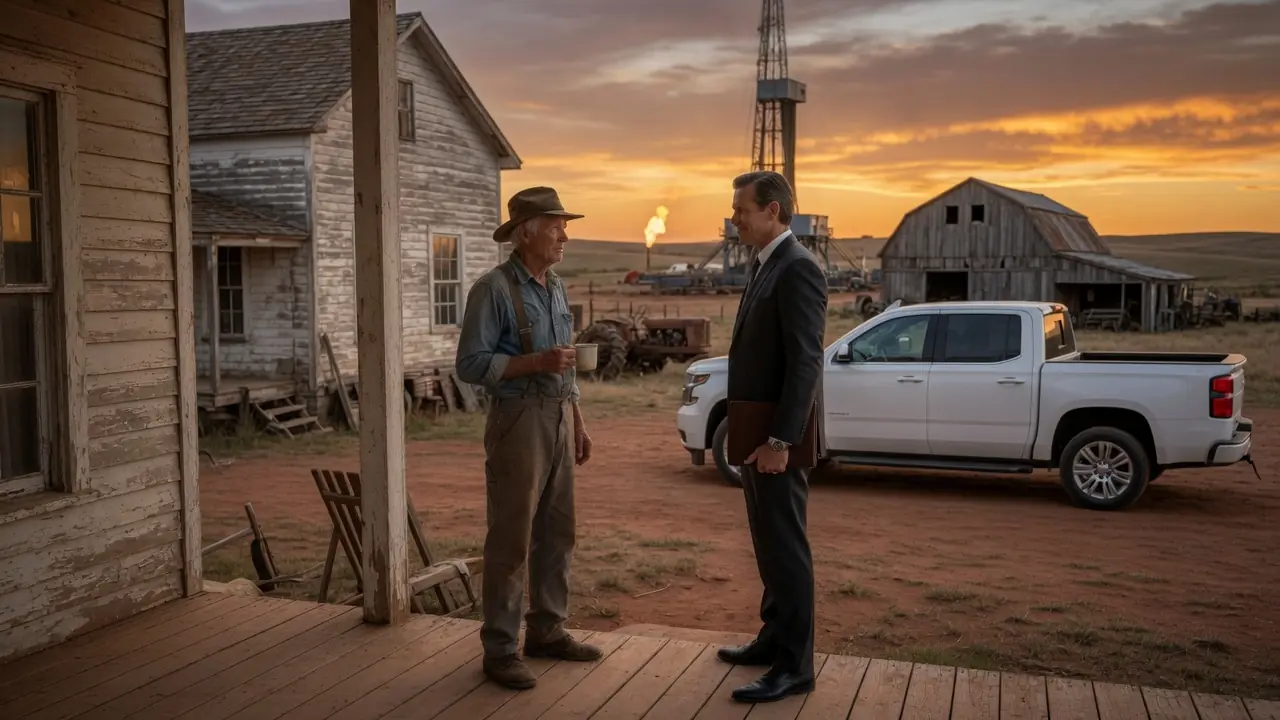
Barnaby Thorne had lived long enough to know that loud men usually feared quiet land. He stood on the front porch of his old farmhouse in Hollow Creek, Oklahoma, with a coffee mug cooling in his right hand and red dust clinging to the cuffs of his work pants. Beyond the wire fence of his north pasture, a towering gray drilling rig hammered against the evening sky, its steel bones shaking under the force of a company that thought money could dig through memory. The gas flare burned orange against the horizon, and every deep thump from the machine rattled the windows of the house his grandfather had built.
For forty years, Barnaby had farmed that land with the stubborn patience of a man who believed soil remembered hands. His father had farmed it before him, and his grandfather Ezekiel had held it through drought, tax debt, bankers, and dust storms that turned daylight into a red wall. The pasture was not pretty in the way city people expected land to be pretty, but Barnaby knew every rise, every creek bend, every stubborn oak that leaned against the wind. Titan Crude Resources looked at the same earth and saw only what could be dragged from underneath it.
Sterling Vance arrived in a polished white SUV that did not belong on a dirt road. The vehicle stopped inches from Barnaby’s porch, throwing dust across the steps and over the old boots lined beside the door. Sterling stepped out wearing a charcoal designer suit, Italian leather shoes, an expensive watch, and a smile that carried more insult than greeting. He looked at the farmhouse, the rusted tractor, and the weathered barn as if he were judging how quickly a dying thing could be removed.
“Still here, Mr. Thorne?” Sterling asked, leaning one arm against the SUV. He did not remove his sunglasses, though the sun was already sinking low. “I thought the noise would have sent you running to Tulsa by now.” Barnaby looked past him toward the rig and answered calmly, “The land was here before the noise, Mr. Vance. It’ll be here after.”
Sterling laughed as if Barnaby had told a joke too simple for a boardroom. He pulled a leather contract folder from the backseat and held it up between two fingers. “I’m authorized to offer you one final inconvenience payment,” he said. “Fifty thousand dollars, if you sign this waiver and agree not to interfere with our horizontal drilling operations.”
Barnaby did not move. He listened to the rig pound behind the fence, each vibration traveling through the porch boards and into his bones. Sterling’s smile widened because he mistook stillness for defeat. “We’re already three thousand feet under your north pasture, Barnaby,” he said. “The oil is flowing, and there is nothing you can do to stop it.”
Barnaby watched him toss the leather folder onto the porch steps. It landed near the dust with a soft slap, as if the history of four generations could be bought and dismissed in one careless motion. Sterling pointed toward the rig and said, “Take the money, buy yourself a condo, and stop pretending this farm still matters.” Then he climbed back into his SUV and drove away, leaving the contract on the steps like trash.
Barnaby stayed on the porch until the taillights vanished. He did not pick up the folder, did not shout after the SUV, and did not call any lawyer that evening. Instead, he turned slowly and went inside the farmhouse, where the air smelled of old wood, coffee, and the quiet of rooms that had held the same family for nearly a century. In the kitchen, he moved the heavy rug beside the pantry and pulled a brass ring set into the floorboards.
The trapdoor groaned open, revealing stone steps that descended into the cellar. Barnaby took an old metal flashlight from a drawer and stepped down into the cool darkness. The cellar smelled of damp limestone, cedar, and years nobody had bothered to count. His grandfather had hidden tools, papers, preserves, and small valuables down there during the hard years, when banks visited farms with clean hands and hungry eyes.
In the far corner sat an iron trunk beneath rotted burlap sacks. Barnaby had not opened it in years, but he knew why he was there. He carried a pry bar from the shed, wedged it beneath the rusted lock, and pushed until the metal snapped with a harsh cry. The lid opened slowly, releasing the dry scent of cedar and paper that had survived longer than most men’s promises.
Inside were photographs, brittle envelopes, old tax receipts, and a bundle wrapped in oilcloth. Barnaby’s rough hands moved gently as he untied the string. Beneath the wrapping lay the original deed and the 1934 mineral transfer agreement signed by Ezekiel Thorne. The paper was yellowed, the ink faded brown, but the words remained where Ezekiel had left them, waiting for the day someone arrogant forgot to read carefully.
Barnaby sat on an old wooden crate and began reading. He had heard family stories about the sale, how Ezekiel nearly lost the farm during the Great Depression and sold mineral rights to settle a tax debt. Titan Crude had built its entire claim on that story, and most people in Hollow Creek believed it too. But Ezekiel had not been an ignorant farmer; he had studied law books by lamplight and trusted fine print more than handshakes.
On the third page, Barnaby found the clause. It conveyed solid combustible minerals, including coal and lignite, to the state for public relief purposes. Then came the words that made Barnaby stop breathing for a moment. Ezekiel had reserved for himself and his heirs all rights to liquid and gaseous hydrocarbons, including crude petroleum and natural gas, whether discovered or undiscovered.
Barnaby read the clause three times. The state had owned coal under the Thorne land, not oil. If the state never owned the oil, it could never lease the oil to Titan Crude Resources. That meant Sterling Vance’s expensive rig was not harvesting state minerals at all; it was pumping Barnaby’s oil from Barnaby’s reservoir.
A younger man might have run to the fence line, waving the document and demanding the rig stop immediately. Barnaby did not. He folded the deed carefully, tucked it into his shirt pocket, and went back upstairs. He made another cup of coffee, sat on the porch, and watched the rig continue to work.
Every barrel mattered now. He knew enough law from a lifetime of keeping land papers to understand the difference between honest mistake and bad faith. If a company drilled in good faith, it might only owe royalties after costs. But if negligence became gross, if arrogance replaced proper title research, the law could turn very expensive very quickly.
Barnaby began keeping records. He timed the trucks, counted the tankers, noted the hours, logged the rig cycles, and wrote every observation in a spiral notebook beside his bed. Titan Crude kept pumping five thousand barrels a day, convinced they were taking fortune from beneath an old farmer’s land without consequence. Barnaby let them believe it.
For three weeks, he became nearly invisible. He stood near the barn at dawn watching new storage tanks arrive. He saw workers lay a high-pressure line across the edge of the pasture as if the land had already surrendered. He watched engineers photograph equipment, supervisors shout over radios, and white SUVs gather near the fence line like vultures around a prize.
Sterling came once more during those weeks. This time, he did not bother stepping out of the SUV. He rolled down the window, tossed another set of legal threats onto the gravel, and shouted, “The offer is twenty thousand now, Thorne. Clock is ticking.” Barnaby was mending a fence post and did not look up.
Patience had always been his strongest crop. He had waited through droughts when the sky refused to open. He had waited through years when cattle prices collapsed and banks smiled too politely. Now he waited while Titan Crude poured more diesel, labor, pipes, tanks, lawyers, and confidence into a mistake that would soon belong to him.
On a Tuesday morning, Barnaby put on his Sunday suit. It was heavy charcoal wool, old but clean, smelling faintly of cedar and church mornings from another life. He polished his work boots until the scuffs disappeared beneath stubborn dark wax. Then he placed the 1934 deed in his father’s old leather briefcase and drove toward Oklahoma City in his rusted Ford F-150.
Titan Crude’s headquarters stood sixty stories high, all glass, steel, and reflected clouds. Barnaby parked between sleek black cars that cost more than his tractor and walked into the marble lobby with red dust still clinging to the seams of his boots. The receptionist looked at him with polite confusion, then with the thin pity people reserve for someone who seems to have wandered into the wrong life. Barnaby stood straight and said, “I’m here to see Sterling Vance.”
“Do you have an appointment?” she asked. “No,” Barnaby said. “Tell him Barnaby Thorne brought the invoice.” Something in his voice stopped her from dismissing him too quickly.
Ten minutes later, he stood in the executive boardroom on the thirty-fourth floor. Sterling sat at the head of a long mahogany table, surrounded by glass walls and framed awards. He did not stand or offer his hand. He leaned back in his chair, glanced at Barnaby’s boots, and smiled.
“Barnaby,” Sterling said, “I’m impressed that old truck made it past the county line.” A few executives seated along the table gave polite little laughs. Sterling tapped his gold watch. “Have you come to sign? The offer is ten thousand now. Every day you wait, the price drops.”
Barnaby walked to the window and looked down at the city. Cars moved below like insects, and all that glass made everything seem temporary. He turned back toward Sterling and said, “You’ve pumped four hundred twenty thousand barrels from under my north pasture.” Sterling’s smile remained fixed, but the executives shifted slightly.
“We’ve been through this,” Sterling said. “We have the state lease. You own the surface. We own the deep.” Barnaby opened the briefcase and removed one laminated copy of the 1934 deed. He slid it across the table until it stopped in front of Sterling.
“My grandfather was a man of specifics,” Barnaby said. “He sold the state what it wanted during the Depression.” Sterling picked up the paper with lazy confidence and began reading. The smirk held for the first line, weakened at the second, and disappeared entirely by the third paragraph.
His face turned pale. His fingers tightened around the paper until the laminate bent. “This wasn’t in the title abstract,” he whispered. Barnaby’s voice stayed steady. “The abstract was a summary. My grandfather’s deed was the agreement.”
The room went silent. Sterling read the clause again, his eyes moving faster now, searching for escape. Barnaby leaned forward with both hands resting on the mahogany table. “He sold solid minerals. He kept the oil and gas. And your company never checked the original ink in the county basement.”
One executive reached for a phone. Another looked at Sterling with open alarm. Sterling forced a breath through his nose and tried to rebuild his face into something corporate. “We can settle this,” he said. “A royalty agreement, backdated, very generous.”
“No,” Barnaby said. The single word made the whole table freeze. “Bad faith conversion means you don’t deduct your rig, your labor, your pipeline, your diesel, or your lawyers. You owe me the gross value of every barrel you took.”
Sterling stood so quickly his chair rolled backward. “You cannot walk in here and threaten a billion-dollar corporation with a farm paper from 1934.” Barnaby picked up the briefcase. “I’m not threatening you. I’m billing you.” Then he turned toward the door.
Sterling followed him with his voice. “We’ll bury you in court.” Barnaby paused, looked back, and said, “You should have buried your nose in the county records first.” Then he walked out, leaving the boardroom to the panic that had finally arrived late.
His flip phone began ringing before he reached the lobby. Barnaby did not answer. It rang again while he crossed the marble floor, and again as he stepped into the Oklahoma heat. He climbed into his old truck, started the engine, and drove away from the glass tower without looking back.
When he reached Hollow Creek near sundown, the rig was still roaring. White SUVs lined the fence, amber lights flashing as workers rushed around the base of the derrick. Barnaby parked in his driveway and watched from behind the windshield. At exactly 6:42 p.m., the deep mechanical thump sputtered, coughed, and fell silent.
The absence of noise felt larger than the noise itself. For three months, the rig had shaken the windows, the porch boards, and Barnaby’s sleep. Now the pasture held still under the fading sky. The orange gas flare flickered once, twice, then died.
The legal battle moved faster than the town expected. Titan Crude’s attorneys searched for loopholes and found only Ezekiel Thorne’s stubborn handwriting waiting for them. The original deed was valid, the reservation was clear, and the state had never owned what it leased. Worse for Titan, the court found that the company had failed to conduct a proper title review before drilling under private land.
Sterling Vance tried to save himself by blaming junior title staff, outside counsel, bad indexing, and old county record systems. None of it mattered. A corporation that could spend fifty million dollars building a rig could spend a few hours reading the original deed. The judge made that plain in language even Hollow Creek folks repeated at the feed store for weeks.
Titan was ordered to pay Barnaby the gross market value of the oil extracted from his land. They could not deduct the cost of equipment, labor, drilling, storage, transport, or infrastructure. The number climbed past forty million first, then higher as updated production records came in. Sterling’s career did not survive the final figure.
The board fired him before the settlement finished. Reporters called it a title disaster, an industry embarrassment, and a landmark reminder that old paper still had teeth. Around Hollow Creek, people called it simpler things. They said the city boys got beat by a farmer with a flashlight.
Sterling came once more, not in a polished SUV but in a rented sedan. His suit was wrinkled, his hair uneven, his eyes bloodshot. He stood at Barnaby’s closed gate and shouted about a buyout, settlement options, future partnerships, and one hundred million dollars for a total release. Barnaby listened from inside the fence with the calm of a man who had already heard enough.
“You’re standing on my road, Sterling,” Barnaby said. “And the land doesn’t want your money. It wants its peace back.” Sterling looked smaller then, not because he had lost money, but because arrogance without leverage is a thin and pitiful thing.
Barnaby did not buy a mansion in Tulsa. He did not buy a new fleet of trucks or move into a gated neighborhood where the grass looked too perfect to trust. He stayed in the farmhouse Ezekiel built, with its creaking floorboards, old cellar, and porch that faced the north pasture. The first thing he did was hire local workers to dismantle the rig.
He stood there as cranes took apart the steel tower piece by piece. The same machine that once looked like a monster became scrap on trailers, hauled away under the open Oklahoma sky. Barnaby paid for soil testing, cleanup, and grass restoration. When the first new shoots appeared, he knelt and touched them with the same care he had given crops his whole life.
Then he went to the local bank. He bought the outstanding mortgages of six nearby family farms struggling under bad loans and worse weather. He handed the deeds back to his neighbors with only one condition. “Keep the land,” he told them, “and read every paper your grandfather left behind.”
He funded a scholarship for local kids who wanted to study agriculture, land law, or rural engineering. He helped repair the county clinic and paid for a new roof at the school. When people asked why he was giving away so much, Barnaby shrugged and said oil money dug from family land ought to repair family country. The reporters liked that line, but Barnaby meant it more plainly than they understood.
A year later, the north pasture had grown quiet again. The grass moved in the wind, cattle lowed near the creek, and meadowlarks sang where the rig once burned. Barnaby walked to the grove of oaks where Ezekiel Thorne was buried beneath a weathered stone. He stood there with the 1934 deed in his hand and placed his palm against the marker.
“It’s quiet again, Grandpa,” he said. The wind moved through the trees like an answer. Barnaby folded the deed carefully and returned it to the inside pocket of his jacket.
He had learned something from the whole terrible affair, though maybe he had known it all along. Some men believed wealth was what could be extracted, sold, counted, and displayed. Barnaby believed wealth was what endured after the machines were gone. Land, memory, paper, patience, and a promise kept across generations.
That evening, he sat on his porch with a fresh cup of coffee and watched the sun set over a horizon that no longer shook. The pasture was scarred, but healing. The farmhouse was old, but standing. The farmer they had called broken had outlasted the rig, the CEO, the lawyers, and the laughter.
Sterling Vance had come to Hollow Creek believing one signature could erase a century of family history. He had been wrong. A single yellowed paper from 1934 did not just change everything; it proved that the past was not dead, the land was not weak, and Barnaby Thorne had never been standing alone.