The birthday cake hit the pavement before Terrence Cole had time to reach for it. The clear plastic lid popped loose at one corner, and pink frosting slid sideways across the white icing until the words Happy Birthday, Mom disappeared into a smeared streak. Terrence stared at the ruined cake for one stunned second before slowly raising his eyes toward Deputy Daniel Mercer. Mercer barely looked at what he had done.
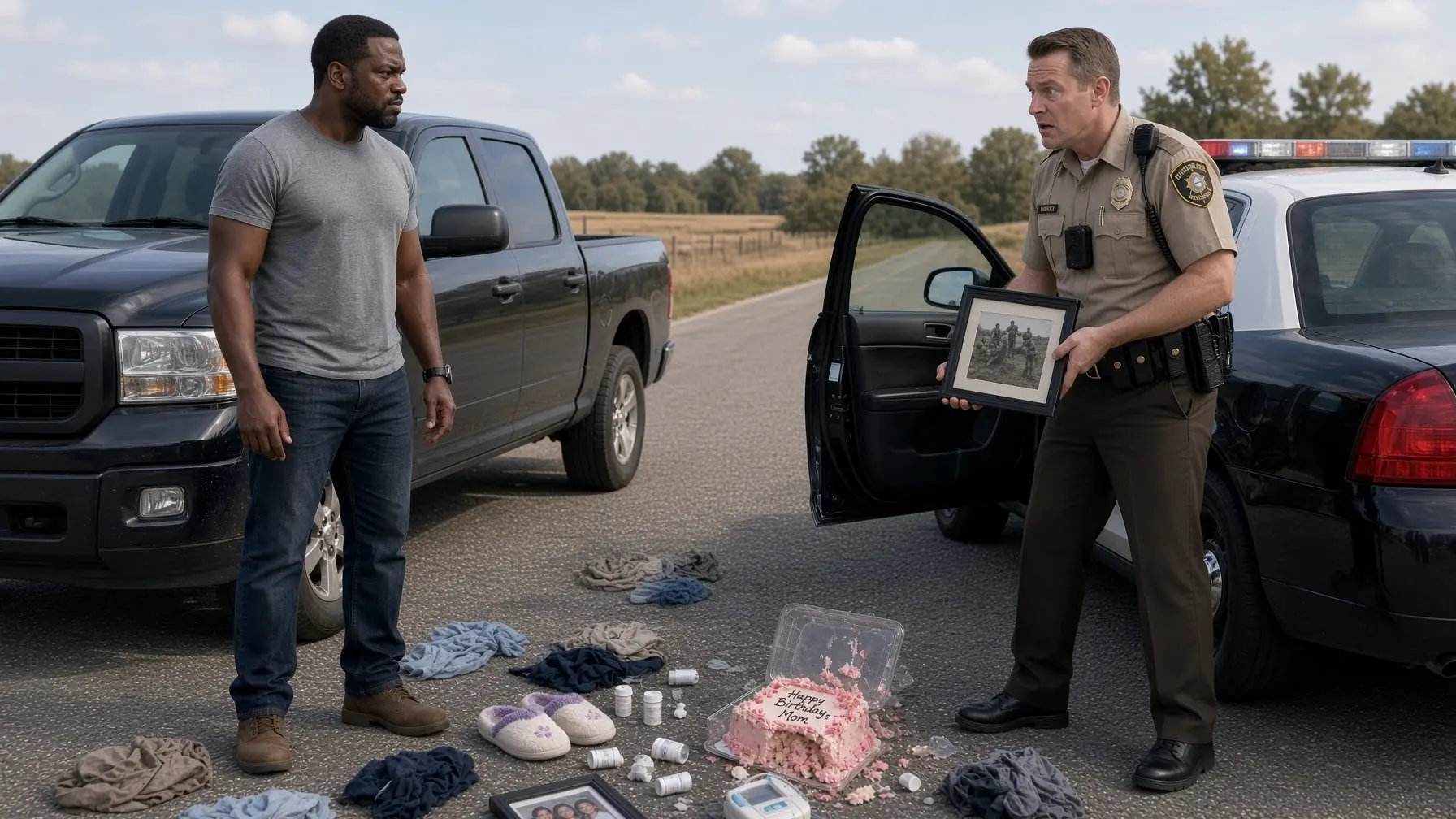
“Keep your hands where I can see them,” Mercer snapped as he leaned deeper into the passenger side of Terrence’s pickup. Terrence’s hands were already visible at chest level, fingers spread exactly as they had been since the flashing lights appeared behind him on County Road 18. “I’m not reaching for anything,” Terrence said calmly, careful to keep his voice lower than the deputy’s. Mercer ignored him and yanked a canvas duffel bag from the front floorboard.
The bag landed hard enough to kick dust across Terrence’s shoes. Mercer unzipped it, turned it upside down, and shook until two shirts, a pair of jeans, a shaving kit, phone chargers, and a wrapped gift spilled across the asphalt. “What are you looking for?” Terrence asked. Mercer straightened and gave him a smile that contained no humor.
“You tell me,” Mercer said. Terrence took one slow breath through his nose and reminded himself of something his mother had told him when he first learned to drive: anger could become evidence in the hands of somebody determined to misunderstand you. He said nothing. Mercer seemed almost disappointed.
The August afternoon pressed heat against the road until the air above the asphalt shimmered. Pine Ridge County sat two hours west of Richmond, far enough from the city that wooded hills still separated farms and subdivisions, and Terrence had driven the route dozens of times since his mother’s surgery had been scheduled. He knew every turn between the rehabilitation center and the little brick house where Evelyn Cole had lived for thirty-two years. Nothing about the drive should have been memorable.
That morning had been different only because it was Evelyn’s seventieth birthday. Terrence had left his own house before sunrise, picked up the cake from a bakery she loved, and stopped at a small boutique to collect the pale blue scarf she had admired months earlier but refused to buy. He had packed clothes, medical supplies, family photographs, prescription medications, and several boxes from her bedroom because she would no longer be living alone after recovery. By evening, he intended to have his mother settled into the guest suite he had renovated for her.
Terrence was forty-two and worked as a regional maintenance director for a medical equipment company outside Charlottesville. He supervised thirty-eight technicians responsible for hospital oxygen systems, patient monitors, and critical-care equipment, which meant most of his days involved schedules, safety procedures, and solving problems before other people noticed they existed. Coworkers described him as calm because they saw the result of years of discipline rather than the work required to maintain it. Terrence thought of himself simply as a man who hated making bad situations worse.
That temperament came largely from his father. Isaiah Cole had served twenty-six years in the United States Army before retiring as a master sergeant, and he believed panic was rarely improved by adding volume. He taught Terrence how to replace brake pads, tie a fishing knot, field-strip an old hunting rifle, and stand still long enough to understand what fear was asking him to do. He also warned his son that some men mistook patience for weakness.
Isaiah had died seven years earlier after a sudden stroke. Terrence still kept his father’s silver watch inside a small wooden box in the truck because Evelyn liked to hold it on difficult days, especially during the months surrounding surgery. Beside the watch rested one military pin and an old photograph Isaiah rarely discussed. Terrence had packed the box that morning because he knew his mother would ask for it.
The traffic stop began eleven minutes before the cake hit the ground. Terrence noticed Mercer’s cruiser behind him shortly after turning onto County Road 18, and the deputy followed for nearly two miles before activating his lights. Terrence immediately pulled onto the shoulder, lowered his window, switched off the engine, and placed both hands on the steering wheel. He had no idea why he was being stopped.
Mercer approached the driver’s side and asked for license, registration, and proof of insurance. Terrence handed over all three and waited. “Do you know why I stopped you?” Mercer asked. Terrence answered, “No, sir.”
“You crossed the center line back there,” Mercer said. Terrence knew he had not, but he also knew arguing about lane position on an empty county road would achieve nothing useful while the deputy still held his license. “I didn’t notice that,” he replied. Mercer looked at him for several seconds before asking where he was headed.
“My mother’s house,” Terrence said. Mercer glanced toward the packed rear seat. “Why all the luggage?”
“She’s moving in with me after surgery.” Mercer’s eyes moved across the truck interior.
“What surgery?” Terrence hesitated because the question had nothing to do with driving. “Hip replacement.”
Mercer looked at the medical bag behind the driver’s seat. “You carrying drugs in here?” Terrence answered no.
“Weapons?” “No.”
“Anything I’m going to find that creates a problem for you?” Terrence looked directly at him.
“No.” Mercer asked again.
Terrence repeated the answer. The deputy’s expression hardened as though consistency itself had become suspicious.
“Step out of the truck,” Mercer ordered. Terrence complied.
Once outside, he asked, “Am I being cited for the lane change?” Mercer told him they would get to that later. Then the deputy asked whether Terrence minded if he took a look inside the vehicle. Terrence said, “I don’t consent to a search, but there is nothing illegal in the truck.”
Mercer looked at him. “That a no?”
“That’s a no to consent.” Terrence kept his voice even.
Mercer told him to stand near the rear bumper. He then opened the passenger door.
Terrence felt his stomach tighten. “Officer, I did not give permission for a search.” Mercer did not look back.
“I have enough reason to check.” Terrence asked what that reason was.
Mercer said, “Your behavior, the luggage, and the way you’re answering questions.” Terrence almost laughed from disbelief, but his father’s voice appeared in memory before the sound could leave him. Do not give a man something he is already looking for. Terrence stayed quiet.
Mercer began with the front passenger compartment. He opened the glove box, inspected receipts, pulled insurance paperwork from a folder, and searched the center console. Nothing appeared.
Then he moved to the rear seat. That was where restraint began to feel more difficult.
The first suitcase belonged to Evelyn. Mercer dragged it out, dropped it onto the road, unzipped it, and scattered clothing across the shoulder. A nightgown landed beside the rear tire, while slippers separated in opposite directions. Terrence watched his mother’s things hit dirt and felt anger rise so quickly that his fingertips tingled. He locked his knees and kept both hands visible.
“That belongs to my mother,” he said. Mercer answered, “Then she should’ve packed lighter.”
Terrence’s jaw tightened. He said nothing else.
The second bag held Terrence’s clothes and the wrapped scarf. Mercer emptied it too. When the small birthday package rolled beneath the truck, he nudged it out with his boot.
A folded blanket came next. Then toiletries, an orthopedic support cushion, and two unopened boxes of compression stockings Evelyn’s surgeon had recommended. Mercer examined each item with increasing irritation. It was as if ordinary objects were failing to cooperate with a theory he had already chosen.
Terrence asked, “What exactly are you looking for?” Mercer responded without turning.
“Contraband.” Terrence looked across the scattered clothes.
“You have a specific reason to think there’s contraband?” Mercer stood.
“You asking legal questions now?” Terrence replied, “I’m asking what justifies this.”
Mercer walked closer. “You want to make this difficult?”
“No.” Terrence held his gaze.
“That’s why I’m standing where you told me.”
Mercer stared at him for a moment before returning to the truck. The deputy checked beneath the rear bench, lifted floor mats, inspected storage compartments, and opened a plastic container holding wound dressings. Nothing appeared.
The longer the search continued, the less methodical it became. Mercer’s movements gained speed while losing purpose.
He opened sealed packages only to discover medical supplies. He shook prescription bottles even though the pharmacy labels carried Evelyn Cole’s name. He unfolded receipts, searched inside shoes, squeezed the lining of a suitcase, and examined a box containing a blood-pressure cuff.
Terrence watched the process with growing disbelief. “Those prescriptions belong to my mother.” Mercer glanced at the labels.
“I can read.”
“Then put them back.” Mercer turned sharply.
“Don’t tell me what to do.”
Terrence felt something harden behind his ribs. “I’m asking you not to damage medication prescribed after surgery.”
Mercer took one step closer. “You think because you talk calm, you get to run the stop?”
“No.” Terrence swallowed.
“I think being calm should make this easier.”
Mercer smiled coldly. “Sometimes calm means rehearsed.”
Terrence understood then that almost anything he did could be repurposed. Anger would be aggression, fear would be guilt, silence would be evasion, and composure could become rehearsal. The realization frightened him more than the deputy’s tone. It meant there might be no correct performance capable of satisfying the suspicion.
A pickup truck approached in the opposite lane and slowed as it passed. The driver turned his head toward the scattered belongings but continued. Terrence briefly wished the stranger would stop, then immediately understood why he did not. Most people were uncertain what authority they had to interrupt a police stop, and uncertainty frequently looked like indifference from the person standing alone.
Mercer pulled the black medical bag from behind the driver’s seat. “What’s this?” he asked.
“Medical equipment.” Mercer unzipped it.
Inside were blood-pressure cuffs, disposable gloves, sealed bandages, a pulse oximeter, charging cables, and printed instructions from Evelyn’s rehabilitation nurse. Mercer looked annoyed rather than satisfied. “You a doctor?”
“No.”
“Nurse?” “No.”
“Then why are you carrying medical equipment?” Terrence stared at him.
“My mother needs it.”
Mercer dropped the bag onto the pavement. The pulse oximeter bounced out and struck the road with a sharp plastic crack.
Terrence stepped forward before thought caught up. Mercer’s hand went immediately toward his holster.
“Stay back.” Terrence froze.
“That machine monitors her oxygen levels.”
“Then pack it better.” Mercer’s words landed almost casually.
For the first time, anger showed openly in Terrence’s eyes.
“You asked me to get out, and I got out.” His voice remained controlled.
“You asked whether there was anything illegal, and I told you no.”
Mercer’s hand stayed near his belt. Terrence continued.
“You are damaging things my mother needs after surgery.”
Mercer stepped closer. “You don’t tell me how to do my job.”
“No, sir.”
Again, the lack of resistance seemed to frustrate him. Mercer returned to the truck.
The cake had remained on the passenger seat until then. Mercer reached across the cabin, pulled the bakery box free, and looked through the clear lid.
“Birthday?” he asked. Terrence answered, “My mother turns seventy today.”
Mercer opened the box as though frosting might conceal a weapon. He pressed one finger against the cardboard beneath the cake, then closed the lid.
When he tossed the box toward the roadside, Terrence moved too late. The cake struck pavement.
Pink frosting slid sideways. One corner collapsed.
The words his mother had been looking forward to seeing disappeared against the lid. Terrence stared.
Mercer told him to keep his hands visible. Terrence almost answered that they had never disappeared.
Instead, he looked at the destroyed cake and remembered being six years old in the kitchen while Evelyn attempted to bake a chocolate birthday cake for him despite a broken oven thermostat. The center collapsed so deeply that Isaiah called it a crater and Terrence ate three slices anyway. Evelyn laughed until she cried.
Every birthday after that, cake became ritual. Sometimes expensive, sometimes homemade, sometimes slightly burned. Terrence had missed only one of his mother’s birthdays in forty-two years.
That was during graduate training in Ohio, and Evelyn mailed him a photograph of herself eating cake beside an empty plate labeled Terrence’s piece. He still had the picture. This year, with surgery behind her and a new life beginning in his home, he wanted the cake to represent something ordinary continuing through change.
Mercer had turned it into debris in less than a second. Terrence felt something inside him tilt. He did not explode.
That almost frightened him more.
Mercer dragged another small suitcase from the truck. One plastic wheel cracked when it hit the road.
“Officer,” Terrence said. Mercer kept searching.
Terrence continued, “If you believe you have legal authority to do this, document everything.”
Mercer stopped. “What did you say?”
“You’re wearing a body camera.” Terrence looked directly at it.
“I want the condition of every item documented.”
Mercer’s expression tightened. “You think you’re threatening me?”
“No.”
Terrence glanced toward the ruined cake. “I think the camera may be the only thing here neither one of us can argue with later.”
Mercer stood very still. Then he said, “You watch too much television.”
Terrence almost responded. Instead, he noticed the red recording indicator.
The camera was on. That fact changed something inside him.
Not safety exactly. Evidence.
Mercer climbed into the truck bed. He kicked aside a folded tarp, opened a toolbox, and examined a sealed package of tie-down straps. Still nothing.
He jumped down and slammed the tailgate. “This doesn’t make sense.”
Terrence heard him. “What doesn’t?”
Mercer did not answer.
He crouched beside the scattered belongings and began reopening smaller items he had already examined. The search was no longer systematic.
It looked desperate. Terrence realized the deputy had expected discovery to justify everything preceding it.
Nothing was cooperating. Medicine remained medicine.
Clothes remained clothes. A mother’s birthday remained a mother’s birthday.
Mercer picked up the wrapped gift. Terrence said, “Please don’t.”
The deputy looked toward him. “What?”
“It’s her birthday present.”
Mercer tore the paper anyway.
Inside was a pale blue scarf. He turned it over twice, checked the folds, then dropped it onto the road.
Dust clung immediately to the fabric. Terrence looked at it and remembered Evelyn touching the scarf in a shop three months earlier.
She had smiled, checked the price, then put it back. “Pretty things should not cost eighty dollars,” she said.
Terrence returned the next morning and bought it.
He had imagined wrapping it around her shoulders after dinner. Now one corner was stained brown from the roadside.
Mercer opened the birthday card next. Terrence’s handwriting covered the inside.
Mom, after everything you carried for me, let me carry this next part for you. Mercer’s eyes stopped on the sentence.
His breathing changed. Terrence noticed.
For the first time since the stop began, Mercer’s movements slowed.
The deputy folded the card badly and placed it on the truck hood. His gaze shifted toward a framed photograph lying face-down near the shoulder.
He walked over, picked it up, and brushed dirt from the glass. Terrence saw his expression change.
The photograph showed Terrence at twelve standing between his parents. Evelyn wore a yellow summer dress.
Isaiah stood in formal Army uniform, one hand resting on his son’s shoulder. Three younger soldiers were visible in the background.
Mercer stared.
Terrence watched the arrogance leave his face by degrees. First confusion appeared.
Then recognition. Then something that looked almost like fear.
Mercer walked to the hood and picked up Isaiah’s military pin. His fingers trembled.
“What was your father’s name?” he asked. Terrence did not answer immediately.
The question felt different from everything before it. Mercer was no longer fishing for suspicion.
He sounded afraid of the answer.
“Isaiah Cole,” Terrence said.
Mercer closed his eyes. The color left his face.
“Where did he serve?”
Terrence frowned. “Several places.”
“What unit?”
“Why?” Mercer opened his eyes.
He looked toward the photograph again. “Please.”
Terrence stepped closer to the hood, careful to keep both hands visible despite Mercer no longer watching them. He took the photograph.
One of the young soldiers in the background had always seemed vaguely familiar. Terrence looked from that face to Mercer.
The years had changed almost everything. The eyes had not.
Terrence turned the photograph over. Isaiah’s handwriting listed four names beneath a date.
Isaiah Cole. Daniel Mercer. Anthony Ruiz. Caleb Hart.
Terrence looked toward the deputy’s nameplate. MERCER.
For several seconds neither man spoke.
Then Terrence said, “You knew my father.”
Mercer looked toward the road. His mouth opened but nothing came.
Terrence studied the photograph again. Something old and half-forgotten moved through memory.
Isaiah rarely told combat stories. He had believed people who needed details usually wanted entertainment rather than understanding.
One night, however, when Terrence was nineteen, father and son sat on the back porch after a storm knocked out electricity. Isaiah told him about pulling a wounded young soldier from a burning vehicle while ammunition cooked off inside.
The soldier had been trapped by twisted metal. Another man screamed that fuel was leaking.
Isaiah went back anyway. He cut the harness, dragged the soldier onto the ground, and carried him nearly thirty yards before the vehicle burned completely.
For years, Isaiah carried scars across one forearm and shoulder from that rescue. Terrence never knew the soldier’s full name.
His father had simply called him Danny.
Terrence looked at Mercer.
“My father saved your life.”
It was not a question.
Mercer closed his eyes again. “Yes.”
The word came out almost inaudibly.
Terrence felt no satisfaction. He had imagined, in some abstract way, that if a person humiliating you suddenly discovered a connection that forced shame upon him, the moment might feel like justice.
It did not. It felt heavier.
The man who had thrown Evelyn’s belongings into the road, cracked her medical equipment, opened her medication, ruined her gift, and destroyed her birthday cake was alive because Isaiah Cole once ran toward a burning vehicle for him. Terrence stared at Mercer and wondered what his father would have done with that contradiction. He suspected Isaiah would have disliked simple answers.
Mercer looked around at the roadside. The broken suitcase wheel, dirty scarf, scattered clothing, cracked pulse oximeter, and collapsed cake seemed to become visible to him for the first time. “I didn’t know who you were,” he said.
Terrence’s expression hardened.
“You shouldn’t have needed to.”
Mercer flinched.
Terrence took one slow step toward the hood. “You should not have needed my father’s name to treat me like a human being.”
“I thought—”
“You decided.”
Mercer fell silent.
“You decided I was lying before you found anything.” Terrence’s voice remained low.
“You decided there had to be something illegal in my truck.”
He pointed toward the scattered items. “Then every time there wasn’t, you searched harder.”
Mercer’s shoulders dropped.
Terrence continued, “My mother’s medicine didn’t matter.”
He looked toward the cake. “Her birthday didn’t matter.”
Then he looked back at Mercer. “My cooperation didn’t matter.”
The body camera sat between them. Terrence glanced toward it.
“Is that still recording?”
Mercer looked down. “Yes.”
“Good.”
The answer frightened Mercer more than Terrence expected.
He seemed to remember suddenly that recognition had not erased the previous twenty minutes. Isaiah’s photograph did not rewind video.
It did not repair property. It did not transform the search into something lawful.
Mercer slowly bent and picked up the blue scarf. He tried to brush away dirt with both hands.
The gesture looked pathetic against the damage.
“I’ll replace this,” he said.
Terrence shook his head. “You will document it.”
Mercer nodded.
He picked up the medical bag. When he saw the cracked monitor, his face tightened.
“I’ll pay for this.”
“Document it.”
Mercer nodded again.
He began collecting the belongings. Terrence did not help.
The decision felt cruel for perhaps one second. Then Terrence realized this was the first consequence Mercer had actually been forced to touch.
The deputy folded the blanket. He closed prescription bottles.
He repacked clothes, placed slippers together, and tried unsuccessfully to repair the broken suitcase wheel. He set the wooden box containing Isaiah’s watch on the passenger seat as though it were fragile enough to explode.
The cake remained last. Mercer crouched beside it.
Pink frosting had smeared against the lid. Dust clung to one corner.
“I’m sorry,” he said.
Terrence looked at the cake. “My mother turns seventy today.”
Mercer lowered his head.
“She spent two years waiting for surgery.” Terrence continued.
“Today was supposed to be the day I brought her home.”
Mercer closed the lid carefully. “I’m sorry.”
Terrence opened the passenger door and retrieved his phone. Mercer watched, suddenly nervous again.
Terrence called Evelyn.
She answered on the third ring. “Baby, are you close?”
Terrence looked toward the road. “I got delayed.”
“Everything all right?”
He almost said yes. The word had protected other people too many times.
“Not yet,” Terrence said.
Evelyn became quiet. Then she asked, “Do you need me to stay on the phone?”
Terrence closed his eyes. His mother could still hear things he never said.
“Yes, ma’am.”
“All right.” Her voice softened.
“I’m here.”
Terrence placed the phone on speaker and set it on the truck hood. Mercer looked at the device as though Evelyn’s disembodied presence had changed the roadside more than another patrol car could have.
Terrence pointed toward the camera. “State your name and badge number.”
Mercer hesitated. “What?”
“You told me this was an investigative stop.” Terrence’s voice remained calm.
“I want the record clear before anyone leaves.”
Mercer looked toward the cruiser. Then he looked at Isaiah’s photograph.
Finally, he gave his full name. “Deputy Daniel Mercer, badge 4172.”
Terrence asked why he stopped the vehicle. Mercer said unsafe lane movement.
“Did you issue a citation?” Terrence asked.
“No.”
“What was the basis for searching my vehicle?”
Mercer’s face tightened. “I believed there might be contraband.”
Terrence asked, “Did I consent?”
Mercer did not answer immediately. “No.”
“Did you find contraband?”
“No.”
“Weapons?”
“No.”
“Evidence of any crime?”