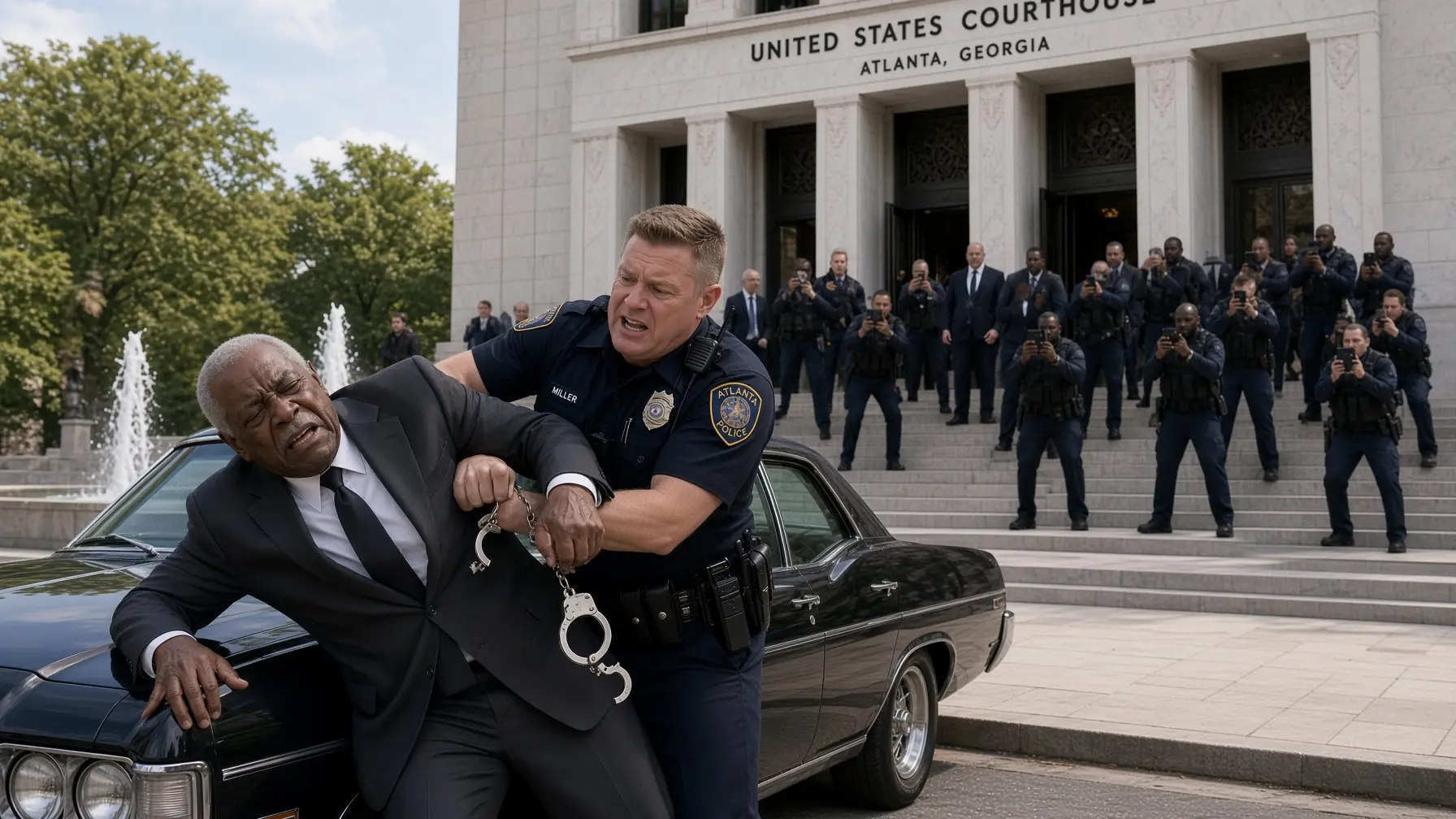
Officer Thomas Miller seemed completely certain that nobody in the courthouse plaza would challenge him when he ordered an eighty-two-year-old Black man away from a gleaming vintage Chevrolet. He stood beneath the Atlanta sun with one hand hovering near his duty belt, speaking in the impatient tone of someone who had already decided that the person in front of him did not belong beside the property he claimed to own. He did not know that inside the old man’s dark Sunday jacket rested a sealed Department of Justice envelope, nor that several people inside the federal courthouse had been waiting for that man to arrive. More important, Miller did not yet understand that none of those facts should have been necessary for Elijah Brooks to receive ordinary lawful treatment.
My name is Elijah Brooks, and I was eighty-two years old that Monday morning, which meant I had learned to respect both the usefulness and the limitations of an aging body. My right knee required several careful movements before it agreed to support me after sleep, arthritis had stiffened three fingers on my left hand, and a wound in my shoulder from Vietnam still announced approaching rain with more accuracy than television forecasts. I moved slowly because speed had stopped impressing me decades earlier, but I could still polish my shoes, press a suit, drive across Atlanta, and complete an errand without assistance. That morning, the errand mattered enough that I woke before my alarm.
I prayed beside the bed, made coffee strong enough to offend my doctor, and removed my best charcoal suit from the closet where my late wife Lillian had once insisted good clothes deserved cedar hangers. The shirt was white, the tie dark blue, and the shoes were older than some attorneys working inside the courthouse but still capable of holding a shine if I gave them enough patience. I placed my wallet in the inside pocket, checked my identification twice, and then took the sealed Department of Justice envelope from the kitchen drawer where I had kept it overnight. The instructions attached to it were simple: bring the envelope personally to the federal courthouse and place it only in the hands of Assistant United States Attorney Maya Franklin or Chief Judge Rebecca Warren.
The envelope did not contain national secrets, criminal evidence, or anything that made me important enough to command federal protection. It contained original documents connected to an oral-history and archival project concerning one of the earliest voting-rights cases handled in northern Georgia after I returned from Vietnam, along with a letter my wife had preserved for almost sixty years. Lillian and I had been interviewed several months earlier because we had both provided statements to federal civil-rights lawyers when we were young, long before anybody imagined those yellowing pages might someday belong in an exhibit about ordinary citizens who documented what they saw. The Department of Justice had sent the sealed archival packet back to me after authentication because the courthouse wanted me to deliver it during a small ceremony that morning.
I was not a judge, prosecutor, retired FBI director, senator, millionaire, or celebrity, and I have always believed that detail should come near the beginning of the story rather than the end. I had served four years in the United States Army, spent most of my adult life repairing automobiles, owned Brooks Automotive for thirty-seven years, raised two children with Lillian, paid taxes, missed church sometimes, made mistakes, apologized for some of them too late, and buried the woman I loved after fifty-four years of marriage. The federal courthouse was honoring a piece of history I had happened to carry through, not crowning me as someone more deserving than the people crossing the plaza beside me. Officer Miller did not know any of that when he decided who I was, but he did not need to.
The 1968 Chevrolet Impala I drove downtown that morning had belonged to my younger brother Isaiah before he died, and restoring it had occupied parts of eight years after retirement. The paint was black enough to reflect the sky, the chrome had been refinished piece by piece, and the engine still possessed the low steady rumble that caused men my age to turn their heads before pretending they had not. I parked in a metered public space along the courthouse plaza because the event coordinator had told me guest parking was temporarily unavailable due to construction. I checked the meter, placed my disabled veteran placard where required for the adjacent accessible zone I was legally using, locked the car, and waited near the front fender because Maya Franklin had said somebody would come outside to meet me.
The federal courthouse rose above the plaza in pale stone and glass, its wide staircase already crowded with lawyers, jurors, employees, defendants’ relatives, reporters, tourists, and people who simply appeared lost. Security bollards separated the pedestrian area from the street, while city police cruisers and federal protective vehicles moved through the surrounding blocks as routinely as buses. I leaned lightly against the Impala for less than seven minutes, checked my watch twice, and watched a young father explain the metal detector process to a nervous child. Then a city police cruiser rolled into the curb lane and stopped close enough behind my rear bumper that I instinctively stepped away.
Officer Miller climbed out before the cruiser’s engine completely settled. He was in his late thirties or early forties, white, solidly built, wearing mirrored sunglasses and a city police uniform that looked freshly pressed despite the heat. His first words were not good morning, are you all right, or is this your vehicle, but, “Step away from the car.” I looked at him, glanced once at the legal parking space beneath my feet, and moved two steps away because arguing about distance seemed unnecessary.
“This is my vehicle, officer,” I said, keeping both hands where he could see them. Miller looked at the Impala, then at me, then back at the car as though the three objects had failed some private test of compatibility. “I said step away from it,” he repeated, although I was already standing several feet from the door. I answered, “Yes, sir, I have.”
He walked around the rear quarter panel and looked through the window without asking permission or explaining why he had approached. I asked whether there was a problem, and he answered that there had been reports of suspicious activity around federal property, which was possible enough that I did not challenge him immediately. Then he asked, “Whose car is this really?” and something in his tone made the question different from a registration inquiry. I told him again that the Impala belonged to me and offered to produce identification and registration if he wanted to verify it.
Miller did not ask for either document. He looked at my polished shoes, suit, and car before saying, “You’ve got an appointment in there too, I suppose,” with a short laugh that made two people walking past slow down. I answered that I did have an appointment and gave him my name. “Elijah Brooks.”
He repeated my name without writing it down. “What kind of appointment?” he asked, and I told him I was expected by people inside the courthouse but did not believe the details were necessary unless he had a lawful reason to investigate them. His eyes moved toward the slight square shape of the envelope beneath my jacket. “What are you carrying?”
“Correspondence,” I said. “Federal correspondence.” Miller stepped closer. “Let me see it.”
I shook my head once. “It is sealed and addressed for delivery to a specific person, but I can show you my identification and the appointment letter that came separately.” The refusal was calm, limited, and accompanied by an offer to verify everything relevant to who I was and why I was standing there. Miller treated it like defiance. “You don’t decide what I need to see when you’re loitering outside a federal courthouse,” he said.
I looked toward the meter behind me. “I am waiting beside my legally parked vehicle for someone who works inside that building.” Miller’s mouth tightened. “Everybody has a story.”
The sentence took me back farther than I wanted to go. In 1966, a sheriff’s deputy outside Columbus had used almost the same words when I returned home in uniform and tried to explain why I was driving my cousin’s Buick after midnight. I had been twenty-two then, recently home from Vietnam, stronger than Miller, angrier than I was now, and still young enough to think a clean explanation would always matter if delivered clearly. Fifty-nine years had changed the condition of my knees more than the familiarity of that feeling.
I kept both hands visible. “Officer, are you detaining me?” Miller ignored the question and pointed toward the curb. “Put your hands on the cruiser.”
“For what reason?” I asked. “Hands on the cruiser.”
The plaza around us began slowing. A woman carrying a legal brief paused near the fountain, two courthouse employees stopped halfway down the steps, and one young man lifted his phone with the cautious posture of somebody trying to record without attracting attention. I could feel Miller’s impatience increasing as witnesses multiplied. I also knew that an officer embarrassed in public could become more dangerous than an officer who had simply made a mistake privately.
I turned carefully toward the cruiser. “I am complying, but I want it clear that I do not understand the basis for this detention.” Miller seized my left wrist before I finished the sentence. The movement drove my arm upward behind my back faster than the old shoulder could tolerate, and pain flashed from the joint into my neck with enough force to make my knees weaken.
I gasped but did not pull away. “My left shoulder is injured, officer, and I am not resisting.” Miller pushed me forward until my chest and cheek touched the cruiser hood. The metal had been baking in the Georgia sun.
Heat burned through my shirt almost instantly. My cheek pressed against paint too hot for bare skin, and the shoulder injury that had survived nearly six decades screamed beneath Miller’s grip. I told him again, more urgently, “My shoulder was wounded in service, and you are hurting it.” He answered, “Then stop fighting me.”
“I am not fighting you,” I said. The body-camera recording would later show my right hand open against the hood and my left arm entirely controlled by Miller. It would also show that my feet remained still until he kicked one ankle wider. At the time, all I knew was that the old lesson had returned: do not give fear a movement somebody else can rename.
Miller reached inside my jacket. “What are you doing?” I asked, and he told me to be quiet while pulling out my wallet. He opened it, saw my driver’s license, veteran identification card, Medicare card, insurance information, and a photograph of Lillian I had carried for twenty years. Nothing in the wallet made him release my arm.
He read my name aloud. “Elijah James Brooks, eighty-two.” Then he said to the watching crowd, “We’ve got an elderly male hanging around restricted federal property with a high-value vehicle and refusing to identify what he’s carrying.” A woman near the fountain shouted, “He just told you who he is,” and Miller ordered everyone to step back.
I heard several people begin talking at once. Someone said the car was in a public parking space, another said I had been standing there peacefully, and a man behind me asked whether Miller had called for a federal officer if he truly believed the courthouse was threatened. Miller’s shoulders stiffened. Instead of slowing down, he began building a larger explanation.
“Possible stolen vehicle, possible suspicious package, possible threat,” he announced into his radio. I listened carefully because repetition can make speculation sound like fact, especially once entered into an official channel. No one had reported the Impala stolen.
No one had identified a suspicious package. I had offered identification, and the Department of Justice envelope remained inside my jacket. The only confirmed facts were that an old man stood beside a registered car in a lawful space and declined to hand a city officer sealed correspondence without explanation. Yet Miller’s version was already becoming more dramatic than the scene itself.
A young woman in a beige trench coat pushed through the edge of the crowd. She was perhaps thirty-five, Black, carrying a federal employee badge clipped near her waist and a phone in one hand. I recognized her from a video conference months earlier.
Maya Franklin had been the Assistant United States Attorney coordinating the historical program. She looked first at my face against the cruiser, then at Miller’s grip on my arm, and finally at the corner of the envelope visible where my jacket had been pulled open. Her expression changed immediately.
“Officer,” she said, “you need to stop and let me speak with you.” Miller barely turned.
“Back up, ma’am.” Maya lifted her credential.
“I am an Assistant United States Attorney in this courthouse, and Mr. Brooks is expected inside.” Miller said, “You can verify him after I finish securing the situation.”
Maya stared at him. “What situation?” Miller pointed toward my jacket.
“He’s carrying unidentified federal material and refusing lawful instructions.” Maya answered, “The material is federal because my office sent it to him.”
The crowd became quieter. Miller looked toward her credential for the first time. “Stay back.”
Maya did. That mattered later.
She did not grab me, argue physically, or attempt to command a city officer whose authority she did not directly supervise. She stepped several yards away and made one phone call. “Bring Warren and the marshal downstairs now,” she said.
Miller heard. “Who are you calling?” Maya answered, “People who can confirm what I have already told you.”
He pulled a handcuff from his belt.
The first metal cuff closed around my right wrist. He began moving my injured left arm farther behind me to secure the second.
Pain made the plaza blur.
Miller leaned toward my ear. His voice dropped low enough that most bystanders probably could not hear. “Not so important now, are you?”
I turned my head enough to see his reflection in the cruiser windshield. “I never said I was important.”
He tightened his grip.
The courthouse doors opened.
Not dramatically at first. One of the heavy glass-and-bronze doors swung outward, then another, and people began descending the wide marble steps with the speed of those responding to something they understood was already being recorded. Chief Judge Rebecca Warren came first in black judicial robes because she had been on the bench minutes earlier and had not bothered changing, followed by United States Marshal Daniel Price, two deputy marshals, the court executive, and another federal prosecutor.
Maya stepped aside. Judge Warren’s face was not theatrical or shocked. It was furious in the controlled way I had learned to fear more than shouting.
Marshal Price reached us first. “Officer, what is the basis for restraining Mr. Brooks?” Miller looked at the marshal’s badge, then toward the judge, then at the second cuff trembling slightly between his fingers.
“He was behaving suspiciously near federal property.” Price asked, “What specific conduct?”
Miller swallowed. “Loitering beside a vehicle that may not belong to him, refusing to provide information about an item concealed inside his jacket, possible security threat.” Price looked toward Maya.
She said, “His identity is confirmed, the vehicle plate can be verified in seconds, and the envelope is part of today’s court program.” Judge Warren descended the final step.
“Mr. Brooks,” she said, looking directly at me, “are you injured?” I answered, “My shoulder is hurting, Judge.”
Miller’s face drained.
“Your Honor,” he began.
Judge Warren held up one hand. “I am not your supervisor and I am not conducting an inquiry on these steps.”
That sentence mattered.
She looked toward Marshal Price.
“Please secure the federal perimeter and request his city supervisor.”
Price nodded.
Then Warren looked at Miller.
“I suggest you listen carefully to your own department’s chain of command from this point forward.”
Miller’s hand shook harder.
I saw the fear and felt no pleasure from it.
He loosened the second cuff but left the first around my wrist. Marshal Price asked whether I was under arrest.
Miller hesitated.
“No.”
“Then why is he cuffed?”
“Investigative detention.”
Price asked again, “Based on what articulable facts now that identification and purpose have been confirmed?”
Miller had no answer ready.
A city police sergeant arrived less than four minutes later because Miller’s radio traffic had already triggered supervisory response. Sergeant Dana Ellis stepped from her cruiser, looked at the crowd, the federal officials, my arm, and Miller’s body-camera indicator. She asked him to step away from me.
Miller began explaining.
Ellis interrupted. “Release the cuff first if there is no current arrest basis.”
He complied.
My right wrist was red where metal had pressed into skin. When my left arm came free, it dropped uselessly for a moment because the shoulder hurt too much to raise.
Maya moved toward me slowly. “May I help?”
I nodded.
She guided me toward a stone bench while a deputy marshal called courthouse medical personnel. Judge Warren remained nearby but did not touch me.
Sergeant Ellis took Miller several yards away. I could not hear everything, but I heard her ask the same questions everyone else had asked: what was the original call, what did he observe, when did he verify identity, what crime did he suspect, and what specifically justified handcuffing an eighty-two-year-old man who said he had an injured shoulder. Miller’s answers grew quieter.
There had been no original 911 complaint about me. He had been patrolling the courthouse block after a general briefing about thefts from parked vehicles and noticed what he later described as “an individual lingering beside a classic car.”
That was the beginning.
Not a stolen-car report. Not a bomb threat.
Not a description matching me.
A man beside a car.
The courthouse nurse examined my shoulder in a small medical room inside the building. I could lift the arm but not without sharp pain, and dark redness had appeared across my cheek where the cruiser hood burned it.
They recommended hospital imaging because of my age and old injury. I said I would go after delivering the envelope.
Maya stared at me. “Mr. Brooks, the envelope can wait.”
“It has waited sixty years.”
“Then sixty more minutes won’t hurt it.”
Judge Warren agreed.
I surrendered.
Before the ambulance arrived, I asked Maya to retrieve the envelope from the plaza. It had fallen near the cruiser when Miller searched my jacket.
A deputy marshal had already placed it inside an evidence sleeve without opening it because the chain-of-custody letter mattered to the archival project. Maya showed me the intact seal. I nodded.
“Good.”
The ceremony was postponed.
That became the first headline.
FEDERAL COURTHOUSE EVENT DELAYED AFTER CITY OFFICER DETAINS HONORED VETERAN.
I hated it.
Not because the facts were entirely wrong. I was a veteran, and the courthouse had planned to recognize my historical contribution.
I hated the structure.
It suggested the outrage began when people discovered whom Miller had detained.
At the hospital, my daughter Denise read the headline aloud from her phone and then looked toward me. “Daddy, the entire city is losing its mind.”
I sat on an examination bed wearing a thin gown with my suit folded over a chair. “The city should conserve energy.”
She did not laugh.
Denise was fifty-six, a school principal, and inherited Lillian’s ability to become calmer as anger increased. She had driven to the hospital after Maya reached her.
My son Marcus arrived twenty minutes later.
He was fifty-three and owned most of Brooks Automotive now.
Marcus entered the room, saw the bruise on my wrist, and swore so loudly that a nurse looked through the curtain.
“Language,” I said.
He stared.
“You are correcting my language right now?”
“Yes.”
“Daddy.”
“Your mother would.”
He sat down.
That ended the argument for thirty seconds.
Imaging showed no fracture or dislocation. The doctor believed Miller had aggravated old scar tissue and caused a new soft-tissue strain, along with a minor first-degree burn on my cheek.
I would recover.
That did not mean nothing happened.
The doctor asked whether I wanted everything photographed.
“Yes.”
I had lived long enough to know memory becomes more negotiable as time passes.
Photographs do not eliminate argument.