The first blast of water hit Naomi Carter square in the chest.
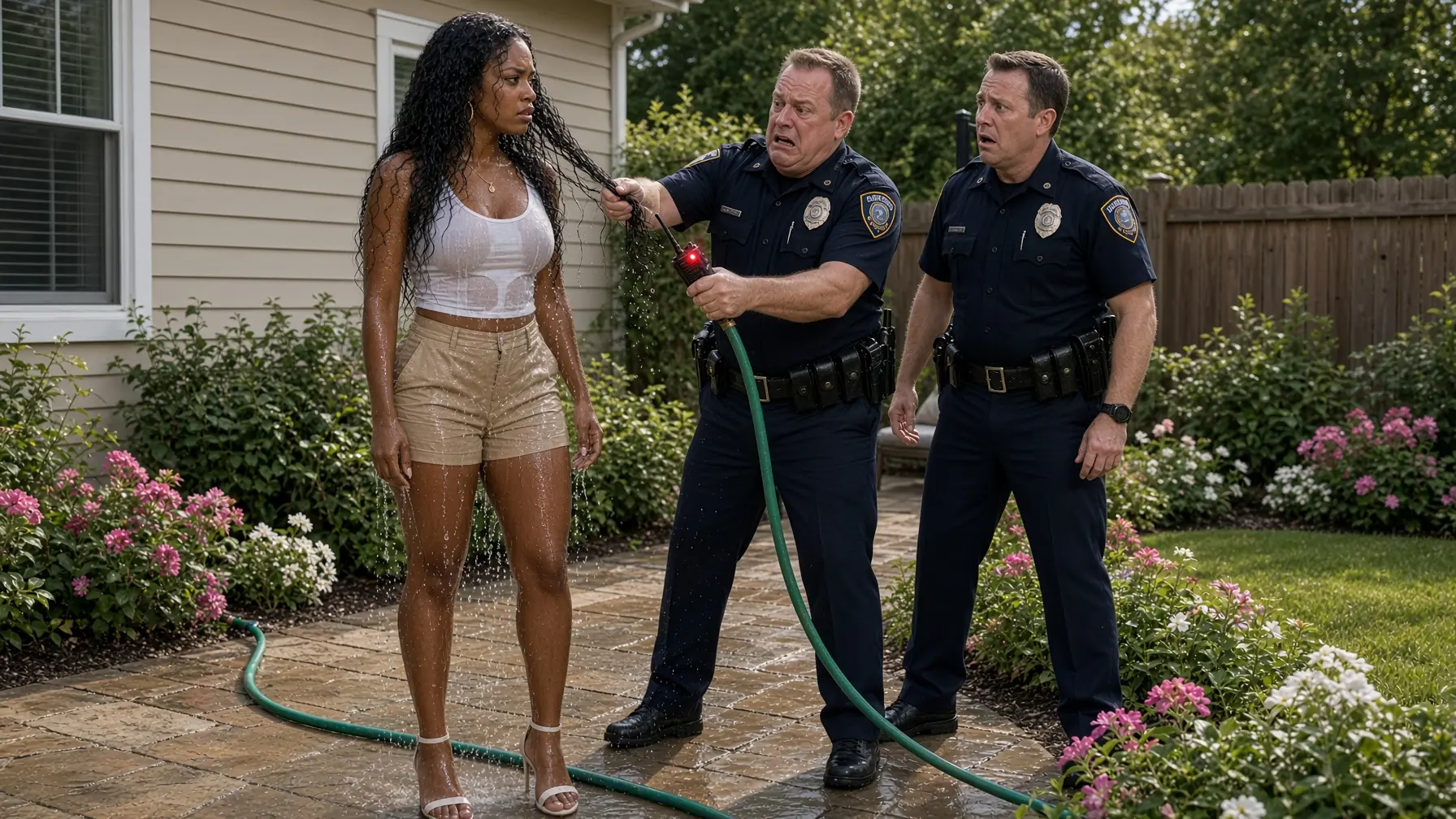
It was hard enough to knock her half a step backward into the flower bed she had spent most of the afternoon repairing.
Officer Brett Mercer laughed.
Not nervously.
Not because something had gone wrong.
He laughed because he thought it was funny.
Naomi stood in the middle of her own backyard, drenched from shoulders to shoes, water running from her black curls and dripping from the sleeves of her pale-blue gardening shirt.
Mercer still held her green garden hose.
Behind him, another officer leaned near the open gate with a crooked smile on his face.
Mercer squeezed the nozzle again.
A second stream struck Naomi across the shoulder.
“Still feel important?” he said. “This is where people like you belong—holding the hose.”
Naomi wiped water from her eyes.
She did not yell.
She did not rush him.
She did not tell him who she was.
She simply looked at the badge pinned to his chest.
Then at the body camera mounted beneath it.
And said:
“You entered the wrong backyard.”
Mercer lowered the hose.
His grin widened.
“Lady, nobody here cares who you are.”
Then his radio crackled.
The second officer’s smile disappeared first.
A dispatcher’s voice came through sharp enough that even Naomi could hear it.
“Mercer, step away from Naomi Carter. Command is listening.”
Mercer froze.
The hose slipped slightly in his hand.
“What?”
The voice came again.
“Officer Mercer, disengage immediately. Step away from Ms. Carter.”
Naomi stood dripping wet in front of him.
Still calm.
Still watching.
Mercer reached for his radio.
His face had changed.
Not confusion anymore.
Fear.
Naomi looked at him and said quietly:
“Now ask them why.”
To understand why a police officer went pale after hearing her name, you have to understand how he ended up inside her backyard in the first place.
And why Naomi had deliberately waited before telling him anything.
Naomi Carter was forty-four years old and had lived in Bellweather Ridge for seven years.
It was one of those suburban communities outside Richmond, Virginia, where every house seemed to have been designed by someone afraid of surprises.
Stone façades.
Two-car garages.
Identical black mailboxes.
Lawns cut to almost the same height.
A neighborhood association that sent emails about patio furniture colors.
Naomi had bought the house after her divorce.
Not because she loved subdivisions.
Because it was quiet.
Her sixteen-year-old daughter, Maya, could walk to school.
Her mother lived twelve minutes away.
And the backyard was large enough for Naomi to build the garden she had wanted since she was a child.
Tomatoes along the south fence.
Lavender near the patio.
Hydrangeas under the kitchen windows.
Two raised beds.
A narrow strip of wildflowers she had fought the homeowners association over for almost a year because someone decided native plants looked “insufficiently maintained.”
Naomi had won that argument.
She usually did.
Not because she enjoyed confrontation.
Because she read things before arguing about them.
Contracts.
Regulations.
Policies.
Statutes.
People.
Especially people.
That skill had shaped most of her adult life.
For eighteen years, Naomi had worked in law and government oversight.
She began as an assistant city attorney.
Then moved into civil-rights litigation.
Later she spent six years advising a state-level law-enforcement standards commission.
By forty-three, she had become known in a very small professional world for one particular talent:
She could walk into an institution that insisted it had no cultural problem and find the paperwork proving otherwise.
Complaints that disappeared.
Discipline that changed depending on rank.
Body-camera reviews nobody completed.
Reports rewritten after supervisors intervened.
Naomi did not shout when she found those things.
She documented them.
That made people far more nervous.
Three weeks before the incident in her backyard, Governor Elena Ward appointed Naomi executive director of Virginia’s newly expanded Office of Law Enforcement Accountability.
The title sounded bureaucratic.
The authority was not.
Naomi’s office was responsible for reviewing serious misconduct patterns across state and participating local agencies, auditing complaint systems, and referring potential criminal conduct or civil-rights violations when appropriate.
The appointment had been announced publicly.
There had been a press release.
A photograph.
A small television interview.
Naomi assumed almost nobody outside government had noticed.
She preferred it that way.
She had not yet officially started.
Monday would be her first day.
The hose incident happened Saturday.
That afternoon, Naomi was alone.
Maya was at a friend’s house.
Naomi’s mother had taken her dog to the veterinarian.
Naomi wore old beige trousers, white sneakers, and a gardening shirt she did not mind staining.
Around three-thirty, she discovered that one section of drip irrigation beside the hydrangeas had stopped working.
She turned on the hose.
Disconnected a clogged piece.
Then heard a voice from the walking path behind her fence.
“Excuse me!”
Naomi ignored it at first.
Bellweather Ridge had a public greenway running behind several homes.
Joggers passed constantly.
Then the voice came again.
“Hey! You!”
Naomi turned.
A woman stood on the other side of the fence.
Late fifties.
Visor.
White tennis skirt.
Phone in hand.
Naomi recognized her vaguely.
Linda Haskell.
Two streets over.
Known primarily for reporting things.
Wrong garbage cans.
Teenagers at the pool.
Dogs without visible leashes.
Linda pointed toward Naomi.
“Do you live here?”
Naomi blinked.
“Yes.”
Linda looked toward the house.
“Which house?”
Naomi almost smiled.
“This one.”
Linda did not.
“I haven't seen you before.”
“I've lived here seven years.”
“I walk this path every day.”
“Congratulations.”
Linda’s expression hardened.
“What are you doing with that hose?”
Naomi looked down at it.
“Gardening.”
“You're messing with the irrigation.”
“My irrigation.”
Linda raised her phone slightly.
“I'm going to call security.”
“There is no neighborhood security.”
“The police, then.”
Naomi stared at her.
“For gardening?”
Linda did not answer.