The first thing Officer Evan Mercer noticed about the Lamborghini was not its speed. It was the color, black enough to swallow the streetlights, with red leather visible through the windows and polished wheels reflecting every passing sign along Jefferson Avenue. The second thing he noticed was the driver, a Black man alone behind the wheel, dressed in a dark button-down shirt with one hand resting loosely near the bottom of the steering wheel. By the time Mercer activated his lights, he had already decided there was something about the combination that required explanation.
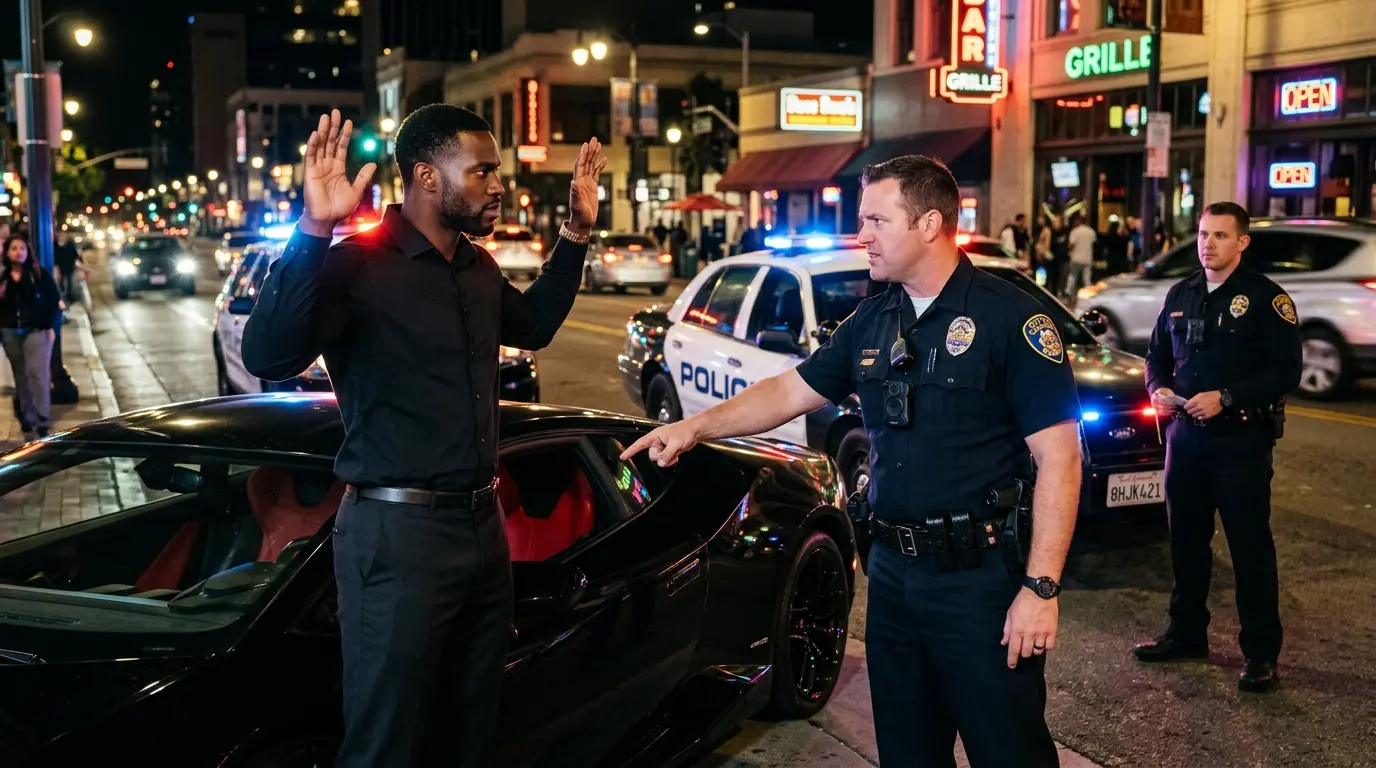
Darius Cole saw the patrol car in his mirror and checked the digital speedometer automatically. Forty-two miles per hour in a forty-five zone, turn signal already off from the last intersection, seat belt on, headlights functioning, nothing obvious enough to explain the stop. He eased the Lamborghini toward the curb, selected a well-lit stretch beneath a pharmacy sign, put the transmission in park, and turned on the interior lights. Then he lowered the driver’s window and placed both hands high on the wheel where they could be seen.
He had owned the car for exactly eleven days. Buying it had taken less than forty minutes, but allowing himself to buy it had taken almost fifteen years because Darius had spent most of adulthood refusing to reward himself before everybody he loved was secure. He paid off his condominium first, fully funded retirement accounts, established college funds for two nieces, cleared the remaining mortgage on his mother’s house outside Baltimore, and built enough savings that an exotic car could become an indulgence instead of a financial wound. Only after all of that did he walk into a dealership and order the Lamborghini he had been sketching in notebooks since he was seventeen.
His mother laughed when he sent her the first photograph. Lorraine Cole had raised Darius and his younger sister alone after their father died in a construction accident, working as a hospital billing clerk by day and cleaning offices at night whenever the electric bill exceeded what one job covered. She stared at the photograph of the black Lamborghini in her driveway and told him, “Your father would have asked how much the insurance costs before saying congratulations.” Darius answered that he had already heard the same question in his father’s voice when signing the paperwork.
He loved the car, but not because it proved anything about him. At forty-three, Darius had accumulated enough credentials, promotions, property, investments, and scars to know that objects could confirm purchasing power without confirming worth. The Lamborghini was simply beautiful machinery, a thing he had wanted as a teenager and could finally own without borrowing from the future. That Friday night, he had taken it to dinner with an old college friend and was driving home before eleven because he had a six-thirty workout scheduled the next morning.
Officer Mercer approached from behind with one hand near his duty belt. Darius watched him in the side mirror, noticing that a second patrol car had not yet arrived and that Mercer’s flashlight swept across the rear plate before moving along the driver’s side. When the officer reached the open window, Darius said, “Good evening, officer,” in the calm tone he had learned to use long before he had any professional reason to study police encounters. Mercer did not return the greeting.
“License,” Mercer said. Darius kept both hands visible and answered, “My wallet is in my right back pocket, if that’s okay.” Mercer gave a short nod, and Darius moved slowly, retrieved the wallet, removed the license, and handed it through the window. The officer looked at the card, then at Darius, then through the interior of the Lamborghini as though the identification had complicated rather than answered something.
“Darius Cole?” Mercer asked. Darius said yes. “Whose vehicle is this?” Mercer asked next, and Darius answered, “Mine.” The officer stared at him long enough that Darius understood the question had not really been about registration.
“I asked whose car it is,” Mercer repeated. Darius looked directly ahead and said, “And I answered you.” Mercer leaned slightly closer to the opening. “You expect me to believe this Lamborghini belongs to you?”
There were several possible responses, none useful. Darius could explain his income, his career, the house he owned, the investment account from which the car had been purchased, the fact that he had wired the dealership money rather than financed it, and the additional fact that none of those things should matter. He could also become angry and provide the officer with exactly the emotional evidence some people unconsciously waited to collect after deciding somebody looked suspicious. Instead he said only, “Yes.”
Mercer held out his hand. “Registration and insurance.” Darius nodded toward the passenger side and said, “The registration is in the glove compartment.” Before he could move, Mercer snapped, “Don’t reach.”
Darius stopped instantly. “I won’t.” Mercer’s flashlight moved over the center console, door pocket, back seat, and Darius’s hands. “Anything in the vehicle I need to know about?” he asked.
“No contraband,” Darius answered. Mercer’s eyes narrowed slightly. “That wasn’t what I asked.” Darius waited for the actual question.
“Weapons?” Mercer asked. “Yes,” Darius said. “There is a lawfully carried firearm secured in a locked compartment behind the passenger seat, and I am telling you where it is so nobody is surprised.”
The officer stepped back half a pace. “Keep your hands where I can see them.” Darius raised them slightly. “They are.”
Mercer asked whether Darius had a permit. Darius said yes and explained that the credential was inside his wallet, which Mercer was already holding. Mercer flipped through the cards, found the permit, studied it, and placed both the permit and driver’s license on top of the patrol car after returning to his vehicle. Darius remained seated with the cabin lights on and his hands visible.
The second patrol car arrived three minutes later. Officer Ryan Becker stepped out, spoke with Mercer near the first cruiser, and looked repeatedly toward the Lamborghini while Mercer apparently summarized the stop. Darius could not hear every word, but he caught “car doesn’t fit,” “firearm,” and something that sounded like “possible stolen vehicle.” His jaw tightened.
He looked at the dashboard clock. Eleven twenty-three. The longer the stop continued without explanation, the more Darius felt the old familiar tension settle behind his ribs, the combination of alertness and restraint that required concentration precisely because anger would have been reasonable. He reminded himself that being calm did not mean being comfortable and compliance did not require pretending everything happening was proper.
Becker approached the passenger side while Mercer returned to the driver’s window. “Step out of the vehicle,” Mercer said. Darius asked, “Am I being detained for a specific reason?”
“You’re on a traffic stop,” Mercer answered. “Step out.” Darius nodded once and reached toward the door handle slowly. Mercer immediately said, “Hands where I can see them,” and Darius stopped again.
“I’m going to open the door,” Darius said. “Do it slowly.” Darius did.
He stepped out and closed the door behind him. Mercer positioned him near the front fender while Becker stood several feet away, watching his hands. Traffic passed intermittently, and a couple in a sedan slowed enough that the passenger visibly raised a phone. Darius hated becoming scenery.
“What was the reason for the stop?” he asked. Mercer said, “Equipment violation.” Darius glanced toward the headlights and asked which equipment. “License-plate illumination looked out,” Mercer said.
Darius knew it was functioning. The dealership had performed a complete inspection eleven days earlier, and he had walked around the car before leaving the restaurant less than fifteen minutes ago. He did not argue about the light because the stop itself could be addressed later. Instead he asked whether his license and registration had come back valid.
Mercer did not answer directly. Becker said, “We’re still sorting that out.” Darius looked toward the patrol car, where his license remained visible on the hood.
Mercer asked when he purchased the Lamborghini. “Eleven days ago,” Darius answered. “Where?” Mercer asked, and Darius named the dealership.
“How much?” Mercer asked. Darius looked at him. “I don’t see how the purchase price is relevant to the traffic stop.”
Mercer’s expression tightened. “If you’ve got nothing to hide, answering shouldn’t be a problem.” Darius had heard variations of that sentence in interrogation rooms, court transcripts, training discussions, internal policy reviews, and conversations far more serious than this one. It remained a poor substitute for legal justification.
“I’m answering questions related to the stop,” Darius said. “The purchase price of my vehicle isn’t one of them.” Mercer looked toward Becker. “See what I mean?”
Darius almost smiled. He had not raised his voice, insulted anyone, moved unexpectedly, or refused to identify himself. Somehow asking why an officer needed to know the price of his car had become evidence of attitude. That transformation was precisely why he had spent most of his life careful about language.
Becker walked toward the rear of the Lamborghini and inspected the plate. Darius watched him crouch, look at the plate light, stand, and say something quietly to Mercer. Mercer asked Darius, “You mind if we take a look inside?”
“Yes,” Darius said. Mercer blinked.
“You mind?” he repeated. “Yes,” Darius said again. “I do not consent to a search.”
The officer stared at him. “Why not?” Darius answered, “Because I don’t consent.”
Mercer looked toward the interior. “You told me there’s a firearm in there.” Darius nodded. “A lawfully carried firearm in a secured compartment, which I disclosed voluntarily.”
“That gives me a safety concern.” Darius remained calm. “Then you can handle whatever lawful safety procedure applies without searching areas unrelated to that concern.”
Becker looked uncomfortable now. He said, “Evan, let’s run the VIN and close it out.” Mercer ignored him.
“Unlock the car,” Mercer told Darius. Darius said, “No.”
The word changed everything. Mercer took one step closer. “What did you say?”
“I said I do not consent to a search, and I am not unlocking my vehicle for one unless you have legal authority to require it.” Darius kept his hands visible. “If you believe you have probable cause, tell me what it is.”
Mercer’s face hardened. “You think you’re a lawyer?” Darius answered, “No.”
“Then stop playing one.” Darius looked toward Becker. “Officer, my registration should show the car is mine.”
Becker hesitated. “Registration matches.” Mercer turned toward him sharply.
Darius heard the confirmation clearly. “And the VIN?” he asked. Becker said, “We haven’t physically checked it yet.”
“The VIN is visible through the windshield,” Darius said. “You can read it from outside.” Mercer answered, “I said unlock the car.”
Darius shook his head once. “I don’t consent.”
Several seconds passed. Mercer looked at the Lamborghini, then at Darius, and something in his posture shifted from investigation to contest. The issue was no longer whether the car was stolen or whether the plate light worked. The issue had become whether a man Mercer had already decided should explain himself was allowed to say no.
“Stand over there,” Mercer ordered. Darius moved toward the curb where he was directed. Becker said quietly, “Evan, we have the owner match.”
Mercer walked to the driver’s door. He pulled the handle and found it locked because the Lamborghini automatically secured itself when Darius stepped away with the key in his pocket. He looked back.
“Unlock it.” Darius said, “No.”
Mercer drew his expandable baton.
For one second, Darius believed the officer intended to threaten him with it. Then Mercer turned toward the Lamborghini and struck the lower corner of the driver’s window. The tempered glass cracked but held.
Darius stared at him. “Officer, stop.”
Mercer struck again. The window exploded inward.
Glass covered the red leather seat, center console, floor, and part of the dashboard. Small fragments scattered onto the pavement. The sound was so violent and unnecessary that even Becker stepped backward.
“What the hell, Evan?” Becker said. Mercer reached through the broken window, unlocked the door, and opened it.
Darius looked at the shattered glass. Something inside him became remarkably still.
“That was unnecessary,” he said.
Mercer turned. “You were refusing a lawful order.”
“No,” Darius said. “I was refusing an unlawful search.”
Mercer gave a dismissive laugh, but Becker was no longer participating. He looked toward the patrol cars and said, “I’m calling a supervisor.”
“Do what you want,” Mercer said.
Darius watched the officer lean into his vehicle. “Do not search my property,” he said clearly. “I am stating again that I do not consent.”
Mercer opened the glove compartment. Registration papers, insurance documents, dealership material, and a maintenance booklet sat exactly where Darius said they would be.
Mercer pulled out the registration. He read it under his flashlight.
The name was clear.
Darius Cole.
The address matched the license.
The vehicle identification number matched the plate return.
Nothing about the paper created uncertainty.
Mercer looked toward Darius. “Could’ve saved yourself trouble if you’d just cooperated.”
That sentence did more to anger Darius than the broken glass. It converted Mercer’s decision into Darius’s responsibility. It suggested obedience would have been the price of avoiding unlawful damage.
“I did cooperate,” Darius said. “You just didn’t like the boundary.”
Mercer moved toward the rear passenger area. Darius raised his voice slightly for the first time.
“The firearm is in a locked compartment. You do not have my consent to access it.”
Mercer turned. “Where’s the key?”
Darius said nothing.
“Where is the key?” Mercer repeated.
“In my possession.” Darius looked toward Becker. “I disclosed the firearm. My carry permit is valid. My license is valid. The registration confirms ownership. What legal basis remains for this search?”
Becker answered before Mercer could. “Evan, stop.”
Mercer stared at his partner officer. “You want to take responsibility if he’s hiding something?”
Becker looked toward the shattered window. “We already verified the car.”
“That doesn’t mean anything else inside is legal.”
Darius heard the logic and felt something cold pass through him. Once suspicion became detached from evidence, no amount of proof could satisfy it because every answered question simply created permission for another. The car was his, so perhaps something inside was illegal; the firearm permit was valid, so perhaps another compartment held something else; he remained calm, so perhaps calm itself became suspicious.
A supervisor was now five minutes away. Darius considered whether revealing his occupation would end the encounter more quickly. He had consciously avoided doing so because the entire point of lawful procedure was that rights could not depend on professional status, and he hated the idea that saying who he worked for might suddenly purchase respect the documents had failed to earn.
Mercer looked toward him. “Any government credentials in the vehicle?”
Darius paused.
The question had come because Mercer had found a hard-sided credential case in the open glove compartment.
“Yes,” Darius said.
Mercer picked it up.
“Don’t open that,” Darius said.
Mercer looked almost amused. “Why?”
“Because it contains federal credentials issued to me, and you do not have permission to handle them.”
Becker’s head turned immediately.
Mercer looked down at the case.
Then he opened it.
The badge was mounted beside a photographic credential bearing Darius’s name, agency, title, and identifying information. Mercer stared at it without moving.
Becker stepped closer. “What is it?”
Mercer did not answer.
Darius did.
“It identifies me as a federal special agent.”
The street changed.
Nothing physical moved except traffic at the far intersection, yet the balance of the stop shifted so quickly that Darius could almost feel it. Becker’s eyes went from the credential to Mercer, then to the shattered Lamborghini window. Mercer looked at Darius as if the same man who had been standing at the curb for twenty minutes had suddenly become somebody else.
“You’re federal?” Mercer asked.
“Yes.”
“Why didn’t you tell me?”
Darius almost laughed.
“You never gave me a reason to believe my job should determine whether you respect my rights.”
Mercer looked back at the credential. “You should’ve identified yourself.”
“I was off duty.”
“You were armed.”
“I disclosed that immediately.”
“You had federal credentials.”
“That does not change the registration.”
Becker stepped away and spoke into his radio. His voice was lower than before.
“Dispatch, request the watch commander expedite. Also notify communications we have confirmed federal law-enforcement credentials for the driver.”
The response came almost immediately. Dispatch asked for Darius’s full name.
Becker gave it.
There was a pause.
Then the dispatcher returned with a different tone.
“Unit twelve, be advised, federal duty officer has contacted command regarding Agent Cole. Lieutenant Harris is en route. Maintain scene and preserve body-worn-camera footage.”
Mercer’s face drained.
Darius noticed the irony with almost physical disgust.
The registration had been valid.
The driver’s license had been valid.
The carry permit had been valid.
The plate had matched.
The VIN was visible.
None of that had changed Mercer’s behavior.
One badge had.
Darius looked at him. “That reaction is the problem.”
Mercer swallowed. “Sir, I didn’t know.”
Darius shook his head.
“You didn’t need to know.”
The words landed harder than shouting would have.
A misunderstanding, Darius thought, would have been pulling over the wrong black Lamborghini because dispatch entered one digit incorrectly. A mistake would have been believing the plate light was out, checking it, discovering it worked, and sending him on his way with an apology. What had happened here was different because each confirming fact had been treated as insufficient until authority appeared in a form Mercer personally respected.
Lieutenant Carol Harris arrived first. She stepped from an unmarked department SUV wearing a patrol uniform beneath a lightweight jacket and immediately looked at the broken window before looking at anyone’s face. Becker walked to meet her.
Mercer remained near the Lamborghini.
Darius stayed where he had been instructed.
Harris listened to Becker for perhaps thirty seconds, then turned toward Darius.
“Mr. Cole?”
“Agent Cole is fine professionally, but Darius is fine right now.”
She nodded.
“I’m Lieutenant Harris. I’m the watch commander.”
Darius said nothing.
“I understand your vehicle window was broken during a search.”
“Correct.”
“Did you consent?”
“No.”
“Was there a warrant?”
“No.”
Harris looked at Mercer.
“What was the probable cause?”
Mercer began explaining the traffic stop, suspected stolen vehicle, firearm disclosure, refusal to unlock the Lamborghini, and what he described as Darius becoming “increasingly uncooperative.” Harris stopped him at that word.
“What did he do?”
Mercer paused.
“He questioned the search.”
Harris waited.
“Anything else?”
“He refused to unlock the car.”
“Anything physical?”
“No.”
“Threats?”
“No.”
“Attempt to leave?”
“No.”
“Failure to provide identification?”
“No.”
The silence became uncomfortable.
Harris asked Becker, “Owner return?”
“Matched before the window was broken.”
Mercer looked toward him.
Becker continued. “License valid. Registration matched. Carry permit valid.”
Harris closed her eyes briefly.
“When did you verify the plate light?”
Becker answered, “I checked it at the scene. It appears operational.”
Darius watched Mercer’s shoulders tighten.
The lieutenant looked toward the Lamborghini.
“Do not touch anything else.”
She called for a crime-scene technician and an internal-affairs duty investigator.
Mercer stared. “Internal affairs?”
Harris answered, “You intentionally broke a civilian’s vehicle window during a nonconsensual search after ownership had been confirmed.”
“He’s not exactly a civilian.”
Darius heard it.
So did Harris.
Her expression changed.
“He was before you opened the credential case.”
Mercer said nothing.
Harris continued. “And it shouldn’t matter.”
That was the first thing anyone from the department said that made Darius feel seen rather than managed.
The federal response was quieter than Mercer apparently expected. There were no sirens, no tactical team, and no squad of agents rushing down Jefferson Avenue simply because one of their own had been stopped. Darius’s agency duty officer confirmed his identity, notified a supervisor, and asked whether he needed medical assistance, legal notification, or preservation support because a federal credential and secured service-related equipment had been handled during the incident.
Darius said he was not injured. The broken glass had cut neither him nor Mercer because Darius had been standing several yards away when it shattered. The primary physical damage was to the car. The more serious damage would require video, reports, interviews, and somebody willing not to simplify the event into a bad night between two stubborn men.
Special Agent in Charge Renee Foster arrived almost forty minutes later. She wore jeans, a dark blazer, and the expression of someone who had been called away from dinner and intended to understand exactly why. She greeted Lieutenant Harris first, then Darius.
“You all right?” she asked.
“Yes.”
“Need medical?”
“No.”
She looked at the Lamborghini.
“Need a better window.”
Darius almost smiled.