The first time Denise Benton saw the video, she did not understand what she was looking at. Her nineteen-year-old nephew Malik was on the floor of a jail booking room with his hands controlled behind him, an officer twice his size leaning over him while two others stood close enough to touch both men. The clip lasted less than two minutes, but several seconds were enough to make Denise grip the kitchen counter until her fingers hurt. Her first question was not whether Malik had committed the carjacking police accused him of; it was, “Did my boy survive that?”
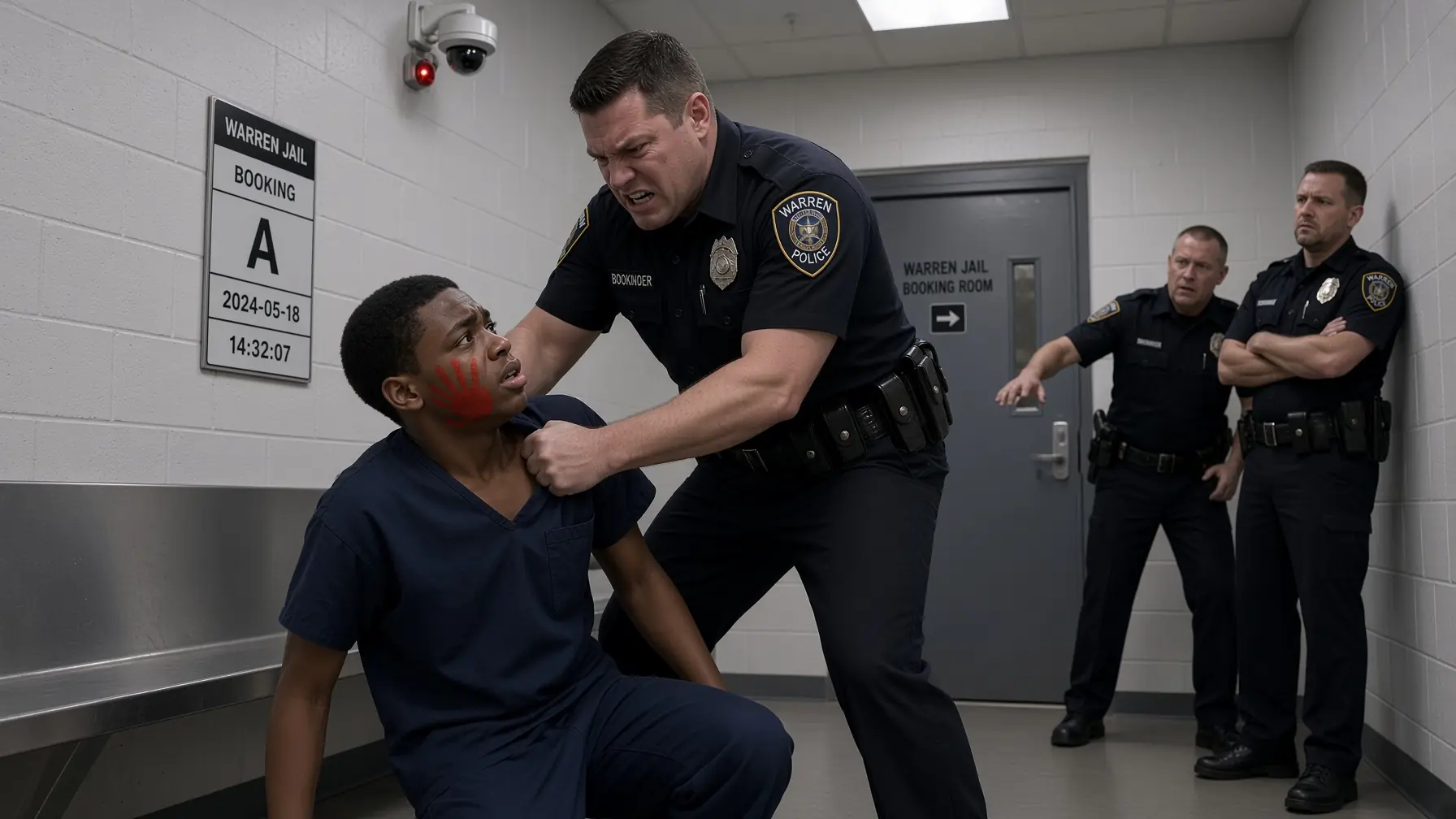
Malik Benton had been arrested the previous evening after police said he was connected to a vehicle taken during an incident on Riverton’s east side. He had not been convicted of anything, but the accusation was serious enough that even members of his own family did not pretend it could simply be ignored. Denise believed two things at once: if Malik had committed a crime, he needed to answer for it, and once police took him into custody, they had an obligation not to punish him in a booking room. The second belief became harder to separate from the first after the jail video reached the public.
The officer at the center of the footage was Darren Cole, a forty-year-old patrol veteran who had been with the Riverton Police Department for more than twelve years. Cole had brought Malik into the booking area after the arresting team completed transport, and the first portion of the video showed the kind of irritated exchange that happened in jails every night without becoming news. Malik was slow to face the camera for an identification photograph and answered one command with a sharp remark. Nothing on the recording suggested he was free to leave, and nothing suggested the officers believed he was armed inside the secured room.
Cole stepped closer and told Malik to turn toward the camera. Malik replied that he was already doing it, though his body remained angled enough that the booking clerk asked him to move again. Cole’s voice hardened, and Malik’s did too. The disagreement should have ended with another command, a supervisor, or simply enough patience to finish the photograph.
Instead, the temperature changed in seconds. Cole grabbed Malik, drove him toward the floor, and continued using force after Malik was already beneath him. The camera captured Malik’s head making contact with the hard booking-room surface more than once while the other two officers moved around them. There was no blood visible in the clip, but there did not need to be blood for the scene to look wrong.
Officer Eric Vaughn entered the immediate struggle after Malik was already down. Officer Lisa Mercer stood on the opposite side and reached toward Cole at approximately the moment the force became most disturbing. Later, the city would say Vaughn and Mercer had not witnessed the beginning, had initially believed Cole was controlling a resisting prisoner, and intervened once they realized what he was doing. Malik’s lawyers would claim they should have recognized the excessive force sooner and that for critical seconds neither officer did enough to stop it.
The booking clerk said almost nothing. A second camera recorded the room from another angle without sound, showing bodies moving across a polished floor under fluorescent lights and a gray door that remained closed through the entire confrontation. The lack of dramatic surroundings made the video more unsettling. It looked less like chaos and more like violence occurring inside a place designed to be controlled.
Afterward Malik sat against a wall with his shoulders forward. One officer asked whether he could stand, and Malik said his head hurt. Jail medical staff evaluated him, and he was later transported for additional examination before being returned to custody. Initial records did not document a skull fracture, brain bleed, or other catastrophic injury, a fact the city would emphasize repeatedly during the first week.
Denise learned about the incident from Malik’s mother, who called after midnight. By then Malik was already back at the jail, and nobody in the family had seen the video. Denise drove to her sister’s house and sat at the kitchen table until nearly four in the morning while they made phone calls that led mostly to voicemail. Every time the phone rang, both women expected someone to tell them Malik was worse than they had been told.
The family already understood he might remain in custody because of the underlying carjacking allegation. They were not asking for the charge to disappear, and Denise became angry whenever anyone treated that as their position. “If he did something wrong, deal with that in court,” she told her sister. “The officer doesn’t get to become the court.”
The video surfaced internally before it surfaced publicly. A jail supervisor reviewed the booking footage after Vaughn and Mercer reported concerns about Cole’s conduct, and the matter moved quickly to command staff. Police Commissioner Thomas Kincaid watched the relevant camera angles the following morning. He later said the department did not need weeks of debate to decide whether the force required immediate action.
Cole was removed from street duty while the internal investigation began. The prosecutor’s office received the video, the city’s legal department received notice, and the police union assigned counsel before reporters knew anything had happened. For almost forty-eight hours, the event existed inside government systems designed to process incidents quietly. Then someone learned there was video.
The first television report aired with only a few seconds of footage. The station blurred Malik’s face because of the continuing criminal case but identified him as a nineteen-year-old carjacking suspect. Viewers saw Cole take him down and saw the movement of Malik’s head against the floor. By the end of the night, longer versions were circulating online.
The comments split almost immediately. Some viewers said Malik’s criminal accusation made the force irrelevant, while others argued that custody was exactly when officers had the greatest duty of care because the person being restrained could no longer simply walk away. A smaller group tried to analyze each frame as though a social-media replay could reveal everything the officers knew in real time. Denise stopped reading after twenty minutes.
She did not need strangers to decide whether Malik was a good person. She knew his history better than they did, including the trouble he had gotten into after dropping out of community college and the friends she wished he had left behind months earlier. She also knew none of those facts changed what happened after the booking-room door closed. “You don’t have to make him a saint to say that was wrong,” she told a reporter who called the family.
The reporter asked whether Denise believed Malik was innocent of the carjacking. She replied that Malik had a lawyer for that case and the evidence would be tested where it belonged. “I’m talking about what happened after police had him,” she said. The distinction became the line she repeated for the next year.
Three days after the video aired, Commissioner Kincaid held a press conference. He said Cole’s conduct violated department expectations and that the video presented a clear disciplinary issue regardless of the pending criminal charge against Malik. He refused to discuss details of the internal investigation because it was still active. Reporters immediately asked about Vaughn and Mercer.
Kincaid said both officers were being reviewed. He added that early information indicated they entered the incident after the most important events had already begun and that at least one of them reported Cole promptly. The commissioner warned against assuming that every person visible in a video carried identical responsibility. That answer pleased almost nobody.
Malik’s family believed the two officers had been close enough to stop Cole earlier. Police supporters argued that officers sometimes needed seconds to understand whether a colleague was applying legitimate control or crossing a line. Civil-rights lawyers appearing on television said those seconds could become the center of a federal failure-to-intervene claim. What the public experienced as a moral argument was already becoming a legal one.
Attorney Jonathan Pike called Denise on the fourth day. Pike had spent nearly three decades handling civil-rights and serious personal-injury cases, had a reputation for aggressive media appearances, and knew how quickly evidence could disappear if nobody formally demanded preservation. Denise had not called him. A cousin who worked at a courthouse had sent his office the family’s number.
Pike did not begin by promising millions. He asked whether Malik had signed anything, whether anyone had obtained his complete medical records, whether he had previous head injuries, and whether the family knew which jail cameras existed. Denise said no to almost everything. Pike told her that was normal four days into a case and that normal was precisely why lawyers started preserving evidence early.
He met Malik at the jail the next morning. Malik had headaches, occasional nausea, dizziness when standing quickly, and difficulty sleeping, though some symptoms could have several causes and none alone proved a traumatic brain injury. Pike told him not to exaggerate anything. “A real case gets weaker every time somebody adds what didn’t happen,” he said.
Malik asked whether the officer was going to prison. Pike said criminal decisions belonged to prosecutors and depended on charges, evidence, and law. Malik asked whether the city would pay fifty million dollars because that was the number one of his friends had thrown around after seeing another lawsuit online. Pike stared at him for several seconds and said, “Forget numbers until we know the injury and the conduct.”
Malik nodded, embarrassed. Pike continued that damages in civil-rights cases could involve physical injury, emotional distress, constitutional harm, medical expenses, lost opportunities, punitive damages against individuals where legally available, and sometimes attorney fees. None of that meant a complaint’s demand equaled what a jury would award. “The number at the beginning is not the ending,” he said.
Pike’s investigators began collecting everything they legally could. They preserved social-media copies of the video in case clips were later edited, requested jail policies, sent formal notice demanding retention of all camera angles, radio traffic, booking records, use-of-force reports, medical documentation, and internal communications. They also requested personnel records to the extent allowed once litigation began.
The city hired outside counsel within the week. Assistant city attorney Rachel Morton remained involved, but Riverton’s insurer wanted a firm experienced with federal civil-rights litigation. Their lawyers immediately recognized that Cole’s conduct presented serious exposure if the video was as difficult to defend as it appeared. They also believed the claims against Vaughn, Mercer, and the city itself were less clear.
Cole was fired before the second week ended. Commissioner Kincaid called the decision “clear and obvious” under departmental policy, language that later appeared in almost every news story about the incident. Cole’s union filed the paperwork necessary to challenge aspects of the termination process, though the union stopped short of publicly defending every movement visible on the video. That distinction vanished in online arguments.
The county prosecutor charged Cole with misdemeanor assault. The charge angered Malik’s family because they expected something more serious, while Cole’s lawyer argued even the misdemeanor overstated conduct that occurred during an uncooperative booking. Prosecutors said the chosen charge reflected the evidence they believed could be proven under applicable law rather than the level of public outrage. Nobody on television liked that explanation because criminal law rarely matched the emotional scale of viral footage.
Fourteen days after the booking-room incident, Pike filed a thirty-page civil complaint in federal court. Malik Benton was the named plaintiff, and the defendants included Darren Cole, Eric Vaughn, Lisa Mercer, and the City of Riverton. The complaint sought damages that could reach fifty million dollars, though the filing did not transform fifty million into a guaranteed value any more than writing a number on a demand letter created money.
The legal theories were broader than the nightly-news summary. Pike alleged excessive force by Cole, failure to intervene by Vaughn and Mercer, and municipal liability based on training, supervision, discipline, and what the complaint described as a pattern of warning signs involving Cole. The city denied the broadest allegations and said the fact it fired Cole quickly demonstrated misconduct was neither authorized nor tolerated. The lawsuit was no longer simply about the video.
Denise watched Pike announce the filing outside the courthouse. He stood behind a row of microphones and said a jail was not a punishment chamber, and that an arrest did not suspend a person’s constitutional protections. He accused the officers in the room of acting as participants rather than protectors. Behind him, Denise kept both hands clasped because she was afraid cameras would capture them shaking.
A reporter asked about the fifty-million-dollar figure. Pike said the case involved constitutional injury, continuing symptoms, emotional trauma, and a city that needed to be held accountable. He did not say a jury would necessarily award that amount. The distinction did not survive most headlines.
Commissioner Kincaid responded several hours later. He criticized how quickly the suit was filed and said the department had already taken decisive action against Cole before lawyers began making broader accusations. He defended Vaughn and Mercer more strongly, saying they did not witness the initial escalation, recognized the problem once Cole’s conduct changed, intervened, and reported him to a supervisor.
Pike replied through television cameras before sunset. “I wish I could have filed sooner,” he said, arguing that government investigations did not require Malik to wait before preserving his civil claims. He accused the city of trying to divide one continuous event into seconds small enough to excuse everyone except Cole. The case became public argument before it became discovery.
Malik remained in jail throughout the first wave of publicity. That fact complicated every interview because cameras showed his aunt discussing police violence while prosecutors continued pursuing a serious criminal charge against him. Denise refused to hide it. “He can be accountable for whatever he did, and they can be accountable for whatever they did,” she said.
Some relatives wanted Pike to attack the carjacking case publicly. He refused. The civil case would already be difficult enough without appearing to use the force incident as a way to erase unrelated evidence. He told Malik’s criminal-defense lawyer that their strategies needed to remain separate whenever possible.
The underlying case contained disputed evidence. Police said Malik had been connected to a stolen vehicle through witness identification and physical evidence, while his defense challenged portions of the identification procedure and disputed the prosecution’s version of his role. Nothing about the booking video resolved those questions. The criminal case moved on its own track.
The medical case did too. Malik continued reporting headaches, dizziness, difficulty concentrating, irritability, and occasional nausea after the incident. A neurologist diagnosed a concussion based on symptoms and history, while defense experts later questioned how much of the continuing complaints could be objectively tied to the booking-room force months after the event.
Pike hated medical uncertainty but understood it was normal. He told Denise not to repeat phrases like permanent brain damage unless doctors actually supported them. “If the truth is headaches for three months, then the case is headaches for three months,” he said. Denise appreciated that even though it sounded less dramatic than television.
Malik’s symptoms did improve. By the third month, severe dizziness had become uncommon, though headaches remained intermittent and sleep problems persisted. He told a therapist he replayed the moment of hitting the floor whenever a guard approached quickly from behind. The therapist documented anxiety without promising it would last forever.
Defense lawyers obtained records too. They learned Malik had reported headaches once after a high-school football collision and had previously complained of insomnia during a stressful period after his father’s death. Those facts did not prove his current symptoms were unrelated to Cole’s force. They did give the city material to challenge causation and damages.
The first major discovery fight involved Cole’s history. Pike had learned through older court records that Cole had been sued after a previous arrest involving allegations of excessive force. One plaintiff’s claim had been resolved through settlement, while another had been dismissed after a court found legal grounds including qualified immunity on certain claims.
Pike argued the prior incident showed Riverton had warning signs. The city replied that allegations were not findings, a settlement was not necessarily an admission, and a dismissed claim could not simply be relabeled proof of misconduct. Both positions contained enough truth to make the records important and dangerous.
The old case had occurred four years earlier. Cole and another officer had arrested two men after a bar fight, and both plaintiffs alleged they were struck unnecessarily during restraint. Internal review at the time found Cole’s force within policy based on the information available, though one supervisor noted in an email that Cole’s temper during verbal confrontations concerned him.
That email became important. The supervisor wrote that Cole was technically competent but had a tendency to “take disrespect personally,” especially from younger male suspects. He recommended coaching and closer supervisory attention during prisoner handling. There was no evidence anyone ordered a specialized intervention afterward beyond a routine counseling conversation.
Pike read the email twice. “There,” he told his associate. His associate warned that one supervisor’s concern did not automatically establish a municipal pattern under federal law.
“I know.” Pike pointed at the screen. “But now we know where to look.”
They looked at complaints. Cole had received several over twelve years, most unrelated to force and some plainly unsupported. Two involved allegations that he escalated verbally with handcuffed detainees.
Neither resulted in sustained discipline. One lacked video.
The other had a witness whose statement conflicted with the complainant. The city argued that disciplining officers for unproven allegations would be as irresponsible as ignoring proven misconduct. Pike agreed in principle and kept digging anyway.
Training records showed Cole completed required defensive-tactics courses. The city had policies prohibiting unnecessary force and requiring officers to intervene when another officer used force that was clearly excessive. Those facts helped Riverton because municipalities were not automatically liable for an employee violating written rules.
Pike therefore shifted toward supervision and implementation. A policy could exist in a binder while officers received unclear practical guidance about when and how to stop a colleague during rapidly changing restraint. He requested lesson plans, scenario training, disciplinary examples, and communications about duty to intervene.
The records were mixed. Riverton had incorporated intervention language into annual training, but most examples focused on obvious prolonged force rather than ambiguous transitions from legitimate restraint into excessive conduct. Vaughn and Mercer both testified that they understood they had a duty to act when another officer crossed the line. The real dispute became when that line became clear in Malik’s case.
Video analysis took months. Experts synchronized multiple cameras frame by frame, measuring when Vaughn entered the room, where Mercer stood, what each could likely see, and how long Cole’s most troubling conduct continued after the others were positioned to respond. Plaintiff and defense experts reached different interpretations using the same seconds.
Pike’s expert said Vaughn had an unobstructed view early enough to physically intervene sooner. The defense expert said Vaughn initially appeared to be assisting with control because Malik’s body position and Cole’s movements could reasonably look like an ongoing restraint from his angle. Mercer’s position became even harder because she moved toward Cole while also trying to control Malik’s legs.
The video did contain one fact favorable to the city. Mercer could be seen touching Cole’s shoulder and then pulling at his arm shortly before the force stopped. Her radio transmission within minutes requested a supervisor.
Pike did not drop her immediately. He argued that a late intervention could still be legally insufficient if she had an earlier realistic opportunity. Yet privately, his team acknowledged her claim was weaker than the allegation against Cole.
Vaughn’s conduct remained more difficult. He entered after Malik was already on the ground and initially placed one hand near Malik’s upper body, apparently helping secure him. For several seconds, Vaughn did not attempt to pull Cole away.
Then he moved backward and said something the silent camera could not capture. Audio from another source later suggested he told Cole, “That’s enough.” The timing became central.
Denise watched a deposition excerpt with Pike and asked why lawyers could spend hours arguing over six seconds. Pike said, “Because six seconds is sometimes the whole case.” She hated that answer.
Cole’s deposition was worse emotionally. He testified that Malik had been verbally defiant, physically resistant, and that he believed continued force was necessary to gain control. He denied intentionally trying to injure Malik’s head.
Pike played the video. Cole watched himself without visibly reacting.
“Do you see his head contact the floor?” Pike asked. Cole said yes.
“More than once?”
“Yes.”
“Why didn’t you stop after the first contact?”
Cole’s lawyer objected to the form of the question, then allowed an answer. Cole said he was focused on control rather than counting impacts.
Pike asked whether Malik had a weapon. Cole said no.
“Was he handcuffed?”
“Yes.”
“Was he surrounded by officers?”
“Yes.”
“Then what were you afraid of?”
Cole looked at Pike. “You don’t have to be afraid to use force.”
That sentence reached the press months later after portions of deposition materials entered a public filing. It became another viral line, stripped from the longer explanation Cole attempted afterward. His lawyer accused Pike’s team of trying the case publicly.
Pike responded that the city had been defending itself publicly since the first press conference. The judge eventually ordered both sides to reduce extrajudicial commentary. For several blessed weeks, the case became quieter.
Quiet did not mean simple. Malik’s carjacking prosecution reached a plea negotiation while his civil suit remained active. Prosecutors offered a reduced charge in exchange for a guilty plea to conduct connected with the stolen vehicle, and Malik’s criminal lawyer believed the evidence created substantial risk if the case went to trial.
Malik struggled with the decision. He believed accepting a plea would make everyone watching the civil case assume he deserved whatever happened in booking. Denise told him those were separate questions even if the public refused to separate them.
Pike gave the same advice. “Do not make a criminal decision to improve a civil headline,” he said. Malik accepted a negotiated plea after consulting his criminal lawyer.
He received a custodial sentence that included credit for time already served and a later period of supervision. News headlines immediately paired the plea with the police-force lawsuit. Social-media commenters announced the civil case should disappear because Malik had admitted criminal conduct.
The law did not work that way. A person could be lawfully arrested, validly prosecuted, and still possess the right not to be subjected to excessive force after restraint. Pike repeated that in one statement and then stopped responding.
Commissioner Kincaid quietly appreciated the distinction even though the city was being sued. During an internal leadership meeting, he told supervisors, “We do not get cleaner force because the prisoner turns out guilty.” One lieutenant wrote the sentence down.
The department’s internal review of Vaughn and Mercer concluded months before the civil case ended. Mercer was cleared of wrongdoing after investigators found she intervened within a reasonable period once she recognized Cole’s conduct had become improper. Vaughn received counseling for delayed recognition but was not suspended.
Pike called the findings self-protective. The city said outside counsel had reviewed the investigative process. Neither side persuaded the other.
More important were changes Riverton implemented after the incident. Booking-room training was revised to require a designated lead officer during difficult prisoner processing, intervention scenarios became more specific, and supervisors received instructions emphasizing that reporting after force did not replace intervention during force when safe and feasible. The city insisted the reforms were improvements rather than admissions of constitutional failure.
Pike called that semantics. His municipal-liability expert called it evidence the old system had gaps.
The defense expert disagreed. Organizations revised procedures after incidents constantly, and subsequent changes did not necessarily prove previous practices were deficient. The judge later limited how some of those reforms could be used before a jury.
The litigation reached its first major turning point when the defendants moved for summary judgment. Cole argued that even if his conduct was mistaken, he had been responding to resistance and should not face all federal claims. Vaughn and Mercer argued they lacked sufficient opportunity to intervene before Cole stopped.
The city argued Malik could not show a policy or custom that caused the incident. Municipal liability under federal law did not arise merely because the city employed a person who committed misconduct. Pike needed to connect the constitutional violation to city action or deliberate inaction of a legally meaningful kind.
The judge’s ruling arrived nearly a year after the video first aired. Cole remained in the case on the central excessive-force claim. Mercer won dismissal of the claim against her after the court found the video and surrounding evidence did not support a reasonable conclusion that she had a sufficiently clear earlier opportunity to intervene beyond what she actually did.
Vaughn did not receive the same complete victory. The judge found a factual dispute about the seconds after he entered and whether a reasonable officer in his position would have recognized Cole’s force as excessive sooner. That question could go to a jury.
The municipal claim against Riverton survived in narrower form. The judge rejected several broad theories but allowed limited claims related to supervision and prior warning evidence concerning Cole to proceed because factual disputes remained about what policymakers knew and how they responded. Pike called the ruling a major victory.
The city called it a substantial narrowing of an overbroad complaint. Both descriptions were accurate.
Denise felt strangely disappointed when Mercer left the case. She had spent months seeing all three officers as one image on a screen. Pike told her the evidence had become clearer.
“Does that mean she did nothing wrong?” Denise asked. Pike said the court’s ruling meant the specific federal claim did not have enough evidence to proceed, not that a judge had declared every human decision perfect.
Denise sat quietly. “I wanted the video to be simpler.” Pike nodded. “Everybody does.”
Cole’s criminal case ended before the civil trial. He pleaded no contest to a misdemeanor assault-related offense under an agreement that avoided a longer contested proceeding. The court imposed probation, anger-management requirements, and restrictions associated with the conviction, while Cole continued challenging parts of his employment termination through separate labor procedures.
Malik expected the outcome to feel larger. It did not. No sentence could reverse the moment in the booking room.
Denise watched the hearing from the back row. Cole never turned toward the family until leaving. For one second their eyes met.
She felt no satisfaction. Mostly she felt tired.
The civil case entered settlement negotiations soon afterward. Riverton’s insurer had watched legal exposure change as claims narrowed, medical evidence became clearer, and Cole’s criminal disposition removed some uncertainty. Pike still had strong video evidence but a more modest injury case than the fifty-million-dollar headline implied.
A retired federal judge conducted mediation. The first day lasted ten hours and ended without agreement. Pike’s opening demand remained extremely high, while the city’s first offer made Denise laugh because she thought someone had omitted a zero.
The mediator moved between rooms. He told Malik’s family that juries could be unpredictable when a plaintiff had pleaded guilty to a serious underlying crime, even though legally that did not excuse the force. He told the city that juries also tended to react badly when video showed a restrained nineteen-year-old’s head striking a jail floor under an officer who had already been fired and criminally charged.
Nobody enjoyed hearing the weaknesses in their own case. That was the point.
The medical damages created another gap. Pike argued Malik’s concussion, months of symptoms, therapy, and continuing anxiety justified substantial compensation beyond direct bills. The city noted he had no neurosurgery, no long-term hospitalization, and no objective evidence of permanent cognitive disability.
Pike replied that constitutional injury was not priced only by medical invoices. The mediator told him a jury still wanted evidence, not philosophy.
They adjourned after midnight. Denise believed the case was headed to trial. Pike was less certain.
Two weeks later, new documents changed the discussion again. An internal email from a police captain written after Cole’s earlier complaint described frustration that supervisors had repeatedly documented his “poor emotional regulation with disrespectful detainees” without developing a formal improvement plan. The captain asked whether the department should require additional intervention-focused supervision before another incident occurred.
No evidence showed the email reached Commissioner Kincaid personally. It did reach command staff. The city had responded with a performance meeting but no specialized plan.
Pike believed the email strengthened the municipal case significantly. The city argued the message also proved supervisors were monitoring concerns rather than deliberately ignoring them. The difference between imperfect management and constitutional deliberate indifference became another question expensive lawyers could argue for months.
Commissioner Kincaid’s deposition was calmer than Cole’s. Pike asked whether he wished the department had done more after the earlier complaints. Kincaid said hindsight made the answer easy.
“What’s the answer?” Pike asked. Kincaid said, “Yes.”
The word surprised everyone.
Pike followed up. “You agree the city failed Malik?” Kincaid shook his head. “I said I wish we had done more with Officer Cole before this happened.”
“That’s failure.”
“That is regret.”
Pike leaned forward. “What’s the difference to Malik?”
Kincaid paused. “Probably none.”