The first thing Solomon Reed noticed about the young police officer was not the badge, the gun, or the way his right hand hovered near his belt. It was the patience with which Officer Ryan Callahan watched him, circling the edge of Foresight Park as if waiting for an eighty-two-year-old man with arthritis, a paper cup of coffee, and the morning newspaper to suddenly reveal himself as dangerous. Solomon turned another page of the Savannah Morning News, adjusted the leather satchel resting against the bench beside his left leg, and pretended not to see him. He had spent too much of his life learning what suspicious eyes looked like to mistake Callahan’s attention for ordinary police vigilance.
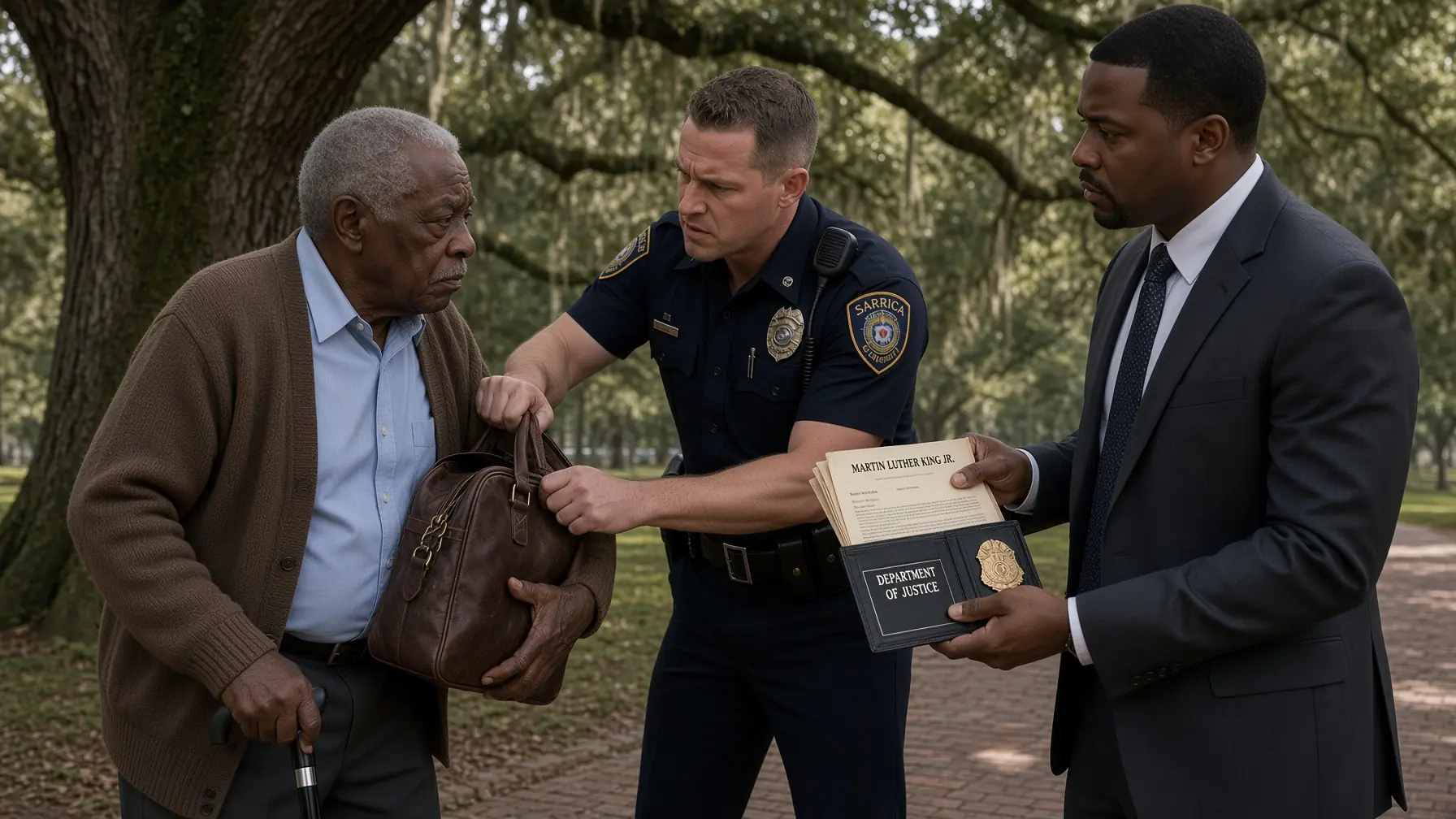
The bench stood beneath one of the oldest live oaks in Foresight Park, weathered wood supported by iron legs that the city had repainted so many times the layers had begun rounding the edges of the bolts. Solomon had been sitting there most mornings for almost twenty years, first with his wife Ruth beside him and then alone after cancer took her five winters earlier. Some people came to parks for exercise, others for dogs or children, but Solomon came because Ruth had once told him the place was one of the few corners of Savannah where she could hear herself think. After she died, maintaining the routine became less about grief than about refusing to let absence decide where he was allowed to feel at home.
At eighty-two, Solomon moved carefully but not weakly. His back remained straight, his silver hair was cut close, and he wore pressed charcoal slacks, polished brown shoes, a pale-blue shirt, and the same narrow leather belt he had owned since retirement. The cane leaning against the bench was mostly for his left knee, which had never forgiven him for several decades of marching, lecturing, climbing courthouse steps, and pretending sixty was young. Nothing about him looked threatening unless calm itself felt threatening to someone searching for submission.
Most people passing through the park knew nothing about him. A jogger might recognize the elderly man who always bought coffee at seven, and a few older residents occasionally stopped to ask whether Professor Reed still remembered them from his classes at Georgia Coastal University. Fewer knew that he had participated in civil-rights demonstrations as a college student, helped lawyers gather affidavits during school-desegregation fights in the late 1960s, and later spent thirty-eight years teaching American history while preserving oral testimonies from people whose names never appeared in textbooks. Solomon preferred it that way because fame tended to simplify people into one moment, and he had lived too many years to be comfortable becoming only one thing.
The leather satchel beside him contained documents because he was scheduled to speak at the city historical society that afternoon. Inside were copies of old voter-registration forms, photographs of lunch-counter demonstrations, transcripts from oral-history interviews, and correspondence between local organizers who had spent years fighting discriminatory housing and school policies without ever becoming nationally known. One original item remained in a protective sleeve because Solomon trusted himself more than any courier: a letter Ruth had written him in 1967 after he was arrested during a peaceful demonstration. Her handwriting began with the sentence, If they frighten you into disappearing, they win twice.
Callahan knew none of that. He had been with the Savannah Police Department for three years, transferred to the downtown foot-patrol unit only five weeks earlier, and already had a reputation for what supervisors called energetic enforcement. His personnel file contained two commendations for locating wanted suspects and four complaints accusing him of unnecessary stops, rude language, or pushing encounters beyond what circumstances required. None of the complaints had been sustained because body-camera footage was incomplete in two, witnesses disagreed in another, and the final complaint involved behavior investigators described as discourteous but within policy.
Callahan interpreted those outcomes differently. To supervisors, an unsustained complaint meant the evidence had not proved the allegation. To Callahan, each closure became confirmation that his instincts were right and that people who objected to his methods simply disliked being policed. The distinction between not proven wrong and proven right had disappeared from his thinking so gradually that no one moment explained when confidence became entitlement. By the morning he noticed Solomon Reed, Callahan had learned to experience questions about his authority as challenges to it.
At 7:08, he radioed dispatch and said he was checking a suspicious individual near the east fountain. The dispatcher asked whether he was responding to a call, and Callahan said there had been complaints about loitering and people approaching tourists in that part of the park. A genuine complaint had been received eighteen minutes earlier, but it described a younger man in a dark hooded sweatshirt asking pedestrians for money near the south gate. Solomon was an elderly man in a dress shirt sitting almost three hundred yards from that location, yet Callahan did not mention those differences over the radio.
The dispatcher logged the contact as officer-initiated. No supervisor was sent because nothing in Callahan’s voice suggested the situation required one. He turned toward Solomon and began walking across the gravel path. The crunch of his boots reached the bench before his shadow did.
Solomon kept reading. He was halfway through an editorial about voting districts and had already decided the writer confused simplicity with fairness. When Callahan stopped directly in front of him, Solomon folded the page rather than the entire newspaper. “Morning, Officer,” he said.
Callahan answered with the same word but none of the courtesy. He asked Solomon what he was doing in the park. Solomon looked at the coffee, the newspaper, and then back at him before saying, “I believed the evidence was visible.” A woman walking a terrier nearby smiled before seeing Callahan’s expression and quickly looked away.
“Do you live around here?” Callahan asked. Solomon replied that he did. Callahan requested identification, and Solomon asked whether he was suspected of committing an offense. The officer’s jaw tightened almost imperceptibly.
“You fit the description of someone we received complaints about,” Callahan said. Solomon studied him for a moment. “What description?”
Callahan did not answer directly. He told Solomon to produce identification so they could clear things up quickly. Solomon said, “Officer, I am happy to answer reasonable questions, but if you are detaining me, I would like to know the basis.” The newspaper remained folded across his lap.
Three benches away, Assistant United States Attorney Marcus Langston heard the exchange. He had come to the park before work because his apartment building’s elevator was being repaired and the construction noise had started before six, making coffee outside more appealing than remaining home. Marcus was forty-seven, worked primarily on financial fraud and public corruption, and had no investigative authority comparable to a federal agent despite the assumptions people often made about prosecutors. He carried Department of Justice credentials because his position required them, but the most important object in his jacket that morning was an ordinary phone.
Marcus looked toward Solomon, then toward Callahan. He did not immediately recognize the elderly man by name, though something about the face seemed familiar from old photographs displayed at a university event. What he did recognize was the legal shape of the conversation. A consensual encounter was becoming something less consensual without anyone clearly stating why.
Callahan said the matter was simple. “Show me ID, prove you belong here, and we’re done.” Solomon raised one eyebrow. “I was unaware residence was required to sit in a public park.”
“Don’t start with me,” Callahan answered. Solomon’s expression did not change. “I haven’t started anything.”
The dog walker slowed. A cyclist who had passed once circled the fountain and returned. Marcus placed his coffee beside his shoe and unlocked his phone without raising it yet.
Callahan pointed toward Solomon’s satchel. “What’s in the bag?” Solomon said documents. “What kind of documents?” Callahan asked.
“Historical records.”
“That mean something to me?”
“It wasn’t intended to.”
Callahan’s patience thinned. He told Solomon to stand so he could conduct a quick check of the bag. Solomon asked whether Callahan had probable cause, consent, or another lawful basis to search it.
Callahan said, “I don’t need a lecture.” Solomon replied, “Then we agree on something.”
The officer stepped closer. The woman with the terrier stopped walking entirely now. Marcus raised his phone enough to capture both men from the side without approaching.
“I’m going to ask one more time,” Callahan said. “Stand up and give me the bag.” Solomon placed the newspaper beside him.
“No.”
Callahan stared. “You refusing to cooperate?” Solomon answered, “I am refusing consent to a search.”
Those words mattered. Marcus had spent enough time in court to know how often disputes later turned on whether a person consented, resisted, or simply failed to understand what an officer wanted. Solomon had removed ambiguity with five calm words.
Callahan reached toward his arm. Solomon’s cane remained leaning against the bench, and both hands stayed visible. “Do not put your hands on me unless I am being detained,” Solomon said.
Callahan touched him anyway. The grip was not a strike or violent twist, but his fingers closed above Solomon’s elbow with enough force to begin pulling him forward. Solomon inhaled once and rose because resisting physically would accomplish nothing.
At full height, he was still several inches shorter than Callahan. Age had narrowed his shoulders but not his posture. “Now tell me why I am detained,” Solomon said.
Callahan replied, “Suspicious behavior and refusal to cooperate.” Solomon looked at him. “Those are descriptions of your opinion, not my conduct.”
The cyclist stopped completely. Marcus began recording video. He could hear Callahan clearly.
“You don’t know when to quit, do you?” the officer said. Solomon’s expression softened in a way that looked almost like sadness. “Young man, I spent most of my life around people who thought silence was the same thing as agreement.”
Callahan pulled Solomon half a step from the bench. The satchel tipped sideways but did not fall. Marcus stood.
“Officer,” he called.
Callahan turned without releasing Solomon. “Sir, keep moving.”
Marcus stayed several yards away and kept both hands visible. “I’m not interfering, but I am recording, and I heard the gentleman decline consent to a search.”
“This is a police matter.”
“I understand.”
“Then stay out of it.”
Marcus answered, “That depends on what happens next.”
Callahan’s hand tightened on Solomon’s arm. “Who are you?”
Marcus slowly removed his federal credential wallet and held it open at chest level. “Marcus Langston, Assistant United States Attorney, Southern District of Georgia.”
Several people nearby reacted more strongly than Callahan did. The young officer looked at the credential, then at Marcus, and said, “Federal prosecutor doesn’t run my stop.” Marcus nodded.
“You’re correct.”
That response disrupted Callahan’s momentum. He had expected the credential to become a challenge to jurisdiction. Marcus had instead agreed.
“I’m here as a witness,” Marcus continued. “You said he fit a complaint description, and I’ve heard no description stated. You ordered a bag search after he refused consent, and I have not heard you identify a lawful basis.”
Callahan released Solomon’s arm. “He was acting suspicious.”
Marcus asked, “Before or after you approached him?” Callahan’s face reddened.
Solomon bent carefully and picked up his cane. Marcus noticed a faint red mark where Callahan’s fingers had pressed into the thin skin above the elbow. He also noticed that Solomon’s left hand trembled slightly when he reached for the satchel.
Callahan saw the tremor and seemed to interpret it as weakness. “You can still be searched,” he said. Solomon answered, “Then explain the legal basis and do what you believe you are authorized to do.”
Marcus did not tell Callahan to take three steps back. He did not threaten federal prosecution or promise that careers would end before lunch. He simply said, “Officer, I strongly recommend that you request a supervisor before escalating further.”
The dog walker spoke from behind Marcus. “I’ve been watching since he was sitting there.” The cyclist added, “Me too.”
Callahan looked around and finally noticed the phones. Another man near the fountain was recording. A teenage girl standing with her father had hers raised as well.
The officer reached for his radio. “Supervisor to Foresight east side, citizen complaint.”
Marcus immediately said, “For accuracy, the citizen has not complained to you.” Callahan’s eyes flashed.
Solomon almost smiled. “Counselor, let the tape work.”
Marcus understood. He stopped speaking.
Captain Thomas Rivers arrived eight minutes later with Sergeant Elise Cooper. Rivers had served twenty-four years, had gray hair beginning at the temples, and was known for avoiding conclusions until someone handed him enough facts that avoiding them became impossible. He saw Marcus’s credentials, the crowd, Solomon’s red arm, Callahan’s posture, and several cameras.
“What happened?” Rivers asked.
Callahan began with, “Suspicious person complaint.” Marcus watched Solomon rather than the officer.
Rivers asked dispatch to confirm the original call description over radio. The response came back quickly: male, approximately twenty to thirty, dark sweatshirt, approaching pedestrians near south entrance. Rivers looked at Solomon.
Solomon wore a blue dress shirt. He was eighty-two.
“Officer Callahan,” Rivers said, “step over there with Sergeant Cooper.”
Callahan objected. Rivers repeated himself.
Sergeant Cooper separated him from the witnesses. Rivers then asked Solomon whether he wanted medical evaluation.
“No.”
“Were you searched?”
“No.”
“Were you told you were under arrest?”
“No.”
“Did he take your identification?”
“I never provided it.”
Rivers looked toward Marcus. “You witnessed the contact?”
“Most of it.”
“Recorded?”
“Yes.”
Rivers nodded. “I’ll need a copy through proper process.”
“You’ll have one.”
Solomon eased himself back onto the bench. His coffee had cooled. He drank it anyway.
The gesture caught Marcus unexpectedly. After everything that had happened, the old man sat exactly where the officer had tried to move him from. Nothing theatrical accompanied the decision.
A woman with a camera bag entered the gathering crowd. Her name was Nora Delgado, a local investigative reporter who had been walking her dog on the opposite side of the park when a text from a photographer friend told her something was happening beneath the east oak. She recognized Marcus first.
Then she recognized Solomon.
Her expression changed completely. “Professor Reed?”
Solomon looked up. “I taught you?”
“No, sir.”
“Then you can call me Solomon.”
Nora laughed once, nervously. She had written a university profile two years earlier mentioning Solomon’s oral-history collection.
She turned toward Marcus. “Is he okay?”
“I’m standing right here,” Solomon said.
Nora apologized immediately.
Solomon smiled. “Good habit to break early.”
Captain Rivers requested the crowd give his investigators room. Nora did not livestream because she had enough experience to know that broadcasting fragments before confirming the sequence could damage the very story she wanted to understand. Instead she took notes and asked witnesses for contact information.
Callahan stood nearly forty feet away with Sergeant Cooper. His arms were crossed. Whatever confidence had carried him toward the bench had disappeared.
Rivers walked over after speaking with dispatch. He told Callahan he was being relieved from field duty pending review of the encounter. Callahan asked whether that was because a federal prosecutor happened to be watching.
“No,” Rivers replied. “It’s because your stated description does not match the dispatch call and because we need the body camera preserved.”
Callahan argued that Solomon’s behavior created independent suspicion. Rivers asked what Solomon did before contact. Callahan said he was watching people.
Rivers looked toward the newspaper. “From a bench?”
“He was paying attention.”
“So were you.”
Callahan stopped.
Rivers instructed Sergeant Cooper to transport him back to headquarters without discussion of the incident beyond what policy required. He was not arrested because no prosecutor had reviewed the evidence, no warrant existed, and immediate public handcuffs would have served cameras more than law. Callahan left under administrative order.
Nora watched him go. “Will he be charged?”
Rivers said, “I don’t know.”
She seemed disappointed.
“That means the process has started correctly,” Marcus said.
Nora looked at him. “You really are a prosecutor.”
“I try.”
Solomon stood slowly. Marcus offered a hand, but Solomon shook his head and used the cane.
“I can still get up.”
Marcus nodded. “Understood.”
The satchel remained beside the bench. Solomon lifted it carefully.
Marcus asked whether the documents had been damaged. Solomon opened the flap and checked the protective folders inside. “No.”
“What’s in there?”
“Things more patient than us.”
Marcus smiled.
Solomon gave a formal statement at police headquarters later that morning. He did not walk there surrounded by cameras and supporters because Captain Rivers arranged transportation in an unmarked city vehicle after asking whether Solomon wanted it. Marcus followed separately and gave his own witness statement.
Nora waited outside. She had already obtained copies of two cellphone recordings from bystanders.
By noon, the first clip appeared online anyway. It showed Callahan gripping Solomon’s arm while Solomon said, Tell me why I am detained. The video ended before Marcus intervened.
Another clip surfaced twenty minutes later. This one included Marcus identifying himself as an Assistant United States Attorney.
The headline practically wrote itself. Federal Prosecutor Witnesses Savannah Officer Detain 82-Year-Old Civil-Rights Historian on Park Bench.
Solomon hated it.
Nora called him before publishing anything. “Why?”
“Because half the sentence is about who I used to be and the other half is about who happened to be watching.”
She was silent.
“What should it say?”
“An officer stopped a man who had done nothing.”
“That’s less specific.”
“It’s more important.”
Nora understood but still had to write journalism. Her article identified Solomon’s history because it was relevant and public.
She added his objection too.
The final paragraph quoted him saying, “If this only matters because I once marched somewhere important, then the story has missed the person who sits on that bench every morning.”
The line traveled farther than the video.
By evening, Solomon’s daughter Evelyn had driven from Atlanta despite being told not to come. She was fifty-five, a pediatrician, divorced, and possessed a lifelong ability to turn worry into instructions. She entered his townhouse carrying two grocery bags and demanded to see his arm.
“It’s a bruise.”
“You’re eighty-two.”
“I was aware.”
“You should have called me.”
“I was giving a police statement.”
“That does not improve the answer.”
Solomon smiled. Ruth had spoken to him the same way.
Evelyn examined the bruise and asked whether his shoulder hurt. He admitted mild soreness. She insisted on urgent-care imaging because older bodies turned small injuries into surprises.
The doctor found no fracture. Solomon returned home with advice to use ice, rest the arm, and avoid lifting heavy objects.
He ignored the final instruction by moving a box of historical files before bed. Evelyn caught him.
“You spent your life teaching people to follow rules.”
“No, I taught them to question rules.”
“That is not what the doctor meant.”
“Then he should have chosen more precise language.”
She took the box away.
The police department opened an Internal Affairs investigation. Callahan’s body camera became the first major piece of evidence.
The recording captured the initial approach. It also captured something the bystander videos had missed.
Before speaking to Solomon, Callahan whispered, “Let’s see what Grandpa’s doing out here.”
The words were not explicitly racial. They were dismissive.
More important was his radio traffic. Callahan cited a complaint description that did not match Solomon.
Investigators requested his prior complaint history. Four previous complaints appeared.
One involved a Black college student stopped near a parking garage after Callahan said he matched a burglary suspect. Dispatch records described a suspect six inches shorter wearing different clothing.
The complaint had been closed because the student was released within eight minutes and no search occurred. Nobody compared the mismatch to other cases.
Another complaint came from a Latino delivery driver. Callahan had demanded identification while the man waited outside an apartment building.
The officer wrote that the driver appeared evasive. Building surveillance showed him checking delivery instructions on his phone.
Again, no discipline followed.
Each case had seemed too small.
Captain Rivers read them together for the first time.
He felt sick.
The department’s complaint system separated allegations by category. Rudeness went one direction.
Unlawful stop allegations went another.
Bias complaints went to a different review path.
No dashboard placed one officer’s name across all categories.
Rivers called Internal Affairs commander Patricia Morse. “How many complaints does Callahan actually have?”
“Four before Reed.”
“How many did you know about?”
“All individually.”
“That wasn’t my question.”
Morse understood.
They began building the combined file.
Marcus Langston faced his own ethical decision. He had witnessed the incident personally, which meant he could not become the prosecutor directing any criminal case arising from it.
He notified the U.S. Attorney that afternoon. “I’m a witness.”
The U.S. Attorney agreed. Any federal review would be handled by lawyers with no role in Marcus’s statement.
Marcus sent his recording through evidence channels. Then he stepped away.
That disappointed reporters who had already invented a story where Marcus would personally dismantle Savannah’s police department. He gave one statement explaining that federal prosecutors did not become investigators simply because they saw something troubling.
“If the law only works when the witness has the right business card,” he said, “we have a larger problem.”
Solomon saw the clip. He called Marcus.
“That was better.”
“Better than what?”
“Your performance in the park.”
Marcus laughed. “I thought I was restrained.”
“You were showing off the credential.”
“I identified myself.”
“With flourish.”
“There was no flourish.”
“You’re a lawyer.”
“That’s prejudice.”
Solomon laughed for the first time since the incident.
The two men met several days later at the Savannah Historical Society. Marcus wanted to understand Solomon beyond the newspaper profile.
Solomon brought the same satchel.
“You still carrying that thing?”
“Yes.”
“After someone tried to search it?”
“Especially now.”
They sat beneath framed photographs of marches, school integrations, labor strikes, and voter-registration drives. One photograph showed twenty-one-year-old Solomon standing behind a line of students outside a segregated lunch counter.
Marcus stared. “That’s you?”
“With more hair.”
“You look angry.”
“I was hungry.”
Marcus smiled.
Solomon’s role in the civil-rights movement had been less famous than the internet now claimed. He had marched, been arrested twice for demonstrations, and later worked as a research assistant for attorneys challenging discriminatory school policies.
He had never given a speech at the March on Washington. He had never drafted the Civil Rights Act.
He had never advised Martin Luther King Jr. personally.
Social media invented all three within forty-eight hours.
Solomon corrected journalists until correcting strangers became exhausting.
One network graphic called him a “forgotten architect of desegregation.” Solomon told Evelyn, “I wasn’t forgotten, and I wasn’t the architect.”
“What were you?”
“Useful.”
She smiled.