David Mercer was halfway through his first cup of coffee when the patrol car stopped in front of his house at 7:12 on a quiet Saturday morning. He wore gray sweatpants, an old Georgetown sweatshirt, reading glasses, and the cracked brown sandals his wife had been threatening to throw away for almost ten years. A folded newspaper rested beside him on the porch table, and behind the front door his wife Angela was sleeping upstairs after returning home from abdominal surgery less than forty-eight hours earlier. Nothing about the morning felt important until the officer stepped out of the cruiser, looked directly at David, and placed one hand near his holster.
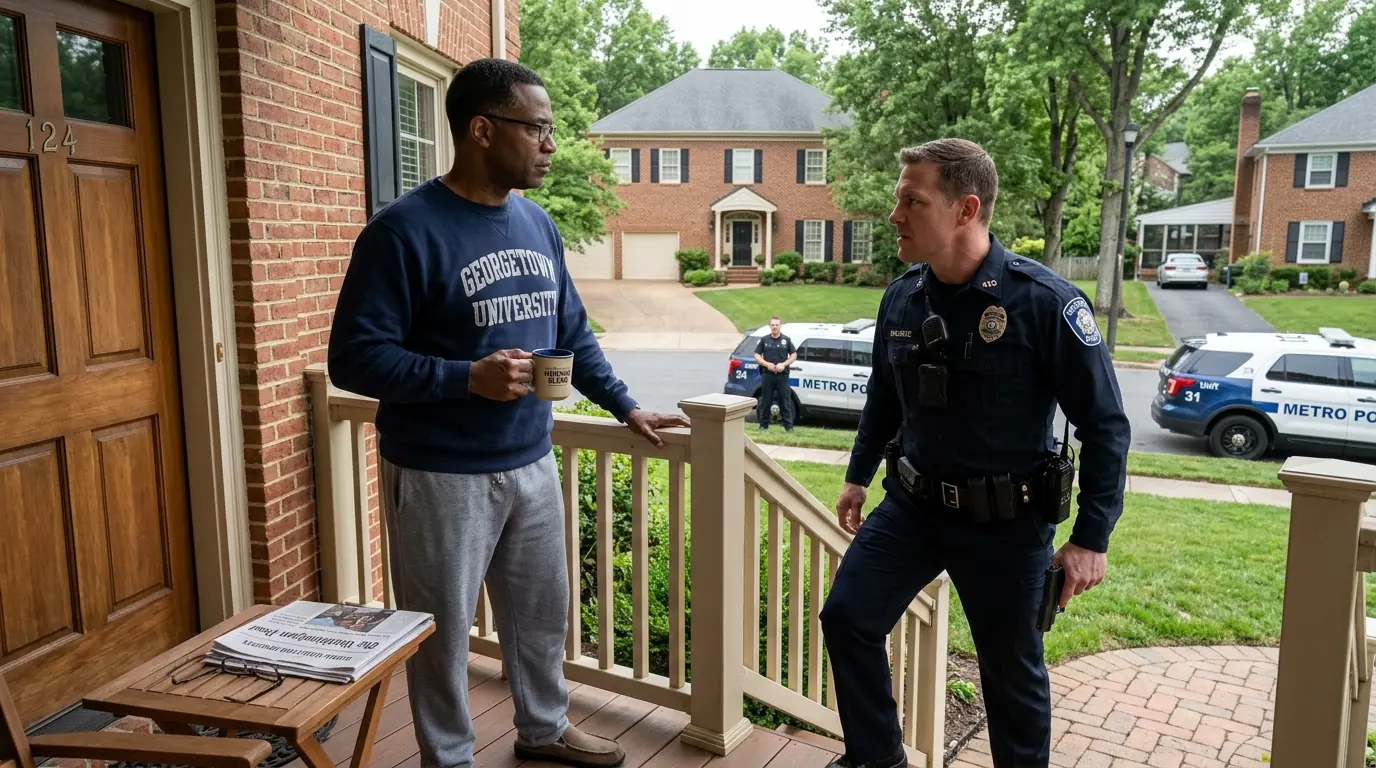
The street was one of those older suburban blocks where large brick houses stood beneath trees planted before most of their current owners were born, expensive without looking deliberately expensive. David and Angela had lived there for nine years, long enough to know which neighbor forgot trash day, whose dog escaped whenever thunderstorms came, and which section of sidewalk collected ice every January. At fifty-one, David had spent enough of his life working late that Saturday mornings on the porch had become something he defended almost religiously. He had promised Angela that this particular weekend would contain no speeches, no briefings, no television interviews, and, if government could manage it for forty-eight hours, no police work at all.
Officer Thomas Rourke crossed the front lawn instead of using the walkway. He was in his early forties, broad across the shoulders, with close-cropped brown hair, a square jaw, and the compact physical confidence of someone accustomed to strangers obeying before he finished speaking. Before reaching the first porch step, he called, “Sir, stand up,” without offering a greeting or explanation. David looked over the top of his glasses, set his coffee carefully on the table, and answered, “Good morning, officer, is there a problem?”
“I said stand up,” Rourke repeated, and David rose slowly with both hands visible in front of him. The officer’s eyes moved from David to the brick house behind him, then back again, as though one of those two things had to be inconsistent with the other. He explained that someone had reported “a suspicious male checking houses” in the neighborhood and asked whether David lived there. David answered yes, expecting the conversation to become easier once the obvious misunderstanding was acknowledged.
Instead, Rourke said, “Proof,” in the clipped tone of someone issuing a command rather than asking a question. David nodded toward the front door and explained that his wallet was on the entry table about six feet inside, beside his keys and phone charger. The officer immediately ordered him not to move toward the house. David paused and said, “You asked me to prove I live here, and then you told me not to retrieve the identification that would prove it.”
Rourke’s face tightened. “Don’t get smart,” he said, although David had neither raised his voice nor moved from the porch. David answered, “I’m not trying to be smart, officer, I’m trying to follow both instructions, and they conflict.” That response seemed to irritate Rourke more than an argument would have. He ordered David to keep his hands where they could be seen, then asked his name.
“David Mercer,” David said, and the name produced no recognition. Rourke repeated it as though testing whether David would change the answer, then asked who owned the house. David said, “My wife and I do,” and saw the officer glance again at the two-story brick home with its wide porch, landscaped yard, and late-model SUV visible through the side driveway. The look lasted only a moment, but David had spent most of his adult life learning how much human judgment could hide inside moments.
Rourke asked whether anybody else was inside. David said his wife was upstairs recovering from surgery and probably still asleep. The officer pointed at the door and told David to call her outside so she could confirm the residence. For the first time that morning, David’s expression changed.
“No,” he said calmly. Rourke stepped onto the first stair and asked, “What did you say?” David answered that Angela had spent the previous two nights struggling to sleep after surgery and he would not drag her onto a porch because a stranger had made a vague telephone call. The officer’s posture hardened as if David had refused something more serious than waking an injured woman.
“You don’t get to tell me how I investigate,” Rourke said. David answered, “I’m not telling you how to investigate, I’m telling you my wife is recovering and there are several less intrusive ways to verify an address.” He suggested checking the vehicle registration in the driveway, the property record available through dispatch, his name against the address, or simply allowing him to retrieve identification under the officer’s direction. Rourke dismissed all four possibilities without explaining why.
A second patrol car appeared at the corner. David watched it slow behind Rourke’s cruiser and felt a small tightening beneath his ribs that had nothing to do with guilt and everything to do with uncertainty. Officer Maya Chen stepped out, adjusted the front of her uniform, and activated her body camera before walking toward the porch. She was younger than Rourke, probably early thirties, and her first expression upon seeing David was confusion rather than suspicion.
Rourke said, “Claims he lives here, won’t verify it, won’t bring the homeowner outside,” and David turned his head slightly toward Chen. “My identification is inside, he ordered me not to retrieve it, and the other homeowner is my wife, who is recovering from surgery,” he said. Chen looked toward the front door, then at the house number fixed beside it. Something in her face suggested that the situation seemed far less dramatic than Rourke’s summary.
“What description did the caller give?” David asked. Rourke told him to stop asking questions. David replied that he wanted to understand what connected him, specifically, to the alleged suspicious person. Rourke said, “My eyes connected you,” and Chen looked at him quickly.
David felt the sentence settle into memory. He did not know yet whether it reflected impatience, bias, poor phrasing, or something worse, but he knew it mattered because nothing else Rourke had described connected David to criminal behavior. A man had supposedly been walking between houses, while David had been seated on one porch drinking coffee since shortly before seven. No description of clothing, age, height, direction of travel, vehicle, tools, or actual attempt to enter property had been offered.
Across the street, a front door opened. Margaret Lawson, a retired elementary-school principal who had lived in the neighborhood for twenty-seven years, stepped onto her porch wearing a robe over pajamas and called, “Officer, that is David Mercer, and he lives there.” Rourke turned toward her as if a third person had joined the argument rather than supplied the information he claimed to need. He told Margaret to go back inside.
“I have known him nine years,” she answered. Rourke raised his voice and said the matter did not concern her. Margaret folded her arms and replied, “Then stop asking whether he belongs in a house I have watched him own for nine years.” Chen looked down briefly, and David could not tell whether she was hiding a smile or discomfort.
Rourke turned back toward David. “You tell her to come out?” he asked. David answered no, and Margaret shouted from across the street, “Nobody tells me when to come outside.” David glanced toward her and said, “Margaret, maybe let us keep this simple,” which caused Rourke to accuse him of directing witnesses. The absurdity of the accusation almost made David laugh, but the officer’s hand remained near his weapon, so he did not.
Rourke ordered David to sit. David sat in the porch chair because arguing about position would accomplish nothing. Thirty seconds later, Rourke told him to stand again, and David obeyed without comment. The shifting commands began to feel less connected to information than to testing whether David would resist one of them.
“Turn around,” Rourke said. David remained facing him and asked why. The officer said, “Because I told you,” then took another step forward. David asked, “Am I under arrest?”
“Not yet,” Rourke answered. David then asked whether he was being detained, and Rourke said yes. “For suspicion of what?” David asked. Rourke replied, “Possible prowling.”
David looked at the newspaper beside his coffee. “You believe I may have been checking houses, then returned here and sat down with coffee and the Saturday paper?” he asked. Rourke said criminals did strange things. David answered, “That is true, but strange things still require facts.”
Chen shifted her feet. “Tom, maybe we can just run the address,” she said quietly. Rourke looked at her with enough irritation to stop whatever second sentence she had planned. “I’ve got it,” he said.
David noticed that phrase. He had heard versions of it in hundreds of investigative files, often immediately before a person with authority stopped listening to everyone around him. Confidence could be valuable during emergencies, but confidence also had a dangerous ability to turn disagreement into disloyalty. David had built much of his career around studying the point where professional certainty stopped serving evidence.
A movement appeared behind the upstairs curtain. David recognized Angela’s outline. She had probably heard voices through the bedroom window.
Without turning fully, David called, “Stay inside, honey, everything’s okay.” The movement stopped. Rourke’s hand closed around his gun.
“Face forward,” he snapped. David immediately did. Chen said, “Tom,” in a warning tone.
Rourke drew the weapon. A woman walking a dog near the corner screamed, and somewhere across the street a phone fell against a window frame. David went absolutely still as the muzzle aligned with the center of his chest.
“Hands up,” Rourke ordered. David raised them slowly beside his head. His heart accelerated so quickly that the first few beats seemed to happen inside his throat.
Nothing about twenty-five years of legal training prepared the body for a gun. David understood use-of-force doctrine, officer-safety arguments, split-second decision cases, qualified immunity, constitutional standards, human-factors research, and almost every phrase that might later be used to describe what he was experiencing. None of those concepts changed the physical fact of a loaded weapon several yards away. His mouth became dry.
“Do not move,” Rourke said. David answered, “I’m not moving.” Chen stood to the officer’s left with one hand out slightly, not touching him but clearly trying to reduce the temperature.
The nameplate was fully visible now. So was the badge number. David read both.
ROURKE. 5631.
Recognition arrived slowly, then all at once. David had seen the number three days earlier in a briefing packet from the state Civil Rights and Public Integrity Division. One complaint involved an extended suspicious-person detention, another a vehicle stop, and a statistical appendix flagged the officer’s discretionary-stop pattern for further review.
The packet had contained dozens of names. David did not personally investigate any of them. His role was supervisory, and the review was still preliminary enough that no one in the packet should have been treated as guilty of anything. Yet Rourke’s full name had been memorable because another report listed him as Thomas Andrew Rourke.
David inhaled slowly. “Thomas Andrew Rourke,” he said. The officer’s eyes changed.
“Don’t move,” Rourke repeated. David remained still. “Badge 5631,” he added.
Chen looked from David to Rourke. Rourke’s grip tightened. “How do you know my name?”
David answered, “I read it this week.” Rourke asked where. David said, “In a state civil-rights review packet.”
For a fraction of a second, uncertainty entered Rourke’s face. Then the uncertainty hardened into suspicion rather than caution. “Who are you?” he demanded.
David looked at the gun. “You should lower that first.” Rourke said, “You don’t give me orders.”
“That was a suggestion.” David kept his voice quiet. “I am unarmed, standing on my own porch, and following your directions.”
Rourke answered, “You know private information about a police officer.” David said his name and badge number were public identifiers displayed on his uniform. “Stay quiet,” Rourke snapped.
David stopped talking. He understood that the goal was no longer to persuade the officer. The goal was to remain alive long enough for the facts to become someone else’s responsibility.
His phone vibrated on the porch table. It stopped after several seconds, then began again. Rourke glanced toward it.
“Who’s calling you?” he asked. David said he did not know. “Don’t touch it.”
“I wasn’t planning to.” David kept his hands raised. Chen’s radio suddenly crackled.
“Unit thirty-one, hold position,” dispatch said. Chen pressed her microphone and answered, “Thirty-one, go ahead.”
“Supervisor responding priority.” The dispatcher added, “Caller at residence confirms detained male is homeowner David Mercer.” Rourke’s face did not relax.
Chen looked directly at him. “Tom, dispatch confirmed residence.” Rourke replied, “That doesn’t explain how he knows me.”
David heard the logic change again. The original problem had supposedly been whether he belonged at the house. Once that fact was resolved, instead of reducing suspicion, Rourke found a replacement. The new problem became David’s knowledge of his name.
A second dispatcher transmission followed. “Unit thirty-one, advise weapon status.” Chen hesitated. “One officer has firearm drawn, subject’s hands visible, no weapon observed.”
“Copy,” dispatch answered. “Supervisor advises de-escalate pending arrival absent immediate threat.” Rourke did not lower the gun.
Chen stepped closer. “Tom, holster it.” He turned his head slightly. “I’ve got it.”
“You have confirmation he lives here.” Chen’s voice became firmer. “He has not threatened us.”
Rourke said, “He knows things he shouldn’t.” David remained silent. He had spent years telling young attorneys that when a government actor changed the justification after the original one collapsed, the transition itself deserved scrutiny.
The front door opened two inches. Angela’s voice came through the gap. “David?”
“Stay inside,” he said immediately. Rourke’s gun moved slightly toward the door.
“Ma’am, close the door,” Rourke shouted. Angela answered, “This is my house.”
David heard the pain in her voice. He also heard the fury. Angela had spent twenty-six years refusing to be spoken for unless she specifically requested the service.
“Angela, please,” David said. She stopped opening the door farther. “I called 911,” she replied.
Rourke’s jaw tightened. “Close it now.” Angela answered, “I already told them my husband lives here.”
Chen said, “Tom, that’s enough.” For the first time, there was no hesitation in her voice.
Rourke lowered the muzzle several inches but did not holster the weapon. David’s arms ached. He could feel the beginnings of a tremor in his right hand and wondered whether Rourke would interpret that too as danger.
A black SUV turned onto the street. Then a second appeared behind it. Neither used lights or sirens.
Rourke glanced toward them. Another marked patrol vehicle approached from the opposite direction. Lieutenant Susan Hale stepped out before the cruiser had fully settled into park.
“Officer Rourke,” she called, “holster your weapon.” Rourke looked toward her.
Hale repeated the command. “Holster it now.” This time he obeyed.
David lowered his hands only after Hale told him he could. His shoulders burned as circulation changed. He had not realized until then how tightly every muscle had been holding him upright.
The first black SUV stopped behind the patrol cars. Rachel Monroe stepped out in jeans, running shoes, and a dark jacket, followed by State Investigator Malcolm Pierce. Rachel had served as David’s chief of staff for six years and was one of approximately four people in the world permitted to call his private phone repeatedly before eight on a Saturday morning.
Rourke looked toward her. Then he looked at Pierce. His face began to change.
Rachel walked to the edge of the yard. “David, are you hurt?” she asked. He answered no.
“Angela?” Rachel asked. David said she was inside. “Go check on her.”
“Not yet.” David looked toward Hale. “I want the scene preserved before anybody starts reconstructing this from memory.”
Rourke stared at him. “Who are you?” he asked again.
Rachel answered before David did. “He is Deputy Attorney General David Mercer.” Silence moved across the street faster than any siren.
Chen’s eyes widened. Hale’s expression did not, but her shoulders shifted. Rourke looked from David to the black SUVs.
“You’re Deputy Attorney General Mercer?” he asked. David said yes.
Rourke swallowed. “Why didn’t you say that?” David removed his reading glasses with one hand and folded them slowly.
“Why should I have to?” he asked.
Rourke looked toward Hale. “Lieutenant, I had a suspicious-person call.” Hale raised one hand.
“Stop.” Her voice remained calm. “No substantive statements until cameras and recordings are preserved.”
David looked toward the camera above his front door. “You’ll want that footage.”
Hale followed his gaze. “Absolutely.” David then looked toward Chen and Rourke.
“And both body cameras.” Chen immediately nodded.
“Mine has been active since I arrived.” Hale turned toward Rourke. “Yours?”
He hesitated. “It was on.”
“Was?” Hale asked.
Rourke touched nothing. “I think it stopped.”
Hale’s expression hardened. “Do not touch the device.” She told Chen the same, then instructed another arriving supervisor to secure both systems through normal evidence-preservation procedures.
Investigator Pierce did not step forward dramatically. He explained that David’s office had no role in investigating the incident because David was now a principal witness and potential complainant. The state team was present because Angela’s emergency call reached a protective-duty contact list after she reported that an armed officer was pointing a gun at the Deputy Attorney General, and Pierce’s only immediate task was ensuring state-held communications were preserved. Jurisdiction for police discipline and any criminal review would be assigned outside David’s chain of command.
David appreciated the distinction. Rourke appeared confused by it. He had expected powerful people to behave more like the kind of power he understood.
Hale asked whether David wanted medical attention. He said no. Rachel looked at his shaking hands and said, “That was not the question.”
“I’m not injured.” David looked toward Angela’s door. “I’m going inside in a minute.”
Rourke interrupted. “Sir, I didn’t know who you were.” David stopped.
The street became quiet enough that he could hear a sprinkler ticking two houses away. He turned toward Rourke.
“That is exactly the problem,” David said.
Rourke looked up. David continued, “You think knowing my title should change whether I deserved to have a gun pointed at me.”
No one spoke. David looked toward the brick house behind him.
“I told you I lived here.” His voice remained calm. “You prevented me from retrieving identification.”
He glanced across the street. “A neighbor confirmed I lived here.” Margaret lifted one hand from her porch.
“My wife confirmed it.” David looked toward the front door. “Dispatch confirmed it.”
Then he looked at Rourke. “And the gun still came out.”
Rourke started to speak. Hale told him to stop.
David continued anyway. “If I were a teacher, mechanic, delivery driver, unemployed man, student, or retiree sitting in that chair, those facts would be the same.” He looked toward the SUVs.
“These vehicles do not make me more innocent.” His voice finally carried beyond the yard. “My title does not create constitutional rights.”
A neighbor holding a phone lowered it slightly. David looked around the street.
“The question is not whether Officer Rourke stopped the wrong man.” He paused. “There is no right homeowner to treat unlawfully.”
Rachel closed her eyes briefly. She had heard David say variations of the idea in speeches, but never while standing beside the porch where a gun had just been pointed at him.
David looked toward Rourke one final time. “The question is whether you would have reconsidered if nobody important ever arrived.” Rourke lowered his eyes.
Angela opened the front door. She wore a robe over loose hospital clothes and held one arm carefully across her abdomen. The sight of her changed David faster than anything else that morning.
He climbed the steps. “You should be in bed.” Angela looked at him as if deciding whether surgery had removed her patience.
“A man pointed a gun at my husband outside my bedroom window.” She rested one hand on the doorframe. “You no longer get to manage my morning.”
David almost laughed. He touched her shoulder.
“Are you okay?” she asked. He nodded.
“Don’t lie to me.” Angela knew him too well.
“I’m not injured.” David corrected himself. “I don’t know about okay.”
“That’s better.” She leaned into him for a second.
Lieutenant Hale approached carefully. “Mrs. Mercer, I’m Lieutenant Hale, and I’m sorry this happened at your home.” Angela looked toward Rourke.
“Is he still working right now?” Hale answered that Rourke had been removed from active field duties until the immediate circumstances could be reviewed. She deliberately did not use words like guilty, fired, arrested, or corrupt.
Angela nodded. “Good.” Then she looked toward Chen.
“You told him to put it away.” Chen’s face tightened.
“Eventually.” Angela said nothing.
That single word carried more judgment than yelling would have.
Hale asked if Angela could give a statement later. Angela answered, “I can give one now.”
David shook his head. “You need rest.”
“I need you to stop deciding that because I had surgery I lost decision-making authority.” David opened his mouth, then closed it.
Rachel smiled despite herself. “I missed her.”
Angela pointed toward the porch chair. “I can sit.”
Hale agreed. David brought another chair outside.
Margaret crossed the street before anyone could stop her. Hale started to say the area should remain controlled, then looked at the seventy-two-year-old principal approaching in slippers and seemed to reconsider what battle she wanted.
Margaret hugged Angela gently. Then she turned toward David.
“You left my book in my flowerpot this morning.” David stared at her.
“This is what you want to discuss?” Margaret answered, “I have already shouted at police.”
“That seems sufficient for one morning.” David almost smiled.
Jamal Brooks, who lived three houses down, approached holding his phone. He told Hale he had recorded from his upstairs window shortly after the second patrol car arrived. Hale asked him not to edit or delete the original.
“I was about to send it online,” Jamal admitted. David said, “Please preserve the original first.”
Jamal nodded. “I can do both.” Hale answered, “You can, but please let us document the source before compression and reposting change the file.”
Jamal looked impressed. “That sounded expensive.” Hale almost smiled.
Within forty minutes, the street contained more cameras than residents. Crime-scene personnel were not needed because no physical evidence had been damaged, but investigators photographed positions, vehicle placement, and sight lines in case the weapon-draw decision later depended on what officers could actually see. Dispatch logs were preserved automatically.
Rourke’s cruiser camera became especially important. It had captured his arrival and the first minutes before his body camera activated. There was no audio from the vehicle microphone at that distance, but David’s porch system had recorded sound.
Hale separated Chen and Rourke before either gave a detailed account. She instructed them not to discuss the incident with one another. Rourke asked whether he was being treated like a criminal.
“No,” Hale said. “You are being treated like an officer involved in a serious use-of-force complaint.”
He looked toward David. “Because he’s Deputy Attorney General.”
Hale’s expression hardened. “Because you pointed a firearm at a man on his porch after the information supporting your suspicion was being contradicted in real time.” She added, “His title makes the conflicts more complicated, not the conduct more serious.”
David heard the answer from several yards away. He remembered it.
He gave a preliminary statement that lasted twenty-three minutes. He described only what he remembered directly and identified points where video would be more reliable than memory. When asked whether he believed Rourke drew the gun because David was Black, he answered, “I don’t know what Officer Rourke believed internally.”
The investigator seemed surprised by the restraint. David explained that race could not responsibly be excluded from reviewing the encounter, but motive should not be invented because the public would find a simple explanation satisfying. “Investigate his decisions,” he said.
Rachel interrupted once. “David, you’re slipping into deposition mode.”