Sergeant Wade Mercer did not even try to hide his laugh when he saw the young woman sitting behind the defense table.
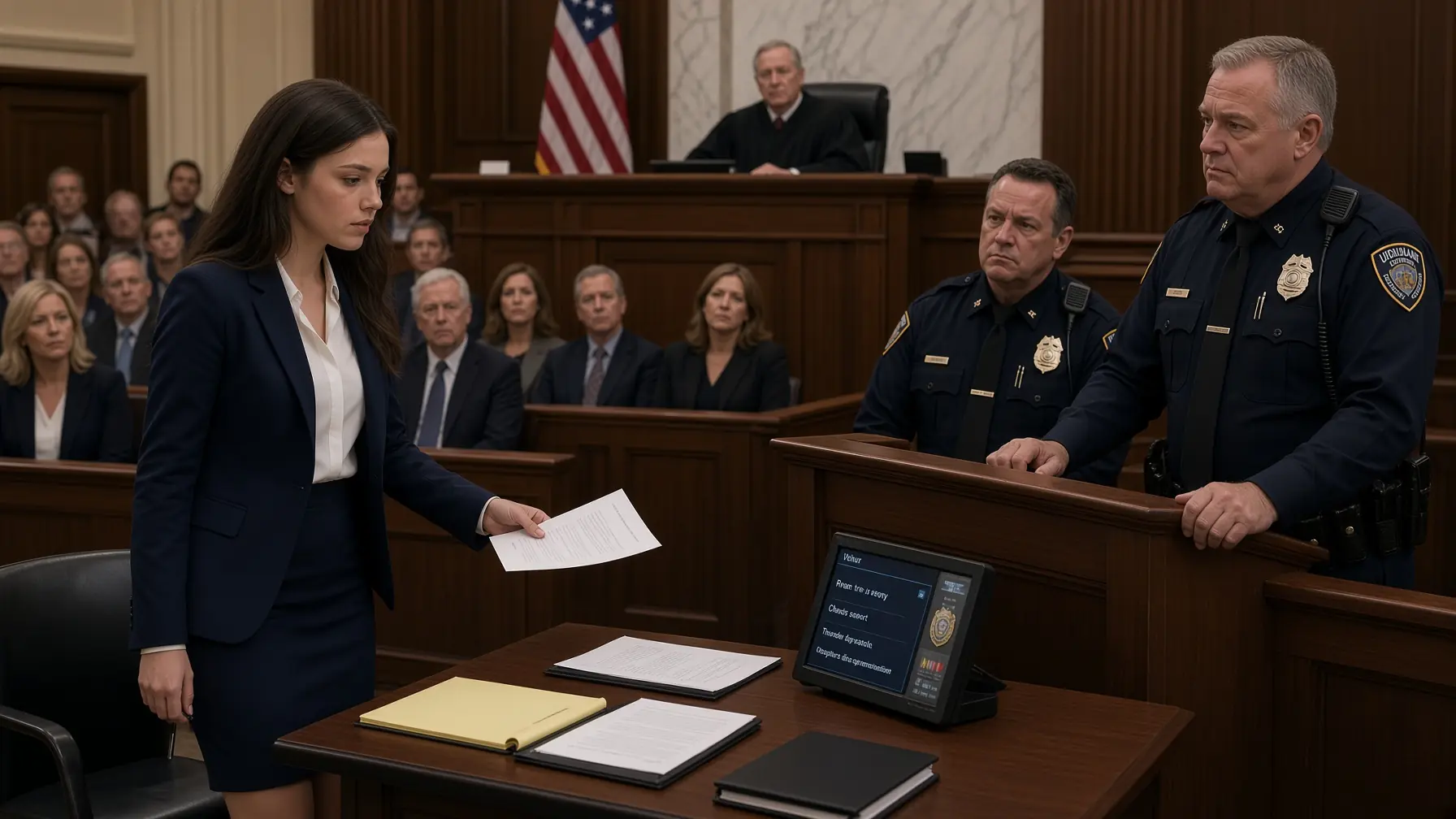
He was forty-eight years old, twenty-three years into a career with the Ashford County Police Department, and had testified in enough courtrooms that the ritual no longer made him nervous. He knew where to sit, when to answer only the question asked, how to look at a judge instead of an attorney when delivering an important fact, and how to make uncertainty sound like caution instead of weakness. Two commendation bars rested above his breast pocket. Another ribbon recognized a highway rescue from six winters earlier. Three younger officers had taken seats behind him, and when Mercer leaned toward one of them and whispered something while looking across the courtroom, the officer covered a smile with his hand.
The source of their amusement was nineteen-year-old Claire Whitaker.
She wore a dark navy suit that had been altered twice because every adult-sized jacket she tried seemed to make her look like a teenager borrowing clothes for a school debate. Her brown hair was pulled into a simple knot. A yellow legal pad sat in front of her beside four narrow binders, each labeled with a strip of white tape. She had no expensive leather briefcase, no dramatic stack of law books, and no gray hair to lend authority to anything she said. From the gallery, she could easily have been mistaken for the defendant’s daughter.
Someone apparently did make that mistake.
A woman behind Mercer whispered, “Is that his kid?”
Another voice answered, “Probably an intern.”
Mercer heard that one.
His smile widened.
Claire heard it too.
She did not look up.
Beside her sat Marcus Hale, thirty-eight years old, an electrical contractor with a wife, a twelve-year-old daughter, and a felony drug charge that had already cost him the largest commercial job his company had ever won. Eight months earlier, Sergeant Mercer had stopped Marcus on his way home from a hospital renovation project. The official version of that stop was uncomplicated. Mercer claimed Marcus failed to signal a lane change, appeared unusually nervous, voluntarily consented to a vehicle search, and then resisted when Mercer discovered a small quantity of methamphetamine inside a blue tool pouch beneath the passenger seat.
Marcus’s version was equally uncomplicated.
He had never consented.
He had never seen the drugs.
And he had not resisted.
For eight months, nearly everyone who read the reports believed Mercer.
Claire was not sure she disbelieved him when the case first landed on her desk.
That part would matter later.
The bailiff called the room to order, and Judge Helen Marrow entered through the door behind the bench. Everyone stood. She was sixty-three, had served seventeen years as a trial judge, and possessed the rare ability to make a courtroom quieter simply by sitting down. Once preliminary matters were handled, she looked toward the defense table.
“Appearances.”
Assistant District Attorney Laura Grayson stood first. “Laura Grayson for the Commonwealth, Your Honor.”
Then Claire rose.
“Claire Whitaker for Marcus Hale.”
Several heads turned.
Judge Marrow looked over her glasses. She knew exactly who Claire was. “Ms. Whitaker, you are lead counsel on the suppression motion?”
“Yes, Your Honor.”
Someone in the gallery whispered something too quietly to distinguish.
Mercer looked back toward his fellow officers.
Another grin.
Judge Marrow noticed that.
She said nothing.
Claire sat down.
She had learned early that being nineteen created two opposite mistakes in adults. Some became overly kind, explaining things she already understood because they assumed she needed help. Others became unusually aggressive because they resented having to take her seriously. Both reactions created useful information. A person trying too hard to establish superiority often revealed what he considered beneath examination.
Mercer had decided she was beneath examination before she asked her first question.
That would be his mistake.
Not because Claire was a prodigy capable of seeing truths older lawyers missed.
Because she had been frightened enough by her first real suppression hearing to watch every second of video three times.
Claire’s age had become the most interesting fact about her to everyone except Claire.
She finished high school early, entered a state university through an accelerated program, and completed her undergraduate degree before most people her age were choosing majors. Law school followed through a compressed program that consumed nearly every waking hour of three years she later described as “a very efficient way to become boring.” She passed the state bar shortly after her nineteenth birthday.
Local newspapers briefly called her the youngest licensed attorney in the state.
She hated the articles.
Every photograph showed her standing beside law books she had not chosen. Every headline contained the word teenager. One television reporter asked whether being a lawyer felt “like playing dress-up in an adult profession.”
Claire answered, “No.”
The interview ended shortly afterward.
She went to work for Beck & Warren, a small criminal-defense firm in Ashford City. Marian Beck, one of the partners, was sixty-four and had practiced long enough to distrust anyone who claimed courtroom talent was instinctive.
On Claire’s first morning, Marian handed her a misdemeanor file and said, “Read everything.”
Claire asked, “What am I looking for?”
“If I tell you, you’ll only look for that.”
That became the closest thing Marian gave her to a philosophy.
Marcus Hale’s case arrived five months later.
At first glance it was not important enough for anyone to imagine it would become a problem for the police department.
The evidence seemed strong.
Mercer’s report stated that at 4:12 p.m. on October 3, he observed Marcus’s work pickup move from the center lane to the right lane without signaling. He initiated a stop. Marcus provided license and registration but appeared “visibly nervous, evasive, and increasingly agitated.” Mercer requested consent to search the vehicle at approximately 4:18 p.m.
According to the report, Marcus replied:
Go ahead. I have nothing to hide.
Mercer then searched the passenger compartment and found a blue zippered tool pouch beneath the passenger seat. Inside was a smaller plastic bag containing a white crystalline substance that later tested positive as methamphetamine. When Mercer informed Marcus he was under arrest, the report said Marcus pulled away and attempted to turn toward the officer, requiring Mercer to take him to the ground.
The body-camera footage supplied with the initial discovery package seemed broadly consistent.
That was the problem.
It began at 4:19:23.
Mercer stood near the passenger door of Marcus’s truck. Marcus was already outside near the rear bumper with Officer Evan Cole, a rookie who had arrived as backup. Mercer’s voice could be heard saying, “I’ve received consent. I’m beginning the search.”
Thirty-eight seconds later, he crouched near the passenger seat.
Then he held up the blue pouch.
“Marcus, what’s this?”
Marcus looked confused.
“My meter pouch.”
Mercer opened it.
He removed a clear plastic packet.
Marcus immediately said, “That’s not mine.”
Mercer told him to turn around.
Marcus repeated, “I never gave you permission to search.”
Mercer responded, “Don’t start changing your story now.”
The recording became chaotic after that. Marcus stiffened when Mercer grabbed his wrist. Mercer interpreted the movement as resistance, swept one leg, and took him down onto the shoulder. Marcus shouted that he was not fighting. Officer Cole remained close but never struck him.
When Claire first watched the footage, she did not see a dramatic exoneration.
She saw ambiguity.
Marcus was angry.
Mercer was forceful.
The alleged consent occurred before the supplied video began.
That meant the case depended heavily on testimony.
Marian Beck read the file and asked Claire what she thought.
“Bad facts.”
“Whose?”
“Marcus’s.”
“Why?”
“Drugs in his pouch. Officer says consent. Camera starts after consent.”
Marian nodded.
“So plead him?”
Claire looked uncomfortable.
“He says the drugs weren’t his.”
“Defendants say things.”
“I know.”
Marian leaned back.
“He also says he didn’t consent.”
“Yes.”
“Do defendants say that too?”
“Yes.”
“Excellent. We’ve established people say things.”
Claire waited.
Marian tapped the file.
“What does anything outside Mercer’s report say?”
That question changed the direction of the case.
Claire began with dispatch records.
The computer-aided dispatch log showed Mercer calling in the traffic stop at 4:11:46. At 4:14:08 he requested a second unit. The reason field read:
SUBJECT DECLINING VEHICLE SEARCH / AGITATED
Claire read the line four times.
If Marcus had declined a vehicle search at 4:14, when had he changed his mind?
Possible.
People changed their minds.
But Mercer’s report said he first asked for consent at approximately 4:18.
That was not possible if dispatch knew at 4:14 that Marcus was declining.
Claire called Marcus.
“Did he ask to search before backup arrived?”
“Yes.”
“What did you say?”
“No.”
“Exact words.”
“I said, ‘No, sir. I’m not consenting to a search.’”
“Why did he ask again?”
“He kept saying if I had nothing to hide, it shouldn’t matter.”
“Did you eventually say yes?”
“No.”
“Did you say anything that might sound like yes?”
Marcus became frustrated. “How many ways do I need to tell you?”
“As many as it takes for me to know what happened.”
There was a silence.
Then he apologized.
Claire said, “Don’t apologize. Just be precise.”
Marcus described the stop again.
Mercer asked once near the driver’s window.
Marcus refused.
Mercer told him to step out.
Marcus complied.
Mercer asked again.
Marcus refused again.
Backup arrived.
Mercer told Officer Cole to stay with Marcus.
Then Mercer went to the passenger side.
Marcus protested.
Mercer searched anyway.
Claire asked, “Could Officer Cole hear you?”
“He was standing three feet from me.”
That sent Claire back to the discovery packet.
There was no Cole body-camera footage.
His name appeared in reports as an assisting officer. He had written a three-line supplemental narrative stating that he arrived, assisted with detention, and transported no evidence.
Claire emailed the prosecutor.
Please produce all body-worn camera footage associated with Officer Evan Cole for this incident.
Laura Grayson replied the next morning.
Cole’s role was traffic control/backup only. No responsive evidentiary footage is listed in the case file. I’ll check.
Two days later:
Department advises no relevant Cole video was exported.
Most young lawyers would have accepted that answer.
Most experienced lawyers probably would have asked once more.
Claire had no experience to tell her when asking became annoying.
So she asked differently.
Was his camera activated?
Laura checked.
Yes.
Then please produce the recording regardless of whether the department classified it as relevant.
That request started an argument.
The police department’s evidence coordinator said Officer Cole’s recording had been categorized as an “assist-only event” because the primary officer’s camera captured the substantive search and arrest. The prosecutor had never received Cole’s file because the department’s export procedure allowed the submitting officer to designate which recordings were related to the charging package.
Claire moved to compel.
Judge Marrow granted it.
The department produced two hours and fourteen minutes of Officer Cole’s shift footage.
Claire watched all of it.
Not just the traffic stop.
All of it.
She wanted to understand the camera clock, audio delay, file segmentation, and whether any automatic buffering occurred. Marian walked past Claire’s office at 9:30 that night and found her eating crackers over a laptop while Officer Cole’s body camera showed him completing paperwork in a parking lot.
“You understand you can fast-forward?”
“I’m checking time drift.”
Marian stared.
“Of course you are.”
At 10:17 p.m., Claire reached 4:17:42.
Officer Cole’s patrol car turned onto Grant Avenue.
Mercer’s cruiser was visible ahead.
Marcus’s truck sat on the shoulder.
Cole parked.
He stepped out.
The body camera was mounted higher than Mercer’s and had a wide view.
Claire stopped eating.
At 4:17:58, Marcus stood near the rear of his pickup with both hands visible.
Mercer faced him.
The audio was clear.
Mercer asked, “Last chance, Marcus. You going to let me take a quick look?”
Marcus answered:
“No, sir. I do not consent to any search.”
Claire froze the video.
Then replayed it.
Again.
Again.
Her first reaction was not triumph.
It was confusion.
Mercer’s report contained a direct quote at almost the same time:
Go ahead. I have nothing to hide.
The two statements could not both be true.
The video continued.
Mercer turned toward Cole.
“Stay here with him.”
Cole said, “Yes, Sergeant.”
Mercer walked to the passenger side of the truck.
Marcus called out, “I already told you no.”
Mercer opened the door.
Claire leaned closer to the screen.
At exactly 4:18:17, Mercer bent into the passenger compartment.
At 4:18:31, he opened the center console.
At 4:18:44, he moved toward the seat.
At 4:18:58, his shoulders shifted as he reached beneath it.
Then he stood.
Something blue was in his left hand.
The tool pouch.
Mercer returned toward the rear of the truck.
Officer Cole’s camera captured Marcus saying, “You can’t just go through my stuff.”
Mercer answered:
“Calm down. You’re making this harder than it needs to be.”
At 4:19:11, Mercer walked back toward the passenger side.
At 4:19:23, his own body-camera recording—the one initially supplied to the prosecutor—began.
I’ve received consent. I’m beginning the search.
Claire sat motionless.
Mercer had already located the pouch.
The so-called beginning of the search was a second performance for his own camera.
She called Marian.
It was nearly eleven.
Marian answered sounding half asleep.
“What?”
“I found it.”
That woke her.
“Found what?”