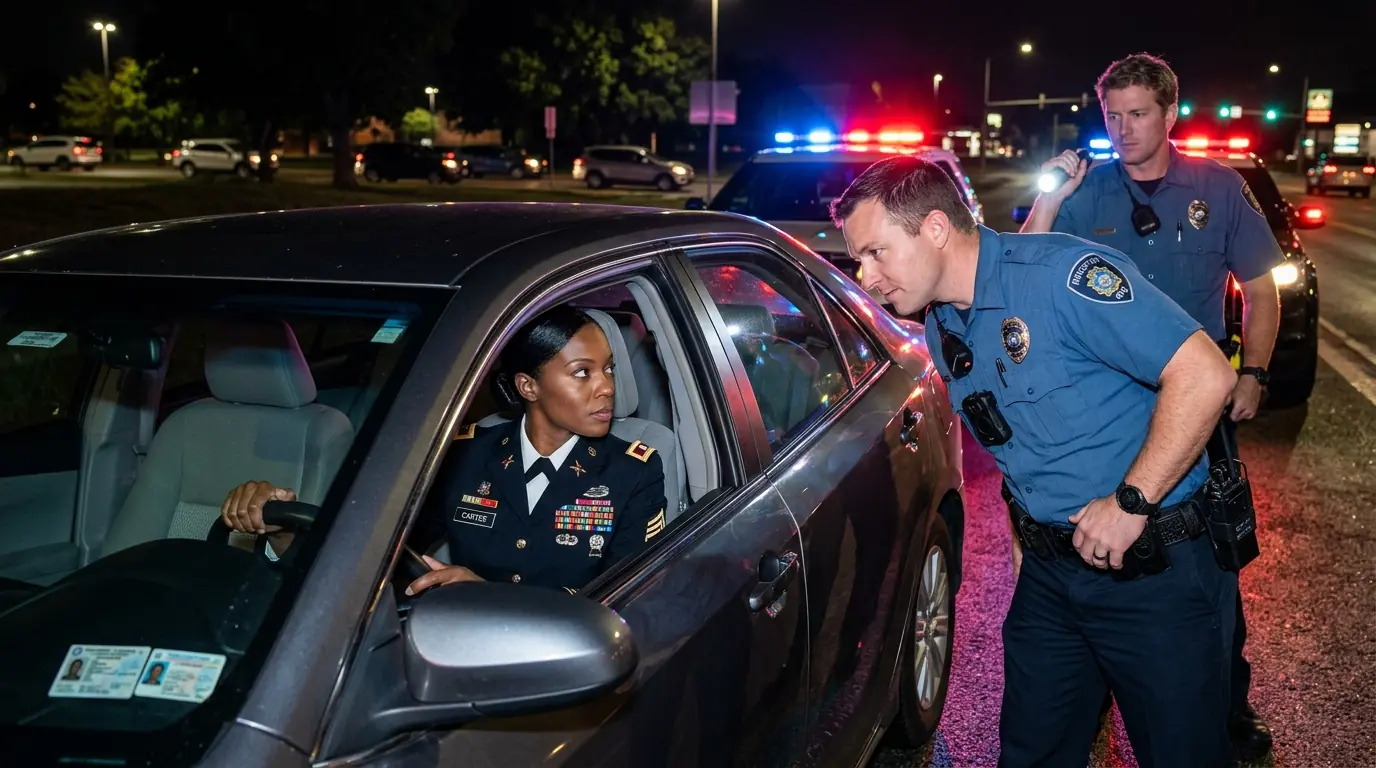
The six words that changed Naomi Carter’s night were spoken so calmly that for one strange second she wondered whether she had heard them correctly. Officer Dylan Mercer stood outside her open driver’s window with red and blue lights washing across the polished medals on her Army dress uniform, and his voice never rose above ordinary conversation when he said, “Go back where you came from.” Naomi stared at him, not frightened yet, but stunned by the casual certainty behind the sentence. Less than an hour earlier, a brigadier general had pinned captain’s bars onto her shoulders while nearly two hundred people applauded.
Fourteen years of Army service had taught Naomi how quickly a room could change without anybody moving. She had entered the military at nineteen as an enlisted communications specialist, spent six years working her way through assignments and deployments, completed college courses at night, and eventually earned a commission through Officer Candidate School. Two overseas deployments, four duty stations, one combat-zone commendation, and more evaluations than she could remember had shaped her into someone who rarely reacted before she understood the problem in front of her. At thirty-three, her promotion to captain felt less like triumph than confirmation that a long, difficult path had finally become visible to other people.
The ceremony had taken place at Fort Halston, a large Army installation outside Riverton, where Naomi served in a signal unit responsible for secure communications support. Her mother had flown from Michigan, her younger sister had brought two children who spent most of the ceremony whispering questions about medals, and Naomi’s closest friends had filled half a row near the front. Brigadier General Ellen Raines pinned the new rank while Naomi stood perfectly still beneath bright auditorium lights and tried not to think about her father, who had died three years earlier after telling everyone in the hospital that his daughter would someday become a general. Afterward, Naomi stayed for photographs, cake, congratulations, and the awkward receiving line that seemed to last longer than the actual ceremony.
By the time she left the installation, it was nearly ten at night. Naomi had changed nothing except removing the white gloves she wore during the formal portion, leaving the dark Army dress coat, skirt, low heels, ribbons, insignia, and newly attached captain’s bars exactly as they had been under the ceremony lights. Her personally leased sedan had a valid state registration, an installation access credential, insurance documents, and a folder containing the lease paperwork because Naomi had recently moved and was still reorganizing records. She wanted nothing more complicated than driving home, removing the uniform carefully, calling her mother, and sleeping late the next morning.
The traffic behind her thinned as she entered Riverton’s eastern commercial district. Naomi drove three miles below the posted speed limit, stopped completely at two signals, and used her turn signal before moving into the right lane near an elevated section of highway. She noticed the patrol car only when it appeared in her mirror several hundred yards later. The lights activated just before she reached a well-lit convenience store.
Naomi signaled immediately and pulled onto the shoulder beyond the store entrance. She stopped the engine, lowered the driver’s window halfway, switched on the interior light, and placed both hands at the top of the steering wheel where any approaching officer could see them. Those movements were partly training and partly habit, because her father had begun teaching her what to do during police stops long before the Army taught her how to approach armed checkpoints. She waited while the patrol vehicle remained behind her for almost forty seconds.
Officer Dylan Mercer approached on the driver’s side. He was thirty-seven, white, solidly built, with short brown hair and an expression that seemed irritated before Naomi said anything. His right hand hovered near his belt as he looked through the open window, first at Naomi’s face, then at the uniform, then across the interior of the car. “License and registration,” he said without greeting.
“Yes, officer,” Naomi answered. “My license is inside the blue folder on the passenger seat, and registration and insurance are behind it, so I’ll need to reach across slowly.” Mercer said nothing for several seconds, then ordered her to retrieve them. Naomi kept her left hand visible and moved her right hand deliberately toward the folder.
A second patrol vehicle stopped behind the first before Naomi found the state license. Officer Aaron Pike approached from the passenger side and swept a flashlight through the cabin, pausing when the beam passed across Naomi’s ribbons, ceremonial program, and Department of Defense identification card resting beside the folder. Naomi had placed the credential there after showing it at the installation gate because the formal coat made her wallet pocket difficult to reach. Pike tapped the passenger window and pointed toward the card.
Naomi lowered that window several inches. Pike asked, “What’s that ID?” and Naomi answered, “Department of Defense identification, sir, but my driver’s license is here.” She offered the state license toward Mercer.
Mercer took the license but pointed toward the DoD credential. “Give me that too.” Naomi hesitated only long enough to understand the request. “Officer, my state license establishes my driving privilege, but if you need to verify military identity I can show you the credential without surrendering it unless you’re seizing it for a specific reason.”
Mercer’s expression changed. “I didn’t ask for a lecture.” Naomi answered, “Understood.”
“Give me the ID.” Naomi removed it and handed it through the window.
Mercer examined the credential under his flashlight. “This isn’t a real license,” he said. Naomi answered evenly, “Correct, it’s not my driver’s license, the state license is in your other hand.”
Mercer looked toward Pike. “She’s got two IDs.” Pike glanced at both and said, “One’s military.”
Naomi waited. Nobody explained why she had been stopped.
Finally, she asked, “Officer, may I ask the reason for the stop?” Mercer looked down at her. “Improper lane change.”
Naomi replayed the last several minutes mentally. “I signaled before entering the right lane.”
Mercer leaned closer. “Are you telling me I didn’t see what I saw?” Naomi answered, “No, I’m telling you I did signal, but I’ll cooperate with the stop.”
That should have narrowed the conversation. Instead Mercer looked over the vehicle again. He asked whose car it was.
“Mine under a personal lease,” Naomi answered. Mercer asked why the registration address differed from the address on her license.
Naomi explained that she had moved recently after receiving orders to Fort Halston. The license reflected her prior address because the state update had been submitted but the replacement had not arrived.
Pike shined his light onto the passenger seat. “What are those papers?” he asked. Naomi said they were lease documents, insurance, installation vehicle registration records, and material from the promotion ceremony.
Mercer looked at the uniform again. “You military?” Naomi answered, “Yes.”
“What do you do?” he asked. Naomi replied, “Army communications.”
Mercer gave a small laugh. “This supposed to be some kind of officer uniform?” Naomi’s stomach tightened.
“Yes.” Mercer pointed toward the bars on her shoulders.
“What rank?” Naomi answered, “Captain.”
Mercer looked toward Pike. “Captain.” Pike’s face remained neutral.
Naomi understood then that her uniform was not reducing confusion. It was becoming another thing Mercer wanted to test. She had seen the reaction before from civilians unfamiliar with military insignia, but confusion usually sounded curious rather than accusatory.
Mercer asked how long she had served. Naomi answered fourteen years. “Fourteen years and you’re just a captain?” he said.
Naomi felt the insult trying to find a place to land. “I served enlisted before commissioning.”
Mercer looked at the credential again. “Convenient.” Naomi remained still.
Pike walked several steps away and spoke quietly into his radio. Naomi heard fragments: name, date of birth, plate, valid registration. Mercer continued looking through the window.
“Any weapons in the car?” he asked. Naomi answered, “No.”
“Drugs?” Naomi said no.
“Open containers?” No.
“Anything stolen?” Naomi stared at him.
“No.” Mercer smiled slightly.
“People get defensive when they’ve got something to hide.” Naomi answered, “I’m not being defensive.”
Pike returned. “Plate comes back registered to the lease company with her listed as authorized driver, insurance current.” Mercer barely looked at him.
“What about the address?” Pike said, “Dispatch says the license is valid, no warrants.”
Naomi expected the stop to move toward whatever citation Mercer believed justified it. Instead Mercer returned her state license to his left hand and kept the Department of Defense card in his right. “Step out of the car,” he said.
Naomi looked at him. “May I ask why?”
“Because I told you.” Naomi took one breath.
“Am I being detained beyond the traffic investigation?” Mercer said, “Get out.”
Naomi complied. She opened the door slowly after Mercer stepped backward, placed both feet on the pavement, and rose with her hands visible.
Cold air moved through the ceremonial skirt. The road shoulder smelled faintly of exhaust and damp asphalt. Pike stood several feet away with one hand near his flashlight.
Mercer ordered Naomi to stand behind the vehicle. She followed. “Keep your hands where I can see them,” he said.
“They are visible.” Mercer told her not to argue.
Naomi stopped talking. She could feel the newly pinned captain’s bars at her shoulders and had the absurd thought that she should have changed clothes at the installation.
Mercer asked again whether the vehicle belonged to her. Naomi repeated that it was personally leased and that Pike had already heard dispatch verify the plate. Mercer said, “That doesn’t mean you’re authorized to have everything in it.”
Naomi looked at him. “What are you referring to?”
“The government stuff.” Naomi followed his glance toward the DoD credential.
“That credential belongs to me for official identification purposes.” Mercer said, “It belongs to the government.”
Technically, government identification remained government property, but Naomi understood the way he was using the fact. “If you’re seizing it, I need to know the basis because I’m accountable for reporting loss or seizure.”
Mercer smiled. “You want to tell me how to do my job?” Naomi answered, “No, I’m telling you what my obligation is.”
Pike shifted his weight. “Dylan, we can just document that she has the ID.”
Mercer looked at him. “I’m handling it.”
Pike said nothing else. Naomi noticed.
Mercer walked toward the passenger side of the sedan and shined his flashlight inside. He asked what was in the glove compartment.
Naomi answered, “Vehicle manual, insurance copy, registration copy, and personal items.” Mercer said, “Open it.”
Naomi looked toward him. “I’ll retrieve the registration if you need it, but I do not consent to a general search.”
His expression hardened immediately. “Nobody said anything about a search.” Naomi answered, “You asked me to open a closed compartment without identifying what you need.”
Mercer walked back toward her. “You military people think memorizing rules means you run everything.”
Naomi said nothing. Pike looked toward the road.
Mercer stopped within three feet. “Open the glove box.”
Naomi replied, “If you need a specific document, I’ll retrieve it while you observe.” Mercer said, “That’s not what I asked.”
Naomi held his gaze. “Then I do not consent to a search.”
Mercer’s face changed so slightly someone not watching closely might have missed it. Naomi had spent fourteen years learning to recognize the moment irritation became personal.
He looked over her uniform again. “Where’d you get that?” Naomi answered, “What?”
“The uniform.” Naomi stared.
“Fort Halston.”
“You stationed there?” She said yes.
Mercer laughed quietly. “They’ll let anybody put on a costume now.”
Pike spoke. “Dylan.”
Mercer ignored him. Naomi felt anger rise from somewhere beneath her ribs.
She did not show it. “Officer, if you’re issuing a citation for an improper lane change, please issue it, and if you’re continuing to detain me for another reason, I’m asking you to state that reason.”
Mercer stepped closer. “You don’t set the pace here.”
Naomi replied, “I understand.” Mercer asked where she was born.
The question seemed so unrelated that Naomi paused. “Michigan.”
Mercer smiled. “Sure.”
Naomi said, “Detroit, if that helps your traffic investigation.”
Pike looked sharply at her. Mercer’s eyes narrowed.
“You think you’re clever.” Naomi answered, “I think where I was born has nothing to do with my turn signal.”
Mercer leaned toward her. “People like you come into this town, get some government job, put on a fancy uniform, and think rules don’t apply.”
Naomi’s disbelief finally became clarity. “People like me?”
Mercer did not answer directly. He held up her Department of Defense credential.
“Go back where you came from.”
Six words. Calm voice.
Naomi stared at him. Pike stared too.
Nothing in Mercer’s tone suggested he had lost control. That made the statement worse.
Naomi asked, “Did you just tell me to go back where I came from?” Mercer said, “You heard me.”
Pike whispered, “Dylan, stop.” Mercer turned.
“You got something to say?” Pike looked at Naomi, then away.
“No.” Naomi felt something inside her settle.
She was no longer wondering whether the stop was merely badly handled. She was documenting.
Her training had taught her to remember sequence before interpretation. She repeated details silently: first vehicle returned valid, then military credential seized, then glove compartment demand, then refusal of consent, then people like you, then go back where you came from.
Mercer pointed toward the sedan. “Open the glove compartment.” Naomi answered, “No, sir.”
“Sir?” he said sarcastically. Naomi nodded.
“I’m being respectful.”
Mercer reached for her left arm. “Turn around.”
Naomi did not resist, but she asked, “Am I under arrest?” Mercer grabbed above her elbow.
“Turn around.” Naomi turned.
His grip tightened. Naomi said, “I am complying.”
Pike moved closer. “Dylan, what’s the charge?”
Mercer said, “Obstruction.” Pike hesitated.
“Obstruction of what?” Mercer twisted Naomi’s arm upward.
Pain shot across her shoulder. The ceremonial jacket pulled tight enough that one button strained.
Naomi inhaled sharply but did not pull away. “Officer, you’re hurting my shoulder.”
Mercer said, “Then stop resisting.” Naomi answered, “I am not resisting.”
Pike took her other arm. Naomi felt the moment he made a decision he would later have trouble explaining.
Instead of stopping Mercer, he assisted him. Her body moved forward, one heel slid on loose gravel, and she corrected balance without jerking either arm.
Mercer pushed her toward the rear quarter panel. “Feet apart.”
Naomi complied. Pike closed one handcuff.
Mercer closed the other. Metal pressed around her wrists.
Naomi flexed her fingers once to check circulation. “These are tight.”
Mercer answered, “Should’ve thought about that before getting difficult.” Naomi looked toward Pike.
Pike avoided her eyes. That hurt more than she expected.
Mercer began searching the exterior pockets of Naomi’s uniform coat. She said, “I do not consent to any search beyond what is lawfully incident to the detention.”
He laughed. “Still giving orders.”
Naomi answered, “No.”
Mercer removed her personal phone from the coat. He also took the ceremony program and a folded card containing names of promotion guests.
“Who’s General Ellen Raines?” he asked after seeing the printed program. Naomi said, “The general who promoted me.”
Mercer laughed again. “Of course.”
Pike looked toward the program. “Dylan, the fort’s ten minutes away.”
Mercer said, “So?” Pike hesitated.
“We can verify all of this.”
Naomi looked toward him. Verification should have ended everything.
Mercer did not want verification. He wanted submission.
He walked around the sedan and opened the driver’s door. Naomi immediately said, “I do not consent to a vehicle search.”
Mercer leaned inside. Pike remained beside Naomi.
She asked, “Are you recording?” Pike looked at his body camera.
“Yes.” Naomi nodded once.
“Please make sure it remains on.”
Mercer heard her. He stood up and slammed the door.
“You threatening us?” Naomi answered, “No.”
“You sound like you’re planning a lawsuit.” She said, “I’m planning to know what happened.”
Mercer walked close enough that she smelled peppermint gum. “People like you always think a fancy uniform makes you untouchable.”
Naomi met his eyes. “My uniform has nothing to do with whether this stop is lawful.”
Mercer smiled. “We’ll see.”
The sentence activated a thought Naomi had been resisting. Her unit had a protected legal and security contact procedure for incidents involving controlled government credentials, encrypted government devices, missing access media, or civilian law-enforcement encounters that might create a security issue. The procedure was informally nicknamed the Carter Protocol, not after Naomi, but after Colonel Joseph Carter, a previous communications officer who had redesigned the unit’s after-hours incident checklist following a mishandled equipment seizure years earlier. The name had always amused Naomi because people hearing it for the first time assumed it referred to her.
The protocol was not a magic federal emergency button. It could not take control of local police, erase charges, command traffic cameras, or summon armored vehicles. It did something less theatrical and more useful: it notified the installation duty desk, legal office, security manager, and designated military law-enforcement liaison that federal credentials or controlled property might be involved, while requiring preservation of any government-controlled telemetry and rapid requests for outside evidence before routine retention cycles could erase it. Naomi had been instructed never to invoke it for ordinary inconvenience.
Tonight no longer felt ordinary. Mercer still had her DoD credential. She did not know whether he intended to search the vehicle, seize other material, or transport her.
Naomi asked, “May I make a phone call?” Mercer laughed.
“To who?” he asked. Naomi answered, “My legal contact.”
“Your costume department?” Mercer said. Pike looked uncomfortable.
Naomi waited. Mercer handed the phone toward Pike.
“Let her call.” Pike looked surprised.
Mercer smiled. “Maybe somebody at the fort can explain obstruction.”
Pike adjusted Naomi’s cuffed hands so she could touch the screen while he held the device. The movement hurt her shoulder. “Sorry,” he whispered so quietly Mercer probably did not hear.
Naomi unlocked the phone and opened the secure contact application. She entered a number she had memorized during annual security training.
The line connected after one ring. A duty specialist answered with the phrase Naomi expected.
She said, “Captain Naomi Carter, Fort Halston signal support, after-hours security incident.” The duty specialist asked for authentication.
Naomi provided it. Her voice remained calm.
She gave the intersection, patrol vehicle number, names and badge numbers visible on uniforms, and stated that she had been handcuffed during a civilian traffic stop after officers retained her DoD credential. The duty specialist asked whether any controlled government devices were inside the vehicle.
Naomi answered, “No classified material, but one encrypted government-issued communications device is locked in the secured trunk container from tonight’s ceremony support detail, inventoried and powered down.” That detail changed the call.
The device was not mysterious or dangerous. It was a secured government laptop Naomi had signed out temporarily because her unit’s property office had closed before the promotion reception ended, with written instructions to return it the next morning.
Civilian officers could potentially seize property during lawful investigations. What mattered was chain of custody, access control, and immediate reporting if protected government equipment was disturbed.
The duty specialist asked, “Has your Department of Defense identification been seized?” Naomi said yes.
“Has force been used?” Naomi looked directly at Mercer.
“Yes.”
The voice on the other end became more formal. “Do you believe officers are attempting access to the secured government container?”
“Unknown.” Naomi watched Mercer.
“He demanded access to the glove compartment and has opened the driver’s door after I refused consent.” Pike looked toward Mercer.
Naomi said the final sentence exactly as training required. “Activate Carter Protocol and preserve every signal from this stop.”
The duty specialist answered, “Confirmed.” The call ended.
Mercer smiled. “Carter Protocol?”
Naomi said nothing. He leaned closer.
“You really expect me to believe the Army named a protocol after you?” Naomi almost laughed.
“No.” Mercer’s smile disappeared.
Pike looked between them. “What did she activate?”
Naomi answered because there was no reason to make the procedure sound more dramatic than it was. “Evidence preservation and security notification.”
Mercer shook his head. “Sure.”
Miles away, the installation duty desk began doing what the checklist required. The security manager confirmed Naomi’s identity, verified her temporary custody of a government laptop, preserved the device-management location record under military control, notified installation law enforcement, and contacted the staff judge advocate duty attorney. A liaison request went to Riverton dispatch asking that body-camera recordings, radio traffic, vehicle-camera footage, and 911 or computer-aided dispatch records associated with Naomi’s stop be preserved pending review.
Nothing magical awakened. Traffic cameras did not suddenly obey the Army.
Instead, people started making phone calls. Those calls were enough.
At Riverton’s communications center, supervisor Karen Liu received the preservation request and initially assumed it was routine. Then she saw the listed detainee name, the DoD credential notation already entered by Pike, and the fact that the stop involved possible government property. She opened the incident log.
Something bothered her immediately. The original reason entered by Mercer read unsafe lane change, possible stolen government property.
No stolen-property report existed. The plate had returned valid.
Karen replayed the radio traffic. Pike had clearly told Mercer the vehicle and driver information were valid.
She called the watch commander.
Lieutenant Rosa Alvarez was eating a late dinner at her desk when Karen said, “You need to look at Unit Twelve’s stop.” Rosa opened the dispatch log.
“Why?” Karen answered, “Fort Halston just sent a formal evidence-preservation request.”
Rosa stopped eating.
“Military?” Karen said yes.
“That’s not why I’m calling, though.” Rosa waited.
Karen continued, “The stop reason keeps expanding after verification.”
Rosa opened the live unit status. Mercer and Pike were still roadside.
She called Pike first. “Status.”
Pike looked toward Mercer before answering. “One detained female, possible obstruction, investigation continuing.”
Rosa asked, “Original violation?” Pike said improper lane change.
“Citation written?” No.
“Any warrant?” No.
“Vehicle return?” Valid.
“Driver return?” Valid.
“Why obstruction?” Pike paused.
Mercer took the radio. “Lieutenant, she’s refusing lawful commands and interfering with the investigation.”
Rosa asked, “What investigation?”
Mercer looked toward Naomi. “Possible unlawful possession of government property.”
Naomi closed her eyes.
Rosa said, “What evidence supports that?”
Mercer answered, “She has a military ID and documents that don’t belong to her.”
Pike looked at him sharply. The documents were lease records.
Rosa’s voice changed. “Hold your position, do not search the vehicle, do not access any locked container, and do not transport until I arrive unless there’s an immediate safety issue.”
Mercer said, “Lieutenant—”
“That’s an order.”
The radio went quiet.
Mercer looked at Naomi. “Happy?”
Naomi answered, “No.”
That seemed to unsettle him.
Pike stepped several feet away. Mercer followed.
Naomi could not hear every word, but she heard Pike say, “We should’ve just cited the lane change.”
Mercer replied, “Don’t start.”
Pike said, “Her documents came back.”
Mercer answered, “You want her telling everybody we folded because she flashed a uniform?”
Naomi heard enough.
She looked toward Pike. He looked back.
Neither spoke.
Lieutenant Alvarez arrived eight minutes later. She stepped from her patrol SUV wearing a dark uniform jacket, clipped her body camera into a better position, and surveyed the scene before approaching anyone.
Her eyes stopped on Naomi’s uniform. “Captain Carter?”
Naomi answered, “Yes, ma’am.”
Rosa looked at the cuffs. “Are you injured?”
“My right shoulder hurts and the cuffs are tight.”
Rosa turned toward Mercer. “Why is she cuffed?”
“Obstruction.” Rosa asked, “Specific conduct.”
Mercer said, “She refused the glove compartment.”
Naomi watched Rosa’s face.
“Refusing consent is not obstruction.” Mercer answered, “She was argumentative and failed to follow commands.”
Rosa looked toward Pike. “What commands?”
Pike swallowed. “She got out when ordered.”
“Then?”
“She asked whether she was detained.”
“And?” Pike looked down.
“She refused consent to open the glove box.”
Rosa turned toward Naomi. “Did you make any physical movement toward either officer?”
“No.”
“Attempt to leave?” No.
“Threaten anyone?” No.
“Refuse to provide license?” No.
Rosa looked at Mercer again. “Take the cuffs off.”
Mercer stared. “Lieutenant—”
“Now.”
Pike moved first. He unlocked Naomi’s wrists.
Blood returned painfully into her hands. Naomi rolled her shoulders slightly and winced.
Rosa noticed. “Do you want medical evaluation?”
“Yes.”
Mercer looked surprised.
Naomi said, “I want my shoulder documented.”
Rosa nodded. “Reasonable.”
The lieutenant asked who possessed Naomi’s DoD credential. Mercer held it up.
“Give it to me.” He hesitated.
Rosa repeated, “Give it to me.”
Mercer placed the credential in her hand.
Rosa looked at Naomi. “I’m going to hold this only long enough to document chain of custody and return it to you.”
Naomi nodded.
“Thank you.”
Rosa then asked what was in the trunk. Naomi described the secured government laptop, explained she had temporary custody paperwork, and said nobody had opened the trunk.
Rosa turned toward Mercer. “Did you attempt to?”
“No.”
“Did you intend to?” Mercer answered, “I was investigating.”
Rosa’s expression remained controlled.
“Do not answer beyond what I ask.”
She radioed dispatch and requested a second supervisor, EMS, and the department’s on-call internal-affairs investigator. Mercer stared.
“You’re calling IA for this?” Rosa looked at him.
“I’m calling them because we have force, a disputed detention, a racial statement alleged on body camera, and a federal evidence-preservation request.”
Mercer’s face changed.
“Racial statement?” Naomi said nothing.
Pike looked toward him.
Rosa noticed both reactions. “Officer Pike, did you hear any racial or nationality-related statement?”
Pike hesitated.
Mercer said, “Aaron.”
Rosa turned sharply. “Do not communicate with him about the substance of the incident.”
Pike swallowed. “Yes.”
“What did you hear?” Rosa asked.
Pike looked toward Naomi.
“He told her to go back where she came from.”
The road seemed quieter than before.
Rosa closed her eyes for half a second. “Exact words?”
“Yes.”
“Any other statement?”
Pike said, “He said people like her come into town with government jobs and think rules don’t apply.”
Mercer interrupted. “That is not what I meant.”
Rosa raised one hand.
“I told you not to discuss it.”
Mercer looked furious.
An ambulance arrived. Naomi allowed a paramedic to examine her wrists and shoulder.
The paramedic found no obvious fracture or dislocation but recommended further evaluation because Naomi had pain with rotation. Naomi chose transport to a nearby hospital rather than refusing care out of pride.
Mercer laughed under his breath. Rosa heard him.
“Officer Mercer, return to your vehicle.” He stared.
“Now.”
Mercer walked away.
Naomi watched him sit inside the cruiser. For the first time that night, he looked less like someone controlling the scene and more like someone waiting for the scene to decide what he had become.
Internal Affairs Investigator Keisha Morgan arrived before the ambulance left. She was forty-six, Black, short-haired, and carried a tablet rather than a notebook.
She introduced herself to Naomi. “I’m not asking for a full statement roadside.”
“Good.” Keisha nodded.
“I want to preserve the evidence before memories start competing.”
Naomi respected her immediately.
Keisha asked whether Naomi’s personal phone had been seized. Naomi said Pike had held it during the call but it was returned.
“Any recording running?” Naomi said no.
Keisha answered, “Body cameras should be enough if they stayed on.”
Pike looked uncomfortable.
Keisha noticed. “Officer Pike, did your camera remain active?”
“Yes.”
She turned toward Mercer’s cruiser. “His?”
Pike said, “I don’t know.”
Rosa walked over. “Do not ask him yet.”
Keisha nodded. “Agreed.”
The protocol notification had done one thing Naomi hoped it would do. It had caused preservation requests to arrive before anyone knew whether particular evidence would help or hurt her.
Riverton’s traffic-management center confirmed that one municipal camera covered the intersection where Naomi changed lanes. Its footage was not designed for enforcement and could not perfectly show a turn signal at all distances, but the department preserved the relevant period before routine overwriting. A convenience-store exterior camera also captured part of the roadway.
No federal agent took control of those systems. Local custodians preserved their own records after formal requests.
The distinction would become important later when television coverage exaggerated the story.
At the hospital, Naomi changed into a gown while a nurse carefully hung the dress jacket so the medals would not pull. The shoulder injury turned out to be a mild strain with bruising around the upper arm where Mercer had gripped her.
Her wrists showed cuff marks. Nothing was broken.
Naomi should have felt relieved.
Instead, anger arrived.
She sat alone for nearly fifteen minutes before the first military representative reached the hospital. Major Leah Barnes from the staff judge advocate office entered wearing civilian clothes and introduced herself even though Naomi knew her from installation briefings.
“You invoked Carter.” Naomi nodded.
“First time since I’ve been duty counsel.” Naomi looked toward her.
“Did I overreact?”
Leah pulled a chair closer. “Do you want the lawyer answer or friend answer?”
“Lawyer.” Leah nodded.
“You had a seized federal credential, possible access to government equipment, physical detention, and a disputed search request, so no.”
Naomi exhaled.
“Friend answer?” Leah said, “Absolutely not.”
Naomi looked away.
“They called my uniform a costume.”
Leah’s face hardened. “Bodycam?”
“I hope.”
“Then let evidence do its job.”
Naomi stared at the hospital curtain. “If there hadn’t been bodycam?”
Leah did not answer immediately.
“That’s a different problem.”
“It’s the same problem.” Leah nodded.
“Yes.”
Army CID Special Agent Mara Bell arrived next. She clarified immediately that CID’s role was narrow at that stage: confirm the status and security of federal property, document the temporary seizure of Naomi’s DoD credential, and determine whether any protected government device had been accessed.
“The local officers are not automatically under our jurisdiction because you’re military,” Mara explained. Naomi said, “I know.”
“You’d be surprised how many people don’t.” Naomi almost smiled.
Mara asked whether the locked government container had been opened. Naomi said no.