The birthday cake hit the grass first, but the plastic lid bounced once and slid onto the concrete patio before anyone understood what Officer Ryan Caldwell had done. Pink frosting smeared against the clear cover, three blue candles rolled beneath the folding table, and the little plastic number eight snapped in half beside a paper plate. Then Caldwell stepped forward and brought the bottom of his black patrol boot down through the center of the box. The backyard went so quiet that Marcus Bennett could hear the bounce house motor humming twenty feet away.
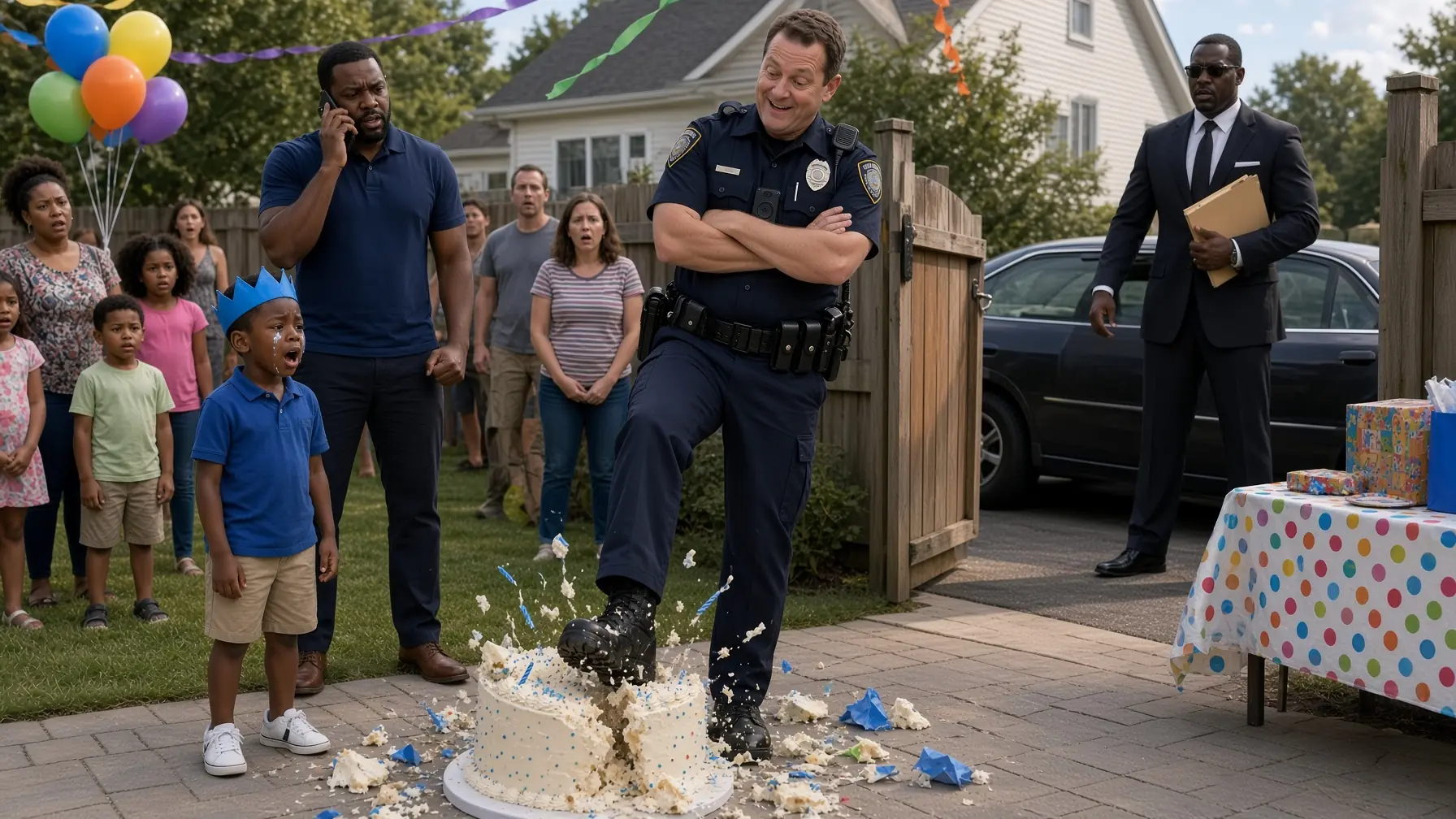
His eight-year-old son, Caleb, stood beside the table wearing the blue paper crown he had refused to take off all afternoon. The boy stared at the crushed cake with both hands hanging beside his shorts, his mouth slightly open, as if his mind had not yet decided whether what he had seen was real. Behind him, children wearing matching birthday hats stopped chasing one another through the yard, and several slowly moved toward their parents. Nobody screamed.
Marcus had been standing near the grill when Caldwell knocked the cake from the table. He saw his wife Renee cover her mouth with one hand, saw his seventy-four-year-old neighbor Samuel Greene lower the barbecue tongs he was holding, and saw Caleb’s best friend Jamal take two frightened steps backward. Every instinct in Marcus’s body told him to cross the yard quickly. Instead, he looked at his son first.
Caleb’s eyes filled. He rubbed them with both fists and whispered, “Dad?” Marcus walked toward him slowly.
Caldwell turned immediately. “Stay where you are.” Marcus stopped.
The officer’s right hand rested near his duty belt. Marcus could see the body camera fixed at the center of Caldwell’s chest, its red indicator still illuminated, and that small light became the most important object in the backyard. He raised both hands slightly. “I’m going to my son.”
“I said stay back.” Caldwell’s voice became louder.
Marcus looked at Caleb. “Come to me, buddy.” The boy hesitated, then ran the five steps separating them.
Marcus knelt when Caleb reached him. His son buried his face against Marcus’s shoulder, the paper crown bending beneath Marcus’s chin. “He ruined it,” Caleb whispered. The words were quiet enough that only Marcus and Renee heard them clearly.
Marcus closed his eyes for one second. The cake had taken Renee almost five hours to decorate because Caleb had asked for a blue-and-white space theme with tiny sugar planets around the edge. Marcus had complained that spending an entire Saturday morning decorating something children would destroy in six minutes made no sense. Renee had told him that was how birthdays worked.
Now the cake was destroyed before anyone had sung. Marcus felt Caleb’s shoulders shake once, and anger rose through him with such force that his hands began trembling. He pressed one palm between the boy’s shoulder blades and waited until he trusted his own voice.
“Are you hurt?” Marcus asked. Caleb shook his head.
“I just wanted my cake.” Marcus looked toward the crushed frosting beneath Caldwell’s boot.
“I know.” Caleb wiped his face.
Around them, approximately twenty adults and fifteen children remained frozen across the backyard. Several guests had phones in their hands now, though Marcus could not tell who had begun recording before the cake fell. Caldwell looked around at the gathering as if he expected someone to challenge him. Nobody did.
Marcus stood. Renee stepped beside Caleb and drew their son against her hip.
Caldwell removed his boot from the ruined cake. “Everybody needs to stay where I can see them until I finish figuring out what’s going on.” Marcus looked toward him.
“What exactly are you figuring out?” Caldwell’s eyes hardened.
“You want to keep pushing me?” Marcus shook his head.
“No.” His voice remained level.
“I want to understand why you came into my backyard and destroyed my son’s birthday cake.”
Caldwell pointed toward the side gate. “We received a complaint.” Marcus waited.
“A complaint about what?” Caldwell glanced toward several coolers near the porch.
“Noise, vehicles blocking access, and possible illegal activity.” Marcus looked around the backyard.
The children’s music had been turned off ten minutes earlier when Caldwell arrived. Every adult beverage sat inside one cooler beside the grill, and none of the guests had been fighting, threatening neighbors, or doing anything more suspicious than trying to keep frosting from melting under the late-July sun. Marcus asked, “What illegal activity?”
Caldwell did not answer directly. “You people always want to debate everything.”
The phrase landed differently than the rest. Samuel Greene’s face tightened near the grill. Marcus’s older sister Denise, standing beside the patio door, quietly raised her phone higher.
Marcus noticed. So did Caldwell.
“Put the phones down,” Caldwell said. Denise replied, “I’m standing in my brother’s yard.”
“I said put it down.” Marcus spoke before Denise could answer.
“She can record.” Caldwell looked toward him.
“You’re an attorney now?” Marcus shook his head.
“No.” He paused.
“But she can record.”
Caldwell took one step toward him. Renee tightened her arms around Caleb.
Marcus had been trying to understand the officer’s behavior since Caldwell first appeared at the open side gate twenty minutes earlier. Now another thought began moving through his mind, something attached to the officer’s name. Ryan Caldwell.
He had heard that name before. Not on television.
Not in a newspaper. Somewhere closer.
Marcus did not yet know why it mattered.
Three hours earlier, the backyard had looked entirely different. Blue streamers hung between two maple trees, foil stars swayed from the porch railing, and a rented inflatable rocket ship occupied one corner of the lawn. Caleb had spent the morning racing from window to window asking when his friends would arrive. Renee eventually sent him upstairs to put on socks simply because she needed five uninterrupted minutes.
Marcus stood over the grill in a faded Howard University T-shirt while Samuel Greene argued that charcoal would have produced better burgers. Samuel had lived next door since Marcus and Renee bought the house nine years earlier and had complained about the gas grill every summer since. Marcus responded with the same answer he always used. “Charcoal is a hobby for retired men with nowhere to be.”
Samuel lifted the tongs. “Flavor requires patience.” Marcus pointed toward the hot dogs.
“Eight-year-olds require food.”
Their families had shared holidays, snow shovels, hospital rides, lawn equipment, and countless afternoons watching children cross between yards without knocking. Samuel’s wife had died five years earlier, and the Bennetts gradually became the people who checked whether he needed groceries after storms. He considered Caleb another grandson. Caleb considered Samuel the man who knew how to fix almost anything except Wi-Fi.
Renee carried the cake from the kitchen shortly before two. Everyone cheered when she placed it on the patio table, and Caleb immediately tried to touch one of the sugar planets.
“Do not,” Renee warned. Caleb withdrew his hand.
“I was checking it.” Marcus laughed.
“Checking what?” Caleb answered, “Quality.”
Renee looked at her husband. “Your child.” Marcus shook his head.
“Your vocabulary.”
Caleb’s party had been planned for three months. The previous year, severe thunderstorms canceled the outdoor celebration, so Marcus promised this birthday would be memorable. They rented the bounce house, ordered pizza for the children, invited classmates and cousins, and told neighbors to come over even if they had no interest in an eight-year-old’s birthday.
By 2:15, nearly forty people had passed through the yard. Cars lined both sides of Hawthorne Drive, but Marcus had walked the block before guests arrived and placed orange cones near the fire hydrant and the elderly Wilsons’ driveway so nobody blocked access. He had learned through years of homeownership that parties became much easier when neighbors had nothing legitimate to complain about. What he had not anticipated was an anonymous caller claiming a silver sedan partially obstructed the road near the corner.
The complaint went to county dispatch at 2:21. The caller also complained about loud music and said “people were coming and going constantly,” a description that could apply to nearly every children’s birthday party in America. When the dispatcher asked whether anyone was fighting or threatening people, the caller said no. When asked about weapons, the caller said, “I don’t know what they have back there.”
Officer Ryan Caldwell heard the call while finishing paperwork three streets away. He volunteered to respond.
Caldwell had been with the Pine Valley Police Department for eleven years. He was thirty-eight, physically fit, highly active in traffic and narcotics enforcement, and known among several supervisors as an officer who “did not wait for trouble to introduce itself.” During annual reviews, that tendency usually appeared under the phrase proactive policing.
His arrest numbers were consistently high. So were his citizen contacts.
Caldwell considered both statistics evidence that he worked harder than officers who spent half their shifts answering calls and avoiding discretionary stops. He had recovered illegal weapons, located stolen cars, and once identified a wanted fugitive during what began as a parking complaint. Those successes reinforced an instinct he rarely examined. Sometimes the ordinary explanation really was hiding something.
That instinct had also generated complaints. Most disappeared into the slow administrative machinery of the department. One involved a nineteen-year-old Black college student whose backpack Caldwell searched after the young man refused to leave a public basketball court after dark.
Another involved a Latino father Caldwell detained outside his own apartment because the man could not immediately produce a lease showing he lived there. A third involved two teenagers questioned after leaving a convenience store with hoodies matching a vague shoplifting description. Nothing illegal was found in any of those incidents.
Caldwell did not think of himself as biased. He thought of himself as suspicious by profession. When people challenged his assumptions, he often believed the challenge proved the assumption deserved more attention.
Three months before Caleb’s birthday, one of those incidents brought Marcus Bennett into contact with Lieutenant Dana Harper from the Professional Standards Unit. Marcus had not been the complainant. He had been a witness.
His nephew Jordan was seventeen and played varsity basketball. One Friday evening, Marcus had arrived at a public recreation center to pick him up and found Caldwell questioning Jordan and two teammates beside a patrol car. The officer claimed someone reported teenagers looking into parked vehicles.
Jordan said they had been waiting for Marcus. Caldwell asked to search their backpacks.
The boys refused. Caldwell threatened to detain them until a supervisor arrived.
Marcus reached the scene before anything escalated. He asked Caldwell what crime the boys were suspected of committing. Caldwell responded that the questions were part of an investigation.
Marcus asked whether there had been an actual theft. Caldwell told him to stay out of police business.
Eventually another officer arrived, confirmed no vehicle had been reported broken into, and the boys were released. Jordan’s mother filed a complaint. Marcus gave a witness statement.
Lieutenant Dana Harper interviewed him two weeks later. She was forty-six, had served twenty-two years with Pine Valley, and had recently transferred into Professional Standards after spending most of her career in investigations. Harper did not promise outcomes.
She asked precise questions. She asked what Marcus saw, what he heard, which statements he remembered exactly, and which impressions were merely interpretations.
Marcus respected that. When the interview ended, Harper gave him her card.
“If anything else directly related to Officer Caldwell occurs involving you or the boys while this review remains open, call the main Professional Standards number.” She wrote an extension on the back.
Marcus placed the card in his wallet. He assumed he would never use it.
The Jordan complaint remained unresolved because investigators discovered two older files involving Caldwell that required review. Marcus knew none of those details. All he knew was the name.
Ryan Caldwell.
That was why, standing beside his son’s destroyed birthday cake, the memory finally returned. Marcus looked at the nameplate on the officer’s uniform.
CALDWELL.
Something inside him became very still.
The encounter had begun innocently enough. Caldwell parked beside the house at 2:34 and walked toward the front yard.
Marcus noticed the patrol car while carrying hamburger buns outside. He set them down and met Caldwell near the driveway.
“Afternoon, officer.” Caldwell looked toward the line of cars.
“You hosting this?”
“My son’s birthday.” Caldwell asked whose silver sedan sat near the corner.
Marcus said it belonged to one of the guests and offered to have it moved. Caldwell said the rear bumper appeared too close to an intersection.
“Okay,” Marcus answered. “I’ll move it.”
That should have resolved the parking concern.
Caldwell then mentioned the noise complaint. Marcus said they would lower the music.
He walked to the speaker and turned it down before Caldwell even finished. Several adults noticed the officer but continued talking.
Then Caldwell remained.
He looked toward the backyard through the open side gate. “How many people back there?”
Marcus said he had not counted. Caldwell asked whether alcohol was being served.
“To adults, yes.”
“Any marijuana?” Marcus frowned.
“No.”
“Weapons?” “No.”
Caldwell looked past him. “Mind if I take a look?”
Marcus responded automatically. “At what?”
“The party.” Marcus stared.
“You can see the yard from here.”
Caldwell’s face changed. “You refusing to let me check?”
Marcus felt the first flicker of concern. “I’m asking what you’re checking for.”
Caldwell told him the department had received reports of possible illegal activity. Marcus asked whether the caller described anything specific.
Caldwell said, “They don’t have to give me a full criminal case before I investigate.”
Marcus kept his voice level. “I understand.”
He did not, but escalation would help no one.
Renee appeared behind him. “Everything okay?”
Marcus nodded without looking away from Caldwell. “Someone needs to move the silver car.”
Renee immediately called toward the backyard. A parent named Michael Harris raised his hand and walked toward the driveway with his keys.
Michael moved the car thirty feet down the block. Caldwell watched.
“There.” Marcus gestured toward the cleared corner.
“Anything else?” Caldwell looked toward the side gate.
“I want to speak to the adults inside.”
Marcus answered, “About what?”
“Why are you making everything a problem?” Caldwell asked.
Marcus felt heat rise behind his neck. “I moved the car.”
He pointed toward the speaker. “We lowered the music.”
Then he looked toward the backyard. “I’m asking what issue remains.”
Caldwell stepped closer. “Sometimes people who ask the most questions are the ones trying hardest to control what I see.”
Marcus almost laughed from disbelief. He chose silence instead.
The officer took that silence as permission to walk past him.
“Officer.” Marcus turned.
Caldwell entered the side gate.
Several guests noticed immediately. The children did not.
Caleb and Jamal were throwing foam rockets near the bounce house. Two mothers sat at a patio table discussing school uniforms.
Samuel tended the grill. Nothing about the yard suggested danger.
Caldwell walked slowly through the gathering. “Everybody relax.”
Nobody had been visibly unrelaxed until he said it.
Marcus followed at a reasonable distance. “Are we being detained?”
Caldwell turned. “You need to stop with the lawyer talk.”
“I asked a question.” Marcus stopped several feet away.
“Am I being detained?”
Caldwell said, “I’m investigating a complaint.”
Marcus tried again. “Am I free to ask you to leave my property?”
The officer’s jaw tightened. “You’re free to stop interfering.”
Renee moved beside her husband. “Marcus.”
He looked at her.
The single word meant Caleb is watching.
Marcus exhaled. “Okay.”
Caldwell continued across the yard.
He opened the lid of a cooler. Beer, soda, juice boxes, and bottled water sat inside.
“Whose?” he asked.
Marcus answered, “Ours.”
“Everyone drinking is over twenty-one?” Marcus replied, “Yes.”
Caldwell looked toward three men near the fence. “How do you know?”
Marcus almost responded sarcastically. Renee touched his wrist.
“They’re our friends and relatives,” she said.
Caldwell shut the cooler.
Then he noticed a second cooler beside the patio table. He opened it.
Ice cream cups.
Nothing else.
A few children had stopped playing. Caleb removed his paper crown and held it against his chest.
Marcus saw that and felt another wave of anger.
“Officer Caldwell.” The name came to him now.
The officer turned.
Marcus said, “You’ve checked the coolers.”
He paused. “You found nothing.”
Caldwell’s eyes narrowed slightly at hearing his name. “I haven’t finished.”
“With what?”
Caldwell looked toward several gift bags under a folding table. “Those yours?”
“They’re birthday gifts.”
The officer crouched.
Marcus moved one step closer. “No.”
Caldwell turned his head. “No?”
“You’re not searching my son’s birthday presents.”
Caldwell stood.
“Then maybe you should explain why you’re so worried about me looking.”
Renee whispered, “Oh my God.”
Marcus stared at the officer. “Because they are presents for an eight-year-old.”
Caldwell stepped toward him. “Back up.”
Marcus did.
His compliance seemed to make no difference.
Caldwell reached down and picked up the first gift bag. A toy astronomy book sat inside with tissue paper.
He put it down.
The next contained a basketball.
The third held a boxed remote-control car.
Caldwell opened the box.
One of the children said, “That’s mine.”
His mother immediately pulled him closer.
Marcus’s voice became harder. “Officer, stop.”
Caldwell looked up.
“Do not order me around.”
“I am asking you to stop opening children’s presents.”
Caldwell stood slowly.
“Maybe if everyone cooperated instead of hovering over me, this would go faster.”
Samuel Greene finally spoke from beside the grill. “Son, there is nothing here.”
Caldwell looked toward the elderly man.
“Did I ask you?”
Samuel’s expression changed. Marcus raised one hand toward him.
“Mr. Greene, it’s okay.”
Samuel hated being told that because nothing was okay. Still, he stepped back.
Caldwell searched another bag. He found a superhero T-shirt.
He looked beneath the gift table. Nothing.
Then he walked toward the cake.
Renee’s entire posture changed. “Don’t touch that.”
Caldwell turned.
Renee pointed toward the table. “That is my son’s cake.”
The officer looked at the large clear plastic container.
“I can see that.”
“Then leave it alone.”
Caldwell glanced toward Marcus. “Your wife always tell officers what they can touch?”
Marcus answered, “She tells people not to destroy things she spent five hours making.”
Caleb had come closer now. His blue crown was back on his head.
“Mom?” Renee looked toward him.
“Go play, baby.”
Caleb did not move.
Caldwell lifted the plastic cake container slightly.
Renee stepped forward. “Put it down.”
The officer’s head snapped toward her. “Back up.”
Marcus moved between them immediately, hands open.
“Everybody is backing up.”
He looked toward Caldwell. “Just put the cake down.”
For one moment, Caldwell did.
Marcus thought the situation had reached the edge and returned.
Then the officer noticed a rectangular storage bin beneath the cake table. “What’s inside that?”
“Decorations.” Marcus answered.
“Move the cake.”
Marcus replied, “I’ll move it.”
He stepped forward.
Caldwell raised one hand. “Stay back.”
Marcus froze.
“I’m telling you I’ll move it so you don’t damage it.”
“I don’t need you touching anything while I’m checking.”
Caldwell lifted the cake himself.
The box tilted. Renee gasped.
“Careful.”
Caldwell looked toward her.
Something in his expression changed.
Marcus would replay that moment dozens of times later. He never decided whether Caldwell intentionally chose cruelty in advance or whether irritation simply overrode restraint.
The officer set the cake near the table edge. Then he pulled the storage bin outward with one foot.
The cake wobbled.
Renee said, “Please.”
Caldwell shoved the bin harder. Its corner hit the folding table leg.
The cake slid.
Marcus moved instinctively.
Caldwell snapped, “Stay back.”
The box hit the grass, bounced onto the patio, and the lid cracked.
Caleb screamed, “My cake!”
He ran forward.
Caldwell stepped between the boy and the box. “Everybody back.”
Caleb stopped.
Then Caldwell looked down at the cake.
Instead of stepping around it, he put his boot directly onto the plastic lid and pressed down.
The box collapsed.
The cake flattened.
A blue sugar planet broke beneath his heel.
That was when the entire backyard stopped breathing.
Caldwell looked up as though he had made a point.
Marcus saw his son’s face.
Nothing else mattered for several seconds.
He walked to Caleb only after making sure the officer understood where he was going. He knelt.
“Are you okay?”
Caleb tried not to cry. “I just wanted my birthday cake.”
Marcus placed one hand behind his neck.
“I know.”
There were moments when parenthood required immediate solutions. A scraped knee needed washing.
A nightmare needed reassurance. A lost toy needed searching.
This was different.
Marcus could not repair the thing Caleb had just watched happen.
He could only decide what his son would watch next.
When Marcus stood again, Caldwell’s body camera was still recording.
So were at least four guest phones.
Marcus looked at the officer’s nameplate.
Ryan Caldwell.
The recreation-center incident returned to him fully.
Lieutenant Dana Harper’s card was still in his wallet.
Marcus reached slowly toward his back pocket.
Caldwell’s hand moved toward his belt. “What are you doing?”
“Getting my phone.”
“Slowly.”