The courtroom fell silent the instant Officer Daniel Martinez jabbed one finger across the room and shouted, “This woman is nothing but ghetto trash, Your Honor.” His voice bounced against the high plaster ceiling, carrying all the way to the back row where several reporters stopped typing at the same time. At the defense table, Dr. Kesha Williams did not flinch. She simply looked down at the leather notebook in front of her and wrote one line beneath the previous three.
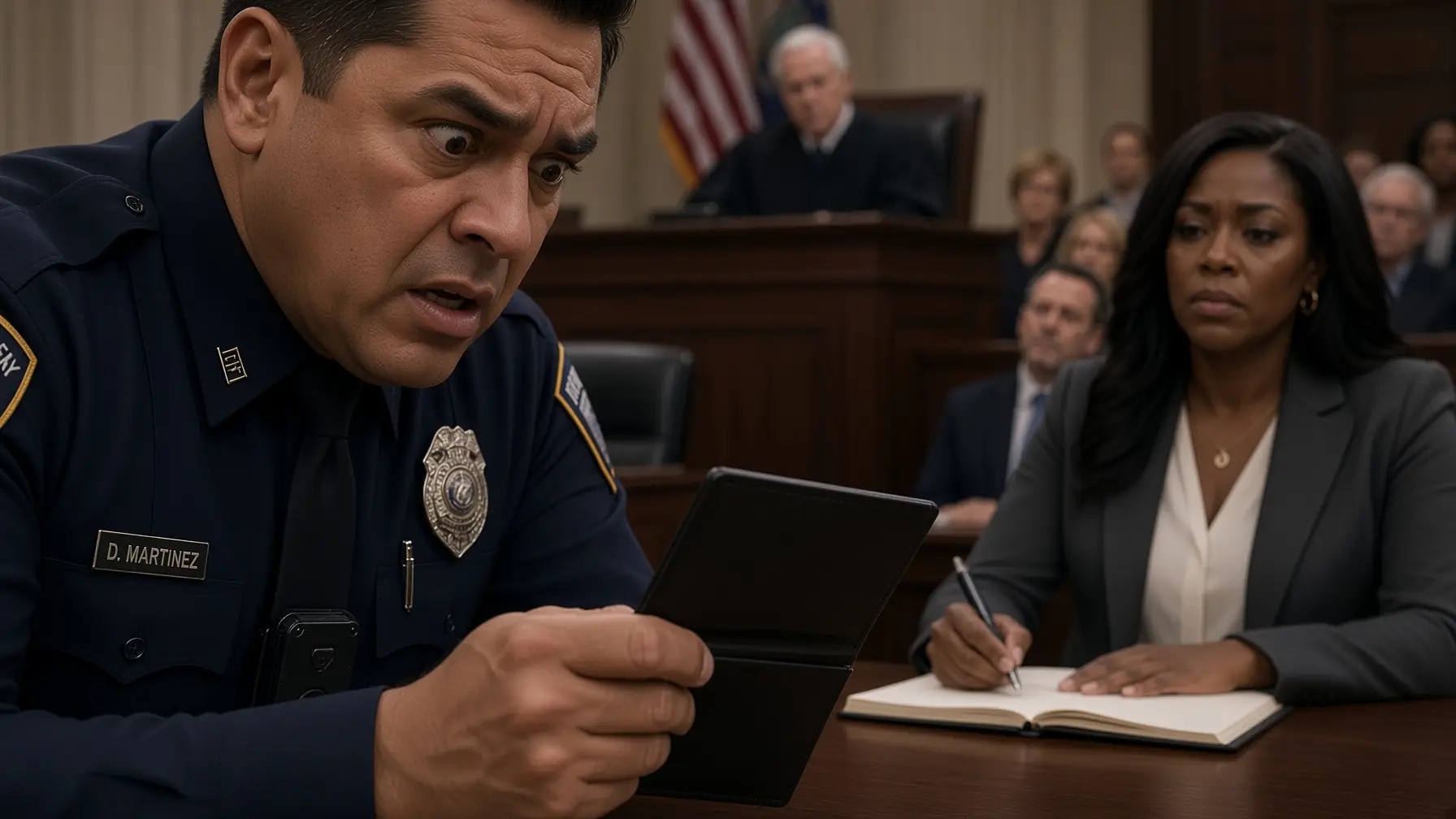
Judge Nathaniel Harrison slowly removed his reading glasses. He had spent twenty-eight years on the bench and had learned that people often revealed more about themselves after believing they had already won. “Officer Martinez,” he said, “you will answer questions about alleged conduct, not offer your personal characterization of the defendant.” Martinez gave a stiff nod, but the confidence remained in his face.
Assistant District Attorney Benjamin Cole stood beside the witness stand with one hand resting on the wooden rail. He had expected Martinez to be forceful, perhaps even angry, because the officer claimed Kesha had threatened his life during a late-night traffic stop six months earlier. Cole had not expected the insult. Still, he believed the underlying testimony remained devastating.
“She pulled a firearm during a lawful traffic stop,” Martinez said when Cole continued. “She screamed racial insults at me, threatened my wife and children, and told me nobody would touch her because she had gang connections.” He looked toward the gallery before adding, “She acted like the law did not apply to her.” Kesha wrote another sentence.
Her attorney, Aaron Pike, sat beside her without moving. Aaron was fifty-one, gray beginning to spread through his beard, and possessed the unnerving patience of a lawyer who rarely asked a question until he already knew at least two possible answers. He had not objected to Martinez’s insult because Judge Harrison had handled it immediately. More important, Aaron wanted the officer talking.
Martinez had been talking for forty-three minutes. He described a black sedan drifting across a lane near Eastwood Avenue, Kesha refusing repeated commands, her hand disappearing beneath the driver’s seat, and the sudden appearance of what he called a compact semiautomatic pistol. He claimed he drew his own weapon only after seeing hers. Then he told the court she tried to negotiate by threatening to “send people” after him.
The charges against Kesha were serious. Aggravated assault on a law-enforcement officer, unlawful firearm possession, obstruction, resisting, and making criminal threats had all survived the initial charging stage because Martinez’s report described an encounter that, if true, made her look extraordinarily dangerous. The gun recovered from the car appeared on the original evidence sheet. So did a small plastic bag containing pills later identified as a controlled prescription medication without a labeled bottle.
There was one major problem. Kesha had maintained from the beginning that neither item belonged to her. She also insisted she had never threatened Martinez, never reached beneath her seat, never used a racial slur, and never physically resisted anything.
Most defendants made some version of that claim. That was how the local prosecutor initially viewed it. Officer Martinez had fifteen years of service, six commendations, dozens of felony arrests, and a reputation for confident testimony.
Dr. Kesha Williams, by contrast, appeared in the charging file as a forty-four-year-old Washington resident driving a rented sedan at 11:47 p.m. through a neighborhood known for narcotics enforcement. Her occupation line had been left strangely vague on the original booking sheet. She listed only “federal consultant.” The phrase sounded important without explaining anything.
Martinez had treated it as a joke. “Everybody’s a consultant when they get caught,” he said on one portion of recorded booking-room audio. The comment had not been included in his report. Kesha’s lawyer knew about it.
Judge Harrison’s courtroom was packed because the morning’s proceeding had begun as a suppression and probable-cause hearing but attracted local media after Martinez’s testimony became increasingly explosive. There was no jury deciding guilt that day, despite what later viral retellings would claim. The judge was determining whether evidence could be used, whether the traffic stop had been lawfully extended, and whether enough reliable evidence remained for the prosecution to continue. What happened over the next two hours would change far more than Kesha’s case.
Martinez sat taller when Cole asked about Kesha’s behavior. “Combative from the start,” he said. “She challenged everything, questioned every command, and kept telling me I had no idea who I was dealing with.” Kesha’s pen stopped for half a second.
Aaron noticed. He leaned slightly toward her.
“You okay?” he whispered. Kesha nodded.
“He changed it again.”
Aaron looked at the notebook. “Which part?”
“The exact wording.” Kesha underlined something.
“He used ‘who I was dealing with’ this time.” Aaron nodded.
Earlier reports quoted her as saying, You don’t know who my people are. In a later internal interview, Martinez said she told him, You have no idea who you’re messing with. Now the phrase had shifted again.
Small changes did not automatically prove lying. Human memory was imperfect, especially under stress. Kesha had spent enough of her career investigating witnesses to know that.
Patterns were different. A witness whose details became more dramatic each time deserved examination.
Martinez described seeing the pistol after Kesha “lunged toward the floorboard.” Aaron quietly turned one page in his binder. Kesha watched him place a yellow tab beside a time code.
Cole asked what happened next. Martinez said he ordered Kesha to raise both hands.
“She refused.” His voice became harder.
“I drew my service weapon and ordered her out.” He looked toward Kesha.
“She called me a racist pig and said she had people who could bury me.” Several spectators shifted uncomfortably.
Kesha wrote the words exactly. She did not look offended. That unnerved Martinez.
He expected anger. He had built his courtroom career partly around provoking it.
For fifteen years, Daniel Martinez had learned how much credibility came with a uniform, a straight posture, and the language of danger. He knew how to pause before describing fear. He knew how to tell jurors he had gone home and hugged his children differently after a dangerous stop.
Some of those stories were true. Martinez had been assaulted twice during his career and hospitalized once after a drunk driver broke his nose. He had pulled a toddler from a burning apartment before firefighters arrived and talked an armed teenager into putting down a pistol during a domestic call.
Good acts existed in his record. So did something darker.
For years, the good had made supervisors reluctant to look closely at the darker parts. Complaints were treated as the cost of proactive policing. Contradictions became misunderstandings.
Martinez came to believe the pattern himself. If someone complained, that usually meant the person was angry about being caught. If body-camera footage was incomplete, that meant technology failed.
If a report contained a small inconsistency, that meant memory under stress. Every explanation was possible.
Eventually, possible became enough.
Kesha had entered his world eighteen months before the courtroom hearing without him ever noticing. She was not originally assigned to Martinez personally. She was part of a joint federal civil-rights task force reviewing allegations of unconstitutional stops, evidence manipulation, and false reporting inside the Eastwood Police Department.
The investigation began with statistics. One public defender noticed that evidence recovered by Martinez’s unit survived suppression challenges at an unusual rate despite an unusual number of citizen complaints. Another attorney noticed body-camera gaps clustering around disputed searches.
Neither fact proved corruption. Together they justified questions.
The first federal review examined ninety-one complaints filed against seven officers over five years. Most were ordinary allegations that could not be substantiated. Some were contradicted by video.
Others had never been meaningfully investigated. That was the problem.
One complaint came from a twenty-two-year-old college student named Andre Lewis. Martinez stopped Andre for a broken taillight and reported smelling marijuana. A search produced six prescription pain pills inside a plastic bag under the passenger seat.
Andre insisted the pills were not his. His mother filed a complaint.
Internal Affairs closed it after Martinez stated he saw Andre “making furtive movements” toward the seat before the search. The body camera began after Andre was already outside. Nobody recovered the patrol-car footage because it had overwritten automatically after thirty days.
Another complaint involved a sixty-one-year-old church deacon named Harold Brooks. Martinez reported finding a small handgun beneath a floor mat during a traffic stop. Brooks claimed the weapon was planted.
The gun had no usable prints. Brooks eventually accepted a plea because his attorney warned that a decorated officer’s testimony would likely defeat him at trial.
He lost his job driving a school bus.
A third complaint came from Rosa Delgado, a home-health nurse whose car was searched after she declined consent. Martinez wrote that Rosa “voluntarily opened the trunk.” Her teenage daughter had recorded the encounter from the passenger seat.
The video showed Rosa saying, “No, you cannot search my car.” Martinez opened the trunk anyway.
That video changed the federal review. A single disputed complaint became a documented contradiction.
Investigators began looking backward.
Dr. Kesha Williams entered the case because she specialized in systems, not because anyone needed an undercover superhero. She held a doctorate in criminology before attending law school, spent seven years working on police-accountability research, and later joined the Justice Department as a senior civil-rights investigator assigned to complex institutional cases. Her job involved patterns.
She disliked stories built around one monstrous officer because institutions rarely failed that neatly. A dishonest officer required supervisors who failed to catch dishonesty, prosecutors who stopped asking questions, evidence systems that tolerated gaps, or coworkers who learned silence was easier. The federal team wanted to know whether Martinez was an isolated problem or the visible edge of something larger.
Kesha’s traffic stop was part of that investigation, but not in the theatrical way reporters later described. Federal agents did not send her out hoping Martinez would commit a crime. She traveled through patrol areas while carrying controlled recording equipment and driving a vehicle prepared for observation.
The sedan contained discreet cameras covering the interior, exterior sides, and rear window. The equipment existed to document what happened if officers initiated contact. Kesha was instructed to obey lawful safety commands, decline voluntary searches, avoid provocation, and identify herself if circumstances became physically unsafe beyond the operational plan.
Nobody told Martinez to stop her. No dispatcher steered him toward her.
He chose the car himself.
Six months before the hearing, Kesha left a late federal briefing at 11:22 p.m. She wore black trousers, a cream blouse, flat shoes, and a dark jacket that concealed a small recording transmitter clipped near her waistband. Her government credential remained inside a sealed compartment in her handbag.
The vehicle was legally registered to a federal leasing contractor under documentation designed to survive routine database checks without revealing the operation. Nothing inside the visible passenger compartment indicated law enforcement. The gun used by the federal security team remained locked inside a separate vehicle miles away.
Kesha drove through Eastwood and stopped completely at a red light. Martinez’s cruiser appeared behind her two blocks later.
At first, she assumed coincidence. Then he remained behind her through three turns.
The emergency lights activated after she entered Jefferson Avenue.
Kesha signaled immediately and pulled into a well-lit gas station. She shifted into park, lowered the driver’s window halfway, placed both hands on the steering wheel, and waited.
The hidden camera recorded everything.
Martinez approached the driver’s side with his flashlight already raised. “License.”
Kesha looked toward him. “Good evening, Officer.”
“License and registration.”
She provided both.
Martinez studied the license. “Washington.”
“Yes.”
“What are you doing here?”
“Work.”
“What kind?”
“Consulting.”
Martinez looked through the window. “Consulting at midnight?”
Kesha answered, “My meeting ran late.”
The statement was true enough to satisfy operational guidelines. Martinez handed neither document back.
“You drinking?”
“No.”
“Drugs in the car?”
“No.”
“Weapons?”
“No.”
Martinez shone his flashlight across the passenger seat.
“What’s in the bag?”
“Work material.”
“Open it.”
Kesha looked at him. “Are you asking for consent to search it?”
Martinez’s face changed.
“I’m telling you to open it.”
Kesha kept both hands visible. “I do not consent to a search.”
That should have been an ordinary sentence. It became the turning point.
Martinez leaned closer. “People with nothing to hide usually don’t care.”
Kesha replied, “I’m still not consenting.”
He asked her to step out.
Kesha complied.
The exterior camera captured her moving slowly, closing the door, and standing where instructed. Martinez told her to place both hands on the roof.
She did.
He frisked her. Nothing.
“What exactly am I being detained for?” Kesha asked.
Martinez said, “Suspicious driving.”
“What driving behavior?”
He answered, “You drifted across the lane.”
The vehicle’s recording system showed no lane departure. That fact would matter later.
Kesha did not argue.
Martinez called for backup. Another officer named Lucas Trent arrived seven minutes later.
Trent stood near Kesha while Martinez returned to the driver’s side. Kesha said, “I do not consent to any search of the vehicle.”
Martinez looked back. “Nobody asked you.”
Then he opened the door.
Kesha’s pulse accelerated. The microphone captured her breathing.
She did not reveal her identity because the operation allowed observation of nonviolent search conduct if safety remained manageable. Federal monitoring agents were less than five minutes away if intervention became necessary.
Martinez leaned inside the car.
He searched the front console. Nothing.
He checked the glove compartment. Nothing.
He looked beneath the passenger seat.
Nothing.
Then he moved toward the driver’s seat.
The hidden camera beneath the rearview housing caught an angle his body camera did not. Martinez’s right hand disappeared near the lower pocket of his vest.
When it returned, a small dark object was between his fingers.
He crouched.
His body blocked part of the view for two seconds.
Then he stood holding a compact pistol wrapped near the grip in a black cloth.
“Gun!” he shouted.
Officer Trent’s hand went to his holster.
Kesha remained completely still.
“That is not mine.”
Martinez turned toward her. “Get on your knees.”
Kesha obeyed.
“You lied to me.”
“That weapon is not mine.”
Martinez walked closer.
“You said no guns.”
“There were no guns in the car when you opened it.”
His face tightened.
“You calling me a liar?”
Kesha looked directly at him.
“I’m telling you that weapon was not in my vehicle.”
Trent told her to stay quiet.
Martinez returned to the car.
Two minutes later, he announced he had found prescription pills beneath the seat.
Kesha knew then that the operation had moved beyond anything the federal team expected.
The monitoring supervisor authorized continued observation only long enough to preserve safety and avoid compromising other targets before backup coordination was complete. Kesha was handcuffed.
She did not resist.
Martinez later reported that she “pulled away violently” and tried to kick him.
The camera showed her standing still.
The report said she screamed racial slurs.
The recording contained none.
The report said she threatened his family.
She never asked whether he had one.
The report said she admitted gang connections.
The only reference to gangs occurred when Martinez asked, “You running with people here?”
Kesha answered, “No.”
The federal team faced a difficult decision. They could immediately identify Kesha, seize control of the scene, and expose eighteen months of investigative work.
Or they could preserve the larger operation while ensuring she remained legally protected.
They chose the second option under procedures prepared in advance.
Kesha was booked under her real name because the operation had not depended on a false identity. A federal liaison quietly notified a restricted supervisory channel at the county prosecutor’s office that the defendant was connected to a sensitive federal matter and that evidence preservation was mandatory.
The local prosecutor handling ordinary charging decisions was not told the full reason.
That secrecy later produced criticism.
Some argued no investigation justified allowing false charges against a federal official to remain active for months. Kesha herself wrestled with that.
The Department’s answer was that the charges were monitored, her release was secured immediately, no plea negotiations would occur without federal approval, and disclosure would happen before any criminal trial.
The hearing before Judge Harrison was where that disclosure was scheduled.
Only the judge had received a sealed filing twenty-four hours earlier explaining that federal evidence relevant to probable cause would be presented. He had not been told every detail.
Assistant District Attorney Cole knew there was sealed material. He did not know what it contained.
Martinez knew nothing.
That was why he spoke so freely.
Back in the courtroom, Aaron Pike closed the final page of his notes as Martinez finished describing Kesha’s supposed threats. Cole asked whether Martinez had any doubt she represented a danger that night.
“None,” Martinez said.
“None at all?”
“None.”
Cole nodded. “No further questions.”
Aaron stood.
He buttoned his jacket and approached the lectern.
Martinez smiled.
Aaron began gently. “Officer Martinez, you testified that Dr. Williams crossed the lane before you stopped her.”
“Yes.”
“How far?”
“Several feet.”
“For how long?”
Martinez shrugged.
“Long enough to be unsafe.”
Aaron looked at his binder. “Your original report says one foot.”
Martinez shifted.
“It was an estimate.”
“Your supplemental statement says approximately two feet.”
“Also an estimate.”
“Today you said several feet.”
Martinez looked toward the judge.
“Road conditions happen quickly.”
Aaron nodded.
“Of course.”
He moved on.
“You testified she appeared extremely nervous.”
“Yes.”
“How?”
“Rapid breathing, avoiding eye contact, stiff posture.”
Aaron lifted a page.
“Your report says she appeared unusually calm.”
Martinez’s expression changed.
“People can go back and forth.”
“So nervousness was suspicious?”
“Yes.”
“And calmness was suspicious?”
Martinez paused.
“Depending on context.”
Aaron nodded.
“Understood.”
Kesha watched Martinez’s face.
He was beginning to realize the questions were not random.
Aaron asked whether Kesha produced a valid license. Martinez said yes.
“Registration valid?”
“Yes.”
“Outstanding warrants?”
“No.”
“Vehicle stolen?”
“No.”
“Contraband visible from outside?”
“No.”
“Odor of marijuana?”
Martinez hesitated.
“I thought I smelled something.”
Aaron looked toward the original report.
“You did not document an odor.”
“It was faint.”
“Did you mention it to Officer Trent?”
“I don’t remember.”
“Did you mention it on radio?”
“No.”
Aaron nodded.
“Did you tell Dr. Williams you smelled marijuana before entering her vehicle?”
“No.”
The courtroom became quieter.
Cole stood. “Your Honor, counsel is suggesting absence from the report proves absence in reality.”
Judge Harrison looked toward Aaron.
“Foundation will matter.”
Aaron nodded.
“It will.”
He continued.
“Dr. Williams refused consent, correct?”
“Yes.”
“More than once?”
“Yes.”
“Did that make you suspicious?”
“It contributed.”
Aaron stopped.
“Her refusal to consent contributed to your belief that she was engaged in crime?”
Martinez realized the problem too late.
“In context.”
Aaron walked closer to the lectern.
“Which crime does refusing a search indicate?”
Martinez frowned.
“That’s not what I said.”
Aaron looked at the transcript monitor.
“It is almost exactly what you said.”
Cole objected.
Judge Harrison sustained the objection to tone.
Aaron immediately rephrased.
“What independent fact did the refusal reveal?”
Martinez said, “It showed she was worried about what I might find.”
Kesha’s pen moved.
Aaron looked toward Judge Harrison.
“No further clarification needed on that point.”
He shifted to the firearm.
“You found the gun beneath the driver’s seat?”
“Yes.”
“Exact location?”
“Toward the rear mounting rail.”
“You reached beneath the seat?”
“Yes.”
“With which hand?”
“My right.”
Aaron picked up a photograph.
“Your body camera shows your left shoulder against the doorframe.”
Martinez said, “I move during searches.”
“Of course.”
Aaron displayed another still.
“Is that your right hand near your vest pocket?”
Martinez stared.
“I can’t tell.”
Aaron nodded.
“Neither can we from this camera.”
Martinez relaxed slightly.
Aaron turned toward the clerk.
“Your Honor, defense requests permission to approach the matter referenced in yesterday’s sealed filing.”
Cole stood immediately.
“Judge, the state still has not been provided the underlying material.”
Judge Harrison looked toward both lawyers.
“I reviewed the authorization this morning.”
Cole’s face tightened.