For thirty years, the old oak beside Saint Bartholomew’s Church carried a swelling so large that strangers stopped on the sidewalk just to stare at it. It grew from the eastern side of the trunk like a heavy wooden shoulder, round, thick, and unnatural, as if the tree had swallowed something and spent decades trying to hide it. Children in town called it the sleeping giant’s heart, old men at the diner called it a disease, and church officials called it a danger waiting for the next storm. But Father Gabriel called it a mystery, and for most of his life, that was reason enough to protect it.
Father Gabriel was sixty-seven when the final argument began, though he had first noticed the swelling when he was still a young priest with black hair and quick steps. Back then, it was no bigger than a saddlebag, rough and dark against the gray-brown bark. A groundskeeper suggested cutting it away, but Gabriel had stopped him, not because he understood it, but because something about the tree felt strangely deliberate. The oak stood near the garden fence, older than any living member of the church, and Gabriel believed old things deserved patience before people decided they were useless.
The church garden was small but loved. Trimmed grass surrounded the stone path, white roses grew near the side gate, and a low iron bench sat beneath the oak’s wide branches. Parishioners often rested there after Sunday service, especially in summer, when the leaves made a deep green roof against the sun. The swelling became part of the garden’s identity, a strange landmark that children dared each other to touch and newlyweds included in photographs because it looked too unusual to ignore.
Over the years, the bulge grew slowly but constantly. It thickened through droughts, widened through snowy winters, and stretched outward as if the tree were building a wooden shell around a secret that kept pushing back. Father Gabriel measured it every spring with a tailor’s tape and wrote the number in a small notebook he kept in his desk. He never knew why he did it, only that the swelling seemed to ask for a witness.
Some people laughed at his concern. They said a tree was only a tree, and a deformity in the trunk did not need spiritual attention. Gabriel accepted the teasing with a patient smile, but he did not stop checking the oak. In the quiet hour before morning Mass, he often stood beneath it with coffee cooling in his hand, studying the enormous curve and wondering why it looked less like sickness than protection.
The town of Harrow Falls had many stories, and the oak had gathered more than most. One claimed that a wounded soldier hid treasure inside the trunk during the Civil War and the tree grew around it. Another said the swelling came after lightning struck the churchyard, leaving a living scar in the wood. Children preferred the wildest version, whispering that the oak held a giant bird’s egg that would hatch when the town needed a miracle.
The church records held an older mystery that bothered Gabriel more. In 1893, according to a brittle ledger in the archive room, lightning struck the original bell tower during a violent summer storm. The tower burned, part of the roof collapsed, and the bronze church bell disappeared in the confusion. Search parties looked through the ruins, fields, drainage ditches, and even the nearby creek, but no one found it.
The missing bell was described in beautiful detail. It had been cast in 1868 with a cross and three small lilies engraved near the rim, and the words “Call the weary home” written beneath the maker’s mark. It was said to have a rich, gentle tone that could be heard across the whole valley on clear mornings. When the replacement bell arrived years later, older parishioners still spoke of the first one as if it had been a person lost to the storm.
Gabriel read those records many times. He loved the phrase “Call the weary home” because it felt like the whole purpose of a church reduced to four simple words. Sometimes, while standing beneath the old oak, he imagined the lost bell ringing in 1893, its sound torn from the tower by lightning and wind. He never connected that missing bell to the swelling in the tree, because some ideas are too impossible to enter the mind until the evidence is already shining in front of you.
The year the church council finally forced his hand, storms came early. Harrow Falls endured three weeks of hard wind and rain, the kind that bent street signs and threw branches into yards. During the worst storm, a heavy limb snapped from the oak and struck the corner of the church office, cracking a window and damaging the gutter. The swelling itself had become so large that one arborist warned it was changing the tree’s balance.
At the next council meeting, Father Gabriel sat at the long table while everyone spoke around him as though the oak were already condemned. Evelyn Marks, the council treasurer, placed photographs of the damaged office on the table. “Father, we cannot let sentiment endanger the church,” she said. Another member added that insurance would not be gentle if they ignored a written warning from a tree expert. Gabriel listened with folded hands, knowing they were not entirely wrong.
He asked for one thing: that the tree not be felled completely unless there was no other choice. The arborist suggested cutting into the swelling first to determine whether the trunk could be safely reduced and supported. It was a strange compromise, but the council accepted it because it sounded practical. Gabriel accepted it because it allowed the oak one last chance to reveal whatever it had been carrying all those years.
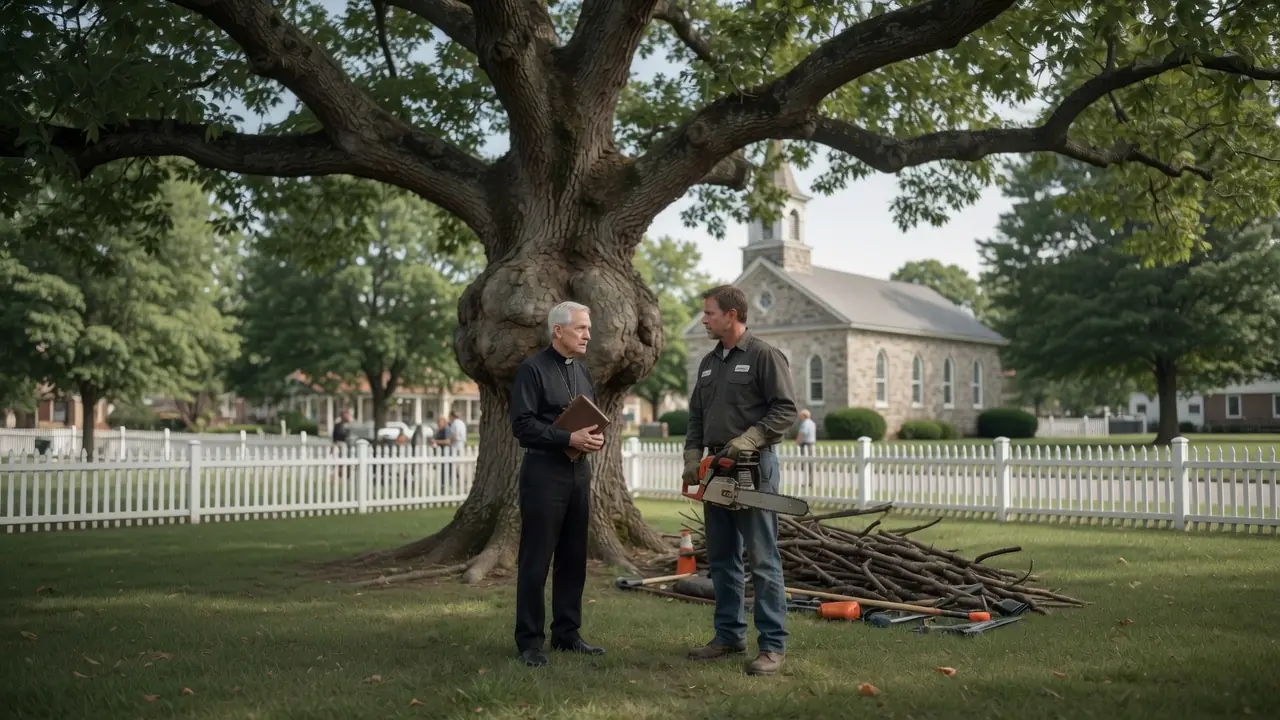
The lead tree worker arrived the next morning just after eight. His name was Martin Hale, a forty-two-year-old man with weathered skin, steady gray eyes, and the careful movements of someone who had learned that trees could be more dangerous than they appeared. He walked around the oak three times before speaking, touching the bark only once. Then he looked at Father Gabriel and said, “I’ve seen burls, cankers, old lightning damage, and trapped fencing. I’ve never seen one quite like this.”
Father Gabriel stood across from him with the old record book tucked under one arm. He had brought it without knowing why, perhaps because the day felt connected to all the other days he had wondered beneath those branches. “Can you save the tree?” he asked. Martin studied the swelling for a long time. “Maybe. But if that mass is hollow or rotted, we need to know before the next windstorm decides for us.”
They set up carefully. Orange safety cones formed a clean perimeter around the garden, cut branches were stacked neatly near the fence, and Martin’s crew checked each tool before work began. A few church staff members watched from the steps, but Father Gabriel stayed closest, far enough to be safe and close enough to witness. The massive bulge looked even stranger under the morning light, its bark stretched and ridged like old knuckles around a buried fist.
The first cut released the smell of green wood and damp age. Martin guided the chainsaw slowly into the outer curve, removing a thick slab while another worker steadied the section with a rope. The inside was not rotten. It was dense, layered, and beautifully ringed, as if the tree had been building wall after wall around its center.
For nearly an hour, the workers cut deeper. Each layer revealed more healthy wood, darker near the core and lighter around the edges. Martin frowned several times, pausing to study the grain, because the rings curved strangely, bending around an invisible shape. “It grew around something,” he said finally, lowering the saw.
Father Gabriel felt the garden become quiet. Even the workers seemed to move more carefully after that. Martin changed tools, using a smaller saw and hand wedges to remove sections without tearing the trunk apart. He had stopped treating the swelling as a tree problem and started treating it as a locked box.
Then the blade struck metal. The sound was sharp and wrong, a hard screech inside living wood that made every person in the garden flinch. Martin shut the saw off immediately and stepped back, his face pale beneath the dust. For a few seconds, nobody spoke.
“What was that?” Father Gabriel asked, though he already knew the answer was not ordinary. Martin crouched near the cut, pulled off one glove, and reached carefully into the opening. His fingers scraped sawdust away from something dark, smooth, and curved. “Father,” he said slowly, “there is metal inside this tree.”
The next hour moved with the strange slowness of moments people remember forever. Martin and his crew removed wood piece by piece, using hand tools now, afraid to damage whatever had slept inside the oak for decades. A curved bronze surface appeared, darkened with age but unmistakably shaped by human hands. Then came a raised ridge, a decorative line, and beneath it, half-buried in packed wood fiber, the edge of an engraved symbol.
Father Gabriel stepped closer with the record book open. His hands trembled so badly that Evelyn Marks, who had come down from the church steps, whispered his name. He turned the brittle pages until he found the description of the missing bell. Cross near the rim. Three lilies. Maker’s mark. Inscription beneath.
Martin brushed away another layer of dust and wood. The cross appeared first, then one lily, then the faint curve of another. Father Gabriel’s breath caught. He did not cry out. He simply lowered one hand to the open page and whispered, “It is the bell.”
Nobody understood at first. Martin looked at him over the opened trunk. “What bell?” Father Gabriel turned the record book toward him, the old ink faded but readable. “The original church bell. It disappeared in 1893 after lightning destroyed the tower.” Martin stared at the bronze, then at the tree, then back at Gabriel. “Father, this thing has been inside the oak for thirty years at least. Maybe longer.”
Gabriel nodded slowly, though his mind was moving beyond thirty years. The records said the bell had vanished more than a century earlier, yet the swelling had only become noticeable three decades ago. Perhaps the tree had held it silently long before anyone saw the shape rising through the bark. Perhaps roots, storms, impact, and time had placed it there in a way no ordinary explanation could fully hold.
The workers pulled back the last heavy section of wood. The bronze bell sat embedded in the trunk cavity, not loose, not placed like a hidden object, but gripped by the oak itself. Wood had grown around the rim, across the crown, into the handle’s broken supports, sealing it in place as if the tree had claimed it and protected it. The inscription was partly visible now: Call the weary home.
Father Gabriel crossed himself. Martin, though not a churchgoing man by his own admission, removed his cap. Evelyn Marks began crying quietly, not loudly or dramatically, just with the stunned emotion of a person who had arrived to approve tree work and found history breathing through sawdust. Someone in the background whispered that the police should be called. Father Gabriel answered before anyone else could decide. “Yes. Call them. No one touches the bell until everything is documented.”
Within an hour, Harrow Falls had gathered at the garden fence. Police officers arrived first, then a county historical preservation official, then a reporter from the local paper who kept saying she had never seen anything like it. Father Gabriel remained near the oak, answering questions as best he could, though most answers were only honest admissions of ignorance. The tree had kept its secret longer than anyone alive had been asking.
The bell was not removed that day. Experts photographed it from every angle, measured the cavity, collected wood samples, and examined the old records. They confirmed the engraving matched descriptions of the missing bell from 1893. They could not confirm how it entered the tree, why no one found it after the tower fire, or how the oak had grown so perfectly around it.
Theories spread faster than facts. Some said the lightning strike blasted the bell from the tower and somehow hurled it toward the oak, where it lodged in a wound that closed around it over the years. Others argued that someone must have hidden the bell after the fire, perhaps to steal it later, but died or vanished before returning. A few believed floodwater or collapse debris might have carried it, though the position inside the trunk made every practical explanation sound slightly foolish.
Father Gabriel did not argue with theories. He had lived long enough to know that people are uncomfortable with unanswered things. They build bridges of explanation over every mystery, even when the bridge does not reach the other side. He only asked that everyone speak with humility, because whether the answer was natural, human, or divine, the bell had survived through a chain of events no one could easily explain.
When the bell was finally removed under supervision, the entire town seemed to hold its breath. Martin and his crew cut away the surrounding wood with extraordinary care, preserving sections of the oak that had grown against the bronze. It took almost a full day. At sunset, the bell was lifted free for the first time in generations, dark, dented, and beautiful.
The sound it made surprised everyone. As workers lowered it onto a padded platform, the rim touched a metal brace and released a low, soft note. It was not loud, not a full ringing, but it carried across the garden with a warmth that made people stop speaking. Father Gabriel closed his eyes, and for one brief second, he imagined every person who had ever heard that bell standing near him in the golden light.
News traveled beyond Harrow Falls. Collectors called. Museums wrote letters. One private buyer offered over two hundred thousand dollars for the bell, arguing that the church could use the money for repairs, outreach, and a better roof. Some council members looked tempted because churches always need money, and practical needs always speak loudly.
Father Gabriel listened to every argument. He understood the roof needed attention, the basement needed waterproofing, and the community pantry always ran short before winter. Still, when the council met again, he placed the old record book on the table beside photographs of the bell inside the oak. “Some things are not given back to be sold,” he said. “This bell was lost from this church, protected by that tree, and returned in our lifetime. We will not put a price tag on it.”
The vote was not unanimous, but it was decisive. The bell would remain church property. It would be restored, displayed, and eventually rehung in a special frame inside the rebuilt garden alcove, where visitors could see it alongside preserved pieces of the oak that had held it. The swelling that once looked like a danger would be remembered as a wooden shelter.
Martin returned several times during the restoration. He never called the discovery a miracle in front of people, but Father Gabriel noticed the way he stood near the bell when he thought no one was watching. One afternoon, the priest found him touching the preserved oak section gently. “Still trying to figure it out?” Gabriel asked.
Martin gave a small laugh. “Trees are supposed to make sense to me.” He looked at the bronze rim and shook his head. “This one doesn’t.” Father Gabriel stood beside him. “Perhaps that is why it was given to us.”
The old oak could not be saved completely. Too much had been cut away, and its balance had been compromised by age, storms, and the removal of the bell. But instead of grinding the stump away, the church preserved the base and planted three young oaks around it. Father Gabriel blessed them on a clear Sunday morning while children from the parish placed their hands in the soil.
The bell was displayed that same day for the first time. Sunlight passed through the garden trees and touched the bronze inscription. Call the weary home. People came forward one by one, some with cameras, some with flowers, some with silence.
An elderly woman named Mrs. Doyle stood longest. Her grandfather had told her stories of the lost bell when she was a little girl, and she had thought he was inventing them. When she saw the inscription, she wept and said, “He was telling the truth.” Father Gabriel realized then that the bell had not only returned as metal. It had returned as proof that old stories sometimes carry more memory than people believe.
The town changed after that, though not in obvious ways. People still argued over parking, budgets, and whose dog kept digging under fences. But the church garden became quieter, more visited, and somehow more respected. Visitors came to see the bell, but many stayed to sit near the stump of the oak that had held it.
Father Gabriel often returned there at dawn. He would stand between the preserved stump and the restored bell, listening to the morning birds and the distant sounds of town waking. He no longer measured the swelling in his notebook because the mystery had opened, though not solved. Instead, he wrote down the names of people who came to the garden carrying grief, gratitude, curiosity, or prayer.
Years earlier, he had believed he was protecting the tree. Now he wondered whether the tree had been protecting the town’s memory, waiting until people had nearly forgotten the old bell before giving it back. It had taken storms, pressure, danger, and one reluctant cut to reveal what was inside. Perhaps that was true of many things.
At the dedication ceremony, Father Gabriel spoke to a crowd gathered beneath clean blue sky. Martin stood near the front in a work shirt, looking uncomfortable with attention but unwilling to miss the day. Evelyn Marks held the record book carefully, as if it had become more fragile and more precious since the discovery. The restored bell rested in its frame behind the priest, dark bronze glowing softly in the light.
“For thirty years, we saw only the swelling,” Father Gabriel said. “We saw a problem, a danger, an ugly shape on the side of an old tree. But inside that burden was something we had lost long before many of us were born.” He paused, letting the words settle. “May this bell remind us that what looks damaged may be guarding something sacred.”
When the bell rang again, it did not sound exactly as the record described. Age had changed it, and the long sleep inside the oak had marked the bronze in ways no restorer could erase. But the tone was still rich, still gentle, and somehow deeper because of everything it had survived. It rolled across Harrow Falls, over rooftops and gardens, past the diner and the school, down streets where children stopped to listen.
Father Gabriel looked toward the place where the oak had stood. For a moment, he imagined the old tree whole again, leaves moving in a quiet wind, the giant swelling heavy on its side, guarding the secret no one understood. Then the bell rang once more, and he smiled.
The tree had looked strange for thirty years. People had laughed at it, feared it, studied it, and argued over it. In the end, it had not been useless or ugly or merely diseased. It had been a keeper.
And when the town finally cut it open, they did not only find a lost bell. They found patience made visible, history held in wood, and a reminder that some mysteries grow quietly beside us for years, waiting for the right moment to call the weary home.