The morning after my wedding, my mother-in-law entered our hotel suite before the flowers had even begun to fade.
Lydia Hale was dressed in ivory, as though she had been the one to marry her son. Behind her stood a notary carrying a briefcase. In her hand was a leather folder and on her face was the satisfied smile of someone certain that her target had already surrendered.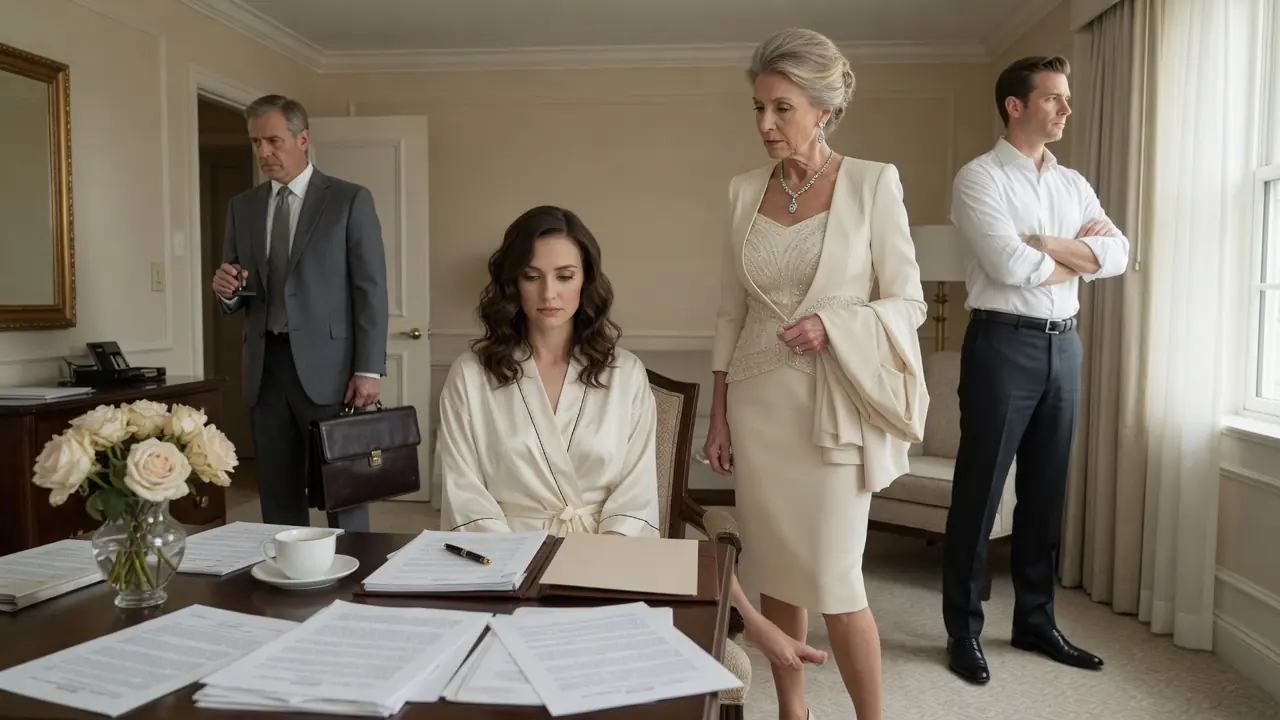
“Sign,” she said, placing the folder on the breakfast table. “Now that you’re family, everything should be in Ethan’s name.”
I looked at the documents, then at my husband.
Ethan stood by the window with his arms folded, his jaw tight, refusing to meet my eyes. Less than twelve hours earlier, he had whispered “forever” into my hair while we danced beneath hundreds of white roses.
Now he looked through me as though I had already become another possession inside his mother’s house.
The suite still smelled of champagne, coffee, and dying flowers. My silk robe brushed my ankles as I sat at the table and opened the folder.
I read the first page carefully.
Then I read it again.
Lydia’s diamond bracelet tapped impatiently against the wood.
“Well?” she asked.
“This isn’t a family trust update.”
She released a thin laugh. “Of course not. It’s much simpler. A spousal transfer agreement. Ethan will manage what little you have.”
What little.
The words almost made me smile.
To Lydia, my background was embarrassing. I was the quiet granddaughter from an ordinary suburb, the woman who wore simple dresses and drove a seven-year-old sedan. She believed my late grandfather had owned “a few warehouses” and left me just enough money to live comfortably.
She had never wondered why attorneys returned my calls within minutes or why suited executives stood when I entered certain rooms.
Ethan finally stepped away from the window.
“Don’t make this difficult, Elena. Mom’s right. You’ve never managed anything at this level. Let me handle the pressure.”
Something inside me cracked.
From confirmation.
My grandfather had warned me before he died.
“Money doesn’t change people,” he had said from his hospital bed. “It removes the price of pretending. Hide the company until you know who deserves your name.”
So I had concealed my controlling interest in Hale Meridian Holdings behind a blind trust and several ordinary-looking entities.
The company owned warehouses, logistics hubs, cold-storage facilities, freight contracts, and valuable industrial land. Its conservative valuation was $16.9 million.
Ethan knew none of that.
He believed I had inherited a modest collection of aging buildings.
And Lydia believed that by marrying her son, I had finally become vulnerable enough to control.
I set the documents down.
“You brought a notary to our hotel room the morning after the wedding?”
“I brought a witness for your good decision.”
“And if I refuse?”
Lydia leaned closer. Her perfume overwhelmed the scent of the roses.
“Then you refuse your husband. You refuse this family. You will discover very quickly how lonely life can become without us.”
I let the silence stretch until Ethan shifted uncomfortably.
Then I picked up the pen.
Lydia exhaled in triumph. Ethan’s shoulders relaxed. The notary removed his stamp.
I signed one line.
Not the transfer agreement.
The acknowledgment of receipt.
I pushed the folder back toward Lydia.
“Now it’s my turn.”
Her smile disappeared. “What did you say?”
“I said it’s my turn.”
Ethan grabbed the folder and flipped through the pages.
“You didn’t sign the transfer.”
“No. I signed proof that these papers were presented to me under pressure, in front of your notary, less than twelve hours after our ceremony.”
The notary looked at Lydia.
“You said she had already agreed to the transfer.”
“She has,” Lydia replied sharply. “She’s being dramatic.”
“I never agreed to anything,” I said.
Lydia’s face hardened.
“You ungrateful little nobody. Do you think one clever sentence changes your position in this family?”
“No. But evidence does.”
Ethan laughed, although the sound carried no confidence.
“Evidence of what?”
I reached for the phone lying beside my coffee.
A voice began playing through the speaker.
It was Lydia’s.
Once she’s married, she’ll be easier to pressure. Ethan just needs to keep her calm until the transfer is signed.
The recording was followed by Ethan’s voice.
What if she refuses?
Then Lydia again.
Remind her that no one else wants her. She’s spent her whole life afraid of being abandoned.
Ethan’s face drained of color.
Lydia remained completely still.
The conversation had taken place the previous evening in the bridal suite next door. They had assumed I was downstairs taking photographs.
But Lydia’s assistant, Claire, had heard them and recorded the exchange after discovering that her name had been used to prepare the transfer documents.
Claire sent the audio to my attorney at 2:13 that morning.
I had listened to it alone while Ethan slept beside me.
That was why I hadn’t confronted him during the night. I needed to know whether, when morning came, he would protect me or stand silently beside his mother.
Some betrayals arrive loudly.
Others stand by a window and avoid your eyes.
Lydia recovered first.
“That recording is illegal.”
“My attorney has already confirmed that it was lawfully obtained by a participant in the conversation,” I replied. “Claire consented to recording a discussion in which she was present.”
Fear flickered beneath Lydia’s polished expression.
She had done this before—coercion disguised as concern, theft dressed up as family responsibility.
Ethan threw the folder onto the table.
“What do you want, Elena?”
There it was.
Not shock. Not heartbreak. Not even denial.
Negotiation.
The instinct of someone who already knew he had been caught.
I walked to the safe, entered the code, and removed a navy folder marked with a silver crest—my grandfather’s crest.
I placed it beside Lydia’s papers.
Inside were shareholder certificates, board resolutions, operating agreements, property schedules, and the most recent independent valuation of Hale Meridian Holdings.
Lydia read the first page.
Then the second.
Her face slowly lost its color.
Ethan stared at the figure at the bottom of the valuation report.
“Sixteen point nine million?”
“Conservatively.”
“What is this?”
“The company I inherited.”
Lydia shook her head. “No. Your grandfather owned a few old warehouses.”
“He started with three. Hale Meridian now controls twenty-two facilities, four regional distribution centers, two cold-storage networks, and more than six hundred acres of industrial land.”
Ethan looked at me as though he had never seen me before.
“You lied to me.”
“I protected what existed before our marriage. You signed a prenuptial agreement identifying my separate business interests.”
“It never listed this company.”
“It listed the trust that owns it. You didn’t ask questions because your mother told you the schedule was routine.”
Lydia snatched the prenuptial agreement from the folder.
Her hand stopped at paragraph twelve.
Any deliberate attempt by either spouse, or a related third party, to coerce, conceal, misrepresent, or fraudulently obtain control of premarital assets would constitute material evidence of marital fraud, waive all negotiated financial benefits, and authorize immediate applications for injunctive relief.
The clause could not automatically erase a marriage. Real law doesn’t work like a magic sentence in a contract.
But it could protect the company, freeze disputed transactions, eliminate Ethan’s claim to financial benefits, and support an annulment petition if I proved that he had entered the marriage intending to obtain my assets.
And Lydia had brought the proof directly to my breakfast table.
For the first time that morning, her hand began to tremble.
“You chose the wrong woman,” I said.
Ethan reached for me.
“Elena, listen. Mom gets aggressive, but I never wanted to hurt you.”
“You knew about the documents.”
“I didn’t prepare them.”
“You stood by the window and told me to sign.”
“I was trying to keep the peace.”
“No, Ethan. You were waiting to profit from my surrender.”
A knock sounded at the suite door.
Lydia turned.
“Who is that?”
“My attorney.”
Nora Vance entered with the hotel’s security director and an independent notary I had requested before Lydia arrived.
She placed a document on the table.
“This is notice that Hale Meridian has sought an emergency injunction preventing any transfer, pledge, or encumbrance involving Ms. Marlowe’s separate assets,” Nora said. “It also preserves every document and electronic record connected to this attempted transfer.”
Lydia scoffed. “Attempted transfer? Elena refused to sign.”
“That isn’t the only problem.”
Nora opened another folder.
The agreement Lydia brought contained a digital version of my signature on its final page—a signature copied from the wedding vendor contracts.
Had I signed the remaining pages, Lydia’s notary intended to certify the entire packet as voluntarily executed.
But even without my signature that morning, the prefilled page was evidence of attempted fraud.
The notary Lydia had brought stepped away from the table.
“I was told the signature was hers and that she had approved the documents.”
Nora looked directly at him.
“Then I suggest you preserve every email and message you received.”
His face turned pale.
Lydia’s composure finally broke.
“You went through my private files?”
“No,” Nora replied. “Your office printer automatically stores document logs. Claire discovered that her employee account had been used to print these papers eight days before the wedding. Once she realized her name was connected to them, she contacted us.”
Eight days before the wedding.
The transfer had not been Lydia’s impulsive idea after too much champagne.
It had been planned before I walked down the aisle.
I looked at Ethan.
“Did you marry me because you loved me, or because you thought I owned property your mother could take?”
His mouth opened, but no answer came.
That silence hurt more than any confession.
I had spent the night hoping there was an explanation. Some part of me had believed Ethan might see the folder, reject his mother, and choose our marriage.
Instead, he had asked me not to make things difficult.
Nora gave me the annulment petition. It alleged fraud in the inducement and requested preservation of Ethan’s financial records and communications with Lydia.
I signed it before the independent notary.
Lydia rose so quickly that her chair fell backward.
“You think money protects you?”
“No,” I said. “Preparation protects me. Money simply gave me access to people who knew how to document the truth.”
Hotel security asked Lydia and Ethan to leave. Lydia shouted all the way into the hallway, threatening lawsuits, humiliation, and consequences.
Ethan said my name only once.
This time, I didn’t turn around.
By noon, Hale Meridian’s board had been informed. By evening, temporary controls were placed on every account Ethan or Lydia might have attempted to reach.
The police were not waiting outside the suite like characters in a television drama. Investigations take time. Evidence has to be reviewed. Statements must be verified.
But the evidence kept growing.
Claire provided emails showing that Lydia had ordered background reports on me before the engagement. Ethan had searched public property databases using my grandfather’s name. He had sent his mother a message three nights before the wedding:
Once she signs, we’ll control the land. She trusts me.
That message destroyed the last part of me that wanted to believe he had simply been manipulated.
The annulment process took months. Lydia fought every request, calling the transfer an innocent attempt at estate planning. Ethan claimed he had signed the prenuptial agreement without understanding it.
But his emails proved intent.
The court ultimately annulled the marriage based on fraud. Ethan received none of the benefits negotiated in our agreement. Civil lawsuits followed over the forged signature and attempted transfer. The notary surrendered his commission while investigators reviewed his role.
Lydia’s influence disappeared slowly.
People like her rarely collapse in one dramatic moment. They lose invitations first. Then clients. Then allies who once laughed at every cruel joke.
Ethan lost several business relationships after his emails became public through court filings. He later tried to contact me, saying therapy had helped him understand how controlling his mother had been.
I believed him.
I also understood that an explanation is not the same as accountability.
I wished him healing from a distance.
Six months later, I stood inside Hale Meridian’s new headquarters while morning sunlight moved across the glass walls. Outside, cranes lifted steel above an expansion my grandfather had planned but never lived to see.
My grandfather had hidden the company to protect me, but I realized I didn’t want to spend the rest of my life hiding.
I became its public chairwoman.
At my first company meeting, I told the employees the truth—not every humiliating detail, but enough for them to understand why our new governance policies mattered. No family member would receive authority without review. No executive could override transfer controls. No employee would be punished for reporting suspected wrongdoing.
Claire became director of compliance.
She had risked her career to warn a woman she barely knew because she understood that silence would make her part of the harm.
The wedding flowers were long gone by then.
For weeks, I had thought the most painful memory would be Ethan standing at the window while his mother ordered me to surrender everything.
It wasn’t.
The hardest part was remembering how sincerely I had loved him.
Betrayal doesn’t erase real feelings. It only proves that real feelings can be given to the wrong person.
I still had my name, my company, and the future my grandfather protected for me. But the greatest thing I recovered wasn’t worth $16.9 million.
It was my ability to trust my own discomfort.
Many people are taught to ignore the moment something feels wrong because asking questions might appear rude, ungrateful, or disloyal. We are told to keep the peace, respect the family, and prove our love by surrendering boundaries.
But love that requires your silence is control.
A marriage that demands your assets before earning your trust is not a partnership.
And a family that threatens abandonment whenever you say no was never offering belonging. It was offering obedience.
Lydia wanted one signature that would give her everything.
Instead, she received the signature that began the end of her control.
My grandfather had been right.
Money didn’t change Ethan or Lydia.
It simply revealed the price of their pretending.
And when that price turned out to be my identity, my future, and my peace, I finally understood something no inheritance could teach me:
The person who truly loves you will never require you to become smaller so they can feel powerful.