The first sign of trouble was not the black Mercedes coming over the ridge.
It was the dust behind it.
Arthur Hayes saw the pale cloud rolling across the eastern pasture long before he heard the engine. The vehicle was moving far too quickly for the county road, bouncing through ruts carved by spring runoff and sending gravel into the dry grass.
Arthur did not stop working.
He held a strand of barbed wire with one leather-gloved hand and twisted the final tie around a cedar post with the other. When the wire tightened, it produced a clear metallic note that traveled across the empty Montana land.
The fence held.
Arthur tested it once more before placing the pliers in the pouch at his waist.
Only then did he turn toward the road.
The Mercedes G-Wagon slid to a stop beside his old Ford F-250. Dust washed over both vehicles, swallowing the faded red paint of Arthur’s truck and settling across the windshield.
The driver did not wait for the air to clear.
Weston Carmichael stepped out wearing black compression shorts, an expensive training shirt, and spotless ostrich-leather boots that had probably never touched mud before he moved to Bitter Creek.
At thirty-two, Weston possessed the polished body of a professional athlete and the confidence of a man who had spent most of his life surrounded by people paid to agree with him.
He had built a technology company before he was twenty-five and sold it for more money than most families in Bitter Creek would earn across several generations.
Then he purchased two thousand acres bordering Arthur’s ranch.
Within six months, a glass-and-steel mansion appeared on the highest ridge. An old cattle barn became a private mixed-martial-arts facility. Luxury vehicles began racing along roads designed for pickups and tractors.
Weston also held a third-degree black belt in Brazilian jiu-jitsu.
Anyone who met him learned that detail quickly.
“Hayes!”
Arthur remained beside the fence.
“Carmichael.”
“You received the letter from my attorney.”
“I received it.”
“You did not respond.”
“I threw it away.”
Weston stopped several feet from him.
For a moment, the only sound was the ticking engine of the Mercedes and wind moving through the yellow grass.
“That road crosses the southeast corner of my property,” Weston said. “I am paving it and installing a gate.”
“The road has been there longer than either of us.”
“That is irrelevant.”
“The deed says otherwise.”
Weston removed his sunglasses.
His eyes were narrow and restless.
“I am developing that section. I have fighters arriving from Las Vegas next week, and I will not have your truck rattling past my facility at five every morning.”
“My truck does not rattle.”
“It sounds like farm equipment falling down a staircase.”
“It still runs.”
Weston looked Arthur over.
Faded denim shirt.
Sweat-darkened hat.
Old boots covered in dirt.
Hands marked by wire, tools, weather, and time.
To Weston, the man before him belonged to a world that should have disappeared years ago.
Arthur was fifty-one, though the years had settled unevenly across him. Gray had entered his hair early. His back stiffened whenever rain moved through the valley. A titanium pin in his left knee had made airport security an inconvenience back when he still flew.
He had not stepped onto an airplane in almost fifteen years.
There was nowhere he wanted to go.
His three hundred acres were difficult and unremarkable, but the silence belonged to him.
Weston reached inside his vehicle and removed an envelope.
“I offered you ten thousand dollars for the easement rights.”
“The road is not for sale.”
“That is more than it is worth.”
“Not to me.”
Weston held out the envelope anyway.
“Take the money. The gate goes up Friday.”
Arthur did not reach for it.
“If you drive through after that,” Weston continued, “I will have you charged with trespassing.”
Arthur looked at Weston’s shoulders.
The younger man was leaning forward, weight heavy on his lead leg, chin raised. It was the posture of someone accustomed to forcing others backward.
Arthur noticed those details without choosing to.
The habit had been carved too deeply into him to disappear.
Twenty years earlier, such observations had kept men alive.
Now he wished they would leave him alone.
“A fence can make a good neighbor,” Arthur said.
He picked up the posthole digger.
“A gate can make a prisoner.”
“I am not asking permission.”
“Neither am I.”
Arthur turned back toward the fence.
The dismissal struck Weston harder than an insult would have.
“You are making a serious mistake.”
Arthur positioned the tool above the dry soil.
“You do not know who you are dealing with,” Weston said.
Arthur drove the blades into the ground.
“Have a good afternoon.”
Weston stood motionless.
He had expected resistance, anger, or fear.
Arthur gave him nothing.
After several seconds, Weston returned to the Mercedes and slammed the door. The vehicle accelerated hard enough to send stones against the side of Arthur’s truck.
Arthur waited for the dust to clear.
Then he continued digging.
The confrontation should have ended there.
In Bitter Creek, however, pride traveled faster than truth.
By Tuesday evening, Weston had told several people that Arthur was attempting to steal access through his land. He described the old easement as an outdated technicality and Arthur as a stubborn rancher trying to obstruct progress.
Arthur heard none of it.
He was sitting in the rear booth at Patty’s Diner, eating meatloaf and drinking black coffee.
He always sat where he could see the entrance.
Most locals assumed he preferred watching the road through the front windows.
The truth was less comfortable.
Arthur disliked having doors behind him.
He disliked crowded rooms, sudden noises, and strangers whose hands disappeared beneath tables. He had become better at hiding those reactions over the years, but he had never entirely stopped calculating distance, exits, and cover.
The bell above the diner door rang violently.
Weston entered with three men from his private gym.
They were broad, loud, and still charged with energy from an evening training session. Each wore black athletic clothing marked with a gold version of Weston’s ranch logo.
Patty Morgan, the sixty-year-old waitress behind the counter, tightened her fingers around the coffee pot.
Weston placed a fifty-dollar bill on the counter.
“Steak, eggs, protein shakes. Whatever you have.”
“The kitchen closes soon,” Patty said.
“Then tell them to move faster.”
Weston had already noticed Arthur.
A grin appeared on his face.
He nodded toward the rear booth, and the three younger men followed him across the diner.
Arthur continued eating.
Weston stopped beside the table.
“Gentlemen, meet my neighbor. Arthur Hayes. He is one of the last surviving experts on ancient property law.”
The others laughed.
A muscular man with cauliflower ears cracked his knuckles.
“How is the fence, old man?”
“Holding.”
Arthur cut another piece of meatloaf.
Weston leaned one hand against the table.
“I heard you spoke with Sheriff Miller.”
“I informed him about the gate.”
“And he told you it was a civil dispute.”
“He told you not to interfere with the easement before a court reviewed it.”
Weston smiled.
“Courts take money. Lawyers take money. You can barely afford this food.”
Arthur placed his fork down.
The porcelain produced a small, precise sound.
“You are standing in my light.”
The diner became quiet.
Two retired ranchers at the counter stopped speaking. Patty paused halfway through filling a mug.
Weston’s smile disappeared.
Arthur had not raised his voice, yet the sentence made him appear exactly as he was—a man leaning over someone else’s meal because he needed an audience.
“You have a great deal of nerve,” Weston said.
He slammed both palms onto the table.
Coffee spilled over the edge of Arthur’s mug.
“I am bringing money into this town. I am bringing jobs and attention. You stand in the dirt clutching a piece of paper written before you were born.”
Arthur watched the coffee move across the white tabletop.
Then he looked up.
“You bring money.”
Weston leaned closer to hear him.
“You bring noise.”
Arthur’s eyes remained flat and unreadable.
“But you do not bring respect.”
One of Weston’s companions stopped smiling.
“And you do not own that road,” Arthur added.
Weston straightened.
“Respect?”
He turned slightly so his friends could see him.
“You think age earns respect? You think shoveling manure and wearing old boots makes you important?”
Arthur said nothing.
“I have competed internationally,” Weston continued. “I have trained with champions. I have submitted men twice your size.”
“I do not play games on mats.”
“Because you cannot.”
Weston picked up the salt shaker from Arthur’s table and tossed it between his hands.
“You hide behind a deed because you are weak. If you were a real man, you would protect your land yourself.”
“Put that down.”
“Or what?”
Weston dropped the shaker into the meatloaf.
It sank into the gravy.
Patty inhaled sharply.
The man with cauliflower ears laughed.
Arthur stared at the ruined plate.
He did not raise his voice.
He did not tighten his fists.
The silence inside him simply grew deeper.
Slowly, he slid from the booth and stood.
He was shorter than Weston and at least thirty pounds lighter.
His arms remained loose beside him.
“You owe Patty for the meal.”
Weston laughed directly in his face.
“I could buy this entire building.”
Arthur removed a worn money clip, placed ten dollars on the table, and walked toward the door.
His shoulder brushed Weston’s chest.
The contact was light.
Weston seized the back of his shirt.
“I am not finished.”
The moment Weston’s fingers closed around the denim, Arthur moved.
He did not pull away.
He rotated his upper body, trapped Weston’s wrist, and applied a brief, precise pressure near the joint.
Weston’s hand opened instantly.
His knees weakened.
A sharp gasp escaped him before he could hide it.
Arthur held the position for less than two seconds.
Then he let go.
Weston stumbled backward, clutching his wrist against his chest. The hand had gone temporarily numb, and pain was beginning to travel toward his elbow.
His companions had not moved.
The entire exchange had ended before they understood it had begun.
Arthur adjusted his shirt collar.
“Do not touch me again.”
Humiliation replaced Weston’s shock.
His friends had seen him lose control of his own arm.
The diner had seen it.
He raised his hands and dropped into a practiced fighting stance.
“You want to attack me when I am not ready?”
“I did not strike you.”
“You think that little trick makes you dangerous?”
“No.”
Weston stepped forward.
The fighter with cauliflower ears caught his shoulder.
“Not here. The sheriff will shut the gym down.”
Weston jerked free but stopped advancing.
His chest rose and fell beneath the tight black shirt.
“You embarrassed yourself,” Arthur said.
Weston pointed at him.
“Friday night. Founders’ Day.”
Arthur placed one hand on the door.
“They put up a boxing ring at the fairgrounds every year,” Weston continued. “You and me. Three rounds.”
“I do not fight for entertainment.”
“Then I will put up the gate.”
Arthur kept his back turned.
“I will buy the note on your ranch,” Weston said more loudly. “I will bury you in legal fees until you cannot afford cattle feed. I will take the land, the house, and that rusted truck.”
The diner remained silent.
Arthur looked through the glass door at the parking lot.
The sunset had left the sky a dark purple.
He had spent two decades building a quiet life around things he preferred not to remember.
He repaired fences.
He checked cattle.
He ate at the same booth.
He went home before dark.
Routine was not boredom to him.
It was containment.
It kept the old memories behind a heavy door.
Weston was threatening more than an easement.
He was threatening the life Arthur had built to prevent himself from becoming the man he once needed to be.
Arthur turned around.
The exhaustion had left his eyes.
What replaced it caused the fighter beside Weston to lower his hand.
“Friday,” Arthur said.
Weston smiled.
“Three rounds.”
Arthur opened the door.
“You will not need three.”
He walked into the evening.
Behind him, Weston’s grin widened.
“I am going to destroy him.”
His friends laughed, but the thick-necked fighter watched Arthur’s truck leave the parking lot.
Something cold settled in his stomach.
Arthur had not looked like a frightened man accepting a challenge.
He had looked like someone opening a door he had spent years keeping locked.
By Friday evening, the entire town knew about the fight.
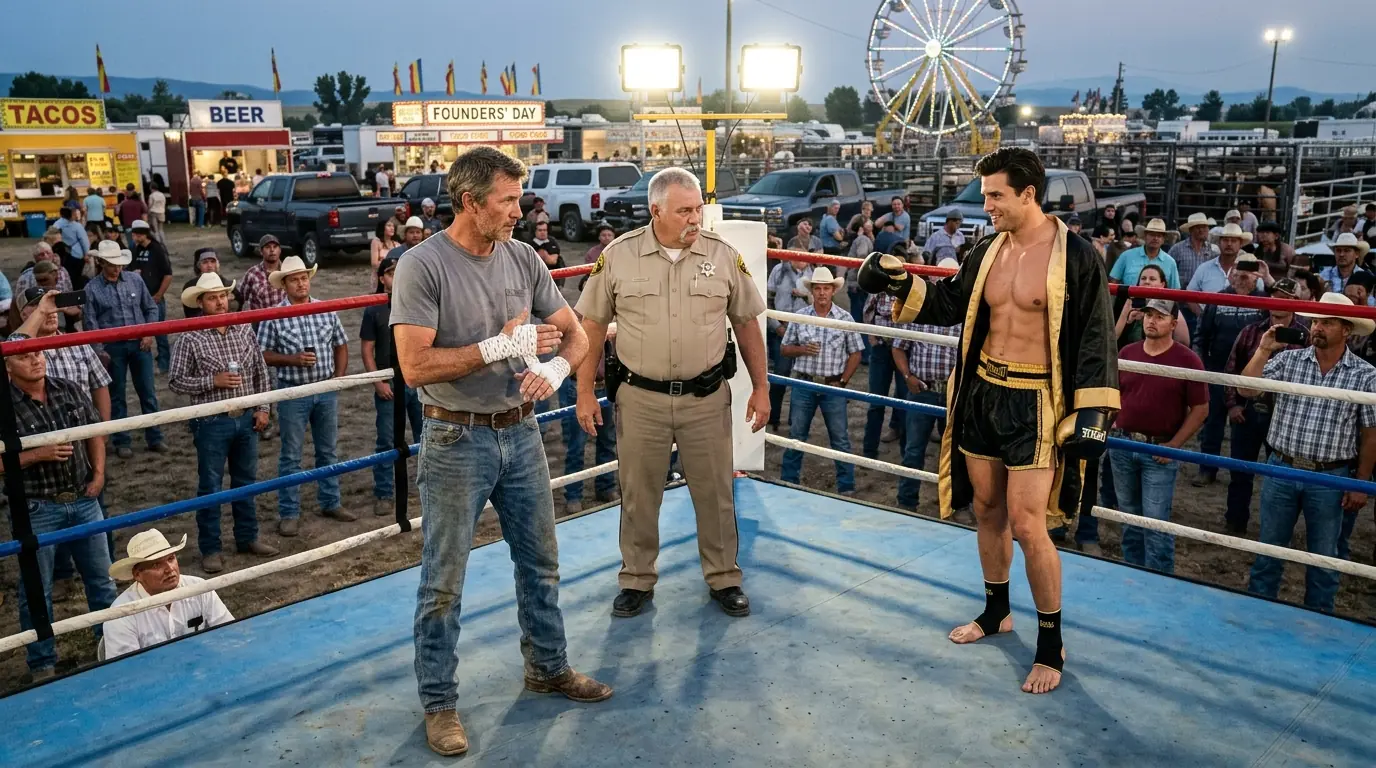
Bitter Creek’s Founders’ Day festival occupied the dirt lots behind the high school football field. A Ferris wheel turned slowly beneath the dark Montana sky. Families moved between food stalls, livestock exhibitions, and games operated by tired carnival workers.
At the far end of the grounds, volunteers had built a temporary ring.
The platform consisted of plywood covered by blue canvas and surrounded by four ropes. Bright work lights stood at each corner. Moths spun wildly around the bulbs.
People gathered long before the scheduled match.
Some believed Arthur had lost his mind.
Others hoped someone would finally humble Weston.
Most expected the rancher to leave in an ambulance.
Weston arrived as though entering a championship arena.
Music blasted from a portable speaker. His three companions walked behind him carrying towels, water bottles, and medical supplies.
A black silk robe covered his fight shorts. His gym’s emblem shone in gold across the back.
Weston climbed into the ring and raised both arms.
Several people cheered.
He shadowboxed beneath the lights, throwing fast, precise combinations. Every movement displayed the years he had spent training.
He looked young.
Powerful.
Prepared.
Arthur arrived in his old Ford.
He parked near the highway and walked across the grounds alone.
He wore faded jeans, a gray cotton shirt, and work boots. A roll of white athletic tape rested in his left hand.
There was no music.
No coach.
No gym bag.
The crowd moved aside as he approached.
People had known Arthur for twenty years, but few could say anything about him beyond the ordinary facts.
He paid bills on time.
He purchased cattle feed every spring.
He kept to himself.
Nobody remembered seeing him fight.
Nobody knew why he limped slightly when the weather changed.
Sheriff Daniel Miller met him beside the stairs leading to the ring.
The sheriff was heavyset, with a gray mustache and the tired expression of a man who had agreed to referee something he already regretted.
“I can stop this,” Miller said.
Arthur looked at Weston pacing above them.
“The easement can be defended in court.”
“Eventually.”
“You do not have to prove anything.”
“I know.”
“Then go home.”
Arthur met the sheriff’s eyes.
“He will not stop at the road.”
Miller understood.
Men like Weston often mistook one person’s retreat for permission to continue.
Arthur climbed the stairs.
Weston laughed when he saw the boots.
“You are fighting in those?”
“Yes.”
“I will break both your legs.”
Arthur stepped through the ropes and entered his corner.
He wrapped his hands slowly.
Across the knuckles.
Around the wrists.
Lock the thumb.
The movements happened without hesitation.
Mason—no, Weston—watched the tape move around Arthur’s hands.
A faint uncertainty entered his face.
Those were not the clumsy movements of a rancher imitating something he had seen in a film.
They belonged to memory.
Sheriff Miller called both men to the center.
“No attacks to the eyes, groin, or back of the head. Obey my commands. Protect yourselves.”
Weston refused to touch gloves.
Arthur gave a slight nod.
The sheriff moved away.
The crowd became silent.
“Fight!”
Weston attacked immediately.
His speed was impressive.
He threw a quick jab toward Arthur’s face while turning his hips into a powerful kick aimed at the lead thigh.
Arthur moved forward.
Instead of retreating from the strike, he stepped inside its strongest arc. Weston’s shin struck Arthur’s hip before the kick could gather full force.
Arthur’s open palm drove into the center of Weston’s chest.
The sound carried beyond the ring.
Weston’s mouthpiece fell onto the canvas.
Air left his lungs in a broken gasp, and his momentum reversed.
Arthur followed him.
Weston threw a desperate overhand right.
Arthur lowered his body just enough for the fist to pass above him. He stepped behind Weston’s forward leg, trapped the arm, and turned.
Weston left the ground.
He struck the canvas flat on his back.
The platform shook.
Before he could recover, Arthur settled beside him, controlling his upper body and pinning him against the mat.
Weston attempted the escapes he had practiced thousands of times.
Each failed before it began.
Whenever he shifted his weight, Arthur adjusted.
Whenever he created an opening, Arthur occupied it.
The movements were not elegant.
They were economical.
Weston had trained for competition.
Arthur moved like a man who had once trained for situations without trophies, bells, or referees.
Pain spread through Weston’s ribs.
He stopped fighting long enough to look at Arthur’s face.
There was no anger there.
No enjoyment.
Only cold concentration.
For the first time, Weston understood that he had not challenged an aging rancher.
He had challenged a survivor who had spent years concealing what he knew.
Arthur brought his forearm across Weston’s neck and applied controlled pressure.
Weston grabbed his wrist.
Nothing moved.
The lights above the ring began to blur.
The sounds of the crowd became distant.
Arthur leaned closer.
“You wanted my road.”
Weston attempted to speak.
Only a rough sound emerged.
“You believed money made you dangerous.”
Weston’s eyes widened.
“You believed a belt made you untouchable.”
The edges of his vision darkened.
He began tapping Arthur’s shoulder.
Once.
Twice.
Again.
Arthur felt the signal.
For a fraction of a second, he remained still.
A much older instinct told him never to release someone who might continue fighting.
That instinct had kept him alive once.
Here, it could destroy what remained of him.
Arthur let go.
He moved backward and stood.
Weston rolled onto his side, coughing and dragging air into his lungs.
The timer read thirty-four seconds.
Nobody applauded.
The crowd had expected excitement.
What they had seen was too quick and too real.
Sheriff Miller stared from Weston to Arthur.
Arthur’s taped hands were trembling.
The tremor was small, but he felt it clearly.
He hated it.
It meant the old door inside his mind had opened wider than he intended.
Arthur returned to his corner and tore the tape from his hands.
“Call it.”
Miller knelt beside Weston.
The younger man could not stand.
The sheriff rose and moved to the center.
“The match is over.”
His amplified voice cracked slightly.
“Arthur Hayes wins.”
A low murmur moved through the people around the ring.
Arthur stepped through the ropes and descended the wooden stairs.
The crowd opened a path.
This time, people gave him more room than he needed.
Weston’s thick-necked friend stood in the way.
His fists were closed, but his shoulders had drawn inward.
“You were lucky.”
Arthur stopped.
He looked at him.
“Do not make me do this twice.”
The younger man swallowed and stepped aside.
Arthur continued walking.
He passed the Ferris wheel, the food stands, and the beer tent until the lights of the fairground weakened behind him.
At his truck, he rested his forehead against the cool metal of the driver’s door.
His breathing remained steady.
His hands did not.
Images pushed against the edge of his memory.
Dust.
Fire.
A doorway in Fallujah.
A friend shouting from somewhere Arthur could no longer reach.
He closed his eyes and waited until the shaking faded.
Winning had not made him feel strong.
It had reminded him how much effort it took to remain gentle.
Arthur climbed into the Ford.
The old engine started with a low rumble.
He drove home without looking back.
Monday morning brought a copper-colored sunrise.
Arthur was beside the fence before six.
His left knee hurt from the movement in the ring. His lower back had stiffened overnight.
None of that changed the work waiting for him.
The cattle needed water.
A new section of wire needed tightening.
The ranch did not care that half the town had watched him fight.
Arthur pulled the wire against a fresh cedar post.
A county truck approached along the dirt road and stopped nearby.
A surveyor climbed out wearing a reflective vest and carrying a clipboard.
“Morning, Mr. Hayes.”
“Morning.”
“I wanted to update you on the Carmichael permit.”
Arthur continued wrapping the wire.
“He withdrew the gate application Friday night,” the surveyor said. “The access road will remain exactly as it is.”
Arthur tightened the tie.
“Is that right?”
“He is moving his private driveway to the northern highway. Apparently, he left for California on Saturday. Something about a corporate restructuring.”
Arthur placed the pliers in his tool pouch.
The surveyor smiled.
“I suppose he decided the easement was not worth the argument.”
Arthur looked along the road.
There was no black Mercedes.
No cloud of dust.
Only morning wind moving through dry grass.
“A fence makes a good neighbor,” Arthur said.
The surveyor laughed.
“Have a good day.”
“You too.”
Arthur watched the county truck disappear beyond the hill.
Then he turned toward his ranch.
Three hundred acres of difficult soil stretched beneath the rising sun.
The roof needed repairing.
The tractor was leaking hydraulic fluid.
Winter feed would cost more than he wanted to consider.
It was not much.
But it was quiet.
Weston had believed strength needed to be displayed. He wore his belt, advertised his victories, and surrounded himself with men who reflected his own importance back at him.
Arthur understood strength differently.
Strength was waking from a nightmare and still repairing the fence before sunrise.
It was living with pain without making someone else carry it.
It was knowing how easily violence could become permanent and avoiding it until every peaceful option had been exhausted.
And sometimes, strength meant opening the cage just far enough to protect the life built outside it.
Arthur lifted another strand of barbed wire.
It tightened between the cedar posts with a sharp metallic note.
He tested it with one gloved hand.
The line held.
Arthur picked up his tools and moved quietly toward the next post.