Every evening, just before the sun disappeared behind the hills of Briar County, Silas Whitaker followed the same dusty path from his farmhouse to the old barn.
He carried a small steel toolbox in his right hand.
The path crossed a narrow field that had once grown tobacco, then corn, then nothing but tall grass after Silas’s knees became too stiff to handle another harvest alone.
At seventy-four, he moved slowly. His shoulders curved forward, and his left boot dragged slightly whenever the ground became uneven.
Drivers passing along County Road 8 often noticed him.
Some slowed down.
Others pointed toward the barn and laughed.
The structure looked as though one strong winter storm might finish what seventy years of weather had begun. Its roof sagged in the middle. Gray boards leaned away from the frame. Several upper windows had lost their glass, and birds nested beneath the eastern eave.
Less than a quarter mile away stood the Vale estate.
Stone gates.
White columns.
Landscaped gardens arranged by professionals.
A swimming pool large enough to reflect the entire western sky.
The mansion belonged to Preston Vale, a real-estate investor who had arrived in Briar County twelve years earlier with more money than patience.
From the balcony of his home, Preston could see Silas’s barn.
He hated it.
He called it an eyesore during neighborhood meetings.
A fire hazard during conversations with county officials.
A disgrace whenever reporters visited his estate for charity events.
Once, he described the building as “a collapsing monument to rural stubbornness.”
Silas heard every remark.
He answered none of them.
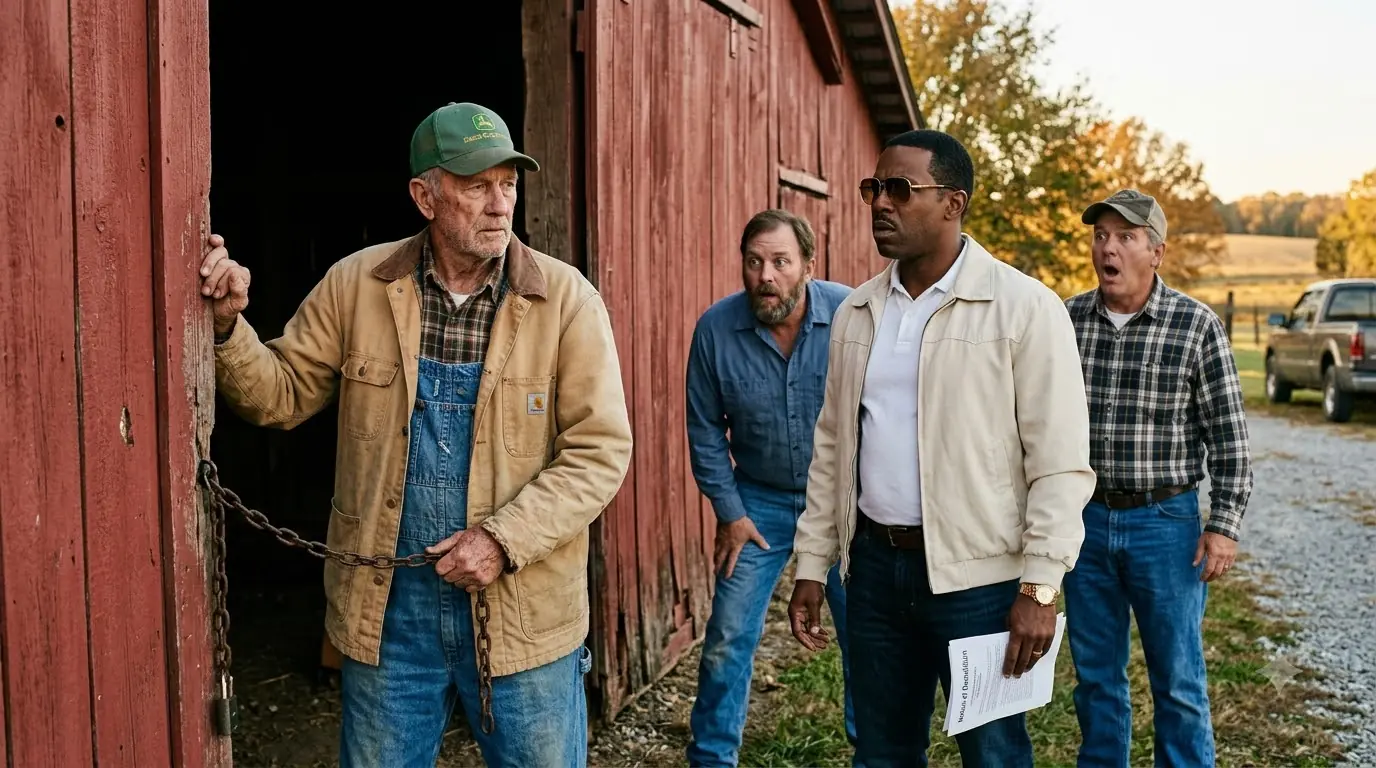
At the barn, he unlocked a heavy brass padlock and pulled one door open just wide enough to enter.
Then he closed it behind him.
A single bulb hung from a ceiling beam.
When Silas pulled the cord, dim yellow light spread across rows of large shapes covered beneath canvas tarps.
He set down the toolbox.
Then he began his evening inspection.
He lifted one tarp and examined a polished brass radiator cap.
Under another, he checked the oil pan of a tractor painted deep green.
He wiped dust from a red steel hood, tightened a loose fuel-line fitting, and rested one hand against a worn leather seat.
“Still here,” he murmured.
The machines remained silent.
Silas knew every one of them by sound, weight, year, and history.
Forty-three tractors stood inside the barn.
Some had been restored until they appeared ready for a showroom.
Others still carried scratches from fields worked before Silas was born.
Together, they represented more than four decades of searching, trading, repairing, and remembering.
No one in Briar County knew the full collection existed.
That was how Silas preferred it.
Preston Vale first attempted to buy the Whitaker property three months after moving into the mansion.
He arrived in a polished black pickup and wore loafers too expensive for the mud surrounding Silas’s porch.
“I’ll make this simple,” Preston said. “I want the western forty acres.”
“They aren’t for sale.”
“You haven’t heard the number.”
“The number won’t change the answer.”
Preston smiled as though negotiating with a confused employee.
“Your barn is falling down. The fields barely produce. You’re sitting on land you can’t properly use.”
Silas continued repairing the wooden handle of a garden rake.
“I use it.”
“For what?”
Silas looked toward the barn.
“For what I need.”
Preston offered three hundred thousand dollars.
Then five hundred.
Eventually, he offered to purchase the entire Whitaker farm and allow Silas to remain in the farmhouse for the rest of his life.
Silas refused every time.
The Vale estate expanded anyway.
Preston purchased neighboring parcels and added a guest house, tennis court, greenhouse, and ornamental pond.
The only thing preventing his property from stretching uninterrupted toward the county road was the Whitaker farm.
That made Silas’s refusal feel personal.
At a town council reception, Preston told several people the old farmer was too proud to recognize reality.
“At some point,” he said, “the county will have to condemn that barn. When it does, I’ll buy the land after the family realizes what it’s actually worth.”
The comment reached Silas the following morning.
He simply carried his toolbox to the barn as usual.
The collection had begun with one tractor.
In 1976, Silas was twenty-six and newly married to a woman named June Holloway.
The Whitaker farm consisted of eighty acres, a farmhouse without central heating, and more debt than machinery.
Silas’s father had recently suffered a stroke. Most fieldwork fell to Silas, using an unreliable tractor that overheated after two hours and leaked hydraulic fluid into the dirt.
One August afternoon, Silas saw an advertisement pinned inside the local feed store.
1938 FARM TRACTOR. NOT RUNNING. $300 OR BEST OFFER.
The tractor sat behind a collapsed shed fifteen miles away.
Its tires were ruined.
The engine had seized.
A tree branch had crushed part of the hood.
June walked around it once.
“You’re going to buy it,” she said.
“I’m considering it.”
“You already decided.”
“We could repair it.”
“You mean you could spend every evening for six months pretending to repair it.”
Silas purchased the tractor for two hundred twenty-five dollars.
He hauled it home on a borrowed trailer and worked beneath a lantern after finishing chores.
June cleaned parts with kerosene.
She kept bolts organized inside coffee cans and wrote their locations on strips of masking tape.
The tractor started for the first time on a cold February morning.
The engine coughed, released a cloud of black smoke, and settled into a slow mechanical rhythm.
June laughed so loudly Silas’s father heard her from the house.
That machine worked the Whitaker fields for twelve more years.
When Silas replaced it with newer equipment, he could not sell it.
“It kept this place alive,” he said.
June understood.
The second tractor came from an estate auction.
The third was traded for hay.
Then Silas found a rare orchard tractor abandoned in a chicken shed. Later, he purchased a narrow-front model identical to the one his father used during Silas’s childhood.
June helped with every restoration.
They traveled throughout Virginia, West Virginia, Pennsylvania, and Maryland searching for machines other people considered scrap.
Some farmers laughed at Silas for paying money to haul away rust.
June never did.
She maintained a notebook containing serial numbers, former owners, repair histories, and stories.
This tractor cultivated a family’s first profitable corn crop after the Depression.
That one pulled a wagon carrying children away from a flooded valley in 1949.
Another belonged to a woman who operated her husband’s farm while he fought in Korea.
To Silas and June, the tractors were not merely machines.
They were witnesses.
Steel remembered labor even when people forgot.
Their two children grew up around the collection.
Their son, Nathan, left Virginia after college and became an engineer in Texas.
Their daughter, Ellen, moved to North Carolina and taught history.
Both loved their parents.
Neither wanted the farm.
Silas accepted that.
June did not pressure them.
“Land should go to the person willing to care for it,” she said. “Blood doesn’t automatically create patience.”
The collection remained private.
Silas occasionally displayed one tractor during the county fair, but he never opened the barn to the public.
Partly because the building was unsafe.
Mostly because the collection belonged to memories he was not ready to explain.
Then June became ill.
Cancer moved quickly.
For eight months, hospital appointments replaced auctions and restoration work.
She died in the farmhouse bedroom while spring rain moved across the roof.
Silas stopped restoring tractors for almost a year.
Still, every evening he entered the barn.
He checked fuel lines.
Covered exposed metal.
Protected tires from damp ground.
June had spent forty years helping preserve the collection.
Allowing it to decay felt like losing her again.
Five years after her death, Silas read a book from the county library titled Machines That Fed America.
The author was Dr. Eleanor Price, an agricultural historian at the University of Virginia.
Silas recognized several models mentioned in the book.
One chapter described a prototype tractor believed to have disappeared after only eleven units were produced.
Silas owned one.
It stood beneath a dark canvas tarp near the northern wall of his barn.
He wrote Eleanor a letter.
Not an email.
Silas did not trust email for important subjects.
He described three tractors, included serial numbers, and explained that the machines remained in original or carefully restored condition.
He did not mention the full collection.
Three weeks later, Eleanor replied.
Her letter contained four pages.
She asked precise questions about engine castings, fuel systems, transmission plates, and factory modifications.
Silas answered them.
Their correspondence continued for six months.
Finally, Eleanor requested permission to visit.
Silas placed the letter inside June’s restoration notebook.
Then he avoided answering for three weeks.
Opening the barn meant exposing a part of his life he had protected for decades.
It also meant someone might finally understand why he continued walking there every evening.
He wrote one sentence.
You may come on October 7. No reporters.
Dr. Eleanor Price arrived in a dusty station wagon shortly after nine in the morning.
She was sixty-one, with silver hair pulled behind her head and a canvas satchel filled with notebooks, measuring tools, and white cotton gloves.
She wore practical boots.
Silas trusted her slightly more because of the boots.
They drank coffee on his porch.
Eleanor did not begin by asking about value.
She asked about June.
Silas looked at her.
“You read her notes?”
“The handwriting changes in the restoration records. Yours becomes more technical. Hers records people.”
Silas poured more coffee.
“She thought the story mattered as much as the machine.”
“She was right.”
After breakfast, they walked toward the barn.
Across the property line, Preston Vale stood beside a landscaping crew directing the placement of young maple trees.
He noticed Eleanor’s satchel and watched them cross the field.
Silas unlocked the padlock.
Inside, he pulled the doors closed before turning on the light.
Eleanor waited while her eyes adjusted.
Rows of covered shapes filled the building.
“How many?” she asked.
“Forty-three.”
She thought she had misheard him.
“Forty-three tractors?”
“Most are complete.”
“Most?”
“Three are waiting for parts.”
Eleanor did not move for several seconds.
Silas approached the nearest tarp.
“This is the one from my letter.”
He pulled back the canvas.
Beneath it stood a 1937 Hawthorne Model C orchard tractor with curved fenders, original brass fittings, and deep burgundy paint.
Eleanor slowly lowered her satchel to the floor.
“That color was discontinued before full production.”
“So June’s notes say.”
“Only six orchard configurations were documented.”
Silas pointed toward the serial plate.
Eleanor approached but did not touch the tractor.
She read the number twice.
Then she removed her glasses, cleaned them, and read it again.
“Where did you find this?”
“Chicken shed outside Winchester.”
“How long was it there?”
“Thirty years, maybe more.”
“Do you understand what this is?”
“A tractor.”
Eleanor looked at him.
Silas’s expression did not change.
Then one corner of his mouth lifted.
Eleanor laughed quietly.
They moved through the barn.
A 1919 kerosene-powered field tractor with original steel wheels.
A restored 1928 three-plow machine from an early cooperative manufacturer.
A compact vineyard tractor believed to be one of four remaining examples.
A 1941 military agricultural unit painted faded olive green.
A row of postwar tractors arranged by year.
Eleanor became increasingly silent.
By the seventeenth machine, she stopped taking notes.
“I cannot document this alone.”
“You said no reporters.”
“I’m not discussing reporters.”
She looked toward the rows disappearing into shadow.
“I need engineers, archivists, and preservation specialists. Some of these machines may be unique.”
Silas rested his hand on the toolbox.
“I don’t want them removed.”
“I am not asking to remove anything.”
“People always ask eventually.”
Eleanor studied him.
“What do you want to happen here?”
Silas looked toward June’s first tractor.
“I want the machines understood before I’m gone.”
That afternoon, Eleanor telephoned two colleagues.
Within days, a small academic team arrived under an agreement protecting Silas’s privacy.
Privacy lasted less than a week.
A county employee saw the university vehicles.
A student posted a photograph online before Eleanor could stop him.
By Friday, a regional newspaper published a headline:
HIDDEN TRACTOR COLLECTION DISCOVERED INSIDE COLLAPSING BRIAR COUNTY BARN.
Cars began stopping beside the road.
Some visitors knocked politely.
Others entered the property without permission.
Silas installed a chain across the driveway.
Preston Vale arrived Saturday morning.
For the first time in twelve years, he walked to the barn instead of summoning Silas to the property line.
“I hear you’ve been hiding a fortune.”
Silas continued repairing a wooden gate.
“I’ve been storing tractors.”
“How much are they worth?”
“That’s not your concern.”
Preston smiled.
“It becomes my concern if I’m purchasing the property.”
“You aren’t.”
“I’m prepared to improve my offer.”
“The land is not for sale.”
“What about the machines?”
“No.”
“One or two, then.”
“No.”
Preston’s smile disappeared.
“You are seventy-four years old. Your children live in other states. That barn is structurally unsound. Eventually, someone will sell.”
“Eventually isn’t today.”
Preston looked toward the roof.
“One bad storm and your entire collection becomes scrap.”
Silas tightened the gate hinge.
“That worries you now?”
“It concerns me as a neighbor.”
“No. It concerns you as a buyer.”
Preston left without answering.
The inspections continued.
Eleanor’s team confirmed that the collection contained at least seven tractors of national historical importance.
Several retained original components that museums had previously believed lost.
One prototype had no known surviving equivalent.
Valuations were difficult because comparable sales did not exist.
A private collector offered two million dollars for five machines.
Silas refused.
Another offered to purchase the entire collection for six million and construct a new storage facility elsewhere.
Silas refused that as well.
The town’s attitude changed quickly.
People who had mocked the barn began describing it as an important local landmark.
County officials discussed historical grants.
The same council member who once called it dangerous now appeared beside television reporters and praised Silas’s “commitment to preserving rural heritage.”
Silas remembered the man offering to arrange free demolition six months earlier.
He said nothing.
Eleanor did.
During one interview, a reporter asked how the collection survived inside such a neglected structure.
“The exterior was neglected,” Eleanor answered. “The machines were not.”
Silas appreciated the distinction.
The barn’s poor appearance had partly protected the collection.
Thieves saw rotting boards.
Speculators saw unwanted land.
No one imagined several million dollars in agricultural history stood beneath the roof.
A structural engineer determined the barn could be saved but required immediate stabilization.
The county offered grant assistance if Silas accepted a historical designation.
He hesitated.
Designation meant oversight.
Paperwork.
Committees.
Strangers deciding which nails could be replaced.
Eleanor spent an evening at his kitchen table explaining the options.
“You can preserve the barn without surrendering ownership.”
“Until the rules change.”
“Then establish a private foundation and conservation agreement.”
“I’m a farmer, not a foundation.”
“You preserved forty-three tractors for more than forty years. You’re already running a museum. You simply forgot to unlock the door.”
Silas looked toward June’s photograph on the mantel.
“She would enjoy hearing you say that.”
“What would she want?”
“A new roof.”
Eleanor smiled.
“Then we begin with the roof.”
Work started in November.
Steel supports stabilized the frame while preservation carpenters replaced damaged beams with wood matched to the original construction.
Every tractor was temporarily moved onto reinforced platforms inside a climate-controlled agricultural building erected beside the barn.
Silas supervised each transfer.
He refused to allow a machine to move without checking the chains himself.
Preston watched the operation from his property.
His interest had changed.
The restored barn would attract visitors.
Visitors created traffic, publicity, and commercial potential.
He returned with a proposal.
A joint heritage resort.
A boutique hotel in one of his guest houses.
Guided tours through the collection.
A restaurant serving “authentic farm cuisine.”
Silas read the proposal.
Then placed it inside his wood stove.
Preston stopped visiting.
By spring, the barn’s exterior appeared almost new.
Weathered boards had been preserved where possible and replaced only when necessary. The roof stood straight. New windows matched the old frames. A concealed climate system protected the machines without changing the interior appearance.
The collection was scheduled to open for limited public tours in June.
Before that happened, Silas asked Eleanor to visit privately.
“There’s one more tractor.”
Eleanor stared at him.
“We documented forty-three.”
“You documented forty-two properly.”
“What does that mean?”
“One remained covered in the northwest corner.”
“I assumed it was one of the incomplete machines.”
Silas took June’s restoration notebook from the kitchen shelf.
A folded envelope rested inside.
“June asked me not to open part of it until I was ready to do something about what we found.”
“What did you find?”
“You should see it first.”
They entered the restored barn after sunset.
Only Eleanor, Silas, his daughter Ellen, the county attorney, and a surveyor named Charles Bennett were present.
Silas led them to the far corner.
The final tarp covered a large gray tractor with unusual rear fenders and a reinforced frame.
He removed the canvas.
Eleanor recognized the model.
“1946 Caldwell utility tractor.”
Silas nodded.
“My grandfather bought it from an Army surplus auction after the war.”
The machine was valuable but not extraordinary compared with others in the collection.
Eleanor walked around it.
“What are we looking for?”
Silas opened a narrow panel beneath the seat.
Inside was a sealed metal compartment built between the transmission housing and rear frame.
He removed a long tin box.
The metal was scratched, but the rubber gasket remained intact.
Silas placed it on a workbench.
“My father told me this tractor once belonged to my grandfather’s brother, Amos.”
He unlocked the box.
Inside were folded surveys, handwritten letters, tax receipts, photographs, and a leather-bound property ledger.
Charles Bennett pulled on gloves.
The oldest map dated to 1923.
It showed the original Whitaker farm extending west beyond the current boundary—across sixteen acres now containing part of Preston Vale’s gardens, guest house, and ornamental pond.
The county attorney unfolded a second document.
“This is a timber lease.”
“Read the last page,” Silas said.
The agreement allowed a lumber company to use the western acreage temporarily in exchange for clearing trees and constructing an access road.
It did not transfer ownership.
A later deed recorded in 1931 appeared to sell the same acreage to one of the lumber company’s creditors.
But the signature belonging to Silas’s great-grandfather was visibly different from signatures on tax records and letters.
A handwritten statement from Amos Whitaker described the dispute.
The company claimed ownership after the Depression forced several neighboring farms into foreclosure.
The Whitakers lacked money for litigation.
County maps were later revised using the company’s claimed boundary.
The family continued paying property tax on the disputed acreage for seven more years before a clerk altered the parcel description.
“What does this prove?” Ellen asked.
The attorney remained cautious.
“It proves there may have been an invalid transfer. It does not automatically return land after ninety years.”
Silas nodded.
“I know.”
Adverse possession, later sales, and statutes of limitation complicated any historical claim.
Silas had no illusion that an old letter alone could remove the Vale mansion.
That was not the important discovery.
Charles Bennett placed a modern survey over the 1923 map.
“The current Vale boundary may still be wrong.”
He aligned two reference points.
An original stone survey monument shown on the Whitaker map had been rediscovered beneath brush the previous year, though no one connected it to the modern property line.
Using the monument and the original county road centerline, the survey suggested a much newer mistake.
When Preston expanded his estate eight years earlier, contractors relied on a digital parcel map rather than the deed’s physical measurements.
The guest house, retaining wall, and pond crossed between four and six acres onto land that even the modern Whitaker deed still described as belonging to Silas.
The historical papers did not revive a ninety-year-old claim.
They revealed a current encroachment.
Eleanor looked at Silas.
“How long have you known?”
“June and I found the box seven years ago.”
“And did nothing?”
“We hired a private surveyor.”
“Why didn’t you challenge Preston?”
“June was already sick.”
Silas touched the metal box.
“She didn’t want our final years spent fighting in court.”
Ellen looked toward her father.
“Why now?”
“Because he kept trying to buy the land he was already using.”
The county attorney closed the file.
“This needs a formal boundary survey and title review.”
The review took four months.
Preston’s attorneys initially dismissed the claim.
Then three independent surveyors reached the same conclusion.
Part of the guest-house driveway, much of the ornamental pond, one landscaped garden, and several acres of pasture stood on Whitaker land.
The county’s permitting office had approved construction using incorrect digital boundaries.
Preston threatened lawsuits against the county, survey company, previous landowner, and Silas.
Silas made no threats in return.
He offered three options.
Preston could remove every structure crossing the line and restore the acreage.
He could lease the land under terms that prohibited future expansion.
Or he could return the disputed acreage, provide a separate conservation easement along the property boundary, and contribute to the barn’s educational foundation.
Preston’s first response was anger.
His second was negotiation.
His third came after attorneys explained that destroying the pond and guest-house driveway would cost more than settlement.
The final agreement returned six acres to the Whitaker farm.
A narrow strip remained under a thirty-year lease so Preston could access his guest house.
He funded a conservation buffer between the properties and contributed seven hundred fifty thousand dollars to the Whitaker Agricultural Heritage Foundation.
The agreement contained no public admission of wrongdoing.
It did not need one.
Everyone in Briar County understood what had happened.
The man who spent years calling Silas’s barn an embarrassment had been using Silas’s land while trying to purchase the rest.
Preston stopped giving interviews about rural preservation.
The barn opened to the public in September.
Silas refused to call it a museum.
The sign outside read:
THE JUNE WHITAKER AGRICULTURAL WORKSHOP
Machines, Land, and the People Who Kept Them Alive
Visitors entered in small groups.
Eleanor designed the exhibits around stories rather than prices.
Beside each tractor stood a photograph or handwritten history.
The machine that carried children through floodwater.
The orchard tractor discovered in a chicken shed.
The first tractor Silas and June restored together.
A separate display contained copies of the property maps and selected letters from Amos Whitaker.
The original documents remained secured.
Silas did not present them as a story of revenge.
The exhibit explained how poorly kept records, financial hardship, and unequal access to courts had altered land ownership throughout rural America.
“People expect a villain,” Eleanor told him.
“Sometimes there is one.”
“And sometimes?”
“Sometimes one bad map survives longer than the person who drew it.”
The collection attracted historians, mechanics, farmers, and school groups.
Children who had never visited a working farm stood beside steel-wheeled tractors and asked how anyone drove without suspension.
Retired farmers touched familiar models and told stories they had not repeated in decades.
Silas listened.
Occasionally, he corrected them.
Often, he simply allowed them to remember.
Nathan returned from Texas for the opening.
He stood inside the barn looking at the machines of his childhood.
“I didn’t know there were this many.”
“You never asked.”
“That sounds like something Mom would say.”
“She probably said it first.”
Ellen donated her time to develop educational programs.
Neither child moved back permanently.
Silas no longer interpreted that as rejection.
The foundation ensured the farm and collection would survive without forcing either child into a life they had not chosen.
Four rare tractors were eventually loaned to state museums.
Silas refused permanent sales.
The rest remained in the barn.
Preston attended the opening ceremony.
His attorneys likely advised him to appear cooperative.
He wore a dark suit and stood near the back.
After the crowd thinned, he approached Silas.
“You could have told me about the boundary years ago.”
“You could have checked it before building.”
Preston looked toward the restored barn.
“You made me look foolish.”
“I didn’t build your pond.”
For a moment, the old hostility returned.
Then Preston released a tired breath.
“How much is all this worth?”
Silas looked down the rows.
“You still don’t understand.”
“Probably not.”
“That first tractor made enough money to keep my father’s farm out of foreclosure.”
Silas pointed toward another.
“That one belonged to a woman who raised four children while her husband was overseas.”
He indicated the military-gray tractor containing the hidden compartment.
“That machine carried proof my family nearly lost because paper mattered more than memory.”
He faced Preston.
“You keep asking for a number because numbers are the only kind of value you trust.”
Preston looked toward the open door.
“Maybe.”
He left without another offer.
Silas continued walking to the barn each evening.
The path had been leveled, and lights now guided visitors during public events, but Silas still carried the same steel toolbox.
After closing hours, he moved through the rows alone.
He checked fuel systems.
Wiped dust from chrome.
Listened for changes in engines when volunteers started them during demonstrations.
The barn no longer sagged.
Its boards had been repaired.
The roof stood straight against winter weather.
Yet Silas missed part of the old building.
When the walls leaned and the paint peeled, the barn belonged only to June, the tractors, and him.
Now photographs were taken inside.
Visitors whispered.
Children pressed faces against display ropes.
Still, he understood that hiding the collection forever would have defeated the purpose of saving it.
A machine preserved but never understood was only well-maintained silence.
Three years after the opening, Silas’s health began failing.
His heart weakened.
Walking the full length of the barn required several stops.
Eleanor visited often.
During her final visit before winter, she found him sitting on the first tractor he and June had restored.
“You’re not supposed to climb onto the exhibits.”
“It belongs to me.”
“The foundation owns it.”
“Worst mistake I ever made.”
She smiled and sat on a wooden crate beside him.
“Do you regret opening the barn?”
“Some days.”
“Which days?”
“School-tour days.”
“And other days?”
Silas looked toward a father showing his daughter how an old hand crank worked.
“No.”
When Silas died the following spring, his children held the memorial inside the barn.
The doors remained open.
Farmers, historians, mechanics, former employees, and neighbors filled the building.
Even Preston Vale attended.
Eleanor spoke briefly.
She did not focus on the collection’s value.
She described Silas writing careful letters because he believed important questions deserved paper.
She described the first morning he lifted the tarps.
Then she repeated something June had written in the restoration notebook decades earlier:
A machine survives when someone believes its work should not be forgotten.
After the service, Nathan found Silas’s steel toolbox beneath the workbench.
Inside were ordinary tools.
Wrenches.
Pliers.
A spark-plug gauge.
Several pieces of chalk.
Taped beneath the lid was a note in Silas’s handwriting.
Keep them running.
Ellen stood beside her brother.
“Do you think he meant the tractors?”
Nathan looked around the barn.
People remained in small groups, sharing stories.
Children examined photographs.
An elderly farmer stood with one hand against a machine he had operated as a young man.
“No,” Nathan said. “Not only the tractors.”
The June Whitaker Agricultural Workshop remained open.
The restored barn became one of Briar County’s most visited historical sites.
People driving along County Road 8 no longer pointed and laughed.
They slowed down.
Some stopped.
Others read the sign and returned later with children or grandchildren.
The Vale mansion still stood beyond the conservation strip, polished and expensive.
But when visitors asked for directions, no one used the mansion as the landmark.
They said, “Turn at the old Whitaker barn.”
The building became more valuable than anyone had predicted.
Not because of fresh paint.
Not because of the several million dollars’ worth of machines inside.
And not because hidden documents had corrected a property line.
Its value came from everything it had protected while the world dismissed its appearance.
A marriage built through shared labor.
A family’s connection to the land.
Machines that carried ordinary people through hard seasons.
Evidence that truth could survive inside steel long after public records failed.
For decades, Silas allowed people to believe the barn was worthless because he understood something Preston Vale never had.
What looks impressive from the road is not always valuable.
And what appears ready to collapse may still be standing because someone has quietly strengthened it from within.