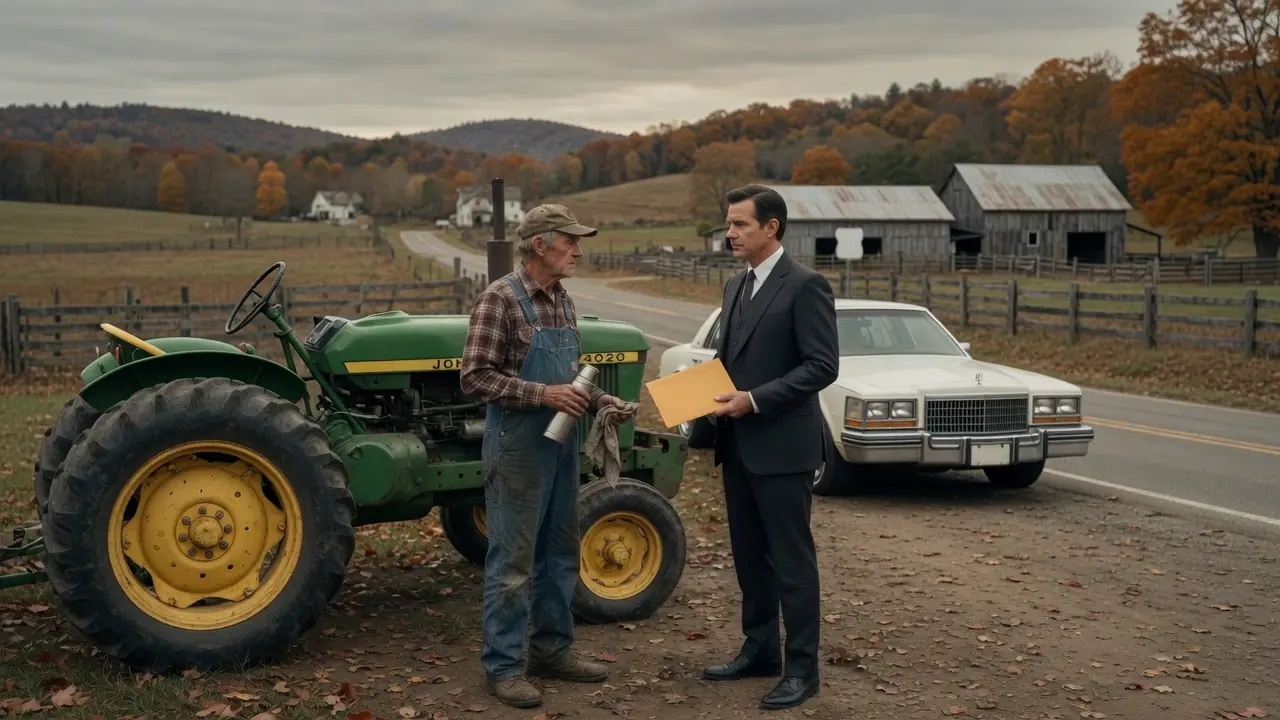
The autumn of 1978 had settled over Harlan County with the smell of dried corn, diesel fuel, and old barns holding on against another winter. Elias Thorne was crouched beside his John Deere 4020 tractor when the sound of a smooth engine rolled down his gravel drive. He did not look up right away, because a man who had farmed for fifty years knew the difference between a neighbor’s truck and a car that did not belong on a dirt road. When he finally straightened, his knees complained, and a spotless white Cadillac Seville came to a stop near the barn.
Richard Vance stepped out of the Cadillac like he expected cameras to be waiting. He was forty-five, polished, sharp, and dressed in a charcoal suit that looked offended by the dust around it. Eight months earlier, he had been elected mayor of Millhaven with speeches about prosperity, development, and bringing new life to the county. Elias had listened to those speeches on the radio and noticed that men who talked most about progress often meant someone else had to move out of the way.
Vance walked toward him without offering a hand. “Mr. Thorne,” he said, not as a greeting, but as if confirming the name on a problem. Elias wiped his hands on a rag, picked up the thermos from the tractor step, and took a slow drink of cold black coffee. Vance pulled a sealed manila envelope from inside his jacket and held it out at arm’s length. The city seal of Millhaven was stamped across the flap like a threat pretending to be official business.
“Municipal notice,” Vance said. “You have thirty days to erect a perimeter fence along the eastern boundary of your property, specifically the stretch adjacent to the Millhaven Estates development.” He tapped the envelope with one finger. “The fence must comply with municipal ordinance 14C, subsection 7. Failure to comply will result in daily fines of two hundred dollars, and after sixty days, the city may pursue condemnation proceedings.”
Elias took the envelope and turned it once in his hands. He looked at the Cadillac, then at Vance’s polished shoes, then past him toward the fields his father had worked before him. The eastern boundary ran along the side of Vance’s new development, a half-built dream of luxury homes, a country club, and a golf course marketed to people who had never changed a tire in mud. Elias knew Vance wanted his land, but until that moment, he had not known how openly the mayor intended to push.
“Appreciate you stopping by,” Elias said. His voice was low and steady, the kind that made louder men uncomfortable. Vance smiled as though he had won something, then turned back to his Cadillac. The car pulled away with irritating ease, leaving a white cloud of dust drifting across the barn lot. Elias stood there until the dust settled on the hood of his old Ford F-100, then tucked the envelope under his arm and went back to the tractor.
That evening, Martha Thorne made chicken and dumplings, the kind that filled the kitchen with the smell of bay leaves, pepper, and forty years of marriage. Elias sat at the table beneath the yellow overhead lamp with the municipal notice spread flat before him. His reading glasses sat low on his nose, one arm bent from years of being carried in the pocket of his overalls. Across the table, his grandson Tommy read over his shoulder, growing angrier with every line.
Tommy slapped one hand on the table. “This is harassment, Grandpa. That fence could cost twelve thousand dollars if we buy everything new.” He was twenty-three and still young enough to believe injustice should look ashamed when named out loud. “Everyone knows Vance wants this farm for his golf course expansion. We should call the newspaper, go to the courthouse, make noise.”
Elias folded the notice carefully and slid it back into the envelope. Martha stood at the sink washing dishes, her back turned, but Elias knew she was listening. He picked up his tea and thought the way he always thought when a matter was serious, slowly enough not to let anger choose the first move. Then he looked at Tommy and said, “Boy, when a man makes a rule to trap you, the most dangerous thing you can do is follow it exactly.”
Tommy stared at him. “What does that mean?” Elias reached for his old pipe from the windowsill, though he did not light it because Martha had made him cut back years ago. “It means the mayor wants a fence,” he said. “So we are going to build him a fence.”
Martha smiled slightly into the dishwater. Tommy looked from his grandfather to the envelope. “You’re serious.” Elias nodded. “The finest, most legal, most perfectly compliant fence Harlan County has ever seen.” Then he pushed his chair back and stood. “But first, I need to call Old Joe.”
Old Joe Pelman had been Harlan County’s land surveyor for thirty-one years before retiring in 1974. He lived in a small white house at the edge of town with a vegetable garden out back and a front porch stacked with boxes full of maps. Joe kept every record he ever touched, and his wife had stopped asking him to throw anything away sometime in the early sixties. When Elias’s Ford rattled to a stop outside Joe’s house the next morning, Joe was already on the porch with coffee in hand.
“Elias,” Joe said, lifting his mug. “Been a while.” Elias climbed the steps. “I need to know exactly where my land ends.” Joe’s eyebrows rose. “You know where your land ends. You’ve been on that place since 1948.” Elias looked toward the eastern horizon. “I know where the old fence line is. I need to know where the land ends.”
Joe was quiet for a moment, then set his coffee down. “You’d better come inside.” They spent the morning going through deed records, title chains, old survey maps, and county filings that went back to the 1870s. Elias brought the original Thorne deed, kept in a tin box his father had given him after the war. Joe brought his transit level, survey chain, canvas stake bag, and a notebook filled with cramped, exact handwriting.
The next afternoon, they went out to the eastern boundary. The leaves had turned red and orange along the creek, and the cottonwoods glowed pale yellow against the gray sky. Joe set up his transit and measured with the careful slowness of a man who had spent his life knowing that an inch on paper could become a lawsuit in a field. Tommy held the rod and wrote numbers in the notebook while Elias walked behind them with coffee.
The work took two full days. At sunset on the second day, Joe sat on the tailgate of the Ford with his notebook in his lap and looked at Elias. “Well,” he said, “you’ve got a problem.” Elias waited. Joe tapped the sketch with his pencil. “Except the problem ain’t yours.”
He turned the notebook so Elias and Tommy could see. “That new road Vance’s crew put in, Millhaven Estates Boulevard, crosses your property line by about fifteen feet at the curve.” He tapped again. “And that ninth green he is so proud of? Four hundred square feet of it sits on your land. Has been your land since 1876.”
Tommy stared toward the distant construction site, where earthmovers sat near the half-built country club frame. “He didn’t do a proper survey before breaking ground.” Joe shook his head. “He did a survey. He just used the old wandering fence line instead of the deed boundary.” Elias poured cold coffee from his thermos and drank it anyway. Then he said, “Joe, I’ll need you to certify those measurements and file them with the county court.”
Joe nodded as if he had expected that. “Already figured I would.” The two old men sat there in the fading light, watching Tommy stare at the stakes as the size of the mistake settled over him. A powerful man had tried to use a boundary law without checking the boundary. Elias said nothing more, but the corner of his mouth moved once, not quite a smile.
A twelve-thousand-dollar fence was not something Elias had twelve thousand dollars for. Milk prices had dropped again, diesel was too expensive, and some months he and Martha ate mostly what came from their own garden and Mason jars in the cellar. But Elias had learned long ago that new price and true cost were two different things. The ordinance said hardwood timbers. It did not say new hardwood timbers.
On Saturday morning, Elias and Tommy drove to the old Hanneman place with chains, come-alongs, work gloves, and the Ford’s flatbed. The dairy barn there had been empty since 1971, slowly leaning into the weeds like a tired animal. Dale Hanneman’s widow had told Elias years earlier that he could take any timber he wanted if he cleaned up the mess. The barn had been built in the 1890s from white oak and chestnut, the kind of wood that weather made harder instead of weaker.
They spent three Saturdays pulling beams. The chainsaw coughed through the old wood, and every cut sounded like it was arguing with history. Beams dropped with heavy crashes that startled crows from the hedgerow, and Tommy’s arms shook by the end of the first day. He did not complain. Elias noticed that and quietly felt better about the future of the farm.
For the foundation, they pried limestone from the creek bottom on Elias’s own property. The outcropping had been used by farmers since before the county had a proper courthouse. After supper, Elias and Tommy worked in the cooling light, lifting stone into the truck bed while the radio played country songs and news about President Carter, oil prices, and markets nobody in Washington seemed to understand. The work was hard, but there was peace in it because every stone meant another part of Vance’s trap being turned into something solid.
By the third week, the material was ready. Dark, heavy timbers lay stacked in the equipment yard, smelling of old barns and coal tar preservative. Limestone blocks sat in neat rows beside bags of concrete. Elias sharpened tools, checked levels, and studied Joe’s certified survey until every line lived in his head. On October 31, 1978, the corrected property boundary was filed, sealed, witnessed, and entered into the Harlan County District Court record.
They broke ground on the first Monday of November, when the sky was pewter and frost had started biting the soil. Elias hired two extra hands, Ed and Carl Busby, brothers in their fifties who knew farm work and did not waste words. He borrowed Dale Renfro’s posthole auger and rented a small concrete pump from the equipment yard in Millhaven. The fence line did not follow the old barbed wire; it followed the deed boundary.
Tommy stared at the orange flags Joe had placed. “Grandpa, that line runs right through Vance’s road.” Elias picked up the first beam. “Mhm.” Tommy pointed farther north. “And through the back of his golf course.” Elias lifted one end of the beam. “Mhm.” Tommy swallowed. “Right through the ninth green.” Elias said, “Yep.”
The auger bit three and a half feet into the cold earth, deeper than required because Elias did not build things halfway. Concrete went into each hole, thick and gray, then limestone footing stones were set with a mason’s level. The posts went in four feet apart, plumbed carefully on two faces and braced with angled boards until the concrete took hold. Every measurement met the ordinance, and most exceeded it.
The horizontal rails were old chestnut, six inches thick and blackened with preservative until they looked like cast iron. Elias cut notched joints by hand in the equipment barn at night, working under a hanging light while Martha brought him coffee. The vertical facing boards were old oak, eight feet tall, fitted so tightly that not a sliver of daylight could pass through. It was not merely a fence; it was a wall built with the patience of a man who knew exactly where the law stood.
On the third day, they reached the new asphalt of Estates Boulevard. The pavement was smooth, black, and not yet two months old. Tommy went quiet when the limestone footing stones were carried onto it. Elias simply set the level down, checked the stone, adjusted it, and checked again. A man had a right to build a fence on his own land.
Word spread by CB radio that night. Dale Renfro called first, asking whether it was true that Elias was building some kind of wall. Then Ray Lester from County Road 7 joined in, then old Bud Whitmore, who did not get out much anymore but kept his radio on all day. By morning, three neighboring farmers had found reasons to drive tractors near the boundary. By noon, they were helping carry boards without anyone officially asking.
Nobody made speeches. They hauled timber, held braces, poured concrete, and drank coffee from thermoses in the cold. There was satisfaction in the work, the kind that did not need to be spoken because everyone understood what was being built. It was a fence, yes, but it was also a line drawn against arrogance.
On the seventh day, they reached the northern stake. Elias stood back and looked at 422 feet of old hardwood, limestone, and compliance. Every post was plumb, every board tight, every foundation deep, every material proper under municipal ordinance 14C, subsection 7. The fence ran straight and true across the eastern edge of Thorne Farm, exactly where the certified boundary said it belonged. Elias took Vance’s notice from his pocket, read it once more, folded it, and said, “Done.”
Richard Vance had planned the Millhaven Estates investor unveiling for the second Saturday of November. A private bus arrived from Kansas City carrying men with money, portfolios, and expensive watches worn loosely on their wrists. Vance greeted them in another charcoal suit, smiling as if the future had already signed his name at the bottom of the page. He had full-color marketing materials showing rolling fairways, luxury homes, and the tagline, “Where the city meets the country.”
He led the investors in golf carts along Estates Boulevard, talking about lot values, membership tiers, and the championship design of the back nine. Then the road curved toward what the brochure promised would be a view of open fairway. Instead, the boulevard stopped at eight feet of black hardwood. The fence crossed the asphalt like a judgment.
For a long moment, nobody spoke. One investor named Foster leaned forward in his seat. “Richard,” he said carefully, “what is that?” Vance swallowed. “That is a fence.” Another investor frowned. “Yes, we can see it’s a fence.” They got out and walked along it, discovering that the wall cut across the ninth hole and split the carefully sodded green with merciless precision.
Vance’s project manager, Bellos, appeared with a document in his hand and a face like a man who had not slept. “I tried to tell you, Mr. Vance.” Vance snapped, “Get Thorne on the phone.” Bellos shook his head. “He doesn’t have a phone at the farm, sir.” Then he held out the paper. “You need to read what he posted on our side of the fence.”
It was a certified copy of Joe Pelman’s survey, stamped by the Harlan County District Court. Attached was the original Thorne deed from 1876 and a letter from attorney Sherwood. The letter stated that approximately fifteen feet of Estates Boulevard and four hundred square feet of the ninth green occupied land legally belonging to Elias G. Thorne. It also stated that Mr. Thorne would be seeking legal remediation at his earliest convenience.
Foster read over Vance’s shoulder. His voice changed when he spoke again. “Richard, how thorough was your title search before you broke ground?” Vance did not answer. He was staring at the fence, beginning to understand that the old farmer he had tried to pressure had followed the order so perfectly that there was almost nothing to attack. The wall was not rebellion. It was obedience.
That afternoon, Vance’s Cadillac came roaring down Elias’s gravel drive for the second time. Behind it came a county sheriff’s cruiser. Elias was cleaning milking equipment in the barn when he heard the engines, and he finished the piece in his hands before walking out. Vance stood by the Cadillac, his tie crooked and two angry spots of color burning in his cheeks.
“You tore up my road,” Vance said. Elias wiped his hands on his rag. “No, sir. I built a fence on my land. That road is on my land.” He reached into his coat and handed an envelope to Deputy Ray Crawford, not to Vance. “You’ll want to look at that, Ray.”
Crawford opened the envelope and read the survey, the deed, the court filing, the original municipal notice bearing Vance’s signature, and the attorney’s letter. His face remained neutral, but his eyes moved carefully over certain paragraphs. Elias spoke quietly. “The mayor ordered me to build a perimeter fence along the eastern boundary of my property in compliance with ordinance 14C. I built it.”
He looked at Vance steadily. “Every inch of it is on my land. Every dimension, every material, every depth of foundation meets the order he signed.” Vance tried to interrupt, but Elias continued without raising his voice. “If Mr. Vance’s road is pressed against my fence, that is because Mr. Vance’s road was built where it should not have been.”
Elias turned to the deputy. “Ray, does the law prevent a man from building a fence on his own property in compliance with a lawfully issued municipal order?” Crawford folded the paperwork carefully. He looked at Vance with the professional calm of a county man who knew exactly what answer the law required. “No,” he said slowly, “it does not.”
Elias nodded. “Then I don’t believe there’s anything here requiring your attention.” He glanced at Vance once, then turned toward the barn. “You’re welcome inside for coffee if you want. Martha made pie this morning.” Nobody came inside for coffee.
Millhaven Estates collapsed with the speed of things built on shaky ground. Foster and his investment partners retained a Kansas City law firm within seventy-two hours. Their position was simple: they had invested in a development promised to be built on legally cleared land. Discovering that the primary access road and part of the golf course sat on a farmer’s deeded property was a material misrepresentation.
The local newspaper ran the story on the front page. Buyers began withdrawing deposits, not all at once, but steadily. The bank that had financed construction began asking questions about title insurance and receiving answers it did not like. County commissioners opened an inquiry into whether Vance had used ordinance 14C in good faith or as a tool to force Elias into a distress sale. The documents from the planning office did not make the mayor look innocent.
By February, the Cadillac Seville was repossessed. By March, Richard Vance resigned as mayor, citing personal reasons in a statement that said almost nothing and confirmed nearly everything. The Millhaven Estates site sat abandoned through the end of winter, with cranes still, earthmovers parked, and the unfinished clubhouse wrapped in plastic that snapped in the wind. The fence remained.
It stood across the ruined boulevard and through the back corner of the abandoned golf course, dark and solid against the open fields. Somebody painted a small American flag on one post facing the development site. Elias never found out who did it, and he never painted over it. Martha read the newspaper articles to him at breakfast, and he listened the way he listened to the weather, not gloating, simply taking in the information.
“You knew he had built on your land,” Martha said one morning over coffee. Elias buttered a biscuit. “Had a feeling.” She watched him for a moment. “Before Joe even checked the deed?” Elias considered that. “A man builds like he lives,” he said. “Vance built like nobody would ever check.”
Spring returned to Harlan County slowly, the way good things usually come. Mud softened in the equipment yard, red-winged blackbirds called from the cottonwoods, and the ground opened with that dark smell that farmers recognize as promise. The dairy herd moved back to pasture, the John Deere ran clean after its winter overhaul, and Tommy worked under the Ford F-100 with the radio playing from the bench. The farm did not become easy, but it remained theirs.
One April evening, Elias sat in the wooden rocker on the porch, drinking hot coffee for once and watching the cows graze. At the far eastern edge of the pasture, the fence ran straight and black against the pale sky. It said what fences are supposed to say: here is the line, this side is mine, and that is a fact, not a negotiation. Beyond it, Vance’s unfinished clubhouse stood silent.
Martha came out with apple pie and set it on the arm of the rocker without asking whether he wanted it. “Good fence,” she said after a while. Elias looked at the old hardwood glowing briefly in the low sun, the limestone base silver along the edges, the boards tight enough to hold back more than light. He rocked slowly and smiled to himself.
The fence had cost roughly four hundred dollars in materials, not counting the labor of men who believed some work was worth doing right. It had been built from a barn raised when Grover Cleveland was in the White House and from limestone pulled from a creek older than anyone’s deed. It had met every specification Richard Vance demanded. It had done exactly what a fence should do.
Elias finished his coffee and listened to the farm settle into evening. Tommy sang along to the radio from under the truck, badly but with feeling. Somewhere beyond the fields, a neighbor’s tractor started up for the last of the evening work, and the sound carried across the flat land like a familiar reassurance. Still here, still here, still here.
There were things Elias could not fight: milk prices, diesel costs, weather, age, and the slow pressure of a changing world on people who fed it. But some things he could fight. When a powerful man handed him the exact rule meant to break him, Elias had simply turned it carefully in his hands and handed it back. No shouting, no rage, no grand speech, just an old deed, a tape measure, a retired surveyor, and the will to do the work exactly right.
The sun touched the tree line, and the last light caught the fence for one shining moment. Elias looked at it for a long time. Then he said quietly, to no one in particular, “Good fence.” And on his own land, in his grandfather’s chair, with his cows in the pasture and his family nearby, Elias Thorne was at peace.