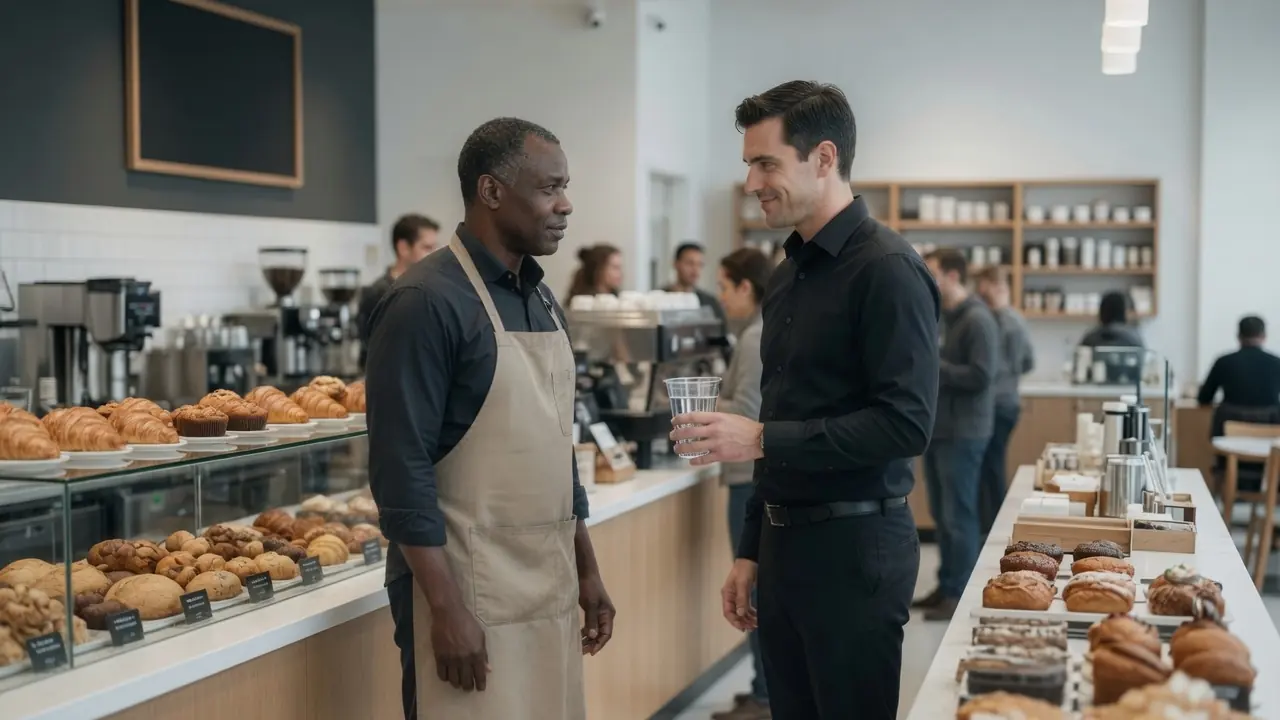
The bell above the door gave a soft ring when Jackson stepped into the flagship Aroma Brews coffee shop just before the morning rush. He was forty-five years old, broad-shouldered, calm-eyed, and dressed like a man trying not to be noticed. A beige trainee apron hung over his clean dark shirt, his trousers were plain, and his shoes looked practical rather than expensive. To anyone watching, he seemed like a nervous new hire starting over later than most people expected.
That was exactly what he wanted them to see. In truth, Jackson was not Jackson at all, at least not in the way the staff believed. His real name was David Chin, founder and CEO of Aroma Brews, the coffee chain that had started with one tiny corner shop and grown into one of the most recognizable cafés in the country. He had built the company on the idea that a coffee shop should feel like a place where tired people became human again.
Lately, the reports from this flagship location had stopped making sense. Customer complaints were rising, employee turnover was alarming, inventory waste was impossible to explain, and sales were sliding in a store that should have been thriving. On paper, the manager, Marcus Holloway, blamed lazy workers, spoiled supplies, and difficult customers. David did not believe paper when people were involved. So he put on an apron, gave a false first name, and walked into his own company as a trainee.
Marcus saw him immediately from behind the counter. He was a lean, sharp-faced man in a fitted black manager shirt, pressed slacks, and polished shoes that clicked against the white floor as he approached. His eyes moved over Jackson’s age, his simple clothes, and the plain apron with open disdain. “You’re the new guy?” Marcus asked loudly enough for nearby customers to hear. “A little old to be learning how to wipe tables, don’t you think?”
Jackson lowered his head slightly, playing the role. “I’m here to work.” Marcus gave a humorless smile. “We’ll see how long that lasts.” Then, as if the moment had been designed by fate, Marcus reached toward a full plastic cup of water sitting near the counter. His elbow knocked it hard, sending it tipping toward the floor.
The cup hit the white tile and spilled across the clean surface in a wide splash. A few customers looked over. The staff froze because they knew Marcus would never take responsibility for anything in front of an audience. But instead of calling it an accident, Marcus picked up the half-empty cup, stepped directly in front of Jackson, and threw the remaining water straight into his face.
The water struck Jackson cold and sudden. It ran down his forehead, across his cheeks, and onto the beige apron. For a moment, the entire café went silent. Sarah, a young barista behind the espresso machine, gasped softly, then covered it by reaching for a towel. Linda, an older employee with tired eyes, looked away as if she had seen this kind of cruelty too many times before.
Marcus stepped closer, his smile tightening. “Staff?” he repeated. “You’re a trainee. You clean spills, serve coffee, and keep your mouth shut.” He threw a dirty rag onto the wet floor at Jackson’s feet. “Now get down there and fix it before someone slips.” The order landed in the room like something meant to break him.
Jackson could have ended Marcus in that exact second. One call to corporate security, one message to his operations director, one spoken sentence revealing who he really was, and Marcus Holloway would have been escorted out before the water dried. The power to destroy the man’s career sat quietly in Jackson’s pocket. But as he knelt to pick up the rag, he looked around at the staff and saw something that stopped him.
No one looked surprised. Sarah’s face was pale, but not shocked. Linda’s mouth was tight, her eyes heavy with the exhaustion of someone who had been warning people silently for months. A young student near the register stared at the floor, shoulders hunched, as if making himself smaller might keep Marcus from noticing him next. This was not one bad morning. This was a culture of fear.
Jackson pressed the rag to the floor and began wiping. The cold water soaked into the cloth and spread under his hand. Marcus stood above him for a second longer, enjoying the image of an older trainee on his knees, then turned away with satisfaction. Jackson kept his head down, but inside, his mind had become dangerously clear. Firing Marcus would remove the man, but it would not reveal how deep the damage went.
The morning rush hit hard. Orders came in fast, the espresso machine hissed, cups lined the counter, and Marcus moved through the café like a man who believed pressure gave him the right to be cruel. He corrected workers loudly, ignored customers who seemed unimportant, and smiled only when someone expensive-looking entered. Jackson watched everything while carrying trays, wiping tables, and restocking napkins. He was invisible, and invisibility had become his greatest advantage.
During a short break, Jackson sat in the cramped back room with a sandwich he barely tasted. The room smelled of old coffee grounds, cardboard boxes, and tired people. The door opened softly, and Linda stepped inside holding a steaming mug. She checked the hallway first, then placed the mug in front of him. “What he did out there,” she whispered, “that wasn’t right.”
Jackson looked up. “Does that happen often?” Linda gave a sad, humorless breath. “More than it should.” She lowered her voice even further. “You’re the fourth trainee in two months. The first quit after Marcus made him reorganize the storeroom three times in one shift. The second was fired for answering a call from her child’s school. The third walked out halfway through lunch rush and never came back.”
Jackson held the warm mug with both hands. “Why does everyone stay?” Linda’s eyes moved toward the door again. “Bills. Rent. Kids. Fear.” She looked back at him with the kind of urgency that made her warning feel dangerous. “Keep your head down, Jackson. Do your work. Don’t ask questions. It’s safer that way.”
That sentence settled heavily in him. Safe was not supposed to be a word employees needed inside his cafés. Aroma Brews had been built to feel welcoming, not to make workers whisper in back rooms like prisoners. Yet here was Linda, a woman who had likely given years of her life to this store, warning a new trainee to survive by staying silent. Jackson thanked her quietly and returned to the floor.
The next thing he noticed was Sarah. She worked with a grace that Marcus did not deserve, moving behind the counter with quick, skilled hands. During a brief lull, she poured steamed milk into espresso and created a delicate swan in the foam. For one small second, pride returned to her face. Then Marcus’s voice cut across the counter.
“Are you painting pictures or making coffee?” he snapped. Sarah’s hand flinched, ruining the swan into a pale swirl. Marcus did not even look at the cup before continuing. “Less art, more speed.” The small light in her expression vanished instantly. Jackson saw her swallow, straighten her shoulders, and become efficient again.
Later, an elderly regular named Mr. Hung entered and greeted Sarah warmly. The atmosphere behind the counter softened for the first time all day. Sarah smiled genuinely as she prepared his usual black coffee, and Linda smiled too, as if the old man brought a little piece of the café’s better past with him. Mr. Hung took the cup, sipped, and paused. His expression changed from comfort to confusion.
He returned to the counter politely. “Sarah, my dear, I am sorry to bother you,” he said, “but the coffee tastes bitter today. Almost burnt.” Sarah’s face drained before Marcus even appeared. She already knew what would happen. Marcus strode out from his office like a man arriving at a stage he had been waiting to perform on.
“You again,” Marcus said sharply, pointing at Sarah. “Always careless.” Then he turned to Mr. Hung with false concern. “I apologize, sir. Some of my staff cannot handle even the simplest order.” Mr. Hung looked startled. “Oh, no, that is not necessary. I only meant-” Marcus cut him off. “Make him another one,” he barked at Sarah. “And do it right this time.”
Sarah did not cry. That almost hurt Jackson more. She simply took the cup back, remade the coffee with mechanical precision, and kept her eyes lowered. Her hands trembled slightly, but her posture stayed straight. She was fighting to keep the last piece of her dignity intact. Jackson had seen boardrooms collapse with less quiet pain than that.
While restocking cups, Linda moved beside him. “He does that to her on purpose,” she whispered. “Last month, there was a company contest for a new signature drink. Sarah created a honey lavender latte that everyone loved.” Linda’s voice tightened with anger. “She gave the entry form to Marcus because managers had to submit them. He promised he would.”
Jackson already knew the ending from Linda’s face. “He never sent it,” she said. “Let the deadline pass. Then told her the drink probably was not good enough anyway.” Jackson looked toward Sarah and felt the shape of the store’s sickness becoming clearer. Marcus did not simply manage through fear. He crushed talent so no one else could shine.
As the day continued, Jackson noticed another pattern. Marcus poured nearly full cartons of milk down the drain and logged them as spoiled. He opened sealed bags of premium coffee beans, took a small scoop, and tossed the rest into the trash. Each time, he wrote carefully in a small black notebook under a spoilage column. The numbers were too deliberate to be carelessness.
Jackson needed proof. When Marcus stepped into the alley for a phone call, the notebook stayed open on his office desk. Jackson moved as if wiping a nearby table, shielded his phone with his body, and took clear photos of the pages. Later, while taking out the trash, he photographed nearly full bags of premium beans Marcus had thrown away. Facts were beginning to replace suspicion.
That evening, Jackson asked to stay late and practice on the espresso machine. Marcus barely looked at him. “Fine,” he said. “Lock up when you’re done.” Once Marcus left, Jackson turned off the front lights and hid in the storeroom. He did not touch the machine. He waited.
One hour later, a key turned in the back alley door. Marcus slipped inside, moving quickly and confidently in the dim security light. He went straight to the shelves, grabbed sealed boxes of expensive coffee beans and a case of organic milk, and carried them toward his car. Jackson recorded everything through the narrow crack in the storeroom door. His pulse stayed steady. This was no longer bad management. This was theft.
But the theft was only one layer. Jackson used the unmarked master key he had created years ago and entered Marcus’s locked office after the manager drove away. He opened the computer, bypassed the password, and searched through emails. Buried in the inbox, he found a chain of messages with a district manager from the Daily Bean, Aroma Brews’ fiercest competitor. The words on the screen made his stomach turn cold.
The plan was simple and ugly. Marcus had been sabotaging the flagship store from the inside, driving down its reputation, stealing inventory, inflating spoilage reports, and helping a rival position itself to take over the location. In exchange, he had been promised a cash bonus and a management position. The burnt coffee, Sarah’s public blame, the ruined morale, the waste, the turnover, all of it connected. Marcus was not failing the store by accident.
A key rattled outside the office door. Jackson closed the email, logged out, and slid beneath the desk seconds before Marcus entered for his forgotten wallet. The manager’s shoes stopped inches from Jackson’s face. Jackson held his breath as Marcus grabbed the wallet and left again. Only after the lock clicked shut did Jackson allow himself to breathe.
That night, he called Alex, his most trusted head of operations. His trainee voice disappeared completely. “Alex, it’s David,” he said. “We have a major issue at the flagship store.” He sent the photos, the video, and the email details. “I need server logs, inventory records, and recovered security footage by morning. Absolute secrecy.”
Alex worked through the night with a digital forensics team. By dawn, the answer came back. The missing footage had been erased, but not well enough. They recovered video of Marcus stealing inventory and meeting with the Daily Bean manager in the alley. Worse, the footage showed them swapping premium coffee beans for cheap, low-grade stock. Marcus had been poisoning the product quality deliberately.
By Saturday morning, Jackson returned to the café as the humble trainee. Marcus was already barking orders, angry at the line, angry at the staff, angry at the world he believed he controlled. Then the bell above the door rang, and three people in sharp suits entered. Alex led them to the counter. “Marcus Holloway?” he asked calmly. “I’m from corporate. This is a surprise operational audit.”
Marcus’s face tightened for one brief second, then he put on a false smile. “Of course. We believe in transparency here.” He began boasting about efficiency, waste reduction, and the standards he had personally implemented. Jackson listened from across the floor with a cloth in his hand. He watched a man standing in the middle of his own evidence and pretending it was a throne.
Then Jackson stepped forward. “Excuse me, Manager Marcus,” he said softly. “I had a question about the log books.” Marcus glared at him. “What is it, trainee?” Jackson looked down as if embarrassed. “The report says two hundred gallons of milk spoiled last month, but the delivery invoices show we only received one hundred and fifty. How can we spoil more milk than we had?”
The café went quiet. Marcus stared at him, his smile frozen. Alex folded his arms. Sarah looked from Jackson to Marcus, hope and fear mixing in her face. Unable to answer, Marcus snapped. “That is none of your business. Your job is to wipe tables, not question reports. You are not paid to think.”
Jackson slowly untied his beige apron. He folded it once and placed it on the counter. When he looked up again, the nervous trainee was gone. His voice was clear, calm, and strong enough to cut through the entire café. “You said my job is not to question your records,” he said. “I think it is.”
Marcus frowned. “What are you talking about?” Jackson stepped forward. “Because my name is not Jackson.” He looked directly into Marcus’s eyes. “My name is David Chin, and I own this entire company.”
The silence that followed was absolute. Marcus’s face turned pale. Sarah’s hand flew to her mouth. Linda leaned against the counter as if her legs had weakened. Customers turned fully in their seats, suddenly realizing they had been watching more than a workplace argument.
Alex pressed a button on a remote. The digital menu screen behind the counter changed from pastry photos to security footage. Everyone watched Marcus load sealed boxes of expensive coffee beans into his car. Another clip showed him meeting the Daily Bean manager in the alley. Then screenshots of emails appeared with damning phrases circled: declining reputation, prime location, transfer bonus, successful takeover.
David’s voice stayed controlled. “The impossible spoilage numbers were not a mistake. The burnt coffee was not an accident. The missing inventory was not bad luck.” He took one step closer to Marcus. “You stole from this company, sabotaged this store, damaged our reputation, and broke the people you were hired to lead.”
Marcus tried to speak, but only a whisper came out. “David, please. I can explain.” David looked at the water stain still faintly visible on the beige apron he had placed on the counter. “You splashed water in my face because you believed I had no power. You insulted Sarah because you believed she had no protection. You threatened students, ignored Linda, blamed staff, and sold this store’s future to our competitor.”
Two corporate security officers stepped forward. David did not raise his voice. “Marcus Holloway, your employment is terminated immediately for theft, sabotage, and conspiracy against the company.” Marcus looked around the café for an ally and found none. The people he had frightened for months watched in silence as security escorted him toward the door. The bell chimed when he left, and the sound felt like the first clean breath the café had taken in a long time.
David turned back to the staff. The hard edge in his face softened into something heavier: regret. “I owe all of you an apology,” he said. “As the owner of this company, my first responsibility is to protect the people who work here. I failed to see what was happening until the damage had already been done.” His voice grew quiet. “That failure is mine.”
Linda’s eyes filled, but she stood straighter than before. Sarah wiped tears from her cheeks, no longer trying to hide them. David looked at her with respect. “Sarah, Marcus tried to crush your creativity because he was afraid of anyone better than him.” Sarah’s breath caught. “This store needs someone who understands both quality and kindness. Effective immediately, I am promoting you to store manager.”
Sarah stared at him. “Me?” David smiled gently. “Yes. We can train systems and reports. We cannot train the heart you showed when this place gave you every reason to stop caring.” The staff broke into applause, first softly, then louder as customers joined in. Sarah covered her mouth, overwhelmed.
David then took a clean apron from the hook and tied it around himself. Sarah looked confused. “Mr. Chin, what are you doing?” He nodded toward the long line of customers. “You are the manager now. Tell me where you need me.” A small, disbelieving laugh broke through her tears. “Espresso station,” she said. “And please do not burn the milk.”
For the rest of that day, the flagship Aroma Brews felt alive again. Linda smiled while serving customers. The student who had been punished for requesting time off was given his hours back and paid study leave for his exam. Sarah remade her honey lavender latte and served it to Mr. Hung, who took one sip and beamed. “Now this tastes like the café I remember.”
David worked the whole shift. He wiped tables, washed cups, ran orders, and listened. He learned more in one day behind the counter than months of reports could have told him. Reports showed numbers. People showed the truth behind them.
By evening, the story had already begun spreading through the company. Not the full details yet, but enough. An owner had gone undercover. A cruel manager had exposed himself. A barista had been promoted because she never stopped treating people with dignity. At every Aroma Brews location, people began wondering whether leadership might finally be listening.
A week later, David announced sweeping changes. Anonymous reporting systems were strengthened, district audits became routine, employee ideas could be submitted directly to corporate, and every store manager had to complete leadership training focused on respect, not fear. Sarah’s honey lavender latte became a seasonal feature across the chain. The launch poster did not mention Marcus, but everyone who knew the story understood what it meant.
David kept the stained beige apron. He had it cleaned but not replaced. It hung in his office, not as a trophy, but as a reminder. When executives asked why the CEO kept a trainee apron near his desk, he told them the truth. “This taught me what my office could not.”
Months later, the flagship store became the highest-rated Aroma Brews location in the region. Customers returned because the coffee tasted right again, but they stayed because the people behind the counter looked proud to be there. Sarah led with firmness and warmth. Linda trained new hires. The young student passed his exam and kept working weekends because, as he told David, “This place finally feels fair.”
As for Marcus, legal action followed quietly. His theft and conspiracy were documented thoroughly, and the rival company distanced itself as soon as the evidence became undeniable. The man who once believed power meant splashing water in another person’s face learned that cruelty leaves records too. Every insult, every false report, every stolen box of coffee had been part of the story that ended him.
David never forgot the moment the water hit his face. Not because it hurt, but because of what came after. He remembered the silence, the staff looking down, and the terrible familiarity in their eyes. That was the moment he understood that the real emergency was not one manager’s cruelty. It was the fear that had taught good people to expect it.
True leadership, he later told his company, is not proven from the top floor. It is proven in the break room, behind the counter, beside the person cleaning the spill no one else wants to touch. It is proven in whether the newest trainee, the oldest worker, the quietest barista, and the most loyal customer are treated as if they matter. Power can fire a bad manager in seconds, but responsibility stays after the door closes.
David had walked into Aroma Brews wearing a trainee apron to find out why one store was failing. He walked out understanding why leadership can never be distant from the people it claims to serve. The water Marcus threw in his face dried within minutes. The lesson it carried stayed much longer.
And from that day forward, whenever David visited a store, he did not begin in the office. He began behind the counter. He asked the baristas their names, tasted the coffee, checked the break room, and watched how managers spoke when they thought no one important was listening. Because the truth was simple.
The person you insult today might be the person who owns the building.
And the person you protect today might be the reason the whole company survives.