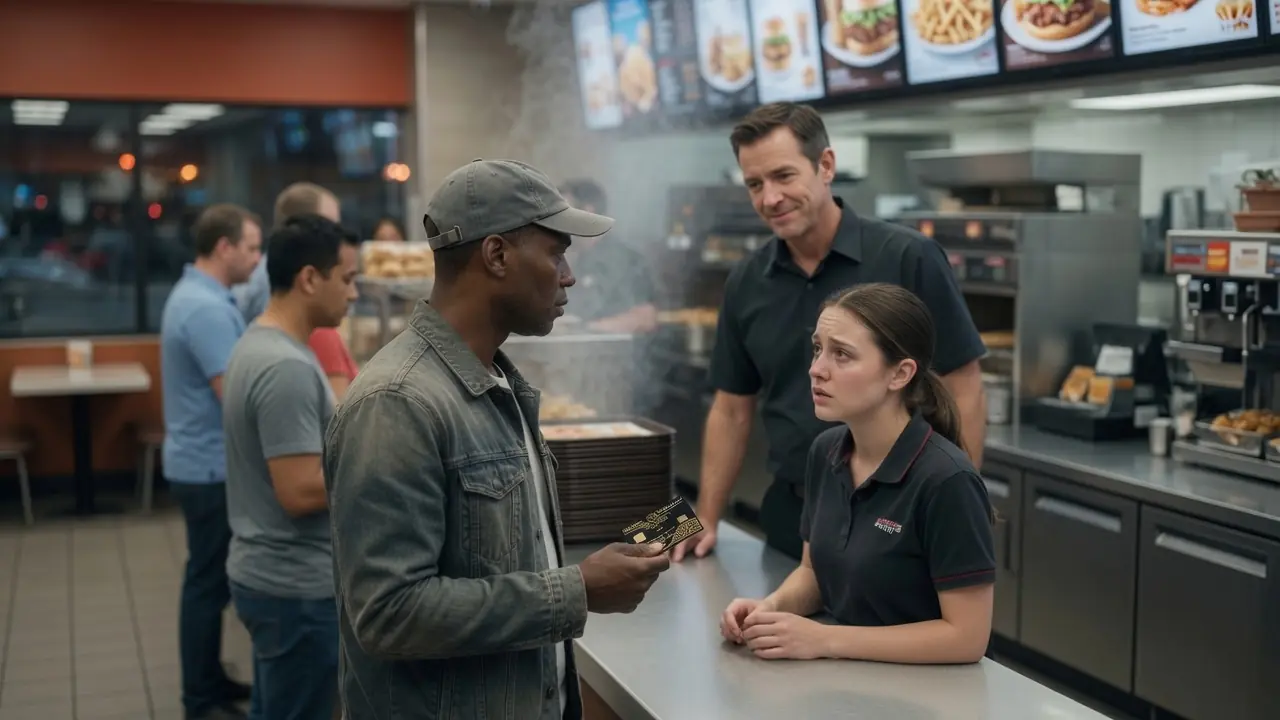
Jackson Hale stood at the counter of Hail’s Burgers with a black and gold internal company card between his fingers, watching the cashier’s face fall apart in silence. The lunch rush was heavy, every booth filled, every fryer working nonstop, every register beeping, yet the restaurant felt strangely quiet. Customers ate quickly, workers moved carefully, and nobody laughed the way people were supposed to laugh inside a busy burger shop. Across the counter, Lisa Carter swallowed hard, looked at the screen, and whispered, “I’m sorry, sir… your card was declined.”
Jackson blinked once, slowly. That card did not decline. It was not a normal credit card, not something tied to a bank balance or a daily spending limit. It was an executive internal pass used for payroll approvals, operational overrides, and backend access across the entire Hail’s Burgers system. If that card failed at a register, it meant someone had changed something inside the store system that should never have been touched.
Lisa’s hands trembled as she slid the card back toward him. She was young, maybe twenty-seven, with tired eyes, a neat uniform, and the strained smile of someone who had learned to keep smiling even when fear pressed against her throat. Her name tag was slightly crooked, and she kept glancing over her shoulder like every breath required permission. Jackson followed her glance and saw the man standing behind her near the fry station.
Mark Dawson, the shift manager, stood with folded arms and a cold smile. He wore a dark manager shirt, a black belt, polished shoes, and the kind of expression men wear when they think the room belongs to them. His eyes moved from Jackson’s cap to his faded denim jacket, then to the black and gold card, then back to Jackson’s face. The look lasted only a second, but Jackson knew it well.
It was the look that said, You do not belong here with anything valuable.
Mark stepped forward slowly, enjoying the pause he created. “Problem, Lisa?” he asked, though his eyes stayed on Jackson. Lisa’s lips parted, but no sound came out. Mark looked down at the card in her hand and gave a short laugh. “Move along,” he said to Jackson. “People like you don’t walk in here with gold cards.”
The line went still around them. A man holding a soda cup stopped mid-step. A cook behind the counter lowered his eyes. Lisa’s face went pale, not with surprise, but with terror, as if she had heard Mark say things like that before and knew what followed if anyone reacted. Jackson only looked at him.
“People like me?” Jackson asked quietly. Mark leaned one hand on the counter, lowering his voice just enough to make it more insulting. “Yeah. The kind who should be cleaning tables, not pretending to own the place.” He gave another cold little laugh. “You want to impress someone, start with a broom.”
Lisa flinched. Jackson saw it. Not the obvious kind of flinch, but a tiny tightening in her shoulders, the instinctive response of someone who had been trained to fear what happened after a manager decided to make an example of someone. Jackson slipped the card back into his wallet and pulled out cash. “I’ll pay this way,” he said.
Jackson took the tray and walked to a corner booth. He did not turn around. He did not react to Mark’s insult, did not raise his voice, did not give the manager the satisfaction of a scene. But as he sat down and unfolded the receipt, the founder of Hail’s Burgers began taking notes inside his head.
The receipt showed the order number, timestamp, location code, and the name of the shift lead on duty. Jackson paused. The name printed at the bottom did not belong to Lisa, and it did not belong to Mark. It was a third person, someone Jackson had not seen on the floor at all. That was the first hard clue that the store’s system was being used like a mask.
He folded the receipt and placed it in his wallet. Around him, the restaurant continued moving with the rhythm of a workplace under pressure. Nobody wasted a step. Nobody joked in the kitchen. Nobody looked at Mark unless they had to, and when they did, their eyes moved away quickly.
Jackson had built the first Hail’s Burgers store fifteen years earlier after working three jobs and saving every dollar he could. He had worn the apron, cleaned tables, burned his hands on fry baskets, and slept in his car during the first year because rent and payroll could not both be paid. The company grew one location at a time, then ten, then fifty, then more than two hundred across several states. But growth had pulled him away from counters like this, away from the sounds and faces that had built the company before executives and regional directors learned how to talk about “efficiency.”
That was why he had gone undercover. Reports from the Houston branch made no sense: low morale, missing payroll hours, high turnover, strange inventory usage, and customer complaints that never quite described the real problem. Jackson could have sent a corporate auditor. Instead, he put on an old cap and a denim jacket and walked into his own restaurant as a customer.
He expected stress. He expected sloppy management, maybe a failing store lead, maybe poor training. What he did not expect was to be looked in the face and told, in his own building, that a Black man like him belonged behind a broom instead of at the counter with a gold card. The insult was ugly, but it was also useful. It told him Mark did not merely abuse power. Mark believed he had the right to decide who mattered.
A plastic cup slipped from the drink station and hit the floor with a sharp sound. Water spread across the tile. A young worker froze, eyes wide, paper towels already in his hand. Mark turned toward him.
“If you can’t carry a drink, don’t bother showing up tomorrow,” Mark snapped. The boy whispered, “I’m sorry,” and dropped to his knees to clean the spill. No one helped. Not because they did not care, Jackson realized, but because helping might attract Mark’s attention.
Jackson watched Lisa return to the register. Her smile reset like a broken machine forced back into service. Customer after customer came forward, and she moved through each order with careful politeness, but her eyes stayed glassy. Every time Mark walked behind her, she straightened, checked the screen twice, and spoke softer.
Jackson ate half his burger and tasted almost none of it. The food was good, which somehow made the scene worse. The systems worked. The kitchen could move. The store had customers. What was broken here was not the product. It was the culture, and someone had broken it on purpose.
He returned the next day at the same lunch hour. Same cap, same denim jacket, same quiet manner. Lisa recognized him and looked momentarily afraid, as if his presence might cause another confrontation. Jackson ordered a burger and fries, paid with cash, and sat at the same corner booth.
This time he watched the employees more closely. Mark ruled without needing to shout. A glance from him changed the speed of the kitchen. A step toward the counter made Lisa’s hands tighten. A clearing of his throat sent workers into sudden silence.
A new hire named Mike was wiping trays near the register when Mark pointed toward the hallway. “Restrooms. Now.” Mike looked confused. “I thought I was training on register today.” Mark did not even stop walking. “You thought wrong.”
Mike disappeared down the hall without another word. Ten minutes later, he came back with his shirt damp and his hands red from scrubbing. Jackson stood near the drink station and spoke casually. “Rough first week?” Mike gave a nervous half smile. “They said it’s part of the process.”
“What process?” Jackson asked. Mike glanced toward Mark, then lowered his voice. “Breaking people early, I guess.” His eyes dropped to the floor. “If they can make you take anything in the first week, they know you’ll take it later.”
That sentence sat heavy in Jackson’s chest. He did not respond right away. He only nodded, because sometimes if a scared person gives you a piece of truth, the worst thing you can do is grab too hard. Mike walked away quickly, as if the words had already put him in danger.
Later, Jackson stood near the back hallway pretending to look for napkins. A shift chart hung on a clipboard beside the breakroom door. He scanned it quickly. Lisa’s name appeared under five-hour shifts for Monday, Tuesday, and Wednesday, but Jackson had seen her work far longer than that.
He took a photo. Then another, closer. The handwriting on the chart was too neat, too controlled, and not Lisa’s. The paper said five hours, but Lisa’s face said exhaustion from full shifts, and Jackson trusted faces when paperwork had reason to lie.
A young employee passed him and pretended to adjust his name tag. Without looking at Jackson, he murmured, “Careful, man. People who ask questions don’t stay on the schedule.” Then he kept walking, not stopping, not waiting for a reply. Jackson slid his phone into his pocket and felt the scope widen.
The next person he watched was Alex Carter. Alex worked the grill with quiet control, broad-shouldered and focused, older than most of the crew, with steady hands and a face that showed little emotion. He did not flinch when Mark walked by. He did not rush, did not drop his eyes, did not perform fear.
Jackson waited until the rush eased and approached the prep line. “You’ve been here a while?” he asked. Alex kept wrapping burgers. “Long enough.” His voice held no warmth, but no fear either. “Long enough to know what kind of place this is.”
Jackson leaned slightly closer. “What kind of place is it?” Alex finally looked at him. “The kind where good workers learn to stay quiet.” His eyes shifted toward Lisa. “And the kind where quiet workers get robbed anyway.”
That was the word Jackson had been waiting for. Robbed. Not stressed, not overworked, not poorly managed. Robbed. He kept his voice low. “By Mark?”
Alex’s jaw tightened. He sliced pickles with careful precision before answering. “Mark takes cash from the drawer after close. Says it is for balancing. No logs. No receipts. I’ve seen it three times.” Jackson’s face did not change, but inside, another piece clicked into place.
“Why hasn’t anyone reported it?” Jackson asked. Alex gave him a flat look. “People report things, then their hours disappear. Or they get written up. Or they become the problem.” He went back to wrapping burgers. “That is how it works here.”
That night, Jackson sat in his hotel room with the curtains closed and his laptop open. He logged into the internal corporate system using executive access only three people in the company had. He searched for payroll corrections under the Houston branch. Then he widened the search to the southern region.
Rows of data appeared. Houston, Dallas, San Antonio, Baton Rouge, Shreveport, Little Rock, and Austin South. Different stores, different managers, same pattern: manual wage corrections, missing hours, high cash discrepancies, unusual inventory use, and repeated approvals under the same regional director. Ronald Vickers.
Jackson stared at the screen. Ronald was not a careless supervisor. He was a senior regional executive, polished, trusted, and highly praised in corporate meetings for keeping labor costs down. Jackson had shaken his hand at conferences and watched him present charts about “operational discipline.” Now those numbers looked less like discipline and more like theft.
The next morning, Jackson returned before the lunch rush. He found Lisa in the breakroom, sitting alone at a plastic table with both hands wrapped around a paper cup. She looked up when he entered, then looked down quickly. The fear in her face made him slow his steps.
“I know something is wrong,” Jackson said softly. “I saw the shift chart.” Lisa’s hands tightened around the cup. “Please don’t,” she whispered. “I need this job.”
“I’m not here to hurt you,” he said. “I need the truth, but only if you are ready.” For a long moment, she said nothing. Then tears slid down her face silently, one after another, without a sob.
“They always ask what I did wrong,” Lisa whispered. “Never if something is wrong.” She wiped at her cheeks, but the tears kept coming. “I thought maybe it was just me. Maybe I was too slow, too nervous, too weak.”
Jackson sat across from her. “It was never just you.” Lisa looked at him then, really looked at him, as if she was hearing a sentence she had needed for months. Slowly, she pulled out her phone and showed him photos of shift boards, pay deposits, and time records.
“Eight hours worked,” she said, tapping one photo. Then she swiped to a bank deposit. “Five hours paid.” Her voice grew steadier with each screen. “Every week, a little missing. Not enough for anyone to notice from outside. Enough that I had to skip groceries twice.”
Jackson felt his hands curl under the table. “Who changes the hours?” Lisa swallowed. “Mark enters them. But he always says Ronald approves the labor cuts.” She lowered her voice. “He tells us corporate wants it this way.”
That sentence hurt more than Mark’s insult at the counter. Corporate wants it this way. That was how cruelty protected itself, by borrowing the voice of leadership. Jackson knew then that his silence from the top had created space for men like Ronald and Mark to speak in his name.
Behind the restaurant near the loading dock, Alex met him with a small USB drive hidden in his fist. “Camera feed,” Alex said. “Two weeks ago. Mark stayed late, opened the drawer, took cash. I copied it before the system cleared.” Jackson took the drive carefully. “Why keep it?”
Alex looked toward the back door. “Because good people kept disappearing from the schedule, and I got tired of pretending I didn’t see it.” His voice was steady, but his eyes carried years of restraint. “I figured one day somebody might care.”
“I care,” Jackson said. Alex studied him like he wanted to believe it but had been disappointed too often. “Then prove it.”
That afternoon, Jackson removed his cap in the breakroom. Lisa and Alex sat across from him while the restaurant hummed outside the door. He placed the black and gold internal card on the table. “My name is Jackson Hale,” he said. “I founded this company.”
Lisa’s breath caught. Alex went still. Neither spoke for several seconds. The silence was not disbelief exactly, but shock pressing against everything they thought they knew.
“You are the boss?” Lisa asked. Her voice trembled again, but this time the fear had changed shape. Jackson nodded. “Yes.” Then he looked down at the table. “And I should have been here sooner.”
Alex leaned back slowly. “Why come alone?” Jackson answered honestly. “Because reports can be cleaned up before auditors arrive. Fear changes when cameras walk in. I needed to see what a normal day looked like.” He looked at Lisa. “And I needed to know what people were afraid to say.”
Lisa’s eyes filled again, but she did not look away. “He said people like you don’t own the place,” she whispered. Jackson gave a small, humorless smile. “I heard him.” Alex’s mouth tightened. “Then you know exactly who he is.”
Jackson spent the next forty-eight hours building the case. He sent encrypted files to David Langley, the CFO he trusted most: Lisa’s wage evidence, Alex’s USB footage, shift charts, register discrepancies, and regional approval patterns. He contacted Cassandra Reed, a former payroll analyst who had been forced out after flagging irregularities the year before. Cassandra agreed to meet him quietly and brought printed emails that tied Ronald Vickers directly to labor manipulation.
One email was brutally clear. Cut wages, reduce hours. If anyone objects, remove them from the schedule. Ronald’s name sat at the bottom, clean and official. Jackson read it three times. The cruelty had a signature.
When Jackson confronted Ronald at corporate headquarters, the regional director smiled like a man who believed paperwork could be buried if the right people stayed nervous. “You’ve been poking around,” Ronald said from behind a polished desk. “That can be bad for business.” Jackson placed the folder in front of him.
“Stealing wages is bad for business,” Jackson replied. “Intimidating workers is bad for business. Letting managers insult customers because of how they look is bad for business.” Ronald’s smile thinned. “You’re emotional.”
Jackson leaned forward. “No. I’m precise.” He opened the folder, spreading payroll charts across the desk. “Seven stores. Same approvals. Same missing hours. Same cash discrepancies.” He tapped Ronald’s email. “Same name.”
Ronald stared at the evidence, then back at Jackson. “You go public with this, you damage the brand you built.” Jackson’s voice was quiet. “The brand is already damaged if people are crying behind the counter while managers steal from them.” He gathered the papers. “I’m taking this to the board, the courts, and every employee we owe money to.”
Ronald’s face hardened. “Then prepare for war.” Jackson looked at him for a long second. “You already started one. You just picked the wrong workers to underestimate.”
The board meeting was ugly. Ronald denied, deflected, blamed store-level mistakes, and accused Jackson of overreacting because of one insulting incident. Then Jackson played the video from Alex’s USB drive. The room watched Mark open the register after closing and pocket cash without logging anything.
Then Jackson displayed Lisa’s shift records. Eight hours worked, five hours paid. Again and again. Then Cassandra’s email. Then the regional data map. By the time he finished, no one at the table was defending Ronald.
Ronald Vickers was suspended before the meeting ended. Mark Dawson was terminated the same day, not only for theft and intimidation but for discriminatory conduct toward Jackson during the undercover visit. External auditors were brought in. Legal counsel began calculating back pay across all affected locations.
Jackson returned to the Houston branch three days later, this time without the cap. He walked in wearing a dark suit, and every employee in the store froze. Lisa stood behind the counter, eyes wide. Alex looked up from the grill and gave one slow nod.
Jackson gathered the staff in the dining area. Customers had been cleared for an emergency meeting, and the store was closed for the afternoon with pay. He stood where the line usually formed and looked at the people who had been afraid in his building. “I owe you an apology,” he said.
No one moved. Jackson continued. “Not because I personally changed your hours or took your wages, but because I allowed a company I built to become large enough for people like Mark and Ronald to hide inside it.” His voice tightened. “That ends today.”
Lisa wiped at her eyes. Mike stood near the back, arms crossed tightly. Alex listened without expression. Jackson looked at each of them. “Every stolen hour will be paid back. Every retaliation complaint will be reviewed by outside counsel. Every manager in this region will be retrained or removed. And from now on, no one gets to use my company’s name to make you afraid.”
The room stayed quiet for one more beat. Then Alex began clapping. Lisa followed. Then Mike. Then the rest of the staff, not loudly at first, but with something real behind it. It was not celebration. It was relief learning how to breathe again.
Weeks later, Lisa became assistant manager. Alex led training for new hires, teaching them that leadership did not mean making people afraid to ask questions. Mike moved back to register training and eventually became one of the fastest employees on the front line. The Houston store changed slowly, then all at once.
Laughter returned first. Small, cautious laughter near the fry station. Then music played low during cleanup. Then employees began correcting mistakes without flinching. The restaurant still worked hard, but the silence was gone.
One afternoon, Jackson brought his young son Ethan to the Houston branch. They stood in the same spot where Mark had once told Jackson that people like him should be cleaning tables. Ethan looked around at the busy restaurant, the smiling workers, the clean counters, and the line of customers waiting for lunch. “Dad,” he said, “this is yours?”
Jackson looked at Lisa helping a new cashier, Alex joking with Mike near the grill, and a dining room full of ordinary noise. “No,” he said softly. “It belongs to the people who keep it alive.” Ethan thought about that, then nodded seriously. “Can I clean a table?”
Jackson smiled. “That is the right place to start.”
As his son picked up a tray and carried it carefully toward the trash station, Jackson stood near the counter and remembered Mark’s face, his cold laugh, the ugly words spoken with absolute confidence. People like you don’t walk in here with gold cards. The memory no longer burned the same way. It had become fuel.
Mark had looked at a Black customer and seen someone he could insult. He had looked at Lisa and seen someone he could frighten. He had looked at workers and seen numbers he could bend. But he never saw the truth standing right in front of him.
Jackson Hale did not need to prove he belonged in his own restaurant. The truth did that for him. And when it finally arrived, it did not shout. It opened the books, played the footage, paid the workers, and removed every man who had built power from silence.