The stagecoach lurched violently over another rut in the dusty trail, and Alaina Spencer pressed her trembling hand against her mouth, fighting the wave of nausea that threatened to overwhelm her again. She had been traveling for three weeks, leaving Boston behind for the untamed territory of New Mexico, and somewhere between Kansas and this unforgiving stretch of desert, her body had decided to betray her completely. The older woman sitting across from her leaned forward, concern deepening the lines in her weathered face. “Miss, you are looking mighty peaked. We should be reaching Lordsburg within the hour. You just hold on now.”
Alaina nodded weakly, unable to form words. Her head pounded with such force that even the dim light filtering through the coach windows felt like daggers piercing her skull. The fever had started four days ago, a slow burn that had gradually consumed her entire body. She had tried to hide it at first, embarrassed to be a burden to her fellow travelers, but by yesterday morning, she could barely sit upright.
The letter in her carpet bag seemed to mock her now. She had read it so many times that she had memorized every word. “Seeking a respectable woman of good character for matrimony. Must be willing to relocate to New Mexico Territory. I am a rancher of modest means, but honest work. If you are hearty and true, we might build a good life together. Philip Emerson.”
Hearty. She had thought herself hearty when she answered that advertisement, sold her few possessions, and bought the train tickets that would carry her west. Her parents were gone, victims of the cholera outbreak that had swept through Boston two years earlier. Her brother had his own family to care for and could not support her indefinitely.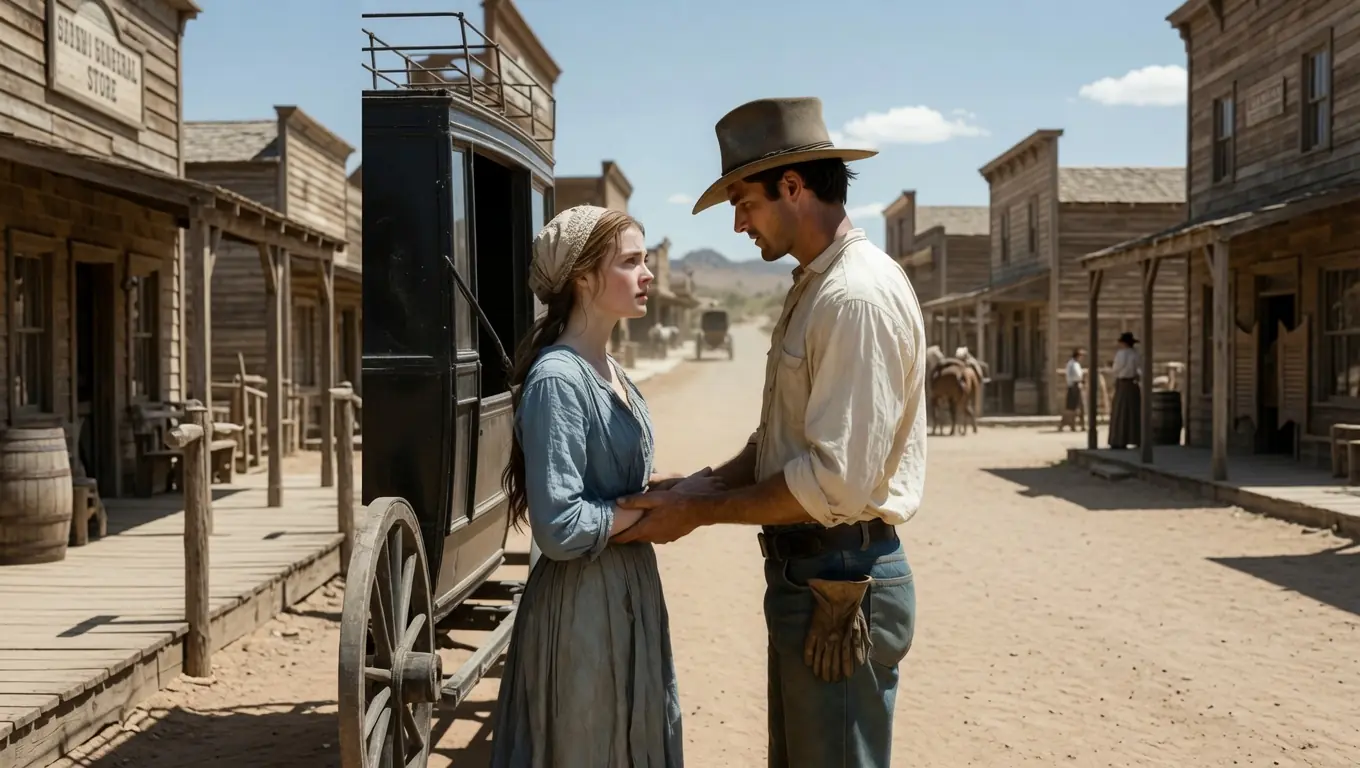
The prospect of becoming a governess or seamstress, living in a cramped boarding house for the rest of her days, had seemed unbearable compared to the adventure waiting in the West. But she had not anticipated this illness. She had not imagined arriving at her new home as a half-dead burden rather than the capable partner she had promised to be. Then the stagecoach driver’s shout cut through her fog of misery.
“Lordsburg ahead.” Alaina tried to sit straighter and smooth her traveling dress so she might appear presentable, but her arms felt like lead weights. The world tilted dangerously, and she gripped the edge of the seat with what little strength remained in her fingers. The coach rolled to a stop in front of the general store, dust swirling around the wheels.
Through the window, Alaina could see a small cluster of buildings lining a wide dirt street. Mountains rose in the distance, purple and imposing against the endless blue sky. It should have been beautiful, and she should have felt excitement, hope, and anticipation. Instead, she felt only the desperate need to lie down before she collapsed entirely.
The door swung open, and the driver’s weathered face appeared. “Miss Spencer, there is a gentleman here who says he is Philip Emerson.” Alaina’s heart hammered against her ribs. This was it, the moment she had both dreaded and longed for during the endless journey.
She took a shaky breath and tried to stand, but her legs buckled immediately. The older woman caught her arm. “Easy now, dear. Let us help you.” Together, the woman and the driver half carried Alaina from the coach.
The bright New Mexico sun hit her like a physical blow, and she would have fallen if strong hands had not suddenly caught her. “What in the hell happened?” a deep voice demanded. “Is she injured?” Through her blurred vision, Alaina saw a tall man with broad shoulders and sun-darkened skin.
He wore a simple cotton shirt, worn denim trousers, and a wide-brimmed hat that shaded his face. But it was his eyes that caught her attention, even through her delirium. They were striking hazel, flecked with gold, and filled with genuine concern rather than the disgust or anger she had feared. “Sick,” she managed to whisper. “I am so sorry. I did not mean to arrive like this.”
“How long has she been sick?” Philip Emerson’s hands were gentle as he steadied her, and she noticed how large they were, calloused from hard work but surprisingly careful. “For days,” the older woman answered for her. “Fever and weakness. She has barely kept down water.” Philip muttered something under his breath that Alaina’s swimming head could not quite catch.
Alaina wanted to protest, to insist that she could walk and maintain some shred of dignity, but her body had other ideas. She found herself leaning into Philip’s chest, feeling the steady thump of his heart through his shirt. He smelled of leather, sage, and honest sweat, and somehow that simple earthiness was more comforting than anything she had experienced in weeks. He carried her to a large bay horse and somehow managed to mount while still holding her, settling her across his lap as though he had done this a hundred times before.
Alaina’s eyes drifted closed as the horse began to move. The gentle rocking motion was surprisingly soothing despite her nausea. “Stay with me now,” Philip said, his voice rumbling through his chest. “Do not go falling asleep until I know what we are dealing with.”
“Trying,” Alaina murmured. “I am so sorry. This is not how I wanted to meet you.” Philip looked down at her. “Life rarely goes according to plan. Can you tell me your symptoms?”
Alaina forced her eyes open and found herself looking up at his profile. He had a strong jaw covered in several days’ worth of stubble and a nose that looked as if it might have been broken once. He was not classically handsome, perhaps, but there was something solid and reassuring about his features. “Fever, headache, everything hurts, and I cannot keep food down.”
She paused, swallowing against the dryness in her throat. “I thought it would pass. It might be influenza. It might be something else.” Philip’s jaw tightened. “We have a doctor in town, but he is visiting his daughter in Silver City this week. I will have to do what I can myself.”
“You do not have to,” Alaina said, though even she could hear how weak her protest sounded. “You could send me back. I would understand. This is not what you agreed to.” Philip glanced down at her, and something in his expression made her chest tighten in a way that had nothing to do with her illness.
“You came all this way,” he said. “The least I can do is make sure you do not die on my account. We will worry about the rest when you are well.” The ride to the ranch passed in a blur of hot sun and swaying motion. Alaina drifted in and out of awareness, catching glimpses of vast grassland dotted with cattle, rocky outcroppings, and a sky so huge and blue it seemed impossible.
Finally, the horse turned down a path lined with cottonwood trees, and a house came into view. It was larger than Alaina had expected, a sturdy adobe structure with a covered porch and real glass windows. Outbuildings dotted the property, and she could see horses in a corral near what must have been the barn. Philip dismounted with the same careful grace he had shown before, keeping her secure in his arms.
He carried her up the porch steps and through the front door into a blessedly cool interior. “The bedroom is this way,” he said, more to himself than to her. He shouldered open a door and laid her gently on a large bed covered with a colorful quilt. Alaina sank into the mattress with a sigh of relief, her body finally able to stop fighting to stay upright.
“I am going to get water and supplies,” Philip said, already moving toward the door. “Do not try to get up.” Alaina could not have gotten up if her life depended on it. She let her eyes close just for a moment, and when she opened them again, Philip was back, setting a basin of water on the bedside table along with several clean cloths.
“We need to get that fever down,” he said, his tone businesslike now. “I am going to put cool compresses on your forehead and wrists. It might be uncomfortable.” “Already uncomfortable,” Alaina managed, and she was rewarded with the faint curve of his mouth. Philip dunked one of the cloths in the water, wrung it out, and placed it gently on her forehead.
Alaina gasped at the shock of coolness, but after a moment, the relief was overwhelming. He repeated the process with her wrists, his large hands surprisingly gentle as he positioned the compresses. “Better?” he asked. “Yes,” she whispered. “Thank you.”
Alaina studied him as he worked, noting the concentration in his expression and the careful way he handled her. “You must think me terribly foolish, traveling all this way only to arrive half dead.” Philip looked at her without hesitation. “I think you are brave.” She blinked at him, unsure she had heard correctly.
“Leaving everything you knew to come to a place you had never seen, to marry a man you had never met, takes courage,” he said. “Getting sick does not change that.” His words settled something in Alaina’s chest that she had not realized was unsettled. She had spent the last four days not just fighting her illness, but fighting her own shame and fear of judgment.
To hear him speak of bravery rather than foolishness was like cool water on a deeper kind of burning. Philip cleared his throat softly. “I should get you out of that traveling dress.” Then he colored slightly. “I mean, you would be more comfortable in a nightgown. I will find something that belonged to my mother.”
“Your mother?” Alaina asked. “She passed five years ago,” Philip said. “Influenza, actually, during a particularly bad winter. My father followed her six months later. Heart just gave out, the doctor said, but I think he died of missing her.”
Philip stood, his expression distant. “They had that kind of love, the kind that cannot survive being torn in half.” He left the room before Alaina could respond, leaving her to think about his words. What must it be like to love someone so completely that losing them meant losing yourself? Her own parents had cared for each other, certainly, but theirs had been a practical partnership, respectful but not particularly passionate.
Philip returned with a simple white nightgown, worn soft from many washings. “I will step outside while you change. Call if you need help.” But when Alaina tried to sit up and lift her arms to unbutton her dress, the room spun violently. She made a small sound of distress, and Philip was back at her side immediately.
“Easy,” he said. “I will help. I promise to be respectful about it.” Alaina knew she should feel mortified, but she was too sick to care about propriety anymore. She nodded weakly, and Philip helped her sit up, supporting her with one arm while his other hand worked the buttons down the back of her dress.
He was as careful and clinical as any doctor. His touch was respectful despite the intimacy of the situation. Getting the dress off required some maneuvering, and by the time he slipped the nightgown over her head and helped work her arms through the sleeves, Alaina was shaking with exhaustion. But she had to admit she felt better without the restrictive traveling clothes.
Philip eased her back down and pulled a light sheet over her. “Better?” “Much,” she whispered. “Thank you for your kindness. I do not deserve it.” Philip’s expression grew firm. “Everyone deserves kindness when they are sick. Now, I am going to try to get some water in you. Just small sips.”
He helped her drink, patient when she could only manage tiny amounts, never showing frustration when she had to stop to let her stomach settle. When she finally could not take any more, he set the cup aside and refreshed the cool compresses. “You should rest now,” he said. “I will check on you in an hour.”
“You have a ranch to run,” Alaina protested weakly. “You cannot sit here watching me sleep.” Philip straightened. “I have hired hands to handle the daily work. Right now, my only job is making sure you recover.”
He stood and moved toward the door, then paused. “Alaina, that is your name, correct? The letter said Alaina Spencer.” “Yes,” she said faintly. “And you are Philip Emerson.” “I am.”
“Well, Alaina, I want you to know something,” Philip said. “Whatever happens, whether you decide to stay after you recover or whether you want to return to Boston, I will not hold any of this against you. You did not ask to get sick. Life just happens sometimes.” Before Alaina could form a response, he was gone, pulling the door partially closed behind him.
She lay in the quiet room, listening to the sounds of the ranch drifting through the window. Cattle lowed in the distance. Horses whinnied. Men’s voices called to one another about work she could not imagine.
She had thought she understood what she was agreeing to when she answered Philip’s advertisement. A partnership, a practical arrangement that would benefit them both. She would gain security and a home. He would gain a wife to help run the household, perhaps to give him children someday.
But lying in his mother’s bed, wearing his mother’s nightgown, having felt the gentleness in his hands and heard the understanding in his voice, Alaina realized the situation was already more complicated than she had anticipated. This man was not just a means to an end. He was real, solid, and kind in a way that made her chest ache with something she could not quite name. She drifted into an uneasy sleep filled with fragmented dreams of her mother’s face, the rolling stagecoach, and strong arms catching her before she fell.
When she woke, the light had changed, and Philip was back at her bedside, replacing the compresses with freshly cooled ones. “How long was I asleep?” she asked, her voice rough. “About two hours,” he said. “How do you feel?” Alaina considered the question. “The same. Perhaps slightly less like death.”
That almost-smile flickered across Philip’s face again. “Progress. I brought some broth. Do you think you could manage a few spoonfuls?” Her stomach churned at the thought, but Alaina knew she needed to try. Philip helped her sit up, propping pillows behind her back, then settled into a chair beside the bed with a bowl of steaming golden liquid.
“Small bites,” he instructed, dipping the spoon. “We will take it slow.” He fed her like a child, patient and steady, never rushing despite how long it took. The broth was simple but good, salty and warm, and to Alaina’s relief, her stomach accepted it without immediate rebellion.
She managed perhaps a dozen spoonfuls before exhaustion overwhelmed her again. “That is good,” Philip said, setting the bowl aside. “Better than I hoped. You rest again. I will be nearby if you need anything.”
The pattern repeated itself through the long afternoon and into the evening. Alaina would sleep fitfully, wake to find Philip there with water, broth, or fresh compresses, then drift off again. He never seemed impatient and never made her feel like a burden. His hands were always gentle, his voice always calm.
As night fell and the room grew darker, Alaina woke to find Philip lighting a lamp. The glow pushed back the dimness, and she realized with a start that he looked exhausted. Dark circles marked his eyes, and his movements were slower than they had been that morning. “You should sleep,” she said. “You have been caring for me all day.”
“I will sleep later,” he replied. “Your fever is still high. I do not want to leave you alone.” “Philip,” she said, waiting until he looked at her fully. “I will be all right for a few hours. You need rest, too.”
He scrubbed a hand over his face, and she could see him considering her words. Finally, he nodded. “The door will be open. If you need anything, anything at all, you call out. I will hear you. I promise.” He extinguished the lamp, leaving the room softened only by moonlight through the window.
Alaina heard him cross to the door. But instead of moving down the hall as she had expected, she heard the creak of floorboards just outside her room and the sound of him settling against the wall. He was going to sleep right there, close enough to hear if she called, refusing to go far despite his own exhaustion. Something in Alaina’s chest cracked open at the realization.
She barely knew this man. They had exchanged only a handful of words, nothing more. Yet he was sacrificing his own comfort and rest to ensure her well-being, not out of obligation or duty, but from simple human kindness. Tears leaked from the corners of her eyes, though whether from weakness or emotion, she could not say.
She had been alone for so long, first after her parents’ deaths and then during the endless journey west. To suddenly have someone caring for her, putting her needs above his own, was overwhelming in its tenderness. She fell asleep with that thought, and for the first time in days, her dreams were peaceful. The next morning, Alaina woke to sunlight streaming through the window and Philip back in the chair beside her bed, a cup of coffee cradled in his hands.
He looked only slightly more rested, and she suspected he had not slept much against the hallway wall. “Morning,” he said. “Your fever broke during the night. You are still warm, but nothing like yesterday.” Alaina took stock of her body and realized he was right.
The crushing pain in her head had diminished to a dull ache. Though she felt weak as a kitten, the bone-deep wrongness had eased. “I feel better,” she said, surprised. “Truly better.” “Good,” Philip said, the relief in his voice unmistakable. “That is very good.”
“I was starting to worry we might need to send for the doctor in Silver City despite the distance,” he continued. “But if the fever is breaking, you should continue to improve.” He helped her drink more water and coaxed her into eating dry toast, which her stomach accepted grudgingly but without revolt. As he worked, Alaina found herself studying him more closely, taking in details she had been too sick to notice before.
He was perhaps thirty years old, with the weathered look of a man who spent his days outdoors. His hands, as she had noticed before, were large and work-roughened, but they moved with a careful precision that suggested he was used to handling things requiring a delicate touch. When he smiled, small lines appeared at the corners of his eyes, suggesting he did it often, though he had been serious during her illness. “You are staring,” Philip said mildly, not looking up from the toast he was spreading with butter.
Alaina felt heat creep into her cheeks. “I apologize. I was just thinking that I should know what my potential husband looks like, since I have seen very little beyond the inside of my own eyelids since I arrived.” “Fair point,” Philip said, looking up and meeting her eyes directly. “What do you think?”
The question was asked lightly, but Alaina sensed genuine curiosity beneath it. She considered lying, offering some polite platitude, but something about Philip’s straightforward manner made her want to match his honesty. “I think you look like a man who works hard and keeps his word,” she said. “I think you have kind eyes and gentle hands. I think I was fortunate that you were the one who answered my letter, and not someone else.”
Philip’s expression shifted, something surprised and tender flickering across his face. “I think I was the fortunate one,” he said quietly. “Not every woman would have had the courage to come all this way, and certainly not every woman would be as gracious as you have been about arriving sick and being cared for by a stranger.” Alaina looked down, then back at him. “You do not feel like much of a stranger anymore.”
She wondered immediately if she had been too forward, but Philip only nodded slowly, his eyes never leaving hers. “No,” he said. “I suppose you do not feel like a stranger to me, either.” The moment stretched between them, fragile and new, until the sound of horses and men’s voices outside broke the spell.
Philip stood and moved to the window. “My foreman and some of the hands,” he said. “I should go speak with them about today’s work.” He turned back to Alaina. “Will you be all right for a little while?”
“I will be fine,” she said. “Go run your ranch. I have monopolized enough of your time.” Philip hesitated at the door. “It was not a monopoly if I gave the time freely.” Then he was gone, leaving Alaina to contemplate the quiet warmth his words had kindled in her chest.
She lay back against the pillows, feeling more alert than she had in days despite her lingering weakness. Through the window, she could hear Philip’s voice, calm and authoritative, as he spoke with his men. Someone laughed at something he said, and Alaina found herself smiling at the sound. She must have dozed again, because the next thing she knew, the sun had moved across the sky, and there were new sounds in the house.
There was the clatter of pots and the smell of something cooking. Alaina’s stomach, which had rejected nearly everything for days, actually rumbled with interest. The bedroom door opened, and a woman appeared, perhaps sixty years old, with iron-gray hair pulled back in a severe bun. She carried a tray laden with bowls and cups.
“So, you are awake,” the woman said, her tone brisk but not unkind. “Good. I am Martha Daniels. My husband, James, is Philip’s foreman. Philip sent word this morning that he needed someone to help care for you so he could get back to work. I brought soup and fresh bread.”
Alaina struggled to sit up, suddenly aware of how disheveled she must look. “It is a pleasure to meet you, Mrs. Daniels. I apologize for the trouble.” “No trouble,” Martha said. “Philip is a good man, and anyone he cares enough to help is worth helping.”
Martha set the tray on the bedside table and began arranging things with efficient movements. “Now, let us see about getting some proper food into you. You are thin as a rail.” Under Martha’s no-nonsense care, Alaina found herself eating more than she had in days. The soup was thick with vegetables and tender pieces of chicken, and the bread was still fresh.
Martha kept up a steady stream of conversation, filling Alaina in on the ranch and the people who worked there. “Philip runs about two thousand head of cattle,” she said, refilling Alaina’s water cup. “Good breeding stock. His father started the ranch thirty years ago with nothing but determination and a small herd. Built it up to something substantial.”
“Philip has been managing it mostly on his own since his father passed, though James helps with the day-to-day operations.” “It must be difficult handling everything alone,” Alaina said. “It is,” Martha replied. “A ranch this size needs a woman’s touch in the house, and Philip needs a partner to share the burdens with.”
Martha gave Alaina a measured look. “I will not pretend to understand the whole mail-order bride situation, but I will say this. Philip is one of the finest men I have ever known. Honest, hard-working, and fair to his people. He deserves someone who will appreciate him.”
The message was clear. Alaina nodded. “I intend to do my best to be a good wife to him if he still wants to marry me after all this.” “Oh, he will want to marry you,” Martha said with certainty. “I saw how he looked when he came to our house this morning. That is not how a man looks when he is thinking about backing out of an arrangement.”
Alaina felt that warmth kindle in her chest again. She wanted to ask exactly how Philip had looked and what he had said, but pride kept the questions behind her teeth. Martha stayed through the afternoon, helping Alaina wash up, change into a fresh nightgown, and brush out her tangled hair until it shone. By the time Philip returned that evening, Alaina was propped against the pillows, feeling almost human again.
“You have color in your cheeks,” Philip said, stopping in the doorway. “Martha’s cooking must agree with you.” “Everything agrees with me better than it did yesterday,” Alaina said. “Mrs. Daniels has been wonderful. She told me about the ranch.”
“Nothing too scandalous, I hope.” Philip came into the room and settled into his now-customary chair. He looked tired again, dust coating his clothes and a streak of dirt across his jaw. But there was satisfaction in his expression, the contentment of a man who had put in a good day’s work.
“Only that you run two thousand head of cattle and treat your people fairly,” Alaina said. “Hardly scandalous.” Philip’s tone turned fond. “Give Martha more time. She will find something to scandalize you with.”
“How are you feeling?” he asked. Alaina considered the question honestly. “Weak and tired, but better. The fever seems to have truly broken. I think I will recover.” Philip leaned back in the chair, some of the tension leaving his shoulders. “Thank God for that. I was more worried than I wanted to admit.”
“Why?” The question slipped out before Alaina could stop it. “You do not know me. I am just a woman who answered an advertisement.” Philip was quiet for a long moment, his eyes on the window where the last light of day was fading into dusk.
“When my mother was dying, she made me promise something,” he said. “She said life was too short to waste on anything less than genuine feeling. She told me to wait for someone who made me want to be better, someone I could respect and admire, not just someone to fill a space in the house.” He looked back at Alaina. “I placed that advertisement six months ago. Do you know how many responses I got?”
Alaina shook her head. “Fourteen,” Philip said. “Most of them were perfectly nice letters from perfectly respectable women, but yours was different. You wrote about wanting adventure, about being willing to work hard, and about hoping to build something meaningful. You did not ask what I could give you. You asked what we could create together.”
Alaina’s breath caught. She remembered writing that letter late at night, pouring her hopes and fears onto the page, trying to be honest about who she was and what she wanted. She had not expected anyone to truly see her in those words. “I worried I had been too forward,” she admitted. “Too bold for a woman.”
“You were honest,” Philip said. “That is worth more than any amount of false modesty.” He leaned forward, his elbows on his knees and his gaze intent. “When you stepped off that coach looking half dead, but still trying to apologize for inconveniencing me, I knew I had been right about you. You are brave and strong, Alaina Spencer. Getting sick does not change that.”
Tears pricked Alaina’s eyes again, but this time she did not try to hide them. “I was so afraid you would send me back, that I had ruined everything before it even began.” “No,” Philip said. “You did not ruin anything.” He reached out and took her hand, his large palm warm and calloused against her skin.
“If anything, these past two days have shown me more about who you are than a dozen letters could have,” he continued. “You are gracious even when you feel terrible. You worry about being a burden even when you can barely sit up. You push yourself to get better instead of wallowing in misery.” “You saw me at my absolute worst,” Alaina pointed out, though she did not pull her hand away.
“True,” Philip said. “And I liked what I saw anyway.” The simple honesty of the statement struck Alaina speechless. She looked down at their joined hands, at the way his thumb slowly, perhaps unconsciously, stroked across her knuckles. Such a small gesture made her feel more seen and cherished than any grand romantic declaration could have.
“Philip,” she said softly, “I want you to know that I meant everything I wrote in my letter. I want to build something real here. I want to be a true partner to you, not just in name, but in every way. I know we have much to learn about each other, but I am willing to do the work if you are.”
“I am more than willing,” Philip said. “But I think we should take our time. Get to know each other properly before we rush into marriage. What do you think?” Relief washed through Alaina. She had been prepared to marry him immediately if that was what he wanted, but the idea of having time to truly build a foundation for their relationship was infinitely more appealing.
“I think that sounds perfect,” she said. Philip smiled, a real smile this time, one that transformed his entire face. “Good. Then we have an understanding. You focus on getting well, and we will figure out the rest as we go.”
Over the following days, Alaina’s health continued to improve. The weakness gradually faded, replaced by returning strength. Martha visited daily, bringing food, gossip, and practical wisdom about life on a New Mexico ranch. Alaina learned that Martha and James had worked for Philip’s father for fifteen years and had stayed after his death, loyal to the family and to Philip personally.
“The boy was only twenty-five when he inherited this whole operation,” Martha told Alaina one afternoon as she helped her into a dress for the first time since arriving. “Younger than most men when they take on such responsibility, but he never faltered. Just rolled up his sleeves and did what needed doing.” Alaina fastened the buttons with fingers that still felt clumsy but were growing steadier each day.
“He seems very capable,” Alaina said. “Capable and then some,” Martha replied. “But lonely, too, though he would never admit it. This ranch is his whole life. He needed someone to share it with.”
Martha gave Alaina a meaningful look. “I think he has found that someone.” By the end of the first week, Alaina was well enough to leave the bedroom. Philip gave her a tour of the house, pointing out the kitchen with its large wood stove, the sitting room with comfortable leather furniture and shelves lined with books, and the dining room with a table that could seat ten.
“My mother loved to have people over,” Philip said, running his hand along the back of one chair. “She said a house was meant to be filled with laughter and good company. After she died, it has been quiet. Too quiet.” “Perhaps we could change that,” Alaina suggested. “Once I am fully recovered, we could have Martha and James over for dinner. I would like to repay their kindness.”
Philip’s face lit up. “My mother would have liked you. She always said the measure of a person was in how they treated those who had been kind to them.” He showed her the rest of the house, including a room he used as an office, filled with ledgers and papers documenting the ranch’s operations. Alaina paused in the doorway, taking in the organized chaos.
“This is where all the real work of running a ranch happens,” Philip said. “Tracking breeding records, managing finances, and planning for the seasons. The hands do the physical labor, but someone has to ensure it all makes sense on paper.” “Could you teach me?” Alaina asked. “About the business side, I mean. I was always good with numbers. In Boston, I helped my father with his bookkeeping before he died.”
Philip looked at her with surprise and admiration. “You want to learn about ranch management?” “I want to be useful,” Alaina said. “If we are to be partners, I should understand all aspects of what we are doing, should I not?” “Most women would have no interest in ledgers and breeding records.” Alaina lifted her chin. “I am not most women.”
That smile flickered across Philip’s face again, stronger this time. “No, you certainly are not.” That evening, they sat together in the sitting room after supper, Alaina in one leather chair and Philip in another. A companionable silence settled between them as the fire crackled.
It was the first time they had simply existed in the same space without the urgency of her illness driving the interaction. “Tell me about Boston,” Philip said eventually. “What was your life like there?” Alaina considered the question, surprised to find that the memories no longer hurt quite as much as they once had.
“Busy,” she said. “Crowded. Everyone always rushing somewhere. My father was a clerk, and my mother took in sewing. We were not wealthy, but we were comfortable.” She paused. “Then the cholera came, and within a month, both my parents were gone. My brother took me in, but his wife had just had their third child, and the house was already cramped. I tried to help and earn my keep, but I felt like I was always in the way.”
“I am sorry,” Philip said quietly. “Losing both parents at once must have been devastating.” “It was,” Alaina said. “But in a strange way, it also freed me. I had always dreamed of adventure, of seeing more of the world than the same Boston streets. When I was a girl, my father used to read me stories about the West, about mountains and deserts and endless skies. I never thought I would actually get to see it.”
Alaina looked out the window at the darkening landscape. “But here I am.” “Any regrets?” Philip asked. Alaina met his eyes. “Not a single one.”
The next day, Philip had work that would keep him away from the house until evening, checking on the herd in the northern pastures. Alaina, feeling restless after days of convalescence, decided to explore the area around the house. The ranch was beautiful in a stark and powerful way that was nothing like the green landscapes of the East. The land rolled away in all directions, brown and gold under the bright sun, dotted with scrub brush and the occasional stand of trees.
The mountains in the distance seemed to change color with the light, shifting from purple to red to gold. Alaina made her way to the barn, curious to see the horses she had heard but not yet met. Inside, the air was cool and smelled of hay and animals. Several horses poked their heads over stall doors, regarding her with mild interest.
“You must be Miss Spencer.” Alaina turned to find a young man, perhaps twenty-two or twenty-three, leaning against a post. He had sandy hair and an easy smile, and he tipped his hat politely. “I am Thomas Wright, one of the hands. Philip said you were sick when you arrived. Glad to see you up and about.”
“Thank you,” Alaina said. “I am glad to be up and about as well. These must be the horses.” “Some of them,” Thomas said. “We have about twenty altogether. These are the ones we use for everyday work.”
Thomas walked over to one stall and patted the nose of a gray mare. “This is Daisy, gentle as they come. Philip said once you were well, you would probably want a horse to ride. Daisy would be perfect for you.” Alaina had ridden as a child, though it had been years.
The idea of being able to explore the ranch on horseback was appealing. “She is lovely.” “I could saddle her up for you now if you want to take a short ride,” Thomas offered. “Just around the yard. Nothing strenuous.” Alaina hesitated, then nodded. It felt good to make a decision for herself, to do something active after days of being an invalid.
Thomas was efficient, and within minutes Daisy was saddled and ready. Alaina accepted Thomas’s help mounting, settling into the saddle with a feeling of rightness. The mare stood patient and steady as Alaina adjusted the reins. “Just take it easy,” Thomas advised. “If you start feeling tired, come right back.”
Alaina walked Daisy around the yard, relearning the rhythm of riding. The mare was indeed gentle, responsive to even the lightest touch. By the time Alaina had completed several circuits, she felt exhilarated rather than exhausted. She was dismounting when the sound of approaching hooves made her turn.
Philip was riding into the yard on his bay, and the look on his face was one of surprise and pleasure. “You are riding,” he said, swinging down from his horse. “Thomas was kind enough to saddle Daisy for me,” Alaina said. “I hope that is all right. I did not mean to overstep.”
“Overstep?” Philip said. “Alaina, this is going to be your home. You do not need permission to ride one of the horses.” He came closer, his eyes searching her face. “But are you sure you are ready? You have been very sick.”
“I feel fine. Truly. A little weak still, but nothing that rest will not cure. And it felt wonderful to be doing something active instead of lying in bed.” Philip nodded, though Alaina could still see concern lingering in his expression. “Just promise me you will not push yourself too hard. Recovery takes time.”
“I promise.” Thomas, tactfully giving them privacy, emerged to take the horses and settle them. Philip placed a hand lightly on the small of Alaina’s back, guiding her toward the house. “I am glad to see you feeling better,” he said. “You had me worried for a while there.”
“I believe I had myself worried, too,” Alaina admitted. “I have never been that sick before. It was frightening to feel so helpless.” “You were never helpless,” Philip said, opening the door for her. “Sick, yes, but you never stopped fighting. That takes strength.”
Inside, Martha had left fresh bread and a pot of stew for their supper. They ate together at the large dining table, and Alaina tried to imagine what it would be like to fill the other chairs with guests, to bring life and laughter back to this house that had been quiet for too long. “You are thinking very hard about something,” Philip observed. “I was thinking about your mother and how she liked to fill this house with people,” Alaina said. “I was thinking I would like to do the same.”
“We will,” Philip said. “Give it time.” He paused, then added, “I have been thinking about something, too. About us and our arrangement.” Alaina set down her spoon, sudden nervousness fluttering in her stomach.
“I know we agreed to take our time getting to know each other before marrying,” Philip said. “I still think that is the right choice, but I want you to know that my intentions are serious. I want this to work, Alaina. I want you to be happy here.” The sincerity in his voice made her chest tighten.
“I want it to work, too,” she said. “And I am happy here, Philip. Happier than I expected to be.” “Even after arriving sick and having a stranger nurse you through a fever?” he asked gently. “Especially because of that,” she answered.
“You showed me exactly who you are in those days,” she continued. “Someone kind, patient, and caring. Someone I could trust with my life because you already saved it.” Philip reached across the table and took her hand, just as he had done in her sickroom. “You are making it very difficult to take things slowly.”
Alaina felt heat creep into her cheeks, but she did not look away. “Is that such a bad thing?” “Not bad,” Philip said. “Just complicated. I do not want to rush you. I do not want you to feel obligated because I helped you when you were sick.”
“I do not feel obligated,” Alaina said. “I feel grateful, yes, but more than that, I feel drawn to you. These past days, getting to know you, seeing how you run this ranch and treat the people who work for you, learning about your parents and their love for each other, it has all made me want to be part of this life even more.” Philip stood and came around the table, drawing Alaina to her feet.
They stood close enough that she had to tilt her head back to meet his eyes, close enough to feel the heat of him. “Alaina Spencer,” he said softly, “would you do me the honor of truly courting you? Not just as part of our arrangement, but because I genuinely want to know everything about you. Your hopes and dreams, your fears and joys, all the little pieces that make you who you are.”