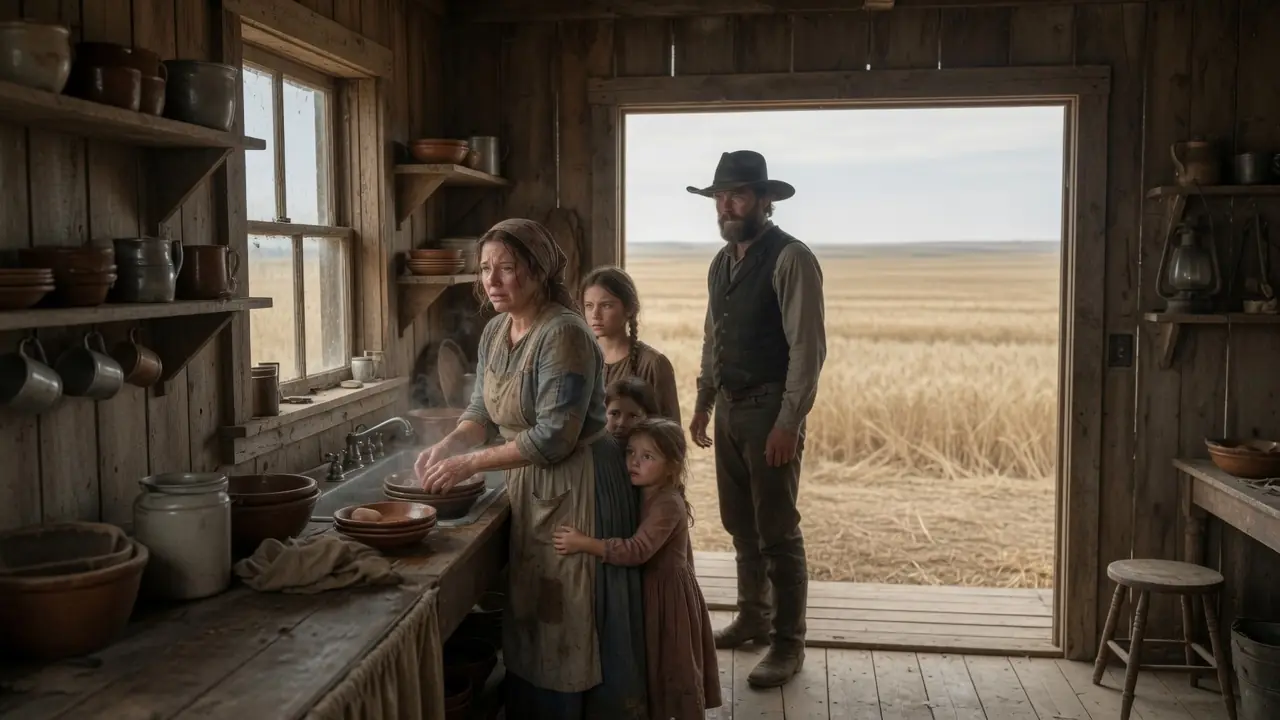
Mabel Harlo stood at the washbasin with her sleeves rolled past her elbows, her hands red from hot water, her patched apron damp against the front of her dress. Steam rose from the tin basin and drifted through the rough frontier kitchen, catching the late sunlight that poured through the small square window. Her three daughters stayed close behind her, so close that little Ada had one fist twisted into the back of Mabel’s skirt while June leaned against her hip and Clara watched the open doorway like she expected the world to come back and take them again. In that doorway stood Gideon Cross, broad-shouldered and silent beneath his black hat, looking at the widow the town had laughed at as if she had just done something holy by simply refusing to fall apart.
Mabel froze when she saw him. Her first instinct was to apologize, though she did not yet know what she had done wrong. She had washed the supper dishes, swept the floor, scrubbed the stove, and folded the towels she had found stiff with old grease from years of lonely neglect. Still, she had spent too many years learning that a woman with no money and three children must apologize before anyone accused her.
“If the dishes aren’t enough,” she said, wiping her wet hands on her apron, “I’ll work harder tomorrow.”
Gideon did not answer immediately. His eyes moved from the basin to her blistered fingers, then to the three little girls pressed against her like frightened sparrows. Clara, the oldest at eleven, lifted her chin with a courage too old for her face. June looked at the floor, and Ada peered around Mabel’s skirt with wide eyes.
“I didn’t come in here to count dishes, Mrs. Harlo,” Gideon said at last.
Mabel searched his face, trying to find the catch in his kindness. Men like Gideon Cross did not spend ten dollars at a labor auction for no reason. Men did not take in a widowed woman and three daughters because they had empty rooms and generous hearts. In Mabel’s experience, every mercy came with a hook hidden somewhere inside it.
Clara spoke before Mabel could. “Are you sending us back to town, sir?”
Gideon looked at the child, and something in his expression shifted. It was not softness exactly, because Gideon Cross was not a soft-looking man. His beard was thick, his face weathered, and a faint scar ran along his jaw like a line carved by a hard year. But his voice, when it came, was lower than before.
“No,” he said. “I’m wondering who taught you all to expect so little kindness.”
Mabel looked away first. It was easier to face dirty dishes than that sentence. The kitchen had already begun changing under her hands, though she had been in the house only two days. The windows were open, the old curtains soaked in a bucket, the shelves rearranged, the plates cleaned and stacked where they could be found. Gideon had noticed, though he had said nothing until now.
Two days earlier, the whole town had watched Mabel stand on a wooden platform in Red Hollow Square while the auctioneer called out her name. Her dress had been mended so often that some patches had their own patches, and her boots did not match, one brown and one nearly black. Her daughters had stood around her like they could hold her dignity in place if they held her skirt tightly enough. When Cecil Potts called her “used goods,” the men near the back laughed into their hands.
Mabel had not lowered her eyes.
That had been the only thing left to her, that one small refusal. Her husband Thomas had died fourteen months earlier, leaving a poor homestead, debts, and three daughters who still woke up some mornings asking questions she could not answer. The bank had taken the land, the store had stopped extending credit, and the town that had once accepted her pies at church suppers began looking through her in the street. By the time she climbed onto that auction platform, she had learned what polite people could do to a widow while still calling themselves decent.
The bids had started as jokes.
Five dollars, then six, then six and a half, each number offered with laughter instead of intent. Bartholomew Crow, the richest cattleman in the county, had stood near the platform with his pale gray eyes and his clean gloves, watching her like a man waiting for a trapped animal to stop struggling. Mabel knew his name too well. His money had touched the note on her homestead before the bank took it, and though she could not prove his hand had pushed the door closed, she knew he had been near the lock.
Then Gideon Cross had spoken from the edge of the crowd.
The laughter stopped as if someone had cut a rope. Gideon Cross did not attend town gatherings, did not come to church, did not linger in Red Hollow longer than supplies required. He lived seven miles past the ridge on a ranch people said had gone quiet after his wife died. When he bid, nobody made another joke.
Cecil Potts sold Mabel and her daughters to him for ten dollars.
Mabel had walked to Gideon with her spine straight and her youngest child pressed to her side. “I have three daughters,” she had said, because she needed to be sure he had not failed to understand the burden he had taken. “I know,” he said. “And I won’t be treated as something you purchased.” Gideon had looked at her with those unreadable eyes and answered, “I don’t need to own anyone. I need a house that remembers how to live.”
That was why she had followed him.
Not because she trusted him. Not because she believed in rescue. She followed because the town had offered humiliation, Crow had offered a cage dressed as opportunity, and Gideon had offered work without pretending it was anything else. His honesty had been cold, but it had been honest.
Now, in his kitchen two days later, that honesty unsettled her more than cruelty would have.
“Girls,” Mabel said softly, “go upstairs and wash for bed.”
Clara did not move at once. Her eyes stayed on Gideon, measuring him with the seriousness of a child who had already learned adults could fail. Gideon did not rush her. He simply stepped aside from the doorway, leaving the path open. That did more than any reassurance could have done.
Clara took Ada’s hand, and June followed them upstairs. Their footsteps were small against the old boards. When they were gone, Mabel turned back to the basin because she needed something to do with her hands. Gideon came no farther into the kitchen, which she noticed.
“You paid ten dollars,” she said.
“I did.”
“People don’t pay money for nothing.”
“I didn’t pay for nothing.”
Her shoulders tightened. Gideon seemed to hear the wrongness of his answer at the same moment she did. He removed his hat and held it at his side. “I paid because Crow was waiting for the price to drop,” he said. “And I know what happens to people when Bartholomew Crow starts calling them an opportunity.”
Mabel turned slowly.
The name sat between them like a knife laid on the table. She had not expected Gideon to name him so plainly. Most people in Red Hollow spoke of Crow with careful respect or careful fear. Gideon spoke as if fear were a coat he had never chosen to wear.
“You know him?”
“I know enough.”
“He wanted me desperate,” Mabel said, and the words surprised her because she had not intended to say them aloud. “Not dead. Not gone. Just desperate enough to accept whatever he offered next.”
Gideon’s jaw tightened. “Then it’s good I spoke first.”
There was no warmth in the sentence, but there was something better. Certainty. Mabel felt her throat close and turned back to the dishes before he could see too much on her face. She had been holding herself together for so long that any kindness touched the seams dangerously.
The first weeks at Cross Ranch were built from work.
Mabel rose before sunrise, lit the stove, fed the girls, washed, scrubbed, sorted, mended, and began remaking the house one corner at a time. She did not ask permission for small repairs because no one had the energy to run a home by permission. If a hook was bent, she straightened it. If a shelf sagged, she emptied it and found a hammer. If a curtain was too stained to save, she cut it into rags and hung a sheet until she could sew something better.
Gideon noticed everything.
He said very little, but Mabel learned to read the way he paused in doorways. The first time he stepped into the main room after she rearranged the chairs near the stove, he stopped for three full seconds, looked at the space, and then sat in the chair closest to the fire as if it had always belonged there. The next morning, he brought in a stack of split wood without being asked and placed it beside the stove. It was the first time since Thomas died that a man had done a useful thing in her house without waiting to be praised for it.
The girls began to bloom in uneven ways.
Clara helped Mabel with the kitchen, keeping accounts of flour, beans, salt pork, and candles in a careful little notebook Gideon gave her after he saw her counting supplies on her fingers. June found the horses and fell in love with a bay mare that did not usually trust strangers but lowered her head to the child as if recognizing another creature that had learned caution too early. Ada followed Gideon whenever she could, asking questions that made the silent rancher look more helpless than any gun ever had.
“Do horses get lonely?” Ada asked him one morning near the barn.
Gideon considered the question as seriously as he would consider weather. “Yes,” he said. “I think they do.”
“Do cowboys?”
Mabel, standing by the pump, went still.
Gideon looked toward her before looking back at Ada. “Some of them,” he said.
Ada nodded as if she had suspected this all along. “You should eat more pie then,” she said. “Mama says pie helps sadness.” Then she ran off toward June, leaving Gideon standing there with an expression Mabel could not name.
That evening, she made apple pie.
Not because of Ada. Not because of Gideon. At least, that was what Mabel told herself as she rolled the crust thinner than she had patience for and sliced the apples carefully. When she set the pie on the table after supper, Ada announced proudly that she had fixed Gideon’s sadness. Clara covered her mouth to hide a smile. June looked between her mother and Gideon with the sharpness of a child who noticed more than anyone wanted.
Gideon took one bite.
Then he looked at Mabel across the table. “It helps,” he said.
It was only two words, but Mabel felt them somewhere beneath her ribs.
By the end of the first month, the house no longer felt abandoned. There were clean curtains at the windows, jars on the shelves, fresh bread in the kitchen, and a vase of dry wildflowers Ada insisted belonged on the sill. Gideon came in for supper on time more often than not. He began asking Mabel what needed doing before deciding everything himself.
That was dangerous.
Not the asking. The feeling it gave her. Mabel had spent years being necessary without being valued. A woman could cook, wash, birth children, bury a husband, fight debt, and still be treated as if her life were a problem to be solved by someone else. Gideon’s questions made her feel not useful, but respected, and respect was harder to defend against than desire.
Then Crow made his first move.
A letter came from the county land office claiming there was a question about one of Gideon’s parcels near the road. Gideon read it twice at the kitchen table, his face still but his eyes colder than usual. Mabel watched him from the stove and knew before he said the name. Bartholomew Crow had found the place to press.
“He wants that land?” she asked.
“He wants me to worry about keeping it,” Gideon answered. “There’s a difference.”
Mabel wiped her hands and came to the table. “Then don’t worry where he can see it.”
Gideon looked up.
She pointed to the letter. “Men like him feed on signs. You give him panic, he eats it. You give him silence, he starts guessing.” Her voice stayed level. “And men like Crow hate guessing.”
For the first time, Gideon almost smiled.
“You know men like Crow?”
“I was widowed with three daughters and no money,” Mabel said. “Every town has a Crow. Some just wear better coats.”
He folded the letter carefully. “Then we fight quietly first.”
“We?”
The word slipped from her before she could stop it.
Gideon looked at her for a long moment. Outside, wind dragged dust past the kitchen window, and somewhere upstairs Ada laughed in her sleep. “If you’re willing,” he said.
Mabel should have been afraid of the word. We was a trap when spoken by the wrong mouth. Thomas had used we when he meant Mabel should carry what he could not face. Crow would use we if he meant someone else should lose so he could win.
But Gideon said it like an open gate.
“I’m willing,” she said.
Crow’s next moves came through town.
The feed store hesitated over credit. A woman at church crossed the street when she saw Mabel. Someone told Clara that her mother was living in sin before she was living in marriage, and Clara came home silent, her jaw set hard enough to frighten Mabel. Gideon heard about it, and that night he sat on the porch with Clara while Mabel watched through the kitchen window.
He did not speak to the girl like she was fragile.
He told her people often repeated the words of powerful men because it was easier than growing their own courage. Clara listened, arms wrapped around her knees. Gideon told her she had the right to be angry, but anger should be used like fire in a stove, not fire in dry grass. Later, Clara came inside and hugged her mother without explanation.
That was when Mabel knew she was in trouble.
Not danger from Gideon. Danger from her own heart. She could protect herself from men who wanted something obvious. She could not protect herself from a man who sat beside her daughter and gave her anger a place to stand.
In February, the barn burned.
Mabel woke to the smell of smoke and had the girls outside before she was fully dressed. The east side of the barn glowed orange against the black sky, flames pushing through the boards while horses screamed inside. Gideon was already moving, his coat thrown over his nightshirt, his face lit by fire. He went into the burning doorway once, twice, then a third time before the roof began to crack.
Mabel screamed his name without meaning to.
He came out leading the bay mare June loved, smoke rolling behind him, his sleeve singed, his beard streaked with ash. June sobbed without sound when she saw the horse alive. Ada clung to Clara, and Clara clung back. The barn could not be saved, but most of the animals were.
By dawn, the structure had collapsed into smoking ruin.
Gideon stood beside Mabel in the gray morning, looking at the place where years of equipment, feed, tools, and memories had burned. His hands were blackened. His face was empty in a way that frightened her more than anger would have. She knew what a man looked like when something inside him made a decision.
“Crow?” she asked.
“Yes,” Gideon said.
“What do we do?”
He turned toward her, and the ash on his face made his eyes look almost black. “We stop pretending this is only about land.” His gaze moved toward the porch, where Clara sat with her sisters wrapped in blankets. “And I ask you something I should have asked before the fire forced my hand.”
Mabel’s breath caught.
“Marry me,” he said.
It was not romantic the way stories made proposals romantic. His voice was rough, the yard smelled of smoke, her hands were numb from carrying water, and the children sat watching with frightened eyes. But the words struck Mabel with a force that had nothing to do with ceremony.
“You’re asking now?” she whispered.
“I’m asking now because now is when standing together matters.” He swallowed once, the only sign that the words cost him. “Because marriage gives you and the girls legal standing here. Because Crow will find fewer cracks if this family has one name.” His voice lowered. “And because I want you here, Mabel. Not as labor. Not as debt. As my wife, if you can bear the idea.”
Mabel stared at him.
She thought of the auction platform, the laughter, Cecil Potts calling her used goods, Crow waiting for her desperation to ripen, and Gideon’s ten-dollar bid cutting through the noise. She thought of him answering Ada’s impossible questions, teaching June about horses, giving Clara a notebook, and asking Mabel what needed doing as if her judgment mattered. She thought of the kitchen window with clean curtains and wildflowers on the sill.
“Yes,” she said.
Gideon released a breath that looked like pain leaving his body.
Ada lifted her head from Clara’s lap. “Does this mean he stays ours?” she asked.
Mabel laughed then, suddenly and shakily, and it turned into tears before she could stop it. Gideon looked at Ada, then at Mabel, and for the first time since she had known him, his face softened fully. “If your mother allows it,” he said.
“I allow it,” Mabel said.
They married three days later in the magistrate’s office in Red Hollow. Mabel wore her best dress, still patched but clean, and Gideon wore a clean shirt and the expression of a man walking into something more sacred than he knew how to name. Clara and June stood straight as witnesses, and Ada announced halfway through that she was hungry. The magistrate cleared his throat and finished quickly.
At the hotel afterward, everyone watched them eat breakfast.
Mabel felt the eyes, but for the first time, she did not shrink beneath them. Gideon sat beside her, not across from her, and the girls filled the table with ordinary noise. When someone whispered near the door, Clara turned her head and stared until the whisper died. Mabel almost laughed into her coffee.
Crow heard about the marriage before noon.
His answer came not as a shout but as pressure. More paperwork, more threats, more whispers, more men suddenly unwilling to trade with Gideon. But the barn fire had changed something in Red Hollow. People feared Crow, but they feared fire more. A barn could be anyone’s barn once the powerful learned they could burn one.
The first man to talk was a freight driver named Ed Ferris, who came out to the ranch with information about Crow’s false land filings. Then came Alice Teller with documents about the farm Crow had taken from her husband. Then Tom Rafferty from the feed store admitted he had been told to cut Gideon’s credit. One by one, people brought the truths they had been carrying too long.
Mabel listened to them at her kitchen table.
That became the heart of it, though no one planned it that way. People came to Gideon for protection, but they spoke to Mabel because she knew what it meant to lose everything in pieces while the world called it legal. She did not rush them. She did not shame their fear. She poured coffee, let them sit, and waited until the words came.
The county investigator arrived in March.
By then, the story was no longer only Gideon’s land or Mabel’s auction. It was water rights, false filings, debt chains, coerced silence, and a barn burned because one man believed the county belonged to him. Crow tried to offer a settlement, arriving at the ranch in his polished coat with his reasonable voice and pale eyes. Gideon met him in the yard, and Mabel stood beside him.
“Name your price,” Crow said.
Mabel looked at him calmly. “You already named mine at the auction.”
Crow’s mouth tightened.
“You thought ten dollars bought my silence,” she continued. “It bought me a witness instead.”
Gideon did not speak, but his presence beside her was answer enough. Crow left with his face still composed, but everyone in that yard knew something had cracked. A man could own banks, notes, stores, and favors, but he could not own the moment people stopped believing he was permanent.
The charges came weeks later.
Crow did not fall all at once. Men like him rarely do. But his credit lines were questioned, his filings investigated, his allies denied knowing what they knew, and his name turned from power into caution. By summer, he was forced to sell property to pay judgments, and by autumn, he had left Red Hollow for good.
The new barn went up in May.
This time, men came from town to help. Not all of them. Some still kept their distance, waiting to see which way history would settle. But enough came. They brought lumber, tools, horses, hands, and quiet apologies they did not always know how to say aloud.
Mabel cooked for everyone.
She cooked beans, bread, potatoes, pies, stew, and coffee strong enough to make men stop pretending they had only come for the work. Clara carried plates with serious pride. June disappeared often to check the horses. Ada told every visitor that Gideon was her father now unless he objected, and since he never did, the matter seemed settled.
That evening, after the frame of the new barn stood pale against the sunset, Mabel sat on the porch steps with Gideon. The girls were asleep, exhausted from a day of watching the ranch become whole again. The air smelled of fresh-cut lumber, smoke, and spring grass. For a long while, neither of them spoke.
“I thought my life was finished,” Mabel said finally.
Gideon looked at her.
“Before the auction,” she continued. “After Thomas died. After the bank. I thought the rest would only be survival. Getting the girls through, keeping them fed, taking whatever work people gave me, and being grateful enough not to complain.”
Gideon’s jaw shifted, but he did not interrupt.
“Then you bid ten dollars,” she said, almost smiling. “Not a flattering amount, really.”
He huffed a quiet laugh. “It was enough.”
“It was.” She looked toward the barn. “You gave me a place to stand, Gideon.”
“You built the rest.”
Mabel turned to him. He had said it plainly, the way he always did when something mattered too much to decorate. She reached for his hand, and he took hers as carefully as if it still surprised him that he was allowed. His palm was rough and warm, the hand of a man who had rebuilt more than a barn that year.
“Do you regret it?” she asked.
“Bidding?”
“Marrying me.”
He looked at her as if the question made no sense. “No.”
“Even with Crow, the fire, the town, the trouble?”
“Mabel,” he said quietly, “before you came, this ranch was a house where a man happened to sleep. Now it is a home I hurry back to.” He looked toward the dark kitchen window where the lamp still burned low. “That is not trouble.”
Mabel’s eyes filled, but she did not hide it from him.
The woman who had stood on the platform in patched clothes while men laughed would not have believed this ending. She would not have believed a silent rancher with a scar on his jaw would become the safest place she had ever known. She would not have believed her daughters would laugh again, or that Red Hollow would one day say her name with respect instead of pity.
But life, she had learned, could surprise you after it had broken you.
Years later, when people told the story, they often began with the auction. They said Gideon Cross bought Mabel Harlo for ten dollars and refused to let her leave. Mabel never liked that version much, though she understood why people told it that way. It sounded dramatic, simple, easy to carry.
The truth was quieter.
Gideon had not bought her.
He had seen her.
And after a lifetime of being treated like a burden, that was the first kindness Mabel could believe in.
Every evening after supper, when the dishes were done and the girls were older and the house was loud with the life she had built, Mabel sometimes stood at the washbasin and looked toward the doorway where Gideon had once paused and asked who had taught her to expect so little kindness.
The answer had been everyone.
Until him.