Ryder Phelps had spent eight years teaching his heart to live like a locked door. In Willow Creek, people knew him as the cowboy who rode alone, drank alone, worked alone, and disappeared into the open range whenever a conversation became too personal. He was thirty-two years old, tall and rugged, with gray eyes that rarely softened and a faint scar across his cheekbone that made strangers think twice before asking questions. Men respected him, women wondered about him, and Ryder preferred both from a distance.
The year was 1875, and the Wyoming frontier did not reward softness. Dust covered everything by noon, gun smoke could change a life before supper, and the horizon always looked wide enough for a man to outrun his past. Ryder had tried exactly that since the day he buried his wife Sarah and the unborn child he never got to hold. He had learned that work was safer than love, whiskey was easier than memory, and silence never asked a man to explain why he woke sweating in the dark.
On the evening everything changed, Ryder stood outside the Dusty Trail Saloon watching the sun sink behind the hills. The whole sky burned orange over Willow Creek, and for a moment it reminded him of the old home he had lost near Fort Griffin. He hated that kind of beauty because it reached through his defenses without permission. So he pushed open the saloon door, stepped into the smell of smoke and spilled liquor, and asked Sullivan for another whiskey.
Sullivan was a large man with a careful voice, the kind who knew when a customer wanted conversation and when he wanted only glass and quiet. He slid the drink across the bar and waited until Ryder swallowed it before speaking. “Marshall Turner’s looking for men,” Sullivan said. “Stagecoach coming through tomorrow with a banker’s daughter and some valuables. Hadley gang might try something.”
Ryder’s fingers tightened around the glass. “Not interested in being anybody’s hero.” Sullivan wiped the bar slowly. “Pays twenty dollars.” That was enough money to buy supplies and ride away from Willow Creek for weeks, which was the only reason Ryder listened. A man did not need a cause when money and distance were on the same side.
By dawn, Ryder was outside the marshal’s office with his bay stallion Thunder saddled and restless. Four other men had answered the call, including a young rider named Farley who looked too eager to prove he had nerves. Marshall Turner explained the plan: ride to Copper Ridge, meet the stagecoach, escort it safely into Willow Creek. Ryder said nothing, but he knew simple jobs on the frontier had a bad habit of turning mean.
They reached Copper Ridge by midday and took positions among the rocks. The land stretched dry and empty around them, scrub brush bending under a restless wind, the canyon trail waiting below like a throat. Ryder checked his Winchester and Colt with the steady hands of a man who trusted iron more than people. His father had taught him that a weapon neglected was a grave half dug, and Ryder had never forgotten it.
The stagecoach appeared in a line of dust before they heard its wheels. As it rolled closer, Ryder could see the driver sitting stiff with both hands on the reins and a shotgun messenger beside him scanning the cliffs. Nothing seemed wrong at first. That was exactly what made Ryder uneasy.
“Miss Lillian Brennan,” the driver announced. “Daughter of Edward Brennan of the First National Bank of St. Louis.” Lillian gave a small nod. “Thank you for the escort, gentlemen. I understand the road ahead may be dangerous.” Her voice was steady, and that bothered Ryder more than panic would have, because courage in a woman had always been the sort of thing that made him careless.
Marshall Turner assured her they would get her to Willow Creek safely, and the party moved out. Ryder took point ahead of the stage, scanning every ridge and wash for movement. He told himself she was only another passenger, another task, another reason to earn twenty dollars and disappear again. But when the wind carried the faint scent of lavender from the coach, he wished he were riding farther ahead.
They were halfway through a narrow canyon when the first shot cracked from above. The sound bounced hard between the stone walls, and then the air filled with gunfire. “Ambush!” Ryder shouted, wheeling Thunder around as the stage horses reared. Bullets struck rock, dirt, and wood, splintering the side of the coach while the driver fought to keep the team from bolting.
Ryder saw the shotgun messenger slump sideways, clutching his shoulder. He spurred Thunder toward the coach without thinking, because in a fight, thought came after motion. Leaping from his saddle onto the coach step, he grabbed the reins with one hand and fired his revolver toward the ridge with the other. “Hold on!” he shouted into the coach, and then snapped the reins hard.
The stage lurched forward, wheels bouncing over stones as the horses broke into a wild run. A bullet grazed Ryder’s arm, hot and sharp, but he barely felt it. Marshall Turner and the others returned fire behind him, but the canyon gave Hadley’s men the advantage. Ryder knew the only chance was to break into open country before the gang boxed them in.
Once they cleared the canyon, he drove the coach off the main road into a thicket of cottonwoods beside a dry creek bed. Branches scraped the roof, and one damaged wheel screamed with every turn. Ryder brought the coach to a halt beneath the trees, jumped down with rifle in hand, and took cover behind a fallen log. Two riders pursued them, their horses pushing through dust toward the hidden coach.
Ryder fired once. The first rider dropped from his saddle before he knew where the shot came from. The second fired wildly into the trees, then turned and fled when no help followed him. Ryder kept his rifle raised until the silence settled again. Only then did he turn toward the coach.
“Miss Brennan,” he called. The door opened, and Lillian stepped out, pale but composed. A small cut marked her cheek where broken glass had caught her, but she stood on her own feet without complaint. “That was impressive shooting, mister,” she said.
“Phelps,” he answered gruffly. “Ryder Phelps. Are you hurt?” She touched the cut lightly. “Only shaken. What about the others?” Ryder looked toward the canyon trail. “If Turner and his men are alive, they’ll catch up. But we can’t wait here long. Hadley wasn’t finished.”
The coach was too damaged to continue. One wheel had splintered badly, and the driver, Hollis, had a bleeding graze along his arm. Hollis shook his head when Ryder looked at him. “You take the lady on Thunder. I’ll wait here for Turner. Got a hideaway pistol and enough bullets to make a fool think twice.”
Ryder did not like leaving anyone behind, but the choice was practical. He gathered his saddlebags from the coach, checked Thunder’s girth, and looked at Lillian. “Can you ride?” She lifted her chin. “I grew up on a Missouri farm before my father became a banker. I can ride.” Ryder almost smiled, though he caught himself before it showed.
He helped her into the saddle, then swung up behind her. The closeness struck him like a warning. Her back rested near his chest, her gloved hands holding the front of the saddle, and the torn edge of her sleeve brushed his wrist. Ryder held himself stiff, keeping as much distance as riding double allowed, because the body could remember what the mind tried to bury.
They rode in silence for several miles. Thunder moved steady beneath them, carrying them across open grassland as the canyon disappeared behind dust and distance. Lillian asked no foolish questions, made no demands, and did not complain about the heat or fear. That quiet strength forced Ryder to notice her more than he wanted.
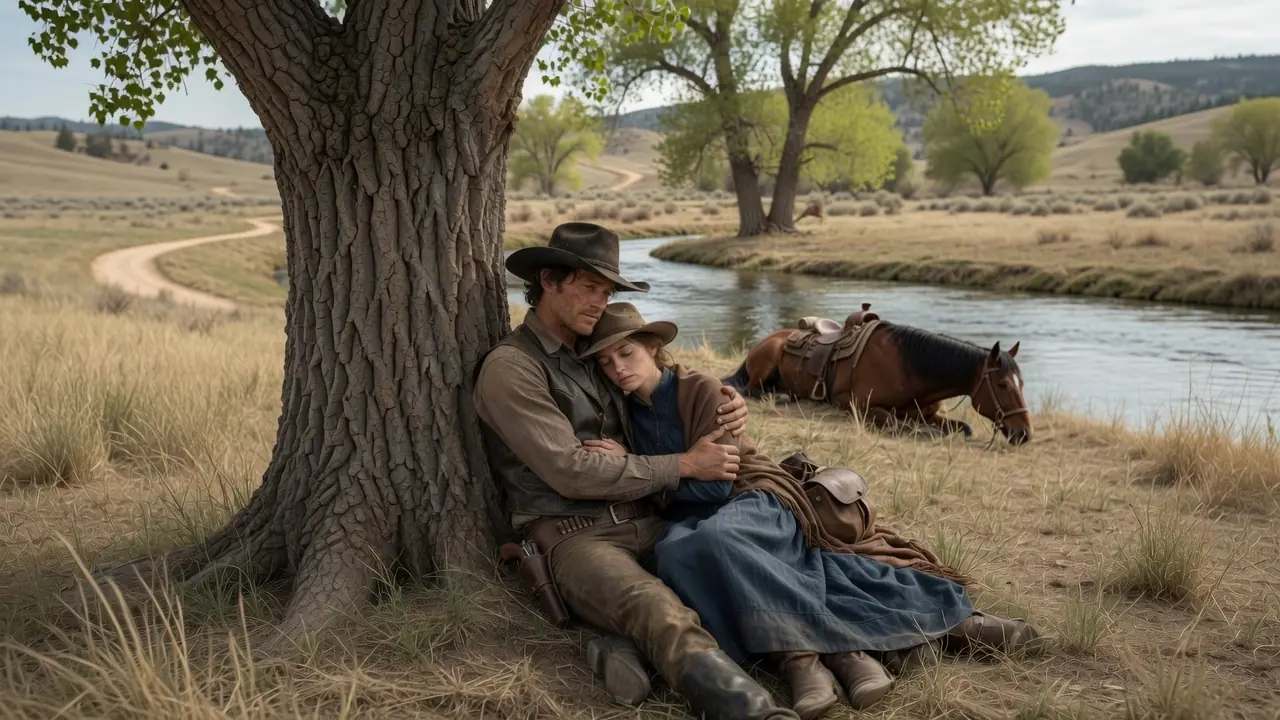
As afternoon slipped toward evening, Lillian’s exhaustion finally won. At first, her head nodded forward, then jerked upright as she fought sleep. Ryder meant to tell her to stay awake, but before he spoke, her body softened against him. Her cheek came to rest against his shoulder, and her breathing deepened.
Ryder went still. The trail, the danger, even the pain in his arm seemed to fade under the simple weight of her trust. It had been eight years since anyone had leaned on him that way, not out of need in a gunfight, but with complete surrender to sleep. One loose strand of her hair touched his neck in the breeze, and the wall inside him trembled.
He told himself it meant nothing. She was tired, frightened, and human, and he was the saddle behind her. Yet his arm moved carefully around her waist to keep her from slipping, and he adjusted his seat so her head could rest easier. The gesture was small, almost nothing, but it scared him more than the ambush. A gunfight was simple. This was not.
By sunset, they reached Clearwater Spring, a quiet place where cottonwood trees circled clear water and the grass grew soft near the bank. Ryder guided Thunder to a halt and sat for a moment longer than necessary, reluctant to wake her. Then he touched her shoulder gently. “Miss Brennan. We’ll rest here.”
Lillian woke slowly, blinking against the fading light. When she realized her cheek was pressed to his shoulder and his arm was holding her safely in place, color rose in her face. “Mr. Phelps,” she said softly, “I didn’t mean to fall asleep on you.” Ryder dismounted first, then helped her down. “No harm done.”
But there had been harm, though not the kind she meant. Something in him had been touched, and he did not know how to put it back where it belonged. He tended to Thunder while Lillian knelt by the spring, washing the cut on her cheek and smoothing her hair with a practical calm that made her seem less like a banker’s daughter and more like a woman who had learned not to wait for rescue. Ryder watched longer than he should have.
They shared jerky and hardtack from his saddlebags. Lillian explained that her father had sent her ahead to prepare for the bank’s new branch in Willow Creek. Her traveling companion had fallen ill in Denver, and Lillian had chosen to continue rather than delay the move. “You traveled alone through this country?” Ryder asked. “Not alone,” she said. “I had a stagecoach full of strangers and, eventually, a very stubborn cowboy.”
He glanced at her sharply, but her smile softened the edge of the words. She asked about him then, why he never stayed long, why everyone in Willow Creek seemed to know his name but not his story. Ryder looked into the spring and said, “Some men aren’t meant for hearths.” Lillian studied him in the amber light. “Every man needs somewhere to return to, Mr. Phelps. Even if it is only in his heart.”
Before he could answer, hoofbeats approached. Ryder was on his feet instantly, rifle raised, his body moving between Lillian and the sound. Relief came when Marshall Turner and two deputies rode into the clearing, battered but alive. Hollis had survived as well, and Hadley’s gang had scattered. But Turner warned that Samuel Hadley himself had not been captured.
They made camp at Clearwater Spring. Ryder gave Lillian his bedroll and settled against a tree nearby with his rifle across his lap. Sleep refused him. He kept remembering her head against his shoulder, her breathing, the trust of it, the way his own hand had held her carefully without being asked.
“You should rest too, Mr. Phelps,” Lillian said from the darkness. She had moved closer, wrapped in his blanket. “I’m fine,” he replied. She did not retreat. “You saved my life today. I never properly thanked you.”
“Just doing the job I was paid for.” The words sounded rougher than he intended. Lillian’s voice stayed gentle. “Is that all it was?” Ryder shifted against the tree. “What else would it be?” She looked toward the low fire. “Human decency. Compassion. Maybe even a little heroism, though I suspect you dislike that word.”
He almost laughed, but the sound would not come. “You make too much of things.” She turned to him, the firelight soft on her face. “No, Mr. Phelps. I think you make too little of yourself.” That sentence stayed with him long after she returned to the bedroll.
Morning brought heat and clear sky. The group rode toward Willow Creek with Turner in the lead and Ryder behind, Lillian once again riding with him on Thunder. She sat straighter now, careful not to lean on him, and somehow that made Ryder miss the weight of her. He hated himself for missing it.
They were five miles from town when dust rose on the horizon. Hadley had gathered his remaining men and was riding hard toward them. Turner ordered everyone toward a small stand of trees, the only cover in sight. Ryder helped Lillian down and handed her his spare revolver. “Only if they get past us,” he said.
Her fingers closed around the weapon with steady confidence. “I told you, Mr. Phelps. My father believed in practical education.” There was no time to answer. The riders came in shooting, and the trees exploded with splinters as bullets struck bark and dirt around them.
The fight was hard and fast. Ryder fired with cold precision, dropping two men while Turner and the deputies held the line. Then he saw Hadley circling south, trying to flank them. Ryder moved through the trees to intercept him, keeping low and quiet until he emerged near a patch of dry grass.
Hadley drew first. His bullet tore across Ryder’s side, hot pain flashing through his ribs. Ryder stayed standing and leveled his revolver. “Drop it, Hadley.” The outlaw’s face twisted with hatred. “Not until the Brennan girl pays for what her father took from me.”
Hadley began to raise his gun again. A shot rang out from behind Ryder, and Hadley staggered as his revolver fell from his hand. Ryder turned and saw Lillian standing with the spare revolver raised, her eyes wide but steady. “I told you I could shoot,” she said, her voice shaking only after the danger had passed.
Ryder swayed then, the wound finally pulling strength from his legs. Lillian rushed to him, concern breaking through her composure. “You’re hurt.” He tried to wave her away, but she ignored him. “Sit down before you fall down, Mr. Phelps.” For reasons he could not explain, he obeyed.
She cleaned the wound with water from a canteen and tied a handkerchief around his ribs. Her hands were firm and careful, and Ryder found himself watching her face while she worked. “Where did a banker’s daughter learn to tend wounds?” he asked. “The same place she learned to shoot,” Lillian answered. “My brother fought in the war. I helped nurse men when they came home.”
“You keep surprising me, Miss Brennan.” Her eyes lifted to his. “Is that so terrible?” Ryder could not look away. “It is unsettling.” She smiled slightly. “Perhaps being unsettled is good for the soul.”
Hadley and his surviving men were taken into custody, and the rest of the ride to Willow Creek passed without trouble. The town gathered when they arrived, eager for news of the ambush and the captured gang. Doctor Morrison cleaned and bandaged Ryder’s wound properly while Lillian gave her statement to the marshal. By the time the formalities ended, Ryder had been paid, thanked, and released from duty.
He should have left. That was what he always did when a job ended. Instead, when Lillian asked whether he knew a reputable boarding house, he heard himself say, “I can escort you there.” Her smile made the offer feel less foolish. “That would be most kind.”
They walked through Willow Creek beneath curious stares. Ryder knew what people were thinking. The solitary cowboy was escorting a lady through town, carrying her bag, slowing his stride for her, speaking quietly as if he cared whether she reached her door safely. “People are staring,” Lillian observed. “I’m not known for socializing,” Ryder said.
“By choice?” she asked. “It’s simpler that way.” Lillian looked ahead toward the boarding house. “Simpler is not always better.” He had no answer to that, and she seemed to know it.
At Widow Cooper’s boarding house, Lillian thanked him and held his hand a second longer than necessary. “I hope our paths cross again.” Ryder told her Willow Creek was a small town, pretending that was answer enough. She smiled as if she could hear all the words he refused to say. “Then perhaps I shall see you at the Sunday social.”
He had no intention of attending. For the next week, he returned to work, to the saloon, to long rides across the range. Still, thoughts of Lillian followed him into every silence. He remembered her sleeping against his shoulder, her hand steady on the revolver, her eyes when she told him he made too little of himself.
On Sunday, he saddled Thunder and rode past the town hall, telling himself he was leaving town. Music drifted through the open windows. On his third pass, he saw Lillian inside wearing a soft green dress, smiling politely at the mayor’s wife but standing with that slight reserve of someone who had not yet found her place. Ryder dismounted before he could argue himself out of it.
When he entered the hall, conversation faltered. Lillian turned, surprise lighting her face, then crossed the room toward him. “Mr. Phelps,” she said warmly. “I confess, I did not expect to see you here.” Ryder held his hat in both hands. “Neither did I.”
That afternoon changed something. They spoke of Willow Creek, books, horses, her plan to start a small school beside her father’s bank, and the wild country Ryder knew better than any map. Lillian drew stories out of him he had not meant to tell. Not the painful ones yet, but enough to make him feel seen and unsettled all over again.
Weeks passed, then months. Ryder helped repair the building that would become the Brennan bank and school. He escorted Lillian to town meetings, walked her home when the sun dropped, and found excuses to fix small things that were not truly broken. The people of Willow Creek watched with interest, but Ryder stopped caring quite so much.
In October, they sat together on the porch of the Brennan residence, waiting for her father’s arrival the next day. The air smelled of woodsmoke and dry leaves. Lillian looked at him in the quiet and asked, “Why do you choose solitude, Ryder?” It was the first time she had used his name with such tenderness that he could not hide behind formality.
He stared toward the dark street. “I had a wife once. Sarah.” The name felt strange and sacred after years of silence. “We had a small ranch near Fort Griffin. I was away driving cattle when raiders came through. By the time I got back, she was gone.” His voice tightened. “She was carrying our first child.”
Lillian’s hand found his in the darkness. She did not gasp or offer empty comfort. She simply held him while the old pain finally had somewhere to go. “I swore I would never let anyone close enough to leave that kind of hole again,” Ryder said. “I thought if I kept moving, grief couldn’t catch me.”
“Oh, Ryder,” she whispered. “It caught you anyway.” The truth of that nearly broke him. They sat together under the stars, her hand warm in his. After a long silence, she said, “Would you trade the days you had with Sarah if it meant never feeling the pain of losing her?”
The question struck him harder than any bullet. For eight years, he had treated love and loss as if one canceled the other, as if the hurt made the happiness foolish. But the answer came immediately. “No,” he said hoarsely. “I wouldn’t trade a single day.”
“Then perhaps the question is not whether love can hurt you,” Lillian said. “It can. The question is whether living without it has hurt you more.” She rose before he could answer, leaned down, and pressed a gentle kiss to his cheek. Then she went inside, leaving him under the stars with the truth he had avoided for eight years.
The next evening, after Edward Brennan arrived and welcomed Ryder with genuine gratitude, Ryder asked to speak with him privately. The banker was sharp-eyed and direct, but kind in a way Ryder respected. Ryder stood before him feeling more nervous than he had in any gunfight. “Sir, I care for your daughter deeply. With your permission, I would like to court her properly.”
Edward studied him for a long moment, then smiled. “My approval depends on Lillian’s wishes, of course. She makes her own decisions.” Ryder nodded. “I would expect nothing less.” Edward’s smile widened. “Then you have my blessing, Mr. Phelps, provided you understand that my daughter deserves a man who stands beside her, not above her.”
Later, Ryder found Lillian alone in the parlor. Lamplight softened her face, and the room felt quiet enough for courage. “What were you and Father discussing?” she asked, though her eyes suggested she already suspected. Ryder stepped closer. “Your future. And I hope mine.”
Her breath caught. “And what conclusion did you reach?” Ryder took her hand. “That some risks are worth taking. That some walls are meant to come down. That I have been half alive for eight years, and I only started breathing again when a woman fell asleep against my shoulder on a dangerous ride.”
Tears shone in her eyes. “Ryder.” He lifted his free hand and brushed a loose curl from her cheek. “I love you, Lillian Brennan. If you will have me, I want whatever years God grants me to be spent learning how to be whole again with you.”
She answered by closing the distance between them. Her arms circled his neck, and when Ryder bent to kiss her, it was not desperate or hungry, but deep with relief, like a man finally stepping home after years in the cold. Lillian’s hand rested over his heart, and Ryder realized it was still beating, still capable, still alive. When they parted, she leaned her forehead against his and smiled through tears.
“I knew it at Clearwater Spring,” she whispered. “Some hearts find each other even when one of them is hiding.” Ryder laughed softly, the sound rough but real. “Then I reckon mine was hiding poorly.” She touched his scar with gentle fingers. “No. It was waiting.”
In the spring of 1876, Willow Creek gathered beneath blooming apple trees to watch Ryder Phelps marry Lillian Brennan. Thunder stood outside the church with ribbons tied into his bridle, looking offended by the decoration and proud all at once. The marshal, Widow Cooper, Edward Brennan, and half the town came to see the cowboy who once avoided every social gathering stand in front of everyone and promise his life to one woman. Ryder’s voice shook only once, and Lillian squeezed his hand until it steadied.
Years later, when they sat on the porch of their ranch house watching their children chase each other through sunset light, Ryder would remember that first ride. He would remember the gunfire, the dust, the spring water, and the moment Lillian’s head came to rest against his shoulder. That small act of trust had cracked the wall he thought nothing could break. It had not erased his past, but it had taught him that a heart could carry grief and love at the same time.
“What are you thinking about?” Lillian would ask, her hand finding his as naturally as breathing. Ryder would smile toward the fading horizon. “About how a man who didn’t want to fall in love got ambushed by a woman who knew just when to fall asleep.” Lillian would laugh then, clear and bright as Clearwater Spring, and Ryder would know, every time, that some dangers were worth riding into.