There's a word that farm equipment dealers use when a farmer asks them to work on a machine that the dealer didn't sell. The word is no. Not the polite kind of no. Not the we're booked through Thursday kind or the let me see if we can squeeze you in kind. The hard kind. The kind that sounds like a policy because it is a policy.
We don't service equipment we didn't sell. We don't have the diagnostic history. We don't have the warranty relationship. We don't have the parts record. Bring us the machine you bought from us and we'll work on it. Bring us the machine you bought at auction or from another dealer or from your neighbor who retired and we'll have to pass.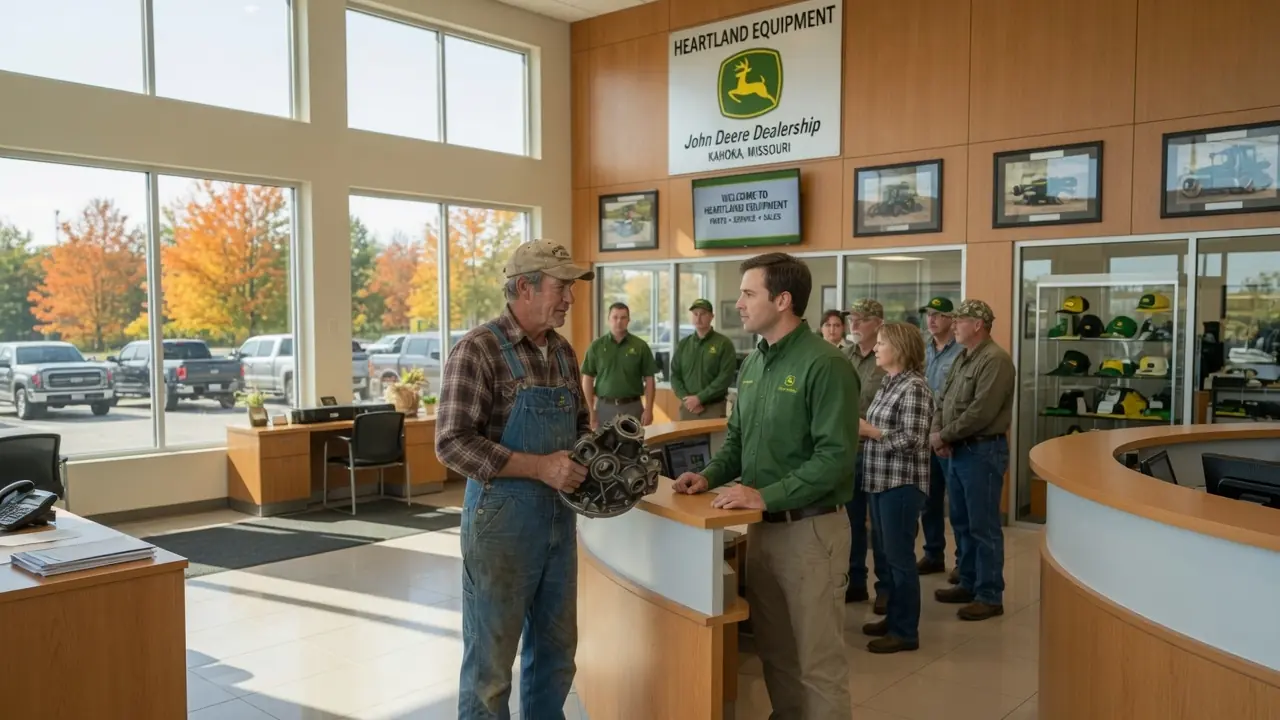
The policy makes sense from the dealer's side of the counter. The dealer's service department generates 35 percent of the dealership's total revenue. The farmer who buys at auction, buys used, buys from a private seller, or the cardinal sin in the dealer's world, buys from a competing dealership in the next county because the price was eight thousand dollars lower. That farmer is outside the pipeline. And outside the pipeline in the modern dealer service model means outside the service.
This is the story of a John Deere dealer in northeast Missouri who enforced the pipeline policy on a Tuesday afternoon in October of 2019 and discovered over the following six months that the pipeline works in both directions. And when the farmer leaves, the revenue goes with him. The dealer's name was Heartland Equipment, a three-location John Deere dealership headquartered in Kahoka, Missouri serving Scotland, Clark, and Lewis counties in the northeast corner of the state. Heartland had been the John Deere dealer in the territory since 1987 when the original dealer, Frogga Implement, a family operation that had sold Deere equipment since 1954, sold to the Heartland Group, a multi-store operation based in Quincy, Illinois that was part of the consolidation wave that reduced the number of John Deere dealers in America from approximately three thousand four hundred in 1980 to approximately one thousand eight hundred by 2020.
The consolidation changed the relationship. Frogga Implement had been owned by Harold Frogga who lived in Scotland County, farmed one hundred sixty acres outside of Memphis, the county seat, population one thousand eight hundred, not the one in Tennessee. And knew every farmer in the territory by name, by equipment, and by the particular mechanical quirks of each farmer's machines. Harold's service policy was simple. If it has a John Deere serial number, we work on it. Harold didn't care whether the farmer had bought the machine from Frogga or from a dealer in Iowa or from a retirement auction in Adair County. If the machine was Deere, Harold's shop would service it because Harold understood that a service relationship was a sales relationship in waiting. The farmer who brought his used four four four zero for service this year might buy a new eight three zero zero next year. And the service was the handshake that opened the conversation.
Heartland Equipment had a different policy. Heartland was a business, not a handshake. The service department was a profit center with quarterly targets, technician utilization metrics, and a priority system that ranked customers by purchase history. Tier one customers, farmers who had bought equipment from Heartland in the last five years, received priority scheduling, loaner equipment during extended repairs, and discounted labor rates. Tier two customers, farmers who had purchased from Heartland more than five years ago but maintained an active parts account, received standard scheduling and standard rates. Tier three, everyone else, received service as available, which in practical terms meant after every tier one and tier two job was completed, which during planting season and harvest season meant never.
The symptoms pointed to a failing hydraulic pump or a control valve issue. A repair that ranged from one thousand eight hundred dollars, valve reseal, to six thousand five hundred dollars, pump replacement, depending on the diagnosis. Nolan couldn't diagnose it himself. The seven eight one zero's hydraulic system was electronically controlled. The diagnostic requiring a Deere service advisor laptop to read the fault codes and identify the failed component.
Nolan called Heartland's service department at seven thirty a.m. on October fifteenth. The service writer, a man named Kyle, pulled Nolan's account and saw the tier three designation. Nolan had no purchase history with Heartland. His parts purchases averaged three hundred forty dollars per year, filters, oil, wear items that Nolan bought at the Heartland counter because the counter was closer than the aftermarket suppliers in Quincy.
Mr. Kirchner, I can schedule you, but we're currently booked through November eighth for tier one and two customers. The earliest I can get your seven eight one zero into the shop would be the week of November eleventh.
November eleventh? That's four weeks. I'm in the middle of fall tillage. The ground freezes by Thanksgiving. If I don't get the hydraulics fixed, I can't run the chisel plow. And if I can't chisel, I've got seven hundred twenty acres of corn stalks going into winter without primary tillage. That's a fifteen thousand dollar yield hit next spring from compaction and residue management.
I understand, Mr. Kirchner. Unfortunately, the cold anger produced a phone call. Not to another dealer, but to a man named Jerome Bross who ran an independent repair shop out of a Morton building on his farm outside of Edina, eighteen miles south of Rutledge.
Now, let me tell you about Jerome Bross because the man in the Morton building was the quiet alternative that twenty-three farms in Scotland County would discover over the next six months. And the discovery would cost Heartland Equipment approximately one point four million dollars in annual service revenue. Jerome was forty-seven years old, a former Deere dealership technician who had worked at Heartland from two thousand one to two thousand twelve, eleven years of diagnosing, repairing, and maintaining John Deere equipment under the fluorescent lights of the Kahoka shop.
Jerome had been Heartland's best technician, the one the service manager assigned to the difficult jobs, the warranty come backs, the machines that had stumped the other techs. Jerome knew Deere equipment the way a cardiologist knows hearts, by system, by symptom, by the particular sound a hydraulic pump makes when the swash plate bearing is failing versus the sound it makes when the charge pressure relief is sticking versus the sound it makes when the control valve spool is scored and bleeding pressure internally.
Jerome left Heartland in two thousand twelve because the dealership's consolidation had changed the job from mechanic to data entry. The modern Deere service model required the technician to connect the service advisor laptop, run the diagnostic scan, read the fault codes, follow the manufacturer's troubleshooting tree, and replace the component that the tree identified, regardless of whether the technician's experience suggested a different diagnosis. The service model prioritized consistency over expertise. The model ensured that every technician at every Heartland location followed the same diagnostic procedure, producing predictable repair outcomes and predictable parts consumption. The model also meant that Jerome's eleven years of hands-on diagnostic skill were being replaced by a software script that a technician with six months of training could follow.
Jerome built his own shop, the Morton building, forty by sixty feet, heated, equipped with a ten-ton overhead crane, a hydraulic press, and the hand tools and diagnostic equipment that Jerome had accumulated over a career. Jerome didn't have the service advisor laptop, the proprietary diagnostic tool that Deere restricted to authorized dealers. What Jerome had was eleven years of knowing what the service advisor would tell him before he plugged it in. The experience of reading symptoms, interpreting sounds, feeling pressures with a gauge set instead of a computer screen, and diagnosing failures by the methods that mechanics had used before the computer replaced the mechanic's judgment with the manufacturer's algorithm.
Jerome couldn't do everything. He couldn't perform software updates. The updates required the service advisor connection and the dealer's authorization. He couldn't clear certain fault codes that the manufacturer had locked to the dealer-level diagnostic tool. He couldn't access the machine's electronic control modules to reprogram components after replacement. The locked functions were approximately twenty percent of the service work on a modern Deere machine, the twenty percent that required the dealer's proprietary tools and that the manufacturer used to enforce the dealer service pipeline. But Jerome could do the other eighty percent, the hydraulic work, the engine work, the drivetrain work, the electrical diagnostics that didn't require dealer-level access, the bearing replacements, the seal kits, the wear parts, the annual service, the clutch rebuilds, the PTO repairs, the loader cylinder reseals, and the hundred other mechanical tasks that a tractor requires and that don't need a computer's permission to perform.
Jerome could do eighty percent of the work at sixty percent of the dealer's labor rate. Eighty-five dollars per hour versus Heartland's one hundred forty-two dollars. Because Jerome's overhead was a Morton building and a space heater instead of a twelve thousand square foot shop with six bays and a parts department and a sales floor and a corporate office in Quincy.
Nolan called Jerome on October fifteenth, the same morning Heartland had told him to wait four weeks. Jerome drove to Nolan's farm that afternoon, a house call, the kind of service that Froelich Implement used to provide and that Heartland had eliminated because house calls were inefficient and the technician utilization metrics favored shop-based repairs.
Jerome spent forty-five minutes with the seven eight one zero. He checked the hydraulic pressures with a gauge set, the same gauges he'd used at Heartland, the same test ports, the same specifications. He found the problem in twenty minutes. The pilot-operated check valve on the rear remote circuit had a scored spool bleeding pressure internally. The valve was accessible without removing major components. Unbolt four bolts, disconnect two hoses, pull the valve, replace the spool kit, reassemble. The spool kit cost one hundred eighty-six dollars from an aftermarket supplier. Jerome's labor for the diagnosis and repair, two point five hours at eighty-five dollars per hour, two hundred twelve dollars and fifty cents. Total repair cost, three hundred ninety-eight dollars and fifty cents.
Heartland's estimate for the same repair, had they accepted the work, would have been approximately one thousand one hundred eighty dollars. One hundred forty-two dollars per hour for three hours of diagnostic and repair time, four hundred twenty-six dollars plus one hundred eighty-six dollars for the spool kit marked up to two hundred ninety-eight dollars at dealer pricing, plus one hundred forty-two dollars for the diagnostic scan that Jerome had performed with a pressure gauge instead of a laptop, plus shop supplies and environmental fees. One thousand one hundred eighty dollars versus three hundred ninety-eight dollars and fifty cents, the same repair, the same result, the same tractor back in the field the same day. The difference was seven hundred eighty-one dollars and fifty cents, the premium for the pipeline, the diagnostic laptop, the quarterly utilization targets, the corporate office in Quincy, and the Tier three policy that had told Nolan to wait four weeks for service that Jerome provided in four hours.
Nolan told three farmers about Jerome, not intentionally. Nolan wasn't on a campaign. He mentioned it at the co-op the following Saturday, the way farmers mention things at the co-op, casually, between coffee and the weather forecast, the conversation that sounds like small talk and spreads like fire.
Heartland told me four weeks. Jerome Bross fixed it the same day, three hundred ninety-eight dollars. Heartland would have charged one thousand one hundred eighty dollars.
Three farmers heard. Three farmers who had their own Tier three stories, machines that Heartland had deprioritized, repairs that had been delayed, service that had been withheld because the machine had been purchased from someone other than Heartland. Three farmers called Jerome.
Now, let me tell you about the six months, because what happened between October two thousand nineteen and April two thousand twenty was not a boycott, not an organized campaign, not a protest. It was something quieter and more devastating, a migration. One farmer at a time, one repair at a time, one Saturday morning conversation at a time. The customer base that Heartland had spent thirty-two years building walked out of the pipeline and into Jerome Bross's Morton building.
November two thousand nineteen, Jerome serviced eight machines from six farms, annual service work, oil changes, filter kits, hydraulic fluid, the routine maintenance that farmers perform before winter storage. Each farm had called Heartland first. Each farm had been told two to three weeks for standard service scheduling. Each farm had called Jerome and been scheduled within three to five days.
December two thousand nineteen, Jerome serviced eleven machines from nine farms. The work expanded from routine maintenance to repair, a transmission reseal on a four four five five, a loader valve replacement on a seven two zero zero, a PTO rebuild on a four four four zero. The PTO rebuild was the job that made the co-op counter pay attention because the four four four zero was a nineteen eighty-two model, an older mechanical tractor that Heartland's younger technicians didn't know well and that Jerome knew intimately because he'd rebuilt four four four zero PTOs at Heartland for a decade before the shop started sending older machines to outside contractors rather than tying up technician hours on equipment that the parts system flagged as legacy.
Legacy was Heartland's word for machines built before two thousand, tractors and combines that were twenty to forty years old, still running, still productive, still the primary equipment on small and mid-size farms that couldn't afford three hundred fifty thousand dollars for a new tractor. Legacy machines were approximately thirty-five percent of the equipment in Scotland County. Heartland service department treated legacy machines as low priority. Low parts margin, low labor margin, high diagnostic time because the technicians trained on current models didn't have the knowledge base for older machines. The legacy machines were the machines that Heartland most wanted to replace with new sales. And the service deprioritization was, whether stated or not, a nudge. A quiet message that said, Your old tractor is too much trouble for us. Maybe you should consider a new one.
The nudge pushed the legacy farmers to Jerome. Jerome didn't call their tractors legacy. Jerome called their tractors tractors. A four four four zero was a tractor. A four two three zero was a tractor. A four zero two zero was a tractor. Jerome worked on them with the same attention he gave a two thousand fifteen model because the farmer paying eighty-five dollars per hour didn't care what year the machine was built and Jerome's overhead didn't change based on the model year of the tractor on the lift.
January two thousand twenty, fourteen machines from eleven farms. February, twelve machines from ten farms. March, eighteen machines from fourteen farms. The spring rush, planter maintenance, pre-season hydraulic checks, the work that had to be done before April planting. By April two thousand twenty, Jerome had serviced equipment from twenty-three farms in Scotland County. Twenty-three operations that had previously been Heartland customers at some level. Twenty-three operations that had shifted their service spending from the John Deere dealership to a Morton building on a farm outside Edina.
The revenue impact was significant. Jerome estimated his billing from October two thousand nineteen through April two thousand twenty at approximately one hundred forty-two thousand dollars. Six months of farm equipment repair from a one-man shop. The same work at Heartland's rates would have billed approximately three hundred forty thousand dollars. But the stable categories were twenty percent of the revenue. The declining categories were eighty percent. Heartland was retaining the twenty percent it had locked behind software and losing the eighty percent it had failed to serve.
Now, let me tell you about the conversation at the parts counter because what happened in Heartland's Kahoka store on a Wednesday in March of two thousand twenty was the moment the service manager realized that the pipeline was leaking from the bottom.
Brandon was behind the parts counter when Vernon Schaefer walked in. A sixty-eight-year-old farmer, four hundred eighty acres, lifetime Deere customer, a man who had bought his first tractor from Frogga Implement in nineteen seventy-eight and had been servicing at the same location under different ownership for forty-two years. Vernon was tier two. He hadn't bought a new machine from Heartland in eight years but he maintained an active parts account and brought his equipment in for annual service every November. He couldn't argue because Vernon was right. The tier system treated farmers as revenue categories, not as people with machines that needed repair. The tier system optimized dealership revenue by prioritizing the customers who generated the most revenue. The optimization worked. Tier one customers received excellent service, remained loyal, and continued to generate revenue. But the optimization had an externality that the spreadsheet didn't capture. The tier two and tier three customers who were deprioritized didn't disappear. They found Jerome.
How many have gone to Jerome? Vernon asked, his voice not accusatory, but factual. The voice of a man who already knew the answer because the co-op counter knew the answer.
I don't know the exact number.
I do. Twenty-three. Twenty-three farms in this county are now calling Jerome before they call you. Not because Jerome is better than your technicians. Your boys are trained. They've got the tools. They've got the parts because Jerome answers the phone and says, Yes. You answer the phone and say, Let me check your tier. That's the difference, Brandon. It's not the labor rate. It's not the diagnostic laptop. It's the word you say when a farmer calls with a broken tractor. Jerome says, Yes. You say, Let me check.
Brandon stood behind the counter and absorbed the math that Vernon was presenting. Twenty-three farms, average annual service and parts spending per farm at Heartland, approximately six thousand two hundred dollars. A figure Brandon knew because he ran the report monthly. Twenty-three farms times six thousand two hundred dollars, approximately one hundred forty-two thousand six hundred dollars in annual revenue that had migrated from Heartland to Jerome's Morton building. Over five years, the typical planning horizon for a dealership, the loss was seven hundred thirteen thousand dollars. Over ten years, one point four three million dollars. One point four three million dollars in service and parts revenue lost because a service writer had told Nolan Kirchner to wait four weeks for a hydraulic valve repair that Jerome performed in four hours. One point four three million from one no, from one policy enforcement, from one Tuesday afternoon phone call where the pipeline was valued more than the customer.
Now, let me tell you about what happened next because Heartland's response to the migration revealed whether the dealership understood what it had lost or whether the spreadsheet had become so dominant that the people behind the numbers were invisible. The logic also assumed that the twenty-three lost farms would remain twenty-three. That the migration would stop. That the satisfied customers of the tier system would remain satisfied. And that Jerome Bross's Morton building had a capacity ceiling that would limit the damage.
The logic was wrong on all three assumptions. The migration didn't stop at twenty-three. By October two thousand twenty, one year after Nolan's phone call, Jerome was servicing equipment from thirty-one farms in Scotland and Clark counties. He'd hired a helper, a young man named Austin Briggs, twenty-four years old, fresh out of a vocational ag mechanics program in Hannibal. The kind of young technician that Heartland would have hired if Heartland had been willing to pay vocational graduates what Jerome paid, which was twenty-two dollars per hour versus Heartland's starting wage of seventeen dollars. Austin brought capacity. Jerome brought knowledge. The Morton building hummed six days a week.
The satisfied tier one customers began to notice that the tier two and three customers they saw at the co-op were getting the same quality repair for sixty percent of the price. The tier one customers had priority. The tier one customers had loaner equipment. The tier one customers also had one hundred forty-two dollars per hour labor rates and OEM parts at sixty percent markup. The priority and the loaners were valuable. The question that the tier one customers started asking was whether the priority and the loaners were valuable enough to justify the one hundred forty-two dollar rate when Jerome's eighty-five dollar rate was producing the same result.
Three tier one customers called Jerome in two thousand twenty-one. Not for major work. For the routine service that didn't require dealer tools. Annual service, filter kits, hydraulic fluid changes. The bread and butter service work that Heartland billed at one hundred forty-two dollars per hour and that Jerome billed at eighty-five dollars. The tier one customers kept their dealer relationship for warranty work and electronic diagnostics. The twenty percent that required the proprietary tools. They shifted the eighty percent to Jerome. The shift represented approximately fourteen thousand dollars per farm per year in service revenue that Heartland lost from its best customers. The customers that the tier system was supposed to protect.
Jerome's capacity was not, as Paul Lutz had assumed, a limiting factor. Jerome's capacity was of demand and demand was a function of Heartland's policy. Every farm that Heartland deprioritized became a potential Jerome customer. Every Saturday morning conversation at the co-op. Jerome fixed my seven eight one zero on the same day, three hundred ninety-eight dollars. Heartland wanted one thousand one hundred eighty dollars in four weeks. Became a referral that no advertising budget could match. The co-op counter was Jerome's marketing department and the co-op counter worked for free because the farmers were telling stories about their own experiences, not selling a service.
Now, let me tell you about the old man at the counter because the conversation that ended the tier system happened in December of two thousand twenty-one. And the man who ended it was seventy-four years old and had been buying John Deere equipment since Lyndon Johnson was president. His name was Wallace Propst. He farmed three hundred twenty acres, a small operation by current standards, a full operation by the standards of the generation that built it.
Wallace had purchased every piece of equipment he'd ever owned from the Kahoka store. From Frogga Implement first, then from Heartland after the acquisition. His purchase history went back to nineteen seventy-two. In forty-nine years, Wallace had bought three tractors, two combines, four planters, and an uncountable number of implements, parts, and accessories from the store on Highway eighty-one. He was tier one. He was the tier system's ideal customer, loyal, consistent, and profitable.
Wallace walked into the parts department in December of two thousand twenty-one and asked Brandon Veach a question that Brandon couldn't answer.
Brandon, I need a hydraulic hose made for my four four five zero. It's a custom length, sixty-eight inches, half inch, two wire with JIC fittings. Jerome can make it, but Jerome doesn't have the right fittings in stock. You have the fittings. Can you make the hose?
Of course, Wallace. We'll have it for you in
That's not the question. The question is, if Nolan Kirchner walked in here and asked for the same hose, would you make it?
Brandon paused. Nolan was tier three. The parts department didn't tier restrict parts sales. Anyone could buy parts at the counter. But the question wasn't about the parts. The question was about the principle.
We'd sell him the hose.
You'd sell him the hose, but you won't fix his tractor. You'll take his money for a part, but you won't take his money for the labor. Explain that to me because I've been trying to understand it for two years and I can't.
The service tier system prioritizes customers who
The service tier system prioritizes customers who buy new equipment. I buy new equipment. I'm tier one. I get priority. Nolan doesn't buy new equipment because Nolan can't afford new equipment. A seven eight one zero costs forty-two thousand dollars used and a new six one five five R costs one hundred eighty-five thousand dollars. Nolan bought what he could afford and you punished him for not buying what he couldn't afford. That's not a business policy, Brandon. That's a penalty for being a small farmer. Harold Frogga never penalized a man for being small.
Brandon didn't respond. Wallace hadn't raised his voice. Wallace was a quiet man, the kind who spoke rarely and meant everything he said. The quiet was more effective than volume.
I've been buying Deere equipment from this store for forty-nine years, Wallace continued. I've spent somewhere north of six hundred thousand dollars in this building. I'm telling you, not threatening, telling, that if this store doesn't fix a farmer's tractor because the farmer didn't buy it here, I'm going to have Jerome do my work, too. Not because Jerome is cheaper, because Jerome treats a farmer like a farmer. You treat a farmer like a revenue category. I don't want to be a category, Brandon. I want to be a customer. And a customer is someone you say yes to.
Wallace picked up his hose and left. Brandon called Paul Lutz in Quincy. The call lasted forty minutes. What was said has never been repeated publicly, but the outcome was visible.
In January two thousand twenty-two, Heartland Equipment quietly eliminated the tier system at the Kahoka location. The service department began accepting all John Deere equipment for service, regardless of purchase history. The scheduling priority, first come, first served, replaced the purchase-based ranking. The change was not announced. There was no press release, no memo, no email blast. The change was implemented the way policy failures are always corrected in small communities, quietly, without acknowledgement, with the hope that the customers who left might return if the door was reopened.
Some returned. Not all. Not most. Approximately eight of the thirty-one farms that had migrated to Jerome returned to Heartland for some portion of their service work. Typically, the electronic diagnostics and software updates that Jerome couldn't perform. The twenty percent that still required the dealer's proprietary tools. The other twenty-three stayed with Jerome. They'd found something that Heartland had stopped offering and that Jerome had never stopped offering. The word, yes.
Let me tell you about how this ends. Jerome Bross is fifty-two years old. His shop employs three people now, Jerome, Austin Briggs, and a second technician, Colby Yager, hired in two thousand twenty-two. The Morton building has been expanded, a twenty by forty-foot addition on the south side, built in two thousand twenty-one, housing a parts inventory that Jerome stocks with aftermarket and salvage yard components for John Deere equipment from the nineteen seventies through the two thousand tens. The inventory is organized the way Carl Detwiler's parts room is organized, by system, by machine, by the logic of a mechanic who knows what breaks and what to have on the shelf when it does.
Jerome services approximately one hundred twenty machines per year from forty-five farms across three counties. His annual revenue is approximately four hundred eighty thousand dollars, generated from a Morton building on a farm outside Edina, with three employees, no corporate office, no quarterly utilization targets, no tier system, and no proprietary diagnostic laptop that the manufacturer uses to lock the farmer out of his own machine.
Jerome can't do everything. The twenty percent of service work that requires the dealer's tools and software still goes to Heartland. The electronic control modules, the software updates, the fault code clearances that the manufacturer has locked to the dealer's service advisor. Those repairs require the pipeline. Jerome tells his customers this openly. For the electronics, go to the dealer. For everything else, come to me. I'll say yes.
Heartland Equipment still operates the Kahoka store. The tier system is gone. The service department accepts all comers. Brandon Veach is still the service manager. The store has not recovered the revenue it lost. The twenty-three farms that migrated to Jerome represent approximately one hundred forty-two thousand dollars per year in service and parts revenue that is permanently shifted to the independent shop. Over the three years since the migration began, the cumulative revenue loss is approximately four hundred twenty-six thousand dollars. The projected ten-year loss remains approximately one point four three million dollars. One point four three million dollars lost because a service writer told a farmer with a broken tractor to wait four weeks. Lost because a corporate policy valued the pipeline over the person. Lost because the word no, spoken once, on a Tuesday afternoon in October to a man with a scored hydraulic valve and seven hundred twenty acres of corn stalks that needed to be chiseled before the ground froze, traveled from the parts counter to the co-op counter to the kitchen tables of twenty-three farms in Scotland County and became the reason that twenty-three farms took their business to a man in a Morton building who said yes.
Harold Frogga said yes to every farmer who walked through the door. Heartland Equipment said no to one. Harold retired with every customer he'd ever had. Heartland lost twenty-three because of one. The dealer said no. The mechanic said yes. That's the whole story.