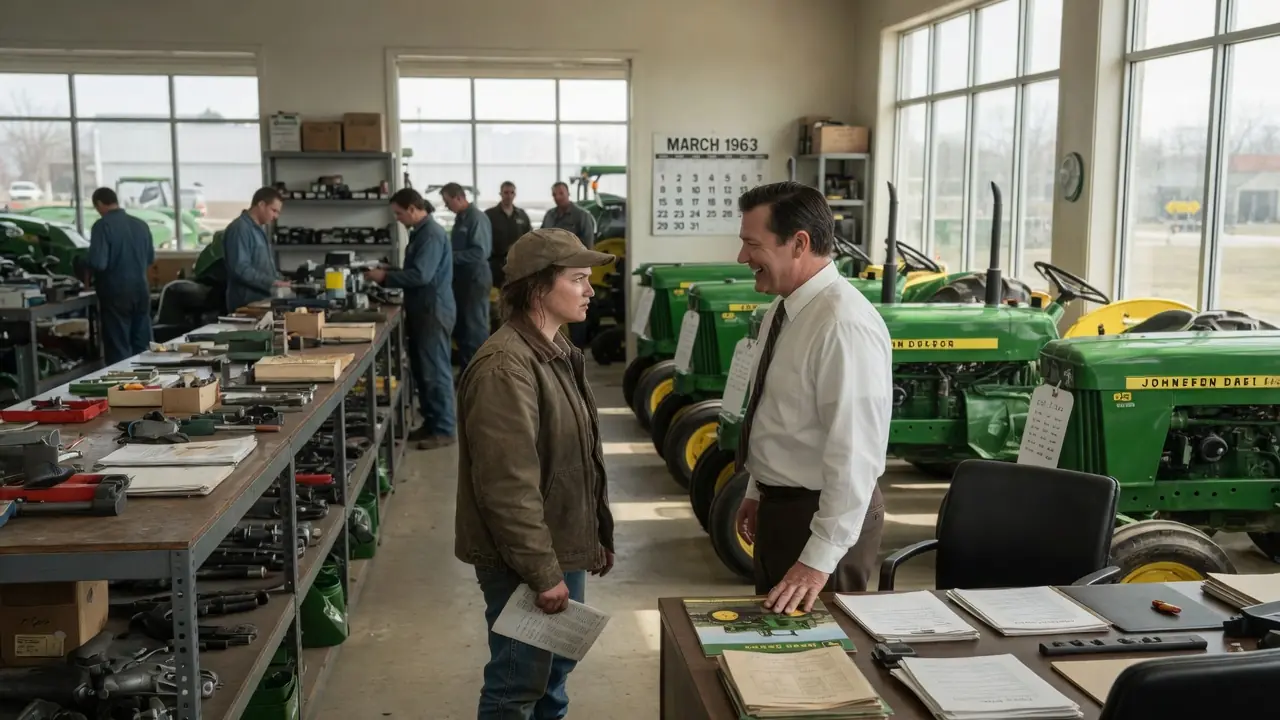
On a windy Tuesday afternoon in March of 1963, Margaret Holcomb walked into Dennison’s John Deere dealership in Russell, Kansas, wearing her dead father’s work jacket and carrying a folded list of tractor parts in her hand. The jacket was two sizes too big, the cuffs were dark with grease, and the shoulders hung on her small frame like a burden she had not yet grown into. Her boots were muddy from the west pasture, her hair was tucked under an old cap, and there was dirt under her fingernails that no amount of scrubbing seemed to remove. Every man in that showroom looked at her before she reached the sales desk, and every one of them seemed to decide she had come to the wrong place.
Roy Dennison looked up from behind his desk, leaned back in his chair, and laughed before she even finished asking about used tractors. It was not a quiet laugh, not a surprised chuckle, not the kind a decent man gives when he misunderstands a question. It rolled across the polished showroom floor and bounced off the green machines lined under the dealership lights. Mechanics in the service bay stopped what they were doing, two salesmen turned from the parts counter, and an old rancher near the coffee pot looked down at his cup like he wished he had not heard it.
Margaret stood in the middle of it with her jaw locked. She had buried her father three days earlier, and grief had left her hollow enough that humiliation had room to echo inside her. Frank Holcomb had dropped in the barn before breakfast, gone before the ambulance made it past the county road, leaving behind 240 acres of dryland wheat and grain sorghum, one farmhouse with a leaking roof, and a 1951 Farmall M with a broken crankshaft. The farm needed a tractor, and the only dealer within thirty miles was laughing at the farmer who had come to buy one.
Roy was forty-six years old, broad and clean-handed, with a pressed shirt, a dark tie, and the easy confidence of a man who had spent years telling farmers what they needed. He had sold equipment to half of Russell County and financed the other half into believing bigger always meant better. His desk was stacked with loan papers, glossy brochures, and calendars showing shining new machines crossing fields that looked too perfect to belong to any real farm. He looked at Margaret’s muddy boots and oversized jacket as if they proved she was a child playing dress-up in a man’s world.
He told her farming 240 acres alone would break her before summer. He said her father had been a good man but stubborn, and that stubbornness had left her with more trouble than inheritance. He suggested she lease the land to Harold Brewer, sell the house if she had sense, move into town, and find a husband before the farm swallowed her whole. He said all of it loudly enough for the room to hear, as though public embarrassment was part of the lesson.
Margaret did not cry. She had done enough of that in private, beside the barn door, at the kitchen sink, and in the dark hallway outside her father’s room where his boots still sat exactly where he had left them. She looked at Roy’s clean hands and thought of her father’s, cracked open at the knuckles, scarred from welding sparks, dark with soil even after Sunday washing. Frank Holcomb had taught her to drive a tractor at twelve, weld at fourteen, rebuild a carburetor at sixteen, and read soil at eighteen. He had never once told her the land was too much for her because she was a girl.
Roy’s smile tightened. He had expected tears, pleading, maybe gratitude for advice she had not asked for. What he got instead was Margaret looking him straight in the eye with a kind of cold fury that made even the machinery around them seem still. She unfolded her parts list slowly, then folded it again, buying herself one breath before she spoke.
“Careful, Roy, men with clean hands shouldn’t preach about land they never bled for.”
The words struck the room harder than his laugh had. A mechanic in the service doorway lowered his eyes, and the old rancher by the coffee pot nearly smiled into his cup. Roy’s face darkened, not because she had insulted him, but because she had done it without trembling. Men like Roy could forgive ignorance in a young woman; what they could not forgive was a sharp tongue backed by truth.
He leaned on his desk and tried to recover the room. He said her father’s old ways were finished, that farming had changed, that the future belonged to men with capital, credit, and modern equipment. He called the broken Farmall a symbol of what happened when pride outran sense. Then he said Frank had left Margaret a burden, not a future.
Margaret’s fingers tightened around the folded list until the paper creased. Her father had left her more than land, though nobody in that showroom was smart enough to understand it yet. He had left her soil records, crop rotations, repair manuals with pencil notes in the margins, and the stubborn knowledge that money borrowed too easily usually came back wearing a banker's grin. He had left her a way to survive without kneeling to people like Roy Dennison.
“No, he left me soil, sense, and enough fire to make you regret every word.”
This time nobody moved. Roy’s mouth opened, then closed again, and for one brief second Margaret saw the truth behind his confidence. He did not know what to do with a woman who would not accept the role he had written for her. He had expected a frightened girl, but the person standing in front of him had grief in her bones and iron in her voice.
She walked out without buying anything. Behind her, as the showroom door swung shut, she heard Roy mutter something to one of the mechanics. The words were soft, but clear enough. Foolish little girl. Margaret did not turn around, but she carried those words with her all the way to the truck.
Two weeks later, she drove forty miles east to an estate auction in Ellsworth County with $1,100 in cash. It was every dollar she had, money from her father’s coffee can in the workshop and two summers of grain elevator wages saved in an envelope. The auction was small, mostly old men looking for parts, and the two red Farmalls sitting in the back row were faded, dusty, and ignored. To everyone else, they were tired iron; to Margaret, they were familiar bones.
The first tractor, a 1949 Farmall M, sold to her for $400 because nobody wanted a machine that old unless they needed parts. The second, a 1953 Super M, cost her $600 after one short bidding fight with a man who gave up as soon as she raised her hand the third time. She had one hundred dollars left, two tractors that barely ran, and a future balanced on machines Roy Dennison would have mocked until his lungs gave out. An older farmer named Tom Weber watched her pay and then nodded to her like one worker recognizing another.
She hauled both tractors home on a borrowed flatbed. The M needed a clutch, hydraulic seals, and a patience most people did not possess. The Super M needed a fuel pump rebuild, rewiring, and three nights of Margaret sitting cross-legged on the workshop floor with her father’s manual open beside her. By mid-April, both tractors were running, coughing smoke at first, then settling into the hard mechanical rhythm that sounded to Margaret like hope.
Her first season nearly broke her. She worked the land before sunrise and after sunset, planting grain sorghum, maintaining wheat, fixing breakdowns, hauling fuel, checking fences, and sleeping so little that some mornings she woke up at the kitchen table with her hands still wrapped around a coffee cup. Neighbors drove slow past her place and watched like they were waiting for a roof to collapse. They said the Holcomb girl was too small, too young, too alone, and too stubborn to know she was finished.
Roy came out in June, pretending concern. Margaret was under the Super M replacing a hydraulic line when his truck rolled into the yard. He stood over her polished shoes with dust on the toes and said old tractors would fail at the worst possible time. He reminded her that her father’s Farmall had thrown a crankshaft, which was a cruel thing to say and a deliberate one.
Margaret slid out from under the tractor with grease on her cheek and a wrench in her hand. The mention of her father hit her, but she did not let Roy see where. She told him the tractors would last because she knew how to take care of them. Roy shook his head like a man watching a child walk toward a storm with a paper umbrella.
By harvest, Margaret’s hands were cracked, her face was darker from sun, and the muscles in her arms had changed shape from work no one believed she could do. The wheat made twenty-eight bushels an acre, not a miracle, but enough. The sorghum held through dry heat better than expected, and when she paid taxes, bought seed, covered fuel, and set aside repair money, she had $4,200 left. She put every penny in the bank and told no one how close she had come to failure.
The first winter was worse than the work. Once the fields were empty and the nights stretched long, the farmhouse became too quiet. Her father’s chair sat near the stove, his jacket hung by the back door, and his handwriting still marked jars of bolts in the workshop. For the first time, Margaret wondered if Roy had been right.
One cold morning in November, she drove into Russell and parked across from Dennison’s dealership. She did not plan to go in, but she did not plan not to either. She sat in the truck with the engine running, watching men walk through the showroom doors with confidence she envied and resented. Her hand was on the door handle when she caught her reflection in the side mirror.
She saw the work jacket, the tired eyes, and the dirt beneath her nails. More than that, she saw her father in the set of her jaw and the way her hand rested steady even when her heart was not. Frank Holcomb had never promised farming would be easy. He had only taught her that land did not reward fear, and that quitting made every hard year before it mean nothing.
Margaret took her hand off the door handle and drove home. She never told anyone about that morning for decades. People later said she never doubted herself, but that was a lie told by people who mistook endurance for certainty. Margaret doubted herself every day for the first five years; she simply kept working anyway.
That December, she cleaned out her father’s workshop properly for the first time since his death. She opened drawers she had avoided, sorted jars of bolts, swept old sawdust from corners, and found a brown leather journal beneath a stack of receipts in the bottom drawer of the workbench. It was not a diary. It was a soil record, twenty-three years of observations written in Frank Holcomb’s careful hand.
Every field had notes: rainfall, soil temperature, organic matter, worm counts, disease pressure, cover crop response, moisture retention, and yield comparisons. Her father had been tracking the farm with the patience of a scientist and the intuition of a man who could smell rain before it reached the county line. He had used cover crops while neighbors mocked him for wasting seed. He had rotated wheat, sorghum, fallow, and soil-building crops in a pattern no bank loan officer would ever understand.
On the last page, in handwriting that had grown shaky near the end, Frank had written a note for her. He told her the land was better than it looked, that he had spent twenty-three years building it, and that she should never let anyone call it just dirt. He told her to trust the soil because it would not let her down. Margaret sat on the workshop floor and cried until the light faded out of the window.
After that, she farmed with a different kind of stubbornness. It was no longer just survival, and it was no longer about proving Roy Dennison wrong, though his words still burned when the nights were long. She followed her father’s rotations, planted cover crops, repaired machinery others had abandoned, and saved money with almost religious discipline. She spent nothing to impress anyone and borrowed nothing that could take the farm from her.
Through the 1960s and into the 1970s, the farm changed slowly but visibly. Her wheat yields rose above county average, first by a little, then by enough that grain elevator men started double-checking the numbers. Her sorghum held better in dry years because the soil kept moisture like a memory. Neighbors began to notice, though they still called it luck before they called it skill.
Roy continued to visit once a year, always with a brochure, always pretending he had stopped trying to sell her equipment. He would ask whether the old Farmalls were still running, and Margaret would say they were. He would tell her she could increase efficiency with a newer tractor, better financing, bigger horsepower, and modern implements. She would tell him she could also increase debt, and that she was not interested.
The agricultural boom made Roy rich for a while. Farmers bought bigger tractors, newer combines, more acres, and more debt. Roy sold them the dream with a firm handshake and payment schedules that looked reasonable when grain prices were high. He believed expansion was progress, and progress, in his world, came painted green with a loan attached.
Margaret watched all of it from her 240 acres. She watched neighbors upgrade machines they had not worn out, buy land they had not paid for, and speak of leverage like it was wisdom instead of a rope. Her father’s journal sat on her kitchen table every winter, reminding her that debt took back more than it gave. So she stayed small, careful, and free.
By 1980, Margaret had $92,000 in the bank. Her land was paid for, her equipment was owned outright, and every building on the place had been repaired by her own hands. The farmhouse roof no longer leaked. The workshop was organized. The two Farmalls still ran.
Then the farm crisis came, and Russell County began to fold. Interest rates climbed, grain prices fell, land values collapsed, and men who had seemed untouchable were suddenly standing beside auction wagons with their hats in their hands. Farms that had carried families for generations went under. Equipment that had gleamed new only a few years before sold for a fraction of what was owed.
Roy’s dealership began to empty. The showroom lost its shine, the salesmen left one by one, and machines sat outside too long with fading paint and flat tires. Farmers who once trusted him stopped looking him in the eye because trust did not survive foreclosure. Roy had not caused the crisis by himself, but he had made debt sound like destiny, and now destiny had come collecting.
Margaret went to the auctions, not to gloat, but because land near hers was selling and she had cash. In 1983, she bought 160 acres from the Brewer place. In 1985, she bought eighty acres from the Whitfield farm. By 1987, she owned 600 acres, every acre paid for, every deed locked away in a metal box in the farmhouse closet.
The day Roy closed the dealership, the wind was hard out of the north. He drove to Margaret’s place near evening and sat in his pickup with the engine running while she worked in the shop. She found him staring past the windshield like a man looking at the remains of his own certainty. The confident dealer in the pressed shirt was gone, replaced by an older man with red eyes and a voice that sounded scraped raw.
He told her the bank had taken the business. He said strangers had spent the day tagging inventory, counting tools, and deciding what thirty-four years of his life was worth at liquidation. Margaret listened without smiling. Roy seemed almost angry that she was kind enough not to enjoy it.
He asked how many acres she owned, though he already knew the answer. When she said 600, he closed his eyes as if the number hurt. He admitted he had pushed loans, new equipment, expansion, and confidence to farmers who were now gone. Then he looked at her and said the sentence she had waited twenty-three years to hear, though it brought less pleasure than she had imagined.
“You were the only farmer in this county smart enough not to buy what I was selling.”
Margaret leaned against his truck and looked toward the fields. The winter wheat was just beginning to show green across the soil her father had built, a thin promise stretched under the fading light. She could have cut him open with old words. She could have reminded him of the showroom laugh, the hand on her shoulder, the foolish little girl muttered behind her back.
Instead, she told him she had only been careful. That was true, but not all of it. She had been angry, lonely, terrified, stubborn, grieving, and often one repair away from collapse. Careful was simply the word that sounded cleanest after the harvest was in.
Roy apologized before he left. Not smoothly, not like a salesman, but like a man pulling barbed wire from his own skin. He said he had been wrong about her father, wrong about the farm, wrong about the tractors, and wrong about Margaret. He asked if the Farmalls were still running, and when she said every day, he shook his head with something like wonder.
After his taillights disappeared down the road, Margaret stood in the yard for a long time. She did not feel victory. She felt the strange sadness of watching a man finally understand a lesson too late to save what it had cost him. Roy had not been evil; he had been certain, and certainty could do damage all by itself.
Margaret farmed for decades after that. She grew from 600 acres to 840, always buying only what she could pay for, always keeping equipment longer than anyone thought sensible, always trusting the soil before the salesman. The 1949 Farmall ran until 1991, and the Super M ran until 2004. She cried when she parked the Super M for the last time because machines can become witnesses, and that tractor had witnessed nearly everything.
University soil scientists tested her land in the early 2000s and found topsoil deeper and richer than almost anything around it. They asked what program she had followed, what chemical system she used, what modern technique explained the difference. Margaret told them she had listened to her father. It was the truest answer and the one they least expected.
Roy Dennison died in 2001. Margaret went to the funeral and sat in the back. His son found her afterward and said his father had spoken of her near the end, calling her the best farmer he had ever met and the worst customer he ever had. Margaret smiled because it was exactly the kind of compliment Roy would have needed forty years to learn how to give.
In her old age, Margaret still lived in the farmhouse Frank Holcomb built. The roof was tight, the workshop was clean, and the brown leather soil journal stayed on the kitchen table more often than not. Sometimes she opened it at night and ran her fingers over her father’s handwriting. She no longer cried every time, but she always remembered.
The JD dealer had told her to sell the farm, little girl. He told her the land was a burden, the tractors were junk, and the work belonged to men. Twenty years later, she owned more land than him, more freedom than his customers, and more proof than any argument could hold. The men in that showroom had laughed because they thought farming was about size, money, and who sounded confident behind a desk.
Margaret knew better. Farming was about staying after the laugh ended, fixing what broke, planting when nobody clapped, and trusting what had been built beneath the surface. The land remembered everything her father put into it. And when the hard years came, it remembered Margaret too.