On the second Saturday of April 1971, Earl Maddox drove his pickup truck and cattle trailer forty miles to the Sedalia Livestock Auction in Pettis County, Missouri. He had six hundred dollars in his pocket, money he had saved over two years, money his wife Lorraine did not know about, and money set aside for exactly this day. Earl had been waiting for this auction since October, when he received a letter from France. He did not tell anyone what he was looking for because sometimes the best advantage a man has is the information he keeps quiet.
The auction barn was crowded that morning. Spring was calving season, and farmers from three counties had come to buy and sell breeding stock. The smell of hay, manure, coffee, and cigarette smoke hung in the air, mixing with the low murmur of men talking cattle. Earl found a seat in the back, away from the main crowd, because he did not want to talk to anyone.
He wanted to watch. The lots came through one by one: Hereford bulls with thick necks and solid frames, black Angus cows heavy with calf, and a few dairy animals that drew less interest. Earl watched the bidding, the prices, and the patterns. Most bulls were selling between three hundred and five hundred dollars, while the premium animals with documented bloodlines went higher.
Then lot forty-seven came into the ring. The bull was different from everything else that had sold that morning. Where the Herefords were red and white, this animal was pale cream, almost white, with a pinkish tint to its skin. Where the Angus were thick and blocky, this bull was lean, rangy, long-bodied, and narrow-headed.
Its ribs were visible beneath the pale hide. Its hip bones jutted out. The auctioneer’s voice dropped slightly, the way it does when even he knows the lot is not going to draw much interest. “Lot forty-seven, gentlemen. Young bull, approximately eighteen months. Breed listed as Charolais. That is a French breed for those unfamiliar.”
He started the bidding at one hundred dollars. Silence. He tried again, but no hands went up. Finally, he dropped the opening price to fifty dollars, and Earl raised his hand from the back row.
“Fifty dollars from the gentleman in back. Do I hear sixty?” the auctioneer called. A farmer in the front row turned around to look at who had bid, and his face showed confusion before it changed to amusement. He nudged his neighbor. No one else moved.
The auctioneer called for sixty again. No one responded. Earl raised his hand a second time. “Seventy-five,” he said.
The auctioneer paused. “Sir, you are bidding against yourself.” “I know,” Earl said. “Seventy-five.” Now people were definitely looking. The low murmur of conversation stopped, and Earl could feel the attention shifting to him.
The auctioneer prepared to close the bid. That was when Glenn Kirby stood up. Glenn Kirby was the John Deere dealer in Sedalia and had been for fifteen years, ever since he inherited the business from his father-in-law. He was a big man with a red face, a loud voice, and an opinion on everything.
Glenn considered himself an expert on all things agricultural. Tractors were his business, but he also talked about crops, weather, politics, and especially livestock. He had grown up on a cattle farm, and even though he had left that life for the dealership, he never missed a chance to remind people of his expertise. He was also a social bully, the kind of man who kept his status by making jokes at the expense of quieter men.
The barn erupted in laughter. Glenn was not finished. He was enjoying himself now, playing to the crowd. “Tell you what, Earl, I will sell you a shovel at cost. You are going to need it. That bull has one foot in the grave and the other on a banana peel.”
More laughter followed. Someone slapped a knee. Ray Morrison, the banker from First National, joined in because he never liked Earl much. Earl was too quiet, too independent, and too reluctant to take on debt.
“Earl, if you want to light seventy-five dollars on fire, you could at least get some warmth out of it,” Ray called. “That thing there, all you are going to get is vet bills and a burial.” The laughter grew louder. Men pointed, nudged one another, and shook their heads.
Tom Garrison, Earl’s nearest neighbor, was grinning like he had just heard the funniest joke of his life. “Maybe it is a dairy bull,” Tom shouted. “Skinny like that, it might give some milk.” Someone else called out, “French breed? Maybe Earl wants to make fancy cheese.”
The whole barn was laughing now. The auctioneer tried to maintain order, but even he could not hide his smile. Even the handlers in the ring were grinning. Earl Maddox stood in the back of the barn, his bid number still in his hand, and said nothing.
He did not argue. He did not explain. He did not defend himself. He simply waited for the laughter to die down, walked to the clerk’s window, paid his seventy-five dollars, and loaded the skinny cream-colored bull into his trailer.
As Earl drove out of the parking lot, he could still hear Glenn Kirby’s voice loud enough to carry through the closed windows of his truck. “Dead by July. You heard it here first.” Earl kept both hands on the steering wheel and looked straight ahead. He had heard enough laughter in his life to know it did not always mean the laughing men were right.
The story really began with the letter from France. Earl Maddox had a cousin named Pierre Dubois. Pierre’s mother was Earl’s mother’s sister, and she had married a French soldier after the First World War and moved to a village in the Burgundy region of France. Earl had never met Pierre in person, but they exchanged letters occasionally, the way distant relatives sometimes do.
In October of 1968, Pierre wrote a letter that changed Earl’s life. Pierre worked for a livestock cooperative in France, helping manage breeding programs for several large cattle operations. He was not a farmer himself, but he understood the business and knew what made certain bloodlines valuable. In his letter, Pierre wrote about a breed of cattle called Charolais.
They had been bred in France for centuries, mostly for local markets. Now Americans and Canadians were beginning to import them, and Pierre believed they were going to change how beef cattle were raised in North America. Earl wrote back asking for more information. Pierre’s next letter was five pages long and explained what made Charolais cattle special.
The breed looked different from traditional American cattle. They were leaner, longer, lighter in color, and to anyone familiar only with Herefords and Angus, they might look sick or underdeveloped. But that difference was exactly why they were valuable. Charolais cattle converted feed into muscle efficiently, gained weight quickly, reached market size sooner, and produced leaner meat with higher carcass yield.
Pierre wrote that the breed was still rare in America. Only a few thousand head were in the country, mostly in Canada and Texas. The bloodlines were tightly controlled. A proven Charolais bull with documented breeding could sell for five thousand dollars, sometimes more.
Pierre believed that in ten or fifteen years, Charolais genetics would be everywhere. Cattlemen would crossbreed them with Herefords and Angus to improve the American beef herd. The people who controlled the bloodlines early would make fortunes. He told Earl to watch for Charolais at local auctions because most American cattlemen would not recognize them yet.
Earl read that letter so many times that the paper began to wear thin at the folds. He did his own research too. He wrote to the American International Charolais Association, read every article he could find in livestock magazines, and even spoke to a veterinarian in Kansas City who had seen Charolais cattle in Canada. Everything Pierre had written checked out.
So when lot forty-seven came into the Sedalia auction ring, Earl did not see a sick animal. He saw opportunity. The pale hide, the long frame, the narrow head, the lean body, all of it looked wrong to men raised on traditional American breeds. To Earl, it looked like the future.
Earl could have defended himself that day. He could have explained about Pierre’s letter, the breed association, the livestock articles, and the Kansas City veterinarian. He could have told Glenn Kirby and Ray Morrison that the skinny cream-colored bull might one day be worth more than all their thick Herefords put together. He did not say a word.
He stayed silent for a reason his father had taught him years earlier. When you know something other men do not, you have two choices. You can tell them the truth and watch them argue, doubt, or learn from you until they become your competition. Or you can stay quiet, let them think you are a fool, and keep the advantage for yourself.
Earl kept the advantage. He named the bull Blanc, the French word for white, and housed him in a separate pen away from his small Hereford herd. Blanc was young, only eighteen months old, and needed time to fill out before breeding. He looked thin, strange, and wrong to anyone who did not know what he was.
Lorraine Maddox had questions. The first morning she saw Blanc through the fence, she frowned and asked, “What kind of animal is that?” Earl told her it was a French breed called Charolais. “He looks sick, Earl.” “He is not sick,” Earl said. “He is just different.”
Lorraine gave him the look wives give when they know something is not being said but decide not to push. “Seventy-five dollars?” she asked. “That is right.” “Could have been seventy-five dollars toward a new stove.” Earl nodded. “Could have been.” Lorraine shook her head and walked back to the house.
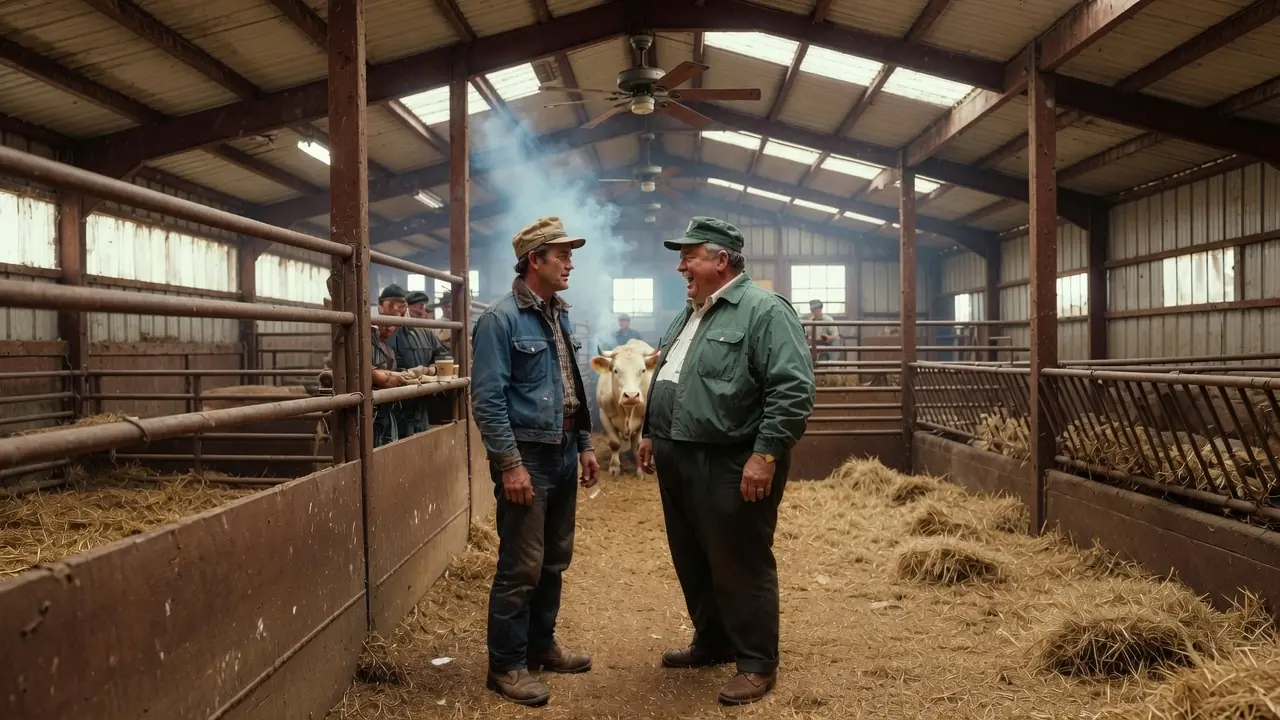
The neighbors came by over the following weeks, curious mostly, but also ready to deliver the mockery they had been preparing since the auction. Tom Garrison stopped his truck at the fence line and leaned out the window. “Still alive, I see. You are already past Glenn’s deadline. July, was it?” Earl just waved and kept working.
“What are you feeding him?” Tom called. “Looks like he needs fifty pounds of grain a day to catch up to a real bull.” Earl ignored him. He had no interest in explaining a thing to men who had already decided laughter was smarter than learning.
Dr. Warren came out in June for the regular herd check. He examined Blanc carefully, running his hands over the pale hide, checking the teeth, eyes, and hooves. “This is a Charolais,” he said. Earl heard something in his voice: recognition and interest.
“Where did you find him?” Dr. Warren asked. “Sedalia auction.” “How much?” “Seventy-five dollars.” Dr. Warren whistled softly.
“Do you know what you have here?” he asked. “I know,” Earl said. “Most people would not,” Dr. Warren replied. “Most people would look at this animal and see a sick bull.” Earl answered, “They told me.”
Dr. Warren finished the examination, packed his bag, and turned back to Earl. “You planning to breed him?” “When he is ready. In a year or so.” The vet nodded. “Keep him healthy. Keep him away from disease. If this animal lives up to his genetics, you could have something special.”
Then Dr. Warren paused. “Do not tell anyone. Not yet. Let them keep thinking he is a failure.” Earl smiled. “That is the plan.”
The first calf proved to Earl that Pierre had been right. In the spring of 1973, Blanc was old enough to breed, and Earl introduced him to three of his best Hereford cows. He chose the females carefully, selecting good frames and proven fertility. He kept the breeding secret and did not tell anyone which bull had sired which calves.
The calves were born in January and February the following year. They did not look like any calves the neighbors had ever seen. Instead of the traditional red-and-white color of Herefords, they were pale cream like their father or washed-out tan from the Charolais white mixing with Hereford red. They were leaner than ordinary calves, longer in the body, and carried the same narrow heads as Blanc.
Tom Garrison saw them through the fence one March morning and stopped his truck again. “What the hell happened to your calves, Earl? They look sick. You got some kind of disease in your herd?” Earl told him they were fine.
“They do not look fine,” Tom said. “They look like someone drained the color out of them. You should call Dr. Warren.” Earl answered, “Dr. Warren has seen them. They are healthy.” Tom shook his head. “Your funeral, Earl. Those animals will not bring ten cents at market looking like that.”
But when fall came and Earl took his first Charolais-cross calves to market, they did not bring ten cents. They brought a premium. A cattle buyer from Kansas City, working for one of the big meatpacking companies, took one look at Earl’s calves and separated them from the rest of the lot. “These are Charolais crosses, are they not?” he asked.
“That is right,” Earl said. “First ones I have seen at this market,” the buyer replied. He walked around the calves, examining them from every angle. “Lean, good frame, long body. These are going to dress out beautifully. High yield, less waste, exactly what the packers are looking for.”
The buyer named a price fifteen percent higher than ordinary Hereford calves were bringing that day. Earl did not smile. He did not gloat. He simply nodded, collected his check, and drove home. That winter, he bred Blanc to six more cows.
By 1976, Earl had figured out the system. The purest Charolais calves, the ones with Blanc close in the bloodline, were too valuable to sell for beef. He kept the females for breeding and began selling the males as breeding bulls to other farmers. The first bull he sold in the spring of 1977 went for twelve hundred dollars.
The buyer was a Kansas rancher named Howard Wells, who had read about Charolais genetics in a livestock magazine and driven three hundred miles to see Earl’s operation. Howard walked the pastures, examined the cattle, and asked about bloodlines, birth weights, and feed conversion. “You have the real thing here,” he said. “Documented Charolais, traceable to French bloodlines. Do you know how rare that is in this part of the country?”
“I know,” Earl said. “Where did you get the original bull?” Howard asked. “Auction.” “How much?” Earl paused. “Seventy-five dollars.”
Howard laughed, not the mocking laugh of the Sedalia auction, but the delighted laugh of a man who appreciates a good deal. “Seventy-five dollars, and now you are selling his sons for twelve hundred.” Earl shrugged. “Seems that way.” Howard said, “You are going to be a wealthy man, Mr. Maddox.” Earl only answered, “I am going to be a cattle farmer, same as always.”
But the numbers were changing. By 1978, Earl had expanded his Charolais breeding program to thirty head. By 1980, he was selling five or six bulls a year at prices ranging from two thousand to five thousand dollars, depending on confirmation and bloodline documentation. The neighbors noticed.
Tom Garrison was the first to come asking questions. This was the same Tom who had mocked the sick-looking calves five years earlier. He told Earl he had been watching the operation and reading about Charolais cattle. He wondered if he could buy a breeding bull and get some of those genetics into his own herd.
Earl looked at him for a long moment. He remembered the truck stopping at the fence line, the jokes about sick calves, and the laughter that followed him home from every trip to town. “I sell bulls at the spring sale,” Earl said. “You are welcome to bid like everyone else.”
Tom tried for a neighbor discount. “We go back a long way, Earl,” he said. Earl nodded. “We do go back a long way, Tom. I remember every mile of it.” He did not offer the discount.
By 1983, Glenn Kirby’s John Deere dealership was struggling. The farm crisis had hit Missouri hard. Interest rates were high, commodity prices were low, and farmers were going bankrupt across the state. Nobody was buying new tractors, and Glenn was barely holding on.
Meanwhile, Earl Maddox was thriving. The Charolais market had exploded just as Pierre had predicted. What had been a rare French import in 1971 was now one of the most sought-after beef breeds in America. Cattlemen had discovered what Earl had known for twelve years.
Charolais crosses produced more sellable beef per pound of feed than ordinary breed combinations. Earl’s breeding program was now worth more than many farms in the county. He had sold his original Hereford herd entirely and converted his whole operation to registered Charolais. His bulls sold at premium prices, his reputation spread across three states, and his cattle began winning ribbons at the Missouri State Fair.
Glenn Kirby had not spoken to Earl since the auction in 1971. They saw each other in town sometimes, at the feed store, the diner, or the gas station, but Glenn always looked away. He always found something else to focus on. That changed in the spring of 1985.
The Sedalia Livestock Auction held its annual spring breeding sale on the second Saturday of April, the same time of year as the sale where Earl bought Blanc fourteen years earlier. This was not an ordinary sale. It was a premium registered cattle sale, the kind where serious breeders came from across the region to buy documented genetics. Earl was consigning four bulls.
The auction barn was packed. Buyers had come from Kansas, Nebraska, Oklahoma, and Texas. The Charolais market was at its peak, and everyone wanted in. Earl sat in the back, in the same spot he had occupied fourteen years ago, and watched the prices climb.
Then he saw Glenn Kirby walk through the door. Glenn looked different now, thinner, older, with a grayness to his face that had not been there in 1971. The confidence was gone. He walked with his head down and his shoulders hunched, looking around the barn like he expected to be recognized and was not sure he wanted to be.
Their eyes met. For a long moment, neither man moved. Then Glenn made his way through the crowd and sat beside Earl. “Been a while,” Glenn said. “Fourteen years,” Earl answered.
Glenn watched the auction ring for a moment. “I see your bulls are selling today.” “Four of them,” Earl said. “What are you expecting to get?” Glenn asked. “Depends on the bidding. Twelve, fifteen thousand for the best one. Maybe more.”
Glenn nodded slowly. “Fifteen thousand.” “Could be,” Earl said. Glenn was quiet again. “And that bull you bought in 1971? The one I said would not last the summer?” “Blanc,” Earl said. “He died last year. Fourteen years old. Good life for a bull.”
“And his bloodline?” Glenn asked. Earl gestured at the sale catalog. “Four of his sons are selling today. Twenty-three of his grandsons are on farms across Missouri. Two hundred head of registered Charolais are in my breeding program. Every one of them traces back to him.”
“All from a seventy-five-dollar bull,” Glenn said. “That is right.” When Glenn spoke again, his voice was lower, soft enough that only Earl could hear. “I owe you an apology.”
Earl did not respond. Glenn continued. “What I said at that auction, what I said about you, I was wrong. I was showing off, trying to get a laugh, and I was wrong. You saw something nobody else saw, and I made you a laughingstock for it.”
“You did,” Earl said. “I am sorry, Earl.” Before Earl could answer, the auctioneer’s voice cut through the moment. “Lot fifty-seven, ladies and gentlemen. Registered Charolais bull, four years old, sired by Maddox Blanc. Documented bloodline tracing to original French imports. We will start the bidding at eight thousand dollars.”
Earl watched his bull enter the ring. The animal was magnificent, cream-colored like his father, but filled out now, heavy with muscle and the kind of frame that made buyers sit up straight. Hands shot up around the barn. Eight thousand became nine, then ten, eleven, and twelve.
A Texas buyer in the front row called out, “Fifteen thousand.” The barn went quiet. The auctioneer repeated the figure and waited. No one raised another hand. “Sold for fifteen thousand dollars.”
Earl did not celebrate. He did not smile. He made a small note in his catalog, then turned back to Glenn Kirby. “Apology accepted,” he said.
“Just like that?” Glenn asked. “What else is there?” Earl replied. “You were wrong. I was right. Fourteen years proved it. What more do you want? You want me to gloat? That is not who I am.”
Glenn shook his head slowly. “I have been thinking about that day for fourteen years. Trying to figure out how you knew, how you saw what none of us could see.” Earl said, “I had help.” “What kind of help?” “A letter from France. My cousin Pierre worked in the cattle industry there. He told me about Charolais and told me what they were going to be worth.”
“A letter,” Glenn said. “That is all it was?” “A letter,” Earl answered, “and the willingness to listen. You could have gotten the same information if you had looked for it. The breed associations were publishing articles. The livestock magazines were covering it. The knowledge was there for anyone who wanted it.”
Glenn looked down. “But I did not look. I already knew everything.” Earl nodded. “That is right. You already knew everything.”
Glenn sat with that for a long moment. Then he said the bank was taking his dealership the next month. Twenty years of his life were gone. He was not asking for sympathy, he said. He had made his choices, spent money he did not have, bought inventory he could not sell, and thought the good times would last forever.
“What are you going to do?” Earl asked. Glenn gave a bitter, tired laugh. “I do not know. I am fifty-nine years old. I do not know anything but tractors and cattle.” He paused. “I do not suppose you are hiring.”
Earl looked at the man who had humiliated him in front of the entire county. He thought about the laughter, the grave joke, the shovel joke, and the years of silence that followed. He thought about fourteen years of success built from a seventy-five-dollar bet. He thought about what it meant to win, really win, and whether grinding Glenn Kirby into the dirt was part of that.
“Come out to the farm next week,” Earl said. “I need someone to help with the spring breeding season. It does not pay much, but it is honest work.” Glenn’s face shifted through surprise, shame, and gratitude. “After everything I said? After the way I treated you?”
“That was fourteen years ago,” Earl said. “We have both gotten older. Maybe we have both gotten wiser.” Then Earl stood as his second bull entered the ring. “I am not offering you charity, Glenn. I am offering you a job. Hard work. Early mornings. Cattle that do not care what you used to be. You interested or not?”
Glenn was quiet for a long time. “I am interested,” he said. “Then I will see you Monday at six o’clock,” Earl replied. “Do not be late.” Earl walked down to watch his second bull sell.
That one sold for thirteen thousand dollars. The next two sold for eleven and twelve thousand. Fifty-one thousand dollars in one afternoon from four animals descended from a seventy-five-dollar bull that Glenn Kirby had once said would not live to see July.
Glenn came to work at the Maddox farm on a Monday morning in May. He arrived at five forty-five, fifteen minutes early, and worked harder than any hand Earl had ever hired. Something was driving him. Maybe it was the need to prove himself, maybe gratitude, maybe guilt, or maybe Glenn had finally been stripped of enough pride to learn.
He learned about Charolais cattle. He learned about breeding programs, bloodline documentation, carcass yield percentages, birth weights, and feed conversion. He learned all the things he had been too confident to learn when he was selling tractors and making jokes at other men’s expense. Earl taught him, but not with speeches or “I told you so” remarks.
That was not Earl’s way. He taught by example, by quiet explanation, by letting Glenn make mistakes and then helping him understand what had gone wrong. It was the same way Earl’s father had taught him and the same way Pierre’s letter had taught him. By 1988, Glenn Kirby was the assistant manager of the Maddox Charolais operation.
He knew every animal in the herd, every bloodline, and every buyer who might be interested in premium genetics. He had become in his sixties the student he should have been in his thirties. One evening, after a long day of sorting cattle, Glenn sat on Earl’s porch and said, “You know what I have learned?” Earl looked at him.
“I have learned that the things I was most certain about were the things I knew least about,” Glenn said. “That bull in 1971, I took one look at him and knew he was worthless. I was so certain. I stood up in front of the whole auction barn and made a fool of myself. I was completely, absolutely wrong.”
“Most people would have made the same mistake,” Earl said. “Maybe,” Glenn answered. “But most people did not stand up and announce it to the world. That is what I cannot forgive myself for. Not being wrong. Everyone is wrong sometimes. It was being so loud about it. So proud of it. Making you into a joke when you were the only one who saw the truth.”
“The past is past, Glenn,” Earl said. Glenn shook his head. “I remember that day like it was yesterday. I remember the sound of my own voice telling you to dig a grave. I remember the barn laughing. I remember the look on your face.”
“What look?” Earl asked. “Calm,” Glenn said. “Like none of it touched you. Like you knew something we did not know. I thought you were too dumb to be embarrassed. Turns out you were too smart to care.”
Earl sipped his coffee. “Pierre told me something in one of his letters. He said a man who knows something valuable has a choice. He can share it or use it. If he shares it, everyone benefits, but no one owes him anything. If he uses it, he benefits most, but he has to endure being misunderstood.”
Glenn looked toward the pasture. “You chose to be misunderstood.” Earl nodded. “I chose to wait.” Fourteen years had passed, and now everyone understood.
Earl Maddox died in 2003 at the age of eighty. He had spent thirty-two years building the Maddox Charolais operation into one of the most respected breeding programs in the Midwest. His cattle won ribbons at state fairs across the country. His bloodlines entered herds from Texas to Montana, and the bull that cost him seventy-five dollars founded a genetic legacy worth millions.
Glenn Kirby spoke at the funeral. He was eighty-one years old by then, retired from the farm but still living in the county, still telling the story of the 1971 auction to anyone who would listen. “I knew Earl Maddox for fifty years,” Glenn said from the front of the church. “For the first twenty, I thought he was a fool. For the last thirty, I knew he was the wisest man I ever met.”
He told the church how he had stood in an auction barn in 1971 and told the whole county Earl was throwing his money away on a sick bull. He had said the animal would not live to see July. He had been so certain and proud of his certainty that he made Earl into a joke. Then that bull lived fourteen years.
Its bloodline was still producing champions. Earl never once threw Glenn’s words back in his face. He could have, and he had earned the right, but that was not who Earl was. He did not need to gloat because he knew the truth.
The truth was in his pastures, in his cattle, and in the checks he deposited every spring when the bulls sold. The truth did not need to be shouted from a podium. It only needed to be lived. Glenn said Earl taught him that the loudest voice in the room is often the most ignorant.
He taught him that real knowledge is quiet and patient, willing to wait years to be proved right. He taught him that when a man has been badly wrong, the only honorable thing to do is admit it and change. Glenn thanked Earl for the job when he needed one, for the lessons he did not deserve, and for being the kind of man who could forgive fourteen years of mockery. Then he said, “Rest easy, old friend. The herd is in good hands.”
The Maddox Charolais operation still carried Earl’s name. His granddaughter Sarah later took it over, the third generation of Maddox cattle farmers. In the barn office, beside breeding records and registration papers, there was a framed photograph of Blanc as a yearling. He looked skinny, pale, and ribbed, exactly like an animal that would seem sick to anyone who did not know better.
Below the photograph was Pierre’s letter, carefully preserved behind glass. The paper had yellowed with age, but the words remained legible. Below the letter was a small brass plaque Sarah’s father had made to mark the beginning of everything. It read: “Blanc. Purchased for seventy-five dollars. Value of his descendants, beyond calculation.”
The plaque also carried Glenn Kirby’s words from 1985. “The things we are most certain about are the things we know least about.” That plaque told the whole story. A skinny bull, a quiet farmer, a crowd of laughing men who knew they were right, and fourteen years of patience proving them all wrong.