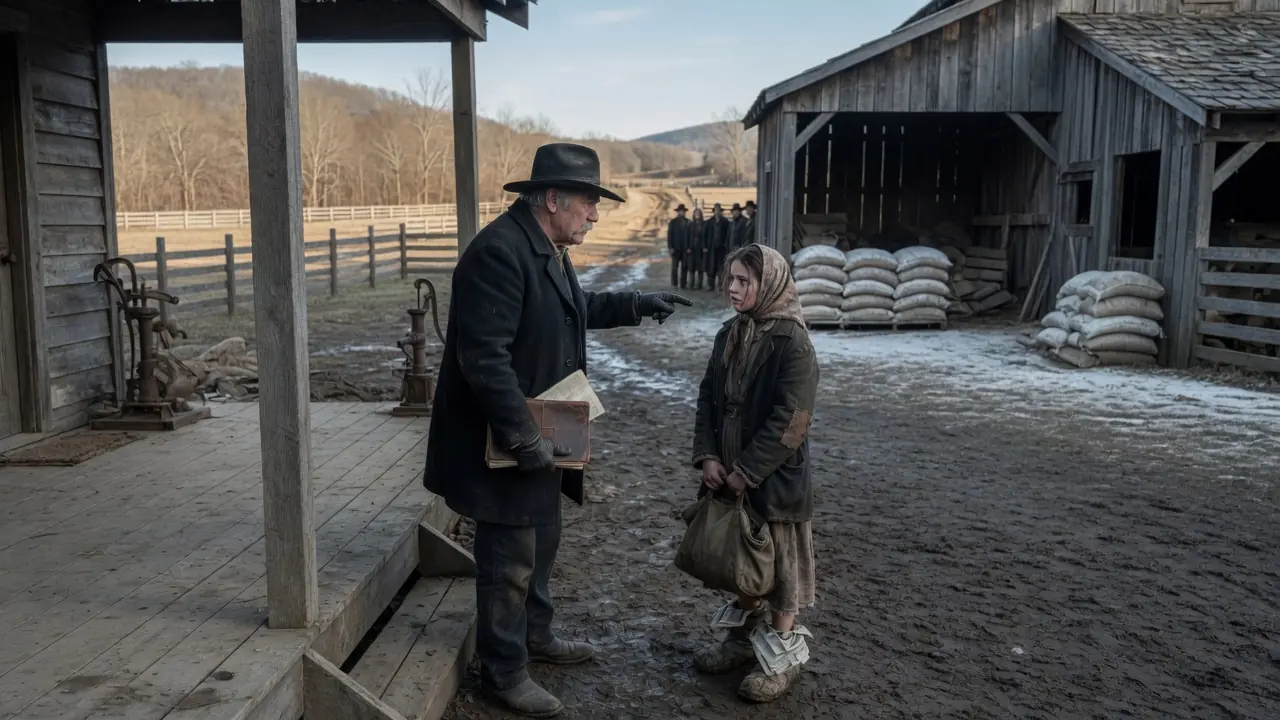
The morning Ada Holloway was cast out of Caldwell Hollow, the wind came down from Smoky Ridge like it had a personal grudge against the living. It rattled the split-rail fences around Cecil Drummond’s ranch, snapped at the bare winter trees, and pushed flour dust across the dirt yard in pale little ghosts. Ada stood near the porch steps with one canvas bag hanging from her shoulder, her thin dress pressed flat against her legs and damp newspaper stuffed inside boots too large for her feet. She was fifteen years old, hungry, cold, and surrounded by people who had already decided she was not worth saving.
Cecil Drummond stood above her on the porch with his ranch ledger in one gloved hand. He was the richest man in Caldwell Hollow, broad through the shoulders, hard around the mouth, and used to having his opinions treated like law. Behind the fence line, townspeople gathered in uneasy silence, pretending they had only stopped to watch because there was nowhere else to look. Nobody spoke for Ada, though half of them knew why she was in trouble.
The truth was simple. Cecil had discovered that food from his storage shed had reached families who could not pay him back. Flour, beans, cornmeal, dried apples, and sometimes a few strips of cured meat had disappeared from his shelves and appeared in the homes of people whose children had gone to bed hungry too many nights. Cecil called it stealing. Ada called it doing what decent folks should have done before her.
“You gave away food I paid for,” Cecil said, slapping the ledger against his palm. “Don’t stand there acting noble when you’ve been taking from my shelves.” Ada kept her shoulders straight, though her fingers tightened around the strap of her bag. “Those families were hungry, Mr. Drummond,” she said quietly. “I only did what I could.”
A murmur moved through the watchers, then died when Cecil turned his glare toward them. He stepped down from the porch, close enough now that Ada could smell leather, tobacco, and cold wool. “What you could?” he repeated. “Girl, you don’t have a name worth defending, a family worth claiming, or a penny worth counting. You ain’t worth feeding anymore.”
Ada heard a woman gasp near the fence, but no one moved. Old Mrs. Bell, whose grandchildren had eaten Ada’s cornmeal three nights earlier, lowered her eyes. Reverend Pike rubbed his hands together and stared at the mud. Even Eli Carson, the young cowboy who worked the east pasture and had once given Ada an apple from his saddlebag, stood near the water pump without stepping forward.
Cecil pointed one gloved finger toward the mountain road. “Then let those decent folks feed you,” he said, cold and loud. “Because you ain’t eating from my table again.” Ada looked down the road where frozen mud bent toward Smoky Ridge. She knew what that road meant in November, but she also knew begging Cecil would only feed his cruelty.
She shifted the bag higher on her shoulder and took one step. Then another. The crowd parted without touching her, like shame itself had given her a path. She did not cry where they could see it. She did not ask for mercy from people who had spent all morning proving they had none.
Only when she reached the bend near the black oak did a voice rise behind her. “I’ll take her!” Ada stopped, but did not turn right away. The voice belonged to Eli Carson, and the suddenness of it froze the yard harder than the wind had. He stepped away from the water pump, a lean cowboy of twenty-two with a worn brown hat, a patched coat, and the kind of steady eyes that belonged to men who had been poor long enough to recognize injustice.
Cecil’s face tightened. “You’ll do what?” Eli walked into the open yard, standing between the fence line and Ada’s retreating path. “I said I’ll take her,” he repeated. “If you’re throwing her out for feeding hungry folks, then I reckon she’s got more character than most of this town put together.”
The words struck Caldwell Hollow like a dropped lantern. Men shifted their boots. Women stared. Ada finally turned and saw Eli standing there with his jaw set and his hands loose at his sides, not reckless, not loud, but decided. For the first time that morning, someone had risked something for her.
Cecil laughed, but the sound came out thin. “You own nothing but a saddle, Carson.” Eli nodded. “That is true.” His eyes moved to Ada, then back to Cecil. “But I know a line when I see one, and this town just crossed it.”
For one bright second, Ada almost believed she might not have to leave. Then Cecil’s expression changed into something uglier. “You walk with her,” he said, “and you don’t work this ranch another day.” Eli looked toward the barn, toward the horses, toward the small bunkroom that had been his shelter for two years. Then he took off his ranch gloves and dropped them in the dirt.
“Then I don’t work this ranch another day,” he said. The crowd stared as if he had fired a gun into the sky. Ada’s chest tightened, not with joy exactly, but with the terrible knowledge that someone else had just paid a price for kindness. Eli walked to her side and said softly, “Come on, Miss Ada. Road’s cold, but we ain’t standing here for him anymore.”
They walked out of Caldwell Hollow together, past the black oak and into the climbing road. Eli did not say much at first. He carried no bundle, only a bedroll from the bunkhouse and a small tin of coffee he had taken from his shelf before Cecil could think to forbid it. Ada kept waiting for him to regret his decision, but he only watched the road ahead.
By sunset, they had reached the lower slopes of Smoky Ridge. Eli knew a half-collapsed line cabin near an old logging trail, but when they reached it, the roof had fallen in and the wind moved through it as if it owned the place. “Not good enough,” he muttered. Ada pushed her scarf tighter around her face and looked toward the ridge. “There’s limestone up there,” she said. “Where limestone is, sometimes there are caves.”
Eli looked at her with surprise. “You know that?” Ada nodded. “My father taught me things before he died.” She did not say more, and Eli did not ask. They climbed until the last light thinned into gray and the trees became black lines against the sky. Then Ada saw the curtain of dead vines hanging over stone.
The cave was narrow at first, then opened into a hidden chamber deep enough to stop the wind. Ada stepped inside and felt the mountain close around her, not like a prison, but like a hand shielding a flame. Eli lit a small fire near the entrance where smoke could escape, and the cave walls turned amber in the glow. They sat facing the flames, two people the town had discarded for the price of one decent sentence.
“You didn’t have to do that,” Ada said after a long silence. Eli stirred the fire with a stick. “Yes, I did.” She looked at him, searching for pity, but found none. He spoke again. “My mother went hungry when I was little. Folks called her lazy because it made them feel better about not helping. I know the sound of that kind of lie.”
They survived that first week on what Eli knew of trapping and what Ada knew of plants. She found watercress near a half-frozen creek, hickory nuts under leaf cover, and bitter greens that could be softened in a pot. Eli brought back a rabbit once and two small fish another day, and Ada made them stretch farther than he thought possible. He began to understand that the girl Cecil had thrown away carried a mind sharper than any knife in the hollow.
The cave changed quickly because Ada could not stand useless space. She built a sleeping platform from branches, lined shelves with flat stone, and hung herbs from cracks in the wall. Eli shaped a better fire ring and hauled in dry wood until one whole side of the chamber smelled like cedar. By the end of the month, the cave no longer looked like desperation. It looked like a place fighting back.
One evening, Ada opened the worn science book her father had left her. She found a note about soapstone somewhere along the ridge, soft enough to shape and strong enough to hold heat. The next morning, she and Eli searched for it, slipping over frost-silver rock and climbing through laurel thickets. They found gray-green stone hidden above a narrow cut in the hill.
For weeks, Ada shaped rough cooking pots with a worn knife, flint chips, and stubborn patience. Her hands ached. Her shoulders burned from carrying stone back to the cave. Eli offered to stop more than once, but Ada only shook her head and kept scraping. “A kitchen needs pots,” she said, as if that settled the matter.
By Christmas, she had two uneven pots and a flat griddle. They were ugly, heavy, and perfect. That night she made soup with wild onions, dried mushrooms, nuts, and what little meat Eli had found. The scent filled the cave slowly, wrapping itself around the stone walls like memory.
When Ada tasted the first spoonful, she went still. It carried her back to her mother’s kitchen, to flour on sleeves, laughter near the stove, and evenings before loss had become the family’s only visitor. She lowered the bowl and pressed her eyes shut while tears slipped down her cheeks. Eli said nothing. He only looked into the fire and gave her the dignity of not being watched.
Spring came with thawing ground, bird calls, and the first green shoots along the ridge. Eli found work shoeing horses two valleys over, but he returned every evening with scraps of flour, salt, or tools whenever he could. Ada planted herbs in terraces near the cave and learned how the sunlight moved across the clearing. Together, they built a stone bread oven outside the entrance.
The oven collapsed twice before it stood. Eli cursed the stones. Ada laughed for the first time since leaving Caldwell Hollow. The sound startled them both, and then Eli laughed too. On the third attempt, the oven held heat, and Ada mixed the first dough with water, flour, and starter coaxed into life from wild yeast.
The first loaf came out uneven, cracked across the top, and more precious than gold. Eli broke it open, steam rising into the clean mountain air. He tasted it, chewed slowly, then looked at Ada with wonder. “Miss Ada,” he said, “there are women in town with proper ovens who could not make bread like this if heaven wrote the recipe on the wall.”
Word spread slowly at first. A boy found his way up the ridge after smelling bread on the wind. Then a widow came, then a father with two thin children, then a woman carrying a sack of turnips and pride worn almost through. Ada did not ask for payment. She handed them bread, soup, and instructions.
That was what made her different. She did not only feed people. She taught them how to keep themselves fed. She showed them how to preserve herbs, stretch flour, find edible greens, build small ovens, save seeds, and keep sourdough alive in cold weather. The cave became a kitchen, then a school, then a gathering place.
Eli stayed through that first year, then the next. People stopped calling him foolish and began calling him brave, though he disliked both words. He built tables from scrap lumber, cut steps into the steep path, and traded labor for goats so Ada could make milk and cheese. When anyone asked why he had given up a ranch job for a girl in a cave, he would shrug. “Some decisions don’t need explaining twice.”
By 1937, the valley fell into harder times. Jobs vanished, farms failed, and Caldwell Hollow grew thinner around the edges. But above Smoky Ridge, the ovens burned every day. Bread came out by the dozens, soup simmered in Ada’s stone pots, and children carried baskets home wrapped in cloth. The smell that drifted through the hills was not only food. It was hope with a crust.
One winter night, Nora Colton climbed the path carrying her young son wrapped in blankets. The boy was weak with fever, and the town doctor had gone to another county. Ada brought them inside, warmed the child near the fire, and brewed herbs her mother had once taught her to use. She stayed awake through the night, steady and calm, refusing to let panic take over the room.
Near dawn, the boy’s breathing eased. By morning, he was sleeping peacefully with color returning to his cheeks. Nora wept into Ada’s hands. News of it reached Caldwell Hollow before noon, and for the first time, people began speaking Ada’s name without shame. Some remembered the food she had given them years before. Some remembered their own silence.
The mountain path grew crowded after that. Families brought what they had: eggs, wool, empty jars, broken tools, stories, and apologies spoken badly but sincerely. Ada accepted useful things and ignored prideful speeches. She had no interest in making people crawl. She wanted them to learn, work, and eat.
Cecil Drummond held out longer than most. His ranch had shrunk after bad seasons and poor choices. Men no longer jumped when he spoke. His ledger still held names, but fewer people feared it. One autumn afternoon, he climbed Smoky Ridge alone, older, smaller, and breathing hard by the time he reached Ada’s clearing.
He stopped at the sight before him. Gardens stepped down the hillside, goats grazed behind woven fencing, smoke drifted from ovens, and long tables stood beneath a shelter of rough-hewn beams. Children ran with baskets of bread. Women stirred pots. Men repaired tools. Everything Cecil had said Ada was not worth feeding had grown into a place that fed half the valley.
Ada saw him from the oven yard. She wiped flour from her hands and walked toward him. Eli, older now and stronger through the shoulders, stood a few paces back but did not interfere. This was Ada’s moment, and he knew it.
Cecil removed his hat. For several seconds, he stared at the ground. “I was wrong,” he said. The words came out rough, as if unused. “I heard what this place became. I thought folks were exaggerating.”
“They often do,” Ada said. Cecil looked at her then, searching for anger. She had anger once, but it had burned into something cleaner over the years. “The soup’s hot,” she said. “If you came hungry, sit down.”
He seemed almost disappointed by the mercy. Ada led him inside, placed a bowl before him, and let him eat the same food as everyone else. No speech. No revenge. No humiliation returned. That, more than any shouted victory, made Cecil’s hands tremble around the spoon.
Years passed, and the cave kitchen became known far beyond Caldwell Hollow. Travelers came from Tennessee, Kentucky, Carolina, and beyond to see the ovens built by the girl who had been cast out. Some came for the bread. Some came for lessons. Some came just to stand in the cave and imagine a fifteen-year-old girl waking there alone and deciding the story was not over.
Ada grew into a woman of quiet authority. She never dressed grandly, never let praise sit too long in the room, and never forgot the cold morning that sent her up the mountain. Eli remained beside her, not as a rescuer expecting gratitude, but as a partner who had seen her worth before the rest of the valley learned to look. When people called him the cowboy who shocked the West, he always shook his head.
“I only said what should have been said sooner,” he would tell them. Ada would hear him and smile to herself, because she knew better. A single sentence spoken at the right moment can become a bridge. Eli’s sentence had not saved her by itself, but it had told her she was not invisible. Sometimes that is enough to keep a person walking.
Long after the worst years ended, the ovens still burned each morning. Ada fed the sourdough starter before sunrise, touched the warm stone of the bread oven, and listened as the mountain woke around her. Children who once came hungry returned as grown people bringing children of their own. They learned the old recipes, the plant names, the patience of heat, and the stubborn grace of feeding others without making them feel small.
Caldwell Hollow changed because Ada Holloway refused to become the story Cecil Drummond wrote for her. She had been called worthless, unwanted, and too poor to matter. But in the cave, with stone pots, wild herbs, hard bread, and one cowboy’s faith, she built a life larger than the town that abandoned her. She turned survival into skill, skill into generosity, and generosity into a place strong enough to hold a whole valley.
Today, people still speak of the morning when fresh bread scented the frozen hills above Caldwell Hollow. They speak of the girl with the canvas bag, the rancher who cast her out, and the cowboy who stepped forward when everyone else stayed silent. But the truest part of the story is not what was done to Ada. It is what she built afterward.
Because cruelty can push a person onto a road.
But courage decides where that road ends.