The first three black SUVs arrived while I was waist-deep in hay, repairing the back fence where my mule had kicked through it the night before.
It was a hot Tuesday afternoon, the kind that made the metal tools too warm to hold without gloves. Sweat ran down the back of my neck as I drove a new staple into the cedar post.
Then I heard tires grinding over my gravel driveway.
I straightened and watched the vehicles stop near the barn.
Three men in dark suits stepped out first, each carrying a briefcase and wearing the same expression people wear when they already believe the argument is over.
The fourth door opened.
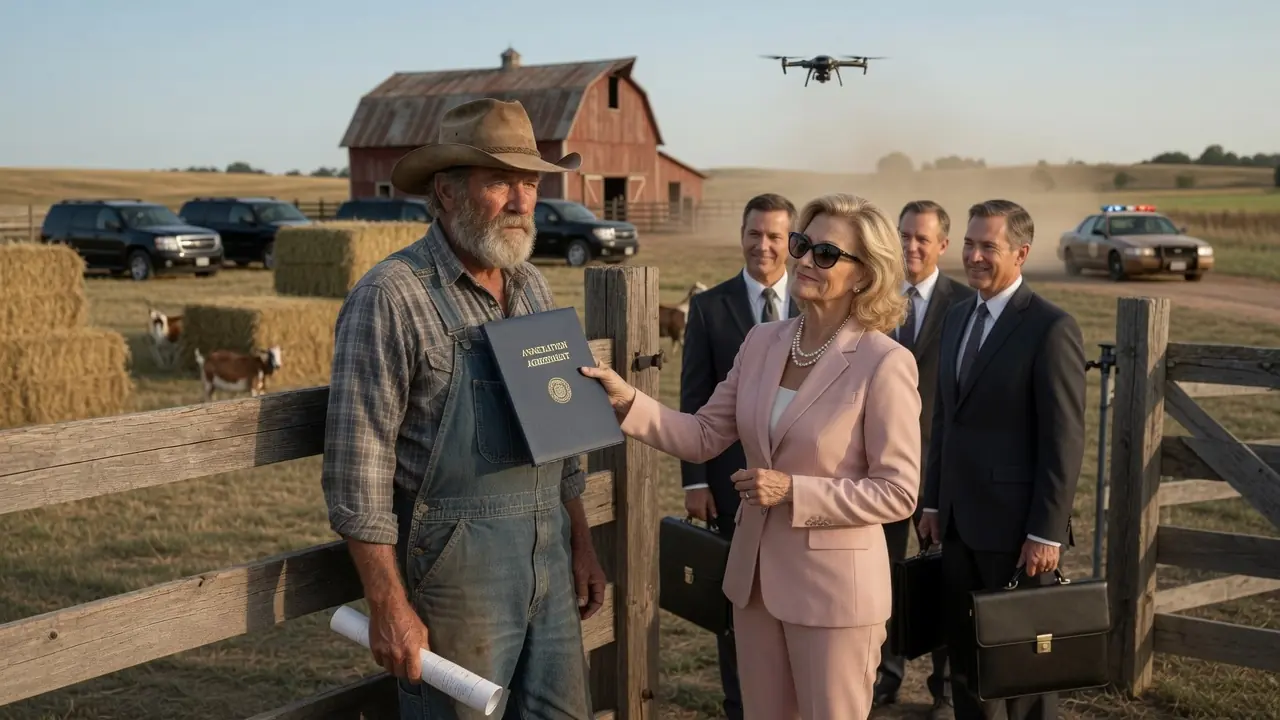
Janette Bradford emerged in a powder-pink pantsuit, oversized sunglasses, and heels that had no business being within fifty miles of livestock.
“Mr. Ezekiel Marsh,” she called. “We need to talk.”
Most people called me Zeke.
Janette always used my full name when she wanted to make a threat sound official.
She was president of the Willow Creek Homeowners Association, a subdivision built a quarter mile east of my land. Willow Creek consisted of seventy-two nearly identical houses arranged around a decorative pond, a clubhouse, and streets named after trees that had been cut down during construction.
Janette had lived there for less than two years.
She already spoke as though she had founded the county.
I leaned against the fence post.
“I do not live in Willow Creek.”
“This concerns more than your residence.”
“This is my farm. It has been my farm for fifteen years.”
One of the lawyers opened his briefcase.
Janette lifted one finger.
“The association voted last Thursday to include adjacent agricultural parcels within an expanded community-impact boundary.”
I looked at her.
“You voted to do what?”
“The expansion allows us to inspect neighboring properties that directly affect Willow Creek’s safety, appearance, drainage, and market value.”
I began laughing.
Not politely.
It was the kind of laugh that startled the goats beneath the shade structure and made one of the attorneys look at his shoes.
Janette’s mouth tightened.
“You find this amusing?”
“You held a meeting and voted yourselves authority over land you do not own.”
“Our counsel believes the shared-perimeter doctrine—”
“There is no shared-perimeter doctrine.”
The slick-haired attorney stepped forward.
“There are several legal theories concerning community risk and adjacent land use.”
“Name one that lets an HOA annex private farmland without the owner’s consent.”
He did not answer.
Instead, he handed me a thick folder.
Inside were meeting minutes, maps, proposed inspection procedures, and a list of alleged violations.
Unsafe livestock containment.
Unapproved agricultural structures.
Excessive equipment noise.
Potential chemical runoff.
Visual blight affecting neighboring property values.
One map showed my entire one hundred and sixty acres shaded pale green beneath the words:
PROPOSED WILLOW CREEK AGRICULTURAL OVERSIGHT ZONE
I flipped through the pages.
“You people made all of this yourselves.”
“These documents were approved by the board,” Janette said.
“That does not make them law.”
“It establishes community consent.”
“The community does not own my land.”
Janette removed her sunglasses.
“You are being unnecessarily hostile.”
“You drove onto my property with three lawyers and a pretend annexation map.”
“We came to resolve the matter professionally.”
“No. You came because you thought a stack of paper and three expensive vehicles would frighten me.”
The attorney with slicked-back hair cleared his throat.
“Mr. Marsh, refusing reasonable access may result in litigation.”
“You are already trespassing.”
Janette stepped closer.
“You have twenty-four hours to permit a survey and compliance inspection. If you refuse, we will return with enforcement.”
“What kind of enforcement?”
“Whatever the court authorizes.”
I closed the folder and placed it on the hood of her SUV.
“The court will not authorize your imagination.”
Her eyes narrowed.
“You may regret taking this tone.”
“I have regretted things more important than your opinion.”
I pointed toward the driveway.
“Now leave.”
They did.
But Janette smiled before getting into the Escalade.
That was when I understood she had not come to persuade me.
She had come to establish a record showing that she had warned me.
Whatever Willow Creek was planning had already begun.
I walked into the barn and called Alina Reyes.
Alina was a property-rights attorney in the neighboring county. Eight years earlier, her mare escaped during a thunderstorm. I tracked the animal for two days through wet woods and found her tangled in an abandoned wire fence.
Alina had never forgotten it.
When she answered, I described the SUVs, the lawyers, and the fake annexation documents.
She was silent for several seconds.
“Send me photographs of every page.”
I did.
Ten minutes later, she called back.
“This is nonsense.”
“I gathered that.”
“But it is organized nonsense.”
“What does that mean?”
“It means someone spent money creating a paper trail. They are not trying to win a clean legal case. They are trying to create enough pressure that you negotiate.”
“For what?”
“That is what we need to find out.”
She emailed copies of the state statutes governing homeowners associations, agricultural exemptions, private access, and nuisance claims.
The language was clear.
Willow Creek’s authority ended at its recorded subdivision boundary.
My farm was independently deeded, agriculturally zoned, and protected under the state’s right-to-farm law.
The HOA could complain about a specific, measurable harm.
It could not invent jurisdiction.
By sundown, I had installed five cameras.
Two watched the driveway.
One faced the barn.
Another covered the livestock pens.
The smallest camera went into the tree line overlooking the eastern boundary nearest Willow Creek.
Alina filed a request for an emergency restraining order that night.
Then we waited.
Janette did not give me the promised twenty-four hours.
She returned at nine the following morning.
This time, the SUVs stopped outside my gate.
A drone flew over them.
It crossed the fence line and descended above my pasture with a high electric buzz. My mustang, Whiskey, kicked at the air and ran toward the far paddock.
The drone moved over the chicken coop, circled the barn, and hovered close enough to the farmhouse windows that I could see the camera turning.
Janette stepped from the Escalade.
The two attorneys followed.
A fourth man wore a reflective vest and carried a tablet connected to the drone controls.
“Morning, Mr. Marsh,” Janette called.
I stood on the porch with my arms folded.
“What is that doing over my house?”
“Visual inspection.”
“You do not have permission.”
“We are collecting preliminary mapping information.”
“For property you do not own.”
“Your land directly affects our drainage and fire safety.”
I walked to the gate but remained inside my boundary.
“The judge signed a temporary restraining order at 7:40 this morning.”
I held up the sealed copy.
“You are prohibited from entering, surveying, recording, or interfering with this property.”
The drone operator looked immediately toward Janette.
“You told me this was approved.”
“It is,” she said.
“No,” I replied. “It is restrained.”
The slick-haired attorney stepped forward.
“We have not received formal service.”
“Your office received it electronically at 8:12. The process server delivered a physical copy to Willow Creek headquarters at 8:35.”
His expression changed.
Janette stared at him.
“You said it had not been filed.”
“I said I had not received confirmation.”
The drone continued hovering over my barn.
I pointed upward.
“That device has already been reported to the sheriff’s department.”
Janette laughed.
“Operating a drone is not a crime.”
“Using it to record through windows and map private agricultural property after being restrained may become one.”
A tan sheriff’s cruiser turned onto the road.
Deputy Gabriel Morales parked behind the Escalade.
He stepped out without rushing.
Janette’s confidence weakened.
Morales had grown up three farms south of mine. He knew the difference between a property dispute and a group of people creating one for financial advantage.
I handed him the order.
He read it carefully.
Then he faced Janette.
“You were served this morning?”
“Our legal counsel is reviewing the validity.”
“That was not the question.”
She hesitated.
“Yes.”
“And you came here anyway.”
“We remained outside the boundary.”
Morales looked at the drone.
“That did not.”
The operator began bringing it higher.
Morales pointed toward the tablet.
“Land it.”
Janette turned toward him.
“Deputy, this association has a duty to investigate threats to residents.”
“What threat?”
“Unsafe livestock structures, possible runoff, unpermitted construction—”
Morales looked toward my barn.
“County inspections show any of that?”
“We have anonymous complaints.”
“From whom?”
“Residents.”
“How many?”
“I am not required to disclose—”
“You are when you ask law enforcement to help you violate a court order.”
The drone landed on the roadside.
The operator immediately began packing it away.
Janette faced me.
“You do not understand what you are doing. Your property affects the value of every home in Willow Creek.”
“I understand exactly what I am doing.”
“This farm prevents coordinated development.”
There it was.
Not safety.
Not drainage.
Development.
One of the lawyers looked sharply at her, but the words had already escaped.
I smiled.
“Thank you for finally saying it.”
Janette’s face tightened.
Morales returned the order to me.
“You need to leave, Mrs. Bradford. Any further attempt to enter or survey the property could result in criminal trespass charges.”
“This is obstruction.”
“No. This is a boundary.”
The attorney touched Janette’s sleeve.
“We should go.”
She climbed into the Escalade without another word.
As the SUVs drove away, Morales remained.
“You think this is about expanding the subdivision?” he asked.
“I think it is about money.”
“Most HOA fights are.”
“Alina is looking at their accounts.”
He glanced toward the road.
“If she finds criminal fraud, call me before you post anything or confront anyone.”
“I was not planning to confront them.”
Morales gave me a long look.
“Zeke, I have known you since you were seventeen.”
“Fair point.”
The tree-line camera had captured the drone’s entire flight.
It recorded the device descending near my windows, hovering over the livestock pens, and scanning the eastern fence.
The flight data Alina later obtained showed it had also crossed several non-HOA properties north of Willow Creek.
The drone was registered to Greenway Planning Solutions.
The company had no website, employees, equipment yard, or visible business location.
Its registered address was a post office box.
The renewal documents had been signed by Paul Henley, Willow Creek’s treasurer.
Alina called me that evening.
“The drone company is a shell.”
“What does Paul gain?”
“Not clear yet. But Willow Creek has paid Greenway almost eighty thousand dollars since February.”
“For what?”
“Retention-management consulting.”
“They have one pond.”
“Exactly.”
My neighbor Franklin Doss stopped by after sunset.
We leaned against the repaired fence while Whiskey grazed nearby.
I explained what Alina had found.
Franklin scratched his gray beard.
“They are using member dues to pay themselves.”
“Maybe.”
“And if they annex your farm?”
“They raise the number of acres under management. Bigger assessments, larger development budget, more contracts.”
Franklin looked toward the subdivision.
“They picked the wrong mule to kick.”
The next morning, someone uploaded my camera footage to Willow Creek’s online community board.
It was not me.
The post showed Janette arriving with the drone, the conversation about development, Deputy Morales reading the restraining order, and the operator admitting he had not been told the flight was disputed.
Residents reacted immediately.
Many had believed their dues were paying for landscaping, road maintenance, pool repairs, and insurance.
They had not known the board was funding surveillance of neighboring properties.
By afternoon, I received a voicemail from Carla Whitmore, one of Willow Creek’s five board members.
Her voice was quiet.
“I voted against the annexation proposal. Janette forced it through with three votes and called it an emergency measure. Most residents were never notified.”
She paused.
“There are financial records you need to see.”
I called her back.
“Are you willing to bring them?”
“Yes.”
“Then come after dark.”
Carla arrived in an old blue sedan and parked behind my barn where it could not be seen from the subdivision road.
She carried two file boxes.
Her eyes kept moving toward the driveway.
“If Janette learns I am here, she will remove me from the board.”
“You may not have a board much longer.”
We sat at the kitchen table.
Carla opened the first folder.
Inside were invoices from Greenway Planning Solutions.
Retention consulting.
Land-impact analysis.
Community-perimeter evaluation.
Security assessment.
Every invoice ended in a round number.
$8,000.
$12,500.
$15,000.
No reports were attached.
No photographs.
No work descriptions.
No proof that services occurred.
“Paul approved these?” I asked.
“Janette authorized them as emergencies. Paul signed the payments.”
“Did the full board vote?”
“No.”
“What explanation did they give?”
“They said a drainage liability near the retention pond required immediate professional review.”
“Was there a problem at the pond?”
“Not that anyone could find.”
Carla opened another file.
These documents concerned an out-of-state developer named Northstar Residential Partners.
Willow Creek’s board had authorized preliminary escrow payments for site analysis along the northern and western boundaries.
My farm sat directly west.
“They have been meeting with Northstar for months,” Carla said.
“What do they want to build?”
“Another phase. Maybe one hundred homes.”
“They have no land.”
“They planned to create it.”
“How?”
“Buy several neighboring parcels through a Nevada trust. Then surround your farm on three sides and argue that annexation was necessary for infrastructure continuity.”
“That would not give them ownership.”
“No. But it could keep you in court for years.”
I examined one map.
A proposed road crossed my eastern pasture and continued directly through the hay field toward the county highway.
Without my land, the development had no second emergency exit.
County rules would never approve the expansion.
“They did not want HOA jurisdiction,” I said.
“They wanted an access corridor.”
Carla nodded.
“And more dues. More developer money. More contracts routed through Greenway.”
“Will you testify?”
Her hands tightened around the folder.
“If I have protection.”
“You will.”
I called Alina from the kitchen.
By midnight, she had arranged a meeting with the state attorney general’s financial crimes section.
Investigators interviewed Carla for four hours.
The evidence led to emergency subpoenas for Willow Creek’s bank records, vendor agreements, board emails, and electronic payment histories.
Alina filed a motion to freeze the HOA’s discretionary accounts.
A judge approved it the same day.
At six the next morning, Morales returned to my driveway with two state troopers.
“They issued search warrants,” he said.
“For Willow Creek?”
“The clubhouse, Paul’s home office, Janette’s residence, and the law firm advising them.”
“That escalated quickly.”
Morales gave me a tired smile.
“So did they.”
He opened a padded evidence case containing a copy of the drone’s memory card.
“The operator kept backup footage.”
“What did it show?”
“Your farm. Four neighboring parcels. Several backyards inside Willow Creek.”
“Why their own residents?”
“To gather footage for compliance letters.”
He looked toward me.
“One recording includes a child changing clothes beside a backyard pool.”
My stomach tightened.
“That was not an accident?”
“The flight log shows the drone returned to that property three times.”
The case was no longer a dispute over land.
The board had used surveillance to manufacture violations, pressure homeowners, and collect information for leverage.
By sunrise, news vans were parked outside the Willow Creek clubhouse.
Residents gathered near the entrance as investigators carried boxes from the building.
Paul Henley emerged first in handcuffs.
Janette followed.
She still wore her pearl necklace and a stiff navy blazer, but without the sunglasses and practiced smile, she looked smaller.
Carla stood across the parking lot.
When she saw me, she handed me another document.
“Emergency security initiative,” she said. “Twenty thousand dollars for motion cameras along the subdivision perimeter.”
“The perimeter included private homes.”
“Any property they considered useful.”
The paper listed twelve target locations.
My farm.
Franklin’s house.
A widow’s property along the north road.
Several Willow Creek homes whose owners had challenged fines.
“They were spying on their own members,” I said.
“They were building files.”
“For what?”
“Control.”
Janette saw us.
For one second, her eyes met mine.
She did not look frightened.
She looked offended.
As though being arrested were another violation committed against her.
The state charged Janette and Paul with wire fraud, theft of association funds, unlawful surveillance, conspiracy, and falsifying corporate records.
Three other board members were later indicted.
Two attorneys from the HOA’s law firm were charged with helping create the fraudulent annexation documents while knowing Willow Creek had no jurisdiction over my farm.
Investigators traced more than two hundred thousand dollars from HOA accounts into shell companies and a Nevada property trust.
Some of the money paid for drone surveillance.
Some funded cash offers to residents outside the subdivision.
Some had gone directly to Paul and Janette through fake consulting invoices.
The Nevada trust controlled four parcels north of Willow Creek.
Its owners were the same people behind Northstar Residential Partners.
The planned corridor would have surrounded my land and connected the proposed development to the highway.
A former paralegal from the HOA’s law firm provided the final piece.
She turned over emails in which one attorney warned Janette that annexing private farmland by board vote was legally impossible.
Janette’s response read:
We do not need the annexation to survive permanently. We need Mr. Marsh to believe litigation will cost more than selling.
That sentence appeared in every newspaper article about the case.
Willow Creek residents voted to dissolve the HOA by ninety-three percent.
A state-appointed receiver handled roads, insurance, and the community pool during the transition. Those services were later placed under a small voluntary neighborhood cooperative with open books and elected oversight.
Carla refused to remain president.
“I have attended enough meetings for one lifetime,” she said.
Civil settlements returned misused assessments to homeowners.
Families targeted with fabricated violations received additional compensation.
The woman whose fence had supposedly crossed five feet into HOA property learned that her boundary had never moved.
An elderly couple discovered that Greenway had photographed their home twenty-six times while preparing a pressure campaign to purchase their lot.
Franklin found survey stakes hidden along the edge of his pasture.
The land grab had been larger than my farm.
I had merely been the first person who refused to be intimidated long enough for the scheme to remain hidden.
I saw Janette again at her arraignment.
The pink suits and sunglasses were gone.
She wore a county-issued uniform and stood beside an attorney who spoke continuously into her ear.
Paul sat behind her, staring at the floor.
Both pleaded not guilty.
Outside the courthouse, a reporter asked me whether I felt responsible for destroying Willow Creek’s leadership.
“No,” I said.
“They did that themselves.”
“What did you do?”
“I asked them to stay off my land.”
The reporter smiled.
“That seems like an understatement.”
“Most important truths sound simple.”
A week later, Carla met me in the courthouse cafeteria.
She looked exhausted.
“They left this beneath my windshield.”
She passed me a typed note.
THE BOARD REMEMBERS ITS FRIENDS AND ITS ENEMIES.
“No signature?” I asked.
“No.”
“Did you touch anything else?”
“Only the edge.”
I placed the note inside a plastic evidence sleeve Alina had taught me to keep in my truck.
The message led investigators to another shell contractor connected to a former Willow Creek security consultant.
That company had been paid to monitor dissenting residents and report their schedules.
The intimidation attempt added witness-tampering charges to the growing case.
The investigation also spread into two neighboring counties.
The same law firm had used nearly identical “community-impact boundary” documents for other associations seeking control over nearby land.
Some owners had sold rather than fight.
One was a widower.
Another was an eighty-one-year-old woman who believed she could not afford court.
Their cases were reopened.
The truth about Willow Creek was no longer just my story.
Months later, Morales sat with me on the porch drinking iced tea.
“They denied bail for Janette and Paul,” he said. “Judge called them an ongoing threat to witnesses and community assets.”
“What happens to the law firm?”
“Federal investigation.”
“The drone operator?”
“Cooperating. He believed he was mapping land for a proposed public park.”
“He never questioned why he was filming houses?”
“He questioned it eventually. Not soon enough.”
We watched Whiskey move along the fence.
Morales nodded toward the new posts.
“You fixed the gate.”
“Goats broke it again.”
“Criminal conspiracy?”
“Highly organized.”
He laughed.
Then his expression became serious.
“You know, most people would have sold.”
“I considered it.”
“When?”
“Before any of this. Farming is hard.”
“What changed?”
“Someone decided difficulty meant weakness.”
Morales nodded.
“That will do it.”
The residents of Willow Creek held a gathering at the community hall after the HOA dissolved.
I nearly skipped it.
Parties were not my thing.
Franklin told me refusing free food was disrespectful, so I went in my oldest boots and a clean shirt.
The hall was full.
Families.
Retired couples.
Young parents.
People who had paid fines for paint colors, children’s bicycles, garden sheds, fences, holiday decorations, and grass measured half an inch too high.
Carla stood near the front.
She raised a glass.
“To Zeke Marsh, who reminded us that a community is not a corporation and a boundary is not an invitation.”
People applauded.
She continued.
“And to neighbors who choose to help one another without needing permission from a rulebook.”
I did not give a speech.
I tipped my hat.
“Glad I could help.”
On the way to my truck, a man with calloused hands stopped me.
His name was Raymond Bell.
He owned one of the northern parcels targeted by the Nevada trust.
“They offered me cash to leave,” he said.
“Why didn’t you take it?”
“The amount was too high.”
I waited.
He smiled faintly.
“People do not pay that much unless they are buying more than they admit.”
“You did the right thing.”
“I did nothing.”
“You held your ground.”
He considered that.
“Sometimes that is all a person can do.”
“Sometimes it is enough.”
Life on the farm returned to its usual problems.
Broken gates.
Restless goats.
A mule with strong opinions.
Hay equipment that waited until the hottest day of summer to fail.
I kept the cameras.
Not because I expected Janette to return.
Because experience had taught me that property lines were only respected when somebody was prepared to prove where they stood.
I installed new signs at the eastern boundary.
They did not threaten trespassers or mention surveillance.
They read:
PRIVATE FARM
PROTECTED BY THE PEOPLE WHO LIVE HERE
The final camera faced the field where the pasture met the tree line.
At sunset, the light moved across the hay in long copper bands. Willow Creek’s rooftops were visible beyond the ridge.
The houses remained.
The families remained.
What disappeared was the small group of people who had confused community leadership with ownership of everyone around them.
Janette Bradford believed three lawyers, a drone, and a stack of invented bylaws could turn my farm into an asset on her development map.
She believed pressure would make me surrender before anyone examined the paperwork.
She came to my fence expecting an isolated farmer.
Instead, she found an attorney who knew the law, a board member willing to tell the truth, a deputy who respected boundaries, and residents who finally asked where their money had gone.
The court order did not defeat her by itself.
It only forced the scheme into the open.
Once people could see it, the paper empire collapsed.
The next spring, I repaired the same back fence again after the mule kicked through a different section.
Franklin stopped beside the road and watched me work.
“You ever think about putting up something stronger?”
“Every week.”
“Why don’t you?”
I looked at the mule standing innocently beneath the sycamore tree.
“Because then he would find another way out.”
Franklin laughed.
Beyond us, the field moved beneath the wind.
The farm was never truly safe from storms, animals, broken equipment, difficult seasons, or people who saw open land and imagined profit.
Nothing worth keeping was protected forever by one victory.
You repaired the fence.
You watched the boundary.
You kept the deeds.
And when someone arrived claiming that a vote taken in a clubhouse gave them authority over the soil beneath your boots, you reminded them of something older than their bylaws.
Land does not belong to whoever speaks most confidently.
It belongs to whoever can prove the truth—and is willing to stand there while the truth catches up.