“I want you and this entire mess gone by the end of the month,” Diane Prescott said from the edge of Arthur Langford’s driveway. She pointed past him toward the weathered barn, the orchard, and the old white farmhouse as though forty-seven acres of Virginia land were a pile of trash someone had forgotten to collect. “That is not a request.”
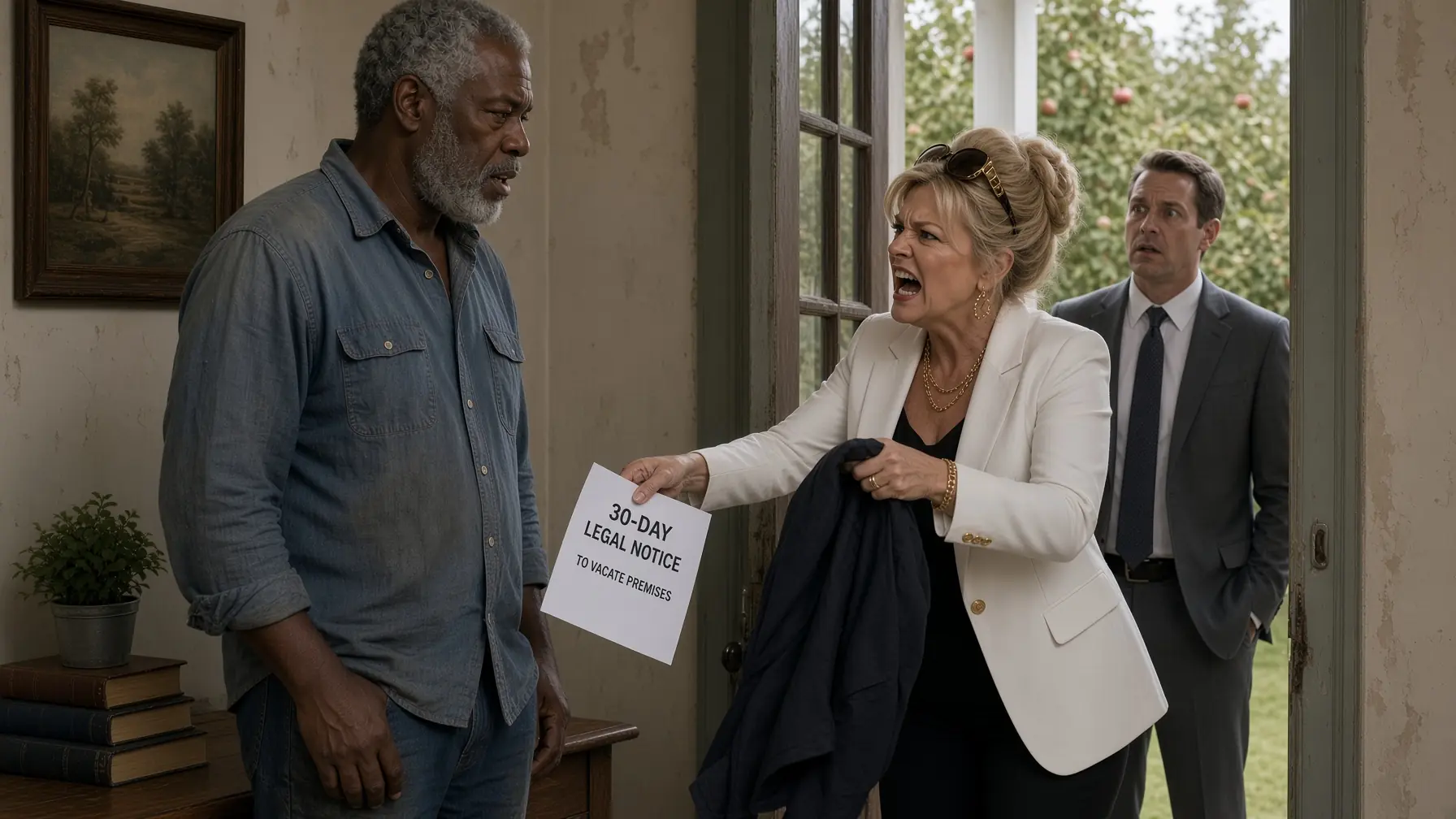
Arthur rested both hands on the top rail of the fence. “Mrs. Prescott, I’d appreciate it if we could discuss this without shouting.” Diane laughed and reminded him that she had already sent three attorneys to his porch with a ninety-day demand letter. Then she added, “You stood there wearing some ridiculous black costume and frightened them off without saying a word.”
Arthur looked at her for several seconds. “It wasn’t a costume.” Diane’s expression sharpened, and she asked what exactly it had been. Arthur answered quietly, “My judicial robes.”
For once, Diane Prescott had nothing ready to say. Arthur continued, “I served twenty-two years on the Virginia circuit court bench before I retired. One of those attorneys appeared before me last year.”
Diane blinked. “You’re a judge?” Arthur shook his head. “Retired judge.” Then he looked across the orchard toward the neighboring subdivision and added, “And I still don’t belong to your homeowners association.”
The ground beneath Arthur’s boots had been in his family since 1946. His grandfather, Henry Langford, came home from Europe after the Second World War with little money and no desire to spend the rest of his life surrounded by noise. He bought forty-seven acres outside Charlottesville, built a two-story clapboard farmhouse with his brothers, and planted an orchard along the southern slope.
The original trees were old Virginia favorites—York Imperial, Stayman, Winesap, and several varieties Arthur never learned to identify with confidence. Later generations grafted newer cultivars into younger rows, so by the time Arthur inherited the property there were Galas and Honeycrisps growing beside trees planted before his birth. Every September the ground beneath the oldest rows smelled of wet grass, fallen apples, and the sweet sharpness of fruit beginning to ferment in the sun.
Arthur’s father took over the farm during the 1970s. Arthur went to the University of Virginia, studied law, became a prosecutor, and eventually spent more than two decades on the circuit court bench. He never became a famous judge, which suited him perfectly.
His wife June loved the farm more openly than he did. Every summer she kicked off her shoes before reaching the porch, planted lavender beside the eastern fence, and complained that Arthur treated vacations like unauthorized absences from work. When she developed pancreatic cancer in her late sixties, the disease moved with a cruelty neither of them had time to understand.
Forty-seven days separated diagnosis from funeral. Arthur retired soon afterward, not because he had planned to leave the bench that year, but because returning to a courtroom where he had spent decades making careful decisions about other people’s lives suddenly felt impossible. He moved permanently into the farmhouse and began repairing everything age had quietly taken apart.
That was when Sterling Ridge Estates arrived next door. A dairy farmer whose land bordered the Langford property sold to a regional developer, and within eighteen months the pasture became ninety-three houses, decorative ponds, vinyl fencing, a clubhouse, and streets named after trees that had been bulldozed during construction. Arthur disliked the change but accepted that the neighboring land belonged to somebody else.
The trouble began when people from Sterling Ridge stopped accepting the same principle about his land. Residents complained about tractors starting before breakfast, manure smells on warm afternoons, and the appearance of his barn from the subdivision’s walking path. Most complaints ended when Arthur explained that his agricultural property existed before the subdivision and remained outside its recorded boundaries.
Diane Prescott did not like explanations that ended her authority. She was fifty-four, energetic, organized, and had been elected the first president of the Sterling Ridge homeowners association after becoming one of the development’s earliest buyers. Diane possessed the unfortunate combination of competence and certainty that sometimes convinces people that every problem belongs under their control.
Her husband, Roland Prescott, ran a construction company that had performed subcontracting work for the developer. Several years after Sterling Ridge opened, Roland was appointed to a county planning commission seat, which gave Diane’s opinions an additional gravity she enjoyed mentioning even when the commission had nothing to do with the subject. Arthur noticed the habit but initially considered it irritating rather than dangerous.
Their first real confrontation happened while Arthur repaired fence posts. Diane stopped her white SUV on the subdivision side of the property line, stepped out carrying a clipboard, and handed him a page stamped VIOLATION NOTICE. The document listed his barn as an aesthetic problem, his tractor as an unreasonable noise source, and unmanaged fruit beneath the orchard as a potential pest attraction.
Arthur read it twice. “Mrs. Prescott, my parcel isn’t part of Sterling Ridge.” Diane smiled and told him community standards applied to adjacent property affecting residents’ enjoyment and property values. Arthur answered, “Not through your covenants they don’t.”
She left the notice anyway. Arthur placed it in a kitchen drawer. Another arrived six days later.
Then another.
The demands became increasingly confident without becoming more legally convincing. Diane insisted he repaint the barn, relocate equipment that could be seen from the subdivision, stop operating machinery before eight in the morning, and remove several sections of old fencing that did not match Sterling Ridge’s approved materials. Arthur answered each letter briefly and kept every envelope.
Two months later, the first law firm contacted him. The letter accused him of maintaining conditions that interfered with Sterling Ridge property values and proposed that he sell the parcel to an unnamed purchaser within ninety days. It threatened litigation if he refused.
Arthur sat on the porch and read the document carefully. The letter did not actually identify a covenant binding his land, a contractual relationship with the HOA, or a county violation supporting most of its claims. It was aggressive correspondence, but Arthur had seen enough genuine litigation to distinguish an intimidating letter from a winning case.
He did not file a lawsuit against the lawyers. A threatening letter without merit did not automatically create a civil cause of action simply because the recipient disliked it. Instead, Arthur sent a short response asking them to identify the recorded instrument giving Sterling Ridge authority over his parcel.
Three attorneys arrived three days later. Arthur happened to be in his study sorting old court files and deciding what to do with the judicial robe he had not worn since retirement. He had put it on one final time before folding it into a storage box when the doorbell rang.
The lawyer in front was named Colin Barrett. Arthur recognized him before Colin recognized Arthur, because twelve months earlier the young attorney had appeared in Arthur’s courtroom during a commercial land dispute. When Arthur opened the door wearing the black robe, Colin stopped halfway through his introduction.
“Judge Langford?”
Arthur said nothing.
The two lawyers behind Colin looked first at him, then at the robe. Colin adjusted his briefcase and said, “I believe there may have been some misunderstanding concerning the ownership status of this parcel.” Arthur replied, “That is possible.”
Colin asked whether they could return after reviewing the county records. Arthur said, “That would be sensible.” The three men walked back to their sedan without serving any papers.
Arthur never knew exactly what Colin told Diane. Whatever it was, the law firm withdrew from further communication a week later. Diane responded by changing tactics.
The first county complaint alleged a failing septic system. An inspector visited, reviewed maintenance records, examined the field, and found no actionable problem. Arthur lost most of a Thursday to the inspection but thanked the man before he left.
The second complaint concerned the structural condition of the barn. A building official inspected it and identified several maintenance items Arthur already knew about, but nothing supporting the allegation that collapse threatened neighboring property. Arthur repaired one cracked brace anyway.
The third complaint involved orchard pests. Agricultural staff found ordinary insect activity consistent with a working orchard and recommended routine management, not emergency intervention. By the seventh complaint in less than two months, several county employees knew Arthur’s address from memory.
Arthur created a binder. Every notice went inside, along with inspection reports, dates, photographs, correspondence, and notes recording who had contacted him. He had spent too many years watching lawsuits turn on the document somebody remembered keeping to trust his own memory.
His neighbor, Franklin Ames, noticed the inspections. Franklin had farmed nearby for almost fifty years and remembered when Sterling Ridge was still pasture. One evening he stopped beside Arthur’s mailbox and said, “She did this to the Mercer family too.”
Arthur looked at him. “Complaints?”
“Complaints, letters, offers to buy.”
Franklin named two more families. Each owned small parcels along the edge of the new development, and each had sold within several years of repeated disputes over access, fencing, maintenance, drainage, or nuisance complaints. None claimed they had been forced to sell illegally, but all described pressure that made leaving feel easier than staying.
Arthur began wondering whether Diane’s behavior was more than personal irritation. The answer arrived in an ordinary white county envelope announcing a planning proposal involving future land-use changes around Sterling Ridge. The document did not rezone Arthur’s land immediately and certainly did not multiply his taxes overnight, but it placed his property inside a study area being considered for expanded residential development.
Arthur found Roland Prescott’s name in the meeting materials. Roland had participated in discussions involving the expansion area while his construction company continued doing work associated with Sterling Ridge and related development projects. Whether that amounted to a prohibited conflict depended on details Arthur did not yet possess.
He attended the next planning commission meeting. When public comment opened, Arthur described his property history, agricultural use, and a conservation easement his father had granted over twenty acres in the late 1980s. The easement did not prevent every possible land-use change on the remaining acres, but it sharply limited residential development on the protected portion.
Roland listened from the dais. When Arthur finished, he said the county needed to consider future housing demand and efficient growth patterns. Arthur thanked him, then asked whether Roland’s company currently had financial relationships with the developer or entities working inside Sterling Ridge.
The room changed.
Roland did not answer immediately. The commission chair asked whether the question related to a potential disclosure issue, and the county attorney requested that further discussion pause until staff could review applicable conflict-of-interest requirements. The planning item was deferred.
Arthur drove home without celebrating. Deferral was not victory, and a question was not proof. He knew better than almost anyone how dangerous it was to confuse suspicion with evidence.
So he started requesting records.
Arthur did not conduct a private criminal investigation. He asked for public planning records, development applications, meeting minutes, disclosed financial-interest statements, and available contracts involving county business. He also encouraged Sterling Ridge homeowners who were actually association members to request HOA financial records they were legally entitled to inspect.
One of those homeowners was Rebecca Sloan. She lived with two children on Juniper Court and had spent three years paying fines because she feared challenging Diane would risk a lien against her property. Rebecca’s file included charges for leaving trash containers visible too long, parking partly across the sidewalk, and installing a basketball goal without obtaining advance architectural approval.
Some fines appeared authorized by the documents. Others were harder to justify.
Rebecca was less interested in debating individual penalties than understanding where the money went. She requested budgets, ledgers, board minutes, vendor invoices, legal expenditures, and reserve-account statements. The HOA eventually produced hundreds of pages.
Arthur refused to review the finances himself. “I know enough accounting to be dangerous,” he told Rebecca. Instead, they hired forensic accountant Denise Rowan using contributions from several homeowners who wanted an independent examination.
Denise spent a week organizing the records. She found roughly ninety-eight thousand dollars in legal and consulting expenditures connected to “adjacent property compliance,” “development interface matters,” and similar descriptions. Some expenditures had board authorization, but others lacked clear supporting minutes or exceeded previously approved amounts.
More troubling was a consulting vendor called Community Standards Advisory LLC. It had received more than thirty thousand dollars over two years for compliance reviews and neighborhood planning support. Corporate records showed the company belonged to Diane Prescott’s sister.
Arthur stared at Denise. “Does that prove theft?”
“No.”
“Fraud?”
“Not by itself.”
“What does it prove?”
“That the board needs to explain why a related-party vendor received association money, what services were provided, how the contract was approved, and whether required disclosures occurred.”
Arthur nodded. “Good.”
Denise raised an eyebrow. “Good?”
“An answer we can prove.”
The planning records produced a separate problem for Roland. His construction company had received several substantial contracts from entities connected to the Sterling Ridge developer during the same years he participated in public planning discussions affecting nearby development. Records did not show that he had consistently recused himself.
Arthur sent the documents to the county attorney and the appropriate state ethics authorities rather than announcing publicly that Roland had committed a crime. Roland retained counsel and disputed that any vote directly affected his private financial interests. The review continued.
Diane became increasingly aggressive as residents began asking questions. The HOA board authorized another twenty-five thousand dollars for legal expenses during a meeting with poor notice and disputed quorum records. Rebecca obtained a copy of the resolution and gave it to Denise.
Then Arthur’s fence was cut.
He discovered the break before sunrise when his six Hereford cattle failed to appear near the usual feeding gate. Three strands of wire had been severed cleanly along a section bordering Sterling Ridge, and hoofprints led through the gap toward manicured backyards.
Arthur called the sheriff’s office before touching the wire. He photographed the cuts, then worked with deputies and neighbors to guide the cattle back without damaging property unnecessarily. Nobody was injured.
Diane sent a neighborhood email before noon describing a “dangerous livestock escape from adjacent agricultural property.” Arthur did not respond publicly. He added the email to the binder.
Two days later, one Sterling Ridge resident contacted him privately. Her backyard camera had captured a figure near the fence shortly before dawn, but the image was too distant to identify the person reliably. Arthur turned the footage over to deputies rather than circulating it online with accusations.
No arrest followed. The incident remained unresolved.
Then a barricade appeared across the narrow access lane connecting Arthur’s driveway to the county road. Two posts and a chain had been installed beside a sign claiming the lane was restricted Sterling Ridge property. Arthur possessed a recorded access easement dating back decades.
Again, he did not remove the obstruction himself. A deputy and county staff confirmed the recorded access, contacted the party responsible, and had the barricade taken down. Arthur photographed everything and added another divider to the binder.
That evening he sat beside June’s empty rocking chair. The lavender she had planted was beginning to bloom along the fence, and fireflies floated above the grass. Arthur had spent most of his adult life believing patience came naturally to him.
Now he understood patience was much easier from behind a bench. A judge could insist that everyone follow procedure because a bailiff stood nearby and the rules of the room were known. On his own land, procedure felt slower, more personal, and considerably less satisfying.
Arthur touched the empty chair. “You would’ve said I was enjoying this too much.” He smiled faintly because June probably would have.
The association’s annual meeting was scheduled for late June. Sterling Ridge’s bylaws allowed homeowners to petition for a special member vote under defined conditions, and Rebecca began collecting signatures with help from other residents. Arthur did not lead the petition because he was not an association member.
That distinction mattered to him.
The HOA had spent months pretending boundaries did not exist. Arthur was not going to defeat them by ignoring the same boundaries when convenient.
Rebecca gathered enough signatures to require member consideration of board removal and financial review. Thirty-nine of ninety-three households eventually signed, far more than the minimum required under the governing documents. Diane called the petition misinformation.
Three days before the meeting, a local reporter named Owen Fletcher contacted Arthur. He had received public planning records from another source and wanted to know whether Arthur would describe the dispute. Arthur handed him copies of documents and said, “If they support a story, write one. If they don’t, please don’t manufacture one because I used to be a judge.”
Owen smiled. “That warning usually comes from lawyers.”
“I had twenty-two years of them.”
The annual meeting filled the clubhouse. More than seventy households were represented in person or by valid proxy, the largest attendance the association had recorded since its first year. Diane stood at the front table beside two remaining allies on the board.
Arthur sat in the third row.
No judicial robe.
No dramatic entrance.
Just a blue shirt, an old sport coat, and one binder on his lap.
Rebecca presented the member petition first. She requested an independent audit, disclosure of related-party contracts, suspension of additional spending related to Arthur’s property until counsel reviewed HOA jurisdiction, and a vote on removal of directors responsible for the disputed expenditures. Diane attempted to rule parts of the motion out of order.
The association’s retained counsel, who had been hired only recently, advised her not to. He had reviewed the recorded plat. Arthur’s forty-seven acres were not inside Sterling Ridge.
That sentence changed the room more than anything Arthur could have said.
A homeowner near the front asked, “Then why did we spend almost a hundred thousand dollars fighting him?” Nobody at the board table answered immediately.
Denise Rowan presented her preliminary financial review. She carefully avoided the word embezzlement because bank records alone did not establish criminal intent. She showed payments, authorization gaps, missing disclosures, related-party transactions, and legal expenses connected to property the association did not govern.
Then Arthur was invited to speak.
He walked to the front carrying only three documents. The first was the recorded Sterling Ridge plat, the second the deed to his property, and the third the conservation easement recorded decades earlier.
“I could show you every complaint Mrs. Prescott filed,” Arthur said. “I could show you photographs of my fence, the blocked road, and the lawyers’ letters. Most of you have already seen copies.”
He looked around the room.
“But none of those things are the central problem.”
Diane stared at him.
Arthur continued, “The central problem is that authority has limits.”
He held up the subdivision plat.
“Your board has real authority over property inside this association. That authority matters because you agreed to it when you bought your homes.”
Then he placed his deed beside it.
“My family did not.”
Arthur did not mention his grandfather’s military service as legal proof. Sacrifice did not create immunity from land-use law, and sentimental history did not outrank recorded documents. Instead, he said, “My grandfather bought this parcel in 1946, and every generation since has been responsible for protecting both the land and the paperwork attached to it.”
He looked at Diane.
“You were free to dislike my barn.”
Several residents laughed.
“You were free to complain about my tractor.”
More laughter.
“You were even free to make an offer to buy the farm.”
The room became quiet again.
“What you were not free to do was pretend your covenants crossed a property line because you wanted them to.”
Diane stood. “This has been an organized attack on me personally.”
Rebecca answered before Arthur could. “No, Diane. This is an association meeting.”
That distinction mattered too.
The vote removed Diane and one other director from the board. A third resigned before his own removal vote. Rebecca did not become president that night because the association documents required a separate organizational process after replacement directors were selected.
Nothing happened instantly.
The new interim board froze questionable vendor payments and retained independent counsel. A full forensic audit began the following week, while the association’s insurer and fidelity carrier were notified of potential losses.
Arthur went home.
There were no handcuffs at the clubhouse.
No sheriff waiting beside the coffee table.
No courtroom applause.
He slept better than he had in months.
The audit took nearly four months. Most of the ninety-eight thousand dollars in legal and consulting expenditures proved to have been spent on actual services, although the wisdom and authorization of those services remained disputed. That mattered because financial incompetence and aggressive governance were not automatically theft.
Community Standards Advisory was different.
Invoices described inspections that homeowners could not verify, and several contained nearly identical descriptions billed multiple times. Subpoenaed banking records obtained during the later investigation showed that part of the money paid to the company had been transferred into accounts used for Diane’s personal expenses.
That evidence changed the matter.
The association referred the findings to law enforcement. Prosecutors conducted their own investigation rather than accepting the private audit as proof, and Diane’s attorney argued that some transfers represented legitimate reimbursement for expenses she had personally advanced. Months passed.
Eventually Diane was charged with offenses related to misappropriation of association funds and falsified records. She did not face a century in prison, and the total criminal allegation was far smaller than every questionable dollar in the HOA books. After negotiations, she entered a plea resolving several charges, repaid money as part of restitution, and received a sentence that included incarceration followed by supervised release.
Arthur did not attend sentencing.
Owen Fletcher asked why.
“I wasn’t the victim of that theft.”
“The HOA money funded the campaign against you.”
“Yes.”
“But you don’t want to see what happens?”
Arthur looked toward the orchard.
“I spent twenty-two years watching sentencing hearings. I don’t need another one for entertainment.”
Roland’s problem unfolded separately. The county’s review found that he should have disclosed and recused himself from several matters where his company’s relationships created at least an appearance of conflicting interests. Some allegations proved overstated, but the controversy damaged his credibility badly enough that he resigned from the planning commission.
No one discovered a secret plan authorizing him to seize Arthur’s farm. The proposed growth-area change went back through ordinary planning review, and Arthur’s parcel remained constrained by its existing agricultural use, recorded easement, infrastructure limitations, and the absence of any voluntary sale. Sterling Ridge could expand somewhere else if the county eventually approved it.
The lawyers who sent Arthur the original ninety-day letter faced no spectacular professional collapse either. Their firm acknowledged after reviewing title records that the HOA had no covenant jurisdiction over Arthur’s parcel and withdrew its threats. Arthur declined to pursue a bar complaint because he had no evidence they knowingly fabricated documents rather than relying too heavily on a client’s assertions.
Colin Barrett visited him months later.
Arthur was pruning one of the younger apple trees when Colin walked up the driveway without a briefcase. He stopped at the fence.
“Judge.”
“Arthur will do.”
Colin looked uncomfortable. “I should have checked the plat before coming here.”
“Yes.”
“I relied on what the client told us.”
Arthur cut a branch.
“You’ll remember that next time.”
“I already do.”
Arthur looked at him.
“That’s enough, then.”
Colin left.
The new Sterling Ridge board ordered a full review of fines imposed during Diane’s tenure. Some were upheld because residents had genuinely violated recorded rules, while others were reduced, withdrawn, or refunded where notice and procedures had been defective. Rebecca received reimbursement for several charges but not all of them.
She became board president the following year.
Arthur warned her not to enjoy it.
“I already hate meetings,” she said.
“Excellent qualification.”
The Langford farm remained forty-seven acres. Arthur repaired the barn roof, replanted several declining orchard rows, and hired a younger farmer to lease pasture because his knees no longer approved of handling cattle alone. He never became the heroic farmer who personally preserved every board and fence rail until ninety.
Time won some arguments.
He opened the orchard one Saturday each October for Sterling Ridge families. People could pick windfall apples from marked rows, children learned why old fruit trees rarely looked like the perfect specimens in grocery-store advertisements, and Arthur served cider from a folding table beside June’s lavender.
The first year, only seventeen people came.
The second year, almost sixty.
Arthur did not turn it into a festival, start a foundation, or invite television crews. He simply liked hearing children run between the trees that had once been described in an HOA complaint as a threat to community wellness.
Franklin Ames arrived one evening with bourbon. They sat on the porch watching sunset color the Blue Ridge while voices from Sterling Ridge carried faintly across the fields.
“Henry would’ve liked this,” Franklin said.
Arthur shook his head.
“My grandfather would’ve asked why strangers were picking his apples without paying.”
Franklin laughed.
“My father would’ve liked it.”
“And June?”
Arthur looked at the empty rocker.
“She would’ve said I took too long.”
They drank quietly.
Years later, newcomers to Sterling Ridge still heard an exaggerated version of the story. According to one telling, Diane had marched onto an old farmer’s property, discovered he was a Supreme Court justice, and been arrested in front of the entire neighborhood after he produced an eighty-year-old deed like evidence in a murder trial.
Arthur corrected that version whenever it reached him.
“I was a circuit judge.”
People usually laughed.
“That’s the part you object to?”
“No.”
Arthur would smile.
“The rest is wrong too.”
Diane had not lost because Arthur wore a robe. Roland had not resigned because Arthur knew powerful judges. The HOA had not changed because one retired man delivered a devastating speech.
Documents mattered.
Boundaries mattered.
Members asking where their money went mattered.
County staff doing their jobs mattered.
An accountant refusing to call something theft until the records supported it mattered.
Arthur’s old profession gave him an advantage, but not the one people assumed. Twenty-two years on the bench had taught him that anger was usually faster than evidence and considerably less useful.
He knew how to wait for reports.
He knew how to read the document people hoped he would skim.
He knew the difference between something that felt unlawful and something he could actually prove.
Most of all, he knew that people who misuse authority often depend on the person across from them becoming frightened enough to obey before checking whether the authority exists.
Diane Prescott had arrived with a clipboard.
Then she sent letters.
Then lawyers.
Then complaints.
For months, almost everyone around Arthur expected the final confrontation to involve his status as a retired judge.
It never did.
His most important piece of paper was not a court order.
It was not an arrest warrant.
It was not even the old photograph of him wearing a black robe.
It was a subdivision plat.
A plain recorded map showing exactly where Sterling Ridge ended.
Arthur kept a copy inside the binder long after the dispute was over. Sometimes younger homeowners asked to see the famous file, expecting hundreds of pages of secret legal strategy.
He showed them the map first.
“Start here,” he would say.
“Why?”
“Because before you argue about how somebody is using power, find out whether they have it.”
The orchard continued producing every autumn. The oldest trees gradually died and were replaced, the barn acquired a new roof that looked much less historic than Arthur preferred, and Sterling Ridge eventually planted actual trees along streets that had been named for them years earlier.
June’s lavender remained beside the eastern fence.
Arthur never moved it.
One October evening, he sat on the porch with the judicial robe folded inside a cedar box beside him. He had finally decided to donate it to a local historical collection along with several professional papers from his years on the bench.
Before closing the box, he ran his hand once across the black fabric.
Diane had thought the robe was the thing that defeated her.
So had the three lawyers on his porch for several uncomfortable seconds.
Arthur knew better.
The robe represented authority he no longer possessed.
The deed represented land he did.
And understanding the difference between those two things was the reason Sterling Ridge had never managed to take either one from him.