The first federal vehicle entered Briarwood Estates at nine o’clock on a Monday morning.
A second followed ten yards behind it.
Then a third.
The black SUVs moved slowly beneath the neighborhood’s perfectly trimmed maple trees, their government plates catching the Virginia sunlight. They did not use sirens. They did not need them.
Curtains shifted in nearly every house.
Garage doors paused halfway open.
A man washing his sedan lowered the hose and stared.
From his front porch, retired Marine Daniel Cross took a careful sip of black coffee and watched the vehicles stop across the street.
Beside his chair, Bruno lifted his broad head.
The Rottweiler was one hundred and twelve pounds of black-and-tan muscle, but he reacted to the arriving strangers by yawning and resting his chin against Daniel’s knee.
“Those aren’t here for us,” Daniel said.
Bruno’s tail struck the porch boards once.
Across the street, Lorraine Whitaker stepped out of her house wearing white trousers, a floral blouse, and the expression of a woman who believed every vehicle entering the neighborhood required her permission.
For almost twelve years, Lorraine had served as president of the Briarwood Estates Homeowners Association.
She controlled landscaping contracts, violation hearings, parking permits, architectural approvals, and the color of every front door in the development.
For the previous eight weeks, she had also devoted nearly every waking hour to removing Daniel and Bruno from the neighborhood.
Now a woman in a dark suit climbed from the lead SUV and opened a leather credential case.
Lorraine stopped walking.
“Patricia Morgan,” the woman said. “Department of Justice, Housing and Civil Enforcement Section.”
Lorraine’s face changed.
Behind Agent Morgan, federal investigators carried briefcases and document boxes toward the community clubhouse.
A process server approached Lorraine’s driveway.
He held a stack of legal documents thick enough to require both hands.
Daniel took another sip of coffee.
He did not smile.
Not immediately.
The satisfaction came more quietly than that.
Eight weeks earlier, he had arrived in Briarwood believing the most difficult part of retirement would be learning how to live without orders.
For twenty years, the Marine Corps had decided when he woke, where he traveled, what he carried, and how long he remained away from home.
He had slept in deserts, aboard ships, inside abandoned buildings, and beneath vehicles while hostile fire passed overhead. He had eaten meals from foil pouches and learned to distinguish harmless nighttime noises from the ones that required immediate movement.
By the time he retired at forty-five, his knees clicked on stairs, his lower back ached most mornings, and sudden sounds could pull his mind several thousand miles away before he understood what was happening.
Daniel rarely discussed the diagnosis.
Post-traumatic stress disorder had become part of his medical record, but he refused to let it become his entire identity.
Bruno helped.
The dog had originally entered a protection-training program but failed because he was too gentle. He disliked raised voices, leaned against anyone who appeared upset, and once abandoned an obedience exercise to comfort a crying child outside the training fence.
A veterans’ service organization recognized his temperament.
After eighteen months of specialized work, Bruno learned to perform tasks that allowed Daniel to function more safely.
He checked rooms before Daniel entered.
He stood behind him in crowded lines to create personal space.
When Daniel’s heart rate rose during a flashback, Bruno pressed his body across Daniel’s legs until the present returned.
He woke Daniel from nightmares.
He was not a pet disguised by paperwork.
He was a trained medical service animal.
He was also Daniel’s closest companion.
Briarwood Estates had seemed ideal.
The gated community sat in northern Virginia, close enough to the veterans’ hospital and far enough from Washington’s noise. The sales brochure promised privacy, security, mature trees, and peaceful streets.
The lawns were uniformly green.
The houses followed six approved exterior designs.
The neighborhood appeared so controlled that Daniel imagined nothing unexpected could happen there.
After two decades of constant unpredictability, that sounded like peace.
He arrived on a Tuesday morning in a rented moving truck.
Bruno occupied the passenger seat, watching the houses pass with calm brown eyes.
Daniel parked in the driveway of 218 Hawthorne Lane.
The brick-fronted house had two stories, a large oak near the mailbox, and a backyard wide enough for Bruno to move freely once a fence was installed.
“We made it,” Daniel told him.
Bruno licked the dashboard.
Daniel lowered the truck ramp and began unloading boxes.
He had moved one armchair and half a bookcase when he heard the faint electric whine of a golf cart.
A white cart rounded the corner with an amber warning light mounted on its roof.
Lorraine Whitaker drove it.
She wore a wide visor and carried a clipboard large enough to suggest she expected a lengthy inspection. A nervous man with a camera sat beside her.
The cart stopped beside Daniel’s driveway.
Lorraine adjusted the mirror before stepping out.
She did not introduce herself.
She studied the moving truck, the open garage, and an old oil mark left by the previous owner.
“That stain must be removed within twenty-four hours.”
Daniel rested one hand on the truck ramp.
“Good morning.”
“Community standard eight point three. Driveways must remain free of automotive fluids.”
“It was here when I arrived.”
“You own the property now.”
Daniel nodded.
“I’ll clean it.”
Lorraine made a mark on the clipboard.
“The moving truck cannot remain overnight.”
“It’s going back this afternoon.”
“Six o’clock at the latest.”
Daniel looked at her.
“I’m Daniel Cross.”
“I know.”
She finally raised her eyes.
“Lorraine Whitaker. President of the Briarwood Estates Homeowners Association.”
“Nice to meet you.”
She did not respond.
At that moment, Bruno jumped from the passenger side of the truck.
He landed with a heavy thud, stretched his front legs, and shook his collar.
Lorraine gasped.
Her clipboard rose against her chest.
“What is that?”
Daniel placed a hand on Bruno’s head.
“A dog.”
“That is a Rottweiler.”
“Correct.”
“Rottweilers are prohibited.”
Bruno sat beside Daniel and looked at Lorraine as though waiting to learn whether she carried snacks.
She stepped backward.
“Community rule four point two prohibits aggressive breeds and any dog weighing more than forty pounds.”
“He’s a service animal.”
Lorraine gave a short laugh.
“Everyone says that now.”
Daniel’s shoulders tightened.
“Bruno is task-trained for a documented disability.”
“Emotional-support animals do not override association rules.”
“He is not an emotional-support animal.”
Daniel kept his voice controlled.
“He performs specific medical tasks. Breed and weight restrictions do not apply to him under federal housing law.”
Lorraine’s face reddened.
“You signed the covenants when you purchased the property.”
“Private covenants cannot cancel federal law.”
She pointed her pen toward Bruno.
“That animal is a threat to this community.”
“He hasn’t moved.”
“Look at his jaws.”
Daniel looked down.
Bruno yawned.
Lorraine interpreted the open mouth as further proof.
“You have until five o’clock to remove him.”
“No.”
The word came out quietly.
Lorraine blinked.
Daniel continued.
“I’ll send the management company the documentation they are legally permitted to request. His medical letter and vaccination records will be delivered today.”
“The board will decide whether those documents are acceptable.”
“The board doesn’t get to decide whether federal protections exist.”
Lorraine stepped onto his driveway.
“Listen carefully. I have protected this neighborhood for more than a decade. People move here because we maintain standards. We will not allow you to arrive with a dangerous animal and start rewriting the rules.”
Daniel felt a familiar stillness enter his mind.
It was not rage.
It was the controlled focus he had relied upon before entering hostile buildings.
“Do not threaten my dog,” he said.
Lorraine stared at him.
“If he is still here at five, I’ll call animal control and have him seized.”
She returned to the golf cart.
Before driving away, she looked back.
“Five o’clock, Mr. Cross.”
Daniel watched the cart disappear.
Bruno nudged his hand.
“We’ve met the local command structure,” Daniel said.
That afternoon, he composed a polite email to the property-management company.
He attached a letter from his Department of Veterans Affairs psychiatrist verifying his disability-related need for a trained service animal.
He included Bruno’s vaccination records and training certification.
He cited the relevant federal housing protections and requested written confirmation that the breed and weight rules would not be applied.
The response arrived thirty minutes later.
It appeared on Briarwood letterhead.
REQUEST DENIED
The board stated that it did not recognize psychiatric service animals when the animal belonged to a prohibited breed. Bruno had to be removed within twenty-four hours.
A five-hundred-dollar fine had already been added to Daniel’s account.
He read the notice twice.
Then he printed it.
The refusal was astonishingly direct.
They had not misunderstood the request.
They had considered it and openly declared their own rules more powerful than federal law.
Daniel looked toward Bruno, who was asleep on the kitchen floor with a stuffed duck between his paws.
“All right,” he said.
The dog opened one eye.
“We’ll do this their way.”
The fines multiplied immediately.
Lorraine appeared outside Daniel’s house before sunrise the next morning with Harold Phelps, the thin man who had accompanied her in the golf cart.
Harold carried a camera fitted with a telephoto lens.
Daniel stood in his backyard wearing sweatpants while Bruno relieved himself on the lawn.
Lorraine pointed.
“Document that.”
Harold began taking photographs.
“Document what?” Daniel called.
“Unauthorized biological waste.”
“He’s using my backyard.”
“The animal is not authorized to occupy the property.”
Daniel tied the waste bag and placed it in the outdoor bin.
“He lives here.”
“Not legally.”
She announced another five-hundred-dollar fine.
By noon, Daniel received additional violations for an uncut lawn, confrontational conduct toward a board member, and keeping unauthorized livestock.
Bruno was apparently now livestock.
Daniel created a binder.
Each notice received a date, time, category, and corresponding photograph or video.
He mounted a camera inside the front window.
He installed a doorbell camera.
He began carrying a small action camera whenever he left the house.
Years of military service had taught him that memory became argument, but documentation became evidence.
Still, the cameras could not create privacy.
Lorraine or Harold appeared every time Daniel stepped outside.
They photographed Bruno drinking from an outdoor bowl.
They measured the grass near the mailbox.
They documented delivery vehicles as unauthorized commercial activity.
Daniel realized he needed a physical barrier.
He called the first fence contractor whose website did not contain stock photographs of smiling suburban families.
The company was called Mason Defensive Fencing.
The owner answered the phone himself.
“Russ Mason.”
“I need a privacy fence,” Daniel said. “Quickly.”
“Where?”
“Briarwood Estates.”
Silence followed.
“Lorraine Whitaker’s kingdom?”
“That’s the one.”
Russ laughed.
“I’ll be there in an hour.”
Russ arrived in a bright-yellow heavy-duty truck and looked as though he had been assembled from spare construction equipment.
He was six feet four, with thick forearms and a beard dusted white by sawdust.
Bruno greeted him by leaning against his leg.
Russ scratched the dog’s ears.
“Terrifying creature.”
“That’s what I’m told.”
Daniel explained the problem.
Russ already knew the association rules.
Briarwood permitted only split-rail or decorative metal fences to maintain an open appearance.
However, county regulations required a secure barrier for any animal formally alleged to be dangerous.
Lorraine’s own violation letters repeatedly described Bruno as a dangerous animal.
Russ grinned.
“She gave you the reason to build the fence.”
“What can we install legally?”
“Seven-foot solid cedar, six inches inside the property line.”
“How soon?”
Russ looked toward Lorraine’s house.
“How angry do you want her?”
“Very.”
“We start Saturday.”
Fourteen minutes after Russ’s excavator began digging, Lorraine’s golf cart appeared.
She brought Harold and a second board member named Gerald Knox.
Lorraine stopped beside the machinery and shouted for the crew to cease work.
Russ lowered the engine speed but did not leave the cab.
“You’re prohibited from operating in this community,” she told him.
“I’m on private property.”
“This structure has not been approved.”
Daniel stepped from the porch with his camera recording.
“I’m complying with the dangerous-animal designation you issued.”
Lorraine turned toward him.
“What?”
“You declared Bruno a threat to public safety. The county requires a secure barrier.”
“I ordered you to remove him, not build a wall.”
“The county’s safety code outranks the association’s aesthetic preference.”
“You submitted no architectural application.”
“This is an emergency safety measure based on your written assessment.”
Lorraine’s face became bright red.
“The fence will destroy the open appearance of the neighborhood.”
“That’s the idea.”
“You will regret this.”
Daniel looked down at the camera clipped to his shirt.
“Could you repeat that?”
She noticed the recording light.
For a moment, caution entered her expression.
Then pride defeated it.
“I will place a lien on your property. I will bury you in legal costs. You will lose this house before that fence is finished.”
Daniel said nothing.
Russ restarted the excavator.
Lorraine retreated to her golf cart while shouting instructions about emergency sanctions.
By sunset, the posts stood around Daniel’s backyard like sentries.
He sat on the rear steps with Bruno leaning against his injured knee.
For the first time since moving in, the yard felt partly protected.
Then an email arrived announcing an emergency board meeting.
The agenda named Daniel’s address.
The board intended to impose maximum fines, authorize removal of the fence, and begin foreclosure proceedings if Bruno remained.
Daniel stared at the word foreclosure.
He had faced armed men with less authority over his future than a homeowners association now claimed.
The following day, he took Bruno for a walk.
The dog wore a red vest bearing the words:
SERVICE DOG — DO NOT DISTRACT
Near the community park, Lorraine stood in the middle of the sidewalk.
She folded her arms.
“Move, please,” Daniel said.
“This path is for residents in good standing.”
“I own a house here.”
“You owe the association several thousand dollars.”
“That doesn’t give you ownership of the sidewalk.”
“Go around me.”
The road beside them carried regular traffic.
Daniel stopped.
“Bruno, sit.”
The dog sat immediately.
Lorraine raised her voice.
“See how he stares? He’s threatening me.”
“He’s sitting.”
“I feel unsafe.”
“You walked into our path.”
Several neighbors had begun watching from nearby yards.
Lorraine looked toward them.
Then she suddenly threw herself forward.
She screamed, flailed both arms, and fell onto the grass.
“Help!”
Daniel stared in disbelief.
Bruno remained seated.
“He attacked me!” Lorraine cried. “The dog knocked me down!”
People rushed from nearby houses.
One man accused Daniel of ordering the attack.
Another called emergency services.
Lorraine clutched her ankle and sobbed loudly.
For one brief second, she looked toward Daniel and smiled.
His hand moved toward the camera clipped to his shirt.
The recording light was dark.
He had forgotten to activate it.
Sirens approached.
Two police vehicles stopped beside the park.
Officers emerged with hands near their weapons.
“Step away from the dog!”
Daniel raised both hands.
“He is a service animal. He has not moved.”
“Step back.”
“Bruno, stay.”
The command came out less steadily than Daniel intended.
He moved away while Bruno remained seated on the sidewalk.
Lorraine increased the volume of her cries.
“He tried to kill me!”
The older officer ordered everyone to stop speaking.
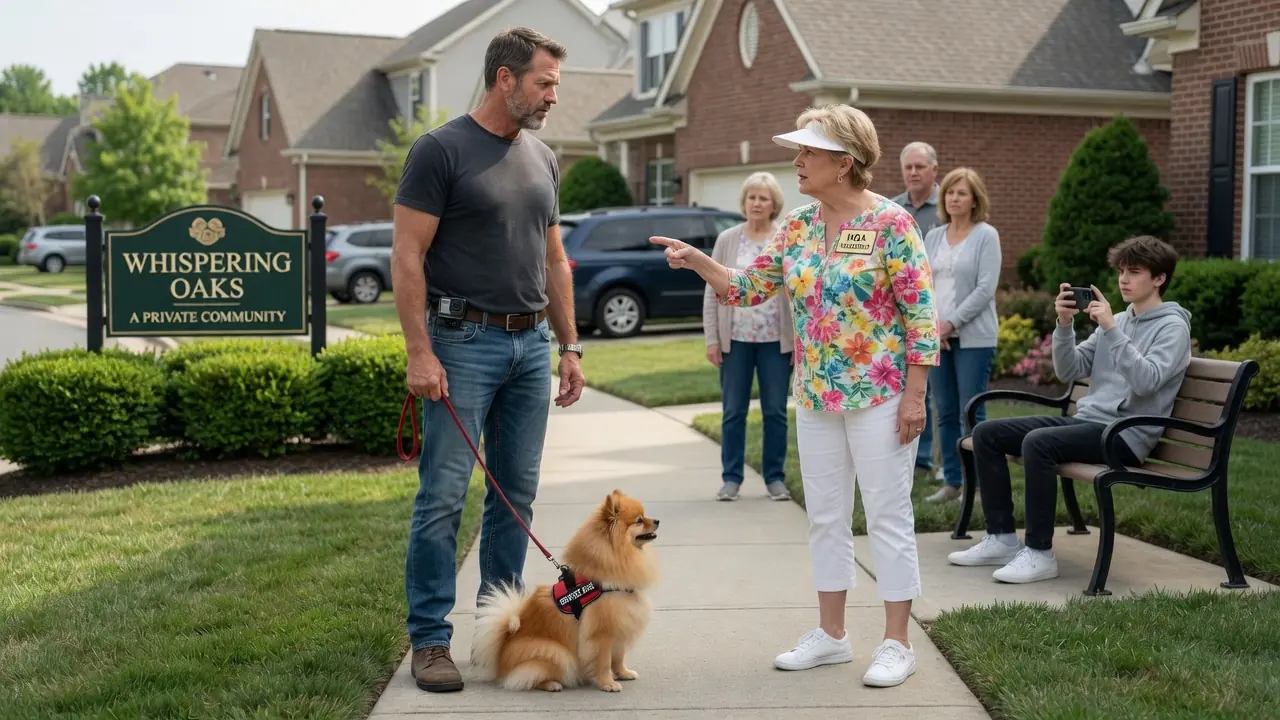
Before Daniel could provide identification, a teenager approached from a park bench.
He wore a gray hooded sweatshirt and carried a phone.
“Officer?”
“Stay back.”
“I recorded it.”
The neighborhood became quiet.
The teenager held up the phone.
“I was making a video. She threw herself onto the grass. The dog didn’t touch her.”
Lorraine stopped crying.
The older officer watched the recording twice.
The video clearly showed Bruno sitting several feet away while Lorraine checked her surroundings and deliberately launched herself onto the lawn.
At the moment she fell, Bruno yawned.
The younger officer looked away to hide a smile.
The older one faced Lorraine.
“Stand up.”
“My ankle may be broken.”
“Then we’ll call an ambulance and include this video in the report.”
Lorraine hesitated.
She rose without difficulty.
The officer explained the consequences of filing a false police report.
Her face lost all color.
“I was startled,” she said. “I must have tripped.”
“You shouted that the dog bit you.”
“I was confused.”
“You were specific.”
She looked toward the watching neighbors.
The public sympathy had vanished.
A man who initially blamed Daniel apologized.
The teenager transferred the video to the officers and to Daniel.
His name was Tyler Nguyen.
“Why were you filming?” Daniel asked.
“Lorraine yelled at me yesterday for skateboarding in my own driveway.”
He shrugged.
“I thought she might do something weird.”
“You may have saved Bruno’s life.”
Tyler looked at the dog.
“He seems less dangerous than she is.”
The police warned Lorraine to avoid further harassment.
She walked away without limping.
That evening, the entire community received another emergency-meeting notice.
The board would vote on declaring Daniel and Bruno a continuing danger, increasing the daily fine to one thousand dollars, removing the fence, and initiating foreclosure.
Daniel finally contacted an attorney.
Gabriel Serrano specialized in civil-rights and disability cases.
His office occupied the upper floor of a glass building in Washington.
Gabriel was short, impeccably dressed, and smiled when people underestimated him.
He knelt beside Bruno.
The Rottweiler licked his face.
“Clearly vicious,” Gabriel said.
Daniel placed the denial letter and the binder of fines on the desk.
Gabriel read the written refusal twice.
Then he leaned back.
“They said they don’t recognize psychiatric service animals?”
“Yes.”
“In writing?”
“Yes.”
Gabriel’s smile widened.
“This is extraordinary.”
Daniel frowned.
“That doesn’t sound good.”
“It isn’t good for them.”
He tapped the notice.
“Most organizations violate federal law while attempting to sound legally cautious. Your board wrote a confession.”
“Can we stop the foreclosure?”
“Yes.”
“Can we stop the fines?”
“Yes.”
Daniel exhaled.
Gabriel lifted one finger.
“But I recommend waiting through tonight’s vote.”
“Why?”
“Because right now, they can claim misunderstanding. If they publicly vote to remove a properly documented service animal and seize your home after being warned, that establishes deliberate discrimination and retaliation.”
“You want them to keep attacking.”
“I want them to create an accurate record of who they are.”
Gabriel gave Daniel a small recorder.
“Attend the meeting. Do not argue. Let Lorraine speak.”
The clubhouse was full that night.
Lorraine sat at the center of the board table wearing a neck brace.
The video had shown her landing on her side and standing normally, but she now claimed severe whiplash.
Daniel sat in the rear row with the recorder inside his jacket.
Lorraine struck a gavel.
“We are here to address the crisis at 218 Hawthorne Lane.”
She described Bruno as a vicious animal and the fence as a prison wall.
She proposed daily fines of one thousand dollars, reimbursement of her alleged medical expenses, demolition of the fence, and foreclosure if Daniel refused to comply.
One board member, Gerald Knox, looked uncomfortable.
“What about the police video?”
“It was misleading.”
“It showed the dog sitting.”
“The animal’s presence caused the fall.”
The board voted.
Four members supported Lorraine.
Gerald hesitated before raising his hand.
The resolution passed unanimously.
Lorraine looked toward Daniel.
“You have twenty-four hours to remove the animal.”
Daniel stood.
“Do you have anything to say?” she asked.
He looked at the board members.
“No.”
Lorraine smiled.
“I think you’ve all said enough.”
He left.
The following morning, Gabriel filed a formal disability complaint and contacted the Department of Justice.
Before investigators arrived, however, the HOA held a final compliance hearing.
Gabriel prepared a written settlement offer.
Daniel agreed to pay unrelated minor fines for temporary window coverings and noise during construction. In exchange, the board would recognize Bruno’s protected status, withdraw the animal fines, approve the safety fence, and end the foreclosure process.
The offer gave them a reasonable exit.
Daniel entered the clubhouse alone.
Lorraine sat behind the long table with the board.
She read the charges before asking whether he disputed them.
Daniel handed her the settlement document.
“This is a formal request for reasonable accommodation.”
Lorraine scanned the first page.
“You want us to erase your fines.”
“The ones connected to Bruno and the fence.”
“And allow the animal to remain?”
“Yes.”
Gerald leaned toward her.
“We should let counsel review it.”
Lorraine pulled the page away from him.
“We do not need attorneys to tell us how to run Briarwood.”
“It cites federal statutes,” Gerald said.
Lorraine stood.
“The Briarwood Estates Homeowners Association does not negotiate with people who terrorize the community.”
She tore the document in half.
Then she tore the pieces again and dropped them onto the table.
“Your request is denied. The foreclosure proceeds.”
Daniel looked at the paper.
“Is that your final decision?”
“For the record,” she said.
He walked out.
Gabriel waited in a car near the clubhouse.
When Daniel entered, the attorney removed his headphones slowly.
“She tore it up?”
“Yes.”
“And used the word terrorize?”
“Yes.”
Gabriel stared through the windshield.
“That may be the worst legal decision I have ever witnessed.”
He reached for his phone.
The next morning, Daniel woke to the sound of a chainsaw.
Three laborers stood in the rear easement cutting into his cedar fence.
Lorraine supervised from a safe distance.
Daniel ran outside with Bruno behind him.
“Stop!”
The workers paused.
Lorraine pointed toward the fence.
“It encroaches on association property.”
“I have a survey.”
“Continue cutting!”
The man holding the chainsaw looked at Bruno, who stood beside Daniel with his service vest visible.
“You didn’t mention the dog.”
“He’s dangerous,” Lorraine shouted. “That’s why the fence must come down.”
The worker shut off the saw.
“I’m not getting arrested over this.”
The crew left.
Lorraine promised to return with heavier equipment.
Daniel told her to check her email.
She opened her phone.
The courtesy notice from the Department of Justice had arrived.
A federal civil-rights investigation was beginning.
Lorraine stared at the screen.
“This is a local matter.”
“Not anymore.”
The investigators arrived the following Monday.
Agent Patricia Morgan interviewed Daniel first.
Then she requested five years of violation records, accommodation requests, fines, liens, board minutes, and internal correspondence.
Lorraine attempted to order the federal vehicles removed.
Agent Morgan calmly explained that interfering with the investigation could result in obstruction charges.
Lorraine moved her golf cart.
Once residents learned the board could not punish them for cooperating, they began speaking.
A Vietnamese American family had been fined for cooking odors described in board correspondence as “foreign spices.”
Parents of an autistic child were denied permission to install a therapeutic swing because it appeared industrial.
A widower using a wheelchair had been cited repeatedly for leaving a mobility ramp visible from the street.
Low-income residents received more aggressive fines than homeowners believed capable of hiring attorneys.
Investigators seized the association computer.
Inside a folder labeled High-Risk Residents, they found a spreadsheet.
It included columns for ethnicity, disability, political affiliation, estimated income, and likelihood of resisting legal pressure.
One note read:
Unable to afford counsel—continue fines until sale.
Another read:
Family likely to leave if social pressure increases.
Daniel had his own entry.
New veteran. Large dog. Probably unstable. Apply immediate pressure.
The case expanded.
What began as a dispute over Bruno became an investigation into systematic discrimination and retaliation.
Lorraine testified under oath.
She continued speaking despite repeated advice from the association’s lawyer.
She said Briarwood’s covenants functioned as the highest law inside the gates.
She admitted attempting to foreclose because Daniel had humiliated her publicly.
She described herself as the voice of the community.
She confirmed hiring workers to damage his fence without a court order.
When asked why she ignored the Fair Housing Act, she answered:
“Because he would not submit.”
The association’s insurance carrier reviewed the testimony.
Its liability policy protected board members against negligence and ordinary mistakes.
It did not cover deliberate unlawful conduct.
Coverage was denied.
The board members suddenly faced personal financial exposure.
Gerald appeared at Daniel’s door carrying a fruit basket.
A pineapple protruded from the top.
“I resigned,” he said.
“You voted to take my house.”
“Lorraine pressured us.”
“You still raised your hand.”
Gerald’s eyes filled.
“I have children in college.”
Daniel looked at the fruit basket.
“So do some of the families you fined.”
“I’m sorry.”
Daniel accepted the basket but made no promises.
A federal judge issued an injunction.
All fines against Daniel were suspended.
The foreclosure process stopped.
Bruno’s service-animal status was formally recognized.
The cedar fence remained.
Lorraine lost all authority while a court-appointed monitor took control of the association.
One by one, the remaining board members resigned.
The management company terminated its contract.
Residents gathered outside Lorraine’s house demanding answers after learning the association’s insurance coverage had disappeared.
She threatened to fine them for trespassing.
Someone reminded her there was no functioning board left to issue the fine.
Three months later, the damages hearing took place in federal court.
Daniel sat beside Gabriel.
Bruno remained at home because the courtroom did not require him to perform a task that day.
Lorraine represented herself.
The federal judge reviewed the denial letters, recordings, videos, fines, false police allegation, attempted fence destruction, and foreclosure vote.
He ruled that the association had deliberately violated federal housing law and retaliated against Daniel for requesting accommodation.
Compensatory damages were awarded for emotional distress, harassment, and loss of peaceful use of the property.
Punitive damages reflected the intentional nature of the conduct.
The association was ordered to pay Daniel’s legal fees and separate civil penalties.
The judgment totaled nearly half a million dollars.
Lorraine gripped the defense table.
“We don’t have that kind of money.”
The judge looked over his glasses.
“That fact should have been considered before the board chose to violate the law repeatedly.”
The association entered bankruptcy.
Because the insurance policy did not cover the conduct, a special assessment was proposed against every house in Briarwood.
Residents reacted furiously.
At the bankruptcy meeting, the trustee explained that the debt resulted from intentional decisions made by the board.
Lorraine attempted to blame Daniel.
“He is the one who sued.”
Daniel stood with Bruno beside him.
“I asked for an accommodation.”
The room quieted.
“I provided medical documentation. Lorraine denied it. I offered a settlement. She tore it up.”
Gerald confirmed the account.
Then Daniel played the recording of Lorraine admitting that the foreclosure was personal.
When the audio ended, the anger in the clubhouse moved entirely toward her.
The trustee explained that the association could pursue Lorraine personally for breach of fiduciary duty.
Every homeowner present voted in favor.
Her house became the primary available asset.
Six months later, Lorraine sold it for far less than she expected.
The federal investigation and association bankruptcy made properties in Briarwood temporarily difficult to sell.
Daniel watched the moving truck from behind the cedar fence.
Bruno sat beside him.
Lorraine carried the final box to her car.
For a moment, she looked across the street.
Daniel expected anger.
He saw only exhaustion.
She entered the vehicle and drove away.
The new owner arrived three days later.
Russ Mason stepped out of his bright-yellow truck and waved.
He had purchased the house as an investment.
Three rescued dogs appeared behind the front window.
One was a pit bull with a white patch over its eye.
Russ planned to paint the front door purple.
Daniel approved.
A new board was elected.
Gerald did not run.
The new president was an accountant named David Owens, who had once believed Lorraine’s false report until the teenager’s video proved otherwise.
The first board action removed breed restrictions.
The second created a straightforward accommodation process based on federal guidance.
The architectural committee was replaced with a neighborhood mediation group that met over potluck dinners rather than formal violation hearings.
Lawns grew slightly longer.
Children rode bicycles in their driveways.
Delivery trucks stopped without generating commercial-activity citations.
People began using their porches again.
Daniel received part of the judgment after legal costs and bankruptcy distributions.
The amount mattered less than the outcome.
Bruno stayed.
The fence stayed.
The house remained Daniel’s.
One evening, he walked Bruno toward the Briarwood entrance.
Wildflowers had replaced the rigid rows of identical tulips around the community sign. The arrangement was irregular, colorful, and impossible to measure with a ruler.
Russ stood on Lorraine’s former porch removing the old NO SOLICITORS sign with a crowbar.
“How’s the neighborhood?” he called.
“Getting better.”
Bruno trotted beside Daniel, his service vest secure around his broad chest.
He did not know that a federal case had been built around him.
He did not understand fines, liens, covenants, or civil-rights investigations.
He knew only that Daniel’s breathing was steady and that the evening walk followed the familiar route home.
At the end of the street, Daniel stopped.
For years, silence had meant many things to him.
Sometimes it meant danger.
Sometimes it meant the moment before an explosion.
When he first arrived in Briarwood, the neighborhood’s silence had felt artificial—the silence of people afraid of being watched, fined, or singled out.
Now the quiet was different.
A lawn mower stopped several houses away.
Someone laughed from an open garage.
A child called a friend’s name.
Bruno leaned against Daniel’s leg.
The silence remaining beneath those ordinary sounds was not control.
It was peace.
Daniel rested one hand on the dog’s head.
“All that trouble because you needed a backyard.”
Bruno sneezed.
Daniel smiled.
Lorraine had believed authority meant possessing the thickest rulebook and punishing anyone who questioned it.
She had forgotten that every rule existed beneath a larger one.
A homeowners association could regulate fences, paint colors, and parking spaces.
It could not erase a person’s rights.
It could not transform disability into disobedience.
And it could not take a veteran’s service dog simply because one woman had decided compassion damaged the neighborhood’s appearance.
Daniel and Bruno turned toward home.
The cedar fence stood beyond the trees.
The gate was unlocked.
The house was safe.
For the first time since leaving the Marines, Daniel had found the quiet he had been looking for—not the quiet created by obedience, but the quiet that arrived after fear finally lost its authority.