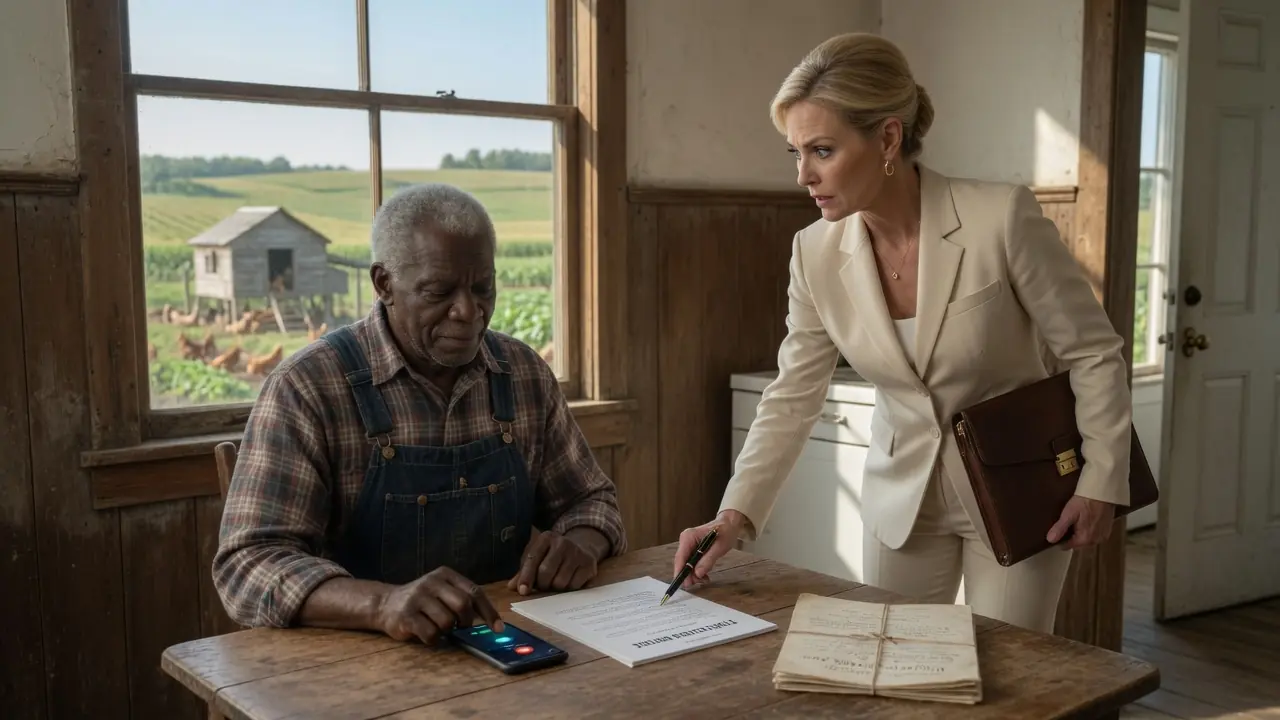
“Sign these today, Mr. Blackwood, or the bank begins foreclosure tomorrow.”
Vivian Hartley slid the papers across the kitchen table with two perfectly manicured fingers.
The table had been built in 1901 by Elias Blackwood’s great-grandfather from white oak cut on the farm. Four generations had eaten at it. Babies had been fed there. Wills had been discussed there. During the Great Depression, Elias’s great-grandmother had kneaded bread on its scarred surface while her husband negotiated with a feed supplier to keep the livestock alive.
Now an HOA president in a tailored cream suit was using it as a stage for an attempted land seizure.
Elias did not touch the papers.
He was sixty-eight, with silver hair, sun-darkened skin, and hands shaped by twenty years of finance followed by twenty years of farm work. He wore denim overalls over a clean flannel shirt. Dirt from the chicken run remained beneath one thumbnail.
Vivian glanced around the kitchen.
Her eyes lingered on the old cabinets, the cast-iron stove, and the family photographs lining the wall.
“This land is worth millions now,” she said. “You must understand that.”
“I understand what land is worth.”
“Then you understand that maintaining forty acres in the middle of a residential development is economically irrational.”
“It was a farm before it was in the middle of anything.”
Vivian smiled.
It was not a friendly smile.
It was the expression of someone who believed she had already won and was waiting for the slower person to accept it.
“Hartley Meadows has grown around you. Circumstances have changed.”
“Not my deed.”
“These documents establish that your property was incorporated into the association’s extended agricultural district in 2019.”
“There is no agricultural district in your covenants.”
“We amended them.”
“Your board cannot amend my deed.”
She tapped the foreclosure notice.
“You owe sixty-two thousand dollars in unpaid assessments, penalties, legal charges, and remediation costs.”
Elias finally looked down.
Twelve thousand dollars in alleged retroactive HOA dues.
Fifty thousand in penalties for livestock odors, unauthorized fencing, nonconforming outbuildings, commercial vehicle storage, and failure to maintain association-approved landscaping.
The farm’s tractor was listed as a prohibited recreational vehicle.
The chicken coop was described as an unlicensed accessory structure.
The barn, built in 1928, was cited for violating architectural standards drafted ninety years later.
The packet also included a notice from Regional Heritage Bank claiming the property’s mortgage had entered default because of an unresolved lien affecting the bank’s collateral.
That was the only part that made Elias angry.
Vivian had not merely fabricated HOA authority.
She had persuaded employees at his own bank to support the lie.
Elias folded his hands.
“Who at Regional Heritage approved this?”
“Bank officers reviewed the documents.”
“Which officers?”
“That is an internal matter.”
“You brought the notice into my house.”
“I am offering you a final opportunity to resolve this privately.”
“How?”
Vivian removed another folder.
“Hartley Development will purchase the farm for three million dollars. We will satisfy the alleged debt, clear the lien, and allow you ninety days to relocate.”
Three million sounded generous until one understood the property.
The forty acres sat at the only point where the subdivision could legally connect its unfinished western phase to the county highway. Without that corridor, Vivian could not build the additional one hundred and twenty homes promised to her lenders.
The land was worth far more to her than the offer suggested.
Elias looked toward the window.
Outside, heritage-breed chickens scratched near the orchard. Rows of tomatoes, beans, and late-summer corn stretched toward the barn. Beyond the trees stood the roofs of Hartley Meadows, one hundred and eighty expensive homes constructed around the farm after Elias repeatedly refused to sell.
“My great-grandfather’s will prohibits transfer to a residential developer,” he said.
“Old wills can be challenged.”
“Not this one.”
“Everything can be challenged if enough money is involved.”
For the first time, Vivian’s smile contained something honest.
She believed money was authority in its purest form.
Elias knew better.
He had spent half his life learning exactly where money’s authority ended.
Vivian pushed a pen toward him.
“Sign.”
Elias looked at the pen.
Then at the foreclosure notice.
Finally, he looked directly at her.
“No.”
Her expression barely changed.
“The bank’s deadline is tomorrow.”
“Then I suppose tomorrow will be educational.”
Vivian stood.
“You are making an emotional decision.”
“This farm has belonged to my family for more than a century. Emotion is included.”
“You could leave wealthy.”
“I already am.”
She laughed as though he had made a joke.
Elias did not correct her.
Vivian gathered her leather briefcase and walked toward the door.
At the threshold, she turned.
“When the bank takes the property, you will receive far less.”
Elias remained beside the table.
“Tell whoever prepared these papers to preserve every email, file, appraisal, and phone record connected to them.”
Her eyes narrowed.
“Is that a threat?”
“No.”
He placed one hand on the foreclosure notice.
“That is professional advice.”
Vivian drove away in a white Mercedes, certain she had frightened an aging farmer who did not understand modern finance.
She had no idea that twenty years earlier, Elias Blackwood had quietly purchased controlling interest in Regional Heritage Bank.
She was trying to use his own institution to steal his family’s land.
And she had just handed him the first piece of evidence.
Long before Elias became a farmer, he made regional banks profitable.
He began his career as a junior analyst in New York and developed a talent for finding value inside failing community institutions. He could look at a loan portfolio and see not only numbers but behavior.
Which branch managers approved loans for friends.
Which developers inflated appraisals.
Which institutions appeared healthy because nobody had yet asked the right question.
By forty, Elias had led acquisitions across six states.
He made more money than he ever told his family.
Then came the financial crisis.
Regional Heritage was a small institution with branches across the county. Its balance sheet had been damaged by careless commercial lending, but beneath the bad decisions remained loyal customers, useful infrastructure, and employees worth saving.
An investment company controlled by Elias purchased a majority stake.
He installed professional management and stepped away from daily operations.
His ownership was recorded through a private holding company. Senior executives knew the chairman’s identity, but most branch employees believed the bank belonged to a distant investment group.
Elias preferred it that way.
He had spent enough years in rooms where people altered their behavior the moment they discovered his wealth.
After retiring, he moved permanently to the Blackwood farm.
His great-grandfather Amos had purchased the first twenty acres in 1899. The family acquired the neighboring tract in 1923.
The farm survived drought, disease, two wars, the Depression, and more bad harvests than anyone recorded.
Amos’s will contained an unusual restriction.
The property could pass through the family, be placed under conservation protection, or sold to another agricultural owner.
It could not be transferred voluntarily to a residential developer.
Elias once considered the clause unnecessarily suspicious.
Then Vivian Hartley arrived.
She purchased several hundred acres surrounding the farm and developed Hartley Meadows in phases. The houses were large, the roads curved, and the marketing photographs carefully framed Elias’s fields as part of the neighborhood’s rural charm.
At first, Vivian treated him pleasantly.
She brought wine.
She praised the orchard.
She offered one million dollars.
Then two.
Then two and a half.
When Elias refused, the friendliness disappeared.
Residents began receiving notices warning them about agricultural odors.
Anonymous complaints brought inspectors to the farm.
Vivian demanded that Elias stop operating tractors before eight in the morning, even though his property was not within the HOA.
She claimed his chickens threatened community sanitation.
Every complaint failed.
The farm predated the subdivision and remained protected agricultural land.
So Vivian changed tactics.
She decided to manufacture debt.
The morning after the kitchen-table confrontation, Elias put on his cleanest work shirt and drove to Regional Heritage’s Hartley Meadows branch.
He entered as a customer.
The lobby had marble floors, soft lighting, and a faint smell of coffee mixed with paper. Elias had approved the renovation plan years earlier.
A loan officer named Janet Morris spotted him and hurried from behind her desk.
“Mr. Blackwood. Thank goodness you came.”
“Good morning, Janet.”
“We need to discuss the lien immediately.”
“That’s why I’m here.”
She led him into her office and closed the door.
A folder bearing Vivian’s development-company logo sat beside the computer.
Elias noticed it before Janet attempted to move it.
“Help me understand the bank’s position.”
Janet folded her hands.
“Regional Heritage received documentation establishing that your parcel falls within the Hartley Meadows association boundary.”
“Who verified that?”
“Our collateral department reviewed it.”
“Independently?”
“We relied upon certified documents supplied by the association’s counsel.”
“Did anyone obtain the original plat from the county?”
Janet hesitated.
“The package appeared comprehensive.”
“That was not my question.”
Her eyes moved toward the door.
Elias continued calmly.
“What debt is secured by my farm?”
“Your agricultural line of credit.”
“I paid that balance eighteen months ago.”
“The account remains open.”
“An open credit line with a zero balance does not give the bank authority to foreclose on an unrelated HOA claim.”
“The association recorded a lien.”
“There is no lawful association lien because the property is not part of the association.”
Janet’s voice became quieter.
“Ms. Hartley’s attorneys assured us—”
“Banks do not replace verification with assurance.”
Elias had used that sentence in executive meetings for decades.
Janet did not recognize it.
She did recognize the tone.
“May I see the original documents?” he asked.
“They remain with the association’s legal office.”
“You initiated default proceedings without possessing the originals?”
“We have electronic copies.”
“Show me.”
Janet opened the digital file.
The first page was a purported 2019 amendment to the Hartley Meadows plat. It showed the subdivision boundary curving around Elias’s forty acres and enclosing it within an “agricultural transition district.”
The county recording number belonged to an unrelated drainage easement.
The notary stamp contained a commission expiration date three years before the document had supposedly been signed.
The signature attributed to Elias was not his.
He studied the screen without reacting.
“Who approved this file?”
“Branch Manager Thomas Webb and someone in commercial lending.”
“Who?”
Janet swallowed.
“Daniel Price.”
Elias knew the name.
Price was a regional vice president whose department had approved several large loans to Hartley Development.
“Print every page.”
“I don’t know whether I’m authorized—”
“This file concerns my property.”
“I need Mr. Webb’s approval.”
“Then get him.”
Thomas Webb entered five minutes later.
He wore a navy suit and the strained smile of a man who had rehearsed calmness too late.
“Mr. Blackwood, I’m sure we can resolve this.”
“I’m sure we can.”
Webb sat.
Elias pointed toward the screen.
“Did your branch verify this recording number?”
“Our legal partners reviewed the package.”
“Which partners?”
“Hartley Development’s counsel provided a title opinion.”
“That is not independent verification.”
“The bank acted in good faith.”
“Good faith does not correct a forged document.”
Webb’s smile disappeared.
“Forgery is a serious allegation.”
“So is attempted wrongful foreclosure.”
Elias stood.
“I want written confirmation by five this afternoon that all foreclosure activity has been suspended and all related records preserved.”
“Mr. Blackwood, you cannot dictate internal procedure.”
Elias buttoned his coat.
“Five o’clock.”
He left without mentioning that the next call would go to the bank’s chief executive.
From the farmhouse, Elias contacted Margaret Sloan, Regional Heritage’s CEO.
Margaret had worked with him for sixteen years.
She answered on the second ring.
“Elias?”
“Freeze all activity connected to the Blackwood farm.”
There was a pause.
“What activity?”
“That is the first problem.”
He described the foreclosure notice, the forged plat amendment, and the branch meeting.
Margaret became silent.
“Who authorized it?”
“Webb and Daniel Price appear involved.”
“Daniel sits on the development lending committee.”
“I know.”
“I’ll suspend the file immediately.”
“No alterations. No quiet corrections. Preserve everything.”
“Understood.”
“And initiate an independent review of every Hartley loan.”
Margaret exhaled slowly.
“How far do you think this goes?”
“I don’t know.”
That was not true.
Elias had a strong suspicion.
But suspicion was not evidence.
“I want outside counsel and forensic accountants,” he said. “Do not use anyone who approved those loans.”
“I’ll call the board audit chair.”
“One more thing.”
“Yes?”
“Do not reveal my ownership to branch staff yet.”
Margaret understood.
“You want to see who moves.”
“Yes.”
By noon, the foreclosure was suspended.
Vivian did not know why.
At two, she called Elias.
“What did you say to the bank?”
“I asked questions.”
“You interfered with a lawful collection process.”
“There was nothing lawful about it.”
“The lien is valid.”
“Then produce the recorded instrument.”
“Our attorneys will.”
“They have until the end of the week.”
Vivian lowered her voice.
“You are putting your neighbors’ homes at risk.”
“How?”
“If the farm remains outside community control, the unfinished western expansion may fail. That will affect property values.”
There it was.
The farm was not merely offensive to her.
It was financially necessary.
“Your construction loan depends on that expansion,” Elias said.
The silence confirmed more than an answer would have.
Vivian recovered quickly.
“You have no understanding of my business.”
“I understand debt.”
“Then you know what happens when an asset stops producing.”
“I also know what happens when collateral values are fictional.”
Vivian ended the call.
The forensic review began that evening.
Elias brought in two former colleagues who specialized in distressed-bank investigations. They worked from a secure office at Regional Heritage headquarters and reported only to Margaret, outside counsel, and the board audit committee.
The first findings appeared within hours.
Hartley Development had borrowed heavily against projected future phases.
Some appraisals treated unapproved homes as if they had already been built and sold.
Other reports included Elias’s farm as “controlled expansion acreage,” despite no purchase agreement.
Infrastructure costs were understated.
Expected sales prices were inflated.
Loan officers repeatedly waived conditions after receiving emails from Vivian.
Daniel Price approved extensions without documenting the justification.
Thomas Webb accepted the alleged HOA lien without confirming the property’s legal status.
The deeper investigators looked, the worse it became.
Hartley Development was not profitable.
It was surviving through new borrowing.
Vivian had personally guaranteed much of the debt.
Her mansion, investment accounts, vehicles, and ownership interest in the development company stood behind loans far larger than her verified net worth.
The western expansion was meant to provide enough new sales to delay collapse.
Elias’s land was the only viable access route.
The attempted foreclosure was not motivated by dislike of chickens.
Vivian was trying to save herself.
That evening, seventy-eight-year-old Evelyn Kowalski appeared at the farmhouse.
She carried an envelope and enough anger to make her hands shake.
“Elias, that woman has lost her mind.”
Evelyn lived in Hartley Meadows and had owned her home for fifteen years.
She placed photographs on the kitchen table.
They showed the farm from the subdivision road.
The chicken run.
The compost area.
The barn.
A formal statement was attached.
It asked Evelyn to certify that the farm caused persistent health hazards, excessive odor, rodent activity, and declining property values.
“What did she offer you?” Elias asked.
“Two years of HOA dues.”
Elias read the proposed affidavit.
Most statements were false.
One line claimed Evelyn had personally observed untreated animal waste entering a community drainage channel.
No channel connected the farm to the subdivision.
“She wanted you to sign this?”
“She said everyone had to protect the neighborhood.”
“What did you tell her?”
“That I’m old, not for sale.”
Elias almost smiled.
Then Evelyn placed a second envelope on the table.
It was a mortgage default notice from Regional Heritage.
“I’ve never missed a payment.”
Elias read the document.
It alleged that three monthly payments had not been received.
Evelyn produced bank statements proving each had cleared.
The notice was dated two days after she refused Vivian’s affidavit.
Retaliation.
Not theoretical.
Documented.
“Did anyone from the bank call you?”
“Janet left a message saying the account was under special review.”
Elias felt the last of his patience disappear.
He called Margaret immediately.
“Freeze every foreclosure or default action initiated through the Hartley branch in the past six months.”
“How many?”
“All of them until reviewed.”
“What happened?”
He explained Evelyn’s notice.
Margaret’s voice became cold.
“I’ll have security preserve the account logs.”
“Remove Webb, Price, and Janet Morris from system access pending investigation.”
“That requires notice to human resources.”
“Give notice.”
“Do you want to disclose your ownership now?”
“Not yet.”
Elias looked at Evelyn.
“Soon.”
The bank’s digital logs showed that Evelyn’s account had been manually reclassified as delinquent despite posted payments.
The change came from Thomas Webb’s credentials.
An internal note referenced “community compliance concerns” supplied by Vivian.
Further review uncovered messages between Webb, Daniel Price, and Vivian.
Some discussed expedited lending.
Others referred to “support” and “consulting compensation.”
Deposits appeared in accounts connected to Webb and Price shortly after Hartley loan approvals.
A recorded call, preserved automatically by the bank’s commercial-lending system, captured Vivian discussing payment for “flexible treatment” of collateral requirements.
Outside counsel contacted federal banking regulators and law enforcement.
Elias did not attempt to direct a prosecution.
He provided evidence and stepped aside.
Bank ownership gave him authority over the institution.
It did not give him authority to declare anyone guilty.
That distinction mattered.
Federal examiners arrived two days later.
Webb, Price, and Janet were placed on administrative leave. Janet requested an attorney and began cooperating almost immediately.
She admitted Vivian often delivered documents personally and pressured branch employees to avoid normal review.
She also admitted Price told her the development was “too important to challenge.”
The foreclosure notice against Elias had been designed to frighten him into accepting Vivian’s offer before anyone examined the underlying lien.
Evelyn’s notice had been created to punish her and pressure her into signing the affidavit.
Janet had known both actions were irregular.
She followed instructions anyway.
Vivian responded by calling an emergency HOA meeting.
Residents packed the clubhouse.
She stood beneath a projection screen displaying falling arrows, alarming charts, and photographs of Elias’s farm.
“The Blackwood property threatens the stability of our entire community,” she announced. “If the agricultural parcel refuses incorporation, the western development phase may be delayed.”
Someone raised a hand.
“What does that have to do with our current homes?”
“Delayed expansion could reduce shared infrastructure funding.”
Another resident asked, “Did the bank really begin foreclosure?”
“The bank recognized the association’s lien.”
Evelyn stood from the second row.
“No, it didn’t.”
The room became quiet.
Vivian stared at her.
Evelyn held up her own false default notice.
“This woman tried to have my house taken after I refused to lie about Elias’s chickens.”
Murmurs spread.
“That is a private banking matter,” Vivian said.
“No,” Evelyn replied. “It’s blackmail wearing letterhead.”
Vivian ordered security to remove her.
No one moved.
Then Sarah Bennett, a high-school teacher and HOA member, rose with a petition.
“Sixty-eight percent of residents have signed a demand for an independent audit.”
Vivian’s face tightened.
“This meeting is not authorized to consider—”
“The bylaws say twenty-five percent can compel a special financial review.”
Sarah placed copies on every table.
“Where are the reserve funds?”
Vivian stepped away from the microphone.
“The board will respond through counsel.”
Elias watched from the back of the room.
Vivian saw him.
For the first time, her expression contained fear.
The audit found that more than one million dollars had been removed from HOA reserves through inflated contracts, consulting payments, and transfers to companies controlled by Vivian’s associates.
One contractor had billed the neighborhood four times the actual cost of drainage work.
Another company received hundreds of thousands for landscaping projects never completed.
The construction inspector, Demetri Russo, documented unsafe retaining walls, undersized drainage pipes, and roadbeds built with cheaper materials than the plans required.
Vivian had concealed the deficiencies because proper repairs would expose inflated development costs.
Her problems were no longer limited to the farm.
Residents had paid for infrastructure they never received.
Regional Heritage’s investigation revealed forty-seven million dollars in questionable lending exposure connected to Hartley Development and associated entities.
Not all of it represented direct theft.
Much of it consisted of loans supported by misleading appraisals, concealed liabilities, or false certifications.
But the total was enough to threaten the development company and damage the bank.
Then investigators discovered attempted international transfers.
Approximately two million dollars had been moved from accounts linked to the HOA and Hartley Development into overseas entities.
The bank’s compliance system flagged additional transfers before completion.
Under instructions from regulators and legal counsel, Regional Heritage restricted the accounts.
Vivian attempted to sell assets quickly.
Jewelry.
Vehicles.
Investment property.
She also scheduled a private flight under another name.
Law enforcement obtained court orders preventing the destruction or removal of evidence.
The scheme was collapsing faster than she could escape it.
On Tuesday evening, residents gathered for another emergency meeting.
This time, representatives from the bank, county, and HOA’s outside accounting firm attended.
Vivian did not appear.
Elias stood at the same table where she had once presented charts about his farm.
Margaret Sloan sat beside him.
Sarah Bennett addressed the room first.
“We have confirmed missing reserve funds, undisclosed vendor conflicts, and false financial reporting.”
Residents shouted questions.
Would the HOA become insolvent?
Would homeowners face special assessments?
Were their mortgages at risk?
Margaret approached the microphone.
“Regional Heritage is reviewing all affected loans individually. No homeowner will face foreclosure or adverse action because of misconduct committed by the developer or association officers.”
A man near the front raised his hand.
“Why should we trust the bank? The bank helped her.”
“That is a fair question,” Margaret said. “Employees of the bank failed. Several have been suspended, and the institution reported the misconduct to regulators.”
“Who is responsible for fixing it?”
Margaret looked toward Elias.
“The bank’s chairman.”
Residents turned.
Elias walked to the microphone wearing the same denim jacket he wore when repairing fences.
Vivian had spent years describing him as a stubborn farmer who did not understand business.
Now the room waited for him to speak.
“My name is Elias Blackwood,” he began. “Most of you know that.”
A few people nodded.
“What most of you do not know is that a holding company I control owns the majority of Regional Heritage Bank.”
The room became completely silent.
Evelyn smiled from the front row.
Elias continued.
“I purchased the institution twenty years ago. I do not run daily operations, and most branch employees had no reason to know my identity.”
A resident whispered, “He owns the bank?”
Elias looked around the room.
“Vivian Hartley attempted to use Regional Heritage to force a fraudulent lien against my farm.”
Nervous laughter moved through the crowd as the irony registered.
“She believed she was threatening a man who had no leverage. The problem was not that she failed to recognize my wealth.”
Elias’s voice strengthened.
“The problem was that the bank accepted documents it should have verified, employees abused their authority, and innocent people such as Mrs. Kowalski were threatened.”
He looked toward Evelyn.
“An institution is not honest merely because its owner is honest. Systems must make misconduct difficult, visible, and punishable.”
No one laughed now.
“The bank will correct every affected account. It will fund an independent review and cooperate with regulators. Employees found responsible will face appropriate action.”
“What about our homes?” a woman asked.
“Existing lawful mortgages remain valid. The bank will not manipulate rates or terms to cover Hartley Development’s losses.”
Another resident stood.
“And the missing HOA money?”
“Asset recovery proceedings have begun. The association must work through its receiver and counsel.”
“You can’t simply replace everything?”
“I could advance money.”
The room waited.
Elias continued.
“But writing a private check without reforming how the HOA operates would rebuild the same weakness that allowed Vivian to steal.”
Sarah nodded.
Elias placed a proposal on the table.
Regional Heritage would provide temporary financing for essential repairs at no profit.
The money would be released only under resident oversight, independent audits, and public invoices.
No single board officer could control the accounts.
Every contract above a modest threshold required multiple bids and a resident vote.
The community would be helped.
It would not be rescued from responsibility.
By the end of the meeting, residents voted to remove Vivian and the remaining compromised board members.
Evelyn Kowalski became interim president.
Her first statement was brief.
“Every dollar will be visible, and nobody is threatening anybody’s grandmother again.”
Investigators arrested Vivian the following morning before she could board the private aircraft.
She was not dragged from a mansion before cheering news crews.
The arrest occurred quietly at a small regional airport.
Federal agents recovered financial records, encrypted drives, and several accounts containing resident information.
Her former husband and the attorney managing several shell companies were charged later.
The criminal cases took months to develop.
Charges included bank fraud, conspiracy, theft from association funds, falsification of lending documents, identity-related offenses, and attempted obstruction.
Thomas Webb and Daniel Price were also charged.
Janet Morris entered a cooperation agreement and lost her banking career.
The law did not move with the speed of a revenge story.
There were motions.
Hearings.
Negotiations.
Disputed evidence.
Vivian’s attorneys argued that aggressive business practices had been misinterpreted as crimes.
The records told another story.
Emails showed she knew Elias’s farm was outside the HOA.
The forged plat had been created because the legitimate map blocked expansion.
The foreclosure threat was meant to force a sale.
Evelyn’s false default notice was explicitly discussed as “pressure.”
At trial, Vivian blamed employees, lawyers, and changing markets.
The jury convicted her on multiple counts.
Her sentence was substantial, though not the lifetime punishment some residents demanded.
Assets obtained through fraud were forfeited.
The mansion, vehicles, investment accounts, and development interests entered restitution proceedings.
Her former husband pleaded guilty.
The attorney involved was disbarred and later sentenced for his role.
Regional Heritage survived.
That outcome was not guaranteed.
Regulators imposed penalties and required changes in oversight. The bank reimbursed affected customers and replaced much of its commercial-lending leadership.
Elias accepted responsibility as chairman.
At a press conference, a reporter asked why he had not monitored the bank more closely.
“Because I believed good managers and written policies were enough,” he answered.
“They were not.”
“Do you regret remaining anonymous?”
“Yes.”
“Would your identity have stopped the fraud?”
“It might have protected my farm sooner.”
Elias paused.
“But an institution that behaves lawfully only when it recognizes a powerful customer is not functioning properly.”
That statement became the foundation of the bank’s reforms.
Independent verification became mandatory for outside liens.
No commercial borrower could provide the only legal opinion supporting its own collateral.
Employee conflicts had to be disclosed.
Automated alerts flagged manual payment reversals and politically sensitive account changes.
Customer complaints involving foreclosure received outside review.
The bank became smaller for several years.
It also became more honest.
Elias considered that a profitable correction.
Hartley Meadows changed too.
The new HOA board published every invoice online.
Residents approved a limited special assessment for urgent infrastructure repairs, but recovered assets eventually returned much of the money.
Demetri supervised the reconstruction of drainage systems and retaining walls.
Sarah created resident committees for finance, maintenance, and long-term planning.
Evelyn served one year as president.
She refused a second term.
“I’ve lived long enough to know when people start enjoying authority too much,” she said.
The board meetings became shorter.
Arguments still occurred.
People disagreed about landscaping, road repairs, and community events.
But disagreement no longer meant retaliation.
The false lien against Elias’s farm was formally released.
The fabricated boundary amendment was voided.
Hartley Development’s unfinished western phase was canceled.
The county approved permanent agricultural and conservation protections for the Blackwood property.
No road would ever cross it.
No developer would ever convert the barn into a clubhouse.
Six months after Vivian’s conviction, workers demolished her mansion.
The structure had serious construction defects and carried liens exceeding its sale value. Residents voted to acquire the parcel through a restitution arrangement and convert it into community space.
They did not build another monument to wealth.
They created a library, meeting room, and public garden.
Elias donated seeds from his family’s heirloom tomatoes.
Children planted them in raised beds where Vivian’s circular driveway once curved around a fountain.
Regional Heritage established a financial-literacy program in the new community center.
Residents learned how to read mortgage statements, association budgets, reserve studies, and public property records.
Sarah helped create a scholarship for students studying ethical banking, agriculture, engineering, and community development.
It was named the Amos Blackwood Heritage Fund.
Elias initially objected.
“My great-grandfather would have hated having his name on a financial program.”
Evelyn shook her head.
“He would have hated somebody stealing land more.”
The name remained.
Elias’s farm prospered.
He expanded the orchard and opened part of the property for educational visits.
Hartley Meadows families rented small garden plots along the eastern field.
Some residents who had once complained about agricultural odors began bringing their children to collect eggs.
Mrs. Patterson, who had cried during Vivian’s warnings about collapsing property values, became particularly devoted to the chickens.
She named three of them without asking Elias.
“You cannot name livestock you do not own,” he told her.
“I already did.”
One was called Margaret after the bank CEO.
Another was called Evelyn.
The third, a loud and unpleasant hen that pecked everyone nearby, was called Vivian.
Elias pretended to object.
He never changed the names.
One Tuesday morning, the elderly residents’ coffee group met around the white-oak kitchen table.
Evelyn sat in the same chair Vivian had occupied when she presented the foreclosure papers.
A plate of biscuits rested in the center.
Mrs. Patterson examined the old burn marks and knife cuts in the wood.
“This table has seen a lot.”
“More than most boardrooms,” Elias said.
Evelyn poured coffee.
“You should put the foreclosure notice in a frame.”
“No.”
“Why not?”
“I don’t need a trophy.”
“It would remind people.”
“The released lien is filed at the courthouse. That is enough.”
Evelyn looked toward the window.
The farm stretched beyond the orchard, green beneath the morning sun.
“Did you ever consider signing?”
“No.”
“Not even for a second?”
Elias took his time answering.
“I considered whether fighting would damage everyone around me.”
“That isn’t the same thing.”
“No.”
“What made you decide?”
He rested his hand on the table.
“My great-grandfather built this while the farm was nearly failing. My grandfather ate here after returning from war. My parents signed their mortgage here.”
Elias looked at the worn surface.
“Vivian believed land was valuable because of what she could build on it.”
“What do you believe?”
“That sometimes land is valuable because of what you refuse to let people erase.”
A year later, Elias stood at the edge of the community garden as children harvested tomatoes.
The houses of Hartley Meadows remained.
Families still lived behind trimmed lawns and painted shutters.
The farm remained too.
Roosters crowed before sunrise.
Tractors operated when weather required.
On warm days, the smell of soil and livestock crossed the subdivision boundary.
Nobody issued a violation notice.
Margaret joined Elias near the fence.
“The board wants you to attend the anniversary dinner.”
“No.”
“They expected that answer.”
“Then why ask?”
“They also want you to speak about institutional accountability.”
“I’m a farmer.”
“You are a bank chairman pretending to be a farmer.”
Elias looked at her.
“I’m a farmer who happens to own a bank.”
“Twenty years ago, you would have said the opposite.”
“Twenty years ago, I was wrong about several things.”
Margaret smiled.
“What is the biggest lesson?”
Elias watched a girl pull a tomato from the vine and hold it above her head triumphantly.
“That hidden ownership is not the same as responsible oversight.”
“I meant Vivian.”
“So did I.”
He turned toward the farmhouse.
Vivian Hartley’s greatest mistake was not failing to discover that Elias owned Regional Heritage.
It was believing that people without visible power could be treated as though they had none.
She threatened an elderly widow because the woman would not lie.
She manipulated bank employees because she thought their fear made them useful.
She frightened homeowners because panic kept them obedient.
She targeted the farm because its owner appeared isolated.
Elias’s wealth allowed him to expose the scheme more quickly.
But wealth was not what defeated her.
Records did.
Neighbors did.
Employees who finally told the truth did.
Independent investigators did.
A community that stopped allowing one person to speak for everyone did.
The night before the false foreclosure deadline, Vivian believed the farm would soon belong to her.
Instead, the paper she placed on Elias’s table led investigators through every hidden loan, altered account, shell company, and stolen dollar.
She had arrived expecting him to sign away his heritage.
She left behind the document that began the collapse of her own empire.
Elias returned to the chicken run as the sun lowered behind the barn.
The unpleasant hen named Vivian stood directly in his path.
“Move.”
The chicken stared at him.
“You have no authority here.”
She pecked the toe of his boot.
Elias sighed and stepped around her.
Some battles, he had learned, were not worth escalating.
Behind him, the farm settled into evening.
The same land.
The same table inside the house.
The same family name on the deed.
Vivian had believed the strongest person was the one who controlled the loans, the contracts, and the fear.
She had misunderstood strength.
Strength was a man who could have destroyed everyone connected to the scheme but chose instead to separate the guilty from the frightened.
It was a bank that admitted its failures rather than hiding them.
It was neighbors rebuilding trust after discovering how easily it had been manipulated.
And it was forty acres of family soil remaining exactly where it had stood since 1899.
Not because its owner was secretly wealthy.
Because when someone tried to erase the truth written into that land, Elias Blackwood knew where to look for the records—and refused to sign.