I woke to the sound of my dogs barking.
Not their ordinary morning bark—the quick announcement they made whenever a delivery truck passed or a squirrel tested its luck near the bird feeder.
This was different.
Deep.
Urgent.
The kind of barking that pulls a person out of sleep before the mind has time to understand why.
I left my bed wearing a flannel robe and one slipper, crossed the kitchen, and stepped onto the porch.
The sun had barely cleared the pines surrounding Fairview Oaks. Mist hung low above the grass, and the neighborhood should have been quiet.
Instead, gravel crunched beneath tires near the end of my driveway.
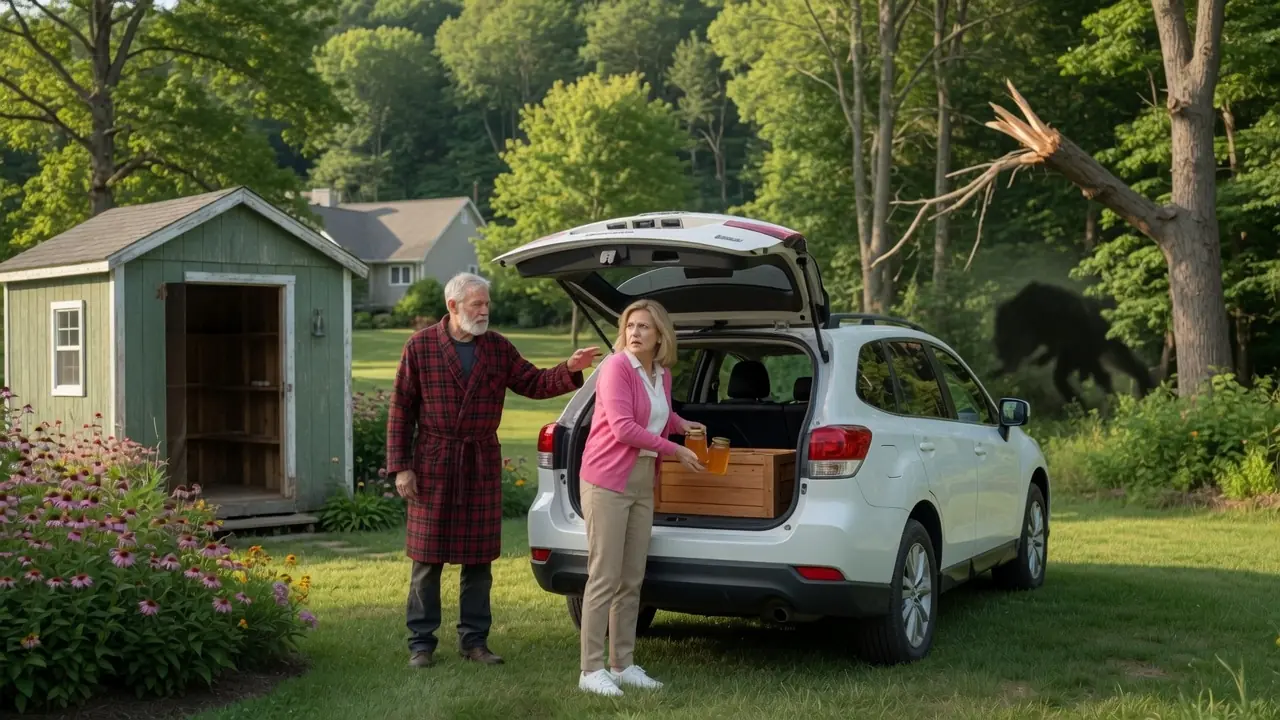
The doors of my honey shed stood wide open.
I froze.
Inside that shed, three long shelves had been filled the night before with jars from the summer extraction. Clover honey. Wildflower honey. A darker batch gathered during the late blackberry bloom.
Nearly all of it was gone.
At the far end of the driveway, Diane Caldwell was loading the final cardboard box into the back of her white SUV.
Diane was president of the Fairview Oaks Homeowners Association.
She was also the only person I knew who could wear a pearl necklace and oversized sunglasses at seven in the morning and somehow make both look like official government equipment.
“Diane!”
She glanced toward me without the slightest sign of alarm.
“Good morning, Walter.”
“What are you doing?”
She closed the rear hatch.
“The community events committee needed local products for the sustainability brunch.”
“You broke into my shed.”
“Oh, don’t be dramatic.”
She adjusted her sunglasses.
“The door was unlocked.”
“It was latched.”
“The association has broad access rights when community safety or shared resources are involved.”
“Those jars are neither.”
“The bees gather nectar throughout the neighborhood.”
For a second, I honestly believed I had misheard her.
“What?”
“The flowers belong to Fairview Oaks residents. Therefore, the honey is partially a community product.”
“You cannot possibly believe that.”
Diane opened the driver’s door.
“You should be proud. We’re showcasing your work.”
“You stole almost three hundred jars.”
“We’ll discuss appropriate compensation after the event.”
She climbed into the SUV.
I stepped toward the driveway.
“Unload them.”
Diane waved through the open window.
“Try to be more cooperative, Walter. People already think you’re territorial.”
Then she drove away.
The rear tires scattered gravel across my lawn.
I stood there in my robe and single slipper, watching the SUV disappear around the corner.
Behind me, the honey shed smelled of wax, wood, and summer flowers.
Sticky rings marked the shelves where jars had rested.
Each one represented months of work.
Checking brood frames.
Treating mites.
Repairing boxes.
Lifting heavy supers in ninety-degree heat while wearing enough protective clothing to roast a person alive.
Honey did not appear magically because flowers existed.
The bees made it.
I cared for the bees.
And Diane Caldwell had carried the result away as though she were collecting forgotten decorations from a clubhouse closet.
My name is Walter Harris.
I had been Fairview Oaks’ resident beekeeper for twenty-one years.
Before retirement, I taught biology at the county high school. Beekeeping started as a small classroom project after a group of students asked whether insects could demonstrate social organization better than people.
The answer, I discovered, was yes.
Far better.
I began with two hives at the back of my property. By the time I retired, I maintained twelve.
They stood beyond the vegetable garden, more than one hundred yards from the nearest neighboring house. A cedar fence and thick hedge separated them from the residential walking path.
Every hive was registered with the county agricultural office.
Every local zoning requirement had been met.
I carried liability insurance, maintained water stations so the bees would not seek swimming pools, and scheduled annual inspections.
None of that mattered to Diane.
She had disliked the hives from the first moment she became HOA president.
“The bees are making my flowers sticky,” she once complained.
“That’s not how bees work.”
“They leave residue.”
“Pollen?”
“Exactly.”
I tried explaining that pollen came from the flowers themselves.
She issued me a warning for condescension.
Another time, her cat slipped beneath my fence, jumped onto a hive, and clawed at the entrance until several thousand residents objected.
Diane accused me of maintaining aggressive livestock.
The cat stayed indoors after that.
Fairview Oaks had existed before Diane became president, but she behaved as though she had personally founded it after defeating wilderness with a clipboard.
She fined residents for leaving trash bins near the road ten minutes too long.
She reported children for unauthorized sidewalk chalk.
She forced a widowed neighbor to repaint a mailbox because its blue color was “emotionally inconsistent with the neighborhood palette.”
She once made me repaint my barn.
The original red, according to her, lacked aesthetic harmony.
“It’s barn red,” I told her. “Barns have been this color for centuries.”
“Not in my HOA.”
That sentence told you everything important about Diane.
My.
Not ours.
I had learned to tolerate the notices, meetings, and passive-aggressive letters.
Stealing the honey was different.
I photographed the empty shelves and checked the motion cameras mounted near the shed.
The footage clearly showed Diane entering my property shortly before sunrise with two members of the events committee. They loaded box after box into the SUV while discussing labels for the brunch.
I saved multiple copies.
Then I called the sheriff’s office.
Deputy Aaron Cole arrived twenty minutes later.
He watched the recording twice.
“She actually said the honey was a shared neighborhood resource?”
“Not on camera. She saved that explanation for me.”
“How much is missing?”
I gave him the inventory sheet.
His eyebrows rose.
“That’s more than seven thousand dollars in retail product.”
“Closer to eight if you include the specialty batches.”
Aaron removed his notebook.
“This is not a neighborhood disagreement. This is theft.”
“Diane will say the HOA authorized it.”
“The HOA cannot authorize entry into a privately owned shed.”
I looked toward the road.
“She believes it can.”
“That belief is going to become expensive.”
He collected copies of the footage and advised me not to confront her alone.
That afternoon, Diane hosted an HOA committee meeting in her backyard.
Long folding tables stood beneath white canopies. Floral tablecloths, glass pitchers, fruit trays, and small baskets covered the lawn.
At the center of everything sat my honey.
Diane had removed my labels and replaced them with elegant cream-colored stickers reading:
FAIRVIEW OAKS LOCAL GOLD
A COMMUNITY HARVEST
Several neighbors gathered around the table.
Diane poured honey across small biscuits and described the product as part of a new association sustainability initiative.
I stood beside my fence and watched for nearly a minute before she noticed me.
“Walter!” she called brightly. “Everyone loves the honey.”
“My honey.”
“Our community honey.”
“You removed my labels.”
“We improved the presentation.”
“You also entered my property without permission.”
Her smile remained fixed, but her eyes sharpened.
“Must we discuss this in front of everyone?”
“You chose the audience.”
One board member named Martin Blake looked between us.
“Diane told us Walter donated the jars.”
“I did not.”
Diane laughed.
“He’s being modest.”
“I filed a police report.”
The laughter stopped.
Several guests lowered the biscuits in their hands.
Diane’s face remained composed.
“Over honey?”
“Over nearly eight thousand dollars of stolen inventory.”
A woman near the table quietly placed her jar back inside the basket.
Diane stepped toward me.
“You are embarrassing yourself.”
“No. I’m correcting the story before you distribute property that does not belong to you.”
Martin examined the label.
“You said the HOA purchased this.”
“We intended to reimburse him.”
“From what account?”
Diane ignored him.
She lowered her voice.
“You’re making a serious mistake.”
“You came into my shed.”
“The latch was unsecured.”
“It was closed.”
“You need to consider whether one morning’s misunderstanding is worth damaging your relationship with the community.”
I looked around at the guests.
Most were no longer eating.
“The community did not steal from me.”
Diane’s smile vanished.
She ended the brunch early and ordered the remaining jars taken into her garage.
Deputy Cole collected them that evening.
Not all were recovered.
More than forty had already been handed out or opened.
Diane avoided immediate arrest by claiming that the removal resulted from a misunderstanding about an alleged HOA resolution. The investigation continued while the district attorney reviewed the evidence.
The board, meanwhile, attempted to distance itself.
Martin came to my house the following morning.
“I didn’t know she planned to take anything.”
“I believe you.”
“She told us you had agreed.”
“I know.”
He looked toward the hives.
“The board never voted.”
“That does not surprise me.”
Martin sighed.
“She has become impossible.”
“Become?”
He almost smiled.
“We should have stopped her sooner.”
That was the first honest sentence I had heard from an HOA officer in years.
Diane’s response arrived later that day.
A formal violation notice was attached to my mailbox.
UNSANCTIONED COMMERCIAL AGRICULTURAL ACTIVITY.
According to the notice, I was using residential property for an unapproved business and creating a wildlife attractant near common land.
The threatened fine was $250 per day.
I read the page twice.
Then I called my attorney.
Rebecca Shaw had represented me during the barn-color dispute and a later argument over hive setbacks.
When I described the honey theft and new violation, she became quiet.
“She issued the notice after learning you filed a report?”
“Yes.”
“That looks retaliatory.”
“It is retaliatory.”
“Do not remove the notice. Photograph it and send it to me.”
“I was considering framing it.”
“That can happen after the case.”
Rebecca challenged the violation immediately.
County records showed that my apiary predated the HOA’s revised restrictions and remained legally protected. The small honey business also met every home-occupation requirement.
The notice had no valid foundation.
Still, Diane circulated an email warning residents that my hives created a growing public-safety threat.
She attached photographs taken through my fence.
POTENTIAL WILDLIFE ATTRACTION ZONE, one caption read.
Another called a stack of empty hive boxes an ILLEGAL EXPANSION COMPLEX.
The county wildlife office sent an inspector.
His name was Thomas Daniels, a polite young man who appeared embarrassed before reaching my porch.
“We received a complaint concerning repeated bear activity associated with your apiary.”
“Repeated bear activity?”
“That was the wording.”
“I’ve seen black bears near the creek, but none have damaged the hives.”
“May I inspect the setup?”
“Of course.”
Thomas examined the fencing, electric deterrent line, sealed feed containers, water source, and storage building.
“Everything looks excellent,” he said.
“The complainant suggested I was recklessly attracting wildlife.”
“The hives are secured. Your waste is sealed. There is no open food source.”
He looked toward the forest.
“Black bears naturally travel the creek corridor. Residents should secure trash and avoid leaving sweet food outdoors.”
“Perhaps mention that in your report.”
“I intend to.”
As he returned to his truck, he hesitated.
“Off the record, was that your honey at the association brunch?”
“The stolen honey?”
He nodded.
“Yes.”
Thomas shook his head.
“Leaving dozens of open jars outside would attract more wildlife than these hives.”
Diane received a copy of his findings.
She did not apologize.
Instead, she announced a “community restoration breakfast” scheduled for the following Saturday.
The event would demonstrate that Fairview Oaks could enjoy local products responsibly without “fear-based obstruction from one difficult resident.”
Her flyer promised pancakes, fruit, pastries, and a special honey tasting.
I could not believe she still had more jars.
Then one of the committee volunteers called me privately.
“She kept a box in her pantry before the deputy collected the rest.”
“How many?”
“Maybe twelve.”
“She knows those are evidence.”
“I told her.”
“What did she say?”
“That the community had already claimed them.”
Saturday morning arrived bright and cool.
Diane arranged tables across her backyard near the tree line. My property bordered hers only at one distant corner, but the old creek ran behind both homes through a wooded strip known locally as Bear Hollow.
The name was not decorative.
Black bears had lived in those woods long before the subdivision existed.
They normally avoided people, but late summer made them active. Fallen apples, unsecured garbage, birdseed, and outdoor cooking drew them closer to houses.
I stayed on my porch.
My dogs rested beside me.
From a distance, I could hear Diane speaking through a portable microphone.
“Community means sharing our resources rather than hiding them behind fences.”
Several people applauded politely.
My attorney had advised me not to attend.
Deputy Cole had advised me not to engage with Diane.
Common sense had advised the same.
So I drank tea and inspected hive records.
Twenty minutes later, a woman screamed.
The sound came from Diane’s yard.
Then several chairs crashed.
I stood.
A black bear emerged from the shrubs behind her property.
It was not charging.
It walked slowly, nose raised, following the smell of pancakes, fruit, and open honey jars.
Guests froze around the tables.
Another scream made the bear stop.
Diane grabbed the microphone.
“Everyone remain calm.”
For once, she gave reasonable advice.
Then she ruined it.
She picked up a garden hose and sprayed water toward the animal.
The bear backed away, startled.
A smaller bear appeared at the edge of the trees.
Likely an older cub following its mother.
Guests abandoned the yard.
One man climbed over a fence.
Two women locked themselves inside the sunroom.
Diane continued waving the hose while shouting at the animals to leave private property.
The bears ignored the concept of property ownership.
They moved toward the food after everyone retreated indoors.
One knocked over a tray.
The other licked honey from an open serving bowl.
I called wildlife dispatch and reported the animals.
Then I remained inside my own fence.
A wildlife officer arrived with local deputies and used noise deterrents to encourage the bears back toward the woods.
No person or animal was injured.
The tables were damaged.
Several jars broke.
Diane’s white tablecloth became a mixture of honey, mud, and paw prints.
Thomas Daniels arrived shortly afterward.
He surveyed the remains of the breakfast.
Diane pointed toward my home.
“This happened because of his bees.”
Thomas looked at the open honey containers.
“Ma’am, the bears came to an outdoor food service beside a known wildlife corridor.”
“He keeps honey.”
“So do you, apparently.”
“They followed the scent from his property.”
The officer walked toward the rear shrubs.
“No. The tracks approach from the creek and lead directly to your tables.”
Diane’s guests remained close enough to hear.
Martin Blake folded his arms.
“Perhaps the breakfast was a poor idea.”
Diane turned on him.
“The breakfast was perfectly controlled until those animals appeared.”
“Wild animals are generally the uncontrolled part of outdoor events.”
Several neighbors tried not to laugh.
Diane saw me near my porch and marched across the common path.
“This is your fault.”
“I was sitting at home.”
“You knew bears were nearby.”
“So did the entire neighborhood. The woods are called Bear Hollow.”
“You should have warned us.”
“The wildlife officer sent a notice last month reminding everyone to secure food.”
“You enjoyed this.”
“I enjoyed my tea.”
Her eyes narrowed.
“You are going to regret humiliating me.”
“I did not host your breakfast.”
She walked away without responding.
By Sunday evening, a video of the incident had spread through the neighborhood group.
The caption read:
BEARS JOIN HOA HONEY TASTING.
Diane demanded that it be removed.
Someone reposted it.
She called an emergency meeting.
The clubhouse was full.
Diane stood behind the podium with several photographs of the bears and a draft proposal banning beekeeping throughout Fairview Oaks.
“Mr. Harris’s commercial operation has created an intolerable danger,” she announced.
I sat in the rear beside Rebecca.
Martin raised his hand.
“County wildlife inspectors cleared the hives.”
“The inspectors were misled.”
“How?”
“Walter staged the property before the visit.”
Thomas Daniels was seated near the door in an official capacity.
He stood.
“My inspection was unannounced.”
Diane faltered.
“The broader concern remains.”
Rebecca lifted a folder.
“Before the board considers restrictions, it should review the association’s governing documents, state agricultural protections, the county report, and the pending retaliation complaint.”
Several board members exchanged looks.
Diane pointed toward me.
“This man is using legal threats to intimidate the community.”
Rebecca remained calm.
“My client was fined one day after reporting the president for removing nearly eight thousand dollars of his property. The timing speaks for itself.”
A neighbor named Susan Hart stood.
“Diane told us Walter donated the honey.”
Another resident spoke.
“She told me the HOA purchased it.”
Martin faced Diane.
“Which was it?”
Diane struck the podium with her gavel.
“This meeting is about safety.”
“No,” Susan said. “It is about you stealing from a neighbor and blaming him when your party went wrong.”
Murmurs spread through the room.
For years, Diane had controlled meetings by making disagreement feel dangerous.
That control was disappearing.
The motion to ban beekeeping failed.
Only Diane voted in favor.
The board suspended her authority to issue violations without a second officer’s approval.
She left before the meeting officially ended.
Three nights later, my motion sensor activated at 11:47 p.m.
I opened the camera feed.
A person wearing a hooded sweatshirt was moving near the front fence.
The figure climbed through an unlocked maintenance gate and approached an empty hive box I had placed near the workshop.
It was Diane.
She carried a jar.
She removed the lid and poured honey across the box.
Then she photographed it from several angles.
The purpose was obvious.
She intended to manufacture evidence that I had placed exposed honey outside to attract bears.
Diane slipped on the damp grass, caught herself against the fence, and hurried away.
I saved the recording.
Then I called Deputy Cole.
He arrived before midnight and collected the jar.
The label was mine.
The batch number matched one of the containers removed from the shed.
Diane had just connected herself to both the trespass and the missing honey.
The following morning, she called another emergency HOA meeting.
This time, she announced that she possessed “irrefutable photographic proof” of intentional wildlife baiting.
Rebecca and I attended.
Diane displayed a photograph of the honey-covered hive box on the projector.
“This was discovered last night,” she said. “Mr. Harris has deliberately placed a bear attractant near residential property.”
A few residents gasped.
Diane smiled.
I raised my hand.
“May I show the board the complete record?”
She looked annoyed.
“This is not a courtroom.”
“No. In a courtroom, presenting fabricated evidence would be even more serious.”
Rebecca connected a flash drive.
The security footage began.
Diane appeared on the screen, entering my property with the jar.
The video showed her pouring the honey.
Taking photographs.
Slipping.
Leaving.
No one spoke when the footage ended.
The air conditioner hummed above us.
Martin looked toward her.
“Is there an explanation?”
“The recording is manipulated.”
Deputy Cole stepped from the rear wall.
“The original file has been preserved as evidence. We also recovered the jar visible in the video.”
Diane’s face went pale.
“I was investigating a hazard.”
“You entered private property after receiving a written trespass notice,” Cole said. “You placed the substance yourself and then represented it as evidence against the property owner.”
“I am HOA president.”
“That does not grant police authority.”
The meeting dissolved into arguments.
Several board members demanded Diane’s resignation.
She refused.
The board voted to suspend her until an independent investigation was completed.
Diane stormed out, accusing everyone of betrayal.
Two days later, I received a lawsuit.
Diane claimed that my negligent beekeeping had caused emotional distress, property damage, and repeated exposure to dangerous wildlife.
She also alleged that I had conducted a campaign of harassment designed to remove her from office.
Rebecca read the complaint in my kitchen.
“She is alleging you weaponized black bears.”
“That phrase appears twice.”
Rebecca removed her glasses.
“I have practiced law for twenty-seven years. That is a first.”
“Does she have a case?”
“She has a filing fee and an imagination.”
The discovery process damaged Diane more than she expected.
Rebecca obtained HOA emails showing that Diane had planned to take the honey before entering my shed.
One message read:
Walter will object, but the board can classify the jars as a contribution after distribution.
Another revealed that she intended to replace my labels and use the honey to promote a personal “community lifestyle consulting” business.
Financial records showed she had charged the HOA for event supplies while keeping reimbursement payments herself.
The theft was no misunderstanding.
It was part ego, part retaliation, and part personal profit.
The court hearing took place six weeks later.
Diane arrived wearing a soft neck brace and dark glasses.
No medical record supported either.
Judge Samuel Whitaker examined the case file with the expression of a man regretting every decision that had led him to that courtroom.
“Ms. Caldwell, you allege the defendant caused black bears to enter your property.”
“Yes, Your Honor.”
“How?”
“Through his honey operation.”
“His licensed apiary located more than one hundred yards away?”
“He understands bear behavior. He used that knowledge against me.”
Rebecca stood.
“Your Honor, county wildlife reports concluded that the bears approached the plaintiff’s outdoor food events from the adjacent creek corridor.”
Diane’s attorney adjusted his papers.
“The presence of the apiary increased overall attraction.”
“Do you have expert testimony supporting that claim?” the judge asked.
“No, Your Honor.”
Rebecca displayed photographs from the breakfast.
Open honey jars.
Pancakes.
Fruit.
Pastries.
Unsecured trash bags.
“The plaintiff created a concentrated outdoor food source beside known bear habitat.”
Diane interrupted.
“That honey belonged to the community.”
The judge looked at her.
“The same honey at issue in the pending theft investigation?”
“It was not theft.”
Rebecca played the shed footage.
Diane and the committee members entered.
Boxes left the property.
Then came the emails and inventory records.
Finally, Rebecca showed the nighttime recording of Diane pouring honey onto the empty hive box.
Judge Whitaker watched without speaking.
When the video ended, he leaned back.
“Ms. Caldwell, did you enter Mr. Harris’s property at night?”
“I was collecting evidence.”
“By creating it?”
“I was demonstrating what he could have done.”
“You photographed the result and presented it to the HOA as something he had done.”
Diane looked toward her attorney.
He stared down at the table.
The judge continued.
“You also served stolen honey at the outdoor events where bears appeared.”
“I dispute the word stolen.”
“The criminal court will address that. This court is addressing your civil claim.”
He reviewed several pages.
“There is no credible evidence that Mr. Harris caused the wildlife incidents. There is extensive evidence that your own conduct created the conditions you now describe as negligent.”
Diane rose.
“He knew the bears lived there.”
“So did you.”
“He should have stopped them.”
The courtroom became completely still.
Judge Whitaker looked at her over his glasses.
“How, precisely, was the defendant supposed to stop wild bears from approaching food placed on your property?”
Diane had no answer.
The judge dismissed the lawsuit with prejudice.
He ordered Diane to reimburse my legal expenses and referred the fabricated evidence to the district attorney.
The HOA’s insurance carrier declined to defend her personally because the conduct fell outside her official authority.
Outside the courthouse, a local reporter approached.
“Mr. Harris, do you feel vindicated?”
“I feel tired.”
“What lesson should the neighborhood take from this?”
I thought about the empty shed, the ruined breakfasts, and the woman who believed a title transformed theft into policy.
“Do not take things that do not belong to you.”
The answer disappointed the reporter.
It satisfied me.
The criminal case ended several months later.
Diane accepted a plea agreement involving restitution, trespass, evidence tampering, and theft-related charges. She avoided jail but received probation, community service, and a court order prohibiting her from serving on an HOA board during the probation period.
The association removed her permanently as president.
An audit uncovered years of questionable fines and reimbursements.
Some residents received refunds.
Several rules were repealed.
The barn-color regulation disappeared first.
My barn returned to its original red before winter.
Diane listed her house for sale.
On moving day, cardboard boxes covered the driveway. Her framed HOA President of the Year certificate leaned against the garage.
I never discovered who had given her the award.
My suspicion remained that she had ordered it herself.
Diane supervised the movers while pretending not to see the neighbors watching from windows and porches.
When she entered her SUV, she looked toward my property once.
I raised my coffee cup.
She drove away without responding.
The silence after her departure felt unfamiliar.
No violation emails.
No clipboard inspections.
No emergency meetings about decorative stones.
Fairview Oaks slowly became a neighborhood rather than an administrative experiment.
Martin Blake became temporary board president.
He lasted three months before resigning voluntarily.
“No sane person should want this job for too long,” he said.
The board replaced many of Diane’s rules with simpler ones focused on actual shared concerns—road maintenance, drainage, safety, and common-area expenses.
People began talking to each other before filing complaints.
Children drew sidewalk pictures without permits.
Trash bins occasionally remained near the road until morning.
Civilization survived.
A young couple purchased Diane’s house.
Emily and David Foster were both teachers. They owned a friendly dog and planned to replace part of the lawn with a vegetable garden.
I brought them a loaf of honey bread on moving day.
Emily accepted it with a smile.
“You must be Walter.”
“That depends what you’ve heard.”
David laughed.
“We heard you keep bees.”
“That part is true.”
“I make beeswax candles,” he said. “We were thinking about starting a hive someday.”
I looked toward the house Diane had once defended against every bee in the county.
“Then you bought the correct property.”
Over the next year, I helped David establish two hives near the rear garden.
We placed electric fencing around them and followed the same county requirements as mine.
Emily planted lavender, clover, sunflowers, and native wildflowers.
The bees thrived.
No one attempted to classify the honey as shared produce.
The black bears continued using the creek corridor.
Wildlife officers worked with residents to secure trash containers and remove outdoor food sources. Motion lights replaced some bird feeders. The HOA distributed real safety guidance rather than dramatic accusations.
Occasionally, a bear crossed the edge of my property.
The animals usually moved on after finding nothing available.
I never left food for them.
Feeding wild bears, even with good intentions, teaches them to approach houses and often ends badly for the animals.
That lesson mattered.
Nature had not punished Diane on my behalf.
The bears did not understand theft, HOA politics, or poetic justice.
They followed food.
The danger came from human arrogance—the belief that consequences could be controlled while sweet-smelling tables remained open beside the forest.
My bees taught a different lesson.
A hive survives through boundaries, communication, and shared work.
No single bee declares herself owner of everything others produce.
Even the queen is not a tyrant. She serves a function inside a larger system.
Diane had loved the image of community while treating neighbors as subjects.
The bees had always understood community better than she did.
Several years later, I received an envelope with no return address.
Inside was a single sheet of cream-colored paper.
I hope your bees remain as stubborn as you are.
The handwriting was elegant.
I recognized it immediately.
There was no apology.
I had not expected one.
Still, I placed the note inside my beekeeping journal.
People rarely change all at once.
Sometimes the first sign is nothing more than the absence of another attack.
The seasons continued.
Spring brought maple and clover bloom.
Summer filled the supers.
Autumn darkened the honey and sent the colony into preparation for winter.
I still woke early.
I still walked to the hives with coffee and listened before opening anything.
An experienced beekeeper learns that the sound of a colony reveals its condition. A calm, steady hum means one thing. A sharp, uneven roar means another.
Attention comes before intervention.
That principle had served me beyond the apiary.
Diane believed control meant issuing orders before listening.
She saw flowers and claimed the honey.
She saw bears and blamed the nearest person she disliked.
She saw evidence and manufactured whatever supported the conclusion she already wanted.
In the end, no bear defeated her.
No clever revenge scheme removed her from Fairview Oaks.
Her own decisions did that.
Theft recorded on a camera.
Retaliatory notices preserved in writing.
False evidence presented before witnesses.
A lawsuit that placed every contradiction beneath courtroom lights.
Truth needed no claws.
It needed patience and a clear record.
One summer evening, I sat on my porch while David checked his first full honey harvest.
His children carried frames toward the shed, moving carefully beneath protective veils.
Emily placed a candle on the patio table.
The flame shone through pale beeswax, filling the air with a soft scent of honey and cedar.
“What are you calling this batch?” I asked.
David examined the candle.
“Peacekeeper.”
“That sounds dramatic.”
“So does the story behind it.”
I groaned.
“Please tell me the bear-whisperer nickname has finally died.”
Emily laughed.
“Not remotely.”
Near the hives, thousands of bees returned from the fields.
Each carried only a tiny amount.
Nothing impressive alone.
Together, they built enough to sustain the colony through winter.
I watched them disappear one by one through the entrances.
For years, I had believed retirement meant escaping noise.
Teaching ended.
Schedules loosened.
The days became slower.
Then Diane Caldwell entered my shed and reminded me that peace was not merely the absence of conflict.
Sometimes peace had to be protected with cameras, records, legal boundaries, and the willingness to stand firm while someone louder insisted that wrong was right.
The neighborhood eventually forgot many details of the dispute.
People remembered the bears.
They remembered Diane falling backward into a table and shouting that her yard was private property.
They remembered the courtroom video of her carrying a honey jar through my fence at midnight.
The laughter became part of local folklore.
But I remembered the first morning most clearly.
The empty shelves.
The tire marks.
Diane waving from her SUV as though possession and permission were the same thing.
She believed that calling theft a community project changed what it was.
It did not.
The truth remained simple.
The honey belonged to the person who had cared for the bees, maintained the hives, harvested the frames, filled the jars, and placed them on those shelves.
No pearl necklace, clipboard, title, committee, or neighborhood vote could change that.
And once the noise finally ended, the hives continued exactly as they always had—quietly, steadily, producing something golden from a world that often gave them very little to work with.