The police cruiser stopped in front of our house at 9:14 on a Saturday morning. My wife, Natalie Brooks, was kneeling beside the front garden in an old gray sweatshirt, pulling dandelions with dirt on her gloves, while Margaret Bell stood six feet away holding an orange HOA notice like a court order. “You need to vacate this property immediately,” Margaret told her. “The board has already decided.”
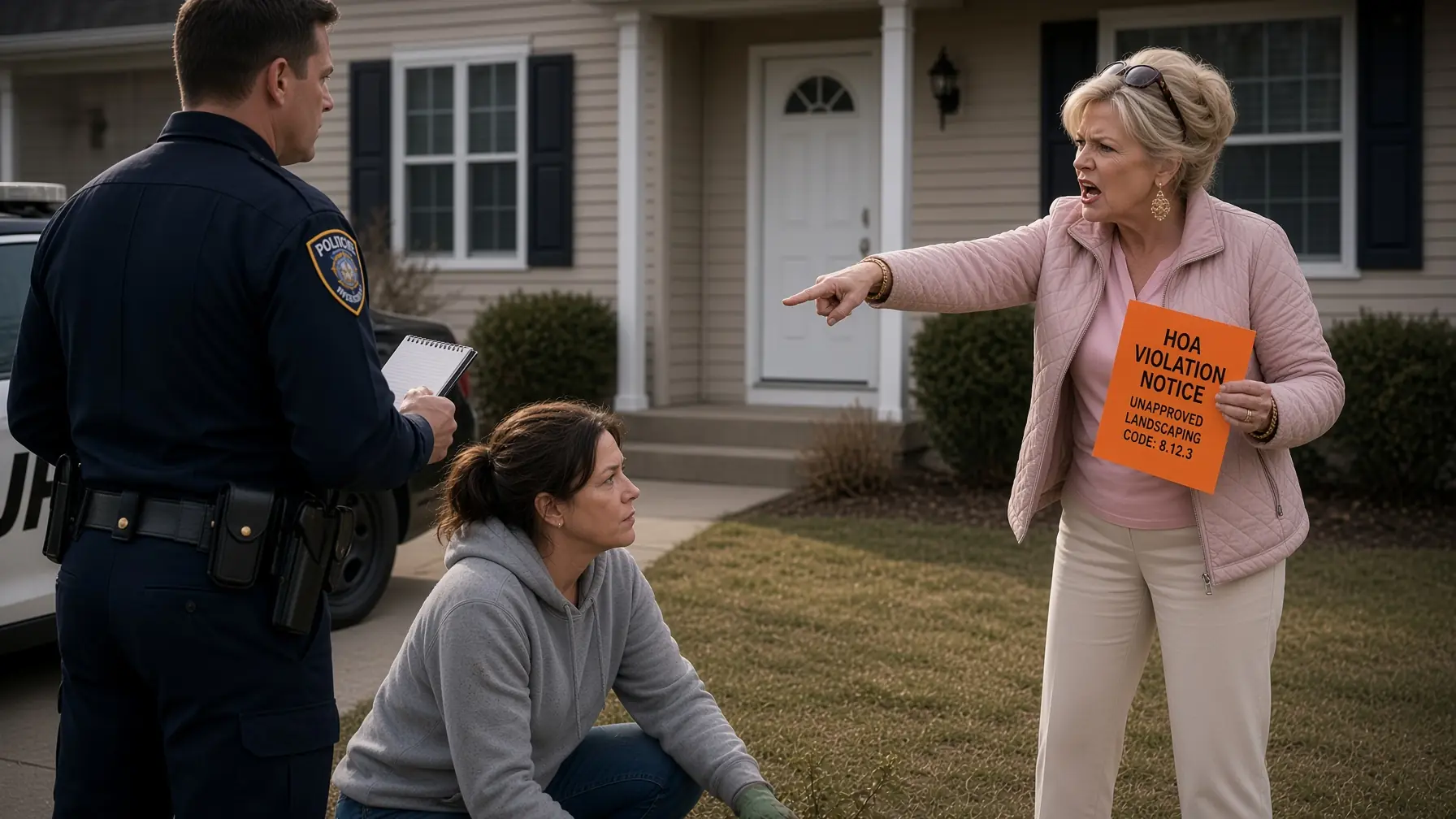
I heard those words as I opened the front door. Natalie’s name was on the deed, the mortgage, the county tax record, and every closing document connected to 18 Crestfield Drive, while Margaret’s name appeared on none of them. Yet Margaret spoke with the confidence of someone who had spent years discovering that if a piece of paper looked official enough, frightened people often obeyed before asking whether it actually meant anything.
The officer stepped out of the cruiser with a small notepad in one hand. He looked to be in his mid-thirties, calm, almost bored, the expression of a man expecting another neighborhood disagreement involving parking, barking dogs, or somebody’s trash cans. Margaret immediately began walking toward him.
“Officer, thank you for coming. That woman is refusing to leave a property under HOA enforcement, and I have a signed board action directing her removal.” She held out the orange paper. “I need you to escort her off the premises.”
The officer did not take it. He had looked past Margaret and seen Natalie standing beside the flower bed, gloves still on, a faint line of soil across her wrist. He stopped walking completely.
For perhaps three seconds, neither of them spoke. Natalie looked at him, and something changed in his face—not fear, not confusion, but recognition. Then his posture straightened slightly.
“Deputy Chief Brooks?”
Margaret’s hand lowered.
Natalie answered with one calm word. “Officer.”
Margaret stared between them. “You know her?”
The officer glanced at Natalie again, then at Margaret. “Ma’am, Deputy Chief Brooks is one of the command officers in this department.”
For the first time in the seven months I had known Margaret Bell, she had nothing ready to say.
That moment would later become the version everybody repeated. The HOA president tried to have a Black woman thrown out of her own house, only to discover the woman was a deputy police chief. It was satisfying, quick, and almost completely missed the point.
Because Natalie’s rank was not what made Margaret wrong. Margaret had been wrong seven months earlier, before any officer recognized anyone, before neighbors gathered statements, before an attorney became involved, and before Margaret signed the document that finally turned her own paper trail against her. To understand why, you have to go back to the week we moved into Meadowbrook Heights.
Natalie and I bought the house in February. Meadowbrook Heights had ninety-six homes, mature maples, matching mailboxes, well-maintained sidewalks, and the kind of entrance sign that made a subdivision look more expensive than it actually was. We had spent nearly a year searching because neither of us wanted to move again anytime soon.
My name is Thomas Brooks, and at the time I was forty-eight and worked in commercial risk management. Natalie was forty-six, quiet by nature, intensely private, and several years into the command staff of the Lakeview Police Department. She had worked patrol, investigations, professional standards, and district command before becoming deputy chief, but at home she preferred old sweatshirts, gardening gloves, and not discussing work unless there was a reason.
Both our names appeared on the deed. Both appeared on the mortgage. There was nothing unusual or complicated about the purchase.
The first HOA notice arrived three days after we moved in. It was orange and taped to the front door, citing an “unauthorized commercial vehicle” in the driveway. The vehicle was Natalie’s department-issued dark blue SUV, parked legally on our private property.
I checked the HOA covenants before replying. Nothing prohibited government-issued passenger vehicles, and the county had no ordinance that applied either. I sent a short email explaining that and attached the relevant covenant section.
Four days later we received another notice. This one cited “failure to correct previously reported vehicle violation.” It did not answer my email or explain why the actual language of the covenants did not matter.
That was when I learned Margaret Bell’s name.
Margaret had been HOA president for seven years. She was sixty, immaculate, always dressed as though the grocery store might contain a television camera, and carried a leather folder to every neighborhood meeting. People described her as organized when they liked her and relentless when they did not.
Her theory of community management was simple. Rules were useful because they allowed her preferences to wear uniforms.
At first, I thought we had encountered nothing more serious than an overzealous board. Then neighbors began talking to me.
The Peterson family had lived four houses down until the previous year. They disputed a lawn fine, received several additional violations over the next six months, and eventually found an HOA lien recorded against their property after the dispute escalated. The lien was contested, but clearing it required legal expenses they could not comfortably absorb, and they finally sold.
The Wynn family had a different story. Margaret called police twice during a period when two elderly relatives were staying with them after surgery, once reporting “unusual occupancy” and once describing a family gathering as an unauthorized disturbance. Neither call resulted in charges, but both became part of a pattern that made the Wynns feel watched inside their own home.
Then there were the Garcias. They had installed a temporary wheelchair ramp for Mrs. Garcia’s brother before obtaining architectural approval. Instead of giving them a reasonable cure period, Margaret pushed fines aggressively enough that the family eventually removed the ramp and later sold the house.
None of those stories proved a conspiracy. Some HOA enforcement against those families may have begun with legitimate rule questions. What disturbed me was the pattern that followed disagreement: more notices, more pressure, more procedural escalation, and an almost complete inability to distinguish a homeowner disputing a board decision from a homeowner defying lawful authority.
Margaret did not seem to understand that an HOA was a private association governed by recorded documents and state law. It was not a municipal government. It did not own our house simply because our house happened to sit inside its boundaries.
Natalie understood that immediately.
She also told me not to make the mistake of assuming we knew everything from angry neighbors. “Records first,” she said. “Stories tell you where to look. Documents tell you what you can prove.”
That became our rule.
Six weeks after we moved in, Margaret came to the front door with two board members. The first was Douglas Kane, the treasurer, a heavyset man in his fifties who seemed permanently tired. The second was Nathan Cole, thirty-one, recently appointed to the board and visibly less comfortable than either of them.
Natalie was still at work. Margaret held a clipboard against her chest and said, “Mr. Brooks, there is an unresolved occupancy issue involving the woman residing here.” I stared at her for a moment because I genuinely thought I had misunderstood.
“My wife?”
Margaret smiled thinly. “The board has not completed resident verification.”
“My wife owns half the house.”
“That may be reflected in county records, but the association maintains its own process.”
I took out my phone and opened the county assessor’s page. “Here are both names.”
Margaret barely looked.
“That does not satisfy association verification.”
“What section of the covenants requires a deeded owner to undergo separate occupancy approval?”
Her expression hardened by perhaps half a degree. “I’m not going to debate governing documents at someone’s front door.”
“You came to my front door.”
Nathan looked down.
Margaret removed a yellow paper from the clipboard. “This is a five-hundred-dollar fine for unresolved unauthorized occupancy.”
I read it.
No covenant section.
No hearing date.
No explanation of what documentation was supposedly missing.
Just the phrase UNAUTHORIZED OCCUPANT beside Natalie’s name.
I accepted the paper only so Margaret could not later claim I had refused service.
Then she said something I wrote down as soon as I closed the door.
“I have had residents removed from this community before. Good people sometimes discover that this simply is not the right fit for them.”
She said it politely.
That made it worse.
When Natalie came home that night, the fine sat on the kitchen counter. She read the entire page, set down her keys, and said, “Make a copy before anything else.” Then she went upstairs to change clothes.
No outrage. No speech about who she was. No threat to call someone at the department.
Just documentation.
So I scanned the notice.
Then I started a spreadsheet.
Date. Incident. Person involved. HOA action. Supporting document. Witness. Response.
At first there were seven entries.
Within three weeks there were twenty-three.
Ted Palmer, the seventy-two-year-old retired civil engineer across the street, gave me a written statement about the Petersons. Sarah Bennett, a nurse three houses down, provided copies of two police incident reports involving Margaret’s calls about her teenage son.
One call claimed Sarah’s son was trespassing on HOA recreational property. He had been skateboarding on the public sidewalk in front of his own house. The second described him as loitering while he sat on the front steps waiting for a friend.
Police found nothing actionable both times.
Sarah had saved the reports because her brother worked in a law office and told her never to rely on memory when somebody was creating a record about her child.
That advice was beginning to sound familiar.
The HOA meeting minutes produced additional information. Two former board candidates had withdrawn during Margaret’s presidency shortly after receiving clusters of violations, although nothing in the minutes established that Margaret had ordered those violations in retaliation. I marked that distinction carefully.
Suspected was not proven.
Natalie approved.
“You’re learning.”
“I married a cop.”
“You married somebody who hates sloppy files.”
“Same thing.”
She almost smiled.
Nine weeks after we moved in, a certified letter arrived from a law firm representing the HOA. It notified us that the association had recorded a lien claiming twenty-eight hundred dollars in unpaid fines and enforcement costs. Several listed violations were ones we had disputed in writing.
Five others were completely unfamiliar.
I called an attorney that afternoon.
Her name was Rebecca Dunn, and she had spent more than fifteen years handling real-estate and association disputes. I sent her the covenants, deed, notices, responses, lien letter, meeting minutes, and my spreadsheet.
She called the next morning.
“The association may have authority to levy fines if it follows the declaration, bylaws, notice requirements, and applicable state law,” she said. “But what you’ve sent me raises serious procedural questions.”
“Can they remove Natalie from the house?”
Rebecca laughed once.
“No.”
“Not even if the board votes?”
“An HOA board cannot vote a deeded owner out of her own house.”
That sentence felt useful.
Rebecca continued. “Foreclosure rights, if any exist under your state’s law and governing documents, are a separate and highly regulated issue. A board notice saying ‘remove occupant’ is not an eviction order, and police do not enforce HOA preferences as though they were court judgments.”
“So what do we do?”
“We challenge the lien properly.”
“And everything else?”
She paused.
“Keep documenting.”
Four days later, Margaret made the first police call about Natalie.
Natalie was watering the front garden at seven in the morning. Margaret told dispatch there was a suspicious woman at our address whose residency was disputed by the HOA. Two officers came.
Natalie provided identification when asked.
They checked the address.
The contact ended.
Their report said: Resident confirmed. No enforcement action.
Natalie requested a copy through normal public-record channels rather than asking anyone at work to obtain it for her. That mattered to her.
“I don’t want anybody later saying rank altered the record,” she explained.
So the report went into the folder the same way Sarah’s reports had.
Date.
Time.
Caller.
Outcome.
No violation.
Rebecca sent the HOA a formal demand letter challenging the lien and requesting the complete enforcement file associated with our property. She asked for hearing notices, board votes, violation evidence, ledger entries, governing-document authority, and all records supporting the five violations we had never received.
What came back was incomplete.
One violation had no photograph.
Two lacked proof of notice.
Another referenced a board meeting that did not contain our address anywhere in the minutes.
The fifth appeared to have been entered into the accounting system only days before the lien was filed.
Rebecca did not call it fraud.
Not yet.
She called it “a record problem significant enough that the association’s counsel should be very concerned.”
Three days later, the HOA scheduled an emergency meeting.
The community room held forty chairs. Thirty-one were occupied by the time Natalie and I arrived. Fourteen people attending had never appeared at an HOA meeting before.
Ted sat in the second row.
Sarah sat nearby.
Nathan Cole, the younger board member who had once stood silently behind Margaret on our porch, was seated at the board table looking like a man who had not slept much.
Margaret had prepared printed slides.
She spoke for eleven minutes about “ongoing noncompliance” at our address. She cited the lien, the disputed occupancy status, and what she called “repeated police involvement.”
I wrote that phrase down.
Repeated police involvement.
She did not mention who had created it.
After three minutes of public comment, Margaret called for a vote authorizing additional legal action and directing us to “remove the unverified resident pending compliance.”
Four board members voted yes.
Nathan voted no.
Margaret signed the document in front of the room.
Then she handed it to me.
I read every line.
There was still no court order.
No legal basis authorizing removal.
Just a board document attempting to transform association language into authority it did not possess.
I gave it to Natalie.
She folded it once and placed it in her jacket.
Margaret watched.
For the first time, I saw uncertainty.
Not fear.
Just the brief possibility that the woman she had spent months describing as an unauthorized occupant might understand exactly what she was being handed.
Rebecca received a scanned copy before we reached home.
Her response came nine minutes later.
Do not argue with them directly. Preserve everything.
That was easy enough.
Margaret did the difficult part herself.
Three days later she called police again.
This time she told the dispatcher the HOA had issued a formal removal order and that an unauthorized woman was refusing to vacate.
The dispatcher asked whether there was violence or an immediate threat.
There was not.
A patrol unit was sent anyway because property disputes involving someone refusing to leave can sometimes require police to determine whether trespass or another issue exists.
That was how the cruiser arrived at 9:14 Saturday morning.
And that was how Margaret Bell finally discovered who Natalie Brooks was.
“Deputy Chief Brooks?”
The officer stood beside the driveway.
Natalie removed one gardening glove.
“Yes.”
Margaret looked at the officer. “This is irrelevant.”
Natalie spoke before he could answer. “It should be.”
That sentence changed the atmosphere more than her rank had.
She continued. “My position has nothing to do with whether I own this house.”
The officer nodded.
His partner had come around the cruiser and was checking the property address through ordinary departmental systems.
Margaret raised her orange paper again. “The HOA voted to remove her.”
The second officer looked at the document. “Is this a court order?”
“It is a board order.”
“That isn’t what I asked.”
Margaret’s face tightened.
The officer returned the paper without taking possession of it.
“We can document your complaint, but an HOA vote does not authorize us to remove a deeded homeowner from a residence.”
Margaret pointed toward Natalie. “She never completed our verification process.”
Natalie answered, “I am a record owner.”
“That does not exempt you from community rules.”
“No.”
Natalie’s voice remained calm.
“But community rules do not convert ownership into trespass.”
Ted had come onto his porch.
Sarah stood near her mailbox.
Two other neighbors appeared in their driveways.
Margaret noticed them.
That was when her tone changed.
“You people have no idea what I have been dealing with.”
Natalie did not react to the phrase.
She simply turned toward the officers.
“I would like the incident documented in full.”
The first officer opened his notepad.
Natalie continued. “Please note that Ms. Bell has now initiated multiple police contacts involving my presence at my own legal residence. There is an active civil dispute between us and the HOA, and counsel is involved.”
The officer wrote.
“I am not requesting special treatment,” Natalie added. “I am requesting the same documentation any resident should receive.”
That line stayed with me.
Because this could easily have become a story about a powerful woman revealing herself and frightening somebody who underestimated her.
Natalie refused to let it become that.
Margaret looked toward the orange notice in her hand.
Then toward the cruiser.
Then Natalie.
“So you’re saying there are no consequences?”
The second officer answered carefully. “I’m saying we are not enforcing this document as an eviction order.”
“What about her refusal to comply?”
“That is a civil association matter unless a court or statute creates some separate enforcement authority.”
Margaret became pale.
The first officer asked whether she wished to make a formal allegation of criminal trespass despite being informed that county ownership records showed Natalie as an owner.
Margaret stared at him.
“No.”
He nodded.
“Then we’ll document the call.”
No roadside arrest.
No dramatic threat of prison.
No officer announcing that Margaret had committed a crime.
Just a report.
That was more damaging than theater would have been.
Because the report joined the others.
Before the officers left, I gave them copies of the prior incident numbers and our attorney’s contact information. I did not hand over my entire HOA file because a patrol officer was not the right person to adjudicate a seven-month civil dispute. The responding officer advised us that repeated non-emergency calls involving the same disputed issue could be referred for supervisory review if the pattern continued.
Then the cruiser left.
Natalie looked at the garden.
“I still have weeds.”
I stared at her.
“That’s what you have to say?”
“They’re still there.”
Ted laughed from across the street.
It was the first time I had heard him laugh in months.
The important consequences began the following week.
Rebecca sent the HOA’s law firm the new police report, the board’s so-called removal directive, the property record, our earlier responses, and a request that counsel identify the exact legal authority supporting an association’s attempt to remove a deeded owner from her residence. She also notified the board that we intended to seek relief regarding the lien and recoverable fees if the association refused to correct the record.
The law firm responded cautiously.
Then it did something Margaret had not expected.
It advised the entire board to stop direct enforcement contact with us while counsel reviewed the matter.
Nathan called for a special meeting.
This time, outside counsel attended.
Margaret did not control the agenda.
The attorney spoke first.
He explained that an HOA could enforce properly adopted covenants within legal limits. It could issue valid notices and fines where authorized, pursue collection through lawful procedures, and in some circumstances record liens. What it could not do was create eviction power by calling a board notice a removal order.
Then he discussed conflicts.
Margaret had personally initiated multiple complaints against Natalie.
She had also participated in board deliberations, votes, fine decisions, and enforcement escalation involving the same dispute.
“That does not automatically invalidate every action,” the attorney said. “But it presents obvious governance and fairness concerns.”
Nobody looked comfortable.
Good governance rarely begins with comfort.
Nathan made a motion to suspend enforcement against our property pending independent review and to release the lien voluntarily while its supporting records were examined.
The vote passed.
Margaret voted no.
Then residents began speaking.
Ted described the Peterson family.
Sarah described the calls involving her son.
Patricia Morris from Willowbrook Lane described receiving three fines in eleven days after questioning Margaret during a landscaping dispute.
Another homeowner described being warned that challenging a roof-color violation could “create title problems.”
Nobody claimed every complaint was illegal.
Nobody needed to.
The pattern was enough to demand review.
Nathan eventually said, “We have treated disagreement as noncompliance.”
The room became quiet.
He continued. “Those are not always the same thing.”
That may have been the most important sentence spoken all night.
The board did not have authority simply to erase an elected president from existence because people were angry. The bylaws allowed officers to be removed from officer positions by board vote under specified circumstances, while directors themselves were subject to member election and recall procedures. With counsel guiding the process, the board voted to remove Margaret as president and replace her temporarily with Nathan pending a community vote.
Margaret remained a director until the membership acted.
That lasted three weeks.
Enough owners signed the recall petition to trigger a special election.
The meeting filled the community room and spilled into the hallway.
Margaret defended herself for nearly twenty minutes. She said she had protected property values, enforced rules other people were too timid to enforce, and become the target of residents who resented accountability.
Some of that was probably sincere.
That made it more troubling.
Bullies do not always wake up thinking, Today I will abuse power.
Sometimes they tell themselves they are protecting standards while gradually learning that nobody around them is willing to ask who gave them the right to define those standards alone.
The recall passed.
Margaret lost her board seat.
No applause followed.
Nathan immediately moved to the next agenda item.
That felt right.
The lien against our property was released.
The association also agreed to reimburse a negotiated portion of our legal expenses rather than force both sides into months of additional litigation. Rebecca insisted the settlement document state clearly that the disputed violations were withdrawn without any admission that Natalie’s occupancy had ever been improper.
I liked that sentence.
Natalie liked the accounting statement showing a zero balance more.
“Cleaner,” she said.
Of course she did.
The police-call issue ended less dramatically.
A supervisor reviewed the repeated contacts, and Margaret received formal notice that future emergency or police calls needed to involve legitimate public-safety concerns rather than efforts to enforce private HOA disputes. No criminal charge resulted from the calls we documented.
That outcome disappointed some neighbors.
It did not disappoint Natalie.
“Punishment is not the only form of correction,” she told me.
“What would you have wanted?”
“A record.”
“We got one.”
“Yes.”
Then she went back to pruning roses.
The independent HOA review took nearly four months.
It found inconsistent fine practices, weak documentation, poor conflict-of-interest procedures, and several liens that had been approved without adequate internal review. Some homeowner complaints were valid, some were not, and several disputes looked far more complicated than neighborhood retellings suggested.
That mattered.
We were not interested in rewriting history so every person Margaret had argued with became innocent.
What needed fixing was the process.
The association adopted written notice timelines, standardized appeal procedures, conflict-recusal rules, documented hearing requirements, and a requirement that lien referrals receive review from association counsel before filing. Police would not be called over covenant disputes unless there was an actual safety issue, suspected crime, or other matter properly requiring law enforcement.
The orange notices did not disappear completely.
HOAs still enforce rules.
The difference was that a notice once again meant there is an alleged violation, not the president has decided who belongs here.
Six months after the recall, I saw Margaret at the grocery store.
She was near the produce section comparing tomatoes.
I considered turning down another aisle.
Then she saw me.
“Thomas.”
“Margaret.”
For a moment neither of us said anything.
She looked older.
Not ruined.
Not broken.
Just like somebody whose position in the world had changed.
“I suppose you’re pleased,” she said.
“About what?”
“You won.”
I shook my head.
“Natalie still owns the same house she owned before you met her.”
Margaret looked away.
“That isn’t what I meant.”
“I know.”
She hesitated.
Then said something I had never expected.
“I thought she was renting from you.”
“You had the county record.”
“I thought something was off.”
“What?”
Margaret did not answer.
She looked at the tomatoes again.
That silence told me more than any confession could have.
Natalie was Black.
I am white.
Margaret had looked at us, our schedules, Natalie’s government SUV, her limited participation in neighborhood social events, and constructed an explanation in which I was the homeowner and Natalie was somehow temporary.
Maybe race was not the only thing inside that assumption.
It did not need to be the only thing.
Bias rarely arrives as one clean sentence.
Often it arrives as certainty built from things nobody bothered to verify.
“She was on the deed,” I said.
“I know that now.”
“You knew it then too.”
Margaret looked at me.
“I should have stopped earlier.”
“Yes.”
That was as close to an apology as she could get.
I accepted it for what it was.
Then I bought coffee and went home.
Natalie was in the garden when I returned.
She listened while I told her about Margaret.
When I finished, she pulled one dead leaf from a rose bush.
“You think she learned something?”
“I don’t know.”
Natalie shrugged.
“She doesn’t have to learn for the rules to work better.”
That was very much my wife.
She had never needed Margaret transformed.
She needed the system to stop rewarding Margaret’s behavior.
A year after the driveway incident, Natalie attended her first HOA meeting voluntarily.
Not as deputy chief.
As a homeowner.
She sat in the third row wearing jeans and carrying the same little notebook she had brought to the meeting where Margaret signed the removal notice.
Nathan was still president.
The agenda lasted forty-seven minutes.
Budget.
Landscaping.
Pool maintenance.
Reserve funding.
One fence appeal.
Nobody discussed who belonged.
When the meeting ended, Sarah came over and asked Natalie whether she wanted coffee.
Natalie said yes.
I nearly fell out of my chair.
The corkboard at the entrance changed too.
During Margaret’s presidency it had almost always been covered with warnings, deadlines, orange notices, and reminders of penalties. A few months after the governance changes, most of what appeared there were meeting dates, neighborhood cleanup announcements, lost pets, pool schedules, and the occasional violation-policy reminder written in language that sounded like it had been reviewed by somebody who understood homeowners were adults.
One Saturday, I stopped and looked at it.
There was nothing dramatic there.
That was the point.
Healthy systems are often boring.
People still tell the story wrong.
They say Margaret Bell called police on the wrong Black woman.
I correct them.
She called police for the wrong reason.
Natalie’s rank only made the contradiction impossible to ignore.
If she had been a nurse, accountant, cashier, teacher, retiree, or unemployed homeowner pulling weeds in front of a house with her name on the deed, the answer should have been exactly the same.
You cannot turn a person into a trespasser because she does not fit your picture of who should own the house.
You cannot turn a private-association vote into a court order by printing it on heavier paper.
And you cannot make weak authority stronger by repeating it louder.
The most famous moment will always be the officer stopping in the driveway.
“Deputy Chief Brooks?”
People love that part.
The recognition.
Margaret’s face.
The orange paper suddenly becoming useless in her hand.
Natalie remembers something else.
She remembers the first yellow notice.
She remembers standing at the kitchen counter after a ten-hour shift and saying, “Make a copy.”
That was where Margaret actually began losing.
Not when the officer recognized Natalie.
When Natalie refused to let Margaret decide what the record would say.
Every letter stayed.
Every disputed fine stayed.
Every call report stayed.
Every meeting vote stayed.
Every document Margaret signed stayed.
One piece of paper had been meant to intimidate us.
A hundred pieces of paper eventually showed exactly how the intimidation worked.
Two years later, Natalie and I still lived at 18 Crestfield Drive.
Her blue department SUV remained in the driveway on nights she brought it home.
Nobody cited it.
The roses matured.
Ted still waved across the street.
Sarah’s son left for college and came home during holidays without anyone reporting him for existing near a sidewalk.
Meadowbrook Heights did not become perfect.
There were still arguments.
People complained about parking.
Somebody always believed somebody else’s grass needed cutting.
The pool committee nearly started a civil war over guest passes one summer.
Normal neighborhood nonsense.
I loved it.
Because normal conflict is different from living under one person’s private definition of belonging.
One autumn morning, Natalie was kneeling in the same garden where the cruiser had found her.
I brought coffee outside.
She looked toward the street.
“You know what the strangest part was?”
“What?”
“She thought the important reveal was going to be whatever was written on her paper.”
I smiled.
Natalie brushed soil from her gloves.
“It never occurred to her that the important document was the deed.”
Then she went back to pulling weeds.
That was the whole story, really.
Margaret Bell spent seven months trying to make authority out of appearance, repetition, pressure, and paperwork.
In the end, paperwork did matter.
Just not hers.