I had met plenty of entitled people before Brenda Ashworth marched across my driveway and demanded that I fill her Range Rover from my private diesel pump, but she was the first person confident enough to call 911 when I refused. I was standing beside my truck with the nozzle in my hand, the October air carrying that familiar smell of diesel and cold leaves, when Brenda stopped ten feet away in designer heels and lifted her clipboard as though it were a badge. “Fill mine when you’re done, Marcus,” she said, pointing toward the dark blue diesel Range Rover idling near the street, and when I told her the tank was private property rather than an HOA amenity, she stared at me as if I had announced gravity no longer applied. Then she pulled out her phone, called emergency dispatch, and said in a trembling voice that had not existed five seconds earlier, “I need police assistance at Willowbrook Estates because a resident is becoming hostile and threatening me.”
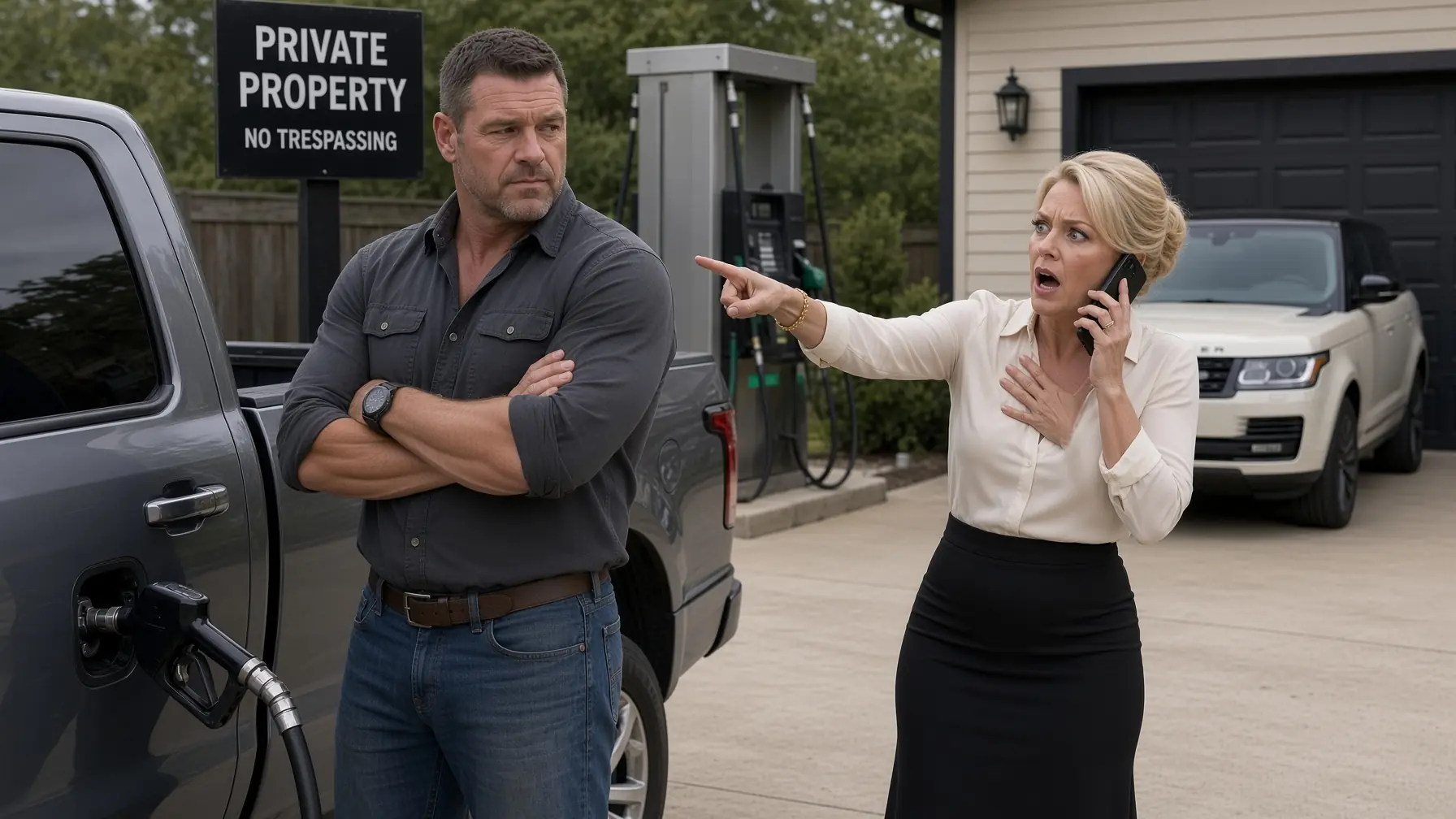
I shut off the pump and replaced the nozzle without moving toward her. Brenda backed away anyway, narrating every step for the dispatcher as though I were advancing, telling them I was angry, confrontational, and refusing to comply with a community safety directive. “I’m standing beside my own truck,” I said, keeping my hands where she could see them, but Brenda lifted one finger and warned, “Do not approach me,” with the satisfied expression of someone who believed saying something first made it true. What she did not know was that I had spent most of my adult life learning exactly what happens when confidence outruns evidence.
My name is Marcus Kellerman, and I was fifty-two years old when Brenda decided my fuel pump represented everything wrong with Willowbrook Estates. I had served twenty years in military logistics before leaving active duty, spent several more years moving through civilian emergency-management and law-enforcement positions, and eventually became chief of police in Fairmont, a city twenty minutes east of Willowbrook. Willowbrook itself was outside Fairmont’s jurisdiction and received law-enforcement service from the county sheriff, which was one reason I had moved there after my wife died; at home, I wanted to be Marcus rather than Chief Kellerman. I had learned long before meeting Brenda that authority works best when people do not need to be reminded you have it.
My wife Sarah had died the previous spring after two years of cancer treatments that rearranged every ordinary thing in our lives. She had been a respiratory therapist before becoming too sick to work, which meant she understood every monitor, oxygen machine, medication schedule, and quiet change in a patient’s breathing long before I did. During the final six months, our house became a place where hospital equipment lived beside family photographs and pill organizers sat next to coffee mugs, and after she was gone I discovered that grief could turn harmless objects into ambushes. I could walk past her coat without thinking one morning and spend the next afternoon unable to touch it.
The house we had shared for nineteen years was filled with more memories than I could carry. Sarah’s favorite mug remained in the cabinet because moving it felt like admitting something, while her side of the closet stayed untouched until my sister finally stood beside me and helped pack it. I sold the property four months after the funeral, not because I wanted to forget Sarah but because I needed a place where every room did not immediately tell me who was missing. Willowbrook seemed quiet enough to let me begin figuring out who I was when I was no longer somebody’s husband, caretaker, or crisis manager.
The neighborhood contained a little more than two hundred homes built in several phases beginning in the late 1980s. Some were small ranch houses occupied by retirees who had lived there thirty years, while newer sections had larger two-story homes owned by young families commuting into Columbus and nearby business districts. Children rode bicycles through the cul-de-sacs, people dragged grills onto driveways during football season, and most arguments involved barking dogs, fence colors, or somebody parking a boat where the covenants said they should not. It was ordinary, which was exactly what I wanted.
The homeowners association had once been managed by Evelyn Henderson, a retired fifth-grade teacher who believed governing adults should require fewer rules than managing ten-year-olds. Her newsletters were famous for their shortness because they usually contained three instructions: pay your dues, maintain your property, and speak to your neighbor before sending the board a complaint. When Evelyn stepped down after fourteen years, Willowbrook spent almost a year with an acting board that mostly approved landscaping invoices and argued about pool hours. Then Brenda Ashworth moved into the neighborhood and decided ordinary management was an insult to her potential.
Brenda worked in residential real estate and had recently left a gated development where the HOA apparently regulated everything from mailbox finishes to acceptable holiday decorations. She arrived at Willowbrook wearing expensive clothes, driving a spotless Range Rover, and speaking about the neighborhood as though she had purchased a struggling corporation in need of restructuring. Within months, she campaigned for the presidency by promising “elevated standards,” “property-value protection,” “strong compliance,” and “a professionalized community identity.” Most residents heard cleaner landscaping and faster repairs, while Brenda seemed to hear permission.
Her first targets were small enough that people treated them as personality conflicts. The Rodriguez family received three warnings because their teenage daughter occasionally parked on the street overnight while working late shifts at a hospital, even though two board members’ adult children did the same thing without receiving notices. Seventy-four-year-old Robert Orion was fined for a vegetable garden visible from the sidewalk because Brenda decided tomatoes and zucchini looked “agricultural rather than residential.” A young Black couple named David and Keisha Brooks received repeated letters about a basketball hoop while four nearly identical hoops remained untouched elsewhere in Willowbrook.
I noticed the pattern because patterns had paid my salary for most of my life. Logistics teaches you that one delayed shipment is inconvenience, five delayed shipments from the same origin are information, and repeated exceptions benefiting the same people are rarely accidents. I did not get involved initially because I was new, grieving, and uninterested in becoming the police chief who moved into a subdivision and immediately started policing the HOA. Brenda interpreted silence as compliance.
The property I purchased had been owned by a semi-retired farmer named Walter McBride before Willowbrook’s final construction phase surrounded much of his remaining land. Walter kept a large detached garage, a workshop, and a permitted aboveground diesel-storage system he used for farm equipment, generators, and his own vehicles. The tank sat behind a screened fence more than sixty feet from the house, rested inside professionally engineered secondary containment, and had survived multiple inspections under the county’s grandfathered land-use provisions. I bought the house partly because that workshop gave me somewhere to put my hands when my mind became too loud.
I restored old trucks after Sarah died. There was something merciful about machinery because an engine did not care whether you were angry, lonely, distracted, or pretending to be fine; either the timing was correct or it was not. I spent weekends rebuilding transmissions, replacing worn brake lines, cleaning parts that had not seen daylight in forty years, and listening to the radio so I would not notice how quiet the house was. When I decided to retain Walter’s diesel system, I spent almost fifteen thousand dollars bringing every component beyond the minimum standards required by its existing permit.
The original pump came out first. A licensed contractor installed modern emergency shutoffs, upgraded the hose assembly, replaced several fittings, repaired the containment curb, installed a locking control box, and added weather-protected signage identifying the installation as PRIVATE — NO COMMERCIAL SALES. I notified my insurer, retained the annual fire-safety inspection schedule, and kept copies of permits, contractor invoices, environmental documentation, and inspection reports in a binder inside the workshop. People later described that preparation as obsessive, but obsessive paperwork becomes very attractive the moment someone starts lying about you.
My first winter in Willowbrook brought an ice storm that knocked out power for almost two days. I owned a diesel generator large enough to keep my house, workshop heaters, and basic systems running, and when Dorothy Martinez knocked on my door asking whether I knew anything about generators, I followed her three houses down. Her husband Harold had advanced lung disease and relied on oxygen equipment, while their backup system had already burned through most of the fuel stored safely in their shed. Sarah had spent years treating patients exactly like Harold, and I did not need to think very long.
I gave Dorothy enough diesel to keep their generator running and checked the installation because emergency fuel is useful only when the machine consuming it is safe. Word traveled, and before the power returned I had helped seven other households with small amounts for approved generators, including a family whose sump pump was losing the fight against rising groundwater. I charged nobody, accepted no reimbursement beyond one apple pie Dorothy delivered three days later, and kept a written record of what I distributed because old logistics habits refuse to die. To me, that was the end of it.
To Brenda, it was evidence that my pump had become a “community concern.” She appeared at my house four days after the storm carrying her clipboard and asked how many residents had obtained fuel from me, how much I kept onsite, whether money had changed hands, and whether the HOA had approved distribution. I answered until the questions stopped sounding like legitimate curiosity and began sounding like cross-examination. When she used the phrase “community resource equity,” I asked what she thought it meant.
“If one resident has infrastructure that benefits the neighborhood,” Brenda said, “the association may need to establish access standards.” I stared at her because the sentence was polished enough to sound almost reasonable until you remembered she was talking about diesel I bought, stored, insured, and maintained on property I owned. “There will be no HOA access standard for my private fuel,” I told her, and Brenda smiled before saying, “We’ll see.” That was the first time I understood she was not asking.
My violation notice arrived the following week. It accused me of operating an unauthorized commercial fuel-distribution activity, generating unapproved traffic, increasing environmental risk, and damaging neighborhood aesthetics. The proposed fine was five hundred dollars, with additional penalties available if I failed to “cease commercial activity” within ten days. I had never charged a cent, advertised fuel, accepted deliveries for other residents, or represented the pump as anything other than private equipment.
I read the covenants twice. Then I read the amendments, enforcement policy, architectural guidelines, and every board resolution available in the homeowner portal. Nothing prohibited the grandfathered installation, nothing gave Brenda authority to transform occasional emergency assistance into commercial activity, and the fine procedure required notice plus an opportunity to be heard before the board. I wrote a response with copies of the county permits, insurance endorsement, contractor certifications, inspection records, and a short statement explaining the emergency fuel distributions.
I expected a reasonable board to look at the paperwork and close the matter. Instead, Brenda scheduled what she called an emergency safety meeting. The community center contained thirty folding chairs, fluorescent lighting, an old coffee machine, and carpet patterned cleverly enough to hide decades of spills. Brenda managed to make it feel like a Senate hearing.
She had built a presentation titled WILLOWBROOK FUEL STORAGE EMERGENCY. One slide showed my tank photographed from outside the screening fence, while another displayed news photographs of unrelated commercial fuel explosions surrounded by red warning symbols. Brenda discussed vapor hazards, groundwater contamination, declining insurance availability, residential traffic, and “potential catastrophic loss exposure” with the confidence of a person who had read enough safety material to become dangerous. Several residents shifted uneasily because disaster photographs work even when the disaster has nothing to do with the thing being discussed.
When I raised my hand, Brenda told me public comments would occur after the board presentation. I let her finish because interrupting somebody who is building a bad case can be an act of generosity. She ended by proposing a one-thousand-dollar fine, a forty-eight-hour deadline to disable the pump, and a requirement that I remove the tank within thirty days. Four board members looked prepared to vote.
I carried my binder to the front when comments opened. The first document was the most recent fire inspection showing no violations, the second was the county permit history confirming the installation’s lawful preexisting status, the third was the contractor certification from the upgrades, and the fourth showed my insurance coverage. Then I pointed toward Jim Holloway, the county fire marshal, who happened to be sitting beside his wife in the third row because Jim lived at Willowbrook too.
“Jim,” I asked, “would you describe the tank as an immediate explosion hazard?” He looked delighted in a way that should have warned Brenda not to answer for him. “No,” Jim said, standing with his hands in his pockets, “I inspected Marcus’s installation myself, and unless he secretly replaced it with something else this afternoon, it exceeds what I require for a system of that age and classification.” People laughed, and Brenda’s mouth tightened.
Jim did not embarrass her further. He simply explained secondary containment, setbacks, shutoffs, inspection intervals, and the difference between a private permitted fuel system and commercial retail operation. Then Dorothy Martinez stood and said the pump had kept Harold’s oxygen concentrator operating during the outage. Another neighbor described the sump pump Marcus had helped fuel, and a third talked about keeping heat running for his eighty-year-old mother.
Brenda tried shifting the argument toward aesthetics and property values. That went badly because the tank could not be seen from the street unless someone walked halfway up my driveway and looked past the screened enclosure. Robert Orion asked whether Brenda believed his tomatoes posed an explosion risk too, and that was the moment the room stopped treating the hearing seriously. The board postponed the vote.
I could have accepted the win and forgotten everything. I almost did. Grief already consumed enough energy, and spending evenings debating fuel codes with a woman carrying a laser pointer was not how I planned to rebuild my life.
Brenda was not interested in letting the conflict end. Two weeks later, a city planning inspector named Dave Morrison appeared at my property after receiving a formal complaint alleging I was operating an unlicensed filling station. The complaint described cash sales to multiple residents, routine tanker deliveries, environmental runoff, and commercial traffic through residential streets. None of it was true.
I invited Dave inside the workshop office and gave him the same binder Brenda had seen. He photographed the system, inspected the containment area, checked the permit numbers, called the county fire marshal, and asked whether I maintained sales records. I told him I had no sales because I had no customers.
Dave spent more than an hour on the property. At the end, he closed his tablet and told me he found no evidence of retail fuel activity, no zoning violation under the existing land-use status, and no observable environmental issue. Then, almost apologetically, he said the complaint had been detailed enough that he was required to take it seriously.
Brenda arrived while he was still there. I never learned whether someone told her about the inspection or whether she had been waiting nearby, but she walked into my driveway and introduced herself as HOA president before demanding an update. Dave explained that he had found no violation.
“What about the sales?” Brenda asked. Dave said he had seen no evidence of sales. She asked about environmental contamination, and he said there was none visible and no report suggesting any.
Brenda finally asked whether local officials understood the liability they were assuming by refusing to act. Dave looked at her for a long moment before answering, “Ma’am, my job is to document violations that exist, not manufacture one because somebody wants a different result.” That sentence ended the conversation. Brenda left without looking at me.
Three days later, posts began appearing on the Willowbrook neighborhood forum. Anonymous residents expressed fears about hazardous fuel, children being exposed to chemicals, home-insurance premiums, and “certain aggressive homeowners who believe rules do not apply to them.” The language mirrored Brenda’s meeting presentation closely enough that several neighbors sent screenshots before I saw the posts myself.
Three of the most active accounts had been created within the same week. Their photographs looked generic, their writing used similar phrases, and each account appeared almost exclusively in discussions involving my property or Brenda’s initiatives. I documented everything but did not accuse anyone publicly. If there was one thing military logistics and police administration both taught me, it was that suspected patterns become useful only when you stop touching them long enough to preserve them.
Around that time, I noticed a sedan parked across the street on three separate afternoons. The driver photographed the house once from the public road and followed me to a hardware store another day, never crossing a line obvious enough to justify confrontation. Private investigators are allowed to observe people from public places in many circumstances, and nothing I saw initially proved wrongdoing. I wrote down the plate number and moved on.
The situation would have remained merely irritating if Brenda had not decided that being denied free fuel was worth turning into an emergency. It happened on the Saturday that opened this story. I was filling my truck when she marched up the driveway, told me to fuel her Range Rover, and explained that the HOA president should not have to purchase diesel “when residents already maintain excess supply.”
I thought she was joking. “My fuel is not part of your compensation package,” I said. Brenda’s expression hardened so fast that any remaining possibility of humor disappeared.
She told me the association was considering a neighborhood emergency-fuel policy. I told her she could consider whatever policy she wanted, but she could not take privately purchased fuel without an agreement, compensation, or authority. Brenda then said, “After everything this board has tolerated from you, the least you could do is cooperate.”
“No,” I said. That was the entire threat. One syllable.
Brenda pulled out her phone and called 911. She told dispatch I had become hostile after she attempted to conduct HOA business, claimed I was physically intimidating her, and said she feared I might have weapons because of my “military background.” I stood beside my truck, shut off the pump, and let her talk.
A county deputy named Aaron Cole arrived twelve minutes later. Aaron knew me professionally because our agencies occasionally coordinated regional events, but I had never supervised him and did not know him socially. The moment he recognized me, I lifted one hand and said, “Treat this exactly like you would if you had never seen me before.”
Brenda looked between us. “You know him?” she asked. Aaron answered, “I know who he is,” then requested identification from both of us and asked separate questions.
I handed over my driver’s license. Brenda launched into a detailed explanation about community safety, HOA authority, my refusal to cooperate, and the fear she experienced when I told her no. Aaron listened without interrupting, then asked what specific words I used that she considered threatening.
Brenda paused. “His tone was threatening.”
“What did he say?”
“He refused to comply.”
“What words?”
She stared at him.
Aaron repeated the question.
Finally she said, “He said no.”
The silence afterward was almost physical. Aaron asked whether I had stepped toward her, raised my voice, displayed a weapon, touched her, blocked her vehicle, threatened harm, or attempted to prevent her from leaving. Brenda answered no to each question, sometimes adding explanations that grew less convincing as the list continued.
Then Aaron looked toward me. “Mr. Kellerman, what happened?” I explained that Brenda requested fuel, I refused, and she called 911. I did not mention her other complaints until he asked whether we had prior disputes.
Brenda interrupted. “He is intentionally leaving out that he’s been under investigation for hazardous activities.” Aaron looked at me. I explained the planning inspection and HOA hearing, then offered the reports if he wanted them.
Aaron asked what I did for work. Brenda crossed her arms as if expecting the answer to confirm whatever image she had built. I said, “I’m the police chief in Fairmont.”
Her face went blank.
“You’re what?”
“I’m chief of police in Fairmont.”
Brenda looked at Aaron. “That doesn’t mean he can threaten me.”
“No,” Aaron replied. “It doesn’t.”
That answer mattered more than if he had laughed at her.
I told Aaron I wanted no special treatment and asked him to document the incident thoroughly because Brenda had made a claim of threatened violence. He separated us again, spoke with dispatch, checked my exterior security camera footage from the driveway, and reviewed the relevant minutes visible on the recording. The footage showed Brenda entering my property, demanding fuel, becoming angry after refusal, and calling 911 while I remained beside the truck.
Aaron did not arrest her. That would have turned a bad complaint into a worse exercise of discretion, especially with me personally involved. He documented the discrepancy, told Brenda no criminal offense had occurred, explained that 911 existed for genuine emergencies, and advised both of us to use civil or HOA processes for future property disputes.
Brenda stared at me after Aaron left. The embarrassment had not softened her. It had concentrated her.
“You think your title makes you untouchable,” she said. I looked at the Range Rover parked at the curb and answered, “No, Brenda. The fact that I said no makes the fuel untouchable.”
She left. I watched her vehicle disappear around the corner and knew the conflict had entered a different phase.
On Monday morning, I notified my city manager and command staff about the incident before Brenda could. I explained the HOA dispute, the 911 call, and the possibility that additional accusations might involve my profession. Then I put in writing that any complaint from Brenda concerning my official conduct should be referred outside my chain of command.
That decision proved useful within forty-eight hours. Brenda submitted a written complaint alleging I had used my position as police chief to intimidate her and interfere with lawful HOA enforcement. The complaint reached Fairmont’s city manager, who sent it to an outside municipal investigator rather than anyone who worked for me.
I provided the deputy’s report, security footage, HOA documents, and my written recusal notice. The investigator interviewed Brenda, Aaron, several neighbors, and me. Three weeks later, he concluded there was no evidence I had used Fairmont police resources or authority in the dispute and recommended no administrative action.
I did not celebrate. The fact that Brenda’s complaint failed did not prove every future accusation would. A person willing to keep rewriting events eventually produces enough versions that somebody may believe one.
That was when I stopped studying only the fuel dispute and started studying the organization supporting her. As a homeowner in good standing, I was entitled under the bylaws to request certain association financial records. I asked for budgets, vendor contracts, meeting minutes, reserve-account statements, invoices above the disclosure threshold, and the board’s conflict-of-interest policy.
Brenda denied the first request as “overly broad.” I narrowed it.
She delayed.
Dorothy submitted a similar request.
Robert Orion submitted another.
Eventually the treasurer, a nervous accountant named Paul Jensen, provided a set of records after several homeowners reminded the board that financial transparency was not optional simply because the president found questions annoying.
What we found did not prove a crime by itself. It proved the HOA had become remarkably comfortable paying people connected to Brenda. Ashworth Legal Services had received more than fifteen thousand dollars for compliance consulting, Premier Grounds Management had collected thousands for landscaping, Residential Safety Solutions had been paid for neighborhood-security recommendations, and Quality Construction Services billed more than twelve thousand dollars for what records described as emergency repairs.
Public business registrations supplied the next layer. Ashworth Legal Services belonged to Brenda’s cousin. Premier Grounds Management was owned by her nephew Derek.
Residential Safety Solutions belonged to another relative. Quality Construction Services shared an address with a company controlled by Brenda’s brother-in-law.
Related-party transactions are not automatically fraudulent. Small communities sometimes hire businesses owned by people who know one another, and the law does not transform family relationships into criminal evidence simply because invoices exist. The problem was that board minutes repeatedly described these vendors as independent selections, several contracts lacked evidence of competitive bidding despite bylaws requiring multiple quotes above specified amounts, and no conflict disclosures appeared in the records we received.
Then we compared prices. Premier Grounds charged nearly twice what two established landscaping firms quoted for comparable seasonal work. Quality Construction billed the HOA for roof repairs on a community building whose roof had been replaced three years earlier, and photographs showed only minor flashing work that other contractors estimated at less than half the invoiced amount.
Residential Safety Solutions billed thousands for a “comprehensive community threat assessment.” The deliverable consisted of eleven pages, several copied almost word for word from freely available neighborhood-security materials. One recommendation urged stronger enforcement against “unregulated mechanical and fuel-storage activity.”
That one had my attention.
I met Dorothy, Robert, David Brooks, Keisha Brooks, Paul Jensen, and three other homeowners at Mel’s Diner on a Wednesday evening. I did not tell them anyone had stolen money because we did not know that. I showed them the records and said, “These are conflicts that appear undisclosed, prices that look high, and procurement steps that may not have been followed.”
Dorothy stirred sugar into coffee and said, “So what do we do?” I explained that the HOA could order an independent audit and the membership could petition for a special meeting under the bylaws.
Robert wanted Brenda removed immediately. Keisha reminded him that anger was exactly what Brenda relied on because angry people skip procedure. I liked Keisha immediately for saying it.
We gathered the signatures required for a special meeting request. The petition demanded an independent financial audit, full disclosure of related-party vendors, suspension of new nonessential contracts pending review, and a membership vote on whether Brenda should remain president after the audit. Nothing in it mentioned my fuel pump.
Brenda received the petition on a Friday. By Saturday morning, every petitioner had received a violation notice.
Dorothy’s mailbox was allegedly the wrong shade. Robert’s garden returned to the enforcement list.
The Brooks family received a notice over their basketball hoop. I was fined again for commercial fuel operations despite the city inspection finding no commercial activity.
Selective retaliation is difficult to prove from one letter. Eight letters issued within twenty-four hours of a financial-audit petition tell a more interesting story. We copied everything.
The private investigator reappeared the following week. This time he approached me rather than pretending I had not noticed him.
His name was Rick Santos, and he owned a licensed investigative firm in Columbus. He said he had been retained initially to conduct a lawful background review and document possible covenant violations involving several Willowbrook residents.
“By Brenda?” I asked.
Rick did not answer directly. Instead he said the client had begun requesting things his firm would not do, including entering private property without consent and finding “anything that could support an arrest.”
I asked why he was telling me. Rick said his attorney had advised him to preserve records because the assignment was becoming ethically dangerous and because he had learned a public official was one of the targets.
“Your being a chief doesn’t make the request wrong,” he said. “It was wrong before I knew.”
That was exactly the answer I wanted.
Rick did not hand me confidential client files. He gave me his attorney’s contact information and said he would respond to any lawful subpoena or investigator inquiry. I thanked him and did not ask for more.
That afternoon, I contacted the county prosecutor’s public-integrity unit as a homeowner, not as a police chief. I explained the related-party contracts, undisclosed connections, questionable procurement, retaliatory notices, and private investigator’s willingness to cooperate under legal process. The prosecutor assigned the matter to investigator James Reynolds, a former financial-crimes detective with an accounting background.
Reynolds met with me two days later. He spent almost three hours going through records and repeatedly stopped me whenever I drifted from what documents showed into what I suspected.
“Do you know Brenda received money personally from any vendor?” he asked.
“No.”
“Do you know these invoices are false?”
“No.”
“Do you know the board received actual services?”
“Some services occurred.”
“Good.”
He tapped his pen.
“Then right now you have conflicts, procurement irregularities, possible overbilling, and retaliation concerns. That is enough to investigate, but it is not enough to tell the neighborhood she stole fifty thousand dollars.”
I respected him immediately.
Reynolds interviewed other homeowners, requested records through appropriate legal channels, and began comparing vendor payments against actual services. I was not invited into the investigation because I was a witness.
When I asked for updates, he usually told me none.
That frustrated me.
It also reassured me.
A legitimate case should not become more transparent simply because the complainant happens to run a police department somewhere else.
Brenda responded to the audit petition by returning to my fuel system. She scheduled another “emergency safety meeting,” this time claiming new information showed the tank presented environmental and public-safety risks beyond local officials’ expertise. The notice proposed a ten-thousand-dollar refundable safety deposit plus mandatory shutdown until an outside assessment could be completed.
I read the supporting documents before the meeting. One carried a heading that suggested a federal hazardous-material advisory, but there was no agency seal, case number, author, or contact information.
Another quoted federal standards that applied to industrial bulk-storage facilities far larger than mine. A third referred vaguely to “terrorism vulnerabilities” associated with residential fuel access.
Brenda had learned from the first meeting. This time she wrapped weak claims in enough technical language that challenging them would require more than standing up and saying she was wrong.
I called my attorney first.
Then I contacted the county fire marshal and appropriate state environmental office through ordinary public channels, not police authority. Both confirmed in writing that the documents Brenda circulated were not official determinations and that no agency had ordered my installation shut down.
At the meeting, Brenda presented the material anyway.
“Federal guidance now indicates that this type of fuel installation may create elevated terrorism and environmental risks,” she announced. People murmured.
I waited until public comment.
Then I asked one question.
“Which federal agency issued the report?”
Brenda said the material came from an outside compliance consultant.
“That wasn’t my question.”
She told me technical sourcing would be provided to the board.
I held up the pages.
“There is no issuing agency because this is not a federal report.”
Her face tightened.
I then read the written statement from the state environmental office clarifying that the cited industrial regulation did not apply to my permitted system at its capacity and classification. Jim Holloway followed with the fire marshal’s confirmation that there had been no change to the installation’s approval.
Board member Denise Walker finally asked Brenda who prepared the document.
Brenda hesitated.
That pause mattered.
The consultant was Residential Safety Solutions.
Her cousin’s company.
The room changed.
Paul Jensen, the treasurer, looked down at his papers and then toward Brenda. “Did the HOA pay them to produce this?”
Brenda said the expenditure fell within presidential emergency authority.
“How much?”
“Three thousand two hundred dollars.”
“For this?”
“It required research.”
Robert Orion laughed loudly enough that everyone heard.
Dorothy stood and moved that no emergency assessment or enforcement action involving my fuel system proceed until the independent audit and a neutral legal review were completed. The motion passed five votes to one.
Brenda was the one.
The special membership meeting was scheduled for three weeks later. Under Willowbrook’s bylaws, Brenda could be removed from the presidency by the board or recalled from her board seat through a membership vote if procedural requirements were met. She started campaigning immediately.
Flyers appeared accusing the audit petitioners of attempting a “hostile takeover.” Anonymous posts claimed outside political interests wanted to seize HOA reserves.
One account suggested I was using law-enforcement influence to intimidate a female community leader.
That allegation bothered me enough that I called Reynolds.
He told me to stop reading social media.
“That is your professional advice?”
“That is my life advice.”
I ignored it.
Two days later, the same anonymous accounts posted that I had been placed under investigation for illegal fuel storage and official misconduct. Both statements were false.
My city communications director wanted to issue a public denial.
I refused.
Turning neighborhood gossip into an official police statement would blur the exact line Brenda claimed I was abusing.
Instead, the city manager responded only when a local reporter asked directly, stating that an independent review of Brenda’s prior complaint had found no policy violation and that my private HOA dispute did not involve Fairmont police operations. Boring statement.
Good statement.
Then the bank problem surfaced.
Paul Jensen called Dorothy first because he was too frightened to call me. The HOA maintained an operating account and a reserve account that contained money set aside for road repairs, storm damage, pool equipment, and long-term capital needs.
Brenda had instructed the bank to transfer sixty-three thousand dollars from reserves into a newly created legal-expense account.
According to Paul, she claimed emergency authority.
The bylaws required two authorized signatures for transfers above a specified amount.
Paul had not approved it.
The bank froze the transaction after noticing the second authorization was missing and contacted him.
Paul immediately sent a written notice to the rest of the board.
Brenda responded that he was obstructing emergency legal protection and attempted to remove him as treasurer.
That was difficult because the bylaws required a board vote.
She apparently had started believing titles created powers faster than documents did.
Reynolds learned of the attempted transfer through Paul and obtained the bank records through legal process. He did not tell us what he found.
We learned later from court filings that the proposed recipient account was associated with a newly created legal-services entity linked to the same cousin already receiving HOA payments.
That changed the case.
Investigators also obtained communications among Brenda, several relatives, and vendors.
Again, we saw those only after charges became public.
Some messages discussed legitimate work.
Others discussed keeping bids “inside the family” and structuring invoices beneath thresholds that would trigger broader review.
One message from Brenda to her nephew said, Break the landscape work into separate approvals so the old people don’t ask questions.
That line would eventually appear in a courtroom.
The social-media accounts also became evidence. Digital records obtained through legal process linked several of them to devices or internet connections associated with Brenda’s residence and a relative helping manage her campaign.
That did not make angry internet posts a major crime by themselves.
It made Brenda’s claim of spontaneous neighborhood outrage much harder to maintain.
Rick Santos, the private investigator, provided records after receiving a subpoena.
His documentation showed Brenda repeatedly pressing his firm to find grounds for criminal complaints against me and two other homeowners who had signed the audit petition. Rick had refused requests to enter private property or create misleading photographs.
The most damaging email was not dramatic.
Brenda wrote, I don’t care what he actually did. I need something that makes authorities take him seriously as a threat.
Reynolds later told me that investigations often turn on sentences people type when they believe nobody outside the conversation will ever read them.
Brenda kept escalating without knowing how much evidence had accumulated.
She filed another complaint claiming I followed her vehicle from an HOA meeting.
My security system and a restaurant receipt placed me at home during most of the period she described.
She claimed Dorothy threatened her physically.
Three witnesses contradicted that.
She accused Robert Orion of vandalizing community landscaping.
Camera footage showed the damaged shrub had been struck by a delivery truck.
Each false allegation looked small.
Together they showed a method.
The morning before the recall meeting, I found Brenda standing at the edge of my driveway.
She did not step onto the property.
That was progress.
“You’re enjoying this,” she said.
I was holding a mug of coffee.
“Enjoying what?”
“Turning everyone against me.”
I shook my head.
“I didn’t award contracts to your relatives.”
Her face tightened.
“You don’t understand HOA management.”
“Probably not.”
“You don’t understand how much work I’ve done.”
“That may be true too.”
She stared at me.
“Then stop acting like you know everything.”
“I don’t.”
I took a sip.
“That’s why we asked for an audit.”
Brenda laughed bitterly.
“You think paperwork makes you righteous.”
“No.”
I looked at her clipboard.
“I think paperwork makes people specific.”
She left.
The recall meeting was scheduled for nine on a Monday morning because Brenda insisted a weekday meeting would reduce what she called disruptive attendance. The community center was full before eight forty-five.
People stood along the walls.
Some had brought folders.
Others had brought nothing but anger.
Brenda had installed poster boards near the front displaying photographs of my tank, the Brooks family’s basketball hoop, Robert’s garden, and several homes she labeled “repeat compliance concerns.”
I sat beside Dorothy.
She whispered, “She still thinks this is about your pump.”
“I know.”
At exactly nine, Brenda called the meeting to order.
She spoke for nearly twenty minutes about order, standards, community values, intimidation, and the dangers of allowing “a small aggressive group” to undermine lawful governance.
Then she pointed toward me.
“Some residents believe professional status places them above community rules,” she said.
People looked at me.
Brenda continued.
“I will not be bullied by anyone, regardless of what uniform they wear outside this neighborhood.”
That was the first time she publicly acknowledged my job.
Interesting.
She moved to postpone the recall vote pending what she described as unresolved safety and legal concerns.
Dorothy objected.
Paul Jensen stated the meeting notice had already listed the recall vote and membership signatures satisfied the bylaws.
Brenda ruled Paul out of order.
That was when the back doors opened.
Nobody gasped immediately because three people entering a community center rarely look dramatic in real life. Investigator Reynolds came first, followed by two county sheriff’s deputies and an attorney from the prosecutor’s office.
Brenda stopped speaking.
Reynolds walked toward her.
“Brenda Ashworth?”
She stared.
“Yes.”
“I have a warrant for your arrest.”
The room became completely quiet.
No speech followed.
No investigator announced the entire case to residents.
No federal agents explained the plot.
Real arrests are more procedural than television prepares people to expect.
Reynolds identified the charges listed on the warrant, advised Brenda of her rights, and allowed her a moment to hand her purse and phone to her attorney, who had been sitting near the front.
The initial counts included felony theft-related allegations, tampering with records, attempted unauthorized transfer of association funds, and falsification connected to financial and official complaints.
Additional matters remained under review.
Brenda looked toward me while one deputy secured the handcuffs.
Her expression held anger first.
Then disbelief.
Then something almost like recognition.
“You did this,” she said.
I shook my head.
“No.”
She laughed once.
“Don’t pretend.”
“I reported records.”
I kept my voice low.
“Investigators did the rest.”
She turned toward Reynolds.
Then back toward me.
Only then did I say, “You should know something, Brenda.”
Her eyes narrowed.
“You spent months telling people my job made me dangerous.”
I paused.
“The only useful thing my job taught me here was not to investigate you myself.”
That disappointed half the room.
Some people had expected a grand reveal.
But Brenda already knew by then that I was a police chief.
The point was never my title.
The point was that the evidence survived without it.
After Brenda left, nobody knew whether the meeting could legally continue.
That was the most Willowbrook moment imaginable.
Two hundred people had just watched their HOA president get arrested and immediately began arguing about parliamentary procedure.
Dorothy opened the bylaws.
Paul called the association attorney.
Twenty minutes later, counsel confirmed that the membership could proceed because proper notice had been issued and Brenda’s absence did not dissolve the meeting.
The recall vote passed overwhelmingly.
Three other board members resigned before lunch.
Paul remained temporarily to preserve financial continuity.
Dorothy refused when people first nominated her for president.
Then everyone stared at me.
“No,” I said before anybody formally spoke.
Robert laughed.
“You don’t even know what we were going to ask.”
“Yes, I do.”
“Come on, Marcus.”
“I run a police department.”
I lifted my coffee.
“One badly behaved government at a time.”
That line traveled around Willowbrook for years.
Dorothy eventually agreed to serve as interim president until proper elections could be held.
Her first act was ordering the independent audit Brenda had spent months fighting.
The accounting firm reviewed contracts, payments, bank records, reserve transactions, meeting minutes, and procurement documentation.
Their report was devastating precisely because it refused dramatic language.
More than sixty thousand dollars in association spending involved vendors connected directly or indirectly to Brenda without adequate disclosure.
Not all of it represented theft.
Some work had genuinely been performed.
The problem was that several invoices were materially inflated, some bidding records had been altered or backdated, and payments were structured in ways that bypassed approval thresholds.
The attempted sixty-three-thousand-dollar reserve transfer had been initiated without required board authorization.
The audit also found legitimate repairs Brenda had approved at fair prices.
That mattered.
Accountability becomes less trustworthy when people pretend someone did nothing correctly simply because they did other things wrong.
Criminal prosecutors narrowed the case as well.
Some allegations originally discussed among neighbors never became charges.
Others were reduced because evidence supported policy violations rather than crimes.
The state ultimately focused on transactions prosecutors believed they could prove beyond a reasonable doubt.
Brenda’s attorney fought aggressively.
He argued the HOA board had given presidents broad emergency discretion, that related-party contracts were legal when services were delivered, that bookkeeping mistakes had been inflated by political enemies, and that the attempted reserve transfer was intended to fund genuine legal representation.
Some of those arguments were not absurd.
The case took almost a year.
That frustrated neighbors expecting courtroom justice to move at social-media speed.
During that year, Brenda remained free on bond and moved out of Willowbrook.
Her real-estate business suffered because public charges made clients nervous, but her license was not magically revoked the day of arrest.
Professional regulators conduct their own processes.
The association pursued civil recovery separately.
Insurance carriers became involved.
Vendors hired lawyers.
Paper multiplied.
Eventually Brenda accepted a negotiated plea.
She admitted to felony theft connected to portions of HOA money diverted through inflated related-party contracts, tampering with association records, and an attempted unauthorized transfer from reserves.
Several lesser counts were dismissed as part of the agreement.
The final established loss used for restitution was a little more than sixty-seven thousand dollars.
The judge sentenced her to a period of incarceration followed by community control and ordered restitution.
It was not twenty years.
It was not life.
It was enough to end the fantasy that HOA money belonged to the president who controlled the clipboard.
The judge discussed something more important than the exact number of months.
He noted that Brenda had repeatedly used community enforcement mechanisms against residents who questioned financial decisions.
The retaliation did not transform every violation notice into a crime, but it demonstrated how ordinary administrative power could be used to discourage oversight.
That observation mattered to Dorothy more than the sentence.
After court, she told me, “That was the part I needed somebody official to say.”
I understood.
People who have been bullied by small systems often do not need spectacular revenge.
They need confirmation that the system was not supposed to work that way.
The association recovered some money through restitution, insurance, settlements, and vendor repayments.
Not every dollar came back.
That disappointed people until the new board explained the numbers honestly.
Instead of promising miraculous recovery, Dorothy published monthly statements showing exactly what had been collected, spent, reserved, and still disputed.
Attendance at HOA meetings tripled.
At first, that made meetings unbearable.
Everyone had discovered democracy simultaneously.
Robert wanted line-item debate over every landscaping bill.
Keisha wanted enforcement statistics published to identify selective patterns.
David insisted vendor bids be visible before major awards.
Paul wanted everyone to stop asking him accounting questions while he was trying to eat cookies.
It was messy.
It was healthier.
The new conflict-of-interest policy required board members to disclose family, financial, and business relationships with proposed vendors.
Competitive bidding thresholds were enforced.
Meeting minutes became detailed enough that residents could understand decisions without attending.
Fine appeals were heard by people who had not issued the original violation whenever possible.
No policy solved every problem.
It merely made abuse harder.
My fuel pump stayed where it had always been.
The HOA’s independent attorney reviewed the covenants, permits, historical land-use status, and county records.
He concluded the association lacked a reasonable basis to order removal so long as the system remained lawful, maintained, screened, and noncommercial.
The fines were withdrawn.
I asked for that determination in writing.
Old habits.
The following February brought another ice storm.
Power failed across Willowbrook shortly after midnight.
By one in the morning, my generator was running and the private pump had become useful again.
This time we handled it differently.
The neighborhood had created an emergency-preparedness list identifying residents with medically necessary equipment, approved generators, transportation limitations, and emergency contacts.
Nobody treated my tank as free community property.
People called.
Asked.
Recorded what they received.
Most brought replacement fuel once roads reopened.
Dorothy’s husband Harold needed assistance again.
I stood beside his generator in freezing rain while Dorothy held a flashlight and joked that Brenda would probably have invoiced us for “oxygen continuity consulting.”
I laughed hard enough that my gloves slipped.
Harold died the following summer.
His illness had been progressing for years.
At the funeral, Dorothy hugged me and said the extra winter Sarah’s old lessons helped give them had mattered more than I understood.
That sentence opened something in me.
For two years after Sarah died, I had treated helping other people as a way to stay busy enough not to feel the empty spaces in my own life.
Harold made me understand that Sarah was still influencing things without me needing to turn every memory into grief.
She had taught me what oxygen equipment meant before I ever met Dorothy.
She had taught me to notice the fear families hide when machines fail.
She had taught me that helping somebody breathe mattered more than explaining why you were qualified to help.
I began talking about her again.
Not constantly.
Just honestly.
At the first neighborhood emergency-preparedness workshop, I explained generator safety and fuel storage, while Jim Holloway covered fire precautions and an electrician discussed transfer switches.
When somebody asked why I cared so much about backup power for medical equipment, I told them about Sarah.
My voice cracked once.
Nobody looked away.
That was progress.
The workshops expanded.
One month we covered severe-weather planning.
Another focused on home emergency kits.
A local attorney volunteered to explain HOA covenants, financial-record requests, and what homeowners should look for before buying into an association.
Dorothy called the program Neighbors Helping Neighbors because committees apparently require names.
I hated it.
Everyone else loved it.
A year after Brenda’s arrest, Willowbrook held its first annual emergency-preparedness day.
Children climbed through a fire engine.
Jim demonstrated extinguishers.
Nurses taught basic first aid.
I displayed the fuel system’s safety components using photographs rather than turning my driveway into a field trip.
Someone printed a banner with NO FREE RANGE ROVER FUEL across the bottom.
I blamed Robert.
He denied everything while wearing a shirt with the same phrase.
The story eventually escaped Willowbrook.
A local reporter wrote about the HOA financial reforms and mentioned almost casually that the investigation began after the association president’s escalating feud with a resident who happened to be a neighboring city’s police chief.
That detail became the headline everywhere else.
HOA PRESIDENT TARGETS WRONG HOMEOWNER — HE’S A POLICE CHIEF.
I hated it.
Not because it was false.
Because it implied the lesson was to check whether the person you were abusing had enough status to fight back.
Brenda should not have demanded free fuel from a mechanic, teacher, nurse, retired widow, warehouse worker, or unemployed father either.
She should not have issued retaliatory fines against Robert.
She should not have targeted the Brooks family.
She should not have treated Dorothy like an inconvenience.
My badge was not what made her behavior wrong.
I agreed to one television interview after rejecting several others.
The producer kept trying to frame the story around the moment Brenda discovered my profession.
Finally I interrupted.
“You’re telling the wrong story.”
The interviewer looked surprised.
“What’s the right story?”
“That she should’ve stopped when a homeowner said no.”
He waited.
“That’s it.”
I continued.
“My being police chief made the reveal entertaining.”
“It did not create my property rights.”
“It did not make false reports more false.”
“It did not make HOA funds more public.”
“And it definitely did not make my neighbors deserve transparency more than they already did.”
That portion of the interview received fewer views than the arrest clip.
Still worth saying.
Fairmont reviewed my handling of the matter once everything concluded.
The city manager asked outside counsel to ensure I had not improperly used police resources, personnel, or databases.
The review confirmed the relevant complaints had been routed outside my chain of command and that the criminal financial investigation had been conducted by county authorities independent of Fairmont.
I kept the report.
Of course I did.
My officers joked that I would request written certification proving sunrise if there were a dispute over it.
I told them documentation protects good people from bad memories.
One lieutenant answered, “Chief, sometimes it protects everyone from you.”
Fair.
The experience changed how I led the department.
Before Brenda, I believed recusal was mostly about avoiding actual conflicts.
Afterward, I understood appearance matters too.
The public does not simply need an investigation to be fair.
They need good reason to trust that it was fair.
We strengthened our written conflict procedures for complaints involving senior officers.
Command staff hated the extra paperwork.
I told them that was how we knew it was government.
Willowbrook changed me in less official ways.
I stopped driving home from work and immediately closing the garage door.
Sometimes I sat with Robert while he pretended not to overwater his tomatoes.
I helped David Brooks rebuild the brakes on his pickup.
Keisha convinced me to attend the neighborhood cookout even though large social events without Sarah still made me uncomfortable.
Dorothy became the kind of friend who entered my kitchen without knocking and criticized my groceries.
“Marcus, this refrigerator looks like a divorced man who got custody of condiments,” she told me once.
“I’m widowed.”
“Your mustard doesn’t know the difference.”
I bought vegetables.
She considered it a victory.
Two years after Brenda left, a woman named Rebecca Lane began volunteering at the HOA legal-information clinics.
Rebecca was forty-six, worked as a paralegal at a small civil firm, and had moved into Willowbrook after her own divorce.
Our first conversation became an argument about whether homeowners should respond personally to every violation notice or let counsel handle repeated disputes.
She told me my instinct to create a file for everything was unhealthy.
I told her being professionally opposed to files was an unusual career choice for a paralegal.
We disliked each other efficiently.
Three months later, Dorothy invited both of us to dinner without warning either of us.
Rebecca recognized the setup immediately.
I did not.
She laughed for nearly a minute when I finally realized why Dorothy kept leaving the room.
Coffee followed.
Then lunch.
Then dinners we stopped pretending were accidental.
Dating after Sarah felt wrong before it felt possible.
I told Rebecca that.
She did not give me one of those speeches about moving forward or what Sarah would have wanted.
She simply said, “Then we go slowly.”
So we did.
Rebecca never asked me to remove Sarah’s photographs.
She never competed with a dead woman.
The first time she used one of Sarah’s old coffee mugs, she paused and asked if it was okay.
I almost cried over ceramic.
Grief is ridiculous that way.
Brenda’s former house sold eventually.
A young couple with twin boys moved in.
For the first few months, neighbors referred to it as “Brenda’s house.”
Then it became the Carters’ house.
That felt important.
Communities heal when places stop belonging to the worst thing that happened there.
The same became true of my driveway.
For a long time, I could stand beside the pump and immediately see Brenda holding her phone, manufacturing fear because she had been denied fuel.
Then that memory weakened.
The driveway became where David and I rebuilt his truck.
Where Dorothy brought pie.
Where Harold’s generator cans had been filled.
Where Rebecca once dropped an entire bag of groceries because she refused to make two trips.
Ordinary life reclaimed the scene.
That was better than revenge.
Five years after the incident, Willowbrook debated replacing part of the playground.
The proposal cost more than some residents liked.
Meetings became heated.
Robert accused the board of overspending.
A young father argued the old equipment was unsafe.
Dorothy, still president, listened for nearly an hour.
Then she said, “Let’s get three bids and an inspection.”
Everyone became quiet.
I started laughing.
“What?” she asked.
“Nothing.”
She narrowed her eyes.
“Marcus.”
“You’ve become boring.”
Dorothy smiled.
“That’s the dream.”
She was right.
Good governance is boring.
Transparent bids are boring.
Minutes are boring.
Audits are boring.
Conflict disclosures are painfully boring.
That is why people who want unchecked authority spend so much energy convincing others that procedures are unnecessary.
Brenda did not lose Willowbrook because I revealed myself as a police chief at the perfect moment.
She lost because residents started reading the papers she hoped they would ignore.
They compared invoices.
Checked business registrations.
Requested minutes.
Asked who approved transfers.
Documented retaliation.
Gave investigators evidence rather than rumors.
Then independent institutions did their work.
Slowly.
Imperfectly.
Enough.
My career eventually reached its own conclusion.
I retired from Fairmont Police at fifty-eight.
The department held a ceremony I tried unsuccessfully to cancel.
Officers gave me a framed photograph of my private fuel pump with a fake evidence tag reading EXHIBIT A: THE MOST EXPENSIVE FREE GAS BRENDA NEVER GOT.
I laughed harder than I wanted to.
Then my deputy chief, Maria Torres, gave a serious speech.
She talked about the Brenda case only once.
“Chief Kellerman taught us that authority is most trustworthy when the person holding it knows when not to use it.”
That sentence meant more than any plaque.
I had spent years believing leadership meant stepping forward first.
Sometimes it means stepping out.
Retirement gave me too much free time.
Rebecca noticed within three days.
She suggested traveling.
I reorganized the workshop instead.
She suggested volunteering.
I built new shelving.
Finally she handed me an application for a county emergency-preparedness advisory board and said, “You are becoming dangerous to household furniture.”
I joined.
We married quietly the following year.
Dorothy served as witness.
Robert insisted on giving a toast nobody authorized.
The wedding took place in our backyard because neither Rebecca nor I wanted ceremony complicated enough to require a spreadsheet.
I wore a suit.
She wore a simple blue dress.
The pump remained hidden behind its fence.
Robert put a small sign near the drink table anyway.
FUEL NOT INCLUDED.
Rebecca almost married him instead.
Sarah was present in the only way that made sense.
Her photograph remained inside the house.
Her memory remained inside me.
Nothing about loving Rebecca required pretending the first twenty-six years of my adult life had not happened.
That understanding made the second chapter possible.
The private pump stayed until I was in my sixties.
Eventually regulations changed enough that keeping the old system became more expensive than replacing it.
I upgraded again.
Permits.
Contractor.
Inspection.
Documentation.
Rebecca stood in the driveway watching the installation and asked whether I planned to laminate the paperwork.
“Obviously.”
“You need help.”
“I married a paralegal.”
“Point taken.”
Willowbrook still used the emergency-preparedness program during storms.
The HOA never owned my fuel.
Nobody demanded it.
We created a voluntary reimbursement fund for households contributing supplies during declared local emergencies.
That system worked because participation remained voluntary and rules existed before the crisis.
The difference between cooperation and entitlement is consent.
Brenda never understood that.
Years later, I received a letter from her.
It arrived at my home without warning.
The return address was in Cincinnati.
I recognized the handwriting only because I had seen her signature on enough HOA notices.
Rebecca asked whether I wanted her nearby while I opened it.
I said yes.
The letter was four pages.
Brenda did not suddenly become a saint.
She explained that after leaving custody she spent years insisting the prosecution exaggerated everything.
She blamed relatives.
The board.
The bank.
Me.
Investigators.
Even residents who had “turned on her.”
Then, according to her, a financial counselor in a court-ordered program asked one question she could not escape.
Which decision in this story belonged only to you?
Brenda wrote that she began with the free fuel.
She knew the pump was mine.
She knew the HOA had no policy giving her access.
She asked because she believed being president meant neighbors should accommodate her.
When I refused, she experienced the refusal as humiliation.
Everything after that became an attempt to reverse the feeling.
The first fine.
The city complaint.
The investigators.
The emergency meetings.
The vendor reports.
The retaliatory notices.
She wrote, I kept using the association to prove that a resident could not tell me no.
I read that sentence twice.
Rebecca remained quiet.
Brenda apologized for calling 911.
She apologized for using my military background to make me sound dangerous.
She apologized for the anonymous accusations.
She also apologized to the broader community for spending money through family-connected businesses without disclosing enough and for convincing herself that being busy justified bypassing rules.
Then she wrote something I believed because it did not ask anything from me.
You being a police chief was never the reason I was wrong. I hated that fact at the time because I thought it was why I lost. I understand now that I had already lost the moment I decided your no was something I was entitled to punish.
I did not answer immediately.
A month passed.
Then another.
Eventually I wrote six sentences.
I told her I had received the letter.
I appreciated that she had named specific actions rather than only regretting consequences.
I told her Willowbrook had moved forward.
I said I had too.
I did not offer friendship.
I did not offer absolution.
My final sentence was simple.
I hope you build the rest of your life around hearing no without needing to destroy the person who says it.
She never replied.
That was fine.
Some endings improve when they remain endings.
When people ask me about Brenda now, they usually expect the funny version.
The HOA president demanded free fuel.
The homeowner refused.
She called the police.
The homeowner turned out to be a police chief.
Then she got arrested.
It makes a perfect three-minute internet story.
The truth is longer.
Messier.
More useful.
Brenda’s downfall had almost nothing to do with discovering my job.
If anything, my job created obligations that made the situation harder.
I had to recuse myself.
Document contacts.
Avoid using departmental databases.
Keep Fairmont officers outside the dispute.
Accept external review when she complained about me.
Let county investigators move at their own speed.
Watch people spread lies I could not ethically answer using official channels.
That was the part nobody turned into a meme.
Authority did not save me.
Restraint protected the case.
Neighbors protected the truth.
Records protected everyone.
The first binder I built about the fuel system still sits in my workshop.
The pages have been replaced over the years as permits changed.
Sarah’s handwriting appears on one old insurance note because she helped me organize household records long before Willowbrook.
I found it after Brenda’s case ended.
At the top Sarah had written, Marcus — keep this because someday you’ll need proof of something stupid.
I laughed until I cried.
She knew me.
She also knew people.
I framed that note.
It hangs above the workbench.
Not the arrest article.
Not my retirement plaque.
Not the photograph of Brenda being escorted from the community center that a newspaper once asked permission to reprint.
Sarah’s stupid little note.
That feels right.
The pump became a story because Brenda thought possession of a title entitled her to somebody else’s property.
The investigation became a story because she thought control of a board entitled her to somebody else’s money.
The retaliation became a story because she thought disagreement entitled her to punish people.
Every part came from the same mistake.
She confused authority with ownership.
I had seen that mistake before in the military.
I had seen officers who believed rank made every idea correct.
I had seen supervisors who believed access to resources made those resources theirs.
I had seen public officials forget that tax money never became personal money simply because their signature appeared on the authorization.
Small power reveals the same weakness as large power.
Sometimes faster.
An HOA president cannot send troops anywhere.
She cannot rewrite criminal law.
She cannot seize a house because somebody annoys her.
But she can make ordinary life miserable if nobody checks her.
Letters.
Fines.
Meetings.
Rumors.
Selective enforcement.
Vendor contracts.
Administrative language intimidating enough that tired residents decide compliance is easier than resistance.
That is why small systems deserve oversight too.
The final Willowbrook policy manual became almost twice as long as the one Brenda inherited.
I teased Dorothy relentlessly about that.
She told me length was the price of cleaning up other people’s shortcuts.
She was right again.
The manual established hearing procedures, disclosure rules, procurement requirements, record-retention standards, conflict policies, and clear limits on emergency authority.
Most residents never read it.
That was okay.
The people exercising power did.
The last time I served on an HOA committee, somebody proposed creating a board-owned emergency fuel reserve.
Everyone looked at me.
I raised both hands.
“Not at my house.”
The room laughed.
The proposal eventually became a properly permitted shared generator-fuel program operated through a local contractor.
No private tanks commandeered.
No residents expected to subsidize others.
No president with a clipboard demanding diesel.
Civilization.
Sometimes I walk through Willowbrook in the evening with Rebecca.
Children ride bikes where different children rode them when I arrived.
The Brooks family moved two streets over into a larger house after having another baby.
Robert still grows tomatoes and still believes every HOA landscaping decision is evidence of incompetence.
Dorothy finally retired from the board after threatening to resign seven separate times.
She remains the first person everyone calls anyway.
My driveway looks ordinary.
That may be my favorite part.
No news crews.
No deputies.
No clipboard.
Just a truck, workshop, fuel enclosure, a few maple trees, and the place where I slowly learned that home could become more than the house I lost with Sarah.
Brenda once believed refusing her free diesel was an act of hostility.
For a long time, I thought her punishment was losing the presidency, facing criminal charges, repaying money, and watching the authority she valued collapse.
I was wrong about that too.
Those were consequences.
The deeper change happened elsewhere.
Willowbrook stopped being afraid of clipboards.
People asked for records.
Challenged inconsistent rules.
Demanded bids.
Appealed fines.
Attended meetings.
Told board members no.
The word that enraged Brenda became ordinary.
That was the healthiest thing we built.
Years after everything ended, Dorothy asked what I would have done differently if I could return to the morning Brenda called 911.
I thought about it.
“I might have said less.”
Dorothy laughed.
“You barely said anything.”
“Exactly.”
She waited.
Then I told her the truth.
“I spent my whole life believing that when someone misuses authority, the answer is to confront them with stronger authority.”
I looked toward the workshop.
“But the thing that beat Brenda wasn’t stronger authority.”
“What was it?”
“Limits.”
Dorothy nodded slowly.
Limits on the HOA.
Limits on me.
Limits on investigators.
Limits on board spending.
Limits on emergency powers.
Limits on what a title lets you take from another person.
A good system is mostly a collection of people agreeing that everyone eventually reaches a line they cannot cross.
Brenda’s problem was not that she had power.
Communities need people willing to serve.
Boards need presidents.
Cities need officials.
Departments need chiefs.
The problem was that every time Brenda found a limit, she treated it like an insult.
I had spent twenty years in logistics learning that boundaries keep systems from failing catastrophically.
Weight limits.
Fuel limits.
Authority limits.
Duty limits.
You ignore them because they inconvenience you, and sooner or later something breaks.
Brenda ignored hers.
The records showed exactly where.
So whenever someone retells the story by saying Brenda Ashworth chose the wrong man to bully, I correct them.
She did not choose the wrong man.
There was no right homeowner to intimidate.
No right widow to fine selectively.
No right young couple to harass.
No right retiree to silence.
No right neighbor whose property became community property because a president wanted it.
She chose to abuse authority.
That was enough.
And the morning she stood in my driveway with her phone pressed to her ear, telling a dispatcher I was dangerous because I would not fill her Range Rover, Brenda believed she was creating evidence against me.
She was wrong.
The fuel pump stayed legal.
The truck got filled.
Her Range Rover did not.
The real evidence came later, one invoice, one email, one bank record, one false complaint, and one carefully preserved document at a time.
By the end, nobody needed my badge to understand what happened.
Nobody needed my military history.
Nobody needed a dramatic title reveal.
They needed the truth.
And unlike Brenda’s authority, the truth never once asked anyone for free fuel.