The wall stood only three feet high, curved gently along the rear edge of the Donovan property, and from the street it looked more like landscaping than flood protection. Garrett Donovan had covered the reinforced concrete core with natural fieldstone, built shallow planters along the top, and tied the structure into a drainage swale designed by a licensed engineer. He had spent almost eight thousand dollars on it, most of what remained in the emergency savings account he and his wife had accumulated during forty-one years of marriage. The Willowbrook Estates homeowners association called it an eyesore.
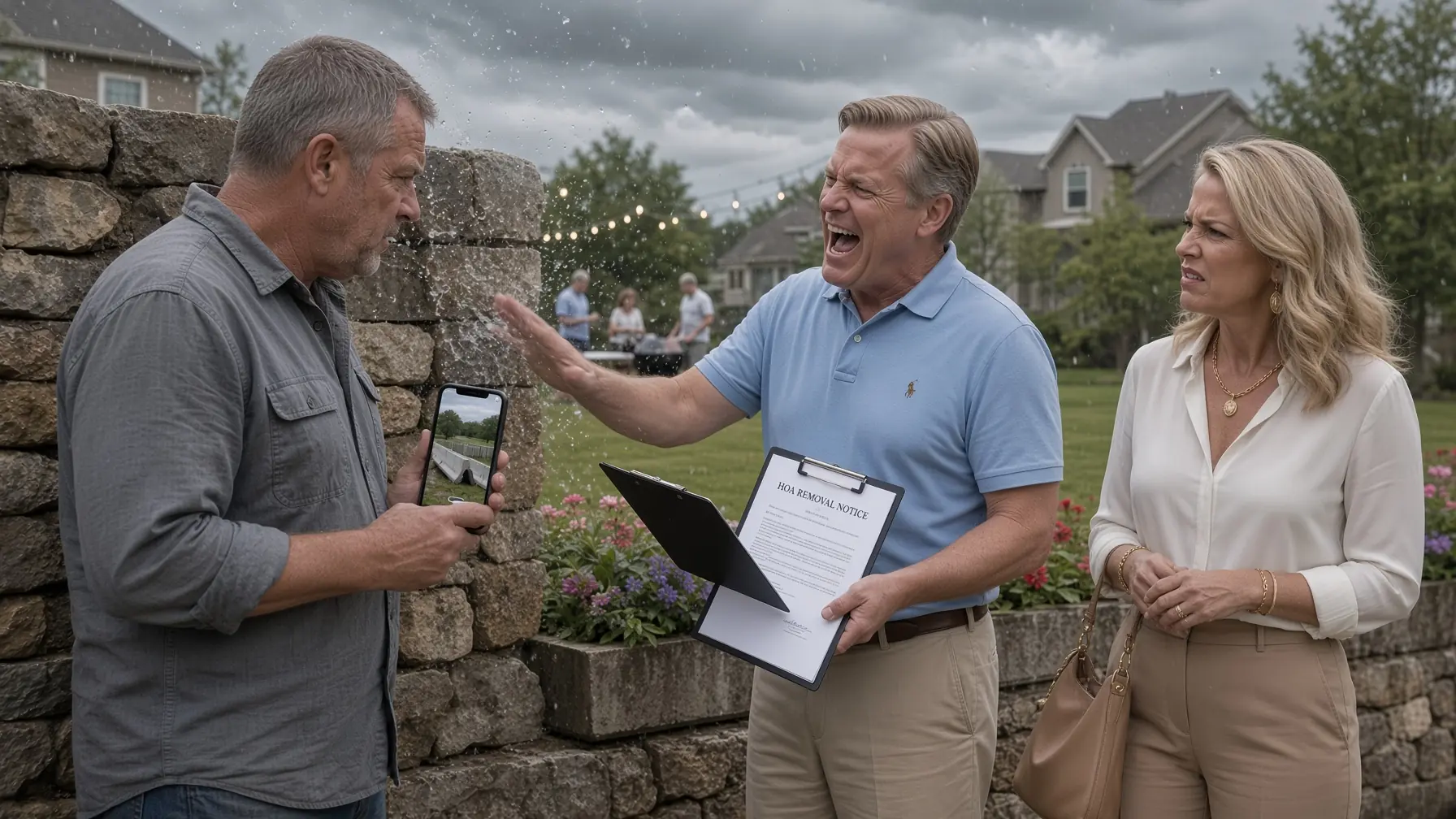
Garrett called it the reason Martha could sleep when thunderstorms came. His wife had been living with dementia for several years, and the last serious flood had left her frightened long after the water receded because she could no longer reliably separate the memory of the disaster from the present. For weeks afterward, whenever rain struck the windows, she packed the same small suitcase and asked Garrett whether they needed to evacuate again. He had promised her he would do everything reasonably possible to keep their home from becoming that frightening place a second time.
Willowbrook sat northwest of Houston in a low suburban basin threaded by drainage channels, detention ponds, and a creek that carried stormwater away during heavy rainfall. The development had been built in phases beginning in the late 1980s, and most residents never thought about the drainage system until rain became intense enough to make every gutter and culvert matter. Garrett thought about it constantly because he had spent most of his working life around pipes, pumps, utility systems, and commercial construction.
He was not a hydrologist, despite what neighbors sometimes assumed after hearing him discuss water. Garrett had worked thirty-eight years as a licensed plumber and later as a facilities superintendent for a large industrial contractor, where he had learned enough about flow, grading, and drainage to know when a problem required an engineer rather than confidence. That distinction became important after the Donovan house flooded.
The first flood occurred during a severe Gulf storm two years after Garrett and Martha moved into Willowbrook. Water crossed their backyard, overwhelmed the patio drain, and entered the lower level of the house through a rear door and foundation opening. They lost photographs, furniture, several boxes of Martha’s sheet music, and a piano she had owned since she was nineteen.
What bothered Garrett afterward was not simply that their house had flooded. Several properties farther uphill had taken water too, while three expensive homes along the creek remained strangely dry despite occupying ground Garrett expected to be vulnerable. During his morning walks after the cleanup, he began noticing concrete structures and berms behind those creekside lots that did not match the original drainage plan displayed in older subdivision documents.
Garrett did not accuse anyone. He photographed what he could see from public areas, requested drainage maps from the county, and hired a civil engineer named Malcolm Serrano to evaluate his own property before he spent money on protection. Malcolm confirmed that the Donovan lot received concentrated runoff from a neighborhood swale and recommended a combination of grading changes, drainage improvements, and a low flood barrier placed entirely within Garrett’s property.
The design was reviewed as required by local authorities. Garrett obtained permits for work that required them, hired licensed contractors for the foundation and electrical portions, and did much of the stone finishing himself because retirement had not removed his ability to work with his hands. Malcolm’s final drawings specifically required openings and drainage paths so the structure would protect the house without simply throwing water toward the next property.
By the time the wall was finished, Garrett was proud of it. Martha liked the flowers in the upper planters and called the structure their “little garden wall,” which pleased Garrett because he preferred that description to anything involving floods. Then the HOA letter arrived.
UNAPPROVED EXTERIOR STRUCTURE — NOTICE OF VIOLATION.
Garrett read the letter twice. He had submitted an architectural request before construction and received no decision within the response period stated in the community documents, while the city permits and engineering approval were already complete. The HOA nevertheless demanded removal and warned that continuing violations could result in fines and further legal remedies.
Three days later, HOA president Preston Ashford arrived at Garrett’s door. Preston was fifty-eight, president of Ashford Residential Development, and lived in the largest house along the creek. His wife Celeste chaired the architectural committee, while board treasurer Dr. Martin Bell owned another creekside property two doors away.
Preston stood on Garrett’s porch holding a clipboard. “This fortress you’ve built is not compatible with Willowbrook’s aesthetic standards,” he said. Garrett looked past him toward the fieldstone wall and asked, “Which part offends you, the flowers or the drainage calculations?”
Celeste did not appreciate the question. She described the wall as “visually aggressive” and suggested that visible flood barriers could make potential buyers believe Willowbrook had a water problem. Garrett answered that Willowbrook did have a water problem because his basement had previously contained six inches of proof.
Preston gave him thirty days to remove the structure voluntarily. He also implied that continued noncompliance could eventually lead to liens if lawful fines accumulated, although he spoke about the process as though the board could simply seize Garrett’s home on command. Garrett had lived long enough to recognize intimidation wrapped in administrative vocabulary.
He requested a formal hearing. Before attending, he hired an attorney named Denise Harper to review the declaration, bylaws, architectural standards, and every document the HOA had sent him. Denise told him the board possessed real enforcement authority, but not unlimited authority, and that whether the wall violated the covenants depended on language far more specific than Preston’s dislike of its appearance.
Garrett brought three folders to the hearing. One contained permits, engineering drawings, inspection records, and photographs showing construction. Another contained the architectural request Garrett had submitted before work began. The third contained the association documents themselves.
Preston opened the meeting by describing the wall as an unauthorized structural alteration. Garrett waited until he finished, then asked which recorded restriction expressly prohibited flood protection. Preston cited a general provision allowing the board to preserve neighborhood character.
Denise responded calmly. “That provision does not eliminate the board’s obligation to apply standards consistently.” She then produced approvals for retaining walls, pool enclosures, masonry privacy structures, and decorative berms on other Willowbrook properties. Several were larger and more visible than Garrett’s wall.
Celeste said those structures were different. Denise asked for the written criterion explaining the difference. Celeste answered that architectural judgment could not always be reduced to numbers, which made several homeowners in the room exchange glances.
Garrett did not enjoy the confrontation as much as people later claimed. He was thinking about Martha sitting with a neighbor because the meeting room confused her after dark. He wanted the wall dispute to end, not become the center of his retirement.
Then a homeowner named Carol Nguyen raised her hand. “Why does the water come through our section so much harder than it used to?” she asked. Preston told her the question was unrelated.
Garrett looked at Denise. She gave a small nod.
He stood again. “Actually, I’d like the board to clarify something before ordering me to remove flood protection.” Garrett projected two county drainage drawings on the meeting-room screen, one from the original subdivision approval and another recent aerial image.
The original plan showed runoff traveling through open swales and detention areas toward the creek. The newer image showed additional berms, concrete channels, and private landscaping changes around several creekside properties. Garrett did not claim those modifications were illegal because he did not yet know who had built them or what permits existed.
He said only what the documents supported. “The drainage pattern appears to have changed.” Then he added, “Before anyone tells residents to remove protective structures, I think we deserve to know whether the neighborhood system is still operating as originally designed.”
Preston adjourned the meeting shortly afterward. No dramatic confession followed, and nobody turned pale beneath the fluorescent lights. But residents began asking questions.
The next morning Garrett received an email from seventy-one-year-old retired librarian Evelyn Brooks. She lived three houses away and had spent thirty-two years teaching other people how to find documents they assumed did not exist. Her message contained one sentence: If you are serious about old drainage records, I may be able to help.
Evelyn arrived that afternoon carrying a legal pad and a folder. She had already searched county property records, planning archives, old HOA minutes, and publicly available aerial imagery. She had found references to drainage repairs approved after major storms, but none corresponding to several of the large concrete modifications Garrett had photographed.
“Could still be permitted under records I haven’t found,” she warned him. Garrett smiled and said, “You and Denise would get along.” Evelyn replied, “People who enjoy evidence usually do.”
Three days later, the HOA filed a formal enforcement action seeking an order requiring Garrett to stop additional work and ultimately remove the wall if the association prevailed. It was not the instant foreclosure Preston had threatened on the porch. It was ordinary civil litigation, expensive enough to frighten a retiree even when the retiree believed he was right.
Martha found Garrett reading the papers at the kitchen table. She could tell from his face that something was wrong even though she no longer understood every detail of the dispute. “Are they taking the house?” she asked.
Garrett folded the papers. “No.”
“You promise?”
He hesitated because promises had become complicated in their life. Then he took her hand and said, “Nobody is taking the house today, and I have good people helping me make sure we’re treated fairly.”
That was the truth he could give her.
Denise recommended an independent engineering review immediately. Garrett called Malcolm Serrano, who returned with survey equipment and two technicians and spent most of a day measuring elevations, flow paths, wall openings, and existing drainage infrastructure. His report concluded that Garrett’s barrier, as constructed, was designed primarily to protect the structure and route collected water toward an existing lawful drainage path rather than materially increase runoff onto neighboring lots.
Malcolm found something else. Several downstream berms and channels appeared capable of reducing flow toward the creekside lots and increasing water elevation upstream during certain storm conditions. He refused to call them illegal without reviewing permits and design documents.
“That’s why I hire you,” Garrett said. Malcolm looked at him. “Because I won’t tell you what you want to hear?” Garrett nodded. “Exactly.”
The city engineering department became involved after Denise submitted a records request and a separate resident filed a drainage complaint. An inspector named Elena Ruiz visited the neighborhood, examined Garrett’s permitted work, and then walked portions of the common drainage area with association representatives present. She did not announce fifty-thousand-dollar fines on the spot.
Instead, she requested records.
That frightened Preston more.
The HOA produced maintenance files but could not immediately locate engineering approvals for several modifications. Ashford Residential Development, Preston’s company, had performed drainage and landscaping work inside Willowbrook after a series of storms, but corporate invoices described much of it broadly as “erosion mitigation” and “property protection.”
Evelyn found the document that changed the investigation. It was a 2019 work authorization filed with a subcontractor, identifying Ashford Residential Development as the client and specifying installation of concrete diversion structures behind three creekside lots. The address list included Preston’s property and Dr. Bell’s.
Again, the document did not prove criminal intent. It proved the work existed and that Preston’s company had ordered it. That was enough for the city to demand engineering plans and permits.
Preston changed tactics. His attorney approached Denise about resolving the wall dispute privately if Garrett agreed not to pursue drainage complaints. Denise brought the proposal to Garrett.
“So I keep the wall if everybody stops asking about the water?” Garrett asked.
“That is approximately what they are suggesting without saying it that directly.”
Garrett shook his head. “Then no.”
Denise looked at him carefully. “Garrett, understand what you’re choosing. This may become expensive.”
“It already flooded my house once.”
“I know.”
“I’m not trying to ruin Preston.”
“Good.”
“I want to know whether they moved water onto everybody else to keep their own lots dry.”
Denise closed her notebook. “Then that is the question we pursue.”
While the records investigation continued, the HOA attempted to pressure Garrett through additional notices. One complained about temporary materials near the wall during maintenance, another alleged landscaping deviations, and a third cited a lighting issue that the city inspector had already found compliant. Denise answered each letter.
Then someone damaged the wall.
Garrett came home from Martha’s neurology appointment to find three capstones removed and part of a drainage opening chipped apart. A contractor named Leonard Price was loading tools into a pickup parked near the rear access lane.
Garrett did not threaten him. He called the police.
The security cameras had recorded Leonard entering the property and striking portions of the wall. When officers arrived, Leonard said he had been hired to perform emergency HOA safety work and believed permission had been granted.
Garrett showed the officers his deed, the pending lawsuit, and the fact that neither he nor Denise had authorized entry. Leonard immediately became less certain.
Preston arrived twenty minutes later. He claimed the contractor had been sent only to inspect a hazardous structure and that any damage was accidental.
Garrett’s camera footage complicated that explanation.
Leonard eventually provided the work order to investigators. It came from a property-management vendor acting at the HOA’s direction and described “removal of unstable drainage components” on the Donovan lot. No court order authorized entry.
The police treated the matter as a property dispute with potential criminal implications and documented the evidence rather than staging an immediate arrest. Denise obtained an emergency order preventing the HOA and its contractors from entering Garrett’s property except under lawful authority while the litigation remained pending.
Leonard repaired the damaged section after his insurance carrier became involved. Garrett did not pay him five thousand dollars to switch sides or promise immunity he could not grant. He simply told Leonard, “Give investigators the same story you gave me.”
Leonard did.
The drainage investigation continued separately. City engineers compared current grades with original subdivision plans and found that multiple private modifications had altered how stormwater moved through part of Willowbrook. Modeling suggested the changes likely reduced exposure on several creekside lots while increasing ponding duration elsewhere under certain severe-rain scenarios.
The investigation did not conclude that Preston had deliberately designed a scheme to flood poorer homeowners so he could buy their houses. That dramatic theory circulated through the neighborhood because Ashford Development had purchased several distressed properties, but the records did not support such a clean conspiracy.
What the records did show was still serious. Preston’s company had performed significant work benefiting properties he and other board members owned, the HOA had not preserved clear evidence of proper approval, and at least some modifications appeared to require engineering and permitting that could not be produced. The board had then aggressively challenged Garrett’s permitted protective structure while applying architectural rules inconsistently.
Residents were furious enough without inventing anything.
Evelyn organized copies of public records into folders and invited homeowners to review them. Denise repeatedly warned everyone not to accuse individuals of crimes they could not prove. Garrett supported her.
“Facts are doing fine by themselves,” he told a crowded living room one evening. “Leave them alone and let them work.”
Then the weather forecast changed.
A slow-moving spring storm system was expected to drop several inches of rain across the area. Garrett hated that he immediately began thinking of the storm as a test because real houses and real people stood on both sides of the drainage dispute. He checked the wall, cleared leaves from every inlet he lawfully controlled, verified that the sump system worked, and helped two elderly neighbors move patio furniture without asking which side of the HOA fight they supported.
Martha watched him from the doorway. “Is the water coming?”
“Probably.”
“Inside?”
“I’m going to do everything I can to keep it outside.”
She nodded, then asked the same question ten minutes later.
Garrett answered it again.
The rain began Sunday afternoon. By early evening, gutters overflowed and the detention areas filled quickly, while city crews monitored several low-water crossings. The HOA had scheduled a resident meeting that evening but canceled it when flash-flood advisories intensified.
Garrett stayed home.
There was no crowd waiting to watch Preston fail, no television reporter positioned conveniently beside the clubhouse, and no hidden switch Garrett could throw to send water toward another person’s house. There was only rain.
The wall worked.
Water crossed the rear portion of Garrett’s lot and reached the barrier, then moved through the designed drainage route without entering the lower level of the home. Garrett checked elevations from beneath the patio cover while Martha sat inside watching an old musical with the volume turned high enough to soften the sound of thunder.
Elsewhere in Willowbrook, the system behaved badly.
Water accumulated behind one of the private berms near the creekside section and spilled into areas the original plan had intended to remain part of an overflow path. Two garages took water, including Dr. Bell’s, while a landscaped retaining feature near Preston’s backyard failed along one end.
Preston’s house was not washed away.
His designer furniture did not float through the living room.
But the storm produced precisely the kind of drainage behavior city engineers had warned could occur when local modifications interfered with a larger system.
More importantly, monitoring equipment had been installed before the storm. City engineers obtained rainfall, water-level, and flow observations that could be compared with the computer model and physical survey. The storm became evidence rather than revenge.
Garrett stood beneath his patio watching water move safely around his home. For a moment, satisfaction rose in him.
Then he saw emergency lights near the creekside section.
He put on his raincoat.
Martha was safe with Evelyn, who had come over before the storm worsened. Garrett drove as far as authorities allowed and found neighbors carrying wet boxes from Dr. Bell’s garage.
Preston stood nearby, soaked and furious. He looked at Garrett and said, “Happy now?”
Garrett stopped.
“No.”
Preston laughed bitterly. “Don’t pretend.”
Garrett looked toward the flooded garage.
“You think I spent eight thousand dollars because I wanted anybody to see this again?”
Preston did not answer.
Garrett joined the neighbors moving boxes.
That moment later became important to Martha, although she remembered it imperfectly. When Garrett told her he had helped at Preston’s property, she asked why he would help someone who had tried to make them tear down the wall.
“Because his house getting wet doesn’t make ours safer,” Garrett said.
Martha thought about that.
Then she answered, “That sounds like you.”
The city engineering report arrived six weeks later. It concluded that unapproved or inadequately documented drainage alterations within the development had materially changed portions of the stormwater system and ordered corrective work subject to engineering review. It also concluded that Garrett’s permitted wall, with minor recommended maintenance adjustments, did not constitute the principal neighborhood drainage hazard alleged by the HOA.
The HOA lawsuit against Garrett unraveled quickly after that. Rather than continue litigating over a wall municipal engineers had largely validated, the association negotiated a settlement. Garrett kept the barrier, the HOA withdrew accumulated violation assessments connected to the disputed structure, and each side resolved portions of the legal fees under confidential terms.
Garrett did not become a millionaire.
He did not need to.
He wanted the wall left alone and the drainage fixed.
The larger fight moved into the association itself. Homeowners demanded access to financial records, engineering contracts, vendor relationships, and meeting minutes. An independent audit showed governance failures, undisclosed conflicts involving vendors connected to Ashford Development, and inconsistent enforcement decisions.
Those findings did not send the entire board to prison. They did something more ordinary and more useful.
They ended careers inside Willowbrook.
Preston resigned as HOA president before a recall vote could be completed. Celeste left the architectural committee, and Dr. Bell stepped down as treasurer after acknowledging that the board should have used independent engineering review before approving work affecting properties owned by board members.
Ashford Development faced civil and administrative consequences related to the drainage work. The company ultimately paid part of the restoration cost under a negotiated agreement while continuing to dispute claims that the modifications had been intentionally designed to harm other residents. Regulators required engineering corrections and better documentation rather than issuing theatrical million-dollar penalties overnight.
Residents also filed civil claims over prior flood damage. Some settled, others did not, and attorneys spent months arguing over rainfall intensity, causation, maintenance failures, property conditions, and how much damage could legally be attributed to specific drainage changes. Garrett learned that water could be simpler than litigation.
The neighborhood rebuilt its governance more carefully. Residents elected a new board, hired outside property management, created conflict-of-interest rules for board contracts, and required independent engineering review before the association could approve work affecting common drainage infrastructure.
Garrett was asked to run for president.
He declined immediately.
Evelyn asked why.
“I’m seventy-two, my wife needs me, and I spent forty years attending meetings I didn’t want to attend.”
“You’d be good at it.”
“That sounds like punishment for competence.”
Evelyn laughed.
He did agree to serve on a temporary drainage advisory committee, but only if a licensed engineer chaired it. His first recommendation was that residents stop calling every stone wall, ditch, pump, and pipe a “simple water problem.”
“Nothing involving fifty houses is simple,” he said.
The committee commissioned a neighborhood-wide drainage study. The resulting plan restored several original flow paths, enlarged selected inlets, corrected failed grading, and identified homes that needed individual flood-mitigation measures. Not every property received a wall like Garrett’s because not every property needed the same solution.
That pleased him.
Good engineering was not copying the thing that happened to work next door.
It was understanding the problem in front of you.
Leonard Price, the contractor who damaged Garrett’s wall, returned almost a year later. He had given statements during the HOA litigation and was embarrassed enough that he stood at the end of Garrett’s driveway for several minutes before approaching.
“I owe you an apology.”
Garrett looked at him.
Leonard continued, “I should’ve asked for written authorization before touching somebody’s property.”
“Yes.”
“I believed what they told me.”
“I know.”
Leonard looked toward the wall. “You ever need masonry work?”
Garrett smiled. “Not from you.”
Leonard laughed nervously.
Then Garrett added, “But Evelyn needs a walkway repaired.”
That was how Leonard eventually became part of the neighborhood repair project, not because Garrett turned him into a secret witness with money, but because a man who made one bad professional decision still knew how to lay stone. Over the next several months, he repaired walkways, drainage edges, and damaged retaining structures under proper contracts and inspections.
Martha’s dementia continued progressing.
The wall did not cure her.
Reduced conflict with the HOA did not reverse the disease.
Garrett never told the story that way.
What changed was narrower and more important. When storms came, Martha no longer watched strangers argue with Garrett at the front door about whether their protection would be torn down, and she no longer woke after every heavy rain to water entering the house.
Some days she remembered why the wall existed. Other days she called it the garden Garrett had built for her.
He accepted both versions.
One evening, nearly three years after the dispute began, they sat beside the wall while rain moved across the neighborhood. Water entered the drainage channel exactly where the redesigned neighborhood plan intended and moved toward expanded detention storage before continuing toward the creek.
Martha watched it.
“Did you make that?”
“Some of it.”
“Is it safe?”
Garrett looked around the yard.
“As safe as we can reasonably make it.”
She nodded.
Then she pointed toward the flowers growing above the stone. “Those are pretty.”
Garrett smiled. “That was your idea.”
“I have good ideas.”
“You do.”
The story traveled beyond Willowbrook because one local reporter eventually wrote about the dispute as an example of why homeowners associations should not manage complex infrastructure through aesthetic rules alone. Garrett agreed to one interview on the condition that the article not describe him as the retired plumber who outsmarted engineers.
“Why not?” the reporter asked.
“Because the engineer was the person I hired before I built anything.”
The reporter smiled.
Garrett continued, “Knowing when something is outside your trade is part of knowing your trade.”
That line made the article.
Preston eventually sold his Willowbrook house. Garrett heard that Ashford Development had reduced its local operations after the litigation and drainage restoration costs, but he did not track Preston’s life closely enough to turn it into another victory.
He had Martha.
He had the house.
He had a wall that worked.
That was enough.
Years later, residents still told new neighbors about “Donovan’s flood wall.” The story grew with each telling until Garrett supposedly built the entire thing alone, discovered a criminal conspiracy with surveying equipment from the Army Corps, and engineered a storm to flood the HOA president’s mansion.
Whenever Garrett heard that version, he corrected it.
“I didn’t send water anywhere.”
People usually looked disappointed.
Garrett would point toward the drainage channel.
“The whole problem started because somebody thought protecting one property justified making water somebody else’s problem.”
Then he looked at them.
“Why would I repeat it?”
That was the part of the story he cared about.
Preston Ashford believed Garrett’s wall was a threat because it challenged the board’s authority and forced people to look more closely at a drainage system nobody had questioned for years. Garrett initially believed he needed to defeat Preston personally.
He was wrong too.
The real victory came when engineers measured the water, attorneys preserved records, residents asked questions, inspectors demanded permits, and a neighborhood stopped treating authority as evidence of competence.
Garrett’s wall had never been a weapon.
It was protection.
That distinction mattered.
On stormy evenings, Martha sometimes still asked whether they needed to leave. Garrett always answered the same way.
“No, sweetheart. We’re all right here.”
Sometimes she believed him immediately.
Sometimes she asked again five minutes later.
Garrett answered again.
Outside, the rain struck the fieldstone and disappeared into channels designed by people who had finally agreed on where the water was supposed to go.
There were no cheering crowds.
No ruined mansions.
No revenge hidden inside a pump control box.
Just a house staying dry.
For Garrett Donovan, that had always been the point.