At 7:40 on a Monday morning, my tractor left my property without me.
It was not being driven.
It was being hauled.
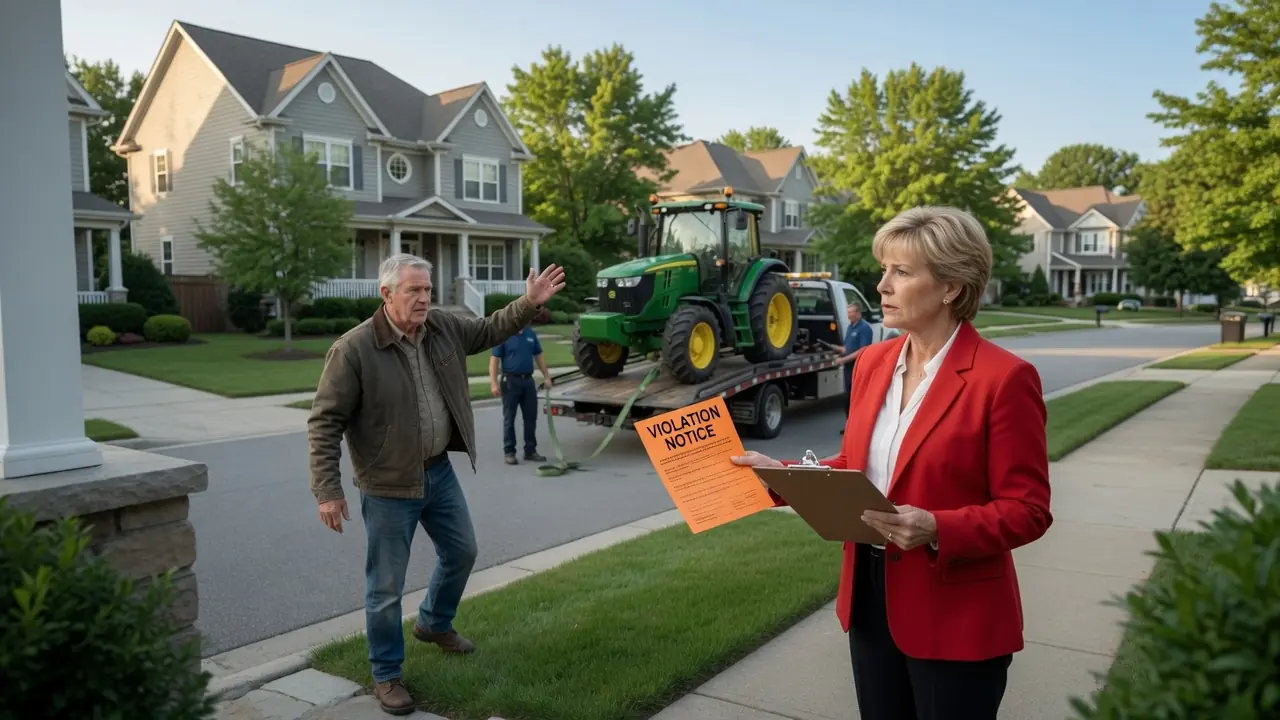
A flatbed trailer sat half in my driveway and half in the street. Two men wearing matching gray polo shirts with the Sycamore Ridge Homeowners Association logo stitched across the chest were fastening heavy straps around the rear axle of my John Deere.
They worked quickly and without hesitation, as though removing farm equipment from private yards was something they did every week.
Perhaps it was.
I stepped off the porch wearing work boots and an old flannel shirt, my coffee still in one hand.
“Stop.”
Both men paused.
Six feet from the tractor stood Cynthia Hale, the HOA president.
She held a clipboard against her chest and wore the calm expression of someone supervising a furniture delivery. An orange violation notice had already been completed and clipped beneath her thumb.
She did not appear surprised to see me.
“Mr. Bennett,” she said. “Your equipment has been cited under the association’s restrictions concerning commercial and agricultural machinery on residential lots.”
“You need to remove those straps.”
“The equipment is being relocated to the association maintenance yard pending your compliance.”
“This tractor is on my property.”
“You were given seventy-two hours to remove it voluntarily.”
“I asked you to provide the rule you claimed I violated.”
“The association has already answered your request.”
“No, it sent me the same bylaws I already had.”
Cynthia extended the orange form toward me.
“You chose not to comply. The board has authority to enforce community standards.”
I did not take the notice.
“Get those men off my land.”
Her expression did not change.
“The governing documents you signed permit enforcement action.”
“They do not permit you to seize personal property.”
“You may raise that issue through the formal appeal process.”
She nodded toward the crew.
The men resumed working.
The strap tightened.
The front wheels of the tractor rose from the concrete pad.
For nineteen years, that John Deere had sat on the south side of my property near the fence. It had cleared storm debris, repaired drainage ditches, moved gravel, pulled fence posts, and carried more fallen trees than I could count.
Now I watched it roll backward onto a flatbed while Cynthia checked something on her phone.
Board member Richard Davis stood beside my mailbox.
He had been there since I came outside, but he had not spoken once.
When the tractor was secured, one of the workers climbed into the tow truck.
Cynthia offered me the orange notice again.
This time, I took it.
At the top was a printed citation number.
SR-2024-118.
Below that was the provision she claimed I had violated:
Section 12.4 — Storage of Agricultural or Commercial Machinery.
At the bottom, in Cynthia’s careful handwriting, were the words:
Equipment removed to HOA maintenance facility. Property will remain in association custody until compliance is confirmed and all fees are paid.
The truck pulled out of my driveway.
I watched my tractor disappear around the corner.
Cynthia clicked her pen closed.
“A compliance form is available through the association office. Once you submit it and pay the outstanding balance, the board will consider releasing the equipment.”
“Consider?”
“You have a good morning, Mr. Bennett.”
She returned to her car.
Davis followed her without looking at me.
Across the street, a curtain moved inside a neighbor’s front window.
When I turned in that direction, the shadow behind it disappeared.
No one came outside.
No one asked what had happened.
I looked at the orange notice again.
Section 12.4.
I had read the association’s governing documents twice during the previous three days.
There was no Section 12.4.
The declaration ended at Section 9.7.
I went inside, finished my coffee, and walked to the small office beside my bedroom.
The bottom drawer of the filing cabinet held an old manila envelope I had not opened in more than a decade.
The pages inside were slightly yellowed at the edges.
One carried the county recorder’s seal and the date August 18, 1987.
My original deed.
I placed it on the desk beside the orange notice.
Then I called Sheriff Frank Collins.
Not the department’s public number.
His personal cell phone.
Frank and I had lived in the same county for nearly thirty years. Before his schedule became impossible, we watched football together on Sunday afternoons.
What I needed was more than a report number.
I needed him to read something.
If Cynthia Hale had known what was recorded in that deed, she would never have allowed the tow truck to enter my driveway.
I bought the property in 1987, when Sycamore Ridge did not exist.
There was no clubhouse.
No community pool.
No decorative entrance sign.
No committee deciding what shade of beige was appropriate for a front door.
There were eleven acres at the edge of a rural county road, a tree line to the north, a drainage ditch to the east, and enough quiet that a person could hear rain approaching before the clouds arrived.
I paid cash for the raw land.
Over the next two years, I built the house with help from my brother-in-law and a framing crew from the county seat.
By the time we poured the porch, I knew every part of that property.
I knew where the soil stayed wet after storms.
I knew which trees lost branches during north winds.
I knew where the deer crossed near the creek and where the ground froze first each winter.
The tractor came in 1994.
A retiring farmer named Gus Parker sold it to me before moving to Florida to live near his grandchildren.
It was a used John Deere 4040 with faded paint, a torn seat, and an engine that sounded better than it looked.
I paid $6,200.
Gus and I shook hands.
Then I drove it home along the county road at eleven miles per hour with the hazard lights flashing.
It was not part of a business.
I did not operate a farm for profit.
The tractor existed because eleven acres required maintenance.
It cleared brush from the back fence.
It kept the drainage ditch open.
It moved gravel after storms washed out the driveway.
It pulled dead trees away from the house.
For years, no one called it agricultural machinery.
No one called it anything.
It was simply my tractor.
The subdivision grew around me in 2003.
A developer named Calloway purchased the old Brennan farm to the south and several vacant parcels east of the road. Within two years, ninety houses appeared where cattle and hay fields had once been.
Most of the new neighbors were decent people.
They worked, raised children, cared for their homes, and generally minded their own business.
In 2004, Calloway Development invited me to join the newly formed Sycamore Ridge Homeowners Association.
The letter described shared road maintenance, neighborhood security, and access to community facilities.
I attended an informational meeting.
Nothing sounded unreasonable.
I signed the declaration without reading every page.
That was a mistake.
At the time, I had lived on the land for seventeen years without a serious disagreement with anyone. I saw no reason to expect one.
For more than fifteen years, the HOA remained a background presence.
I paid annual dues.
The board approved landscaping contracts, managed the pool, and argued about fence styles.
Occasionally, someone received a notice about an unapproved paint color or an abandoned vehicle.
Then Cynthia Hale became president.
Within six months, the number of formal violations tripled.
Residents were fined for garden borders, shutter colors, basketball hoops, decorative barrels, temporary parking, and mailboxes that supposedly failed to match a standard no one remembered approving.
The fines began small.
Fifty dollars.
Eighty dollars.
Then they increased if residents asked questions or failed to comply quickly.
Two families had liens placed against their homes.
One of them, the Carsons, sold their house after a year-long dispute over a fence line.
I watched their moving truck leave and wondered how a disagreement about six inches of cedar had ended with a family abandoning the neighborhood.
My tractor received no notice during any of that.
It had remained visible from the street since 2009, when I poured the concrete pad beside the south fence.
Then, six weeks before the tow truck arrived, an envelope appeared in my mailbox.
The letter stated that my John Deere violated Section 12.4 of the HOA declaration.
I had thirty days to remove it.
I read the notice twice.
Then I downloaded the current governing documents from the HOA website.
The table of contents listed nine sections.
The final provision was Section 9.7.
There was no Section 12.
I searched the PDF for “12.4.”
Zero results.
I searched for “agricultural machinery.”
Nothing.
I searched for “commercial equipment.”
Nothing.
I assumed the citation number was an error.
Then Cynthia came to my door three days before the tractor was removed.
She arrived shortly after nine in the morning wearing a dark blazer and an HOA identification lanyard.
She held a leather portfolio beneath one arm.
“Good morning, Mr. Bennett. I wanted to handle this matter personally.”
She handed me a second violation notice.
It gave me seventy-two hours to remove the tractor or face daily fines and forced relocation at my expense.
I stood in the doorway and read the paper.
“Show me Section 12.4.”
“It is in the current declaration.”
“I have the declaration.”
“The document has been updated since you joined.”
I went inside and returned with my printed copy.
“Show me where.”
Cynthia looked at the binder but did not take it.
“The current version is available online.”
“That is the current online version.”
“Then you may need to refresh your records.”
“I downloaded it yesterday.”
Her smile tightened slightly.
“If you believe a document is missing, you may submit a formal records request.”
“I will. I also want the board minutes from the meeting where Section 12.4 was adopted.”
“The association maintains its records according to standard procedures.”
“That does not answer the question.”
“The seventy-two-hour period has already begun.”
She stepped away from the porch.
“I hope we can resolve this amicably.”
I spent the rest of that day documenting everything.
I downloaded the online declaration again and took screenshots showing the date, time, and table of contents.
I telephoned the HOA office and asked the administrator, Dolores Reed, for the complete current declaration, including Section 12.
Three hours later, I received an email from the official association address.
The attachment was the same document.
It ended at Section 9.7.
I printed the email and attachment.
That evening, Cynthia called.
Her voice was less polished over the telephone.
She said the board’s position was that Section 12.4 remained valid and enforceable regardless of what earlier or incomplete versions of the documents might show.
I asked again for the minutes adopting it.
There was a pause.
Then she said, “Failure to comply will result in a $500 daily fine and a lien against your property. The association has pursued foreclosure referrals before. I want you to understand the seriousness of this matter.”
“I understand.”
She ended the call.
I wrote down the time—7:14 p.m.—and recorded as much of the conversation as I could remember.
Seventy-two hours later, the flatbed arrived.
After the tractor disappeared, I opened the old deed.
The first page contained the legal description of the property.
The second included several use provisions established when the county sold the parcel from a larger agricultural tract.
Paragraph Seven addressed land access and maintenance.
Subsection B contained the language I had only half remembered:
The owner and successors shall retain the perpetual right to possess, store, and operate agricultural and land-maintenance equipment reasonably necessary for the care, drainage, cultivation, clearing, and preservation of the property, which right shall run with the land and shall not be diminished by subsequent private covenant or association agreement.
I read it again.
Then a third time.
The right ran with the land.
Any later association agreement could not eliminate it.
Even if Section 12.4 had existed, it could not legally prohibit the tractor.
But Section 12.4 did not exist.
That was when the situation changed.
Until then, I had believed Cynthia was abusing an overly broad rule.
Now I suspected she had invented one.
The morning after the tractor was taken, I walked next door to see my neighbor, Earl Hutchins.
Earl was seventy-eight, retired from the postal service, and had lived in Sycamore Ridge since 2005.
He was sweeping pine needles from his driveway when I approached.
“I heard them take your tractor,” he said. “I’m sorry.”
“Have you received any recent HOA citations?”
He leaned the broom against the garage.
“A few.”
“Did any mention Section 12.4?”
Earl went inside and returned with a folded notice.
His storage shed door had supposedly violated the approved color requirements for accessory structures.
The citation relied on Section 12.4.
He had paid an eighty-dollar fine and repainted the door.
“I figured they changed the rules again,” he said.
“Did they provide the rule?”
“No.”
“May I copy this?”
He handed me the paper.
“Keep it. I don’t want it in my house.”
Over the next two days, I quietly visited other neighbors.
I did not announce a campaign.
I asked whether they had received citations and whether I could review them.
At first, people were cautious.
Cynthia’s administration had created an atmosphere in which questioning the HOA felt dangerous. Residents believed that once someone attracted the board’s attention, more violations followed.
But people began talking.
A family on Sycamore Lane had been fined for a raised garden bed.
Section 12.4.
An RV parked beside a corner house.
Section 12.4.
A basketball hoop left near a driveway.
Section 12.4.
A flagpole the board considered too tall.
Section 12.4.
A decorative rain barrel.
Section 12.4.
Different violations.
The same nonexistent provision.
Every family had paid.
None knew the rule had never appeared in the declaration.
I copied the notices, labeled each one by date and address, and placed them inside a folder with my documents.
Then I submitted a formal records demand to the HOA under state association law.
I requested every amendment to the declaration and all board minutes concerning a proposed Section 12.4.
I also checked the county recorder’s office.
Any valid amendment affecting the declaration should have been properly approved and recorded.
No Section 12.4 had ever been recorded.
The association eventually produced the meeting records.
Most were ordinary.
Budgets.
Pool repairs.
Landscaping.
Insurance.
Then I reached the minutes from October 2022.
Agenda Item Seven:
Proposed Section 12.4 — Prohibition of Commercial and Agricultural Machinery on Residential Lots.
Motion introduced by Cynthia Hale.
Seconded by Richard Davis.
Vote:
Two in favor.
Three opposed.
Motion failed.
The minutes stated that the proposal might be reconsidered at a later meeting.
I read every meeting record that followed.
It never appeared again.
There was no second vote.
No amendment.
No adoption.
No recording with the county.
Cynthia had proposed Section 12.4.
The board rejected it.
At some point afterward, she began citing it as though it had passed.
Residents trusted that if a notice contained a section number, the rule probably existed.
Cynthia used that trust to collect fines.
More than a thousand dollars from the households I had already identified.
And now she had used the same false provision to seize my tractor.
I sat at the kitchen table with the October minutes open before me.
There is a particular feeling that comes when documents confirm something you had only suspected.
It was not satisfaction.
It was clarity.
The pieces stopped moving.
I added the failed vote to the folder.
A yellow tab marked the page:
OCTOBER 2022 — MOTION FAILED 3–2.
Two days after the tractor was removed, I visited the HOA management office.
The office occupied the rear wing of the clubhouse.
Cynthia sat behind a desk.
Davis stood near the window.
Dolores worked quietly at a smaller desk in the corner.
Through the window, I could see the maintenance yard.
My John Deere was parked beside the rear fence with an orange tag attached to the steering column.
Cynthia gestured toward the chair across from her.
“We have prepared a resolution agreement.”
She slid three stapled pages across the desk.
An uncapped pen had been placed beside them.
The agreement required four things.
First, I would acknowledge that the tractor violated Section 12.4.
Second, I would pay $2,800 in accumulated fines and towing costs.
Third, I would agree to remove all agricultural and commercial machinery permanently.
Fourth, I would waive every legal claim against the HOA, its officers, board members, employees, and contractors.
I read all three pages.
Then I placed them on the desk.
“Is Section 12.4 a lawfully enacted part of the declaration?”
“Yes.”
“Show me the meeting where it passed.”
“Board records require a formal petition.”
“I submitted one.”
“Then it will be processed.”
“I already received the October 2022 minutes.”
For the first time, her expression changed.
Only slightly.
Dolores stopped typing.
Cynthia folded her hands.
“Then you have received the records you requested.”
“The proposal failed.”
“The board’s enforcement authority extends beyond individual votes.”
“Not when you claim a specific amendment exists.”
“The agreement represents the association’s position.”
I pushed the pages back toward her.
“I will not sign it.”
Her face tightened.
“The lien against your property will be escalated. If this remains unresolved, the board may refer the matter for foreclosure.”
“You are threatening to take my home over a rule the board rejected.”
“I am explaining the consequences of noncompliance.”
I stood.
“You should speak with your attorney.”
“Our counsel has reviewed this.”
“Then you should find another attorney.”
I folded the unsigned agreement and placed it inside my jacket.
Cynthia watched me take it.
She did not object.
When I returned home, I arranged everything across the kitchen table.
The false citation.
The current declaration ending at Section 9.7.
The screenshots.
The HOA email.
My call notes.
The neighboring citations.
The failed vote.
The recorded deed.
The unsigned waiver.
Then I called Sheriff Collins.
We spoke for twenty minutes.
I explained what had been taken and how.
I described the false provision and the fines collected from neighbors.
Finally, I sent him a photograph of Paragraph Seven, Subsection B.
Forty seconds later, my phone rang.
“I’ll be there Thursday at nine,” he said.
“Should I do anything before then?”
“Do not sign anything.”
“I already refused.”
“Good.”
The HOA called an emergency general meeting for Wednesday evening.
The email subject read:
IMPORTANT ENFORCEMENT UPDATE — ALL RESIDENTS REQUESTED TO ATTEND.
I arrived at 6:52.
More than forty residents filled the clubhouse.
Earl sat two rows behind me.
We exchanged a quiet nod.
Cynthia called the meeting to order at 7:04.
She wore a dark blazer, her president’s lanyard, and reading glasses I had never seen her use before.
Davis and three other board members sat beside her.
“The board has called this session to present and ratify enforcement action concerning the property at 4412 Sycamore Ridge Drive.”
My address.
She did not say my name.
Cynthia summarized the original citation, the removal authorization, the fines, the supposed lien, and the agreement I had refused to sign.
She referred repeatedly to “the applicable community standard.”
She never said “Section 12.4.”
I wrote that down.
Davis moved to ratify the enforcement.
Another board member seconded.
The vote passed four to zero, with one member absent.
Then Earl raised his hand.
Cynthia looked annoyed before recognizing him.
“Yes, Earl?”
He stood slowly.
“I received a citation under the same provision. Several of us have tried to find it in the declaration. Could you tell us what section is being enforced and where it appears?”
“What you are describing is a separate matter.”
“If it is the same rule—”
“The floor is not open for general discussion.”
A younger man near the back had started raising his hand.
He lowered it.
The room became quiet in the way rooms do when people have questions but no longer believe they are permitted to ask them.
Cynthia delivered her closing statement.
“Sycamore Ridge enforces community standards equally. Every property owner is subject to the same requirements, regardless of tenure or personal circumstance.”
She looked directly at me.
I set down my pen.
For a moment, we held each other’s gaze.
Then I nodded once.
Not agreement.
Acknowledgment.
She believed the matter had ended.
“The meeting is adjourned at 8:47.”
Residents gathered their belongings.
Earl touched my shoulder briefly as he passed.
I remained seated until most of the room emptied.
Then I drove home and set my alarm.
Sheriff Collins arrived at 9:02 the next morning.
He came in his personal truck but wore full uniform.
Civil Process Deputy Elena Reyes sat beside him with a body camera already recording.
This was no longer a conversation between neighbors.
It was official.
I brought them to the kitchen table.
Frank began with the deed.
He read Paragraph Seven slowly.
When he reached Subsection B, he placed one finger beneath the final line.
“Which right shall run with the land and shall not be diminished by subsequent private covenant or association agreement,” he read.
“That is what it says.”
“They could not prohibit this tractor even with a valid amendment.”
“That was my understanding.”
He turned toward Reyes.
She nodded and made a note.
Then he read the HOA minutes.
His expression remained controlled when he reached the failed vote.
He placed the papers down carefully.
“What time does Cynthia normally reach the office?”
“By nine.”
Frank called her.
He identified himself and asked her to come to my property.
He did not explain why.
She arrived eighteen minutes later.
Davis was in the passenger seat.
Cynthia stepped from the car and straightened her blazer.
She walked toward the porch wearing the same confident expression she had used during the meeting.
Then she noticed the sheriff.
She saw Reyes’s uniform.
The body camera.
The county truck.
Something changed in her face.
She continued walking.
“Sheriff, I’m glad you’re involved. This property owner has refused to comply with—”
Frank raised one hand.
Cynthia stopped speaking.
He carried the deed from the hood of his truck and held it open before her.
“Paragraph Seven, Subsection B. Read it.”
She took the document.
Her eyes moved across the paragraph.
Then returned to the beginning.
Her jaw tightened.
“The HOA’s legal counsel has reviewed our authority.”
Frank retrieved the October 2022 minutes.
“Is this the meeting where Section 12.4 was proposed?”
Cynthia looked at the page.
“Board procedure allows—”
“Yes or no?”
“The proposal was introduced there.”
“And rejected three to two.”
“The vote was procedural.”
“There is no later vote adopting it.”
“The board retains broad authority to protect community standards.”
“Not by inventing an amendment.”
The driveway became completely quiet.
Davis took one step backward.
Frank noticed.
“The seizure of Mr. Bennett’s tractor was carried out under a provision that was never legally adopted. The property itself carries a recorded right protecting the storage and use of this exact type of equipment.”
Cynthia lowered the deed slightly.
“The association acted in good faith.”
“You demanded payment and a waiver after taking property without lawful authority.”
“We were enforcing compliance.”
“You were not enforcing a valid rule.”
Frank’s voice remained calm.
“That creates potential criminal and civil issues involving conversion of property, false lien filings, and fraudulent collection of fines.”
Cynthia’s confidence disappeared.
“Our attorney—”
“Call your attorney.”
She did not move.
“I’ll wait,” Frank said.
Davis stared at the ground.
After several seconds, he spoke.
“I’ll contact Dolores and arrange the tractor’s return.”
Frank turned toward him.
“Within twenty-four hours.”
“Yes, Sheriff.”
“All fines against this property are void. Any lien notice must be withdrawn immediately.”
Cynthia still held the deed.
Frank gently took it back and handed it to me.
I placed it inside the manila envelope.
Across the street, Earl opened his front door.
He walked to the edge of his yard.
Another family stepped onto their porch.
Then a woman who had attended the previous night’s meeting stopped beside her car and watched.
Cynthia stood alone in my driveway.
Davis had already returned to the vehicle.
She looked at the neighbors, then at Frank, then at me.
No one said anything.
She walked to the Audi and drove away.
Earl lifted one hand.
It was not quite a wave.
Something quieter.
I nodded.
My tractor came home Friday morning.
A private towing company backed the flatbed into my driveway at 8:15.
The men asked where I wanted it.
“The same place it was.”
They lowered the John Deere onto the concrete pad beside the south fence.
One handed me a work order.
NO CHARGE TO PROPERTY OWNER. THIRD-PARTY BILLING: SYCAMORE RIDGE HOA.
After they left, I removed the orange tag from the steering column.
For a moment, I held it in my hand.
Then I placed it on the garage workbench.
The sheriff’s written finding arrived three days later.
It stated that the tractor had been removed without lawful authority, that Section 12.4 had never been properly enacted, and that the recorded land-use provision predated the HOA and remained enforceable.
A copy was filed with the county recorder.
The false lien disappeared from my parcel record within seventy-two hours.
Two weeks later, the district attorney opened a preliminary investigation into Sycamore Ridge’s enforcement practices.
I provided the complete folder.
Every notice.
Every email.
Every photograph.
Every meeting record.
The October 2022 failed vote went on top.
Investigators eventually identified more than twenty citations issued under Section 12.4.
The total fines exceeded eleven thousand dollars.
All were voided.
Residents received refunds.
Earl got his eighty dollars back.
The family with the RV received $340.
The flagpole citation disappeared.
So did the garden-bed fine, the basketball-hoop penalty, and the rain-barrel violation.
The HOA’s insurance carrier opened a separate inquiry into board conduct.
Cynthia’s personal legal expenses were not covered after the insurer concluded that knowingly enforcing a rejected amendment fell outside her official authority.
Davis resigned.
The remaining board members removed Cynthia as president by a unanimous vote.
She did not attend the meeting.
Instead, she submitted a written resignation.
The new interim president was a retired teacher named Margaret Owens.
Margaret had received her own Section 12.4 citation fourteen months earlier because of a decorative rain barrel.
She had paid forty dollars and repainted it.
Her first official notice to residents was three paragraphs long.
It stated plainly that Section 12.4 had never been validly adopted, that all enforcement actions based on it were unauthorized, and that the association would review every violation issued during the previous three years.
There was no legal hedging.
No discussion of misunderstandings.
No attempt to call fraud an administrative error.
It was not a full apology from those who owed one.
But it was the first honest document the association had issued in years.
Three weeks after the tractor returned, I drove it toward the back fence on a gray November morning.
Brush had grown thick along the drainage ditch while the machine sat in the HOA yard.
I spent two hours clearing it.
The work was familiar.
The engine remained the loudest sound in the neighborhood.
No bulldozers.
No tow truck.
No clipboard.
When I finished, I shut down the mower attachment and sat behind the wheel.
The trees along the north boundary had begun turning orange near the top while remaining green below.
A dog barked somewhere beyond the houses.
Then it stopped.
I drove back toward the south side of the property.
The tractor rolled across the same ground it had crossed for decades.
I backed it onto the concrete pad.
Same fence.
Same oil stain.
Same distance from the road.
Then I shut off the engine.
The silence afterward felt earned.
The orange violation notice, SR-2024-118, now hangs on the wall of my office.
I framed it partly as a joke.
The copy filed with the county carries a red stamp across the back:
VOID — UNLAWFUL ENFORCEMENT.
That side faces outward.
The original deed no longer rests inside the forgotten bottom drawer.
It sits in a new protective folder at the front of the top drawer, where I can reach it easily.
I learned several things from the experience.
I learned that people often obey authority because questioning it feels harder than paying eighty dollars.
I learned that a false rule can become powerful if printed on official paper and repeated with enough confidence.
I learned that silence inside a community does not always mean agreement.
Sometimes it means people are afraid they will become the next target.
Most importantly, I learned that patience is not the same as surrender.
Cynthia expected anger.
She expected me to shout, threaten, or make a mistake she could use.
Instead, I read.
I saved documents.
I asked for records.
I compared dates.
I spoke to neighbors.
Then I placed the truth in front of someone with the lawful authority to act.
The tractor was not returned because I was louder than the HOA president.
It came back because the deed was older than her title, the minutes contradicted her notices, and the evidence survived every version of the story she tried to tell.
For nineteen years, that John Deere had done ordinary work on ordinary land.
Clearing brush.
Maintaining drainage.
Moving soil.
It became important only when someone tried to take it.
The same was true of the rights recorded in the deed.
They had existed quietly since 1987, unnoticed because no one had challenged them.
Cynthia believed that because the subdivision had grown around my property, the HOA had somehow grown above it.
It had not.
My land had been there first.
The tractor had been there before the clubhouse, the pool, the welcome signs, and the committees.
And although neighborhoods change, officers change, and boards rewrite their rules, some things remain exactly where the law placed them.
That tractor still sits beside the south fence.
It is faded now.
The seat has been replaced twice.
The paint carries scratches from three decades of useful work.
Every autumn, I start it, let the diesel engine settle into its familiar rhythm, and drive toward the back drainage ditch.
Occasionally, a new neighbor asks why I keep such a large machine on a residential lot.
I tell them the truth.
“Because the land needs it.”
That answer is enough.
And if anyone ever decides it is not, the original deed is waiting in the top drawer.