“Sir, you are under arrest.”
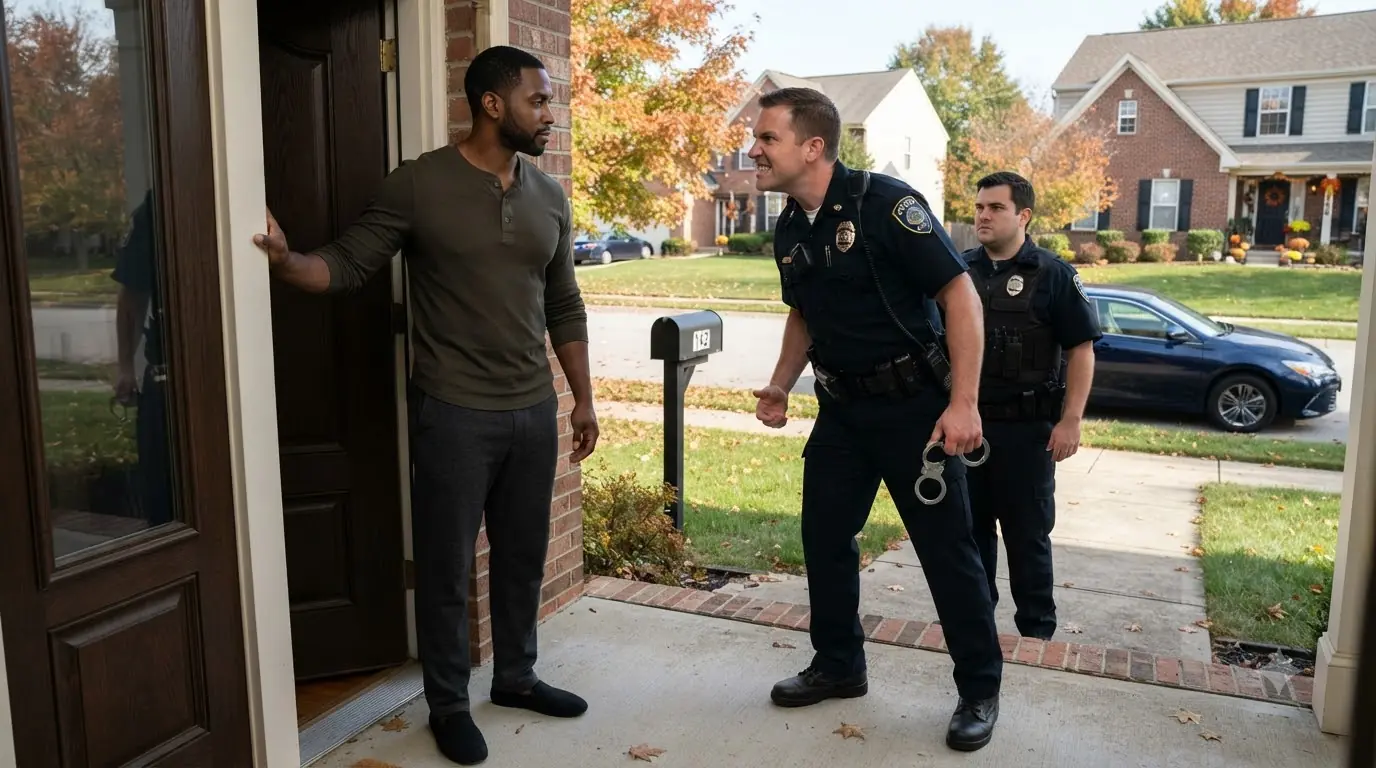
Special Agent Marcus Reed stood inside his open front door, one hand resting against the frame and the other hanging loosely beside him.
The two uniformed men on his porch attempted to look official.
They failed.
The taller man wore a navy shirt with POLICE printed across the chest in white letters. His badge leaned several degrees to the left, and the stitching around his shoulder patch had begun to separate.
The second man had placed his hand near a plastic holster attached to a department-store duty belt.
Neither man carried a radio.
Neither wore a body camera.
Their trousers did not match their shirts.
Marcus looked from one man to the other.
“For what reason am I under arrest?”
The taller man raised his chin.
“Repeated violations of homeowners association rules and community regulations.”
Marcus almost smiled.
Almost.
“Which law makes an HOA violation an arrestable offense?”
The shorter man stepped forward.
“Don’t make this difficult. You have ignored multiple official warnings.”
“From whom?”
“The neighborhood association.”
“That isn’t a law-enforcement agency.”
The men exchanged a quick look.
It lasted less than a second, but Marcus saw it.
He had spent fifteen years studying the small things people did when a prepared story began to fall apart.
The eyes moving first.
The delayed answer.
The unconscious glance toward the person expected to lead.
The taller man recovered.
“We are part of a special compliance unit.”
“Which department?”
“The county.”
“Which county agency?”
The shorter man’s hand moved closer to the holster.
“You ask too many questions.”
Marcus’s expression remained calm.
Real officers were trained to tolerate questions, even irritating ones. These men became nervous every time he requested a fact.
“Show me your credentials.”
The taller man removed a leather case from his pocket and opened it too quickly.
Inside was a gold-colored badge surrounding an eagle.
Above it appeared the words FEDERAL COMMUNITY ENFORCEMENT.
No such agency existed.
Marcus looked at the identification card beside it.
The photograph had been printed slightly off center. The seal imitated that of the United States Department of Justice, but the Latin text around the border contained several misspelled words.
The man snapped the case shut.
“You’ve seen it. Now turn around and put your hands behind your back.”
Marcus remained in the doorway.
Behind the two men, a white SUV waited at the curb with no official markings. A magnetic blue light had been placed on the dashboard.
Across the street, the curtains in Mrs. Holloway’s front window moved.
Someone was watching.
Good.
Marcus spoke carefully.
“This is about the HOA?”
The shorter man relaxed slightly.
“That’s right.”
“And if I promise to follow its rules?”
“We may let you off with a warning.”
“What rules am I accused of violating?”
The taller man removed a folded sheet of paper from his pocket.
“Lawn maintenance. Mailbox appearance. Failure to attend mandatory meetings. Failure to cooperate with the association president.”
The list confirmed what Marcus already suspected.
Only one person in Cedar Ridge had spent months repeating those complaints.
Elaine Porter.
President of the Cedar Ridge Homeowners Association.
Marcus allowed his shoulders to lower.
He looked down and let uncertainty enter his voice.
“I didn’t know it had become this serious.”
The men relaxed further.
Their confidence had depended entirely on his fear.
“Now you understand,” the taller one said.
“Can I get a coat?”
The shorter man looked at his partner.
“Make it quick.”
“I also want a pen. I should write down the rules before this gets worse.”
The taller man laughed.
“Fine. We’ll wait.”
Marcus stepped inside and closed the door.
He did not retrieve a coat.
He locked the deadbolt, crossed the foyer, and activated the exterior cameras through his telephone.
The entire exchange had already been recorded by the doorbell system, but he wanted a second feed saved remotely.
Then he called 911.
Two men are at my residence impersonating federal law-enforcement officers. They have attempted to place me under arrest and appear to be carrying at least one imitation or possibly real weapon.
The dispatcher asked his name.
“Marcus Reed. I’m an FBI special agent currently on administrative leave. My credentials are valid. I am inside the residence and secure.”
“Do not confront them.”
“I won’t unless they attempt entry.”
Marcus gave the address and remained on the line.
He then sent a short emergency message to his field-office supervisor.
The men knocked again.
“Mr. Reed,” the taller one called. “You have thirty seconds.”
Marcus opened the small safe inside the hall closet.
He removed his credentials but left his service weapon secured.
There was no reason to introduce a firearm while a locked door separated him from two uncertain men and real officers were already responding.
He clipped the credentials to his belt beneath his jacket.
Then he returned to the door.
“Sir!” the shorter man shouted. “Open this door now.”
Marcus unlocked it but kept the security chain engaged.
The men saw the gold badge attached to his belt.
Their faces changed.
Marcus opened the leather credential case and held it where both could read it.
FEDERAL BUREAU OF INVESTIGATION.
SPECIAL AGENT MARCUS REED.
The taller man stepped backward.
The shorter one looked toward the SUV.
Marcus’s voice lost every trace of uncertainty.
“You are not police officers.”
Neither answered.
“You displayed counterfeit federal credentials and attempted to take me into custody.”
“We were only hired to deliver a warning,” the taller man said quickly.
His partner turned toward him.
“Shut up.”
Marcus continued.
“Keep your hands visible. Do not reach for the vehicle.”
“You can’t hold us here,” the shorter man said.
“I am not asking you to enter my property. I am advising you that real police officers are arriving, the interaction has been recorded, and leaving will add flight to an already serious situation.”
A siren sounded in the distance.
The shorter man ran.
He made it three steps before the taller man grabbed his sleeve.
“Don’t.”
The first patrol car turned onto the street.
A second followed.
The magnetic light remained useless on the dashboard of the white SUV.
The two fake officers stood in Marcus’s driveway while uniformed Cedar County deputies approached with weapons holstered but hands ready.
Marcus kept the security chain attached until Deputy Leah Morgan identified herself.
Then he stepped outside and presented his credentials.
The deputies separated the two men.
The shorter one attempted to explain that they were private security officers.
Deputy Morgan examined his badge.
“Private security officers do not carry counterfeit Justice Department credentials.”
“We weren’t going to hurt anybody.”
“You told the homeowner he was under arrest.”
“It was supposed to scare him.”
“Who paid you?”
Both men became silent.
Marcus looked toward the house across the street.
Mrs. Holloway now stood openly behind her window with a telephone against her ear.
The neighborhood had begun watching.
For six months, Elaine Porter had made certain Marcus felt observed.
Now the entire street was observing the result of her decisions.
Marcus Reed had returned to Cedar Ridge on an early Tuesday morning after six months away.
Officially, he had been assigned to temporary duty.
In reality, he had participated in a classified undercover investigation involving stolen defense technology and an international smuggling network.
He had lived under another name, slept irregularly, and spent every conversation measuring how much truth it was safe to reveal.
When the assignment ended, Marcus wanted only three things.
His own bed.
Coffee made in his own kitchen.
Silence.
His home stood near the eastern boundary of Cedar Ridge, an attractive suburban development outside Richmond, Virginia.
The neighborhood contained wide streets, landscaped entrances, and an HOA that took great interest in paint colors, mailbox designs, and the exact number of days a basketball hoop could remain near a driveway.
Marcus’s house looked as though it belonged to the development.
Legally, it did not.
The three-bedroom property had been built decades before Cedar Ridge existed. When developers acquired the surrounding land, the elderly owner refused to join the subdivision or attach the new restrictive covenants to his deed.
The road eventually surrounded the property on three sides, but the house remained an independent parcel.
Marcus’s attorney had confirmed it before the purchase.
He paid county taxes.
He followed municipal codes.
He voluntarily maintained the house to a higher standard than most HOA rules required.
But the Cedar Ridge board had no legal authority over the property.
Most previous board members accepted that.
Elaine Porter did not.
She became HOA president eight months before Marcus returned from his assignment.
Elaine was fifty-eight and carried a clipboard as though it were an extension of her authority.
Her first letter arrived the morning after Marcus returned.
NOTICE OF LAWN NONCOMPLIANCE.
Marcus read it while standing in his kitchen.
The grass had been cut by a professional service two days earlier. The edges were trimmed. No weeds were visible.
He photographed the lawn and placed the letter in a folder.
The second notice concerned his mailbox.
The mailbox was black, clean, upright, and located exactly where county regulations required.
Elaine claimed it failed to reflect “the unified architectural character of Cedar Ridge.”
Marcus photographed that as well.
The third notice demanded his attendance at a mandatory community meeting.
Elaine delivered it in person at eight o’clock on Friday morning.
Marcus opened the door holding coffee.
“You are expected at seven tonight,” she said.
“I won’t be attending.”
Her mouth tightened.
“This is not optional.”
“My property is not subject to the association.”
“You benefit from the neighborhood.”
“I use a public road and pay county taxes.”
“You live among our residents.”
“That doesn’t change my deed.”
Elaine held the clipboard closer to her chest.
“You should cooperate for the sake of community harmony.”
“Community harmony generally begins with leaving people alone when you have no authority over them.”
The words were not rude.
Elaine reacted as though he had shouted.
“There will be consequences.”
Marcus closed the door.
The harassment continued.
Letters about grass height during weeks when his lawn had been cut more recently than Elaine’s.
Complaints that his porch light was too bright.
A claim that his dark sedan attracted “unwanted attention.”
A demand that he remove a small security camera because residents might feel watched, even though six HOA homes used identical devices.
Marcus kept everything.
Photographs.
Envelopes.
Delivery dates.
Copies of his deed.
Cedar Ridge’s recorded declaration showing his parcel outside the association boundary.
He sent one formal response through an attorney.
The letter explained the legal position and instructed Elaine to stop representing that the association possessed authority over his home.
Elaine ignored it.
She began appearing near the property during her morning walks, pausing beside the driveway to make notes.
Neighbors told Marcus she discussed him at meetings he did not attend.
She described him as hostile.
Secretive.
Uncooperative.
One resident later admitted Elaine had warned that Marcus’s “type of lifestyle” might reduce nearby property values.
Marcus understood the phrase.
He had heard polished language used to conceal racial assumptions throughout his adult life.
He did not accuse her publicly.
He simply continued documenting.
The lack of reaction enraged her.
Elaine wanted an argument because an argument could be reframed as aggression.
She wanted visible frustration because frustration would confirm the story she had already told about him.
Marcus gave her neither.
By October, she had issued seventeen notices.
None had legal effect.
Then she found two men willing to create the appearance of authority she did not possess.
Their names were Dylan Mercer and Travis Bell.
Dylan worked irregular construction jobs and had once served as a security guard before losing his license.
Travis sold used auto parts online and had several misdemeanor convictions.
They knew a cousin of Elaine’s handyman.
The arrangement was uncomplicated.
One thousand dollars in cash.
Uniform shirts purchased online.
Replica badges.
A white SUV borrowed from Dylan’s brother.
They were instructed to knock on Marcus’s door, claim they represented a federal compliance unit, and threaten arrest unless he agreed to meet Elaine that evening and sign a document recognizing HOA jurisdiction.
Elaine had prepared the document herself.
Deputies found it inside the SUV.
The first page was titled VOLUNTARY COMMUNITY PARTICIPATION AGREEMENT.
If Marcus signed, Elaine intended to argue that he had voluntarily submitted the property to HOA enforcement.
The second page authorized immediate payment of more than four thousand dollars in accumulated “fines.”
The men claimed they did not understand the document.
They only knew they were supposed to frighten him into signing.
Inside Dylan’s pocket, deputies found a handwritten instruction from Elaine.
Be firm. He responds only to authority.
The investigation expanded before sunset.
Marcus spent three hours giving statements to county investigators and agents from the FBI’s inspection division.
Because counterfeit Department of Justice credentials had been used, federal prosecutors joined the case.
Marcus requested no special treatment.
“I am the complaining witness,” he reminded his supervisor. “I shouldn’t participate in the investigation.”
His supervisor agreed.
Marcus turned over the recordings, photographs, letters, and his timeline of Elaine’s conduct.
Then he went home.
For the first time since returning from undercover work, his own living room felt like another crime scene.
Evidence technicians had photographed the porch.
Deputies had walked through the driveway.
Neighbors stood in small groups discussing what happened.
Marcus closed the curtains and made coffee.
He had spent months in danger abroad without feeling personally violated.
Two untrained men standing on his porch had produced a different kind of anger.
The house was supposed to be the place where vigilance ended.
Elaine had attempted to bring counterfeit authority directly to his door.
At eight that evening, agents arrested her.
They did not do so because Marcus had guessed she was responsible.
They did so because the evidence appeared almost immediately.
The two men unlocked their telephones after receiving legal advice.
Messages showed Elaine providing Marcus’s name, address, photograph, and schedule.
She sent photographs of his driveway.
She told them he lived alone and was unlikely to resist if confronted by officers.
She selected the replica badges from an online store.
One message read:
Make him understand that people like him cannot simply move into a community and ignore how things are done.
Another said:
Do not let him talk his way around it. Put the cuffs where he can see them.
Bank records showed two five-hundred-dollar withdrawals that morning.
A security camera outside Elaine’s bank recorded her handing envelopes to Dylan and Travis in the parking lot.
Agents obtained a warrant to search her home.
They found printed drafts of the participation agreement, copies of Marcus’s property records, and a folder labeled REED ENFORCEMENT STRATEGY.
The folder contained photographs of his car, lawn, visitors, and deliveries.
It also contained notes about three other homeowners.
All were members of minority groups.
All had received more complaints from Elaine than surrounding properties with similar or worse conditions.
One family had been fined repeatedly for children’s bicycles left near the garage while identical bicycles at another home generated no complaints.
An Indian American couple had received demands to remove religious decorations displayed inside a front window.
A Latino homeowner had been threatened with legal action over work vehicles that association rules explicitly permitted.
Elaine had not created Cedar Ridge’s prejudices.
She had merely discovered how easily paperwork could disguise them.
During her first interview, Elaine denied everything.
Her attorney advised her to remain silent.
She ignored him.
“I was protecting the community,” she said.
The investigator placed the voluntary participation agreement on the table.
“By sending fake federal officers?”
“I didn’t tell them to say federal.”
The messages said otherwise.
“I may have suggested they look official.”
“You purchased counterfeit badges bearing a Justice Department seal.”
“I didn’t realize that was illegal.”
“You believed impersonating local officers would be legal?”
Elaine stopped speaking.
The investigator showed her photographs of Marcus’s property.
“Which condition violated county law?”
“This isn’t about county law. It’s about standards.”
“Your association has no recorded jurisdiction over his parcel.”
“He lives in the middle of our community.”
“That does not transfer ownership or authority.”
“He refused every attempt to cooperate.”
“He exercised his property rights.”
Elaine leaned forward.
“He was arrogant.”
The investigator studied her.
“How?”
“He looked at me as though I couldn’t tell him what to do.”
“You couldn’t.”
For the first time, Elaine seemed genuinely confused.
Authority had shaped her identity for so long that the legal absence of it felt like a personal insult.
The criminal case developed over several months.
Dylan and Travis pleaded guilty to impersonating federal officers and conspiracy to commit attempted unlawful restraint.
Neither had a significant criminal history involving violence.
Both agreed to testify.
Elaine faced federal charges for conspiracy and causing the impersonation of federal officers. State prosecutors added attempted coercion, harassment, and conspiracy to commit unlawful imprisonment.
The evidence of racial targeting did not automatically create a separate charge for every act, but it became relevant to motive and to a parallel civil-rights investigation into the association’s enforcement practices.
Cedar Ridge’s board held an emergency meeting.
More than one hundred residents attended.
For years, most had treated HOA disputes as background noise.
Now federal agents had arrested the president because she attempted to use fake officers against a homeowner outside the association.
The board’s attorney explained that Elaine had acted without authorization.
Several residents laughed bitterly.
Meeting minutes showed she had repeatedly discussed “bringing Marcus Reed into compliance.”
Board members had not known about the fake officers, but they had allowed her campaign to continue even after receiving proof that Marcus’s property was exempt.
A resident named Priya Shah stood.
“My family received eleven violation notices in one year. The house beside ours received none for the same conditions.”
Another homeowner described Elaine photographing his children.
A retired teacher admitted she had remained silent because Elaine never targeted her.
One by one, the private complaints became public.
The board voted to remove Elaine immediately.
It canceled every invalid fine issued under her presidency and appointed an independent firm to review five years of enforcement records.
The review found a clear pattern.
Minority homeowners received notices at more than twice the rate of white homeowners with comparable properties.
Complaints initiated by Elaine were especially disproportionate.
The HOA’s insurance carrier threatened to withdraw coverage unless the board adopted reforms.
Residents finally understood that Elaine had not been protecting property values.
She had been deciding who deserved comfort and who should remain permanently aware that their belonging could be questioned.
Marcus did not attend the first emergency meeting.
He was tired of being discussed in rooms he had not chosen to enter.
The new board president visited his home afterward.
Her name was Sarah Kim.
She stood on the porch without a clipboard.
“I owe you an apology.”
“You didn’t hire them.”
“I sat through meetings where Elaine described you as a problem. I saw your attorney’s letter. I assumed someone else would handle it.”
Marcus waited.
Sarah continued.
“Silence gave her room.”
“Yes.”
“The board will issue a written acknowledgment that your parcel is outside the HOA.”
“That acknowledgment already exists in the county records.”
“I know. This is for the residents who chose not to read them.”
Marcus accepted the letter when it arrived.
He placed it inside the same folder as the violation notices.
At trial, prosecutors did not present Marcus as a superhero who had turned the tables on foolish criminals.
They presented him as a homeowner.
That distinction mattered to him.
The crime was not serious because Elaine accidentally targeted an FBI agent.
It was serious because she believed any homeowner could be frightened into surrendering legal rights by people wearing uniforms.
Marcus testified for less than two hours.
He described the men arriving.
Their counterfeit credentials.
The demand that he submit to HOA authority.
Elaine’s attorney asked whether Marcus had found the situation intimidating.
“I recognized immediately that they were not trained officers.”
“So you were never in fear?”
“I was concerned they might be armed and willing to enter my home.”
“But you knew how to protect yourself.”
“My occupation is irrelevant to whether their conduct was lawful.”
The attorney tried another approach.
“You had ignored Ms. Porter’s correspondence for months.”
“I responded through counsel.”
“You declined to attend community meetings.”
“I was not a member.”
“You could have reduced tension by cooperating voluntarily.”
Marcus looked toward the jury.
“A person does not become responsible for coercion because he refused to surrender a right peacefully.”
The courtroom became quiet.
Dylan and Travis testified next.
Dylan admitted Elaine instructed them to act as though they could arrest Marcus.
“She said he would fold as soon as he saw badges.”
“Why did you believe her?” the prosecutor asked.
“She said she ran the neighborhood.”
“Did you know an HOA president could not order arrests?”
“I didn’t really think about it.”
“That was the business model?”
A few jurors reacted.
Dylan lowered his head.
Travis described the cash envelopes and the document Marcus was expected to sign.
He admitted the plastic object in his holster was not a firearm but a realistic replica.
“I wanted it to look real.”
“To frighten him?”
“Yes.”
Elaine did not testify.
Her messages testified for her.
The jury saw photographs of the maintained lawn and clean mailbox.
They saw other properties Elaine had ignored.
They read her instruction to display the cuffs.
They watched the doorbell recording of the fake officers announcing an arrest over HOA violations.
The trial lasted eight days.
The jury found Elaine guilty on the federal conspiracy and impersonation-related counts.
She later entered guilty pleas in the state case rather than face a second trial.
The judge imposed a prison sentence shorter than prosecutors requested but significantly longer than the defense sought.
In explaining the sentence, he addressed Elaine directly.
“You did not misunderstand the limits of an association.”
He looked over his glasses.
“You understood those limits and attempted to manufacture greater power through deception.”
Elaine stared ahead.
“You selected the appearance of law enforcement because you believed ordinary citizens should fear it. You intended that fear to accomplish what the law would not.”
The judge paused.
“The fact that Mr. Reed recognized the deception does not lessen the offense. Had you chosen an elderly resident, an immigrant family, or someone without legal knowledge, the intimidation might have succeeded.”
Elaine received thirty months in federal custody followed by supervised release. She was ordered to pay restitution covering Marcus’s security expenses and legal fees attributable to the scheme.
Dylan and Travis received shorter sentences because of their early cooperation.
The court permanently prohibited all three from possessing or using law-enforcement insignia, uniforms, or credentials without legitimate authorization.
Marcus declined to pursue a large personal civil judgment against the HOA.
Instead, he joined a settlement requiring institutional reforms.
Independent review of violations.
Written confirmation of jurisdiction before enforcement actions.
Annual fair-housing and anti-discrimination training.
An appeal process handled by residents not involved in the original complaint.
Public reporting of enforcement statistics without identifying individual homeowners.
The settlement also compensated the other residents who had been disproportionately targeted.
Some neighbors believed Marcus should have demanded more money.
He disagreed.
A personal payment would help one person.
A changed system might protect the next family Elaine would have selected.
Six months after the trial, Marcus attended his first Cedar Ridge community meeting.
Legally, he still had no obligation to be there.
Sarah Kim introduced him only as Marcus Reed, a neighboring homeowner.
Not Special Agent Reed.
Not the man who exposed Elaine.
Just Marcus.
He stood near the back of the room.
Several residents apologized.
Others avoided his eyes.
Mrs. Holloway approached with a plate of cookies.
“I saw those men through the window,” she said. “I called the police, too.”
“I know.”
“I should have spoken up sooner. About Elaine.”
Marcus accepted a cookie.
“Why didn’t you?”
Mrs. Holloway looked toward the floor.
“She liked me.”
That was the most honest answer anyone gave.
Marcus nodded.
“That is usually when speaking matters most.”
During the meeting, the board discussed new landscaping plans, pool repairs, and election procedures.
No one attempted to regulate Marcus’s lawn.
Near the end, a young father raised his hand.
“How do we make sure this never happens again?”
Residents looked toward Marcus.
He had not planned to speak.
Still, he stood.
“You cannot guarantee that another person will never abuse authority.”
He looked around the room.
“You can make abuse harder to hide.”
No one moved.
“Read the rules before enforcing them. Ask whether the same standard is applied to everyone. When someone is repeatedly described as difficult, find out what they were asked to surrender.”
He glanced toward Mrs. Holloway.
“And do not wait until the target turns out to have a badge.”
The room remained quiet.
“That morning, I knew those men were fake. I had cameras, training, legal knowledge, and colleagues I could call.”
Marcus’s voice softened.
“Many people confronted by false authority have none of those things.”
He returned to his chair.
The board adopted the reforms unanimously.
Marcus returned home after dark.
His lawn was green.
The mailbox remained black.
A new security light illuminated the driveway, though he no longer checked it every time a vehicle slowed outside.
Inside, the folder of letters stayed in a kitchen drawer.
He considered throwing them away.
He kept them instead.
Not as trophies.
As evidence of how something absurd could become dangerous when enough people agreed to treat it as normal.
Elaine began with lawn notices.
Then a mailbox complaint.
Then mandatory meetings.
Each step appeared too small to justify a public confrontation.
That was why the pattern survived.
The fake officers were not the beginning of the abuse.
They were merely the moment it became impossible to ignore.
People later repeated the story as if its satisfying conclusion were the look on the men’s faces when Marcus displayed his federal badge.
That was the easiest part to understand.
False officers confronted a real agent and discovered their mistake.
But Marcus never believed the badge was the lesson.
Elaine’s actions would have been just as wrong if he had been a teacher, mechanic, nurse, retiree, or man looking for quiet after a difficult year.
His profession gave him tools.
It did not give him greater ownership of his dignity.
The more important moment occurred before Marcus revealed who he was.
It happened when he stood in the doorway as an apparently ordinary homeowner and asked a simple question.
“Which precinct are you from?”
The men had uniforms.
Badges.
Handcuffs.
A vehicle with a flashing light.
They had everything required to resemble authority from a distance.
What they did not have was an answer.
Real authority could explain where it came from.
False authority demanded obedience before anyone looked closely.
Marcus had spent fifteen years investigating people who relied on fear to prevent questions.
Elaine Porter made the same mistake they always made.
She believed confidence could replace jurisdiction.
She believed official-looking paper could replace law.
And she believed the man at the door would be easier to control than the truth.
He was not.