The nightmare always began with black water.
It rose around Chief Petty Officer Walter Grayson in walls higher than houses, folding over the flight deck of the USS Resolute while the ship rolled beneath him.
Steel screamed.
Men shouted through wind strong enough to tear the sound from their mouths.
Then the hands appeared.
Thirty sailors had gone overboard.
Walter could see every one of them reaching through the waves.
He caught three.
The other twenty-seven disappeared before he could reach them.
Walter woke at six o’clock on Tuesday morning with both hands stretched toward the ceiling.
His heart hammered against his ribs.
For several seconds, he did not recognize the small bedroom surrounding him. The ocean still moved beneath the mattress. Salt filled his mouth. Men continued calling his name from somewhere beyond the dark walls.
Then the refrigerator began humming in the kitchen.
The familiar sound pulled him back.
He was not twenty-seven years old aboard an aircraft carrier in the Philippine Sea.
He was seventy-eight, alone inside a one-bedroom apartment in Crescent Bay, Oregon.
The storm had ended fifty-one years earlier.
Walter sat up slowly.
His knees hurt.
His lower back hurt.
Even breathing seemed to disturb something inside his chest.
On the dresser stood three reminders of the life that remained after the typhoon.
The first was a photograph of his wife, Eleanor, taken before cancer hollowed her face and turned their living room into a hospice room.
The second showed their only son, Matthew, wearing an Army uniform at twenty-two. He died near Fallujah before his twenty-third birthday.
The third frame held no photograph.
It contained a folded American flag.
Walter rose and entered the bathroom.
The man in the mirror looked carved from gray driftwood. His white hair stood in uneven tufts, and deep lines spread from eyes that remained surprisingly blue.
He swallowed his medication.
Then he opened a wooden box beside the sink.
Inside lay the Navy Cross.
The medal rested against faded blue velvet. Its metal surface had remained bright because Walter rarely allowed daylight to touch it.
He lifted it carefully.
According to physics, it weighed only a few ounces.
According to memory, it weighed twenty-seven lives.
Walter fastened the ribbon around his neck and concealed the medal beneath his undershirt.
He had worn it hidden every Tuesday for twelve years.
Not because he was proud.
Because Tuesday was the day he permitted himself to remember.
He dressed in a flannel shirt, worn jeans, and white sneakers Eleanor had purchased three Christmases before she died.
Last came the cap.
USS RESOLUTE was stitched across the front in faded gold letters.
Walter ran his fingers over them.
“Another Tuesday,” he said to the empty apartment.
No one answered.
No one had answered for five years.
At seven thirty, Walter locked the door and began the eight-block walk to the Harbor Light Café.
He followed the same route each week.
The first block passed an elementary school.
Children shouted on the playground, chasing one another beneath bright plastic slides.
Walter kept his eyes ahead.
Children reminded him of the grandchildren he would never have.
The second block passed the hardware store where he once purchased paint, nails, and plumbing supplies for the home he shared with Eleanor.
The third led through Veterans Memorial Park.
Walter stopped before the black granite wall.
Names appeared beneath the dates of conflicts—World War II, Korea, Vietnam, the Persian Gulf, Iraq, Afghanistan.
Wars ended.
The names continued.
Walter straightened his back despite the arthritis.
He raised his right hand in a perfect salute.
Three seconds.
He always held it for exactly three seconds.
Then he lowered his hand and continued.
At the sixth block, he found Marcus Reed sitting on the bus-stop bench.
Marcus had served during the Gulf War. He wore a green surplus jacket and carried everything he owned in a backpack between his feet.
His hands trembled constantly.
“Morning, Chief,” Marcus said.
“Morning.”
Walter removed a ten-dollar bill from his wallet.
“You gave me five last week.”
“I know.”
“You sure?”
“No.”
Marcus accepted the money.
His eyes moved toward Walter’s chest.
“You still wearing it?”
Walter pressed one palm against the hidden medal.
“Every Tuesday.”
“For the twenty-seven?”
“For the twenty-seven.”
Marcus nodded.
Every veteran carried a number.
Walter did not need to ask for his.
“See you next week,” Walter said.
“If we’re both still here.”
It was the same dark joke they exchanged every Tuesday.
Neither man was entirely joking.
The Harbor Light Café stood on the corner where Main Street met the waterfront.
Its red-brick walls had been weathered by decades of salt air and winter storms. A wooden sign above the entrance showed a coffee cup beside an anchor.
Walter reached the door at exactly eight fifteen.
The bell rang when he entered.
“Morning, Walter.”
Grace Holloway stood behind the counter with his blue ceramic mug already in her hand.
Grace was forty-six. Five years earlier, her husband died from a heart attack inside the café’s storage room. Since then, she had run the business alone while chain coffee shops opened throughout town.
“Strong and black,” she said. “Just how you like it.”
“Thank you.”
The blue mug had a chip near the handle from the morning Walter dropped it in 2016.
Grace glued the piece back instead of replacing the mug.
Walter understood repaired things.
He carried it to the corner table beside the window.
From there, he could see the harbor and the American flag moving above the memorial across the street.
He unfolded the local newspaper.
For several minutes, the café offered the closest thing to peace he knew.
Then three young men entered.
Walter noticed them first because of their voices.
They wore tailored suits and expensive watches. The tallest was perhaps twenty-nine, with carefully arranged hair and the bright smile of someone accustomed to being welcomed.
“I’m telling you, Daniel, the Harbor Point contract changes everything,” he said loudly.
His name, Walter soon learned, was Preston Hale.
The second man, Daniel Morris, appeared uncomfortable with the volume of the conversation.
The youngest, Evan Cole, had already taken out his telephone.
“Two million in commission,” Preston continued. “Even split three ways, we’re clearing more than six hundred thousand each.”
“Keep your voice down,” Daniel said.
“Why? People should hear success occasionally.”
Preston glanced around the café.
“Instead, all anyone talks about is government waste.”
Evan nodded.
“Did you see the federal budget report? Military benefits are out of control.”
Preston laughed.
“Disability claims, trauma payments, pensions. Half those people probably never left an office.”
Walter’s fingers tightened against the newspaper.
Daniel shifted in his chair.
“My grandfather served in World War II.”
“Exactly,” Preston said. “Normandy. Never complained. Never asked anyone to support him for the rest of his life.”
Walter folded the paper slowly.
Grace looked toward him from behind the counter.
He kept his eyes lowered.
The three men approached his table.
Preston smiled.
“Excuse me. Mind if we sit here?”
Several empty tables remained nearby.
Walter glanced at them.
“I prefer to sit alone.”
“It’s a large table.”
“I sit here every Tuesday.”
Preston pulled out a chair.
“So you own it?”
“No.”
“Then it’s public seating.”
Daniel touched his arm.
“Let’s sit somewhere else.”
Preston ignored him and sat.
Evan followed, still holding his telephone.
Walter lifted his mug.
His hand trembled slightly.
Preston noticed.
“Nice cap.”
Walter did not respond.
“USS Resolute,” Preston read. “What did you do in the Navy? Cook? File paperwork?”
“I served twenty-four years.”
“Doing what?”
“I don’t owe you my story.”
Preston leaned back.
“Oh, we have a hero.”
Daniel’s expression hardened.
“Preston, leave him alone.”
But Evan had begun recording.
“This might go viral,” he whispered. “Old veteran gets angry at harmless questions.”
Walter stood.
His knees resisted, but he forced them straight.
He would leave.
There were other cafés.
Other tables.
Preston reached out and caught his forearm.
“We’re only talking.”
Walter pulled away.
The movement caused him to strike the edge of the table.
The chain around his neck slipped from beneath his shirt.
The Navy Cross fell against his flannel.
Every conversation nearby stopped.
Preston stared at the medal.
Then he smiled.
“Well, look at that.”
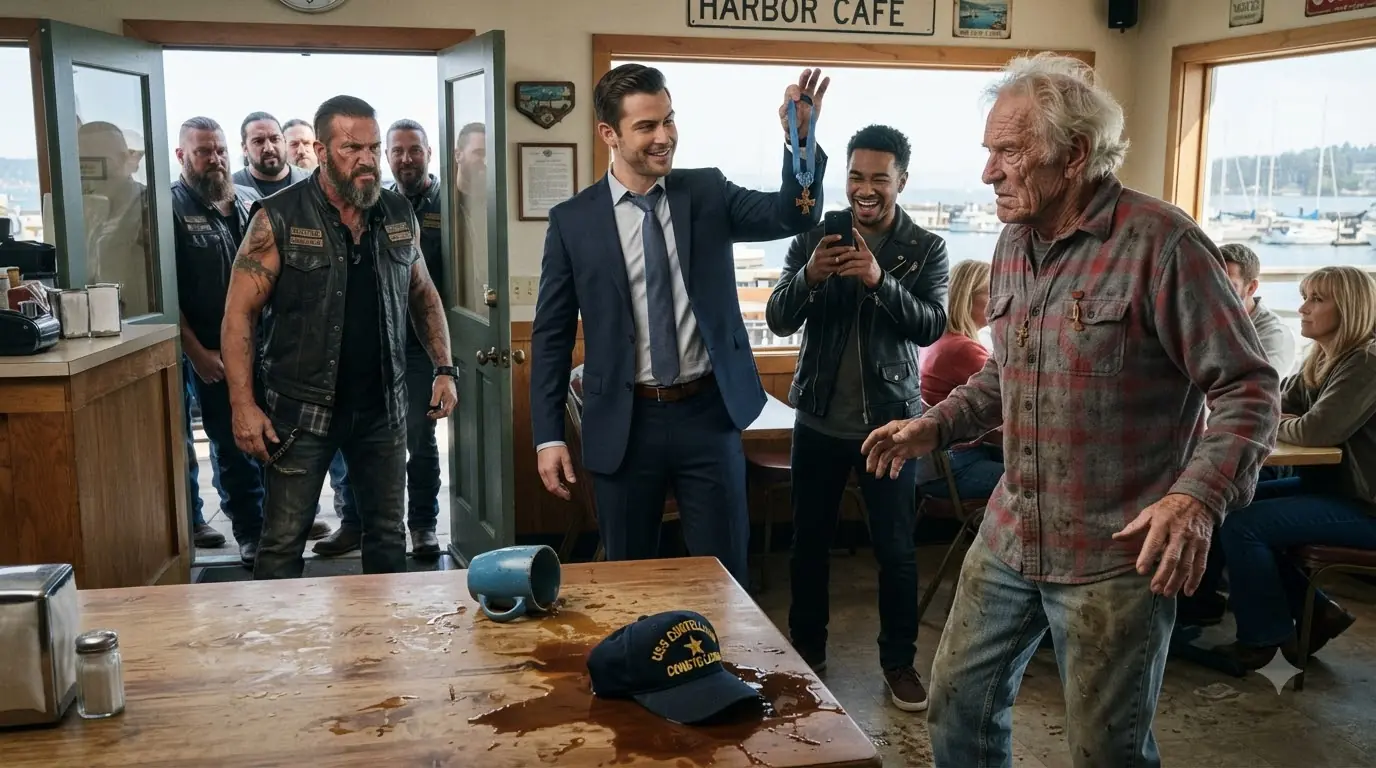
Before Walter could react, Preston reached forward and caught the medal between two fingers.
“A Navy Cross?”
“Let go.”
“Where did you buy it?”
Walter’s voice dropped.
“Give it back.”
“These are sold online, aren’t they?”
Grace came from behind the counter.
“That medal is real.”
Preston did not look at her.
“How would you know?”
“Because I know Walter.”
“That doesn’t prove anything.”
He lifted the medal higher.
“What was it? Fifty dollars at a military surplus store?”
Walter’s hands began shaking.
Not from fear.
From the effort required to contain rage inside a body too old to release it safely.
Daniel stood.
“Give him the medal.”
Evan continued recording.
Preston turned toward the camera.
“Possible stolen valor at the Harbor Light.”
Daniel reached across the table, perhaps trying to lower the phone.
His elbow struck Walter’s coffee.
The blue mug tipped.
Hot liquid rushed across the table and poured onto Walter’s lap.
He gasped.
The heat passed through his jeans immediately.
Walter stood too quickly. Pain shot through his hip and lower back.
His Navy cap fell from his head and landed in the coffee spreading across the floor.
The faded gold letters darkened beneath the liquid.
Daniel froze.
“Oh God. I’m sorry.”
Grace grabbed towels.
Customers rose from their seats.
Preston looked down at Walter’s soaked clothing.
Then he laughed.
“Careful, old man. You’re going to break a hip.”
Something inside Walter became very quiet.
The cap on the floor had belonged first to his father.
Matthew wore it the day before deploying to Iraq.
It had survived fifty-six years, two wars, countless storms, and every Tuesday since Eleanor died.
Now it lay in a puddle while a young man filmed his humiliation.
“I need the restroom,” Walter said.
He limped toward the rear of the café.
Behind him, he heard Preston’s voice.
“Someone call his nurse.”
The restroom door closed.
Walter gripped the sink.
The mirror showed him an old man with coffee-stained clothing and a medal hanging outside his shirt.
For fifty-one years, he had hidden the Navy Cross because he could not reconcile the three men it represented with the twenty-seven it did not.
Now a stranger had handled it like a toy.
Walter touched the medal.
Names moved through his mind.
Mason.
Rodriguez.
Williams.
Chen.
Martinez.
Baker.
Sullivan.
Twenty-seven voices beneath black water.
“Did I wear this for nothing?” Walter whispered.
The man in the mirror offered no answer.
He rinsed his burned leg with cold water and pressed wet paper towels against the fabric.
Then he made a decision.
He would never return to the Harbor Light.
Twelve years of Tuesdays were enough.
He would find another café where no one knew him.
Somewhere he could disappear completely.
Walter straightened and reached for the door.
Then he heard the motorcycles.
At first, the sound was distant.
A low vibration beneath the building.
It grew rapidly until the restroom mirror trembled against the wall.
One engine became several.
Walter counted seven.
They stopped outside.
The café went silent.
Walter opened the restroom door.
Through the front window, he saw seven motorcycles parked beside the curb. Their chrome reflected the morning light.
The riders entered together.
They wore black leather vests bearing the insignia of the Iron Harbor Veterans Motorcycle Association.
At the front walked a tall man with broad shoulders and a gray-black beard. A pale scar ran from his left temple to his jaw.
His name was Mason Brennan.
Walter did not know that yet.
Mason’s eyes swept across the café.
He saw Preston at Walter’s table.
The overturned blue mug.
The coffee dripping onto the floor.
Then he saw the Navy cap lying in the puddle.
Mason stopped.
The other riders spread behind him.
Not threateningly.
Purposefully.
Mason bent and picked up the cap with both hands.
Coffee ran from its brim.
He read the letters.
USS RESOLUTE.
His face changed.
Then he saw Walter standing near the restroom, the Navy Cross visible against his shirt.
Mason’s breath caught.
“Chief Grayson?”
Walter stared at him.
“How do you know my name?”
Mason reached into his vest and removed a folded letter.
The paper had been opened and closed so often that its creases had almost become tears.
“My name is Mason Brennan.”
His voice shook.
“I have been looking for you for twenty-six years.”
He handed Walter the letter.
Walter unfolded it carefully.
The handwriting was uneven.
My son Mason,
If you are reading this, I failed to stay.
There is something you need to know about a man named Chief Walter Grayson.
October 12, 1973, Typhoon Ruth.
I went overboard from the USS Resolute.
I could not swim. I panicked when Chief Grayson reached me and nearly drowned us both. He struck me unconscious because it was the only way to save us.
He tied me to his rescue line and brought me back to the ship.
I lived because of him.
Twenty-seven others did not.
Chief Grayson blamed himself for every one of them, though none of those deaths belonged to him.
I never found him after we returned home. I never thanked him properly.
Everything I gave you—every birthday, every Christmas, every lesson, every bad joke—exists because he jumped into that storm.
Tell him I remembered him.
Tell him I tried to make the life he saved worth something.
Tell him he was the bravest man I ever knew.
Your father,
Caleb Brennan
Hospital Corpsman, USS Resolute
April 14, 1998
Walter’s hands shook.
Caleb Brennan.
The frightened twenty-two-year-old who had wrapped both arms around Walter’s neck in the black water.
Walter struck him once beneath the jaw, dragged him unconscious through the waves, and watched medics revive him on the deck.
He had never learned what happened afterward.
“Your father made it home,” Walter whispered.
Mason’s eyes filled.
“For twenty-five years.”
“What happened?”
“Carbon monoxide in his garage.”
Mason swallowed.
“The official report called it an accident. I knew better.”
Walter lowered his eyes.
“I’m sorry.”
“I was twenty-six when I found him. The same age he was when he became a father.”
Mason looked at the letter.
“He gave me twenty-five years because you saved him.”
Behind Mason stood six riders.
Thomas “Forge” Kelley.
Gavin “Viper” Ross.
Samuel “Kodiak” Price.
Leon Grant.
Peter Walsh.
Anthony Reed.
Each man wore a small memorial patch bearing the name of a veteran lost to war, illness, addiction, or suicide.
“We ride for them,” Mason said. “The people who died overseas and the ones who came home carrying wars no one could see.”
He looked toward Preston.
“And we do not enjoy watching people use veterans as entertainment.”
Preston had gone pale.
Mason turned back to Walter.
Then he stood at attention.
His right hand rose in a salute.
The six riders followed.
Walter’s own hand lifted automatically.
For three seconds, seven men in leather stood motionless inside the café, honoring an old sailor covered in spilled coffee.
Customers began lowering their phones.
Some cried.
Walter returned the salute.
When the riders lowered their hands, Mason spoke gently.
“Chief, would you sit with us?”
“I should go home.”
“Please.”
Mason’s voice cracked.
“Let me buy coffee for the man who gave me a father.”
Walter looked at the table.
Preston still occupied the chair beside it.
Mason’s expression hardened.
“You need to stand.”
Preston looked around.
“You can’t order me around.”
Mason remained calm.
“I’m asking you to leave a table belonging to the man whose medal you took.”
“It doesn’t belong to him. He said so himself.”
Grace stepped forward.
“It belongs to Walter every Tuesday.”
She pointed toward the door.
“And you are no longer welcome in my café.”
Preston stood.
His humiliation had replaced his confidence with anger.
“You can’t ban us because of an accident.”
“The coffee was an accident,” Grace said. “Everything before it was a choice.”
Daniel stepped away from his colleagues.
“She’s right.”
Preston stared at him.
Daniel continued.
“You grabbed him. You mocked him. Evan filmed it. I should have stopped you earlier.”
Evan lowered his telephone.
Mason handed Walter’s cap to Grace.
“Can this be cleaned?”
“I’ll do everything I can.”
He then pulled Walter’s chair away from the table and wiped it dry with a cloth from his pocket.
Walter sat.
The bikers gathered around him.
Grace brought a fresh blue mug.
Walter touched the repaired chip near the handle.
Mason sat across from him.
“Tell me about my father.”
Walter looked into the younger man’s face.
Caleb’s eyes looked back.
“I don’t know if I can.”
“You don’t have to.”
Mason placed one hand on the table.
“But you have been carrying that day alone for fifty-one years. Maybe you shouldn’t carry it alone anymore.”
Walter stared into his coffee.
The café waited.
Then he began.
“October twelfth, 1973. We were returning from exercises west of Guam.”
He described the sky becoming black within minutes.
The wind striking the carrier.
Waves crashing across a deck people believed was too high to reach.
Thirty men swept overboard.
Walter had been part of the ship’s rescue team.
The proper equipment failed almost immediately.
He tied himself to a reinforced line and jumped.
The first sailor he reached was nineteen-year-old Anthony Rodriguez.
A wave had broken the young man’s arm. Walter secured him and signaled the deck crew to pull them in.
The second was Ensign Robert Williams, already unconscious beneath the surface.
Walter found him by reaching blindly into dark water.
Williams survived after several minutes of resuscitation.
The third was Caleb Brennan.
“He couldn’t swim,” Walter said. “When I reached him, he grabbed my neck and pushed me under.”
Mason listened without moving.
“I hit him.”
Walter’s voice became rough.
“I struck your father hard enough to knock him unconscious. I thought I killed him.”
“You saved him.”
“I dragged him to the line. When we reached the deck, he wasn’t breathing.”
Walter closed his eyes.
“He woke up asking me to go back for the others.”
The rescue line snapped during the next wave.
Without a tether, the captain refused to let Walter jump again.
Twenty-seven sailors remained in the water.
Walter could hear them.
He could see Lieutenant James Mason—the officer after whom Caleb later named his son—reaching toward the ship.
Then another wave came.
The men disappeared.
“They awarded me the Navy Cross for three lives,” Walter said. “All I could see were twenty-seven deaths.”
Mason wiped his face.
“My father named me after Lieutenant Mason.”
Walter looked up sharply.
“He remembered?”
“Everything.”
Mason removed his vest.
Beneath it, he wore a shirt bearing Caleb Brennan’s name and dates.
Then he turned.
A large tattoo covered much of his back.
It showed an aircraft carrier inside a storm and a rescue swimmer entering the waves with a line around his waist.
“My father described that image before he died,” Mason said. “I had it finished ten years ago.”
Walter reached toward the tattoo but stopped before touching it.
“I thought everyone forgot.”
“My father never did.”
Forge spoke quietly.
“Neither did our families.”
One by one, the riders described fathers, brothers, and uncles who returned from war but remained trapped inside it.
A Marine who drank himself to death.
An Army medic lost to suicide.
A Vietnam veteran who slept with the lights on until the day he died.
Walter listened.
For the first time in decades, his private nightmares seemed connected to a larger grief.
He was not the only person who woke reaching for the dead.
Movement near the edge of the table caught his attention.
Preston stood a few feet away.
Grace had not yet forced the three men outside because Daniel was helping clean the spilled coffee.
The confidence had left Preston’s face.
He held an old photograph.
“Chief Grayson?”
Mason began to rise.
Walter lifted one hand.
“Let him speak.”
Preston approached slowly.
“This was my grandfather.”
The photograph showed a young Marine in dress blues.
“Gunnery Sergeant Harold Hale. Fifth Marine Division. Iwo Jima.”
Walter studied the image.
“He raised me after my parents divorced,” Preston said. “He told me stories. I stopped listening because I thought they were old stories about another world.”
His voice broke.
“He died six years ago. The last promise I made was that I would respect the people who served.”
Preston looked at Walter’s soaked jeans.
“I broke that promise today.”
No one spoke.
“I cannot excuse what I did. I wanted to impress my colleagues. I wanted someone weaker than me to feel small.”
He looked toward Mason.
“And I became exactly the kind of man my grandfather warned me not to become.”
Walter pointed toward an empty chair.
“Sit down.”
Preston hesitated.
“Sit.”
He obeyed.
“You want to honor your grandfather?” Walter asked.
“Yes.”
“Then listen more than you speak.”
Walter touched the Navy Cross.
“Medals are memory made metal. They do not make us better than anyone. They remind us of people who cannot speak for themselves.”
Preston lowered his eyes.
“What can I do?”
Mason placed a small card on the table.
The Iron Harbor Veterans Association was organizing its annual memorial ride that Saturday.
The proceeds would support a new trauma-counseling program at the regional veterans hospital.
“We need fifty thousand dollars,” Mason said. “We have seventeen pledged.”
Preston removed his telephone.
He entered several commands, then turned the screen toward Mason.
A transfer of one hundred thousand dollars had been submitted to the Crescent Bay Veterans Foundation.
Mason stared.
“You don’t need to buy forgiveness.”
“I know.”
Preston’s eyes moved toward Walter.
“My grandfather left me money. I have used it to buy houses, cars, and the kind of suit I wore while humiliating a man who served longer than I have been alive.”
He placed the phone down.
“This will not erase anything. It is only the first useful decision I made today.”
Walter studied him.
“Do better tomorrow.”
“I will.”
“That is your apology.”
The following hour changed the Harbor Light Café.
Grace brought eggs, bacon, pancakes, and bread no one had ordered.
Customers began approaching Walter’s table.
Some were veterans.
Others had parents or children in uniform.
They did not ask Walter to perform heroism for them.
They listened.
By ten o’clock, Walter was exhausted.
Mason handed him an invitation to Saturday’s ride.
“I can’t ride a motorcycle.”
“Kodiak has a sidecar.”
“My knees barely bend.”
“It was built for his father.”
Walter looked toward the enormous rider standing near the counter.
Kodiak nodded.
“Most comfortable seat in Oregon.”
Walter almost smiled.
“I’ll think about it.”
Mason extended his hand.
“Please come, Chief.”
Walter accepted it.
“I’ll come.”
Saturday arrived beneath a thin layer of coastal fog.
Walter woke at five without the nightmare.
The Navy Cross rested on his nightstand.
This time, he fastened it over his shirt.
He wore a clean button-down Eleanor had purchased for their fiftieth anniversary.
Grace had cleaned and restored his Navy cap. The gold letters appeared brighter than they had in years.
At eight o’clock, Kodiak arrived on a cherry-red motorcycle with a custom sidecar.
Walter climbed in slowly.
A heating vent warmed his legs.
“My father had poor circulation,” Kodiak explained. “I built this for him before cancer took him.”
Walter adjusted the safety strap.
“How many times did he use it?”
“Twice.”
Kodiak looked at him.
“I have been waiting for the right passenger.”
They rode to the Harbor Light.
More than fifty motorcycles filled the parking lot.
Riders stood beside them wearing memorial patches and carrying flags.
Mason stepped forward.
“Chief Walter Grayson, welcome to the twenty-seventh annual Crescent Bay Veterans Memorial Ride.”
The number struck Walter.
Twenty-seven.
Mason saw his reaction.
“One mile for every sailor you lost,” he said quietly. “Then another mile for every veteran still trying to find the way home.”
Walter faced the riders.
Someone asked him to speak.
He recited the names of the twenty-seven men.
Every one.
The riders removed their helmets.
When Walter finished, he touched the Navy Cross.
“I wore this hidden for fifty-one years because I believed the medal represented the men I failed.”
His voice shook.
“Today I understand it also represents the men who lived long enough to have sons, daughters, families, and stories.”
He looked toward Mason.
“I ride for all of them.”
Preston arrived carrying a large ceremonial check.
His company had matched his donation.
The total contribution reached two hundred fifty thousand dollars.
He also brought the photograph of his grandfather.
“Could we stop at his grave?”
Mason nodded.
“We will.”
The motorcycles moved through Crescent Bay in formation.
Walter sat inside Kodiak’s sidecar with the wind striking his face.
For the first time since Eleanor died, he laughed without forcing the sound.
They stopped at Veterans Memorial Park.
A blue banner bearing twenty-seven names was placed beneath the granite wall.
Fifty riders raised their hands in salute.
Three seconds.
Walter laid a wreath beneath the names.
“I’m sorry,” he whispered.
Mason stood beside him.
“They know you tried.”
The next stop was the cemetery.
Preston knelt before his grandfather’s headstone.
“Grandpa, I brought someone you would have respected.”
Walter lowered himself painfully beside him.
“Gunnery Sergeant Hale, your grandson made a mistake.”
He placed one hand against the stone.
“But he returned to correct it. Not everyone does.”
Preston cried openly.
Walter put an arm around his shoulders.
“The dead are often more generous than we expect.”
They rode next to the regional veterans hospital.
Patients and staff lined the entrance.
Young veterans in wheelchairs waited beside men who had served in Korea and Vietnam.
The hospital director announced that the donations would fund a mental-health and suicide-prevention program.
Then a blue cloth was pulled from a brass plaque.
THE BRENNAN-GRAYSON VETERANS RECOVERY CENTER
In memory of Hospital Corpsman Caleb Brennan
In honor of Chief Petty Officer Walter Grayson
For those who served, those who saved them, and those still fighting to return home
Walter read the words twice.
A young Afghanistan veteran named Christopher rolled his wheelchair forward.
Both legs ended below the knee.
“Does the guilt ever go away?” he asked.
Walter knelt until they were eye level.
“No.”
Christopher looked disappointed.
Walter continued.
“But it becomes possible to carry when you stop carrying it alone.”
He handed Christopher a card with the café address.
“I sit there every Tuesday.”
Christopher accepted it.
“I might come.”
“You should.”
That evening, the riders returned Walter to his apartment.
Grace stood outside holding a wooden plaque for the café.
THIS TABLE IS RESERVED FOR
CHIEF PETTY OFFICER WALTER GRAYSON
NAVY CROSS RECIPIENT
NEVER ALONE ON TUESDAYS
Mason carried a black leather vest.
The back displayed the emblem of the Iron Harbor Veterans Association.
Across the shoulders, gold letters read:
THE TWENTY-SEVEN — NEVER FORGOTTEN
The front carried Walter’s name and ship.
“We voted unanimously,” Mason said. “Honorary member.”
Walter looked at the riders.
“I’m seventy-eight. I’m not sure how useful I can be.”
Forge answered.
“You remind us why we ride.”
The riders stood together.
“Welcome home, Chief.”
That night, Walter placed the café plaque near Eleanor’s photograph.
He left the Navy Cross outside its wooden box.
Then he went to bed wearing the leather vest over his shirt.
For the first time in fifty-one years, the dream changed.
Walter stood on the deck of the USS Resolute.
The storm still moved around him.
But the men in the water were no longer reaching for rescue.
They stood above the waves.
Lieutenant Mason smiled.
“You did enough, Chief.”
The twenty-seven raised their hands.
Not asking for help.
Waving farewell.
Then they turned and walked into light.
Walter woke with tears on his face.
His heart was calm.
The weight had not disappeared.
It had shifted.
Tuesday morning, Walter entered the Harbor Light at seven instead of eight fifteen.
The plaque had already been mounted beside his table.
Mason and the six riders waited with coffee.
Christopher, the young Afghanistan veteran, sat near the window in his wheelchair.
Marcus Reed had been brought from the bus stop and given a hot breakfast.
Grace placed Walter’s blue mug before him.
“Morning, Chief.”
“Morning.”
Mason stood and embraced him.
“Sit down, Dad.”
The word stopped Walter.
Mason seemed uncertain.
“I’m sorry. I didn’t mean—”
Walter tightened his arms around him.
“No.”
His voice broke.
“You meant it correctly.”
They sat together.
Morning light entered through the café window and touched the Navy Cross resting against Walter’s chest.
For decades, he believed heroism meant saving everyone.
It had taken fifty-one years for him to understand the truth.
No one saved everyone.
Sometimes courage meant reaching for the people you could.
Sometimes it meant admitting you could no longer carry the dead alone.
And sometimes the final person a hero needed to rescue was the old man still waking every Tuesday morning with his hands stretched toward black water.