“Give me the bag now, or I’ll tase both of you.”
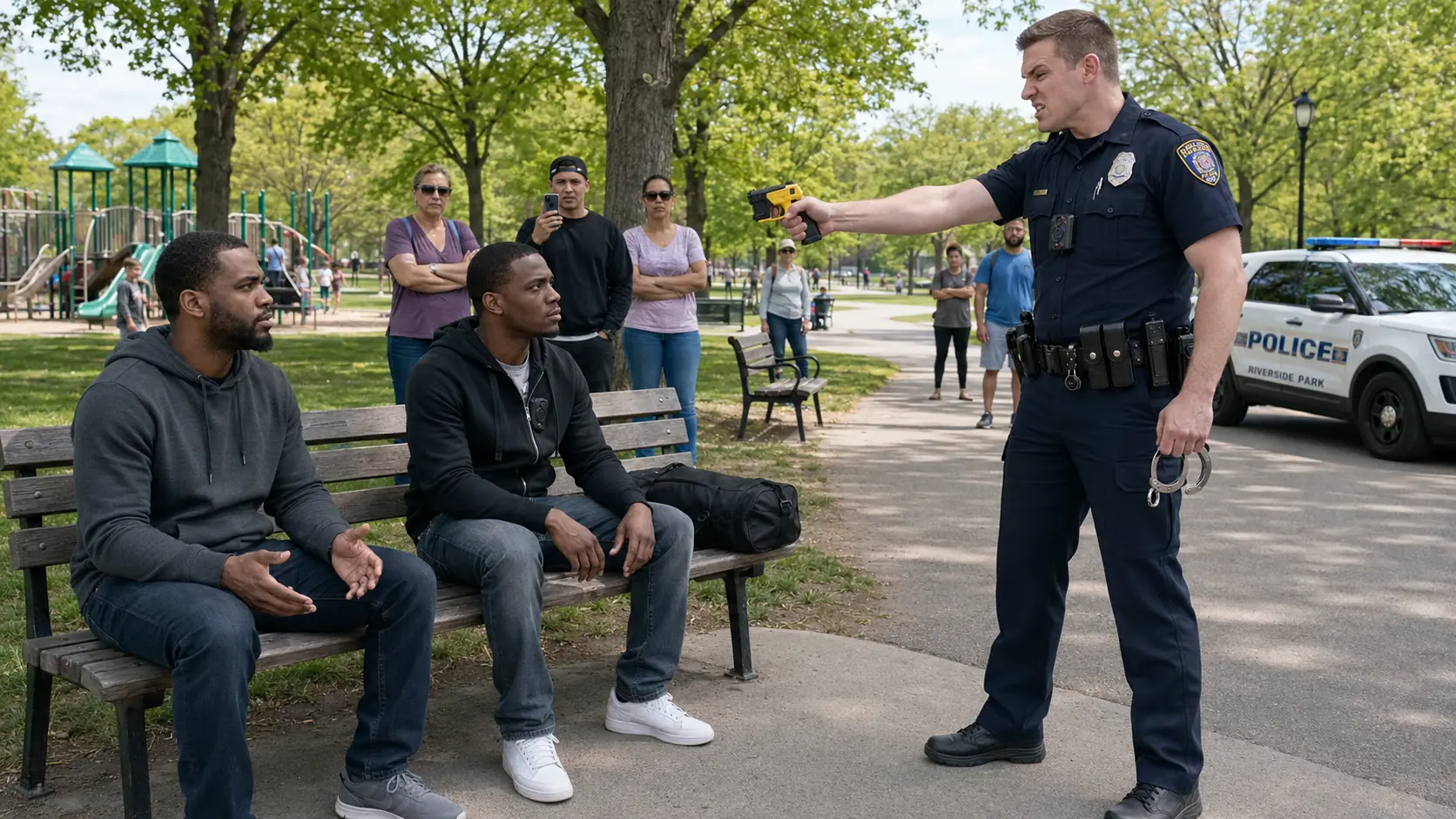
Officer Ryan Caldwell stood beside the wooden bench with his right arm fully extended.
A yellow Taser was aimed directly at Damon Wright’s chest.
In Caldwell’s other hand, a pair of open metal handcuffs swung beneath his clenched fist.
The young officer’s body camera was blinking red.
Recording.
Damon noticed it immediately.
So did the man sitting beside him.
Kelvin Miles glanced at the small device clipped to Caldwell’s uniform, then subtly touched the recording unit concealed beneath his own black hoodie.
Around them, Riverside Park had gone almost completely silent.
Joggers had stopped on the walking path.
Parents stood near the playground, pulling their children closer.
A man in a black baseball cap held up his telephone and began recording.
Only minutes earlier, the park had been filled with ordinary Thursday-afternoon sounds—children laughing, bicycle bells ringing, birds moving through the trees.
Now every face was turned toward the confrontation beside the bench.
Damon remained seated.
At thirty-four, he possessed the athletic build of someone who trained regularly but never advertised it. His charcoal hoodie covered a white shirt, and beneath that shirt hung a gold federal badge.
His hands remained open near his knees.
“We haven’t committed a crime,” he said.
Caldwell’s mouth tightened into a contemptuous smile.
“I didn’t ask for your opinion.”
“You approached us without explaining why.”
“I received a report of suspicious activity involving two men and a black bag.”
Damon looked briefly at the closed duffel resting between him and Kelvin.
“What activity?”
“I’ll ask the questions.”
Kelvin remained still.
He was thirty-two, leaner than Damon and slightly shorter. His face revealed almost nothing, but Damon knew him well enough to recognize the tension in his jaw.
Kelvin’s recording device had been active for the past forty minutes.
Everything Caldwell said was being captured twice.
Once by the officer’s body camera.
Once by the federal equipment hidden beneath Kelvin’s hoodie.
Caldwell snapped the handcuffs open.
“You’re both under arrest. Stand up and put your hands behind your backs.”
“For what offense?” Kelvin asked.
Caldwell moved the Taser closer.
“Interfering with an investigation.”
“You haven’t begun an investigation,” Damon said.
The officer’s finger shifted alongside the trigger.
“I’m giving you one final warning.”
Kelvin looked directly at Caldwell’s camera.
“Make sure your body camera catches this part.”
Caldwell’s sneer deepened.
“You think that camera is going to help you?”
Damon slowly rose from the bench.
Several bystanders gasped.
The Taser immediately followed his chest.
“Don’t move!” Caldwell shouted.
Damon stopped with both palms clearly visible.
He looked into the young officer’s eyes.
There was fear there.
But the fear was buried beneath something more dangerous—the certainty that the uniform guaranteed obedience.
Damon spoke calmly.
“Officer, lower the Taser.”
“You don’t give me orders.”
“I’m attempting to prevent you from making a mistake you cannot reverse.”
Caldwell took one aggressive step forward.
“I said put your hands behind your back.”
Damon and Kelvin exchanged a controlled glance.
The undercover operation was about to be compromised.
They had spent six months building it.
Dozens of interviews.
Financial records.
Surveillance warrants.
A confidential witness who had risked his life to expose what was happening inside the Riverside Police Department.
Everything had led to the black duffel sitting on that bench.
But none of it was worth allowing a frightened officer to pull a trigger.
Damon reached slowly toward the collar of his shirt.
Caldwell’s arm stiffened.
“Hands where I can see them!”
“They are where you can see them.”
Damon pulled a thin chain from beneath his shirt.
A gold badge dropped against his chest.
At the same moment, Kelvin opened his hoodie and revealed a second badge beside the recording device.
Caldwell’s smile vanished.
His eyes moved from Damon’s badge to Kelvin’s.
Then back again.
For several seconds, he appeared unable to breathe.
Damon took one measured step closer.
“Read the badge before you pull that trigger.”
Caldwell’s hand began trembling.
The letters were visible from where he stood.
FEDERAL BUREAU OF INVESTIGATION.
Kelvin’s badge carried the same seal.
Caldwell swallowed.
Anyone else might have interpreted the moment as the end of the confrontation.
It was not.
“Those could be fake,” he said.
Damon’s expression changed slightly.
Not anger.
Disappointment.
“Lower the weapon.”
“I need identification.”
“You’ll receive it after you lower the Taser.”
“This is my scene.”
“No,” Kelvin said. “It stopped being your scene the moment you aimed a weapon at two federal agents without establishing a crime.”
Caldwell looked toward the crowd.
Too many people were watching.
A father near the playground had moved closer while continuing to record. A woman stood with one hand over her mouth.
Caldwell understood that retreat would look like humiliation.
And to a man like Ryan Caldwell, humiliation felt more dangerous than a bad decision.
His finger moved again.
Damon’s voice became harder.
“Do not touch that trigger.”
A police siren sounded from the park entrance.
Caldwell glanced toward the approaching patrol car.
That single movement gave Kelvin the opportunity to rise.
He did so slowly, keeping both hands visible.
The second patrol vehicle stopped near the walking path.
Sergeant Rebecca Hayes stepped out with another officer.
She had served Riverside for eighteen years and knew immediately that something was wrong.
Two men stood beside the bench with federal badges displayed.
Caldwell still had a Taser aimed at them.
A crowd was recording.
Hayes approached carefully.
“Ryan, lower it.”
Caldwell looked over his shoulder.
“Sergeant, they were involved in a suspicious exchange.”
“Lower the Taser.”
“They only showed the badges after refusing orders.”
“Ryan.”
Hayes’s voice left no room for argument.
“Lower it now.”
Caldwell finally pointed the weapon toward the ground.
Damon did not relax.
“Remove the cartridge,” he said.
Caldwell stared at him.
Sergeant Hayes stepped between them.
“Do it.”
The officer removed the cartridge with unsteady hands.
Kelvin retrieved his credentials and opened the leather identification case.
“Special Agent Kelvin Miles.”
Damon presented his own.
“Supervisory Special Agent Damon Wright.”
Sergeant Hayes examined both carefully.
The color drained from her face when she saw the investigative division listed beneath Damon’s name.
Public Corruption and Civil Rights.
“What are two FBI agents doing in Riverside Park?” she asked.
Damon looked toward the black duffel.
“Conducting a federal operation that Officer Caldwell may have just compromised.”
Caldwell began speaking immediately.
“I responded to a dispatch call. Two suspicious men with a bag. They refused to cooperate.”
Kelvin turned toward him.
“What description did dispatch provide?”
Caldwell hesitated.
“Two males.”
“What clothing?”
“I don’t remember.”
“Age?”
“No.”
“Reported behavior?”
“They were sitting near the playground with a duffel bag.”
Damon looked around the park.
More than a dozen people carried backpacks, gym bags, diaper bags, or picnic baskets.
“What made our bag suspicious?” he asked.
Caldwell’s mouth opened.
No answer came.
Sergeant Hayes activated her radio.
“Dispatch, provide the original call information for Officer Caldwell’s Riverside response.”
Static followed.
Then the dispatcher answered.
“No civilian call is logged for that location, Sergeant.”
Hayes turned toward Caldwell.
His face had gone pale.
“What do you mean, no call?” he said.
“Officer Caldwell requested self-initiated backup seven minutes ago. No associated emergency call appears in the system.”
Every bystander near the bench heard it.
Caldwell looked down at his radio as though the device had betrayed him.
“That’s wrong. Lieutenant Mercer contacted me directly.”
Sergeant Hayes became very still.
“Lieutenant Mercer told you to come here?”
“He said two men were making a narcotics exchange near the playground.”
“Over the department radio?”
“My phone.”
Damon and Kelvin looked at each other.
The operation had not been destroyed.
It had just moved in an unexpected direction.
Damon turned toward Sergeant Hayes.
“Secure Officer Caldwell’s telephone and body camera.”
Caldwell stepped back.
“You can’t take my phone.”
“You just identified it as evidence in a federal corruption investigation.”
“I’m not part of any investigation.”
“You are now.”
Six months earlier, Damon Wright received a sealed envelope at the FBI’s Detroit field office.
There was no return address.
Inside were photocopies of police evidence logs, property-room receipts, and bank deposits connected to Lieutenant Grant Mercer of the Riverside Police Department.
The numbers did not match.
Cash seized during narcotics arrests was disappearing before reaching the evidence room.
In some cases, the official reports listed far less money than officers recorded during traffic stops.
In others, entire seizures vanished.
The anonymous sender included one sentence.
Look at who gets stopped, who loses cash, and which officers never activate their cameras until afterward.
Damon’s team examined three years of records.
A pattern emerged.
Mercer and several officers targeted people unlikely to challenge the department—undocumented workers, low-income drivers, people with previous arrests, and young men traveling through neighborhoods where police presence was heavy.
Cash was taken under the claim that it might be connected to drug activity.
Sometimes charges were never filed.
Recovering the money required attorneys many victims could not afford.
A local towing contractor helped conceal vehicles temporarily while Mercer searched them without proper documentation.
A businessman named Charles Vance laundered stolen money through two cash-heavy car washes.
The operation remained hidden because individual victims believed their experiences were isolated.
Then a Riverside evidence clerk named Aaron Bell discovered that Mercer had altered records using another employee’s login.
Aaron began copying documents.
He contacted federal authorities through an attorney and became a confidential witness.
The black duffel in Riverside Park contained $100,000 in marked federal funds.
Aaron was supposed to deliver it to Charles Vance’s courier that afternoon.
The money represented the proceeds of a fabricated seizure.
The plan was simple.
Vance’s courier would accept the cash.
Mercer would later collect his share.
The entire exchange would be recorded.
Damon and Kelvin were sitting on the bench as backup while undercover personnel watched from vehicles around the park.
Then Caldwell arrived ten minutes before the courier.
At first, Damon assumed the young officer had stumbled into the operation by accident.
Now he knew otherwise.
Lieutenant Mercer had sent him.
The question was why.
Sergeant Hayes instructed the other patrol officer to place Caldwell’s telephone inside an evidence bag.
Caldwell resisted.
“I need to call my union representative.”
“You may make that request after the device is secured,” Hayes said.
“This is ridiculous. Mercer gave me a lawful order.”
“What exactly did he tell you to do?”
Caldwell looked toward Damon.
“I’m not answering without an attorney.”
“That is your right,” Damon said.
He turned toward Hayes.
“Where is Lieutenant Mercer now?”
Hayes contacted the station.
No one could locate him.
His department vehicle was missing from the secured garage.
His work telephone had been switched off.
Damon called his surveillance team.
“Move on Mercer. He knows.”
Within minutes, unmarked federal vehicles left positions surrounding the park.
The sting involving the duffel bag had failed.
But the corruption investigation was accelerating.
Kelvin secured the bag while Damon spoke privately with Sergeant Hayes.
“Who knew Caldwell was coming here?”
“According to dispatch, no one.”
“Would Mercer normally give assignments directly by personal phone?”
“No.”
“Then he wanted no radio record.”
Hayes looked toward Caldwell.
“He sent a twenty-six-year-old officer to interfere with a federal operation.”
“He may have expected Caldwell to seize the bag and bring it to him.”
“Ryan wouldn’t knowingly steal evidence.”
Damon watched the young officer speaking urgently to the other patrolman.
“Maybe not knowingly.”
Caldwell had joined the department only fourteen months earlier.
His record included several complaints about unnecessary escalation, rude language, and stops lacking clear justification.
None resulted in discipline.
Mercer had personally defended him each time.
He described Caldwell as proactive.
Aggressive in the right ways.
A future leader.
Damon had seen the pattern before.
Corrupt senior officers rarely began by asking young subordinates to commit obvious crimes.
They began with smaller tests.
Ignore a questionable search.
Leave a sentence out of a report.
Trust the lieutenant instead of checking the law.
The young officer received praise.
Protection.
A sense of belonging.
By the time the senior officer asked for something serious, loyalty had already replaced judgment.
That did not excuse Caldwell’s actions in the park.
Mercer had not forced him to sneer.
He had not forced him to threaten two seated men.
He had not forced him to invent an arrest when they asked why they were being detained.
Those choices belonged to Caldwell.
But Mercer had recognized exactly which officer would follow an unofficial order without asking enough questions.
Damon approached him.
“You said Lieutenant Mercer called you.”
Caldwell looked toward Sergeant Hayes.
“I requested an attorney.”
“I’m not asking you to waive that. I’m telling you something you should understand before your representative arrives.”
Damon pointed toward the body camera.
“Everything you did is recorded.”
Caldwell’s face tightened.
“You approached us without reasonable suspicion. You refused to identify an offense. You threatened arrest for asking questions. You pointed a Taser at my chest after I kept my hands visible.”
“I believed you were armed.”
“You never asked.”
“The bag could have contained narcotics.”
“You never asked for consent to search it. You demanded it as though it already belonged to you.”
“I was following an order.”
“That sentence has ended many careers.”
Caldwell looked toward the ground.
Damon continued.
“Mercer placed you here for a reason. If he wanted a professional investigation, he would have used dispatch. He would have sent you a description and requested proper documentation.”
“What are you saying?”
“He sent you to retrieve that bag.”
Caldwell stared at the duffel.
“I didn’t know what was inside.”
“I believe you.”
Relief appeared briefly on the officer’s face.
Damon removed it with his next sentence.
“But ignorance about the bag does not erase what you chose to do to the men sitting beside it.”
Caldwell was placed on administrative leave before leaving the park.
His weapon, badge, telephone, and body camera were secured.
The bystander videos spread online within hours.
One recording began with Caldwell already pointing the Taser.
Another captured Kelvin’s warning about the body camera.
The clearest video showed the moment the badges fell against the agents’ chests and Caldwell continued aiming the weapon.
Public reaction was immediate.
Some people defended him.
They claimed police work required quick decisions.
Others said Damon and Kelvin should have identified themselves sooner.
But the full body-camera recording changed the conversation.
Caldwell had approached without introducing himself.
He never asked their names.
Never requested identification.
Never explained the source of his suspicion.
Within forty seconds, he was threatening to tase them.
His report, drafted before he was placed on leave, claimed Damon made “a sudden movement toward his waistband.”
The video showed Damon moving slowly toward his shirt collar only after stating what he intended to do.
That false sentence created a second problem for Caldwell.
The first was his conduct.
The second was his attempt to rewrite it.
Lieutenant Mercer was arrested the following morning at a hunting cabin seventy miles from Riverside.
Federal agents found $240,000 in cash, three unregistered firearms, and a partially burned notebook inside a metal stove.
Mercer had not managed to destroy everything.
The remaining pages contained dates, vehicle descriptions, seizure amounts, and initials.
Caldwell’s initials appeared twice.
Both entries were recent.
One referred to a traffic stop in which Caldwell seized $4,800 from a man traveling to purchase used construction equipment.
The driver was never charged.
Only $1,900 reached the evidence room.
Caldwell insisted he gave Mercer the entire amount.
Damon believed him.
Mercer had taken advantage of the officer’s trust.
Again, that did not erase Caldwell’s responsibility.
But it helped establish the system Mercer built.
Under advice from his attorney, Caldwell agreed to a formal interview.
He admitted that Mercer had called him the morning of the park operation.
The lieutenant described two men with a black duffel and said they were suspected drug couriers.
He ordered Caldwell to obtain the bag without using the department radio.
“What were you supposed to do after taking it?” Damon asked.
“Call him.”
“File an arrest report?”
“He said he would handle it.”
“Book the bag into evidence?”
Caldwell stared at the table.
“He didn’t say.”
“Did that concern you?”
“It does now.”
“What concerned you then?”
Caldwell remained silent for a long time.
“That I might look weak.”
“To whom?”
“Mercer.”
The answer was quieter than the others.
“He said I hesitated too much. That people didn’t respect officers who explained themselves. He said the street needed to feel authority before it would obey it.”
Damon leaned back.
“So you entered the park intending to demonstrate authority.”
“I believed they were suspects.”
“You knew nothing about them except their location, the bag, and whatever image formed in your mind.”
Caldwell looked down.
“Yes.”
He eventually agreed to testify.
His cooperation helped establish how Mercer recruited inexperienced officers, bypassed dispatch, altered reports, and collected seized money before it entered the evidence system.
Charles Vance and two other officers were arrested.
Aaron Bell, the evidence clerk who first exposed the scheme, entered witness protection until the trials concluded.
The federal case lasted nearly a year.
Mercer was convicted of conspiracy, theft, obstruction, civil-rights violations, and evidence tampering.
Vance pleaded guilty to money laundering.
Two officers received prison sentences.
A third cooperated and permanently surrendered his law-enforcement certification.
Caldwell faced separate consequences.
His attorney argued that he had been manipulated by a superior and had never personally received stolen money.
Prosecutors agreed that his role in the larger conspiracy was limited.
But the park encounter could not be dismissed as a misunderstanding.
Caldwell pleaded guilty to falsifying his report and unlawfully depriving Damon and Kelvin of their civil rights under color of law.
His sentence included probation, community service, and permanent loss of his police certification.
Some people called the outcome too severe.
Others called it too lenient.
Damon refused to comment publicly.
He understood why people wanted a simple ending.
A good officer.
A bad officer.
A victim.
A villain.
Real institutions rarely failed so cleanly.
Mercer was corrupt.
Caldwell was not Mercer.
But Caldwell had carried Mercer’s philosophy into the park.
Authority before explanation.
Control before evidence.
Humiliation before questions.
The system had rewarded him for behaving that way until the men on the bench happened to carry federal badges.
That fact troubled Damon more than the Taser.
If he and Kelvin had been ordinary civilians, the ending might have been different.
The bag could have been searched.
Their objections described as aggression.
Their movements rewritten in a report.
The body-camera footage might have remained unseen unless an attorney fought to obtain it.
Their badges protected them.
Most people stopped under similar circumstances had no such shield.
Six months after the trial, Riverside Park looked exactly as it had before.
Children played near the slides.
Joggers followed the same paths.
Parents sat beneath the same trees.
The wooden bench remained beside the trail.
Damon returned one Thursday afternoon.
Kelvin met him there carrying two coffees.
“No duffel bag?” Damon asked.
“I thought that might attract attention.”
They sat.
For several minutes, neither spoke.
The confrontation had been replayed millions of times online.
The moment their badges appeared became the focus of nearly every report.
People loved the sudden reversal.
The arrogant officer realizing he had threatened the wrong men.
Kelvin disliked that interpretation.
“He didn’t threaten the wrong men,” he said.
Damon looked at him.
“He threatened two men without cause. Who we were shouldn’t determine whether it was wrong.”
Damon nodded.
“That doesn’t fit into a headline.”
“Most truth doesn’t.”
A father walked past holding his daughter’s hand.
He recognized them and slowed.
“You’re the agents from the video.”
Damon gave a small nod.
The man hesitated.
“My son wants to become a police officer.”
Neither agent responded immediately.
“I almost told him not to,” the father continued. “After watching what happened.”
“What did you tell him instead?” Kelvin asked.
“That if he wears the badge, he has to remember the person in front of him is still a person.”
Damon looked toward the playground.
“That’s a better lesson.”
The father thanked them and continued walking.
Kelvin drank his coffee.
“Do you think Caldwell learned anything?”
“I think he lost enough to understand the cost.”
“That wasn’t my question.”
Damon considered it.
“I don’t know.”
The honest answer settled between them.
People could change.
But consequences did not guarantee wisdom.
Sometimes a person learned humility.
Sometimes he learned only resentment.
That choice still belonged to Ryan Caldwell.
Before leaving, Damon stood beside the exact place where the young officer had aimed the Taser.
He remembered the trembling hand.
The open cuffs.
The contemptuous smile disappearing when the badges appeared.
For years, Damon had carried his credentials as proof of authority.
After Riverside Park, the badge meant something different.
It reminded him how quickly respect appeared once power became visible.
Caldwell did not become polite because he suddenly recognized Damon’s humanity.
He became afraid because he recognized federal authority.
That distinction mattered.
Damon touched the chain beneath his shirt but did not pull it out.
The badge remained hidden.
Around him, the park continued as normal.
People passed without knowing who he was.
That was how most citizens moved through the world.
Without titles displayed.
Without institutions standing behind them.
Without a gold seal capable of transforming contempt into fear.
The true test of authority was not how an officer treated a federal agent after seeing a badge.
It was how he treated an unknown person before seeing one.
Ryan Caldwell failed that test on a clear Thursday afternoon.
Unfortunately for him, three cameras were recording.
And the two men he attempted to silence had spent their careers ensuring that evidence, once preserved, could speak far louder than a uniform.