 The first violation letter arrived on a Tuesday afternoon.
Ethan Cole found it folded neatly inside his mailbox between an electric bill and a grocery-store flyer. The envelope carried the dark-green seal of the Willow Creek Homeowners Association, along with the words OFFICIAL COMPLIANCE NOTICE printed in bold across the front.
He opened it while walking back toward the house.
By the time he reached the driveway, he had read it three times.
The letter accused him of violating the neighborhood’s restrictions against agricultural activity and livestock. It ordered him to remove all chickens, goats, fencing, feed containers, and cultivated crops within thirty days.
A fine of $250 had already been added to his HOA account.
Ethan looked over the roof of his house toward the back of the subdivision.
Beyond the last row of homes stood a wooden boundary fence.
On the other side of that fence ran a narrow county road.
Across that road sat fifteen acres of agricultural land.
His agricultural land.
The chickens mentioned in the notice were nearly a quarter mile away from the nearest HOA-controlled property.
Ethan carried the letter into the kitchen.
His wife, Rachel, was slicing tomatoes at the counter.
“You need to read this.”
She wiped her hands and took the page.
Halfway through, she looked up.
“They’re fining you for the chickens?”
“And the goats.”
“The chickens and goats that aren’t in the neighborhood?”
“Those would be the ones.”
Rachel read the final paragraph again.
“This has to be a mistake.”
“That was my first thought.”
“What was your second?”
“That someone worked very hard to make the mistake sound official.”
They had purchased the house six years earlier.
Willow Creek was an attractive suburban development outside Franklin, Tennessee, with tree-lined streets, a community pool, and enough decorative stonework near the entrance to make every homeowner feel slightly wealthier than they actually were.
The house itself sat within the HOA.
The fifteen-acre parcel did not.
Both had been included in a complicated estate sale. The previous owner had purchased the house in the early 1990s and later acquired the field across the county road from an elderly farmer.
When the owner died, his children sold everything together.
Ethan had almost rejected the deal.
He was an electrical engineer who worked for a manufacturing company in Nashville. Rachel taught third grade. Neither had been searching for agricultural property.
The real-estate agent described the parcel as “bonus acreage.”
For the first several years, that description felt accurate.
Ethan paid the taxes, mowed the field twice each summer, and did little else.
The land had its own parcel number.
Its own deed.
Its own agricultural zoning designation.
It had never been incorporated into Willow Creek.
The county road between the subdivision and the field made the separation impossible to misunderstand.
Then Ethan became interested in gardening.
It started with three raised beds behind the house.
He grew tomatoes, peppers, beans, cucumbers, and enough zucchini to overwhelm every neighbor who made the mistake of accepting the first basket.
The work helped him recover from the long hours and constant noise of his job.
After two seasons, he looked across the road at the unused field and wondered why he was squeezing vegetables into a suburban backyard while fifteen acres sat empty.
He began carefully.
A half-acre vegetable plot.
Eight laying hens.
Two small goats to control brush around the fence line.
A compact shed for tools and feed.
Everything was placed well inside the agricultural parcel.
He registered the operation with the county, installed proper fencing, and followed the setback requirements.
The chickens were quieter than most neighborhood dogs.
The goats complained only when breakfast was late.
Rachel began selling eggs and vegetables at the Saturday farmers market.
The farm did not make much money, but it gave Ethan something his office never could.
Work that ended with a visible result.
A repaired fence stood straight.
A harvested tomato filled a basket.
A goat cleared a section of weeds that had resisted machinery for years.
Most evenings, Ethan crossed the county road after work, fed the animals, collected eggs, and watched the light settle over the field.
Then the HOA letter arrived.
He called the management office that afternoon.
A woman named Melissa answered.
“I received a livestock violation notice.”
“Property address?”
Ethan gave it.
Keyboard keys clicked.
“Yes, Mr. Cole. The board received multiple complaints regarding agricultural activity associated with your property.”
“The activity is not on my HOA property.”
“The animals are connected to your residence.”
“They are on a separate agricultural parcel across a public road.”
“The board’s position is that livestock connected to a Willow Creek homeowner is prohibited.”
“That is not what the declaration says.”
“Our community standards are intended to protect all residents.”
“I understand what they are intended to do. I’m telling you the HOA has no authority over that land.”
Melissa’s voice became colder.
“The violation will remain active until the board confirms compliance.”
“I can send you the deed and parcel map.”
“You are welcome to submit supporting documents with your appeal.”
“This is not an appeal. It is a correction.”
“The process is the same.”
Then she ended the call.
Ethan stood in the kitchen holding the silent telephone.
Rachel watched him.
“How did that go?”
“They invited me to prove that my property belongs to me.”
He spent the evening gathering documents.
The deed.
The county zoning map.
A parcel boundary survey.
Tax records.
An aerial photograph showing the public road between Willow Creek and the field.
He wrote a calm, professional letter explaining that the agricultural parcel was legally independent and outside the association’s jurisdiction.
He sent it by certified mail and email.
For two weeks, nothing happened.
Then a second notice arrived.
The fine had increased to $500.
The new letter claimed that property adjacent to or visible from Willow Creek remained subject to association review if its use affected community aesthetics, quiet enjoyment, or property values.
Ethan searched the declaration.
No such authority existed.
The HOA could regulate lots legally bound by its recorded covenants.
It could not regulate every property visible from a bedroom window.
Rachel placed the letter beside the first.
“They’re inventing rules.”
“Not quite.”
“What would you call it?”
“They’re inventing authority.”
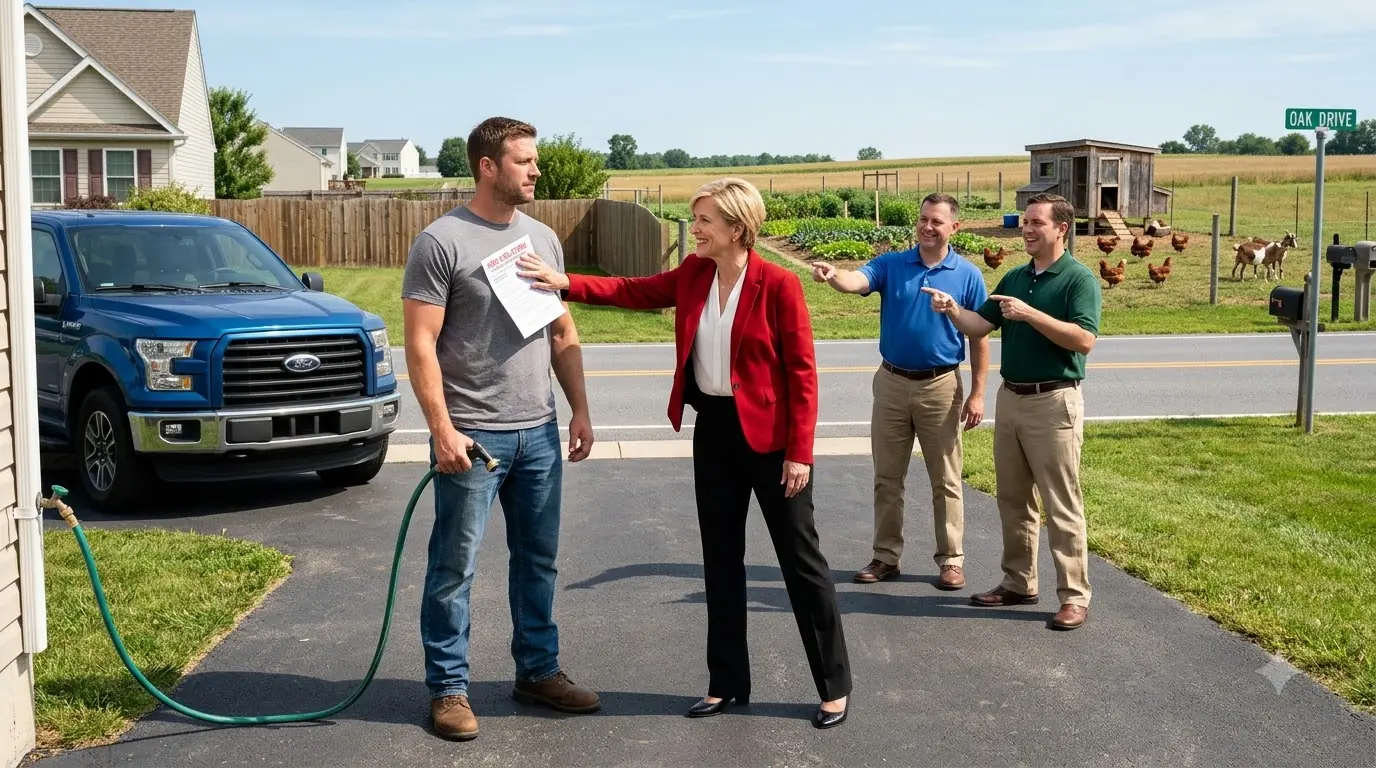
The following Saturday, three HOA board members arrived at the house.
Ethan was washing his truck when a white sport-utility vehicle stopped at the curb.
A woman in her mid-fifties stepped out first.
She wore a cream-colored jacket despite the warm weather and carried a leather folder against her chest.
Two men followed.
One looked uncomfortable.
The other looked bored.
The woman crossed the driveway without introducing herself.
“We need to discuss your farm project.”
Ethan shut off the hose.
“And you are?”
“Patricia Vaughn. President of the Willow Creek board.”
He had seen her photograph in the neighborhood newsletter.
Patricia had been elected eighteen months earlier after campaigning on stricter enforcement and higher property standards.
Her monthly president’s messages used phrases such as protecting our investment and preserving the Willow Creek lifestyle.
“I received your letters,” Ethan said.
“Then you understand the issue.”
“I understand that you’re attempting to fine me for activity on property outside the association.”
Patricia gave a small laugh.
“Do you think the board is unaware of where the field is?”
“I was beginning to wonder.”
Her smile disappeared.
“The land sits directly beside our community. Residents can see it from their homes.”
“Visibility does not create jurisdiction.”
“The animals produce odor and noise.”
“Eight hens and two goats produce less noise than the lawn crews you approve every Saturday morning.”
One of the board members looked away to hide a smile.
Patricia continued.
“Willow Creek has standards.”
“Then apply them inside Willow Creek.”
“It affects our property values.”
“The field was overgrown before I started using it.”
“That is not the point.”
“What is the point?”
Patricia stepped closer.
“You will remove the livestock and discontinue the agricultural operation. If you refuse, the board will continue assessing fines and may place a lien against your residence.”
Ethan stared at her.
“You are threatening my home over chickens located on land you do not control.”
“I am explaining the consequences of noncompliance.”
“Then allow me to explain something.”
He pointed toward the back of the neighborhood.
“That field has a separate deed, a separate tax record, and agricultural zoning that predates this subdivision. Your authority ends at the boundary fence.”
Patricia closed her folder.
“We will see what our attorney says.”
“Please ask him before sending the next letter.”
Her eyes narrowed.
“You should not test the board, Mr. Cole.”
“You came onto my driveway to threaten me with a false lien. I think the testing has already started.”
After they left, Rachel came outside.
“They’re not going to stop.”
“No.”
“What are you going to do?”
Ethan looked across the road.
“I’m not getting rid of the chickens.”
The aggression bothered him more than the fine.
The situation did not feel like an ordinary misunderstanding. The board had received conclusive property records and continued anyway.
Ethan began asking questions.
He spoke with long-term residents.
Searched county property filings.
Reviewed old HOA meeting minutes that were available to homeowners.
A retired board member named Howard Lane eventually gave him the answer.
Eight years earlier, Willow Creek had tried to purchase the fifteen-acre parcel.
The board wanted to build a private park, walking paths, and a second community entrance. They offered the previous owner less than half the appraised value.
He refused.
The negotiations became bitter.
Several board members argued that the field reduced the neighborhood’s appeal and should eventually be controlled by the association.
Patricia had served on the landscape committee at the time.
According to Howard, she never accepted that the deal failed.
“She talked like the parcel had been stolen from us,” he said.
“It was never yours.”
“I know that.”
“Did the residents know the board tried to buy it?”
“Most didn’t. The proposal never reached a formal vote because the owner rejected the offer.”
Ethan returned home with a clearer understanding.
The dispute had never really been about chickens.
The HOA wanted the land.
If it could make agricultural use expensive or unpleasant enough, perhaps Ethan would sell.
Instead of responding immediately, he scheduled a meeting with an attorney.
Laura Bennett specialized in property law and agricultural disputes.
She reviewed the deeds, maps, notices, and HOA declaration.
“The board has no authority over the farm parcel,” she said.
“Can they place a lien on my house?”
“They can attempt to record one for unpaid assessments on the HOA property, but these fines are based on conduct outside their jurisdiction. We would challenge it immediately.”
“Can I stop the letters?”
“I’ll send a formal demand.”
“What about the field?”
“What do you want to do with it?”
Ethan leaned back.
“That depends.”
“On what?”
“On what I’m legally allowed to do.”
Laura studied him.
“That sentence makes me nervous.”
“I want to understand the agricultural zoning.”
The county confirmed what Ethan already suspected.
The parcel was protected for legitimate agricultural use.
Livestock operations were permitted, subject to environmental, waste-management, setback, and animal-welfare rules.
Tennessee’s Right-to-Farm protections could limit certain nuisance claims when an established operation followed accepted practices and complied with the law.
The protection was not absolute.
A farmer could not deliberately create a hazard, ignore waste regulations, or operate negligently.
But neighbors could not simply eliminate lawful agriculture because they disliked seeing or smelling it.
Ethan spent several days researching potential uses.
He considered expanding the vegetable operation.
Planting an orchard.
Raising cattle.
Then his uncle Raymond visited.
Raymond had operated a hog farm in western Kentucky for almost thirty years before retiring.
He walked the fifteen acres with Ethan and examined the slope, drainage, access road, and distance from nearby homes.
“You could run hogs here,” Raymond said.
“How many?”
“Depends on the system.”
“I’m not interested in a filthy confinement operation.”
“Good. Neither am I.”
Raymond explained rotational outdoor production.
Smaller groups of pigs moved between paddocks.
Shelters shifted with them.
Vegetative buffers reduced runoff and odor.
Manure was distributed across land instead of concentrated in one lagoon.
The animals could be raised humanely, the soil improved, and locally produced pork sold directly to customers.
“It is more work than people think,” Raymond warned.
“I have a full-time job.”
“I know someone looking for land.”
His name was Samuel Reed.
Samuel had twenty years of experience raising hogs and wanted to expand his pasture-based operation closer to Nashville’s restaurant market.
He had animals, equipment, buyers, and expertise.
Ethan had underused agricultural land.
They spent three weeks developing a business plan.
Samuel would handle daily operations.
Ethan would lease the acreage and receive a share of profits.
They would begin with forty feeder pigs, not one hundred twenty.
The number could increase only after the system proved manageable.
They filed the necessary county documents.
Created a nutrient-management plan.
Installed water lines and movable shelters.
Established wide vegetative buffers along the county road and nearest property boundary.
Constructed secure fencing.
Set designated composting and manure-handling areas far from the subdivision.
An agricultural extension specialist reviewed the plan.
So did Laura Bennett.
The farm was lawful.
Professional.
And much larger than eight chickens.
Rachel read the final agreement at the kitchen table.
“You’re actually doing this.”
“The numbers work.”
“You researched hogs because Patricia threatened us.”
“I researched farming because we own farmland.”
Rachel stared at him.
“The fact that it will irritate the HOA has nothing to do with it?”
Ethan considered lying.
“Not nothing.”
She laughed.
“At least you’re honest.”
Construction crews arrived in early spring.
From the back windows of Willow Creek, residents saw fencing, water tanks, mobile shelters, and feed bins appearing across the road.
Patricia sent another notice before the first pig arrived.
The fine had reached $1,000.
The letter demanded immediate removal of all agricultural infrastructure.
Laura responded on Ethan’s behalf.
Her letter identified the separate parcel, documented the agricultural zoning, cited the association’s lack of jurisdiction, and warned that further attempts to collect invalid fines or record a lien could expose the board to legal liability.
She also included copies of the county permits.
The HOA went silent for nine days.
Then the pigs arrived.
Samuel transported them early in the morning.
They were young, healthy, and curious. Within minutes, several were investigating the fence while others rooted through the pasture.
The chickens barely noticed.
The goats objected loudly for two days and then accepted the new arrangement.
At first, there was little odor.
The paddocks were clean, the animals moved regularly, and the waste was not concentrated.
But agriculture still smelled like agriculture.
On warm afternoons, especially when the wind moved from west to east, residents closest to the boundary occasionally detected the unmistakable presence of livestock.
It was not the suffocating cloud Patricia later described.
It was enough to remind anyone opening a back door that fifteen acres of working farmland existed across the county road.
Two weeks later, Patricia returned.
She came alone.
Ethan was repairing a gate when her vehicle stopped beside the field entrance.
She did not wait to be invited onto the gravel apron.
“What do you think you’re doing?”
“Fixing a hinge.”
“You know what I mean.”
Ethan set down the wrench.
“I’m operating a farm.”
“This is retaliation.”
“This is a permitted agricultural business.”
“You chose pigs because of the smell.”
“I chose a partner with experience, established customers, and a profitable operation.”
“You’re destroying our property values.”
“That sounds like a matter the board should have considered before threatening liens over eight chickens.”
Patricia’s face reddened.
“We will bury you in legal fees.”
“You already consulted an attorney.”
She said nothing.
“The letters stopped after Laura contacted you,” Ethan continued. “I assume your lawyer explained the boundary.”
“You are acting in bad faith.”
“Everything on this farm is inspected and permitted.”
“That does not make it right.”
“No. The deed makes it mine. The zoning makes it legal. The management plan makes it responsible.”
She pointed toward the pigs.
“You know exactly what this is doing to us.”
Ethan looked across the road toward the expensive houses built beside land that had remained agricultural for generations.
“You bought homes next to farmland.”
“The land was unused.”
“Unused does not mean surrendered.”
Patricia stepped back toward her car.
“This is not over.”
Ethan picked up the wrench.
“It was over the moment you crossed the road and imagined the boundary followed you.”
The farm developed steadily.
Samuel proved meticulous.
He moved the pigs before paddocks became damaged.
He reseeded disturbed ground.
He maintained clean water, shade, and shelter.
The operation expanded from forty pigs to eighty by late summer.
Restaurants in Nashville purchased much of the pork.
Families bought freezer shares directly from the farm.
Rachel developed a small farm website.
Egg and vegetable sales increased because customers came for pork and left with other products.
The field that had once generated only tax bills began producing income.
The HOA, meanwhile, struggled with the consequences of its own campaign.
Residents complained at meetings.
Some blamed Ethan.
Others blamed Patricia.
A real-estate agent began scheduling showings near the rear boundary during cooler morning hours.
Two prospective buyers withdrew offers after learning that the agricultural parcel could remain in production permanently.
Property values did not collapse.
Homes still sold.
But houses nearest the county road sat longer and required more negotiation.
At one meeting, a resident asked why the HOA could not simply force the farm to close.
The association’s attorney attended and answered directly.
“The parcel is not part of Willow Creek. It is lawfully zoned and permitted. The board has no enforcement authority over it.”
“Then buy it,” someone said.
Patricia admitted the HOA had tried years earlier.
“What would it cost now?”
The farm operation, improvements, and development pressure had increased the value dramatically.
The reserve fund was nowhere near sufficient.
A homeowner near the back fence stood.
“So the board threatened a resident over eight chickens on land it doesn’t own, and now we have a commercial farm beside us?”
Patricia objected to the wording.
The resident continued.
“Would the hog operation exist if you had left him alone?”
No one answered.
Howard Lane told Ethan the meeting deteriorated from there.
Residents demanded copies of legal invoices.
They discovered the HOA had spent almost $18,000 pursuing the invalid livestock violations and consulting attorneys after Ethan provided proof that the farm was outside the boundary.
A recall petition began circulating.
Patricia approached Ethan again one evening near the mailbox.
Her manner had changed.
No folder.
No threats.
No board members behind her.
“The HOA would like to discuss a compromise.”
“What kind?”
“We are prepared to reimburse some of your startup costs if you reduce the hog operation.”
“How much?”
“Five thousand dollars.”
Ethan laughed before he could stop himself.
Patricia’s expression hardened.
“You find that amusing?”
“You fined me a thousand dollars for chickens. Now you’re offering five thousand to remove a profitable business.”
“Name a reasonable figure.”
“The land is not for sale.”
“I am not asking you to sell.”
“You’re asking me to surrender its legal use because the board dislikes the result of its own behavior.”
“This affects innocent homeowners.”
That argument reached him.
Ethan had thought about the families who had never written a letter or threatened him.
He did not enjoy making ordinary neighbors uncomfortable.
He also would not dismantle a lawful operation because Patricia finally discovered that authority had limits.
“We already use buffers, rotational paddocks, and regular manure management,” he said. “Samuel is adding another tree line this fall. We will continue reducing impact where reasonably possible.”
“So you admit there is a problem.”
“I admit farms should be good neighbors.”
“Then remove the pigs.”
“No.”
Patricia’s temporary calm disappeared.
“You’re doing this out of spite.”
“I’m doing it because the farm earns money and the land is suited to it.”
Ethan paused.
“The fact that you created the opportunity is the part you should think about.”
The recall vote occurred the following month.
Patricia lost her position by a wide margin.
Two other board members resigned.
The new president was Howard Lane, who had never wanted the job but agreed to serve until the next annual election.
His first action was canceling Ethan’s invalid fines.
The second was issuing a written statement acknowledging that the agricultural parcel lay outside Willow Creek’s jurisdiction.
The third was creating a committee to review legal spending and prevent future enforcement actions without confirming property boundaries.
Howard visited Ethan after the announcement.
“I owe you an apology.”
“You weren’t on the board when this began.”
“I was on the board years ago when they tried to buy the parcel. I should have told residents what happened sooner.”
Ethan leaned against the fence.
“What happens now?”
“We stop pretending the farm belongs to us.”
“That’s a good start.”
Howard looked toward the pigs.
“Would you ever consider reducing the operation?”
“Not because the HOA orders it.”
“What about working with residents?”
“That is different.”
Over the winter, Ethan, Samuel, and the new board developed practical agreements that neither side was legally required to accept.
The farm planted a dense vegetative buffer along the eastern boundary.
Manure handling was scheduled to avoid major neighborhood events when possible.
The HOA contributed to additional tree planting, not as payment for control, but as a shared effort to improve the boundary.
Residents received advance notice before pigs were moved into paddocks closest to the road.
The farm hosted an open day so families could see how the animals were raised.
Many residents arrived expecting filth.
They found clean shelters, healthy animals, rotational pasture, and a farmer who could explain every part of the system.
Children fed pumpkins to the pigs.
Several homeowners purchased pork.
One woman who had filed an early odor complaint became a regular egg customer.
The farm continued to smell like a farm.
No agreement could eliminate that.
But the relationship changed when people stopped using complaints as weapons and began discussing actual solutions.
A year after the first violation letter, Ethan stood inside the field with Rachel.
The original eight hens scratched near the garden.
The goats rested beneath a shelter.
Pigs moved through a fresh paddock behind temporary fencing.
Rows of young trees marked the boundary beside the county road.
Samuel’s records showed the operation had produced a meaningful profit.
“What would have happened if they never sent the letter?” Rachel asked.
Ethan considered the field.
“I probably would have kept the garden and chickens.”
“No pigs?”
“Probably not.”
She smiled.
“So Patricia accidentally built your farm.”
“Not alone.”
“She provided motivation.”
“That she did.”
Ethan kept the first $250 violation notice inside his office.
He framed it beside the agricultural deed and the first profitable farm statement.
Visitors often assumed the display celebrated revenge.
That was only partly true.
The letter reminded Ethan how easily people confused confidence with authority.
The HOA seal looked official.
The language sounded legal.
The fine appeared inside a formal account.
None of those details gave the board power over land outside its boundary.
Patricia had expected Ethan to obey because most people found resistance exhausting.
She believed he would remove the animals rather than read deeds, study maps, contact attorneys, and defend a parcel he had barely used.
Instead, her pressure forced him to understand what he owned.
The fifteen acres were not empty land waiting for the HOA to claim.
They were agricultural ground with their own history, legal identity, and potential.
Years later, Willow Creek remained an attractive neighborhood.
The houses nearest the farm sold at fair prices, though buyers were clearly informed that active agriculture operated across the road.
The disclosure prevented future arguments.
People who wanted a perfectly controlled suburban view purchased elsewhere.
Those who liked seeing pasture, gardens, and animals often considered the location an advantage.
The farm grew modestly but never became the enormous confinement operation Patricia once described at meetings.
Ethan and Samuel kept the herd at a level the acreage could support.
They rotated animals, protected the creek, and maintained the buffers.
The farm became known for responsibly raised pork, eggs, vegetables, and seasonal community events.
Each October, Willow Creek families crossed the county road for pumpkins and cider.
Howard usually stood near the entrance collecting donations for the neighborhood food pantry.
One afternoon, a new resident asked Ethan why the farm entrance displayed an old HOA violation notice beneath a sheet of glass.
Ethan smiled.
“That is the letter that taught me what the property was worth.”
The resident studied it.
“It says chickens were prohibited.”
“They were.”
“But the HOA doesn’t control this land.”
“No.”
The man looked toward the pigs in the distant pasture.
“So they fined you for eight chickens, and you responded by starting all this?”
Ethan considered the question.
The easy answer would have been yes.
It would have made a better revenge story.
The truth was more complicated.
“The board pushed me to learn what I could legally build here,” he said. “Once I understood that, the land did the rest.”
Across the pasture, the original goats moved along the brush line.
The hens disappeared into the garden.
Samuel opened a gate, and the pigs followed him toward fresh grass.
The farm had not become valuable because it punished an HOA.
It became valuable because someone finally used it.
Still, on warm summer evenings when the wind crossed the pasture and moved toward the subdivision, Ethan occasionally remembered Patricia standing in his driveway.
You will remove those animals.
We will put a lien on your house.
Do not test us.
The smell that reached Willow Creek was mild now, softened by distance, clean management, and the trees planted along the boundary.
But it remained enough to carry one unmistakable message across the county road.
The land had never belonged to the HOA.
And neither did the decision about what could grow there.