The HOA Claimed a Widower’s Strawberry Farm as Its Community Landmark — Then He Slid a Manila Folder Through the Locked Gate
“Open the gate, Cal. The magazine crew is already here.”
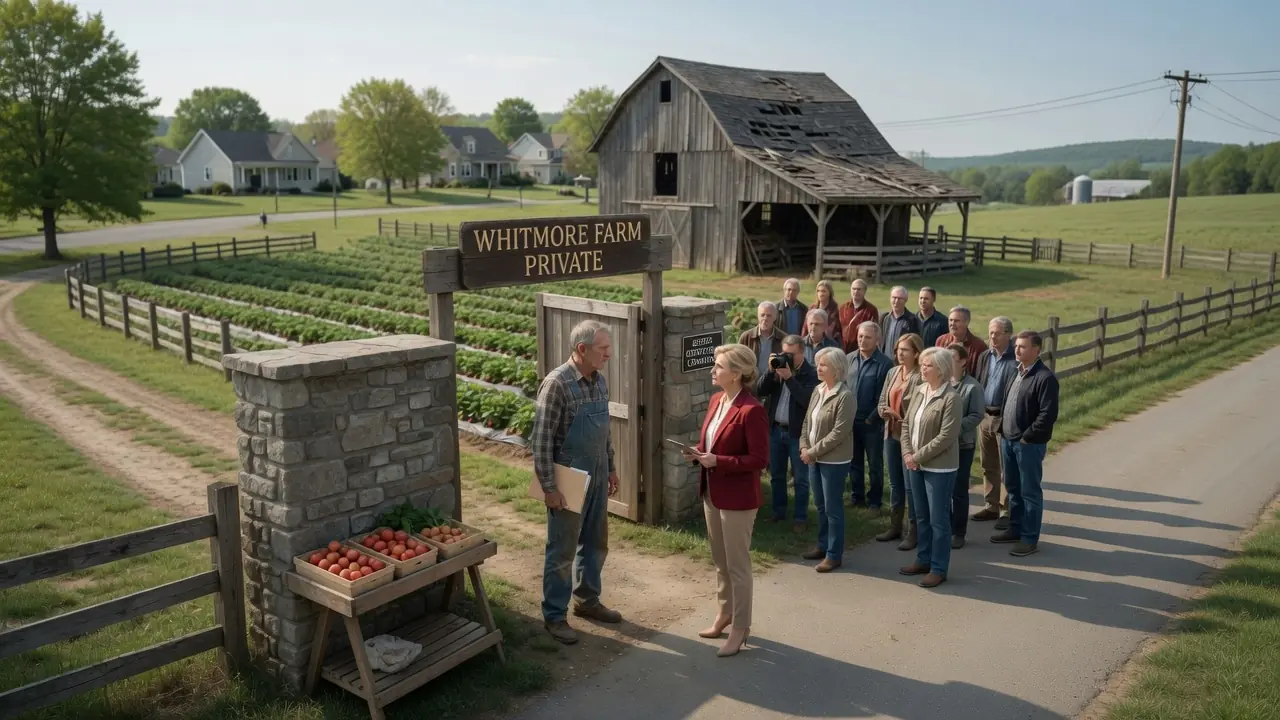
Diane Mercer stood outside Whitmore Farm wearing a cream-colored blazer, pressed navy trousers, and shoes too clean for eleven acres of working soil. Behind her, a photographer lifted a camera from the back of a white SUV while his assistant unfolded a tripod beside the road.
Cal Whitmore remained on the other side of the wooden gate.
He wore faded jeans, brown work boots, and the dark green shirt he used during harvest season. One weathered hand rested firmly over the iron latch. The other held a sealed manila folder.
“It’s Whitmore Farm,” he said. “And the gate stays closed.”
Diane’s professional smile sharpened.
“Don’t be difficult. Coastal Neighbor is featuring Crestfield’s community green spaces. This is good publicity for everyone.”
“You were told the farm isn’t part of Crestfield.”
“The neighborhood has supported this property for years.”
Cal looked beyond her at the magazine crew.
The photographer had stopped unpacking.
He was listening now.
Diane reached for the latch without asking.
Cal placed his hand over it before her fingers touched the metal.
Then, without raising his voice, he slid the manila folder through the wooden rails.
Diane snatched it from him.
For half a second, her irritated smile returned. She appeared to believe the folder contained a release form or perhaps the written permission she had expected Cal to surrender once enough people arrived to witness the confrontation.
She tore open the envelope.
Her eyes moved across the first page.
The smile vanished.
At the bottom of the document, printed in clean black numbers, was the total:
$3,890.00
Diane looked up slowly.
“What is this?”
“Your bill.”
“You can’t charge a community for enjoying its own landmark.”
Cal’s expression did not change.
“You didn’t create a partnership, Diane.”
He nodded toward the papers in her hands.
“You created a $3,890 bill.”
The photographer lowered his camera.
Diane stared at Cal as though she had only now realized the quiet widower behind the gate had been measuring everything.
She had no idea that measuring was how his late wife had taught him to survive.
Eighteen months earlier, Cal Whitmore had buried Elena beneath a maple tree at the edge of the county cemetery.
She had been sixty-one.
An agricultural engineer.
A wife for thirty-five years.
And the only person Cal had ever known who could explain soil drainage with the intensity other people reserved for politics or religion.
The cancer took eleven months.
During the final six, Elena became too weak to walk the eastern rows, so Cal brought the farm to her.
He carried soil samples into the kitchen in labeled glass jars.
He took photographs from the same location every morning so she could compare plant development.
When the first berries appeared, he placed three of them on a white plate beside her hospital bed.
Elena did not eat them immediately.
She examined the color near the stem.
“You picked these early.”
“Only by a day.”
“A day is early.”
“I thought you’d want them.”
“I want you to stop making emotional decisions about fruit.”
Cal laughed.
Elena did too, though laughing made her cough.
That night, she ate all three berries.
Two weeks before she died, Elena asked Cal to bring her the laminated planting calendar from the barn.
She rested it across the blanket and studied the columns she had written by hand.
“You’ll need to adjust the east rows after the third season.”
“I won’t remember all this.”
“Yes, you will.”
“You have too much confidence in me.”
“No. I have confidence in documentation.”
She tapped the calendar.
“People forget. Records don’t.”
Cal looked toward the dark window.
“I don’t know whether I can run this place without you.”
“You already run it.”
“I follow instructions.”
“That is how competent people begin.”
She took his hand.
“Don’t turn the farm into a memorial, Cal.”
“What does that mean?”
“Don’t preserve it until it stops living. Plant. Sell. Make mistakes. Correct them. Let it remain a farm.”
He promised.
For eighteen months, Cal kept that promise one row at a time.
Whitmore Farm covered eleven acres at the edge of Crestfield Commons.
Elena had purchased the parcel nearly twenty years earlier, when the surrounding land was mostly pasture and woodland. The property included a weathered red barn, a small white farmhouse, and a southern slope that most people considered too uneven for commercial growing.
Elena saw something different.
She spent three months testing the soil before putting one plant into the ground.
She measured the acidity in dozens of locations.
She mapped where rainwater traveled after a storm.
She calculated how morning sunlight moved across the eastern slope in early spring.
Then she designed the farm.
Three sections of strawberry rows occupied the best ground.
The north section produced steadily.
The center section tolerated dry weather.
The east section received the strongest morning sun and consistently produced the farm’s largest crop.
Cal had spent twenty-two years teaching shop at Ridgeline High School. He understood tools, measurements, and the consequences of skipping preparation.
Elena taught him farming in the same order.
First soil.
Then water.
Then roots.
Then plants.
She did not let him pick strawberries simply because they appeared red.
He had to understand firmness, sugar development, weather, market timing, and what she called the three-day window.
“Strawberries don’t care what’s happening in your life,” she once told him. “They ripen when they ripen. Miss the window, and the row goes soft.”
Cal never forgot it.
After Elena died, he maintained the farm ledger exactly as she had designed it.
Every weekly page contained the same columns:
Date.
Section.
Row number.
Harvest weight.
Labor hours.
Soil observations.
Weather.
Sales.
Commercial orders.
Damage or loss.
He filled it in by hand every evening.
The habit kept the farm accurate.
It also kept Cal connected to Elena without turning every morning into a conversation with grief.
Her handwriting remained inside the barn.
His continued beneath it.
That was enough.
Crestfield Commons arrived nine years after Elena purchased the property.
Developers built two hundred houses around three sides of the farm. The subdivision’s walking path ran along the eastern fence, close enough for residents to watch Cal working among the strawberries.
The HOA boundary excluded Whitmore Farm completely.
Cal and Elena had refused every offer to sell.
There was no shared-use agreement.
No easement.
No partnership.
For years, that did not matter.
Residents walked past the rows.
Children waved.
Cal waved back when he noticed.
On Saturdays, some families entered through the driveway and purchased strawberries from the farm stand.
The stand was simple.
A folding table.
A blue-and-white tablecloth Elena had chosen.
Fresh flats of fruit.
Mason jars of strawberry jam made from her recipe.
A wooden cash box Cal’s former students built during his final year of teaching.
The farm also supplied two restaurants.
Greystone Bistro ordered two cases every Tuesday.
Alderman’s Table purchased one case and several jars of jam.
Those orders paid specific bills.
Property tax.
Utilities.
Equipment maintenance.
Insurance.
Whitmore Farm was not a hobby or grief project.
It was a functioning business.
For nearly a decade, the farm and neighborhood existed beside each other peacefully.
Then Diane Mercer became president of the Crestfield Commons Homeowners Association.
The first person to warn Cal was Patrice Coleman.
Patrice bought two flats most Saturdays and used them to make preserves for her grandchildren.
One morning in early May, she waited until the other customers had left before speaking.
“There was a woman photographing your rows yesterday.”
Cal closed the cash box.
“People take pictures from the path.”
“This was different.”
“How?”
“She walked the whole fence. Back and forth. Took pictures of the barn, the stand, your sign, everything.”
“You know her?”
“Diane Mercer. HOA president.”
Cal glanced toward the eastern fence.
The fruit was still two weeks from peak.
“What did she want?”
“Didn’t say.”
Cal recorded the information in the ledger that afternoon.
Diane Mercer observed photographing east rows from community path. Purpose unknown.
He did not consider it important.
Nine quiet years had taught him to expect a tenth.
Two Saturdays later, Diane walked up the driveway.
She was in her mid-fifties, with a carefully styled blonde bob and the kind of smile developed through years of persuading rooms full of people that her decision had been their idea.
“Mr. Whitmore?”
Cal was stacking jars.
“Yes.”
“Diane Mercer. President of Crestfield Commons.”
He nodded.
Diane looked over the farm as though touring a property she might purchase.
“This place is extraordinary.”
“It produces well.”
“It’s exactly the kind of authentic community feature Crestfield has always needed.”
Cal stopped arranging the jars.
“The farm isn’t in Crestfield.”
“Not technically.”
“There’s no other kind of boundary.”
Diane laughed softly.
“I’m speaking culturally.”
She raised her phone and photographed the farm stand.
Then the rows.
Then a jar catching the sunlight.
Cal watched her shift angles until the barn appeared behind the strawberries.
“You could ask before photographing my business.”
Diane lowered the phone.
“I’m sorry. I assumed you’d appreciate the promotion.”
“I didn’t ask for promotion.”
“That’s the wonderful thing about community. We help each other.”
She purchased one flat, took a photograph of it, and left.
Cal documented the visit.
HOA President Diane Mercer photographed property and products without permission. Described private farm as community feature.
Eight days later, the Crestfield newsletter arrived.
Whitmore Farm filled the front page.
The headline read:
CRESTFIELD’S WORKING FARM — A HIDDEN GEM IN OUR OWN BACKYARD
The article described the property as part of the neighborhood’s green identity.
Cal’s full name and farm-stand hours appeared in a sidebar marked Community Features and Events.
At the bottom was an invitation:
Visit Crestfield’s own strawberry farm every Saturday from 8:00 a.m. to noon.
Cal read the newsletter twice.
No sentence directly claimed the HOA owned the farm.
That was what made the article clever.
The language created ownership without stating it.
Cal opened the ledger.
HOA newsletter used farm name, owner’s name, operating hours, and property images without consent. Described private agricultural business as Crestfield community feature. No contact before publication.
He underlined the final line.
Then he started a manila folder.
On the tab, he wrote:
CRESTFIELD HOA CORRESPONDENCE
Four days later, Diane sent an email.
The subject line read:
STRAWBERRY SATURDAY — A CRESTFIELD COMMUNITY CELEBRATION
The event would take place on May 14.
Families were encouraged to visit the farm.
Children would experience agriculture.
Parents could take pictures among the rows.
Diane expected approximately forty families.
She described Whitmore Farm as a “shared community treasure.”
She used the word we eleven times.
Cal counted.
There was not one question in the message.
Diane did not ask whether she could hold the event.
She informed Cal that it was happening.
The final sentence read:
Please let me know if you have any questions.
Cal printed the email.
In the margin, he wrote:
No permission requested. No permission granted.
He considered responding.
Instead, he walked to the barn and studied Elena’s calendar.
May 14 fell three days before peak harvest in the east section.
Rows seven through twelve would be at maximum weight and maximum fragility.
The berries would be dark red, full, and easily bruised.
The plants would be vulnerable to compacted soil, damaged crowns, and careless feet.
Elena had marked that period in red.
Cal touched the date.
Diane had chosen it because the rows would look beautiful in photographs.
She did not understand that beautiful was not the same as available.
Cal drafted three possible replies.
He deleted all of them.
Part of him believed that refusing publicly would make him appear hostile to families who had done nothing wrong.
Another part believed the event was so obviously inappropriate that Diane would eventually contact him properly.
She did not.
On May 14, Cal reached the barn before sunrise.
He inspected rows seven through twelve with a flashlight.
The fruit was exactly where Elena’s chart predicted.
He recorded the condition in the ledger.
At eight, he opened the farm stand.
At nine thirty, the first family entered through the equipment gap in the eastern fence.
They did not use the driveway.
A father pushed a stroller while two children ran toward the rows.
More families followed.
By ten fifteen, Cal counted forty-three visitors on the property.
None appeared malicious.
That mattered to him.
They spoke quietly.
Children laughed.
Parents carried phones and reusable bags.
They believed they had been invited to a legitimate community event.
Diane had placed them inside someone else’s boundary while protecting herself with their innocence.
Cal approached the first family he saw picking fruit.
“These rows aren’t open for harvesting.”
The father looked surprised.
“Diane said the children could pick.”
“She didn’t ask me.”
The man immediately gathered his children.
“I’m sorry. We thought this was arranged.”
“I know.”
Four minutes later, another family entered the same row.
Cal redirected them.
At ten forty-five, he found a woman in a sun hat photographing her daughter in row eleven.
The girl knelt between plants, holding up a strawberry.
“Please step out of the row,” Cal said.
The woman smiled.
“Are you one of the workers?”
“I own the farm.”
“Oh, wonderful. Diane said it was a real working farm.”
“That’s why people can’t walk through the crop.”
The woman photographed Cal.
Less than a minute later, a notification appeared on his phone.
She had posted the picture to the Crestfield social-media group.
Met the farmer! Such an authentic experience for our children!
Cal returned to the barn doorway.
He stood there with Elena’s ledger in his hand and counted.
He counted visitors.
Children.
Families.
The number of people entering each row.
The length of time they remained.
Counting did not stop the damage.
It made the damage visible.
Shortly after noon, the final family left through the equipment gap.
Cal began his inspection.
Elena had taught him never to jump directly to the worst area.
Start at the first row.
Walk the full length.
Observe everything.
Small damage compounds.
Twenty-three plants were damaged or destroyed.
Several stems were broken near the crown.
Two plants had been pulled from the soil.
Root zones were disturbed.
Fruit lay crushed beneath footprints.
Rows seven through twelve had been stripped before peak.
Using the four-year yield chart, Cal calculated that thirty-four pounds were already missing.
More would be lost because the damaged plants could no longer reach their projected peak production.
He documented every row.
That evening, Diane posted a collection of smiling photographs.
Her caption read:
A magical afternoon at Crestfield’s own strawberry farm. We’re grateful for this beautiful community treasure.
The word magical appeared repeatedly in the comments.
Cal’s name did not appear.
Greystone Bistro called before dinner.
The farm could not fill Tuesday’s order.
The restaurant would purchase elsewhere.
Cal sat at the kitchen table with the ledger open.
Thirty-four pounds.
Twenty-three plants.
Two labor hours displaced.
One restaurant order lost.
For the first time since Elena’s death, he could not finish the evening entry.
He closed the book.
The next morning, before checking a single plant, Cal reopened the ledger.
He completed every column.
No missing lines.
No guesses.
Ten days later, Coastal Neighbor Magazine called.
An editorial assistant wanted to schedule a photo shoot featuring Crestfield’s community green spaces.
Diane had submitted Whitmore Farm.
She had provided Cal’s name, number, address, farm description, and photographs.
Cal stood at the kitchen counter after the call ended.
The newsletter had borrowed his identity.
Strawberry Saturday had used his property.
Now Diane was selling the farm’s story to strangers.
She wanted the appearance of authenticity without any relationship to the work that created it.
Cal picked up the manila folder and drove into town.
Rachel Pierce practiced agricultural property law above a tax office.
Cal placed the deed, correspondence, restaurant records, photographs, planting calendar, and farm ledger on her desk.
Rachel studied the ledger longest.
“Who designed this?”
“My wife.”
“What did she do?”
“Agricultural engineering.”
“Were these records maintained before the dispute?”
“Three years without a missed day.”
Rachel nodded.
“That’s important.”
“Why?”
“Because you didn’t create them to win an argument. You created them to run a farm.”
Cal explained the yield chart.
The damaged plants.
The restaurant order.
The replacement stock.
“I don’t want a lawsuit,” he said.
“Most people who understand lawsuits don’t.”
“I want them to stop.”
“And the loss?”
“I want them to pay for what they damaged.”
Rachel closed the folder.
“Send an invoice.”
Cal stared at her.
“To the HOA?”
“They organized unauthorized access to private commercial property. Their event caused measurable crop and revenue loss. Your records support every figure.”
“They’ll laugh.”
“They may.”
“What happens then?”
“They show the invoice to their attorney.”
Rachel tapped the ledger.
“The attorney won’t laugh.”
Cal spent three evenings calculating.
He used Elena’s old consulting invoice format.
The first line covered thirty-four pounds of strawberries removed or destroyed, priced at actual farm-stand value.
The second calculated projected peak-yield loss using four years of east-section data.
The third listed the canceled Greystone order.
The fourth covered twenty-three replacement plants.
The fifth covered two documented hours of displaced labor.
The final line charged for one day of unauthorized commercial-property access.
Cal included no charge for embarrassment.
No penalty for the photograph.
No value for the night he could not finish Elena’s ledger.
Some losses did not belong on invoices.
The total was $3,890.
He checked every figure twice.
At the top, he wrote:
WHITMORE FARM
INVOICE FOR UNAUTHORIZED USE OF PRIVATE AGRICULTURAL PROPERTY
Payment terms: thirty days.
Rachel prepared the accompanying notice.
Effective immediately, Crestfield Commons could not use Cal’s name, the farm’s name, images, description, or contact information in any communication, event, or outside media submission without written authorization.
Cal mailed copies to Diane, the HOA office, and Coastal Neighbor.
Certified mail.
Receipts filed in the manila folder.
Then he returned to work.
Diane called after receiving the invoice.
Cal saved the voicemail.
Four minutes and twelve seconds.
She called the situation a misunderstanding.
She praised the community experience.
She said the children had learned where food came from.
She used partnership five times.
She never said permission.
She never apologized.
Then she attempted to save the magazine feature.
She told Coastal Neighbor that Cal was experiencing grief-related anxiety and would cooperate once she spoke to him in person.
The magazine team arrived at Whitmore Farm three days later.
Diane came with them.
Cal had already closed the gate.
That was when she ordered him to open it.
That was when he slid the folder through the rails.
And that was when she saw the number.
$3,890.
For several seconds, nobody spoke.
Finally, Diane lowered the invoice.
“This is absurd.”
“Every line has a source.”
“You stood there and allowed the event.”
“I redirected your guests repeatedly.”
“You never told me to cancel.”
“You never asked to organize it.”
Diane glanced toward the magazine crew.
“We can discuss this privately.”
“We are.”
“The photographer is here.”
“Because you brought him.”
Her jaw tightened.
“You’re damaging the neighborhood’s reputation.”
Cal looked past her at the east rows.
Twenty-three new plants stood smaller than the others, following the recovery schedule Elena had written years earlier.
“You damaged the farm.”
Diane lowered her voice.
“This invoice is intimidation.”
“No.”
Cal rested both hands on the gate.
“It’s accounting.”
The photographer stepped forward.
“Mr. Whitmore, did you authorize the magazine submission?”
“No.”
He turned toward Diane.
“You told us the HOA managed the property.”
Diane’s face changed.
“I said it was an important part of the community.”
“You listed the HOA as the coordinating organization.”
“That was for convenience.”
The assistant began folding the tripod.
“We’ll need to suspend the feature.”
Diane looked from the crew to Cal.
“You’re making a mistake.”
Cal’s voice remained quiet.
“The mistake is documented on page two.”
The magazine team left.
Diane stayed outside the gate.
“You think one invoice changes anything?”
“No.”
Cal looked at the folder in her hand.
“But the deed might.”
The conflict spread through Crestfield.
Thomas Rafferty posted a factual comment beneath Diane’s Strawberry Saturday photographs.
Whitmore Farm was private.
It predated the neighborhood.
The event had not been authorized.
Thirty-four pounds of fruit had been destroyed.
Diane deleted the comment.
Residents had already saved screenshots.
Questions began circulating.
Had the HOA verified the property line?
Was the farm actually part of Crestfield?
Had community funds been used to promote the magazine feature?
Why had Diane called it a partnership when Cal denied one existed?
The HOA board held an emergency meeting.
Board member Frances Nguyen read the invoice aloud.
Frances had been a school principal for thirty years and possessed the rare ability to make a room uncomfortable without changing her tone.
Gerald Price opened the official property map on his laptop.
The HOA boundary stopped clearly at the eastern fence.
“When did you verify this before scheduling the event?” he asked Diane.
She spoke about community identity.
Gerald repeated the question.
“Did you verify ownership?”
Diane said the farm had always been part of Crestfield’s visual landscape.
Frances looked at her.
“Did Mr. Whitmore give permission?”
Diane called the relationship informal.
“That isn’t an answer.”
The HOA attorney reviewed the complete file.
The conclusion was simple.
Cal’s property was private.
The association had organized entry without consent.
The crop damage was supported by records created before any dispute.
The invoice was conservative.
A legal challenge would cost more than the claim before anyone entered a courtroom.
The board voted to settle.
Diane opposed the motion.
She lost.
Cal accepted $3,600.
Rachel asked why he reduced the amount.
“Some projected loss carries uncertainty.”
“You could defend the full amount.”
“I’m not trying to see what I can extract.”
He looked at Elena’s old invoice template.
“She charged what the work was worth.”
The settlement included two permanent conditions.
Crestfield Commons could not use Whitmore Farm in any communication, publication, event, or promotion without Cal’s signed permission.
The HOA issued a written statement acknowledging that the farm was private agricultural property with no affiliation, partnership, or shared-use arrangement with Crestfield.
Frances signed.
Gerald signed.
Diane refused until the board’s attorney informed her that the agreement had already been approved.
Six weeks later, Diane resigned.
Her announcement said she wanted new leadership to guide Crestfield into its next chapter.
Frances became interim president.
The following newsletter contained no photograph of the farm.
Only a brief correction.
Cal cut it out and filed it in the manila folder.
Then he returned to the rows.
By late October, the east section had recovered.
Cal replanted according to Elena’s calendar.
The new plants remained behind schedule, but their crowns were strong.
On the final Saturday of the month, Cal knelt at the end of row twelve with the last seedling in his hand.
He set the roots at the depth Elena had taught him.
Not too deep.
Not too shallow.
He pressed the soil firmly without compacting it.
Then he sat back on his heels.
Beyond the fence, the community path was empty.
The afternoon light crossed the rows at a low angle.
The new plants looked smaller than those around them.
Still, every damaged space had been filled.
Elena had once explained that repair and restoration were not the same thing.
Repair stopped immediate failure.
Restoration returned a system to the work it had been designed to perform.
The east rows were restored.
Cal cleaned the trowel and walked to the barn.
Elena’s planting calendar remained at eye level.
Her final entry had been written two weeks before she died.
Cal knew every letter.
He removed a pen from his pocket.
Beneath Elena’s handwriting, he added:
East rows restored. Season three.
His writing was larger.
Less precise.
But accurate.
Cal stood in the doorway as evening settled across Whitmore Farm.
Diane had looked at the property and seen a backdrop.
Something real she could attach to the neighborhood’s image.
She had seen strawberries but not the soil testing.
Rows but not the drainage calculations.
A widower but not the engineer whose knowledge continued guiding every harvest.
She believed photographing the farm gave her a claim to its story.
She believed calling it a partnership could replace asking permission.
Cal answered her in the language Elena had left behind.
Dates.
Weights.
Rows.
Labor.
Revenue.
Loss.
The numbers did not shout.
They did not insult.
They did not need to.
A good record did not argue.
It remained accurate until the argument collapsed around it.
Cal closed the barn door and walked toward the house.
Tomorrow, the strawberries would continue growing on their own schedule.
They would not remember Diane Mercer.
They would not care about newsletters, invoices, settlements, or HOA elections.
They required only light, soil, water, timing, and someone willing to pay attention.
Cal could provide those things.
Elena had taught him how.