“Tow it. My son is the legal owner now.”
Vanessa Crowley shouted the order from the opposite side of the cul-de-sac as though the two uniformed officers had arrived to carry out a decision she had already made.
One hand rested against her hip.
The other held a folded vehicle receipt bearing a notary stamp.
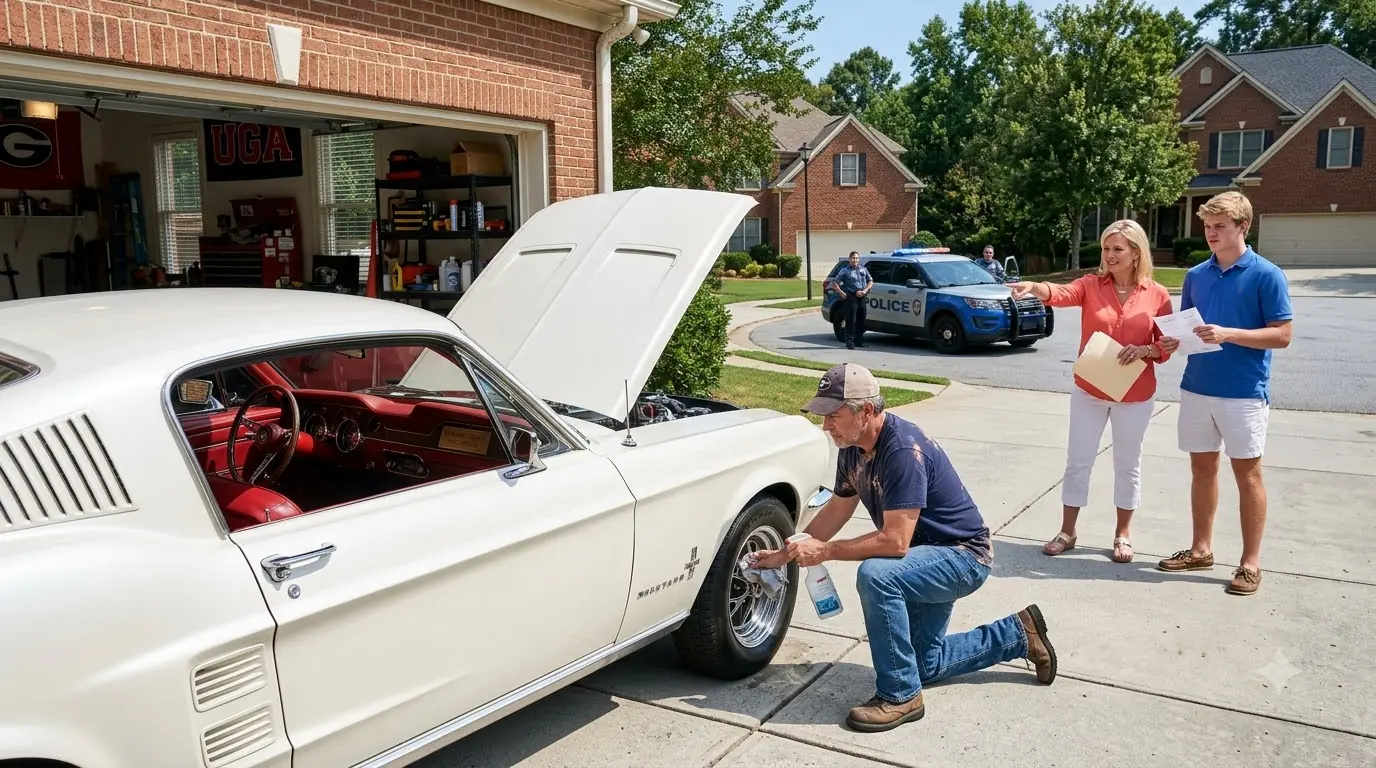
Behind the officers, a pearl-white 1967 Ford Mustang Fastback sat halfway out of an open garage. Its chrome grille reflected the afternoon sun. The burgundy interior had been restored by hand, and a small brass plate was mounted above the glove compartment.
Nathan Caldwell had been polishing the front bumper when the patrol vehicle arrived.
He wore faded jeans, a navy University of Georgia cap, and an old gray T-shirt marked with a small bleach stain near the collar.
To Vanessa, he looked like the same quiet widower she had spent nearly a year pressuring.
To Sergeant Eric Dalton and Officer Mia Reeves, he was simply an unidentified man standing beside a vehicle reported stolen.
“Sir,” Dalton called as he walked up the driveway, “Pinehaven Police. We need you to step away from the vehicle and identify yourself.”
Nathan placed the polishing cloth on the ground.
He rose slowly.
Then he removed his cap and turned around.
Dalton stopped.
Officer Reeves nearly walked into his back.
Recognition passed across both their faces.
Their posture changed immediately.
“Chief Caldwell, sir.”
Nathan had led the Pinehaven Police Department for seven years.
Vanessa Crowley stood across the street holding a forged receipt and watched the two officers salute the man she had accused of stealing his own car.
The confident smile disappeared from her face.
But the real end of her authority had begun months earlier.
Long before the patrol vehicle entered the cul-de-sac.
Long before the false report.
Long before Vanessa understood that the quiet man in the UGA cap had spent thirty years investigating people who believed rules existed only for everyone else.
Pinehaven sat in the wooded northern edge of Georgia, far enough from Atlanta to have its own rhythm but close enough to feel the pressure of rapid development.
The town had grown from fewer than ten thousand residents to almost thirty thousand in two decades.
Old farmland became subdivisions.
Two-lane roads became commercial corridors.
Family hardware stores disappeared beneath shopping centers and national chains.
The Pinehaven Police Department consisted of forty-seven sworn officers, a small investigations division, and a chief who avoided television cameras whenever possible.
Nathan Caldwell had entered law enforcement in 1993.
He spent eight years in Atlanta patrol districts before joining the Fulton County Sheriff’s Office. He became a detective, then supervised major-crimes investigations before accepting a deputy chief position in Pinehaven.
When the previous chief retired, the city council appointed Nathan.
His wife, Elise, claimed the promotion would finally force him to purchase suits that fit properly.
She was wrong.
Nathan continued wearing the same three dark suits until she took him to a tailor and refused to leave without placing an order.
Elise Caldwell died four years later.
She was forty-nine.
One Sunday morning, she poured coffee into two mugs, sat down at the kitchen table, and complained of the worst headache of her life.
By the time paramedics arrived, she had lost consciousness.
A cerebral aneurysm had ruptured.
The surgeons could do nothing.
Nathan returned home after sunrise and entered the garage because every other room contained too much of her.
The Mustang stood beneath a canvas cover.
Elise had purchased the rusted car at an estate auction as a gift for Nathan and their son, Owen.
Owen had been thirteen.
“You two need something to build together,” she told them. “Preferably something that keeps you both out of my kitchen.”
The car barely resembled a Mustang when it arrived.
The floor pans had rusted through.
The engine had been removed.
Mice had destroyed the seats.
For almost four years, Nathan, Elise, and Owen restored it.
Nathan handled the mechanical work.
Owen selected the burgundy interior.
Elise chose pearl-white paint despite both men arguing for dark blue.
She found the final color during a trip to Savannah and refused further discussion.
“Some decisions require authority,” she said.
Near the end of the restoration, Elise ordered a small brass plaque.
FOR MY TWO FAVORITE MEN
NOVEMBER 12, 2018
She mounted it above the glove compartment herself.
Four months later, she was gone.
Nathan and Owen finished the Mustang without her.
They completed the engine on what would have been Elise’s fiftieth birthday.
The first time the car started, Owen stood beside the open hood and cried silently while the rebuilt V8 filled the garage with sound.
Nathan did not tell him to stop.
Three years later, Nathan sold the family home in Roswell.
He could no longer sit beneath the porch swing Elise had chosen or pass the kitchen table without remembering the unfinished coffee.
He bought a brick house inside Hawthorne Glen, a newer subdivision in Pinehaven.
The neighborhood contained curved streets, ornamental trees, a clubhouse, and an active homeowners association.
Nathan did not introduce himself as police chief.
He wanted to be a resident, not a title.
On weekends, he drove an aging pickup and wore the same UGA cap.
His badge remained locked in the truck console unless duty required it.
The first person to welcome him was Vanessa Crowley.
She arrived carrying a lemon pound cake on a porcelain plate.
Vanessa was fifty-five, carefully dressed, and had served as Hawthorne Glen’s HOA president for nearly a decade.
She spoke about the neighborhood as if she had personally designed every house.
“We maintain standards here,” she explained. “That protects everyone’s investment.”
Nathan thanked her for the cake.
She glanced past him into the garage.
The Mustang’s rear quarter panel was visible beneath the raised door.
“What is that?”
“A restoration project.”
Vanessa stepped slightly closer.
“What year?”
“Sixty-seven.”
“My son is obsessed with classic Mustangs.”
Nathan closed the garage door halfway.
“It isn’t finished.”
“Tyler would love to see it sometime.”
Nathan gave no invitation.
Three weeks later, Tyler Crowley entered the garage without one.
Nathan was replacing a brake line when the young man walked up the driveway.
Tyler was twenty, athletic, and accustomed to being welcomed.
“That’s a real Fastback?”
“Yes.”
“What engine?”
Nathan continued working.
“A two-eighty-nine.”
“Original?”
“Mostly.”
Tyler walked around the car.
Nathan stood.
“You need to remain outside the garage.”
Tyler looked surprised.
“I’m just looking.”
“You can look from the driveway.”
The young man remained for several minutes, asking about the transmission, paint, and estimated value.
Nathan gave short answers.
That evening, Vanessa sent him a message.
Tyler cannot stop talking about your Mustang. My husband and I would love to discuss purchasing it as a graduation present. Would Saturday work?
Nathan replied:
The car is not for sale.
Vanessa responded almost immediately.
Every vehicle has a fair price. Let’s at least talk like neighbors.
Nathan did not answer.
Vanessa and her husband, Grant Crowley, arrived Saturday morning anyway.
Grant was a commercial-property developer with a practiced handshake and the calm expression of a man accustomed to people accepting his terms.
He examined the Mustang from the driveway.
“I’ll give you thirty thousand today.”
“No.”
“Thirty-eight.”
“It is not for sale.”
“Forty-five.”
Nathan looked directly at him.
“You are attempting to purchase the only object my son and I built with my late wife. There is no number.”
Grant’s smile tightened.
“I respect sentiment. But cars deteriorate. Cash does not.”
“Then you should keep yours.”
Vanessa laughed as though Nathan had made a joke.
They left ten minutes later.
The first HOA violation appeared three days afterward.
UNMAINTAINED VEHICLE VISIBLE FROM PUBLIC RIGHT-OF-WAY
FINE: $150
The photograph showed the Mustang through Nathan’s garage window. A thin layer of ordinary dust lay across the roof.
Nathan reviewed Hawthorne Glen’s covenants.
The document prohibited disabled vehicles stored outdoors.
It said nothing about insured cars inside private garages.
He submitted an appeal.
The board rejected it without a hearing.
Instead of paying, Nathan requested the association’s evidence, meeting minutes, enforcement policy, and records showing similar violations issued to other homeowners.
No response came.
A late fee was added.
The second violation arrived two weeks later.
EXCESSIVE VEHICLE NOISE DURING QUIET HOURS
FINE: $250
The complaint stated that Nathan had started the Mustang after eleven at night.
His security footage showed the Mustang had not moved.
The only vehicle started that evening was his pickup at 6:10 the following morning.
Nathan saved the footage.
He requested the time, complainant, and evidence supporting the violation.
The HOA refused to identify the complainant.
A third notice accused him of leaking oil onto the driveway.
Nathan found a dark puddle near the curb.
The Mustang had remained inside for more than a week.
A discarded plastic oil container lay behind a utility box beside his property.
Nathan photographed it without touching it.
Then he called the county sheriff’s nonemergency line.
He did not call his own department.
A deputy documented possible vandalism and collected the container.
Nathan identified himself only after the deputy asked why he seemed unusually familiar with evidence handling.
“You could have mentioned that earlier, Chief.”
“You were doing fine.”
Nathan notified Pinehaven’s city attorney and deputy chief that he was experiencing a private dispute involving the HOA.
He requested that any future criminal complaint connected to his address be reviewed by the county sheriff’s office to avoid a conflict.
That decision would later matter.
Vanessa’s pressure continued.
She parked her Mercedes near the edge of Nathan’s driveway.
She circulated comments that the widower was “not adjusting well.”
She told neighbors the Mustang had become an obsession and implied Nathan was drinking.
Then the HOA announced a mandatory garage inspection.
Three men arrived wearing matching navy shirts printed with HAWTHORNE GLEN COMMUNITY COMPLIANCE.
None displayed government identification.
None held an inspection license.
Nathan met them outside.
“Do you have a warrant or written permission from the homeowner?”
One man lifted a clipboard.
“The covenants authorize inspection.”
“No covenant gives private individuals authority to enter a home without consent.”
“Refusal will result in additional penalties.”
“Document my refusal.”
Nathan closed the garage door.
He photographed the men as they left.
Later, he learned one was Grant’s cousin. Another worked occasionally for a Crowley-owned property company. The third had an outstanding misdemeanor warrant.
Nathan forwarded the information to the sheriff’s office and the city attorney.
He did not order arrests.
He did not use his position to retaliate.
He simply documented.
The first serious warning arrived through Owen.
Owen was nineteen and preparing to begin his first year at the University of Georgia.
He worked at a grocery store during the summer and spent weekends helping Nathan finish small details on the Mustang.
One afternoon, he returned home visibly angry.
“Tyler says his family is going to take the car.”
Nathan closed the refrigerator.
“What exactly did he say?”
“He said his father could make the fines hurt until you sold. Then he said it would belong to him one way or another.”
“Were there witnesses?”
“Two people from work.”
“Write down their names and what you remember. Do not contact Tyler.”
Owen stared at his father.
“You’re treating this like a case.”
“It may become one.”
“Why haven’t you told them who you are?”
Nathan looked through the kitchen doorway toward the garage.
“Because a person’s conduct should not depend on whether the neighbor they are abusing has a badge.”
The abandoned-vehicle notice arrived in October.
The HOA alleged the Mustang was nonoperational and threatened to request municipal removal unless Nathan proved registration, insurance, and mechanical function.
The claim was legally weak.
The car was stored on private property.
Its registration and classic-car insurance were current.
Nathan submitted both.
The board ignored the documentation.
Instead, Vanessa photographed the Mustang during its monthly maintenance drive and issued another violation for “visible disrepair.”
The photograph showed sunlight reflecting from fresh wax.
Then came a letter from an attorney demanding removal of the car within fourteen days.
Nathan searched the name.
The state bar number belonged to a retired lawyer who had never represented the HOA.
The law firm listed in the letter occupied a rented mailbox.
Nathan forwarded the letter to the sheriff’s financial-crimes investigator.
That was when the dispute stopped being merely personal.
Detective Carla Monroe of the county sheriff’s office reviewed the forged legal letter, the suspicious fines, and the oil container.
She asked Nathan for everything.
He provided a chronological file.
Photographs.
Security footage.
Messages.
Violation notices.
HOA payment records available to members.
The attempted garage inspection.
Owen’s account of Tyler’s threat.
Nathan formally signed a conflict disclosure stating that he would exercise no command authority over the investigation.
The sheriff assigned the case to Monroe and notified the district attorney.
Within three weeks, the investigation expanded.
Vanessa had filed vehicle-ownership complaints against nine other Hawthorne Glen residents during the previous six years.
In several cases, her son or one of his friends claimed to have purchased a classic vehicle through a handwritten receipt.
The receipts were notarized by the same individual.
That notary’s commission had been revoked for misconduct.
Four homeowners eventually sold their cars to people connected to the Crowley family at prices far below market value.
Others hired lawyers and forced the HOA to retreat.
The financial records were worse.
Over four years, Hawthorne Glen collected more than one hundred sixty thousand dollars in fines and special assessments.
Less than one third had been spent on landscaping, repairs, insurance, and community services.
Large amounts moved into a company called Hawthorne Property Renewal LLC.
Grant Crowley controlled the company.
The LLC had purchased three homes from residents facing unusually high HOA fines.
Each home was renovated and resold for a large profit.
The pattern was simple.
Target a resident.
Create violations.
Increase fees.
Threaten liens.
Offer a convenient buyer connected to the Crowleys.
The homeowners believed they were losing a dispute with an HOA.
They were actually being pressured by a private acquisition scheme.
Carla Monroe met Nathan inside the sheriff’s office.
“The Mustang is one small part.”
“I assumed it might be.”
“We need an overt act connected to the forged ownership claim. Something current.”
Nathan looked at the file.
“They will call police eventually.”
“How do you know?”
“Because Vanessa believes uniforms will make the lie feel official.”
The investigation team developed a controlled plan.
Nathan would continue normal maintenance on the Mustang.
The sheriff’s office would monitor any complaint connected to the address.
Pinehaven officers would respond as usual because deliberately manipulating dispatch could compromise the case.
However, the sheriff’s investigators would remain nearby with judicial authorization to seize evidence if Vanessa acted on the forged documents.
Nathan would not make arrests.
He would be a witness.
The district attorney approved the plan.
So did Pinehaven’s city attorney.
On Thursday, the police department announced a community classic-car exhibition benefiting vocational scholarships.
The promotional photograph included Nathan’s Mustang.
The Hawthorne Glen entrance sign appeared faintly in the background.
Vanessa saw it.
By Friday afternoon, she had filed an invalid lien for more than eleven thousand dollars.
The county clerk rejected it for failure to provide required notice.
She posted online that an unnamed resident was provoking the board and damaging neighborhood harmony.
Then Tyler approached a sixteen-year-old acquaintance named Evan Brooks.
He asked Evan to sign a statement claiming he had witnessed Nathan sell the Mustang for thirty-five thousand dollars.
Evan refused.
He called Owen.
Owen immediately contacted Detective Monroe.
Evan gave a sworn statement the following morning.
He also reported that Vanessa planned to file a stolen-vehicle complaint Saturday afternoon.
The forged receipt named Tyler as purchaser.
Nathan’s signature had been copied from an HOA document.
The revoked notary’s stamp appeared at the bottom.
A judge approved search warrants for the Crowley home, Grant’s office, and HOA financial records.
Saturday arrived cool and bright.
Nathan opened the garage shortly before noon.
Owen positioned a phone camera inside an upstairs window at Detective Monroe’s request.
The sheriff’s office had already installed a temporary evidence camera with Nathan’s written consent.
Nathan rolled the Mustang halfway into the driveway.
He warmed the engine, disconnected the battery afterward, and began polishing the grille.
At 1:40, Vanessa emerged from her house holding a manila folder.
Tyler followed her.
They remained across the street.
At 1:48, Nathan’s phone received a notification from the home security camera.
A Pinehaven patrol vehicle had entered the subdivision.
Nathan continued polishing.
Sergeant Eric Dalton and Officer Mia Reeves stopped twenty feet from the driveway.
They had been dispatched to a reported stolen vehicle.
They knew nothing about the broader investigation.
That was intentional.
Dalton stepped from the patrol vehicle.
“Sir, Pinehaven Police. Please move away from the vehicle and identify yourself.”
Nathan stood.
He removed his cap.
Recognition stopped both officers.
“Chief Caldwell?”
Nathan displayed his identification but did not issue operational commands.
“Sergeant, I am the registered owner. Because I am involved personally, the county sheriff’s office is handling the investigation. Please preserve the scene and follow your normal procedures.”
Across the street, Vanessa raised the receipt.
“My son bought that vehicle. I have proof. Tow it.”
Dalton looked at the paper.
“Ma’am, remain where you are.”
“You work for him. Of course you’re protecting him.”
Officer Reeves activated her body camera.
“So there is no misunderstanding,” she said, “you are reporting that Mr. Caldwell sold the Mustang to your son?”
“Yes.”
“For thirty-five thousand dollars?”
“Yes.”
“When?”
“August fourteenth.”
“How was payment made?”
“Cash.”
“Who witnessed the sale?”
Vanessa pointed to Tyler.
“My son was present.”
Tyler looked at the ground.
A dark sedan entered the cul-de-sac.
Detective Carla Monroe stepped out with two sheriff’s investigators.
She approached Vanessa.
“Mrs. Crowley, I need the document in your hand.”
Vanessa took one step backward.
“This is an HOA matter.”
“You filed a stolen-vehicle complaint. It is now a criminal matter.”
Vanessa’s face changed.
Grant appeared at the front door of their house.
Behind the investigators, additional deputies entered the street to execute the search warrant.
Carla placed the receipt inside an evidence sleeve.
“The registered owner did not sign this document. The notary commission shown here was revoked more than two years ago.”
“That’s ridiculous.”
“We also have a sworn statement from a minor you attempted to recruit as a false witness.”
Vanessa turned toward Tyler.
He sat down on the curb.
Carla continued.
“Vanessa Crowley, you are under arrest on suspicion of filing a false police report, forgery, attempted theft by deception, and conspiracy.”
The handcuffs closed around Vanessa’s wrists.
No one cheered.
Nathan stood beside the Mustang and watched the woman who had spent months trying to make him feel powerless.
She looked smaller than he expected.
Not harmless.
Only ordinary.
The search of the Crowley residence uncovered receipt templates, copies of homeowners’ signatures, financial ledgers, and HOA correspondence never disclosed to residents.
Investigators found records connecting fine collections to Hawthorne Property Renewal LLC.
Grant Crowley was arrested at his office later that afternoon.
The HOA treasurer and two members of the compliance committee were questioned.
One agreed to cooperate.
Another was charged after investigators discovered he had entered homes and photographed interiors while falsely claiming legal inspection authority.
The case took more than a year to resolve.
There was no sudden federal raid.
No courtroom confession delivered in five minutes.
There were document reviews, forensic accounting, civil claims, and negotiations among prosecutors, homeowners, lenders, and title companies.
The evidence showed that the Crowleys had manipulated the association for years.
Vanessa did not personally steal every dollar.
Grant did not personally threaten every homeowner.
Their scheme depended upon a network of people willing to ignore irregularities because they benefited or feared becoming the next target.
Vanessa eventually pleaded guilty to forgery, false reporting, conspiracy, and multiple fraud counts.
Grant pleaded guilty to racketeering-related state charges, real-estate fraud, and theft.
Both received prison sentences and restitution orders.
Hawthorne Property Renewal entered receivership.
Two former homeowners received financial settlements after courts determined their sales had been induced through fraudulent pressure.
A third chose not to return to the neighborhood but recovered a significant portion of the resale profit.
The HOA itself survived.
Nathan opposed dissolving it immediately because the subdivision still required insurance, storm-water maintenance, and common-area management.
Instead, residents elected an entirely new board.
The bylaws were rewritten.
No board member or close relative could hold a financial interest in a company purchasing property inside Hawthorne Glen.
Fines required photographic evidence, written notice, and an independent appeal.
Entry into a private residence required consent or lawful authority.
Financial statements had to be reviewed annually by an outside accountant.
Meetings were recorded and made available to members.
The new president was a retired school principal named Ruth Ellison, one of the residents Vanessa had pressured over a cracked driveway.
At the first meeting, Ruth stood before the community and said, “An HOA should maintain common property, not manufacture fear.”
The vote approving the new rules was unanimous.
Sergeant Dalton and Officer Reeves received commendations for handling the confusing vehicle complaint professionally.
Detective Carla Monroe received the county’s investigative-service award.
Nathan declined public recognition.
He had not solved the case.
He had documented what happened and allowed independent investigators to do their work.
Evan Brooks, the teenager who refused to sign the false statement, received a letter from the sheriff and an invitation to attend a youth leadership program.
Owen left for the University of Georgia that fall.
Before moving into his dormitory, he and Nathan took the Mustang for a long drive through the North Georgia hills.
They stopped at a roadside diner.
Owen ordered pecan pie and ate only half.
Nathan drank coffee.
“Mom would have enjoyed the salute,” Owen said.
“She would have laughed until she couldn’t breathe.”
“She would have said you were being dramatic.”
“She often said that.”
They drove to the cemetery afterward.
Nathan parked near Elise’s grave and opened both windows.
For almost an hour, neither man spoke.
The Mustang remained in the family.
Nathan drove it on the first Saturday of every month.
Sometimes Owen joined him.
Sometimes Nathan went alone.
The brass plaque above the glove compartment caught the sunlight whenever he turned south.
The following year, Nathan created the Elise Caldwell Automotive Trades Scholarship through a local technical college.
It supported students studying collision repair, restoration, welding, and engine technology.
The scholarship did not require applicants to become police officers or attend a four-year university.
It required only that they show skill, persistence, and a willingness to help another student learn.
Owen volunteered during the summer.
The first scholarship recipient rebuilt the carburetor on a 1971 pickup.
Nathan gave each graduate a replica of Elise’s brass plaque.
The replicas carried different words.
BUILD SOMETHING WORTH KEEPING.
Years later, new residents still heard the story of the day two Pinehaven officers saluted a man in a faded cap beside a Mustang.
Most versions exaggerated something.
Some claimed Vanessa fainted.
She did not.
Some claimed Nathan revealed himself only after the tow truck arrived.
There had been no tow truck.
Others claimed he had secretly orchestrated every moment.
He had not.
The truth was less theatrical and more important.
Nathan won because he did not use his authority to win a personal argument.
He preserved evidence.
Disclosed his conflict.
Allowed another agency to investigate.
He understood that anger might satisfy one afternoon, but documentation could expose six years.
Vanessa’s greatest mistake was not targeting a police chief.
Targeting any homeowner with fabricated fines, forged documents, and false reports would have been wrong.
Her mistake was believing quiet people were unaware.
She interpreted Nathan’s restraint as weakness.
She assumed every paid fine was surrender.
Every unanswered insult was fear.
Every closed garage door meant she was gaining ground.
In reality, each notice became another dated record.
Each forged letter became another exhibit.
Each threat gave investigators a clearer view of the pattern.
Nathan did not defeat Vanessa by announcing who he was.
He defeated the scheme by refusing to become the kind of man who believed his title placed him above the process.
On the anniversary of Elise’s death, Nathan drove the Mustang beyond Pinehaven with the windows open.
The engine settled into a steady rhythm.
Autumn air moved through the burgundy interior.
At a red light, he rested one hand against the brass plate.
“For my two favorite men,” he read quietly.
Elise had bought them a broken car because she wanted a father and son to build something together.
She could never have known the car would later become evidence in a fraud investigation.
She could never have known strangers would attempt to take it.
But Nathan believed she would have understood the lesson.
Some possessions mattered because of their price.
Others mattered because they contained time.
The Mustang contained four years of evenings.
Owen’s first successful weld.
Elise choosing paint.
Nathan rebuilding the transmission while she read instructions over his shoulder and corrected him.
The car was not valuable because someone else wanted it.
It was valuable because three people had made it theirs long before Vanessa Crowley tried to place another name on the registration.
The light turned green.
Nathan shifted into first.
The Mustang moved forward, still in the family, carrying its memories exactly where they belonged.