The whip cracked across Fort Blackwood’s courtyard, and every man gathered around the punishment post expected Ethan Boone’s back to split open for the fifth time. Instead, Abigail Turner stepped between the mountain man and the descending lash, turning her body at the last second as leather slammed across the back of her plain work dress. The force knocked the breath from her lungs and drove her onto one knee, but she did not scream. For the first time in six years, every man at Fort Blackwood looked directly at Abigail Turner and nobody laughed.
Ethan’s wrists were tied above his head against a rough pine post, his shirt discarded somewhere in the dirt and four fresh red wounds crossing an older collection of scars along his back. Blood ran slowly toward his ribs, and his knees had begun trembling before Abigail moved, though he had refused to make a sound while Clayton Reed delivered the first four lashes. Now Ethan lifted his head and stared at the broad woman kneeling beside him as though the pain had suddenly become less understandable than the punishment. “What are you doing?” he rasped.
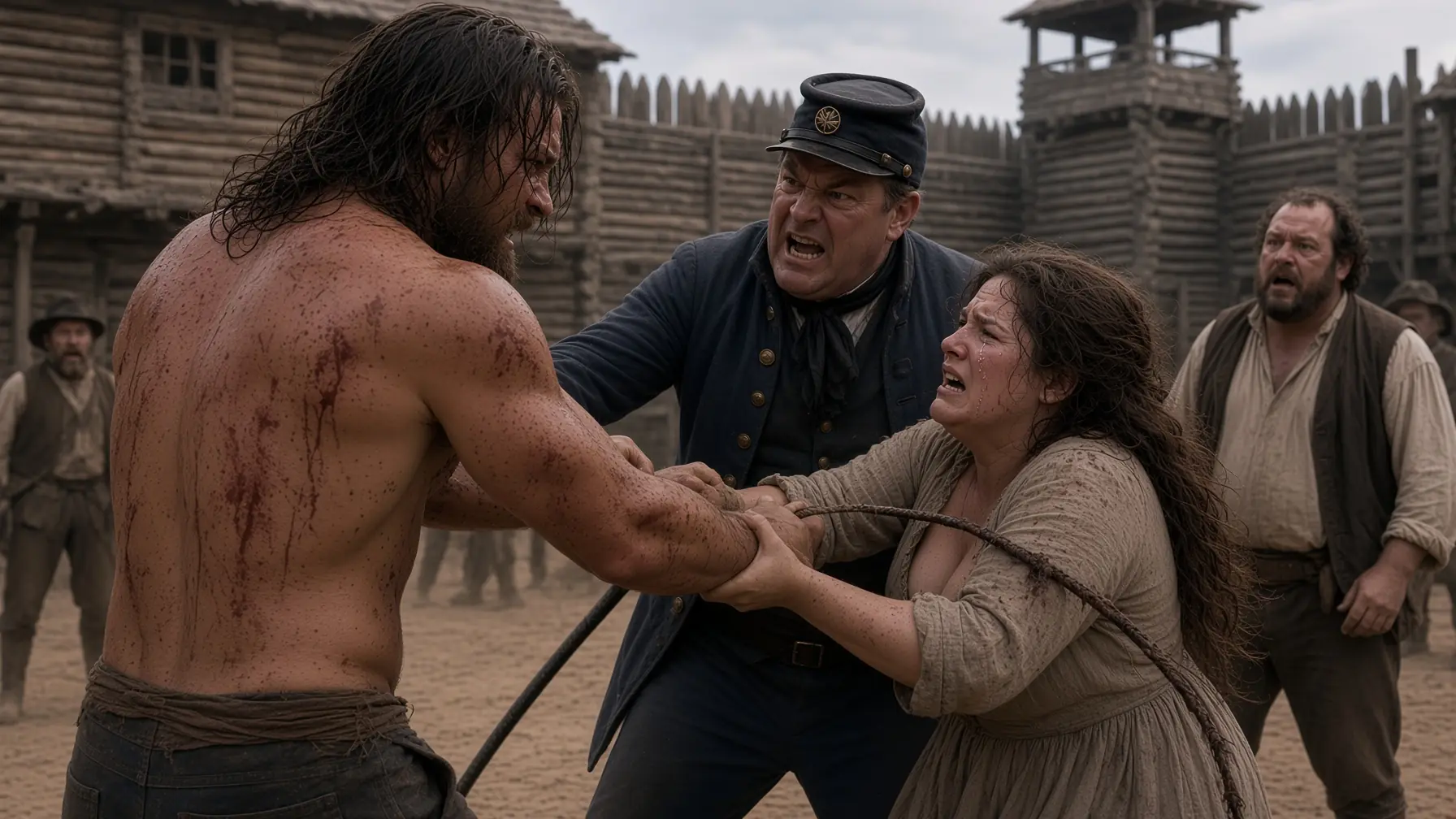
Abigail could barely answer because fire spread beneath her dress from shoulder to shoulder, but she forced herself upright and looked toward Silas Mercer. The trader stood near the punishment platform in a brown waistcoat with one hand resting comfortably against his stomach, wearing the satisfied expression of a man watching someone else pay for embarrassing him. Abigail pointed toward the washhouse where steam curled from two enormous boiling vats. “You hit him again,” she said, “and I’ll drown you in the soap water myself.”
Someone inhaled sharply. Nobody laughed.
Silas stared at her as if the furniture had spoken. “You crazy cow.”
Abigail had been called that before. She had been called ox, sow, mule, wagon, mountain, barrel, and several names soldiers only used when officers were far enough away to pretend not to hear them, and after six years she had discovered insults became strangely weightless once the speaker stopped mattering. “I’ve heard better,” she said. “Usually from men clever enough to keep their hands out of my laundry.”
Silas’s face hardened. He crossed the courtyard, seized the back of Abigail’s dress, and ripped her away from the punishment post so violently that the fresh welt tore against the fabric. White pain flashed through her shoulders, but her weight pulled against Ethan’s bound arms as she stumbled, shifting one rope barely an inch around his left wrist. For an ordinary prisoner it would have meant nothing. Ethan Boone was not an ordinary prisoner.
His entire body changed. Abigail saw it before Silas did.
Ethan rotated his wrist, forcing blood-slick skin against the loosened rope, then dropped his weight with a violent twist that scraped flesh from his hand. The rope caught once, slipped over the heel of his palm, and suddenly his left arm came free. Silas had only enough time to turn before Ethan seized his beard and pulled him forward into a knee that sent the trader backward into the dirt.
The courtyard exploded into shouting. Clayton Reed charged with the weighted whip handle raised like a club, but Ethan kicked sideways into his knee and sent both men crashing beside the punishment post. Clayton landed on top, locked both hands around Ethan’s throat, and pressed downward while Ethan’s torn back ground against dust and gravel. Abigail crawled toward the fallen whip, grabbed its wooden handle with both hands, and swung it into Clayton’s shoulder hard enough to break his grip.
Ethan rolled away coughing. Clayton tried to rise, and Ethan drove a boot into his chest, sending him backward again before any of the surrounding soldiers decided whether they were witnesses or participants. Several men had rifles in their hands, but nobody lifted one toward Ethan because fear moved through the courtyard faster than orders. A half-naked mountain man covered in blood looked less like a prisoner once he was no longer tied to anything.
Sergeant Amos Pike shouted from the barracks steps, demanding that Ethan surrender. Ethan ignored him, crossed to Abigail, and pulled her upright with his free arm. She nearly collapsed against him, and for one brief second Ethan looked surprised by how much of her weight he had to support. Then he turned toward the armed men.
“She’s with me now.”
It was not romantic. It was not even particularly kind.
It sounded like a boundary.
Ethan pointed toward the open fort gate. “Anybody wants to finish this, follow us to the tree line.”
No one moved.
“Bring the whip.”
Still nobody moved.
Ethan pushed Abigail gently forward. “Walk.”
So she did.
She walked past the washhouse where she had spent six years boiling other people’s shirts and blankets. She passed the bench where soldiers sat eating apples while inventing names for her body, the trading room where Silas Mercer weighed pelts on brass scales, and the kitchen door where she once heard Sergeant Pike tell a new recruit that Abigail was “too ugly to cause trouble and too stupid to know when she’s being insulted.” She passed all of it without turning her head.
The gate stood open. Nobody stopped her.
Once beyond the palisade, Ethan led her north toward the pines. He moved quickly for the first mile, driven by whatever reserve a hunted man discovered when danger remained close enough to hear behind him. By the second mile his breathing became rough, and when the trail climbed beside a dry creek bed, Ethan slapped one bloody hand against a dead pine and stopped.
Abigail looked at him. “Keep moving.”
He tried.
His knees folded beneath him.
Ethan collapsed face-first into pine needles.
For several seconds Abigail simply stood there, staring at the man who had just challenged an entire fort and now appeared unable to challenge gravity. The road back remained possible. She could return, claim Ethan forced her, apologize to Pike, accept whatever punishment Silas demanded, and perhaps resume the life she had despised only an hour earlier.
She looked south. Fort Blackwood was invisible behind the trees.
Then Ethan groaned.
Not like the creature who had torn free from the post. Not like the man soldiers feared.
Like someone whose body had reached the end of what anger could make it do.
Abigail cursed softly. “You useless fool.”
Ethan opened one eye. “Thought you were grateful.”
“I took one lash for you.”
“One?”
“If you survive, I may give you another.”
He tried to smile and failed.
Abigail dropped beside him, pulled one of his arms across her shoulders, and began dragging him toward a shallow rock shelf beyond the creek bed. Years of hauling wet blankets had built strength men at Blackwood preferred to turn into jokes because joking was easier than acknowledging the woman carrying twice what some of them could. Ethan was heavier than any laundry bundle, but weight remained weight. Abigail understood weight.
She found shelter beneath an overhang surrounded by brush and lowered Ethan against the stone. His back looked worse away from the courtyard, partly because dried blood had begun collecting dust and partly because Abigail could now see where older scars crossed the fresh wounds. She took his canteen, tore strips from the lower portion of her dress, and washed the skin as carefully as she could. Ethan clenched his jaw.
“You know what you’re doing?”
“No.”
“That’s comforting.”
“My mother treated wounds.”
Ethan opened his eyes.
Abigail continued cleaning. “She delivered babies too.”
“Planning on doing that while we’re out here?”
“If you become pregnant, I’ll consider it.”
Ethan laughed once and immediately regretted it.
Abigail almost smiled.
Her mother, Sarah Turner, had been the closest thing three river settlements ever had to a physician. She knew which wounds needed stitching, which fevers needed water rather than blankets, which herbs were useful and which were stories told by people who enjoyed sounding wise. Abigail had spent half her childhood carrying bowls behind her.
Then Sarah died of river fever when Abigail was seventeen. Her father followed three years later.
Abigail rarely thought about those lessons anymore. Fort Blackwood had required laundry, not medicine.
Now she remembered more than she expected.
By sunset Ethan had developed a fever. Abigail kept the fire small and hidden between rocks, heated water in Ethan’s tin cup, and placed damp cloth against his neck while listening for horses along the trail. She had no weapon except the knife Ethan wore at his belt and no idea where they were going.
Around midnight Ethan woke. “Cabin.”
Abigail leaned closer. “What?”
“Twelve miles north.”
“You have a cabin?”
“Coldwater Creek.”
“How far?”
“Twelve.”
“You’re lying.”
Ethan’s eyes opened. “Why?”
“Men always say twelve when they mean fifteen.”
He considered that.
“Fourteen.”
Abigail sat back. “I knew it.”
“There’s food.”
“Anything else?”
“Blankets.”
“Horse?”
“Maybe.”
“That is not a promising amount of certainty.”
“It’s what I’ve got.”
In the morning Ethan could stand if Abigail helped him. They followed a narrow trapping trail north, moving slowly through pine and spruce as the country rose toward rougher ground. Abigail carried Ethan’s rifle because his hands shook too badly to use it, and every few hundred yards he tried to take it back.
She refused.
“You know how to shoot?”
“No.”
Ethan stopped.
Abigail kept walking.
“You’re carrying my rifle and you don’t know how to shoot?”
“I know which end points away from me.”
“That’s not enough.”
“It is until you can hold it.”
Ethan caught up. “We need to fix that.”
“We need to fix your back.”
“One problem at a time.”
“Exactly.”
He taught her that evening.
Ethan placed an empty tin cup against a fallen log and showed Abigail how to brace the rifle against her shoulder. The recoil nearly knocked her backward on the first shot, and Ethan laughed until she pointed the barrel in his general direction.
“Careful.”
“I thought I only needed to know which end.”
“Now you know more.”
Her second shot missed the cup by several feet.
The third hit the log.
The fourth sent the cup spinning.
Ethan looked impressed.
Abigail lowered the rifle. “What?”
“Nothing.”
“You expected me to be bad.”
“I expected you to need practice.”
“That is a polite way of saying the same thing.”
Ethan smiled. “You notice everything, don’t you?”
Abigail looked away.
“Not everything.”
That answer stayed with him.
They reached the cabin on the third afternoon. It stood beside a narrow creek under tall spruce, no larger than the Blackwood washhouse and constructed from hand-hewn logs darkened by weather. Inside were two bunks, a stone fireplace, sacks of cornmeal and beans, dried meat hanging from beams, several traps, ammunition, and enough tools to make Ethan look less foolish for promising survival.
He collapsed before Abigail finished checking the room.
The next seven days belonged entirely to fever.
Ethan drifted between sleep and confusion. Sometimes he thought Abigail was his dead sister.
Sometimes he spoke French words she did not understand. Once he grabbed her wrist and begged her not to let “Mercer take Luc’s share,” then fell unconscious before explaining who Luc was.
Abigail cleaned his wounds twice each day. She boiled cloth.
Cooked thin porridge.
Split firewood.
Checked the creek.
Learned how to load Ethan’s rifle.
At night she slept sitting against the door because the second bunk stood too far from the entrance for her liking.
The fever finally began dropping on the eighth morning. Ethan woke and watched Abigail carrying a bucket from the creek.
“You’re doing that wrong.”
She stopped.
“Carrying water?”
“Using both hands.”
Abigail stared.
Ethan smiled weakly. “Thought I’d see how it felt.”
She set the bucket down harder than necessary.
“You nearly died.”
“So I’ve been told.”
“You talked.”
“That bad?”
“You called me Martha.”
His expression changed. “My sister.”
“I guessed.”
“She died when I was sixteen.”
Abigail nodded.
Ethan looked toward the fire. “Sorry.”
“For what?”
“Making you hear it.”
Abigail sat opposite him. “People say strange things when they’re sick.”
“You remember them?”
“Usually.”
Ethan studied her again.
“You remember a lot.”
Abigail stood before the question became dangerous.
Recovery was slow.
Ethan could walk by the second week and cut wood by the third, though Abigail threatened to break the axe handle over his head when she caught him trying to carry a full log. He taught her to set simple snares, identify tracks, and fire the rifle accurately enough that missing became less likely than hitting the wrong thing. Abigail taught him how to cook beans without turning the bottom of the pot into charcoal.
They argued constantly.
It surprised both of them how pleasant that became.
Ethan never mocked her body. At first Abigail assumed this was politeness.
Then she realized he seemed genuinely uninterested in judging it at all.
When she carried firewood, he noticed the firewood.
When she climbed a slope faster than expected, he noticed the climb.
When she complained about the cabin stool being built for “a man with no hips,” Ethan repaired the stool.
No speech.
No reassurance.
Just wood and nails.
That kindness was almost harder to trust than insults.
One evening Ethan sat outside cleaning a trap while Abigail mended the shoulder of her dress. The whip welt had healed into a red line across her back, painful when she twisted too quickly but no longer dangerous.
Ethan watched her thread the needle.
“Why did you do it?”
Abigail knew immediately what he meant.
“You carried my bucket.”
He laughed.
“That cannot be the reason.”