The Family Thought Their Dog Was Jealous of the Baby — Until Doctors Discovered What He Had Been Trying to Stop
The first time Max knocked Noah down, everyone thought it was an accident.
The golden retriever had been lying beside the living-room rug, his large head resting between his paws, while two-year-old Noah pulled himself upright using the edge of the coffee table.
Noah had only recently begun standing without help.
Every attempt became a family event.
His mother, Emily Carter, sat nearby with her phone ready.
His father, Daniel, crouched several feet away with both arms extended.
“Come on, buddy,” Daniel said. “Walk to Daddy.”
Noah grinned.
His knees shook beneath his small body.
He released the table with one hand.
Then the other.
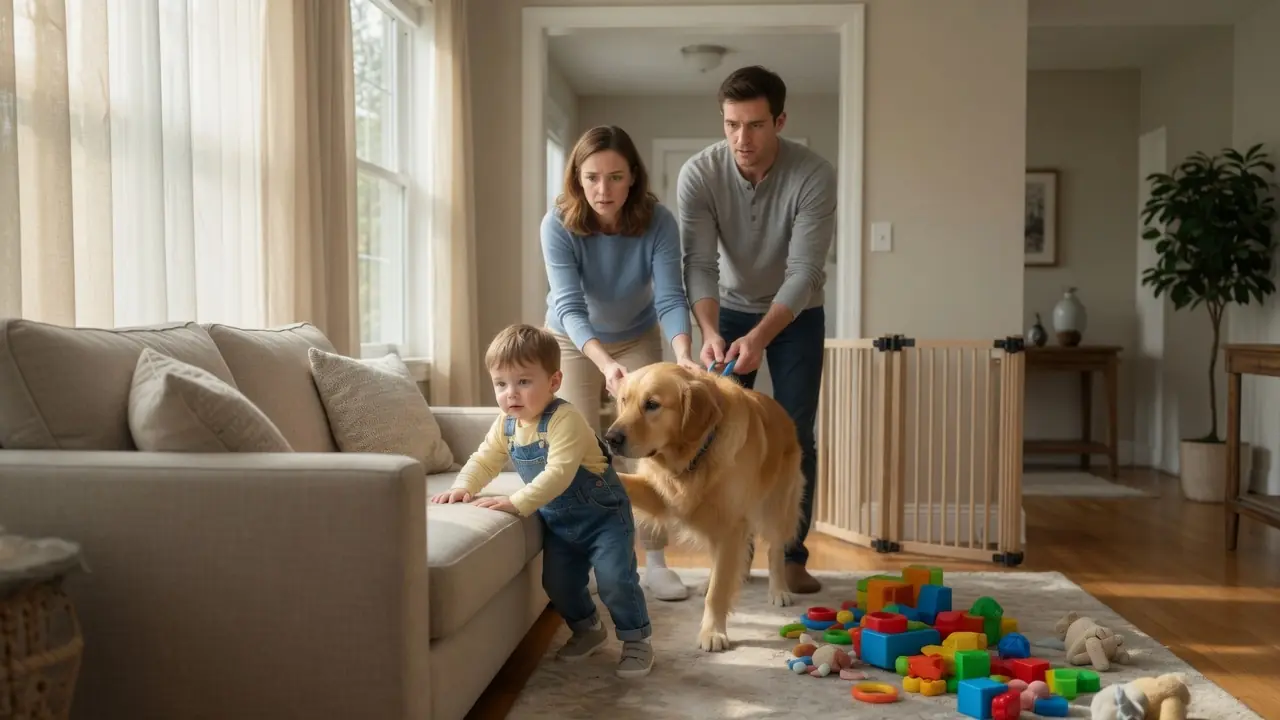
Before he could take a step, Max rose suddenly.
The dog crossed the space in two quick movements and pressed his shoulder against Noah’s chest.
Noah fell backward onto the rug.
He stared upward, shocked.
Then he began to cry.
“Max!”
Daniel grabbed the dog by the collar and pulled him away.
Max did not resist.
He only stared at Noah.
His ears were lowered.
His breathing came quickly.
Emily lifted her son and checked his head.
“He’s okay.”
Daniel looked at the dog.
“What was that?”
Max had lived with them for six years.
He was gentle with everyone.
He allowed neighborhood children to pull his ears.
He slept through thunderstorms.
He once carried an injured bird from the backyard and placed it carefully on the porch without leaving a mark.
Most importantly, he had adored Noah from the moment the baby came home.
During Emily’s pregnancy, Max followed her everywhere.
After Noah was born, the dog slept beside the crib.
He waited outside the bathroom during baths.
Whenever Noah cried, Max found the nearest adult and nudged them until they responded.
He had never shown jealousy.
He had never knocked Noah down before.
“It must have been excitement,” Emily said.
Daniel kept one hand on Max’s collar.
“That didn’t look like excitement.”
Max whined.
Noah reached toward him.
“Ma.”
That was Noah’s name for Max.
The dog tried to move closer.
Daniel held him back.
“Not now.”
Ten minutes later, everything appeared normal again.
Noah sat on the floor stacking wooden blocks.
Max lay across the room watching him.
Emily replayed the video she had accidentally recorded.
At first, it seemed exactly as they remembered.
Noah stood.
Max moved.
Noah fell.
But when Emily watched again, she noticed something strange.
Max had not run directly at the child.
He had waited.
His eyes remained fixed on Noah’s legs.
Only when Noah released the table did the dog rise.
Still, there was no reason to believe the behavior meant anything.
Dogs reacted unpredictably sometimes.
Toddlers fell.
Life continued.
The second incident happened the following afternoon.
Emily was folding laundry on the couch when Noah pulled himself up beside a chair.
Max had been sleeping near the hallway.
The moment Noah straightened, the dog’s head lifted.
The dog stood.
Noah released the chair.
Max rushed forward.
This time, he used his nose against Noah’s stomach and pushed him backward.
Noah landed on a pile of towels.
He did not cry.
Emily did.
Not from sadness.
From anger.
“Max, stop!”
The dog backed away.
His tail tucked between his legs.
Emily picked up Noah.
“What is wrong with you?”
Max stared at the child and gave a low whine.
Not a growl.
Not aggression.
Something closer to distress.
Daniel came home twenty minutes later and found Max behind the baby gate near the kitchen.
The dog paced back and forth.
“What happened?”
Emily explained.
Daniel looked toward Noah, who sat in his high chair eating pieces of banana.
“Twice in two days.”
“I know.”
“He could hurt him.”
“I know.”
Max pressed his nose against the gate.
Daniel approached.
The dog looked at him, then toward Noah.
“I don’t understand,” Daniel said quietly.
They discussed calling a trainer.
Daniel suggested a veterinarian first.
Emily searched online for sudden aggression in older dogs.
The results frightened her.
Pain.
Neurological problems.
Territorial behavior.
Stress caused by changes in the home.
Jealousy after a new child received attention.
Noah was no longer a newborn, but his growing mobility had changed the relationship between child and dog.
Perhaps Max tolerated a baby but felt threatened by a walking toddler.
That explanation seemed possible.
It also seemed terrible.
That evening, Daniel moved Max’s bed into the laundry room.
The dog stood at the doorway, refusing to enter.
“Come on,” Daniel said.
Max looked toward the stairs.
Noah’s nursery was on the second floor.
“You can’t sleep beside him tonight.”
Max remained still.
Daniel guided him inside and closed the half door.
For most of the night, the dog did not sleep.
He paced.
Scratched once at the door.
Then lay beneath the small window, listening.
At 2:40 in the morning, Noah began crying.
Max rose immediately and barked.
Daniel came downstairs.
“Quiet.”
Max barked again.
Daniel opened the door.
The dog rushed past him and ran upstairs.
He entered Noah’s room before Daniel could stop him.
Noah stood inside the crib holding the rail.
Max pressed both front paws against the mattress and barked in the child’s face.
Noah sat down abruptly.
Daniel pulled the dog away.
“What are you doing?”
Max struggled harder than he ever had before.
Not toward Daniel.
Toward Noah.
Emily ran into the room.
“What happened?”
“He went after him again.”
Noah sat inside the crib looking confused but unharmed.
Max whined desperately.
The following morning, the veterinarian found nothing wrong with him.
Dr. Laura Kim examined his joints, ears, teeth, vision, heart, and reflexes.
“He’s in very good health for a six-year-old golden retriever.”
“Then why is he doing this?” Emily asked.
Dr. Kim watched a video of the second incident.
“Has he shown aggression at any other time?”
“No.”
“Growling?”
“No.”
“Guarding toys or food?”
“Never.”
“Any attempt to bite?”
“No.”
Dr. Kim replayed the video.
“He isn’t using his mouth.”
Daniel folded his arms.
“He’s still knocking down a two-year-old.”
“Yes.”
The veterinarian watched again.
“What happens immediately before each incident?”
“Noah stands,” Emily said.
“Anything else?”
They looked at the screen.
Noah’s face.
His posture.
His hands releasing the chair.
Nothing appeared unusual.
Dr. Kim looked toward Max, who was lying beside the examination table.
Noah sat on Emily’s lap.
The dog’s eyes remained fixed on the child.
“Try putting Noah on the floor,” the veterinarian said.
Emily hesitated.
“With Max loose?”
“I’ll hold his leash.”
She placed Noah on the floor.
The boy crawled toward a low bench.
Max rose.
Dr. Kim shortened the leash.
Noah grabbed the bench and pulled himself upright.
Max’s entire body changed.
His ears lifted.
His muscles tightened.
He began pulling forward.
“Max,” Dr. Kim said.
The dog ignored her.
Noah stood fully.
Max whined.
Then barked.
He pulled with enough force that the veterinarian had to brace both feet.
Daniel stared.
“That’s exactly what he does.”
Dr. Kim looked at Noah.
The boy’s face had become slightly pale.
It lasted only a second.
Then the color returned.
“Has Noah been evaluated recently?”
Emily frowned.
“For what?”
“Anything unusual. Fainting. Weakness. Delayed movement?”
“He was a late walker.”
“How late?”
“He’s two and still mostly crawls.”
“What does his pediatrician say?”
“That some children develop later.”
Dr. Kim looked toward the dog.
“I don’t think Max is jealous.”
Daniel’s expression changed.
“Then what?”
“I’m not sure.”
She released some pressure on the leash.
Max moved toward Noah slowly.
The child was sitting again.
The dog licked his face and lay beside him.
All tension disappeared.
Dr. Kim watched carefully.
“He reacts only when Noah stands.”
“Yes,” Emily said.
“And when he sits or falls?”
“He becomes calm.”
Daniel looked toward Max.
“You think he’s afraid Noah will fall?”
“Possibly.”
“Why would he know?”
“Dogs notice small changes we miss.”
Dr. Kim handed the phone back.
“I would schedule a pediatric appointment.”
Emily felt a sudden coldness.
“You think something is wrong with our son?”
“I think it would be responsible to check.”
Noah’s pediatrician examined him the next day.
Dr. Michael Reeves listened to his heart.
Checked reflexes.
Watched him crawl.
Tested muscle tone.
Everything seemed normal.
Noah laughed during most of the appointment and tried to take the doctor’s stethoscope.
“He appears healthy,” Dr. Reeves said.
Emily looked toward Daniel.
“What about the standing?”
“Some toddlers are cautious.”
“He goes pale sometimes.”
“How often?”
“I only noticed after the veterinarian mentioned it.”
“Any loss of consciousness?”
“No.”
“Seizures?”
“No.”
“Breathing problems?”
“No.”
Daniel showed the doctor the videos.
Dr. Reeves watched Max knock Noah down.
Then watched again.
“The dog reacts before Noah visibly loses balance.”
“That’s what concerns us,” Emily said.
The doctor remained thoughtful.
“I can order blood work and a cardiology evaluation.”
“Cardiology?” Daniel asked.
“It may be unnecessary. But certain heart-rhythm conditions can cause brief changes in blood flow when a person changes position.”
Emily’s chest tightened.
“Wouldn’t we have seen symptoms?”
“Not always.”
The earliest cardiology appointment was three weeks away.
Daniel tried to get one sooner.
The receptionist promised to call if there was a cancellation.
In the meantime, they kept Max separated from Noah whenever the child played on the floor.
The arrangement distressed everyone.
Max refused to eat unless he could see the boy.
Noah crawled toward the baby gate and pushed toys through the bars.
“Ma.”
Max rested his head against the gate.
Emily sometimes found them sleeping on opposite sides of it.
She began doubting herself.
Perhaps Max was trying to protect Noah.
But protecting him by knocking him down could still cause injury.
They could not allow the behavior to continue based on an uncertain theory.
Daniel contacted a dog trainer named Karen Holt.
She came to the house on Friday.
Karen had worked with service dogs, rescue animals, and behavior cases for more than twenty years.
She watched Max from the moment she entered.
“He’s highly focused on your son.”
“That’s the problem,” Daniel said.
Karen observed Noah crawling.
Max lay behind the baby gate.
His eyes followed every movement.
“Open the gate,” she said.
Emily shook her head.
“He’ll push him.”
“I’ll control Max.”
Karen attached a leash.
Noah crawled toward the couch.
The dog remained calm.
The boy pulled himself upright.
Max rose instantly.
His nose lifted toward the air.
Then he pulled hard.
Karen held him back.
Noah began to sway.
Max barked sharply.
“Sit him down,” Karen said.
Daniel lifted Noah.
The dog became calm immediately.
Karen knelt beside Max.
“He’s alerting.”
“To what?” Emily asked.
“I don’t know.”
“You’ve seen this before?”
“Not exactly this.”
Karen stroked the dog’s neck.
“Some dogs naturally detect medical changes. Blood sugar. Seizures. Heart-rate shifts. They don’t always respond in ways humans understand.”
Daniel looked at Noah.
“You think Max smells something?”
“Possibly.”
“Then why knock him down?”
“Because he learned that lying down ends whatever he senses.”
Emily felt tears rising.
“So he isn’t attacking him.”
“No.”
Karen looked toward Max.
“He may believe he’s preventing something.”
That evening, Emily allowed Max into the living room while Noah played.
The dog settled beside him.
For the first time in days, both appeared content.
Daniel remained nervous.
“Should we let him keep doing it?”
“No,” Emily said. “We watch.”
Noah crawled toward the coffee table.
Max stood.
Emily moved closer.
The boy reached upward.
Before he could pull himself to standing, she lifted him.
Max immediately sat.
Daniel looked at her.
“He knew.”
“I know.”
On Sunday morning, the hospital called with a cancellation.
The cardiology appointment was scheduled for Monday.
They almost made it.
At 4:17 Sunday afternoon, Emily was in the kitchen preparing dinner.
Daniel sat on the floor assembling a wooden train set with Noah.
Max lay nearby.
For several days, the dog had not knocked the child down because the family intervened whenever Noah tried to stand.
Daniel reached into the toy box for another train piece.
Noah crawled toward the couch.
Max lifted his head.
The baby gate between the dog and child had been removed.
Daniel saw Noah grab the cushion.
He also saw Max rise.
“No, Max.”
The dog froze.
His training held him in place.
Noah stood.
Max whined.
Daniel pointed toward the dog bed.
“Stay.”
Max took one step forward.
“Stay!”
The dog stopped.
Noah smiled.
He released the couch.
For one brief second, he stood alone.
Then his face lost all color.
His eyes rolled upward.
His knees folded.
Noah collapsed before Daniel could reach him.
Max broke the command.
He lunged forward and positioned his body beneath the child’s head.
Noah struck the dog’s side instead of the floor.
Emily dropped a plate in the kitchen.
Daniel lifted Noah.
The child was limp.
“Noah!”
No response.
His lips had begun turning blue.
Emily called emergency services.
Daniel laid Noah on the rug.
Max moved around them frantically, barking toward the front door, then returning to lick the child’s hand.
After several terrifying seconds, Noah gasped.
His eyes opened.
He began crying.
Daniel held him against his chest.
“What happened?” Emily sobbed.
Max pressed his body against them.
The ambulance arrived nine minutes later.
To Daniel, it felt like an hour.
Paramedics placed monitors on Noah.
His heart rhythm appeared irregular.
They transported him to St. Matthew’s Children’s Hospital.
Emily rode in the ambulance.
Daniel followed in the car.
Max remained at home with their neighbor, pacing from window to door.
At the hospital, Noah underwent blood tests, an electrocardiogram, an echocardiogram, and continuous heart monitoring.
The first tests showed nothing conclusive.
Then, shortly after midnight, Noah tried to stand inside the hospital crib.
His heart rate changed abruptly.
The monitor alarmed.
A nurse guided him back down.
The rhythm returned to normal.
The pediatric cardiologist, Dr. Samantha Lee, reviewed the recording.
She ordered additional testing.
The following afternoon, she met with Emily and Daniel in a small consultation room.
Noah slept in Emily’s arms.
“What did you find?” Daniel asked.
Dr. Lee folded her hands.
“Your son has a rare cardiac rhythm disorder.”
Emily tightened her hold on Noah.
“What kind?”
“His heart occasionally enters an abnormally fast rhythm when his body is under certain kinds of stress.”
“What stress?” Daniel asked.
“Standing is one trigger.”
Dr. Lee explained that when Noah moved from sitting or crawling to standing, his body had to adjust blood pressure and circulation.
Most of the time, that happened automatically.
For Noah, the position change sometimes triggered an electrical disturbance in the heart.
His heart beat too quickly to pump blood effectively.
Blood flow to his brain dropped.
That caused the paleness, weakness, and collapse.
“Is it dangerous?” Emily whispered.
“Yes.”
The room became silent.
Dr. Lee continued gently.
“The good news is that we found it.”
“Can it be treated?”
“Yes.”
She outlined the options.
Medication.
Monitoring.
Possibly a procedure later, depending on how Noah responded.
For now, they would begin treatment immediately and teach the family what warning signs to watch for.
Daniel looked toward his sleeping son.
“If Max hadn’t knocked him down…”
Dr. Lee looked confused.
“Max?”
“Our dog.”
Emily explained.
Every time Noah stood, Max pushed him down.
The cardiologist listened without interrupting.
“He reacted before Noah collapsed today,” Daniel said.
“He has probably been reacting for weeks.”
Dr. Lee looked toward the heart-monitor readings.
“Dogs can detect changes in body chemistry, breathing, movement, and heart rate that humans may not perceive.”
“So he knew?” Emily asked.
“We can’t know exactly what he sensed.”
The doctor’s expression softened.
“But he appears to have recognized that standing was followed by danger.”
Daniel covered his face with one hand.
For days, they had scolded Max.
Locked him away.
Called him jealous.
Considered sending him to another home.
The dog had been trying to keep Noah conscious.
Emily cried quietly.
“He was saving him.”
Dr. Lee nodded.
“In his own way, yes.”
Noah remained in the hospital for four days.
The medication stabilized his heart rhythm.
Doctors monitored him while he stood with support.
There were no further episodes.
On Thursday afternoon, the family returned home.
Their neighbor had kept Max in the backyard so he would not rush the car.
The moment Daniel opened the gate, the golden retriever ran toward them.
He stopped several feet from Noah.
His entire body trembled.
Emily carried the boy closer.
Max sniffed Noah’s feet.
His legs.
His chest.
Then he pressed his head against the child’s stomach.
Noah laughed.
“Ma!”
The dog’s tail struck the ground.
Emily knelt and wrapped one arm around Max’s neck.
“I’m sorry.”
Max licked her cheek.
Daniel sat beside them.
“You were trying to tell us.”
The dog looked toward Noah.
For several days, Max remained unusually close.
Whenever Noah stood, the dog rose.
But he no longer pushed immediately.
He watched.
The medication had changed something he could detect.
Sometimes Max sniffed the air and lay down again.
Other times, he whined softly and nudged Emily’s hand.
The family began recording every reaction.
Dr. Lee encouraged them to continue.
“If Max alerts before an episode, that information could be useful.”
Karen Holt returned to help transform the dog’s natural behavior into a safe medical alert.
The goal was simple.
Max needed to stop knocking Noah down.
Instead, he would learn to alert an adult.
Karen taught him to touch a small button with his paw.
The button produced a loud chime.
Whenever Noah stood and Max showed concern, they directed him toward it.
The first weeks were confusing.
Sometimes Max pressed it because he wanted food.
Once he pressed it repeatedly when a squirrel appeared outside.
But gradually, he understood.
Stand.
Dangerous scent or sound.
Press the button.
Find an adult.
Sit beside Noah.
Three months later, the system proved its value.
Noah was playing in the living room when he pulled himself upright beside a toy shelf.
Max lifted his head.
He sniffed.
Then ran to the button.
Chime.
Emily looked up.
Max returned to Noah and sat against his legs.
The boy appeared normal.
Emily checked the portable heart monitor doctors had provided.
His rhythm had begun accelerating.
She gave the emergency medication exactly as instructed and lowered him onto the couch.
Within minutes, his heart rate returned to normal.
When Dr. Lee reviewed the data, she stared at the timing.
“Max alerted before the monitor alarm.”
Emily looked toward the dog asleep beneath Noah’s chair.
“He always does.”
The cardiology team helped connect the family with a medical-alert-dog organization.
A trainer evaluated Max.
He had never received formal service-dog training.
He was older than most dogs entering the program.
But his natural ability and bond with Noah were extraordinary.
The organization agreed to certify him after additional work.
Max learned to alert by pawing Emily or Daniel, pressing the emergency button, and lying beside Noah to prevent a fall.
He learned to retrieve a small medication pouch.
He learned to bark twice if no adult responded.
Most importantly, he learned not to push.
Noah learned too.
As his speech improved, he began saying, “Max says sit.”
Whenever the dog alerted, Noah lowered himself without argument.
At first, Emily believed the obedience came from training.
Then she realized Noah trusted Max in a way he trusted nobody else.
The dog had been beside him before he understood danger.
Max became more than a pet.
But the family refused to describe him as a machine or medical device.
He still stole socks.
Rolled in mud.
Barked at delivery drivers.
And waited beneath Noah’s chair for food to fall.
His new responsibility did not erase who he had always been.
A loving, imperfect dog who had noticed something was wrong.
News of the story spread after the medical-alert organization shared it during a fundraising event.
Local reporters arrived.
Then national ones.
They asked Emily to describe the moment she realized Max had not been jealous.
She struggled every time.
“We were afraid of him,” she said during one interview.
“We thought he was becoming dangerous.”
The reporter asked, “Do you feel guilty?”
“Yes.”
Emily looked toward Max, who was lying beside Noah.
“But guilt only matters if it changes how you listen.”
Daniel disliked the attention.
He worried people would romanticize the story and ignore the medical reality.
Max had helped.
Doctors had diagnosed and treated Noah.
Both mattered.
During one interview, a host called the dog a miracle.
Daniel answered carefully.
“Max wasn’t a miracle instead of medicine.”
The host looked surprised.
“He was the reason we reached medicine in time.”
That distinction became important to the family.
They began working with the hospital and the medical-alert organization to teach parents about unexplained fainting, paleness, and exercise-related weakness in young children.
Most children who fell while learning to walk were healthy.
Most dogs who nudged toddlers were simply excited.
But repeated patterns deserved attention.
The family’s message was not to treat every pet as a doctor.
It was to stop dismissing behavior simply because they did not yet understand it.
Noah’s condition improved.
Medication controlled most episodes.
At age four, he underwent a specialized procedure to correct the abnormal electrical pathway in his heart.
The procedure lasted several hours.
Max waited at home because hospital policy did not allow him inside the surgical area.
He remained beside the front door the entire day.
When Noah returned, the dog sniffed him carefully.
Then walked around him twice.
Noah stood.
Max watched.
Nothing happened.
No whining.
No button.
No urgent movement.
The dog lay down.
Emily began crying.
Daniel placed an arm around her.
“He knows.”
For the first time since Noah learned to stand, Max appeared unconcerned.
Weeks passed without an alert.
Then months.
Noah began walking confidently.
At first, Max followed one step behind him.
Soon, he allowed the distance to grow.
Noah ran across the backyard.
Max ran beside him.
Not blocking.
Not pushing.
Simply playing.
One afternoon, Daniel found Emily watching them from the porch.
Noah threw a red ball.
Max chased it across the grass.
“He looks younger,” Emily said.
“Who?”
“Max.”
Daniel smiled.
“He finally thinks Noah is safe.”
The dog returned carrying the ball.
Noah hugged his neck.
Max dropped the ball and licked the boy’s face.
Years later, Noah remembered almost nothing about his heart condition.
He remembered hospital rooms in disconnected images.
A nurse with purple glasses.
A red balloon.
His mother crying near a window.
But he remembered Max clearly.
The dog sleeping beside his bed.
The sound of the alert button.
The warm body against his legs whenever he felt weak.
Max lived until Noah was nine.
His muzzle turned white.
His steps slowed.
He no longer climbed the stairs without help.
The heart condition never returned, but the alert button remained in the living room.
Sometimes Max pressed it accidentally while walking past.
Every time the chime sounded, Noah came running.
“What is it, buddy?”
Usually, the dog wanted a treat.
On his final morning, Max could not rise from his bed.
Noah sat beside him and placed one hand on his golden fur.
The dog opened his eyes.
His tail moved once.
“You can rest,” Noah whispered.
Emily stood in the doorway crying.
Daniel knelt beside his son.
Max died peacefully that afternoon with the entire family around him.
They buried him beneath the maple tree in the backyard.
Noah chose the words for the stone.
MAX
MY FIRST BEST FRIEND
HE KNEW BEFORE WE DID
The medical-alert organization later created a training fund in Max’s name.
It helped families who could not afford service dogs.
Noah donated the red alert button to the children’s hospital.
The hospital placed it inside a display beside a photograph of a young boy standing with one hand on a golden retriever’s head.
The plaque explained that animals could sometimes notice changes before people did.
But the final sentence mattered most.
PAY ATTENTION TO PATTERNS, EVEN WHEN YOU DO NOT YET UNDERSTAND THEM.
When Noah became old enough to hear the full story, he struggled with one detail.
“You thought Max wanted to hurt me?”
Emily looked down.
“Yes.”
“Why?”
“Because we only saw what he did.”
Daniel continued.
“We didn’t understand why he did it.”
Noah looked toward the photograph.
“He kept pushing me down.”
“Yes.”
“Because standing made my heart go wrong.”
“That is what we believe.”
Noah remained quiet.
Then he said, “He couldn’t tell you.”
“No.”
“So he showed you.”
Emily felt tears fill her eyes.
“Yes.”
That was exactly what Max had done.
The family once believed their dog was jealous of the baby.
Then they thought he had become unpredictable.
Dangerous.
A problem that needed to be separated from their child.
In truth, Max had been responding to a danger nobody else could see.
He did not know the name of Noah’s condition.
He did not understand electrical pathways, blood pressure, or abnormal heart rhythms.
He only knew that whenever the small boy stood, something changed.
A sound.
A scent.
A rhythm.
And if Noah returned to the floor, the danger stopped.
So Max did the only thing he knew how to do.
He knocked him down.
Again.
And again.
Until the people he loved finally understood that the dog they were trying to stop had been trying to stop something far more dangerous.