Every morning at exactly seven fifteen, Max scratched the same place on the hallway wall.
Not somewhere close to it.
Not along the baseboard.
Not at the corner where mice or insects might have hidden.
The exact same spot.
Thirty inches above the floor, between a row of family photographs and a narrow linen closet, where years of afternoon sunlight had faded the floral wallpaper into a pale rectangle.
Scratch.
Pause.
Scratch.
Then Max would press his nose against the wall and release a low, unhappy whine.
At first, the Bennett family thought it was funny.
Max was a six-year-old Golden Retriever with patient brown eyes, a gentle face, and the unwavering belief that every person who entered the house had come specifically to visit him.
He had never destroyed furniture.
He did not chew shoes.
He did not dig through trash unless someone left roasted chicken within reach, and even then, he usually looked guilty before anyone discovered what he had done.
So when he began scratching the hallway wall one spring morning, twelve-year-old Ellie Bennett laughed and called him a confused carpenter.
Her younger brother, Noah, sat beside Max and copied the movement with both hands.
Their mother, Sarah, took a photograph.
Their father, David, examined the wall for insects, loose paint, or anything else that might have attracted the dog’s attention.
He found nothing.
“Probably a mouse,” David said.
There were no droppings.
No sounds during the night.
No openings around the baseboards.
Still, David placed two traps in the crawlspace.
Both remained untouched.
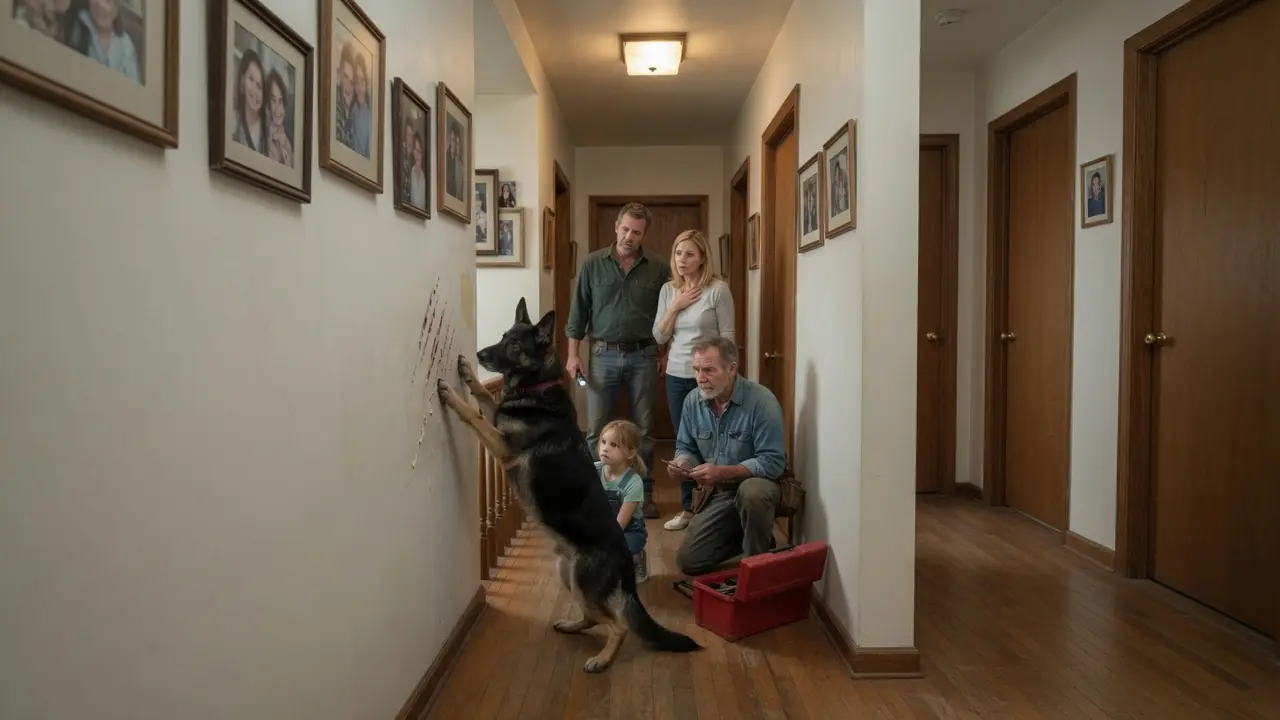
The following morning, Max returned at seven fifteen and scratched again.
His claws dragged rapidly across the drywall.
Scratch.
Pause.
Scratch.
Then came the same low whine.
“Max,” Sarah called from the kitchen. “Stop.”
He stopped immediately.
He looked toward her with his ears lowered.
Then he looked back at the wall.
The next morning, he returned.
Within a month, the paint began peeling.
David repaired the area with joint compound, sanded it smooth, and applied a fresh coat of paint.
Max waited until it dried.
Then he scratched through the new surface.
David installed a thin wooden panel.
Max scratched the panel.
Sarah placed a console table against the wall.
Max squeezed between the table and the hallway, knocking a vase onto the floor in the process.
They bought puzzle toys.
They increased his walks.
They changed his food.
They took him to a veterinarian.
Dr. Helen Moore examined Max carefully and found nothing physically wrong.
“Has anything changed inside the house?” she asked.
Sarah and David looked at one another.
Nothing recent had changed.
But the house itself carried a history they rarely discussed.
The Bennetts had purchased the two-story home outside Cedar Falls, Iowa, eight years earlier.
It had been built in 1948 by a local carpenter named Walter Hayes, who lived there with his wife, Margaret, and their two children.
The house changed owners several times after the Hayes family left.
During the inspection, the Bennetts learned about outdated wiring, old plumbing, and minor water damage in the basement.
Nothing unusual for a house that old.
The wall Max scratched separated the upstairs corridor from a narrow unused area behind the staircase.
According to the original floor plans, there should have been nothing inside except several pipes and old electrical lines.
Dr. Moore suggested anxiety.
A trainer suggested boredom.
An animal behavior specialist believed Max might hear a vibration or sound the family could not detect.
They placed a white-noise machine in the hallway.
It changed nothing.
They installed a baby gate.
Max waited until someone forgot to close it.
They sprayed the wall with a scent dogs disliked.
Max sneezed several times, walked away, and returned ten minutes later.
Over time, the scratching stopped being amusing.
It became irritating.
Then expensive.
David repaired the wall four times.
On the fifth occasion, he replaced an entire section of drywall.
The following morning, before the family finished breakfast, Max scratched through the fresh paint.
David stood in the hallway holding a coffee mug.
“Enough!”
Max froze.
David rarely raised his voice at him.
The dog lowered his head.
His tail disappeared between his legs.
David regretted the shout immediately.
“I’m sorry.”
He placed the coffee on the floor and knelt beside him.
“But I don’t understand what you want.”
Max moved closer and placed one paw against David’s knee.
Then he turned his head toward the wall.
David pressed his palm over the scratched area.
The surface felt cool.
But old interior walls often felt cold during winter.
He heard no movement.
No dripping.
No scratching from inside.
No hum from electrical wires.
Nothing.
“What is in there?” Ellie asked behind him.
“Probably nothing.”
“Then why does he keep doing it?”
David looked at Max.
“I don’t know.”
By the end of the first year, they covered the damaged area with a thick acrylic shield commonly used to protect doors from large dogs.
Max could no longer reach the paint.
But every morning, he returned and dragged his nails across the clear surface.
The noise echoed through the house.
Scratch.
Pause.
Scratch.
Then the same quiet whine.
Noah began calling it Max’s morning job.
Ellie stopped laughing.
She became convinced he was trying to communicate.
“Maybe someone is trapped inside.”
“There is not a person in the wall,” David said.
“Maybe there used to be.”
Sarah looked at her daughter.
“Please don’t start telling ghost stories before school.”
But Ellie had already begun researching the history of the house.
She searched newspaper archives and public records.
Most of what she found was ordinary.
Walter Hayes had owned a small construction business.
He died in 1986.
His wife, Margaret, remained in the house for several years before moving into assisted living. She died nine years later.
Their son, Thomas, moved to Arizona.
Their daughter, Claire, disappeared in September 1969.
Claire had been seventeen.
The newspaper article contained only a few paragraphs.
LOCAL TEEN REPORTED MISSING
According to the report, Claire had argued with her parents and left home voluntarily.
Police believed she might have traveled to Chicago with an older boyfriend.
No body was found.
No arrest was made.
The case eventually became another forgotten file inside a police archive.
Ellie printed the article.
The black-and-white photograph showed a teenage girl with dark hair, bright eyes, and a smile that seemed almost too hopeful for the story beneath it.
She showed it to Noah.
“Don’t tell Mom,” she whispered.
Noah stared at the photograph.
“Do you think she’s inside the wall?”
“No.”
Ellie looked toward the hallway.
“But maybe Max smells something connected to her.”
Children could turn a strange habit into a mystery.
Adults were much better at finding reasons not to.
Sarah told Ellie that old houses made noises.
David suggested that pipes expanded when the temperature changed.
Life continued.
Sarah worked long shifts as a nurse at Cedar Falls Memorial Hospital.
David managed a hardware store.
Ellie entered middle school.
Noah joined a baseball team.
Max scratched the wall.
Every morning.
Through spring rain.
Summer heat.
Autumn wind.
Winter snow.
Eventually, the sound became part of the house.
Then the headaches began.
At first, Sarah blamed her hospital schedule.
She came home exhausted with pressure behind her eyes and nausea she could not explain.
David began waking with a sore throat.
Ellie said the hallway smelled strange.
“Like wet pennies,” she explained.
David inspected the plumbing beneath the upstairs bathroom.
Everything appeared dry.
Noah developed a cough that lasted three weeks.
The doctor called it seasonal irritation.
Max became more insistent.
He no longer scratched only in the morning.
Some nights, he stood in the hallway staring at the wall.
His ears pointed forward.
His body remained rigid.
When the family called him, he refused to leave.
One night, Sarah woke around three and found Max lying beside the wall with his nose pressed against the baseboard.
“What are you doing, sweetheart?”
Max looked at her and whined.
She knelt beside him.
The wall felt colder than the surrounding drywall.
The next day, David borrowed a moisture meter from the hardware store.
The reading was slightly elevated.
Not enough to indicate a major leak.
A week later, the level had risen.
They called a plumber.
He inspected every accessible pipe.
“There could be condensation inside the wall,” he said. “But I don’t see an active leak.”
“Should we open it?” Sarah asked.
“Not unless the readings become worse.”
Opening the wall meant dust.
Repair costs.
Possibly discovering old plumbing that required thousands of dollars to replace.
The Bennetts did not have thousands of dollars.
They waited.
Max continued scratching.
During the second summer, dark discoloration appeared near the baseboard.
David removed the acrylic panel.
The drywall underneath appeared normal except for the old claw marks.
He repainted the baseboard.
The stain returned two weeks later.
A faint musty odor developed.
Sarah worried about mold.
A remediation company inspected the area using a thermal camera.
The technician identified a cool space behind the wall but could not determine its cause without cutting through the drywall.
His estimate for opening, inspecting, and repairing the wall was more than the family could afford.
David bought a dehumidifier.
The odor weakened.
Everyone relaxed.
Max did not.
He scratched harder.
Sometimes he barked.
Sometimes he moved from the wall to the linen closet and back, as if searching for another way inside.
One evening, Ellie sat beside him.
“You know something, don’t you?”
Max placed his head against her shoulder.
She rested one hand on the wall.
For several minutes, she felt nothing.
Then there was a faint vibration.
So slight she might have imagined it.
Ellie pulled her hand away.
“Dad!”
David came upstairs carrying a screwdriver.
“What happened?”
“I felt something moving.”
He pressed his ear against the drywall.
Nothing.
Ellie insisted.
David removed the cover from an electrical outlet and shone a flashlight into the opening.
He saw insulation.
A pipe.
Dust.
No animal.
No movement.
“You probably felt the furnace.”
“The furnace isn’t running.”
David checked the thermostat.
Ellie was right.
Still, he did not open the wall.
Not yet.
The storm arrived in early October.
Weather reports warned of powerful winds, flash flooding, and possible tornadoes.
By sunset, rain struck the windows so violently that the family could barely hear the television.
David carried patio furniture into the garage.
Sarah filled containers with water.
Ellie charged the flashlights.
Noah sat near the basement stairs with Max, watching lightning turn the windows white.
At 9:17, the electricity failed.
The house disappeared into darkness.
Wind howled around the roof.
A branch broke somewhere outside.
Then Max ran upstairs.
“Max!” Ellie called.
The dog ignored her.
He reached the hallway and began scratching with such force that his claws tore through the old paint around the protective panel.
David followed with a flashlight.
“Stop!”
Max barked.
He struck the wall again.
Then something deep inside the structure collapsed.
Not the sound of an animal.
Not a pipe.
A heavy internal movement.
The drywall bulged outward.
Everyone stepped back.
A dark stain spread rapidly from the place Max had scratched for two years.
It moved downward in crooked lines.
Water began dripping onto the floor.
The odor that followed was thick, damp, and rotten.
Sarah covered her mouth.
“Oh, God.”
David touched the wall.
It felt soft.
Another section bulged.
He shut off the main water supply.
The dripping continued.
“This isn’t coming from the plumbing,” he said.
Rain had entered a hidden space behind the staircase.
Whatever had been sealed inside was now soaked.
Max stood several feet away and barked.
But his barking had changed.
It was no longer frantic.
It sounded almost expectant.
As though he had finally made them understand where to look.
The family spent the rest of the night in the living room.
At dawn, David called Frank Doyle.
Frank had repaired plumbing in half the houses in Cedar Falls and complained about nearly every one of them.
He arrived wearing muddy boots and carrying a heavy tool bag.
Max followed him upstairs immediately.
Frank examined the stain, checked the plumbing, and tested the moisture level.
“This wall is full of water.”
“Where is it coming from?” David asked.
“Could be the roof. Could be an old drainage line. Could be something that was built wrong seventy years ago.”
Frank tapped the drywall.
Near the place Max always scratched, the sound changed.
Hollow in one area.
Dense in another.
The dog sat behind him, watching.
“This where he’s been scratching?” Frank asked.
“For two years,” Sarah replied.
Frank studied the claw marks.
“You should have listened sooner.”
David folded his arms.
“We had people inspect it.”
“I’m not blaming you.”
Frank reached for a drywall saw.
“But we’re opening it now.”
He cut a square around the stained section.
The softened drywall offered little resistance.
When Frank pulled away the first piece, an unbearable odor escaped.
He stopped.
“What is it?” Sarah asked.
“Stay back.”
Frank put on gloves and removed the soaked insulation.
Then he froze.
His flashlight remained pointed into the cavity.
David moved closer.
“What did you find?”
Frank did not answer.
He reached carefully into the darkness.
His arm disappeared past the opening.
For several seconds, he searched by touch.
Then he removed a small bundle wrapped in decaying cloth.
He placed it on a towel.
Inside was a leather shoe.
Small.
Old.
A child’s or teenage girl’s shoe.
Sarah pulled Noah behind her.
Ellie stared at it.
Frank reached into the wall again.
This time, he removed a rusted metal lunchbox.
Its lid hung partly open.
Inside were several objects sealed in brittle plastic.
A silver bracelet.
A school photograph.
A folded letter.
A small brass key.
The photograph showed a teenage girl with dark hair.
Ellie ran toward her bedroom.
She returned holding the newspaper article.
The girl in the lunchbox was Claire Hayes.
David looked from the photograph to the wall.
“Call the police.”
Officers arrived within twenty minutes.
Detective Rachel Morgan took control of the house.
She ordered the family away from the hallway while forensic technicians examined the cavity.
The storm had damaged the roof above the staircase.
Water entered through an abandoned ventilation channel and flowed into the hidden space.
As the insulation became saturated, a false wooden panel inside the wall loosened.
Behind it was a narrow sealed compartment.
Nearly three feet wide.
Extending beneath the stairs.
It did not appear on any floor plan.
Frank enlarged the opening.
The odor intensified.
A forensic technician wearing protective equipment crawled into the compartment.
He found a yellow cardigan.
A cracked pair of glasses.
Three notebooks.
A purse.
Then he found human remains.
The Bennett family waited in the kitchen.
Sarah held Noah against her.
David sat beside Ellie.
Max remained at the end of the hallway and refused to move.
When Detective Morgan entered the kitchen, everyone understood before she spoke.
“We found human remains.”
Ellie began crying.
“Is it Claire?”
“We don’t know yet.”
But the bracelet carried the initials C.H.
The notebooks contained Claire’s name.
The purse held an old library card.
Detective Morgan looked toward Max.
“How long has he been scratching that wall?”
“Two years,” David answered.
“Did anything change two years ago?”
The family tried to remember.
Max had not always behaved that way.
He began scratching in March.
Sarah searched through photographs on her phone.
Then she remembered.
They had renovated the upstairs bathroom that winter.
A contractor removed an old ventilation duct and sealed several openings near the staircase.
Before the renovation, air may have circulated freely through the hidden compartment.
After the openings were sealed, moisture and odor might have begun escaping through the smallest remaining crack near the baseboard.
Humans could not detect it.
Max could.
A K9 trainer later explained that dogs could identify the scent of human remains through walls, even after decades, particularly when water or structural changes released trapped particles.
Max had not been bored.
He had not been anxious.
He had not developed a destructive habit.
He had been alerting them.
Every day.
For two years.
The medical examiner confirmed that the remains belonged to Claire Hayes.
She had been seventeen at the time of her death.
The evidence showed she had never run away.
Her notebooks told part of the story.
Claire wrote about constant arguments with her father, Walter.
She wanted to attend art school in Chicago.
Walter believed his daughter should remain in Cedar Falls, marry a local man, and help her mother.
The final entries described a deeper fear.
Claire discovered that Walter had been stealing money from customers through his construction business.
He billed families for materials he never purchased.
He forged receipts.
He took deposits for work that was never completed.
Claire found the records.
She threatened to tell the police.
Her final notebook entry was dated September 14, 1969.
Dad knows I found the receipts.
He says I am confused.
He locked the front door tonight.
If I can get to Mrs. Palmer’s house, I will call someone.
The police reopened the case.
Walter Hayes had died decades earlier.
Margaret was also gone.
Their son, Thomas, was still alive.
He was seventy-two and lived outside Phoenix.
Detective Morgan traveled to Arizona.
At first, Thomas claimed he remembered nothing.
Then she showed him photographs of the compartment.
His hands began to tremble.
Thomas had been thirteen when Claire disappeared.
He remembered hearing an argument between Claire and Walter.
Claire shouted that she would go to the police.
Walter shouted that she would destroy the family.
Then came a heavy impact.
His mother began crying.
Later that night, Thomas saw his father carrying something wrapped in a blanket toward the staircase.
The following morning, Walter told him Claire had run away.
He ordered Thomas never to mention the argument.
“Why didn’t you tell the police?” Detective Morgan asked.
“I was thirteen.”
“You were an adult for more than fifty years.”
Thomas looked down.
“I spent my whole life trying to believe I remembered it wrong.”
The folded letter inside the lunchbox had been written by Margaret Hayes.
It was addressed to Thomas.
It had never been sent.
My dear Thomas,
If you ever find this, forgive me.
Your father struck Claire during the argument.
She fell against the stairs.
He said it was an accident, but she was still breathing when he carried her away.
I begged him to call an ambulance.
He said prison would destroy the family.
He hid her beneath the staircase and forced me to tell everyone she ran away.
I have lived beside her every day since.
I hear her when the house is quiet.
I do not know how to save her without destroying you.
Margaret apparently hid the lunchbox inside the compartment so that someone might eventually discover the truth.
But Walter sealed the opening completely during a later renovation.
The secret remained inside the house for more than fifty years.
Until Max smelled it.
News of the discovery spread across Cedar Falls.
Television crews gathered near the Bennett house.
The cold case appeared on national news.
Reporters called Max the dog who solved a fifty-year-old disappearance.
The Bennetts did not feel that anything had truly been solved.
A girl had died.
Her mother had spent the rest of her life afraid.
Her brother had carried a memory he refused to confront.
The truth came too late for a criminal trial.
But it arrived in time to return Claire’s name to her.
She was no longer the rebellious teenager who ran away after an argument.
She was a victim who had been hidden by the person responsible for protecting her.
Investigators located Claire’s closest surviving friend, Linda Palmer.
She was seventy-three and lived in Wisconsin.
When Detective Morgan called, Linda began crying.
“I knew she didn’t run away.”
Claire planned to sleep at Linda’s house on the night she vanished.
The girls intended to take a bus to Chicago and visit an art school.
Claire never arrived.
Linda told the original investigators about the argument with Walter.
They dismissed it.
Teenage girls ran away all the time, they told her.
“I waited for a letter for fifty-four years,” Linda whispered.
Claire was buried in Cedar Falls Memorial Cemetery on a clear November morning.
The town paid for the service.
Linda attended.
So did Thomas Hayes.
He stood away from the other mourners, holding the letter his mother had never sent.
The Bennett family brought Max.
He sat beside Ellie beneath a maple tree.
A framed copy of Claire’s school photograph rested among the flowers.
Linda spoke during the service.
“She wanted to paint.”
Her voice trembled.
“She saw colors differently from other people.”
Linda looked toward the Bennett family.
“Claire once told me that old houses were full of stories people covered with wallpaper.”
She looked at Max.
“She was right.”
After the service, Thomas approached the family.
He stared at the dog.
“I should have told someone.”
David did not answer.
There was no answer that could repair what silence had done.
Thomas slowly knelt.
Max watched him.
“I’m sorry,” the old man whispered.
Max moved forward and allowed Thomas to place one trembling hand on his head.
Noah watched.
“Do you think Claire forgives him?”
Sarah rested a hand on her son’s shoulder.
“I don’t know.”
Max turned toward Claire’s grave.
Then he lay down beside it.
The Bennett house required extensive repairs.
The hidden compartment was opened completely.
The damaged insulation and walls were removed.
The roof was repaired.
A remediation team treated the staircase and hallway.
David expected Max to return to the new wall.
The first morning after the work was finished, the family waited.
At exactly seven fifteen, Max walked into the hallway.
He stopped in front of the rebuilt wall.
He sniffed once.
Then he turned and followed Sarah into the kitchen.
The scratching never returned.
For weeks, the silence felt unnatural.
No claws against drywall.
No low whine.
No daily frustration.
David sometimes stood in front of the new wall remembering every time he had shouted at Max.
One evening, he sat beside the dog on the living-room floor.
“You were right.”
Max placed his head on David’s knee.
“I’m sorry we didn’t listen.”
Ellie created a small memorial for Claire.
She framed a drawing found inside one of the notebooks.
It showed the house from the road, sketched in pencil with unusual attention to the upstairs windows.
Beneath it, Ellie placed a brass plaque.
CLAIRE HAYES
1952–1969
SHE WAS HERE.
SHE WAS NOT FORGOTTEN.
The memorial hung exactly where Max had scratched.
Visitors sometimes asked whether it made the hallway frightening.
Sarah always said no.
The hidden truth had been frightening.
Remembering Claire was not.
One year later, the county sheriff’s office presented Max with an award.
The ceremony took place at the Cedar Falls courthouse.
Max wore a blue ribbon around his neck.
He tried to chew it during the sheriff’s speech.
Ellie laughed.
Detective Morgan attached a small medal to his collar.
“For extraordinary persistence,” she said.
Noah raised his hand.
“He also ruined the wall.”
The courtroom laughed.
David looked toward the dog.
“No.”
The room became quiet.
“He was trying to save what was behind it.”
The discovery changed more than the Bennett family.
Detective Morgan reviewed other missing-person cases from the same era.
Several involved teenage girls who had been quickly classified as runaways.
A new cold-case project was established.
Linda donated Claire’s surviving artwork to the local high school.
The school created an annual scholarship for students pursuing art despite financial hardship.
The first recipient was a seventeen-year-old girl planning to study painting in Chicago.
Max grew older.
The golden fur around his muzzle turned white.
His hips became stiff.
He spent less time running through the backyard and more time sleeping near the kitchen.
But he remained interested in anything David repaired.
Whenever a toolbox appeared, Max followed.
“Supervisor is here,” David would say.
Max lay nearby until the work was finished.
Nearly four years after the wall was opened, Ellie found him sleeping beneath Claire’s memorial.
For one terrified moment, she thought he was dead.
Then his tail moved.
She lay beside him and wrapped her arms around his neck.
“You scared me.”
Max licked her cheek.
His health declined the following spring.
Dr. Moore explained that his heart was failing.
Medication could keep him comfortable.
Nothing could make him young again.
The Bennett family took him on slow walks.
Noah gave him food from the table when Sarah pretended not to notice.
Sarah allowed him onto the couch after years of insisting dogs belonged on the floor.
David built a ramp over the back steps.
Ellie spent evenings beside him in the hallway, reading aloud.
On Max’s final morning, sunlight entered through the window and fell across Claire’s photograph.
The old dog lay on a blanket surrounded by the family.
His breathing was shallow.
Ellie held one paw.
“You found her,” she whispered.
Max opened his eyes.
His tail moved once.
David rested a hand on his head.
“We finally listened.”
Max died quietly in the hallway.
Only a few feet from the wall he had scratched for two years.
The family buried him beneath the maple tree in the backyard.
They placed no mention of the award or the news reports on his stone.
It read:
MAX
A GOOD DOG
WHO NEVER STOPPED TRYING TO TELL US THE TRUTH
The house eventually became quiet again.
But it did not feel empty.
Claire’s memorial remained on the hallway wall.
Max’s collar hung beside it.
When visitors stopped to read the plaques, Ellie told them the story.
She never described Max as a hero in the dramatic way reporters had.
She described him as loyal.
Persistent.
Certain.
He had smelled something no human could detect.
Then he refused to accept their explanations.
The family thought he was bored.
Then anxious.
Then destructive.
They bought toys.
Hired trainers.
Repaired the damage.
Covered the wall.
But Max had never been ruining anything.
The wall was already hiding something broken.
He had only been trying to open it.
For two years, every scratch carried the same message.
Something is here.
Someone has been forgotten.
Please listen.
When the storm finally weakened the wall enough for human eyes to see what a dog had known all along, the Bennett family understood something they would remember for the rest of their lives.
Loyalty is not always quiet.
Sometimes it scratches.
Sometimes it barks.
Sometimes it returns to the same place every morning, even after being told to stop.
Because truth does not disappear simply because it has been sealed behind a wall.
And sometimes the only one willing to keep searching for it is the dog everyone believes is misbehaving.