The plumber’s saw had traveled less than six inches through the dining-room wall when he suddenly released the trigger.
The high-pitched whine died.
For several seconds, Frank Delaney did not move.
He remained kneeling beside the opening, one hand gripping the saw and the other pressed flat against the faded wallpaper. Fine white dust rested on his gray hair and work shirt.
Behind him, Daniel Harper waited with his arms crossed.
“Well?”
Frank did not answer.
Daniel stepped closer.
The plumber raised one hand without turning around.
“Don’t move.”
Something in his voice made Daniel stop instantly.
Frank leaned toward the narrow cut and listened.
From inside the wall came a faint sound.
Tick.
Hiss.
Tick.
Hiss.
It was so quiet Daniel wondered whether he had imagined it.
Frank slowly placed the saw on the floor.
“Where is your electrical panel?”
“In the basement.”
“And your gas shutoff?”
“Outside, near the meter.”
Daniel’s stomach tightened.
“What did you find?”
Frank finally turned.
His face had lost its color.
“Get your children out of the house.”
Daniel stared at him.
“Frank—”
“Do not turn on a light. Do not unplug anything. Do not use your phone until you’re outside.”
The plumber pointed toward the front door.
“Walk. Don’t run.”
At that moment, a gray tabby cat appeared in the hallway.
His name was Winston.
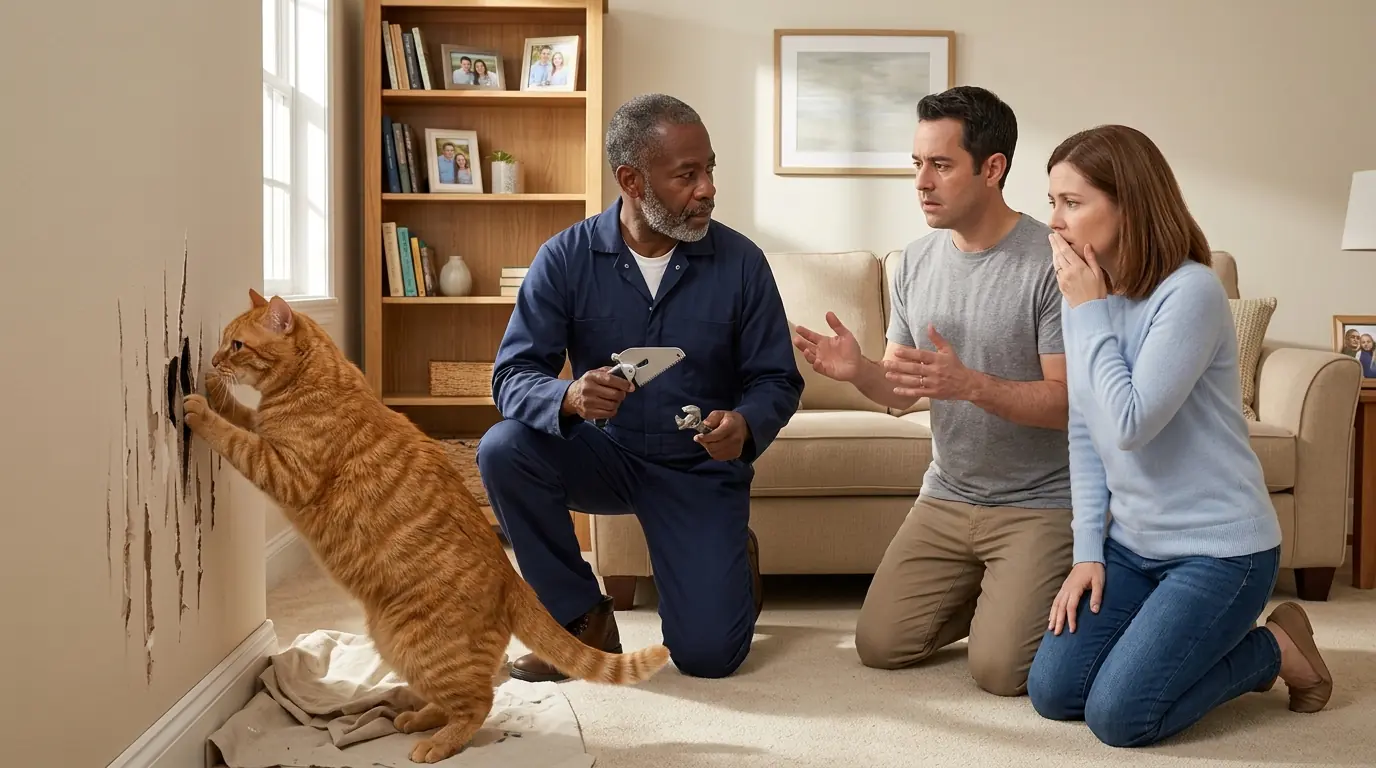
For seven months, Winston had scratched, clawed, cried, and thrown himself against that exact section of wall.
The family believed he had become obsessed with a mouse.
Then they believed he was anxious.
Their veterinarian found nothing wrong with him.
A behavior specialist suggested boredom.
Daniel had repaired the wallpaper three times, placed furniture in front of the spot, sprayed it with citrus repellent, and finally shouted at the cat so harshly that his youngest daughter began crying.
Now Winston stood ten feet from the opening.
His back was arched.
His ears were flat.
A low, urgent sound came from his throat.
Frank looked at him.
“How long has that cat been doing this?”
Daniel’s mouth went dry.
“Since February.”
The plumber glanced back at the wall.
“Then he may be the reason you’re still alive.”
Seven months earlier, the Harpers believed Winston’s behavior was merely one more problem in a house already filled with them.
Daniel had purchased the old home in Cedar Falls, Pennsylvania, after his wife died.
The house stood at the end of Linden Street beneath two enormous maple trees. It had been built in 1927 and still carried evidence of every family who had lived there.
Uneven floors.
Cast-iron radiators.
A narrow staircase that creaked on the fourth step.
Wallpaper hidden beneath newer wallpaper.
Cupboard doors that opened whenever the weather changed.
Daniel loved none of those things when he bought it.
His late wife, Laura, would have.
She had always wanted an old house.
A place with history, she called it.
Daniel called it a building where other people had already used up the reliable years.
Laura died before they could purchase one together.
At thirty-nine, she suffered an aneurysm while preparing breakfast on an ordinary Monday morning.
There had been no warning.
One moment, she was complaining that the coffee maker needed cleaning.
The next, she was on the kitchen floor.
Daniel had spent two years afterward moving through life as though every day were happening behind thick glass.
He continued working as an accountant.
Packed school lunches.
Paid bills.
Attended parent conferences.
He kept his children alive, but he was no longer sure he was raising them.
His son, Michael, was fourteen and had become quiet after Laura’s death.
His daughter, Sophie, was nine and still occasionally asked questions no adult knew how to answer.
Can Mom see us?
Does she know we moved?
Would she like my new teacher?
Daniel bought the house because Sophie said the front porch looked like something her mother would have chosen.
It was not a rational financial decision.
The roof needed repair.
The plumbing was old.
The furnace produced noises that made the children nervous.
But the house had a garden, three bedrooms, and enough distance from their old neighborhood that every grocery store and traffic light no longer reminded them of Laura.
Winston arrived four months later.
They found him at the county animal shelter.
The gray tabby had a torn left ear, white paws, and the deeply suspicious expression of an animal who had already been disappointed by humans.
His records estimated his age at six.
He had been surrendered twice.
The first owner entered assisted living.
The second family returned him after three weeks, describing him as unfriendly and strangely alert at night.
Michael wanted a kitten.
Sophie chose Winston.
“He looks sad,” she said.
Daniel looked at the cat sitting at the back of the enclosure.
“He looks angry.”
“So do you sometimes.”
The shelter worker pretended not to hear.
Sophie crouched.
Winston approached the metal door and pressed his head against her fingers.
That settled the matter.
During the first weeks, Winston remained mostly upstairs.
He slept beneath Sophie’s bed and followed her from room to room. He tolerated Michael, ignored Daniel, and left the room whenever the furnace started.
Then, one cold night in February, Daniel woke to scratching.
At first, he thought an animal was moving in the attic.
He checked the hallway.
Nothing.
The scratching stopped.
The next evening, it returned.
Daniel followed the sound downstairs.
Winston sat beside the dining-room wall near the doorway to the kitchen.
The cat raised one paw and dragged his claws down the wallpaper.
Scrape.
Scrape.
Scrape.
“Stop that.”
Winston looked at Daniel.
Then scratched again.
Daniel picked him up and carried him away.
The cat returned within minutes.
The following morning, long white lines marked the wallpaper.
Daniel placed a chair in front of the spot.
Winston squeezed behind it.
He did not scratch other walls.
He did not damage furniture.
He wanted that exact place.
Michael suggested mice.
Old houses attracted them, and Winston might hear movement behind the plaster.
Daniel set traps in the basement and attic.
They caught nothing.
He contacted a pest-control company.
The technician inspected the exterior, crawlspace, and kitchen.
“No droppings. No nesting material. I don’t see evidence of rodents.”
“What else could he hear?”
“Pipes. The house settling. Insects.”
The scratching continued.
Sometimes Winston pressed his ear against the wall before clawing.
Other times he sat several feet away and stared at the wallpaper for hours.
At night, he cried near the dining room until someone followed him.
Sophie believed a ghost lived inside the wall.
Michael teased her about it, though he stopped walking through the dining room alone after midnight.
Daniel became increasingly frustrated.
The cat woke him before work.
Damaged the wall.
Knocked over a lamp when Daniel placed a narrow table in front of the spot.
One Saturday morning, Daniel found strips of wallpaper scattered across the floor.
Winston’s claws had torn deeply enough to expose the plaster beneath.
Daniel shouted.
“Enough!”
The cat ran.
Sophie appeared in the doorway wearing pajamas.
“Don’t yell at him.”
“He’s destroying the house.”
“He’s trying to tell us something.”
“He is a cat.”
“He knows things.”
Daniel closed his eyes.
He had slept four hours.
A client audit was behind schedule.
The roof repair had cost twice the original estimate.
Sophie’s school counselor had called because she had begun drawing pictures of Laura standing outside the family’s new house.
Daniel heard himself becoming angrier than the damaged wallpaper deserved.
“I cannot handle one more problem.”
Sophie’s expression changed.
She thought he meant Winston.
Perhaps part of him did.
The cat remained beneath her bed for the rest of the day.
That evening, Sophie placed a handwritten sign beside the damaged wall.
WINSTON IS NOT BAD.
Daniel removed it before dinner.
Then returned it after she went upstairs.
The veterinarian found no physical cause for the behavior.
Winston’s hearing was excellent.
His bloodwork was normal.
He showed no neurological problems.
“He may be responding to a sound,” Dr. Helen Morris explained.
“We had someone check for mice.”
“Cats hear frequencies we don’t.”
“What kind of sound?”
“Water movement. Electrical equipment. Insects. Something outdoors reflecting through the wall.”
Daniel looked toward Winston sitting calmly on the examination table.
“Could this be anxiety?”
“Possibly.”
“Can you give him something?”
Dr. Morris studied him.
“Medication should not be our first response to an animal repeatedly focusing on one location.”
“So what should we do?”
“Investigate the location.”
“I have.”
“Then investigate it again.”
Daniel left dissatisfied.
By spring, the scratching had become part of family life.
Guests asked about the damaged wallpaper.
Daniel blamed the cat.
Winston occasionally stopped for several days.
Then the behavior returned more intensely.
During those quiet periods, Daniel believed the problem had ended.
He patched the plaster.
Painted over the marks.
Moved the dining-room cabinet against the wall.
Winston climbed onto the cabinet and scratched above it.
Michael recorded him one night.
The video showed Winston sleeping in the hallway.
His eyes suddenly opened.
He lifted his head before any human-detectable sound occurred.
Then he ran downstairs.
Twelve seconds later, a faint clicking sound entered the recording.
Michael replayed it for Daniel.
“Listen.”
Daniel increased the volume.
Click.
Nothing.
Click.
“It could be the radiator.”
“The heat is off.”
“The refrigerator.”
“The refrigerator doesn’t sound like that.”
Daniel listened again.
The sound was too weak to identify.
He promised to contact someone.
Then work became busy, Michael injured his wrist during baseball practice, and the video disappeared beneath the family’s other problems.
In May, Winston began preventing Sophie from sitting near the wall.
She liked using the floor beside the dining-room cabinet to complete puzzles.
Each time she sat there, Winston walked across the pieces, pushed against her legs, and cried until she moved.
Once, he bit the sleeve of her shirt and pulled.
Not hard enough to injure her.
Hard enough to frighten her.
Daniel separated them.
Sophie defended the cat even while crying.
“He wanted me to move.”
“He cannot bite you.”
“He didn’t bite me. He grabbed my shirt.”
“Because he is becoming unpredictable.”
That night, Daniel searched adoption websites.
He did not complete the surrender form.
The empty section asking for the reason stopped him.
He could not write dangerous.
Winston had never shown aggression anywhere else.
He could not write destructive without remembering the cat pressing against Sophie during her nightmares.
He closed the computer.
In June, the dining room began smelling faintly strange.
Daniel noticed it first after returning from a weekend visit to Laura’s parents.
The odor reminded him of dust, heated metal, and something chemical he could not identify.
He opened the windows.
The smell disappeared.
When it returned two weeks later, he checked the stove.
No burner had been left on.
The carbon-monoxide detectors showed normal readings.
He inspected the basement but found nothing.
The old house produced countless odors.
Wet wood after rain.
Warm paint near radiators.
Dry dust when the furnace started.
Daniel decided this was another one.
Winston did not.
The cat’s scratching became frantic during hot afternoons.
He began digging at the baseboard with enough force to split one claw.
Sophie found small spots of blood near the wall.
She carried him upstairs and cleaned his paw with warm water.
“Please stop,” she whispered.
Winston rested his head against her arm.
At two in the morning, he returned downstairs.
By August, Daniel was considering removing the wall himself.
Calvin Marsh, a contractor who repaired the porch, warned him not to.
“Old houses hide surprises.”
“Mice?”
“Pipes, wiring, structural supports, previous repairs. You cut the wrong thing and turn a small problem into an expensive one.”
Daniel pointed toward the damage.
“The cat has already started.”
Calvin placed one hand against the plaster.
He waited.
“I don’t hear anything.”
“Neither do I.”
“Any water damage?”
“No.”
“Heat?”
Daniel touched the wall.
It felt normal.
Calvin knocked in several places.
Solid wood framing responded behind part of it.
An empty cavity sounded near the scratched area.
“Probably a pipe chase.”
“Can you open it?”
“I could.”
“How much?”
The estimate made Daniel decide the cat could continue scratching.
The family covered the damaged section with a thick decorative panel.
For two weeks, Winston stopped.
Daniel felt victorious.
Then Sophie woke to a crashing sound.
The panel lay on the floor.
Winston had pushed behind it and clawed through a weakened part of the plaster.
His nose was white with dust.
His front paws were bleeding.
Daniel stood over him.
Anger rose.
Then disappeared.
The cat was trembling.
Not from pain.
From fear.
Winston stared at the opening he had made and released a sound unlike his usual cry.
A low, broken howl.
Sophie knelt.
“He’s scared.”
Daniel finally believed her.
Not that the wall contained a ghost.
Not that Winston possessed some supernatural knowledge.
But the cat was responding to something real.
Daniel contacted Frank Delaney the following morning.
Frank had been a plumber for forty-one years.
He repaired older homes other contractors refused to touch because he understood that buildings constructed before modern codes rarely followed the drawings owners possessed.
He arrived Tuesday at eight thirty.
Winston immediately ran to the dining room.
The cat scratched once and looked toward Frank.
“Well,” the plumber said, “at least the customer knows where the problem is.”
Daniel explained the history.
Seven months of scratching.
No rodents.
Intermittent clicking.
Occasional odor.
Frank’s humor disappeared.
“What kind of odor?”
“Dust. Maybe metal.”
“Sulfur?”
“I don’t think so.”
“Rotten eggs?”
“No.”
“Does anyone get headaches?”
Daniel thought.
Michael had complained several times.
Sophie became nauseated one evening during dinner.
Daniel had experienced pressure behind his eyes but blamed work.
“Sometimes.”
Frank inspected the gas appliances.
No immediate leak appeared on his handheld detector.
He checked the plumbing.
An old galvanized water pipe and a gas line both entered the wall from the basement.
The plumbing showed slight corrosion but no active leak.
Then Frank placed a listening device against the dining-room plaster.
He moved it slowly.
At the damaged section, he stopped.
“What do you hear?” Daniel asked.
Frank removed one side of the headphones.
“Something electrical.”
“You’re a plumber.”
“I know what water sounds like.”
He listened again.
“And something else.”
Frank examined the baseboard.
A faint brown stain had formed near the corner, almost invisible against the wood.
He touched it.
The surface was warm.
“Has this always been warm?”
“I’ve never noticed.”
Frank stood.
“I’m going to open a small inspection section.”
Daniel nodded.
Winston positioned himself in the hallway.
Frank drew a rectangle on the wall.
He checked for studs, pipes, and wires.
Then he began cutting.
Six inches later, he stopped moving.
Inside the cavity, an old cloth-wrapped electrical wire had deteriorated until the copper conductor was exposed.
Each time the furnace relay activated, electricity jumped across a narrow gap.
The arc produced the clicking sound Michael’s phone had recorded.
Less than two inches away, a threaded joint in the original gas pipe had corroded.
Gas escaped in a stream too small to trigger alarms in the open rooms but large enough to accumulate inside the sealed wall.
The cavity also contained dry wood shavings and old newspaper insulation from a renovation performed decades earlier.
The electrical arc had already blackened part of the timber.
One spark had been repeatedly jumping beside trapped gas and tinder.
Frank understood the danger instantly.
One wrong movement could create the final arc.
He ordered the family outside.
Daniel sent Michael upstairs for Sophie.
“No switches,” he warned. “Leave everything.”
Sophie ran downstairs carrying Winston.
The cat fought to escape her arms and return to the wall.
Daniel opened the front door.
They crossed the lawn.
Frank followed after shutting nothing off.
He called the fire department from the sidewalk.
Firefighters blocked Linden Street.
The gas company shut the main supply at the road.
An electrician disconnected power from the exterior service.
Only then did the crews enter.
They removed a larger section of wall.
The damage extended upward almost four feet.
Black scorch marks covered a wooden stud.
The newspaper insulation crumbled when touched.
Fire Captain Joseph Randall examined the cavity.
“How long has the cat been reacting?”
“Since February.”
Joseph looked toward Winston.
The tabby sat inside Sophie’s arms with his eyes fixed on the house.
The captain turned to Daniel.
“You were close.”
“How close?”
“I cannot give you a time.”
Joseph pointed toward the charred wood.
“But this had already begun igniting and extinguishing from lack of oxygen. The next sustained arc could have started a hidden fire.”
“And the gas?”
“It could have accelerated it.”
Daniel looked toward the upstairs windows.
Michael’s bedroom sat directly above the wall.
Sophie’s room was across the hallway.
“What would have happened?”
Joseph hesitated.
“We might have received a call about smoke.”
“That isn’t what I asked.”
The captain answered quietly.
“A flash inside the wall could have opened the gas line further. In a wood-frame house this old, fire could reach the second floor before everyone woke.”
Sophie buried her face in Winston’s fur.
Daniel could not speak.
Frank crouched near the cat.
Winston leaned forward and sniffed his hand.
“He heard the arcing,” the plumber said. “He may also have smelled the leak through the baseboard.”
Daniel remembered every time he had carried the cat away.
Every repair.
Every spray meant to discourage him.
The chair.
The cabinet.
The decorative panel.
Winston had spent seven months trying to reach the danger while Daniel repeatedly covered it.
The family stayed with Laura’s parents for nine days.
Electricians replaced the damaged wiring.
The gas company removed the corroded pipe.
Contractors opened additional sections of wall to confirm the problem had not spread.
The repair cost was significant.
Daniel paid it without complaint.
The alternative appeared each night in his imagination.
Smoke filling the staircase.
Children trapped upstairs.
The old house becoming a headline.
He began waking before dawn and checking that Michael and Sophie were breathing.
Winston slept beside Sophie.
When they returned home, the dining room looked different.
The wall had been rebuilt and painted pale blue.
No wallpaper.
No panel.
Daniel placed nothing in front of it.
Winston approached cautiously.
He sniffed the baseboard.
Listened.
Then sat.
For the first time in seven months, he showed no interest in scratching.
Sophie sat beside him.
“You fixed it.”
The cat began washing one paw.
Daniel stood in the doorway.
“I’m sorry.”
Michael looked toward him.
“Who are you talking to?”
“Winston.”
Michael smiled slightly.
“He probably understands.”
Daniel crouched near the cat.
Winston stopped washing and watched him.
“I thought you were destroying the house.”
The cat blinked.
“You were trying to save it.”
Winston turned away and continued cleaning his paw.
That evening, Daniel cooked Laura’s tomato soup recipe.
It was the first family dinner in months when no scratching interrupted them.
The quiet felt strange.
Sophie placed a piece of chicken beneath the table.
Daniel pretended not to see.
The story spread after Frank told another contractor about the cat who detected a wall fire.
A local reporter contacted the family.
Daniel refused at first.
He did not want Winston turned into entertainment.
Then Fire Captain Randall explained that the story might convince other homeowners not to ignore repeated animal behavior, strange odors, warm walls, or unexplained sounds.
Daniel agreed to one interview.
Reporter Melissa Grant stood in the dining room beside the repaired wall.
“Did you believe your cat was trying to warn you?”
“No.”
“What did you think?”
“I thought he was anxious, bored, or misbehaving.”
“How do you feel now?”
Daniel looked toward Sophie holding Winston near the window.
“Ashamed.”
The reporter lowered the microphone slightly.
“You investigated mice, took him to the veterinarian, and hired professionals. You didn’t ignore him completely.”
“I kept trying to stop the behavior.”
Daniel looked at the blue wall.
“I focused on the damage I could see instead of asking what caused it.”
The interview aired that evening.
People called Winston a hero.
A pet-food company offered the family a lifetime supply of food in exchange for using his image.
Daniel declined.
The fire department gave Winston a small red collar with a brass tag shaped like a firefighter’s shield.
Sophie accepted that.
The tag read:
WINSTON HARPER
FIRST TO SOUND THE ALARM
At the ceremony, Winston attempted to climb beneath a folding table.
He disliked applause.
Months passed.
The house became quiet in ordinary ways.
Pipes knocked when the temperature changed.
The fourth stair creaked.
The furnace started without Winston running from the room.
Daniel repaired his relationship with the cat slowly.
Winston did not begin sleeping beside him.
He remained Sophie’s animal.
But he occasionally joined Daniel in the living room after the children went upstairs.
One winter night, Winston climbed onto the opposite end of the couch.
Daniel remained still.
The cat moved closer.
Eventually, he rested against Daniel’s leg.
Daniel placed one hand lightly on his back.
“You tried for seven months.”
Winston purred.
“I’m not proud it took me that long.”
The purring continued.
Daniel looked toward a framed photograph of Laura.
She held Sophie as a baby while Michael stood beside her making a face at the camera.
The old grief entered the room, but it no longer felt like a fire hidden inside a wall.
Daniel had spent years believing he protected his children by controlling every problem.
Fixing schedules.
Paying bills.
Replacing broken objects.
Keeping the house quiet.
Winston taught him something different.
Protection sometimes began with listening to what could not explain itself clearly.
The following spring, Daniel planted hydrangeas beside the porch.
Laura had once said they would make any old house look loved.
Sophie helped.
Michael complained about the digging but carried the soil.
Winston watched from the window.
When Daniel came inside, he noticed the cat staring toward the dining room.
His chest tightened.
Winston walked to the repaired wall.
He sniffed once.
Then continued toward the kitchen.
Daniel laughed with relief.
Years later, the pale blue wall still carried a small framed section near the baseboard.
Inside the frame was a torn piece of the old wallpaper.
Four deep claw marks crossed its surface.
Beneath it, Daniel placed a plaque.
HE KEPT WARNING US UNTIL WE LISTENED.
Visitors often assumed the words referred only to the gas pipe and electrical wire.
For Daniel, they meant more.
They reminded him of Sophie insisting the cat was not bad.
Michael replaying the faint clicking sound.
Dr. Morris advising him to investigate again.
Frank stopping the saw.
And Winston returning to the same wall even after his claws bled.
The cat had no way to describe an electrical arc.
He could not explain trapped gas, deteriorated wiring, or burning insulation.
He knew only that something dangerous lived behind the plaster.
So he used the only language available to him.
Scratch.
Cry.
Return.
Refuse to stop.
The family thought Winston had gone crazy because his warning did not look like a warning they understood.
The plumber cut open the wall and revealed the truth.
But the danger had been there all along.
So had the answer.
Four white paws.
A torn ear.
And a stubborn gray cat who loved his family enough to keep destroying a wall until they finally learned how to listen.