“Well, I reckon most people would say I’m a woman who pays attention.”
That was what I told Tyler years later when he asked how I had spotted the problem in less than a minute.
The truth was simpler.
When you spend nearly three decades working beside a machine, you learn its moods. You hear the difference between a healthy rattle and a dangerous one. You notice when a motor is straining before the warning light ever comes on.
You learn to pay attention because people’s paychecks, fingers, and sometimes their lives depend on it.
I lived in a small town outside Amarillo, where the wind carried red dust beneath doors and into kitchen drawers no matter how tightly you sealed the house. The dust never really settled, and the money was always shorter than the month.
I had spent twenty-eight years on the production line at Panhandle Valley Foods, a cannery that packed beans, tomatoes, chili, and whatever else the contracts demanded. For most of those years, I worked the sealing station.
That station was the heart of the plant.
If the cans did not seal correctly, nothing else mattered. The labels, boxes, forklifts, and shipping schedules all became useless if the product spoiled before it reached a grocery shelf.
I knew the old hand-crimping system. I knew the first automatic sealer and every unreliable model that followed it. I knew which bearing overheated in August and which belt stretched too far during cold weather.
I knew how to listen.
Then my husband, Harold, died.
He had worked as a diesel mechanic most of his life. He was a big, quiet man with hands permanently darkened by grease and a habit of humming when he repaired things.
He died six months before I went back to the cannery.
The doctors said it was his heart, though that did not feel like an explanation. His heart had carried me through thirty-seven years of marriage, two miscarriages, one tornado, three layoffs, and more lean winters than I cared to count.
Then one morning, it simply stopped.
His pension did not continue the way we had expected. Between medical expenses, funeral costs, and an old loan against the house, most of what we had saved disappeared in less than four months.
Grief did not stop the electricity bill.
It did not lower property taxes or fill the gas tank.
I tried to stretch what little money remained. I stopped buying meat unless it was discounted. I turned off the heat in two rooms and wore Harold’s old flannel shirts inside the house.
Eventually, I realized being careful would not be enough.
I needed my job back.
I had retired from the cannery eleven months earlier to care for Harold when his health declined. The old floor manager, Cal Moreno, had promised that if I ever needed to return, he would find a place for me.
“You could run that line blindfolded,” he had said.
So I put on my best blouse, the one that still fit from the nineties, and drove my old Ford pickup through the plant gates.
The parking lot looked different.
The faded employee sign had been replaced with a polished metal one displaying a new corporate logo. Several security cameras had been added around the entrance, and the old smoking bench was gone.
Inside, the plant still smelled like brine, hot metal, and industrial cleaner.
That smell brought twenty-eight years rushing back at once.
I expected Cal to be sitting in his glass booth above the production floor with a mug of black coffee and a pencil tucked behind one ear.
But Cal was gone.
A receptionist with bright red nails told me he had been forced into retirement during a management restructuring.
The new plant manager was a man named Tyler Bennett.
He could not have been a day over thirty. He had a clean jawline, narrow glasses, and a haircut that probably cost more than my weekly groceries.
His office looked like a bank branch. Everything was gray, polished, and empty of personality. There were framed certificates on the wall and a small plastic plant on his desk that did not even require water.
He did not stand when I entered.
He barely looked up from his computer.
“I’m here to reclaim my shift,” I said.
My voice was steady even though my heart was hammering against my ribs.
I gave him my full name and seniority number.
“Darlene Whitaker. Employee number four-seven-eight-two. Sealing and quality control.”
Tyler typed something into his computer.
“You retired,” he said.
“To care for my husband.”
He nodded without looking at me.
“I’m ready to return.”
He continued clicking through screens.
I told him how many years I had worked there. I told him I had trained half the senior operators still on the floor. I explained that I knew the rhythm of the line better than I knew the back of my own hand.
Tyler finally sighed.
It sounded like a tire losing air.
Then he leaned back and looked at me over the rim of his glasses.
“We don’t do things the way we used to.”
“The cans still need sealing.”
“I worked on the new sealer before I left.”
“It has been upgraded.”
“Then I can learn the upgrade.”
His mouth tightened slightly.
“We need people with more stamina. It’s fast in here now.”
For a second, I thought I had misheard him.
“I worked twelve-hour shifts during the tornado shutdown.”
“That was a long time ago.”
“It was six years ago.”
He glanced at the application I had printed at the public library.
“We are building a younger, more adaptable workforce.”
There it was.
He did not ask whether I could still do the job.
He did not ask about the power outage of 2008, when I kept the emergency line moving by hand while the backup generator failed. He did not ask about the recall I prevented after noticing a hairline crack in the crimping head.
He looked at my gray hair and the veins on my hands, and he made his decision.
“Is that it?” I asked.
“It’s a demanding environment.”
“I asked whether that was it.”
Tyler slid my application into the bottom drawer of his desk.
“That’s it.”
Then he turned back to his computer.
The movement was small, almost casual.
Still, it felt like he had swept me into the trash.
I stood there another moment because walking away would make the rejection real.
Tyler did not look up again.
I left his office, crossed the lobby, and walked through the front doors without speaking to anyone.
Outside, the wind was rising.
Dust moved in thin red sheets across the parking lot.
I climbed into my truck and sat behind the wheel. When I opened my purse, I found exactly eleven dollars in crumpled bills, three quarters, and a grocery coupon that had expired two weeks earlier.
I should have driven home.
Instead, I remained in that parking lot for nearly an hour and cried.
It was not only the money.
It was the way Tyler had looked through me.
For twenty-eight years, I had shown up before sunrise, missed family dinners, worked through pain, and kept production running when younger employees panicked. Then a man who did not know the difference between a gear and a gasket decided I was too old to matter.
I had become invisible.
The next three weeks were quiet.
Too quiet.
I filled out applications at grocery stores, a feed supplier, and two discount shops. One store manager told me they were looking for someone who could stand for long periods.
I told him I had stood on concrete floors for most of my adult life.
He never called.
I began selling things.
My grandmother’s silver spoons went first. They had been wrapped in blue cloth inside my kitchen drawer since my wedding day.
Then I sold Harold’s old air compressor to a man from Lubbock who offered fifty dollars less than it was worth.
My good winter coat went to a consignment shop.
Each sale made the house feel emptier.
I stopped turning on the living room lamps at night. Darkness cost less.
On the third Monday after Tyler rejected me, an electric company notice arrived. If I did not pay by Friday, they would disconnect the power.
I placed the notice beneath a saltshaker on the kitchen table and stared at it until the words blurred.
The following afternoon, I was sitting in the same chair with a cup of lukewarm tea when I heard a heavy engine in my driveway.
It sounded like a freight train idling outside my house.
I stood and looked through the blinds.
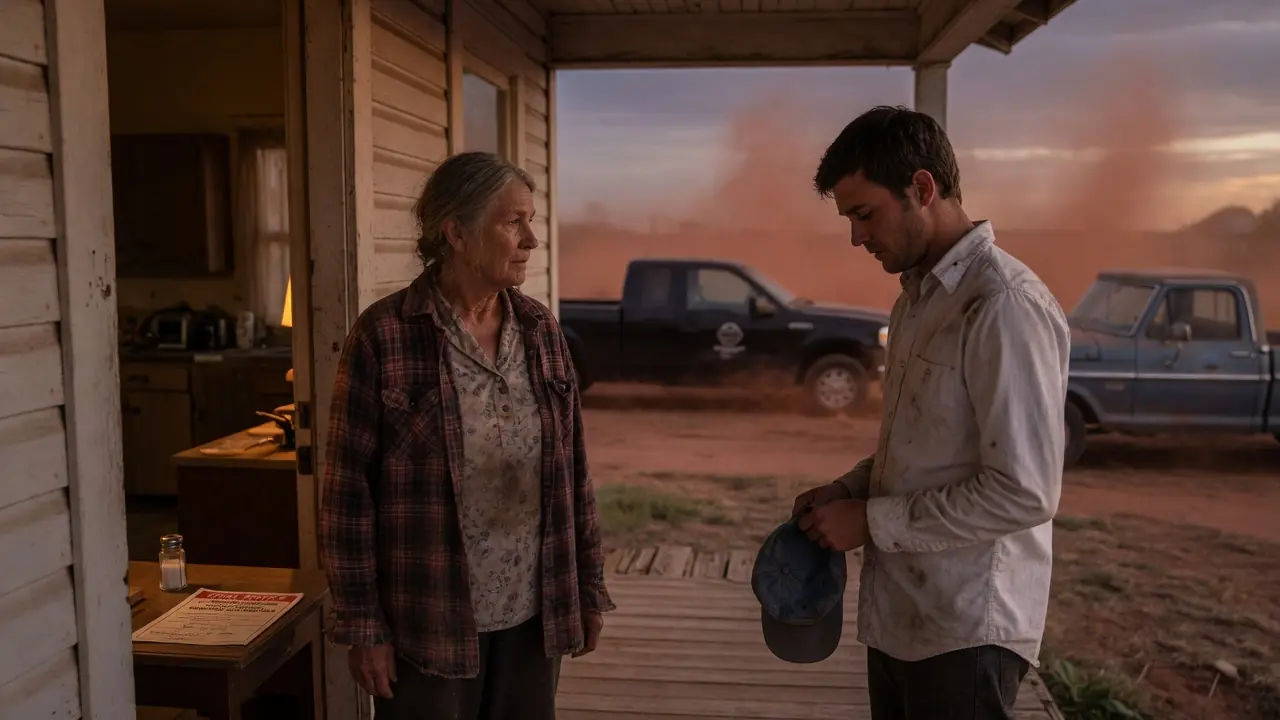
A new black pickup sat beside my old Ford.
Tyler climbed out.
He wore khaki pants and a white company shirt that looked as though it had been slept in. There was grease on his collar and a dark stain beneath one arm.
He stood in the driveway staring at my little house as if he could not believe someone from his workforce might live there.
Without his office and polished desk around him, he looked younger.
He also looked afraid.
I did not open the door.
I watched him climb the porch steps.
He hesitated before knocking.
The sound was frantic and uneven.
I let him knock a second time before opening the door.
I leaned against the frame and said nothing.
“Mrs. Whitaker.”
He was twisting a baseball cap in his hands, turning it until the brim began to bend.
“Darlene,” I corrected.
“Yes. Darlene.”
I waited.
“We’re in trouble.”
I kept my face still.
“We need you at the plant.”
“Do you?”
He glanced back toward his truck.
“Yes.”
“What happened to your younger, adaptable workforce?”
His face colored.
“I deserve that.”
“You deserve more than that.”
He looked down at the porch boards.
“The sealer is failing.”
“Which one?”
“Line Three. The new automatic unit.”
“What is it doing?”
“Jamming every ten minutes. The cans are buckling beneath the crimp head.”
“And your maintenance crew?”
“They’ve replaced the belt, reset the sensors, and recalibrated the control board.”
“Did they check the mechanical tension?”
“They said the system regulates itself.”
I almost smiled.
Machines regulate nothing by themselves. They only follow the instructions people give them, including bad ones.
“How much product is sitting?” I asked.
Tyler swallowed.
“Forty thousand dollars’ worth.”
I raised an eyebrow.
“Forty thousand so far,” he added. “If the shipment misses tonight’s truck, we lose the contract.”
I thought about the twenty-eight years I had spent protecting that plant from exactly this sort of crisis.
I thought about my grandmother’s spoons in a stranger’s house and the electric notice on my table.
“You said I was too slow.”
His shoulders dropped.
“I was wrong.”
He did not offer an excuse.
He simply stood on my porch with dust coating his expensive shoes.
“Please,” he said. “I’ll pay double your old hourly rate. There will be a bonus if you save the shipment.”
“I don’t work for bonuses.”
He looked up.
“I work for respect.”
“You’ll have it.”
“Not only from you.”
“I understand.”
“No, you don’t.”
My voice remained calm, but he stepped back as if I had shouted.
“If I walk through those doors, no one treats me like an old woman who wandered onto the floor. I make decisions at the sealer. Your crew listens. Your engineers listen. You listen.”
He nodded.
“And my time starts now.”
“Now?”
“You drove to my house for my expertise. That means I’m already working.”
“All right.”
“Triple my old rate for the emergency shift.”
His mouth opened.
“Double was before I heard you might lose the contract.”
Tyler looked toward his truck, then back at me.
“Triple.”
“And a written consulting agreement if I find the problem.”
“We can discuss that afterward.”
“No.”
I began closing the door.
“Wait.”
He put one hand against the frame but quickly removed it when I looked down at his fingers.
“What kind of agreement?” he asked.
“Six months. Twenty hours a week minimum. I train your operators and review equipment maintenance.”
“I don’t have authorization for that.”
“Then call someone who does.”
The wind pushed dust across the porch.
Tyler stared at me for several seconds.
Then he took out his phone.
He walked to the edge of the porch and spoke quietly with someone from the corporate office. I heard words like shipment, contract, emergency, and liability.
After ten minutes, he returned.
“Six months,” he said. “Twenty hours a week. Triple pay tonight.”
“Put it in writing.”
“I can email it.”
“My printer is broken.”
He looked past me into the dark house.
“I have a printer in the truck.”
Of course he did.
He printed the agreement from a small portable machine in the back seat. I read every line before signing it.
Then I took my keys from the hook beside the door.
I did not ride with Tyler.
I drove my own truck.
He followed me all the way to the plant.
When we entered, the smell struck me like a ghost.
Brine.
Iron.
Hot oil.
The line was silent.
Pallets of unsealed cans stood near the loading dock while employees gathered around the automatic sealer. Some looked exhausted. Others looked terrified.
A young maintenance technician was kneeling beside the control panel with a laptop.
Tyler clapped his hands.
“Everyone, this is Darlene Whitaker. She’s taking lead on the sealer.”
The technician looked me up and down.
“With respect, we’ve already run every diagnostic.”
I set my purse on a worktable.
“Then the computer has told you everything the computer knows.”
He frowned.
“What does that mean?”
“It means move.”
The crew looked toward Tyler.
He nodded.
The technician stood reluctantly.
I walked around the sealer without touching it.
The metal housing had been removed, exposing the gears and crimp assembly. A pile of crushed cans sat inside a yellow bin.
“Run one,” I said.
The technician looked surprised.
“It will destroy the can.”
“I know.”
He started the machine.
The conveyor moved.
A can entered beneath the sealer head. The machinery pressed down, hesitated, and released with a sharp metallic snap.
The can emerged buckled around the rim.
“Again,” I said.
The second can failed the same way.
“Turn it off.”
I crouched beside the machine.
My knees complained, but I ignored them.
I ran one finger along the guide rail, then placed my hand on the housing near the tension assembly.
The metal was too warm.
“What did you set the tension at?” I asked.
The technician checked his laptop.
“Factory specification.”
“What number?”
“Eight point four.”
“That’s too high.”
“The manual says—”
“The manual assumes a different gauge of aluminum.”
He stared at me.
“This shipment uses the thinner cans from the Oklahoma supplier,” I said. “The old setting was six point nine.”
“That was before the upgrade.”
“The metal does not care about your upgrade.”
One of the older operators coughed to hide a laugh.
I pointed to a tension screw behind the crimp head.
“Who tightened that?”
The technician looked at it.
“It’s automatic.”
“No, it isn’t.”
I took a wrench from the wall.
My hands did not tremble.
I loosened the tension screw a quarter turn, then adjusted the guide rail by less than an eighth of an inch.
“Run it.”
The technician hesitated.
Tyler said, “Do it.”
The machine started.
A can traveled beneath the sealer. The crimping head lowered smoothly, sealed the rim, and released.
The can emerged perfectly shaped.
No one spoke.
“Again,” I said.
Five cans passed through without damage.
Then ten.
The line supervisor checked the seals with a pressure gauge.
“Perfect,” he said.
The crew erupted.
Some clapped. Someone near the loading dock shouted my name.
I did not smile.
I turned toward Tyler.
“Get the line running.”
He nodded and began issuing orders.
The crew scrambled into position.
Within minutes, Line Three was alive again.
The familiar rhythm moved through the floor. Conveyor belts rolled, cans clicked against metal guides, and forklifts carried finished pallets toward the loading dock.
I remained beside the sealer for six hours.
I watched every vibration and listened to each change in pitch.
Twice, I stopped production to make minor adjustments. Both times, the maintenance technician tried to object.
Both times, I was right.
Around midnight, he finally approached me with two cups of coffee.
“Cream?” he asked.
“Black.”
He handed me one.
“I’m Evan.”
“I know. Your name is on your shirt.”
He looked embarrassed.
“I shouldn’t have dismissed you.”
“No.”
“My degree is in automated systems.”
“Degrees are useful.”
He waited.
“Experience is useful too,” I added.
He nodded.
“Could you show me how you knew?”
I pointed toward the crimping head.
“The sound was wrong.”
“That’s it?”
“That’s where you start.”
For the next hour, I explained what I had heard. I showed him how the motor pitch changed when pressure built inside the housing and how the temperature near the screw confirmed the tension problem.
Evan listened carefully.
That mattered to me.
By four in the morning, the final pallet was wrapped and loaded.
The shipment left six minutes before the cutoff.
The employees cheered again when the truck pulled through the gates.
Tyler found me near the locker room holding a clipboard.
“I need your signature on the overtime form.”
I signed it.
“You saved the contract,” he said.
“I saved the shipment.”
“The contract too.”
“That remains to be seen.”
He gave a tired smile.
“I was wrong about you.”
“You were wrong about more than me.”
His expression changed.
“You have older workers on this floor who understand equipment your new managers have never touched. You treat them like a problem instead of an asset.”
“I inherited a plan to modernize.”
“Modernizing does not mean forgetting.”
He lowered the clipboard.
“What would you change?”
It was the first intelligent question he had asked me.
“Training,” I said. “Every new operator should work beside a senior employee. Every maintenance decision should include someone who has actually run the machine.”
“That takes time.”
“So does losing forty thousand dollars.”
He almost smiled.
“You’re going to make these six months difficult, aren’t you?”
“I plan to make them useful.”
I collected my purse and walked to the parking lot.
The sky was beginning to lighten at the horizon.
Tyler watched from the office window as I drove away.
At home, I found an envelope inside my purse containing the emergency check. It was more money than I had seen at once in years.
Enough to pay the electricity bill.
Enough to buy back my winter coat, though the spoons were already gone.
I placed the check on the kitchen table and sat beside it.
For several minutes, I did not think about the money.
I thought about the machine.
It had not needed magic. It had needed someone who understood it.
Maybe people were not so different.
The world had looked at my gray hair, aching knees, and old blouse and decided I had reached the end of my usefulness.
Tyler’s visit had not given my worth back to me.
It had merely forced him to see what had always been there.
At nine that morning, the phone rang.
It was Tyler.
“The corporate vice president wants to meet with you.”
“When?”
“This afternoon.”
“I have been awake all night.”
“Tomorrow, then.”
“What does he want?”
“To discuss the consulting program.”
“We already have an agreement.”
“He wants to expand it.”
I looked at the check.
“How far?”
“All three shifts.”
I smiled for the first time.
“Tell him to bring a notebook.”
The next six months changed the plant.
I returned twenty hours a week at first, then thirty. I did not reclaim my old shift because I no longer wanted to stand in the same place for twelve hours a day.
Instead, I moved across the floor.
I created maintenance notebooks for every major machine. Not computer files that could disappear after an update, but physical records containing dates, sounds, temperatures, repairs, and operator observations.
I required young technicians to shadow senior workers.
Some resisted.
Most eventually understood.
Experience stopped being something the plant waited to lose through retirement. It became something we transferred deliberately.
Evan became my best student.
He knew more about electronics than I ever would, but he learned to take his eyes off the laptop and look at the machine. Together, we solved problems neither of us could have fixed alone.
Tyler changed too, though not immediately.
He still liked reports, charts, and polished presentations. He still spoke too quickly during meetings and trusted efficiency models more than people.
But he began walking the production floor every morning.
He learned employees’ names.
He asked questions before making decisions.
One afternoon, I saw him sitting beside an older forklift driver named Luis, listening while Luis explained why the new loading route created a blind corner near the freezer.
Six months earlier, Tyler would have ignored him.
That day, he changed the route.
When my consulting agreement neared its end, the corporate office offered me a permanent role as workforce training supervisor.
The salary was better than my old line pay.
The health insurance was decent.
The title sounded more important than I felt.
I accepted on three conditions.
First, no employee would be rejected based on age without a documented physical assessment related directly to the job.
Second, senior employees would receive paid time to train replacements before retirement.
Third, the company would create a hardship fund for workers facing medical or family emergencies.
Tyler objected to the third condition.
“That isn’t part of workforce training.”
“It is if you want workers to stay alive long enough to use the training.”
Corporate approved all three.
The hardship fund was named after Cal Moreno, the old floor manager who had once promised I could come back.
We invited him to the dedication.
He arrived using a cane and cried when he saw his name on the wall.
“You always did know how to make trouble,” he told me.
“Only useful trouble.”
A year after Tyler came to my porch, I stood inside his office again.
The plastic plant was gone. In its place sat a real cactus in a chipped clay pot.
My original job application lay framed on the wall.
I stared at it.
“What is that doing there?”
Tyler looked embarrassed.
“A reminder.”
“Of your excellent judgment?”
“Of the most expensive mistake I nearly made.”
I read the note he had placed beneath it.
EXPERIENCE IS NOT A LIABILITY.
“I don’t need to be a lesson on your wall,” I said.
“No.”
He stood.
“But I do.”
He had changed more than I realized.
Not because I had humiliated him.
Because he had allowed humiliation to teach him something.
That was rarer.
My financial life stabilized slowly.
I paid the electric bill, repaired my truck, and replaced the winter coat I had sold. I never recovered my grandmother’s silver spoons, but I stopped thinking of them as proof of failure.
They had kept my lights on.
That was work too.
The house remained quiet after Harold’s death, but the silence changed.
It no longer screamed that I had been abandoned.
Some evenings, I sat at the kitchen table and told Harold about my day as though he were still in the next room cleaning grease from his hands.
“You would like Evan,” I told him once. “Smart boy. Doesn’t know when to stop talking.”
I could almost hear Harold humming.
Two years later, the automatic sealer failed again.
This time, no truck appeared in my driveway.
Evan called me from the plant.
“We have a vibration in the upper assembly,” he said. “Temperature is normal, pressure is normal, but the sound changes under full speed.”
“What do you think it is?”
There was a pause.
“The lower bearing is beginning to crack.”
“Have you opened it?”
“Not yet.”
“Why not?”
“I wanted to ask whether you agreed.”
I smiled.
“What do your ears tell you?”
“That it’s the bearing.”
“Then trust them.”
The crew shut down the line and found a fracture beginning inside the lower bearing.
 If they had continued operating, the assembly could have broken apart and injured someone.
Evan replaced it before the morning shift.
He did not need me to come in.
That was the proudest moment of my career.
Knowledge is not power because only one person possesses it.
Knowledge becomes power when it survives you.
I retired for good at sixty-eight.
The plant held a dinner in the warehouse. Folding tables stretched between stacks of empty pallets, and someone decorated the sealer with silver ribbons.
Tyler gave a speech.
Evan cried before reaching the second sentence of his.
Then a young woman named Maribel approached the microphone.
She had started on the line three years earlier as a temporary worker. At twenty-two, she had been raising two children alone and was too frightened to speak during meetings.
I had taught her quality control.
She was now the youngest shift supervisor in the plant’s history.
“Darlene taught me that paying attention is a form of respect,” she said. “You pay attention to the machine because it can hurt someone. You pay attention to the product because families will eat it. And you pay attention to people because being overlooked can break them.”
I looked toward Tyler.
He lowered his eyes.
He remembered.
After the speeches, he handed me a small wooden box.
Inside lay my grandmother’s silver spoons.
For several seconds, I could not speak.
“How did you find these?”
“The consignment store still had the buyer’s information.”
“You tracked down a stranger over spoons?”
“It took a while.”
I lifted one from the box.
The familiar floral pattern shone beneath the warehouse lights.
“Why?”
Tyler glanced toward the framed application now hanging beside the training office.
“Because I could not give you back the three weeks when you thought you were worthless.”
His voice became quiet.
“But I could return one thing you should never have had to sell.”
I closed the box.
“Thank you.”
It was the first time I had ever said those words to him without reservation.
When I left the plant that evening, employees lined the walkway to the parking lot.
Some were young.
Some were old.
Many were people I had trained.
The automatic sealer continued running behind the walls, steady and strong.
I climbed into my truck and looked back at the building.
Years earlier, I had driven away believing my value depended on whether that place needed me.
I understood better now.
The plant had not created my worth, and Tyler’s rejection had not erased it. My knowledge, endurance, judgment, and attention belonged to me before anyone recognized them.
Respect was not the reward for rescuing a shipment.
It should have been present before the emergency.
That was the lesson I carried home.
I placed my grandmother’s spoons in their old drawer and made a cup of tea. The house was quiet, but not empty.
On the table lay a photograph from my retirement dinner. I stood in the center with Maribel on one side and Evan on the other. Tyler stood behind us, smiling without trying to look important.
The phone rang.
It was Maribel.
“I know you’re retired,” she began, “but can I ask one question?”
I laughed.
“One.”
She described a problem with the cooling line.
I listened.
Then I asked her what she thought was wrong.
She gave me the correct answer.
“Then why are you calling me?”
“I suppose I wanted to be sure.”
“You are sure.”
There was a pause.
“Thank you, Darlene.”
“For what?”
“For teaching me to trust what I know.”
After we hung up, I sat near the open door and watched the sun fall across the red Texas dirt.
The silence did not feel like waiting anymore.
It felt like rest.
For most of my life, I believed I was the person who kept the world from falling apart. The machines, the line, the bills, Harold’s medications—everything seemed to depend on my ability to notice what others missed.
But the world had never needed only one pair of hands.
What it needed was for one generation to teach the next before walking away.
I had done that.
The sealer would break again someday.
Every machine does.
But someone would hear the change in its rhythm. Someone would check the tension before the cans buckled. Someone would speak up when a manager dismissed a worker who still had something valuable to offer.
Maybe that person would remember me.
Maybe not.
Either way, the knowledge would remain.
I lifted my tea and looked toward Harold’s empty chair.
“I reckon that’s enough,” I said.
The wind moved gently through the open doorway, carrying a thin line of dust across the floor.
For once, I did not rush to sweep it away.