Arthur Hemlock had lived beside the western fence long before the factory ever arrived. His family’s land sat on the edge of Oak Haven, long and narrow, with wild cherry trees, blackberry brambles, and a low workshop his father had built by hand. For most of Arthur’s life, the property had been quiet except for birds, wind, saws, and the slow scrape of a hand plane moving across good wood. Then Precision Prefab bought the land next door, leveled the field, and raised an eighty-thousand-square-foot factory where the brambles used to grow.
The chain-link fence came first. It ran the full length of Arthur’s western boundary, bright and hard and new, turning what had once been a soft line of trees into an industrial edge. Arthur watched the workers set the posts in concrete and stretch the metal mesh until it glittered under the spring sun. He did not complain, because Arthur was not a man who complained before he understood what was happening.
By the autumn of 2000, the factory was running day and night. Trucks came in loaded with Douglas fir, southern yellow pine, laminated veneer stock, maple blocks, and flawless sheets of plywood. Inside the building, computer-controlled saws cut beams, panels, and trusses with a precision that would have impressed even Arthur if the waste had not offended him so deeply. Every two days, a yellow dumpster filled with pieces of wood that were too short for the company’s machines but too good for any honest craftsman to ignore.
Arthur saw three-foot pieces of fir tossed aside like kindling. He saw clear-grained maple blocks dumped into bins with split plywood and broken pallet boards. He saw expensive kiln-dried lumber, straight and dry and perfectly usable, sent toward the landfill because it no longer fit the factory’s automated system. To Precision Prefab, those pieces were process-generated waste; to Arthur Hemlock, they were unfinished promises.
One November morning, Arthur walked to the loading dock in his canvas work coat and worn leather gloves. The shift foreman, Bill Peterson, was standing beside a steel scrap bin while the forklift operator prepared to dump another load. Arthur pointed to a clean length of Douglas fir sticking out from the pile. “Can I have that for my wood stove?” he asked.
Bill looked at the wood, then at Arthur, then at the dumpster they were paying to empty every month. He shrugged like practical men do when a solution is too obvious to need a meeting. “Take what you want, old man,” he said. “It is all going to the dump anyway. Just stay clear of the forklift.”
The next day, the forklift operator tipped a bin of offcuts over the back fence onto Arthur’s property. No contract was written, no lawyer was called, and no one from corporate knew or cared. It saved the factory a little dumpster space, saved the forklift driver a trip, and gave Arthur time to sort through the pieces at his own pace. It was the kind of handshake arrangement older men understood and younger managers later ruined by trying to document what common sense had already solved.
For eleven years, the wood came over the fence two or three times a week. The sound became part of Arthur’s days: the rumble of the forklift, the grind of the bin lifting, then the clatter and boom of lumber falling onto his side of the chain link. People driving past on the county road saw the growing mound and called it Arthur’s trash heap. His grandson David, who was eleven when it began, hated the sight of it most of all.
David loved his grandfather, but he did not understand him. To David, the pile looked like embarrassment, like proof that old people sometimes lost their grip on what mattered. When friends rode by and laughed, David looked out the car window and wished the ground would swallow the fence, the wood, and everything his grandfather called useful. “Grandpa,” he asked more than once, “why do you keep all this junk?”
Arthur never snapped at him. He only picked up a board, brushed dust from the grain, and turned it so David could see the tight lines running through it. “This is not junk,” he said. “This is lumber.” David rolled his eyes, because teenagers are often loudest when they know the least.
Arthur did not let the wood rot in a heap. Every evening after closing his cabinet shop, he went to the fence line and sorted. He separated fir from pine, maple from oak, plywood from solid stock, and firewood from furniture-grade pieces. He measured, stacked, labeled, and recorded what came in with a carpenter’s patience and a bookkeeper’s discipline.
His method was old and exact. He kept the good wood off the ground on heavy timbers, laid each course flat, and placed small spacers between layers so air could move around every board. His father had called it stickering, and Arthur believed in it the way some men believe in weather signs. Kiln-dried wood was useful, but wood that had rested, breathed, and settled into local air was better.
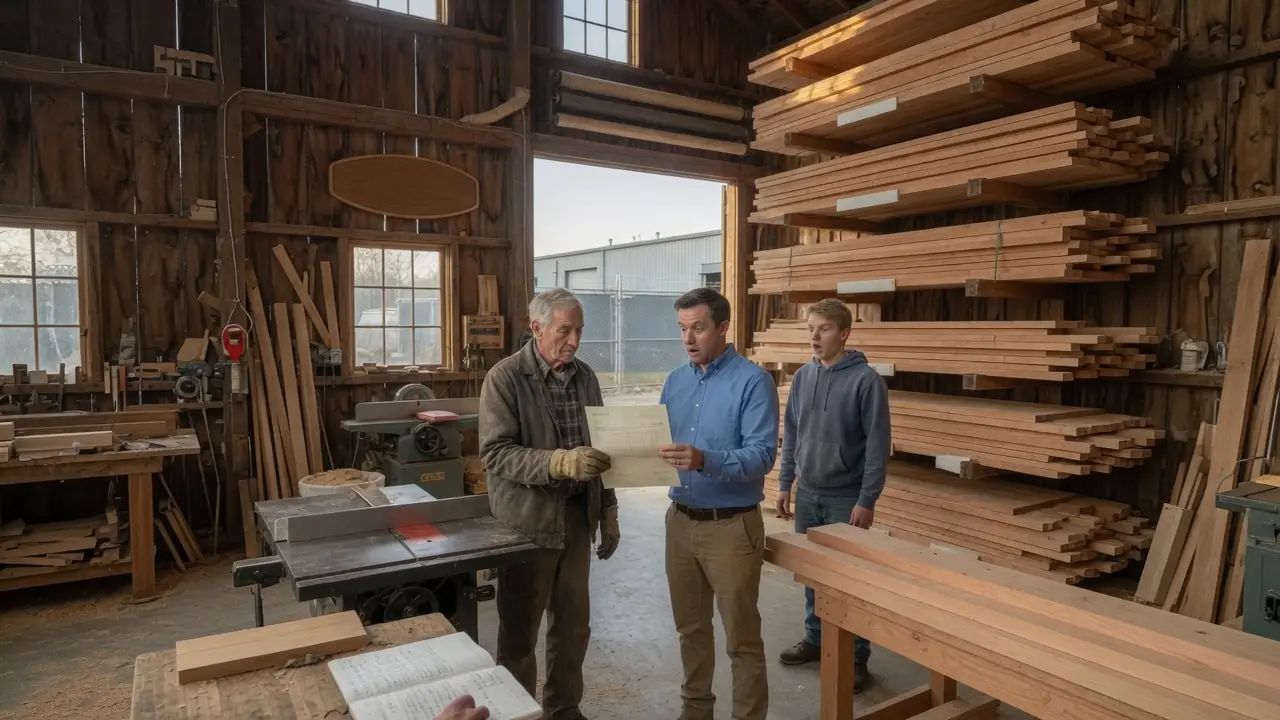
By 2005, Arthur had more than ten thousand board feet of seasoned lumber stacked behind what outsiders still called a trash pile. He built a new shed first, twelve by twenty-four, with a gambrel roof and a loft for storage. The framing came from Douglas fir offcuts, the sheathing from squared pieces of plywood, and the rafters from factory scraps that had once been deemed too short for a customer’s order. It took him the whole summer, but when he finished, the shed stood straight, tight, and quiet, smelling of pine and patience.
David helped sometimes, though he made sure to complain while doing it. “You could buy this lumber and finish in a week,” he said one afternoon, wiping sweat from his face. Arthur fitted a board into place and checked the joint before answering. “Faster is not the point,” he said. “Better is the point.”
By 2008, the first shed was full. Arthur began building a second structure, larger and stronger, a thirty-by-fifty-foot barn with an open central bay and side wings for storage. He bought metal roofing, concrete anchors, and electrical supplies, but every board, post, brace, and wall section came from the factory’s discarded material. For two years, he worked on it in stages, slowly turning the castoffs into a building designed to hold even more castoffs.
David was in community college by then, studying business and talking often about efficiency, opportunity cost, and market logic. To him, the barn was a monument to wasted labor. He told Arthur that his time would be worth more if he simply worked somewhere else and bought what he needed. Arthur listened, planed a board until the shaving curled like ribbon, and said, “You are confusing price with value, son. They are not the same thing.”
In the spring of 2011, Precision Prefab was acquired by a national conglomerate. The old plant manager retired, and a new operations manager named Mark Jennings arrived with a tablet, polished boots, and a professional hunger for optimization. Mark was thirty-four, educated, efficient, and certain that anything not documented was either a risk or a missed revenue stream. On his third day, he saw a forklift dumping wood over Arthur’s fence and stopped walking.
“What is that?” he asked the foreman. The foreman shrugged. “Old arrangement. We dump scraps there. Hemlock cleans them up.” Mark did not like the word arrangement. He liked contracts, liabilities, procedures, and measurable outcomes.
That afternoon, Mark pulled property records, disposal invoices, satellite images, and plant reports. He saw that the company paid fifteen hundred dollars a month to dispose of industrial wood waste. He saw Arthur’s property beside the fence, where the apparent pile had grown for more than a decade. In Mark’s mind, the situation became simple: undocumented disposal, potential liability, possible ordinance violation, and a resource being transferred without compensation.
The next day, Mark walked to Arthur’s workshop. Arthur was sharpening his grandfather’s old Stanley Bailey jointer plane, a heavy iron tool he treated with more respect than most men treated their cars. Mark knocked on the doorframe and introduced himself with the crisp confidence of someone used to being obeyed. Arthur finished tightening the cap iron before he looked up.
“I am here to formalize the offcut arrangement,” Mark said. “For legal and efficiency reasons, we cannot continue the current practice without documentation. Precision Prefab is willing to pay you one hundred dollars a month to lease the back corner of your property as a designated debris staging area.” He smiled as if he had brought Arthur a gift.
Arthur set the plane down on the bench. “The wood is not debris,” he said. “It is lumber.” Mark’s smile tightened, but he kept his voice polished. “With respect, Mr. Hemlock, it is waste product. My company pays to dispose of it.”
Arthur looked past Mark toward the barn he had built from that so-called waste. He thought of every board he had sorted, every stack he had stickered, every note in his weathered notebook. Then he looked back at the young manager. “No,” he said.
Mark blinked. He had expected negotiation, maybe a higher monthly number, maybe a complaint about the word debris. He had not expected a single quiet refusal. “Then I will have to stop the deliveries,” he said, his tone cooling. “And the existing accumulation on your land may violate local ordinance.”
Arthur picked up the plane and tested the blade edge with his thumb. “You do what you have to do,” he said. The sentence bothered Mark because it gave him nothing to push against. He left feeling as though he had been both dismissed and misunderstood.
A certified letter arrived two days later. It stated that Precision Prefab would terminate the informal disposal practice on October thirty-first and that the accumulated debris on Arthur’s property had to be remediated. If Arthur failed to clear it, the company would notify code enforcement. The letter was cold, legal, and absolute.
David read it at the kitchen table and exploded. “Grandpa, why did you say no?” he demanded. “They were offering you money for nothing.” Arthur oiled the handle of his plane and did not look up at once. “They were offering to pay me to store trash,” he said. “I am not a junkyard.”
“But you have been using it for years,” David argued. “Now they will stop giving it to you, and we will still have to clean up the pile.” Arthur looked at his grandson with tired patience. “The wood has a purpose,” he said. “It is not finished yet.” David threw up his hands because patience sounded useless to a young man who thought urgency was intelligence.
From Mark Jennings’s office window, Arthur’s property seemed unchanged for the first week. The pile remained near the fence, ugly and sprawling, exactly as it had been before. Mark assumed Arthur was ignoring the letter or hoping the company would back down. He made a calendar note for November first to call code enforcement.
But what Mark could not see was happening inside the barn. For more than a year, Arthur had been acquiring old woodworking machines: a Delta table saw from a farm auction, a twenty-four-inch jointer from a closed school shop, a band saw, a drill press, and a dust collection system. He had restored each machine slowly, replacing belts, cleaning cast iron, rewiring motors, and tuning tables until they ran true. The barn was not storage anymore; it was becoming a mill.
In the final week of October, Arthur hired a young man from down the road and began moving the wood. He did not start at the messy front of the pile where passing cars could see him. He started behind it, where the oldest and best stacks had been seasoning for years in neat, hidden order. Piece by piece, wheelbarrow by wheelbarrow, the lumber moved indoors.
David came by one afternoon expecting chaos and found aisles forming inside the barn. Douglas fir stood in one section, pine in another, maple and oak stacked on labeled racks along the side walls. Arthur directed each load with his notebook in hand, knowing not only what species each stack held, but roughly when it had arrived. David stood at the door, suddenly quiet.
On October thirty-first, the fence line was clear. What had looked like a mountain of junk for eleven years was gone, leaving bare ground, flattened grass, and a few wood chips scattered in the dirt. Mark saw the cleared area from his office and felt professional satisfaction. The system had worked, he thought.
At nine o’clock the next morning, Arthur Hemlock walked into the Precision Prefab reception area wearing clean work clothes. In his hands was a thick cream-colored envelope addressed in his careful script. Sharon from accounts payable took it first, opened it, and frowned at the single invoice inside. Then she carried it to Mark Jennings, who read the total and laughed.
“Forty-seven thousand two hundred eighty-one dollars and fifty cents?” Mark said, looking at Arthur as if the old man had finally confirmed every suspicion. “Is this a joke?” Arthur’s face did not change. “It is not a joke.”
Mark held up the invoice. “Storage, sorting, and curation of raw materials, November 2000 to October 2011,” he read. “Mr. Hemlock, you were allowed to take scrap wood for free.” Arthur nodded. “And I used it.”
“You cannot invoice us for material we gave you,” Mark said. Arthur slipped one hand into his pocket and pulled out a small carved wooden key. “Come see what you gave me,” he said. Against his better judgment, Mark followed.
David came too, nervous and embarrassed, certain that he would have to apologize for his grandfather’s strange behavior. They crossed the factory lot, passed through the gate, and walked onto Arthur’s land. Mark saw the clean fence line first, then the old workshop, then the large barn standing beyond it. On the front hung a carved sign made from a single piece of laminated Douglas fir: Hemlock and Son Custom Millwork.
Arthur unlocked the side door and opened it. Morning light fell through the high windows and spread across the concrete floor. Mark stepped inside and stopped so abruptly that David nearly ran into him. The space was not a shed, not a storage room, and certainly not a trash pile.
It was a fully equipped woodworking mill. Restored cast-iron machines stood in clean rows, oiled and wired, ready for work. Dust collection pipes ran overhead, handmade benches lined one wall, clamps hung by size, and stacks of seasoned lumber rose toward the rafters. Every board was sorted, labeled, stickered, and accessible.
Arthur walked to a notebook lying open on a workbench. “I recorded the estimated board feet of every delivery,” he said. “I separated the species, sorted by dimension, and seasoned the material at my own expense. Your company called it waste. I treated it as inventory.”
Mark looked at the invoice in his hand, then at the endless racks of wood. His spreadsheet brain began calculating despite his pride. Disposal cost, saved dumpster space, avoided landfill fees, market lumber value, storage, labor, exposure, public relations. The number on the invoice no longer looked funny.
David stared at the sign. “Grandpa,” he said softly, “this was never a trash pile.” Arthur turned toward him, and something like tenderness moved through his stern face. “No, son,” he said. “It was a mill waiting for patience.”
Mark tried to recover his authority. “This does not mean the company owes you money,” he said. Arthur nodded as if he had expected that answer. “Then consider it the start of a conversation.” He did not raise his voice because the room itself was already making the argument for him.
The lawyers became involved within a week. Precision Prefab did not want to pay the full invoice, but it also did not want a public fight with a seventy-two-year-old craftsman who had turned their disposal problem into a functioning business. A corporation suing an old cabinetmaker for preserving their waste would not look good in the county paper. Mark understood that, and his superiors understood it even faster.
Arthur attended the meetings with David sitting beside him. He wore the same canvas work coat and kept his hands folded on the conference table while company lawyers discussed liability, informal practices, unjust enrichment, property use, and settlement language. Arthur did not interrupt. He had waited eleven years, and a few more weeks meant nothing to him.
They settled before Thanksgiving. Precision Prefab paid Arthur fifteen thousand dollars and signed a ten-year agreement to sell all usable offcuts to Hemlock and Son Custom Millwork at a small fraction of original material cost. Mark Jennings framed it internally as a documented sustainability partnership that reduced landfill costs and improved waste recovery metrics. Arthur framed it more simply: the wood would keep coming, and now everyone had admitted what it was.
The mill came alive that winter. The table saw sang through fir beams, the jointer flattened maple, and the band saw cut curves from pieces that had once been destined for the dump. Arthur built tables, cabinets, moldings, shelves, doors, and custom furniture with a quality that came from old methods and unusually good material. Word spread quickly because good work always travels if it is allowed to stand long enough.
David did not return to college the next semester. At first, he told himself he was only taking time off to help his grandfather. Then he began learning how to sharpen blades, read grain, lay out boards, and match offcuts so their differences became design instead of limitation. For the first time, price and value stopped being ideas in an argument and became things he could feel under his hands.
Arthur was not easy on him. He made David redo joints that looked acceptable to customers but not to the Hemlock name. He made him stack wood properly, sweep the floor before leaving, oil machine tables, and write every board-foot estimate in the same careful ledger system he had mocked for years. David learned slowly, then all at once, that discipline is not stubbornness when it builds something real.
Mark Jennings visited the mill one more time in the spring. He stood near the door in the same polished boots, though they had more dust on them now. Arthur showed him a conference table being made for a law office in Lincoln, its top built from factory offcuts joined so cleanly the seams looked intentional, almost decorative. Mark ran his hand across the surface and said nothing for a long time.
“You know,” Mark finally said, “my report calls this material recovery.” Arthur looked at him. “Does it?” Mark smiled a little, not proudly this time, but with reluctant respect. “I suppose you would call it something else.”
Arthur picked up a plane and set it on the bench. “I call it not wasting good wood.” Mark nodded, because for once he had no better phrase. He left without laughing.
For eight more years, Arthur worked in the mill beside his grandson. Hemlock and Son became known across the state for custom cabinetry, architectural moldings, farmhouse tables, and furniture that looked simple until a person noticed how carefully it was made. Clients liked the story of the reclaimed lumber, but they returned because the work was excellent. Arthur insisted on that distinction.
When Arthur died at eighty, he left the house, the land, the workshop, and the mill to David. The original invoice was framed and hung in the office, not because Arthur had won money from a corporation, but because he had proved something harder. He had proved that patience can make an argument louder than anger. He had proved that a man with skill, time, and discipline could turn another man’s waste into inheritance.
David still runs Hemlock and Son Custom Millwork. The factory next door still sends offcuts, now neatly bundled, documented, and invoiced under the agreement Mark Jennings once thought unnecessary. Three employees work in the mill, and every apprentice learns to sticker lumber before touching the machines. On the wall near the framed invoice is a smaller sign with Arthur’s favorite lesson carved into pine.
Waste is a failure of imagination.
David reads it sometimes when the day is long and the orders are stacked high. He thinks of the fence, the old pile, the years he wasted being embarrassed by what he did not understand. Then he walks through the lumber racks, touches the seasoned boards, and remembers his grandfather standing in the barn beside a stunned manager and a silent grandson. The whole room had been proof that value does not disappear just because someone else cannot see it.
The factory had dumped scraps at Arthur Hemlock’s fence for eleven years.
Arthur did not see scraps.
He saw time, material, work, and future.
And when the door of that barn finally opened, everyone else saw it too.