Ada Voss arrived at Harlo Ranch believing she understood the rules better than anyone could explain them to her. A housekeeper cooked, carried, washed, counted, mended, comforted, and disappeared before the people who employed her had to remember that she possessed hunger, exhaustion, pride, or dreams of her own. The empty chair at a family table was never really empty to Ada, because it represented every place she had been taught not to occupy. When Eli Harlo reached toward the cupboard for another plate on her first evening in West Texas, she had no idea that such a small act would begin changing not only where she sat, but what she believed she was allowed to become.
The summer heat had followed Ada for nearly forty miles before Harlo Ranch finally appeared through the trembling air. She sat rigidly on the rear bench of a freight buckboard with one hand protecting a worn carpetbag and the other resting over a thick leather ledger tied shut with faded blue cord. Dust coated the hem of her white dress, sweat gathered beneath the collar, and the constant jarring of the wagon had left every bone in her body aching. She still kept the ledger against her as carefully as though it contained gold.
To anyone else, the book held columns of figures written in a neat hand. There were food inventories, household budgets, livestock expenses, wage calculations, purchase receipts, savings projections, and examples of accounts Ada had balanced for employers who rarely admitted she had done more than sweep floors and boil potatoes. She had copied each set of numbers before leaving those positions, never taking information that belonged privately to anyone, but preserving examples of her own methods because she had learned that people believed a woman’s capability more readily when she could put proof in front of them. The ledger reminded Ada that being ignored did not make her ignorant.
She was thirty-one years old, soft-bodied and full through the hips and waist, with gentle brown eyes, fair skin freckled lightly across the nose, and chestnut hair that resisted every pin she used against the West Texas wind. Men had described her as pleasant when they wanted labor, sturdy when they wanted something carried, and heavy when they wanted laughter. Women who considered themselves charitable often called her dependable, which Ada had learned could mean they expected her to accept twice the work without requiring twice the respect. Nobody had ever called her indispensable while paying her accordingly.
The advertisement for Harlo Ranch appeared on a notice board inside Mrs. Bellweather’s boarding house in Crestfall. It contained only four lines: HOUSEKEEPER WANTED. HARLO RANCH. TENDING HOUSE AND ACCOUNTS. ROOM AND BOARD PROVIDED. INQUIRE CRESTFALL FREIGHT OFFICE. Ada read it three times because the words and accounts separated it from dozens of positions she had rejected. She needed work badly enough that she might have accepted housekeeping alone, but she wanted an employer who understood numbers belonged among her duties because she had become tired of performing bookkeeping secretly while being paid only for scrubbing.
Mrs. Bellweather tried to discourage her. “Harlo Ranch is fourteen miles beyond the Mercer fork and another six past the old stage road, and Eli Harlo has a reputation for speaking ten words where another man might use fifty,” she warned while folding sheets in the boarding-house yard. Ada asked whether he beat employees, withheld wages, drank excessively, or mistreated women. Mrs. Bellweather admitted she had heard none of those things, so Ada replied, “Then silence sounds almost luxurious.”
What Ada did not say was that her money would last less than three weeks. Her previous employer, a widower named Cyrus Mott, had died unexpectedly, and his married daughter had immediately dismissed every female servant under forty because she considered unfamiliar women inside her father’s house improper after his death. Ada received the wages owed but no reference beyond a note saying she had kept a clean kitchen. The daughter omitted that Ada had managed household expenditures for four years and found nearly six hundred dollars in annual waste.
Ada had carried worse references. She had also carried better ones that somehow became irrelevant whenever a prospective employer looked at her body before asking what she could do. The ranch advertisement offered distance from Crestfall gossip, a room of her own, and the possibility that someone actually needed the part of Ada people usually pretended not to see. She sent a note that afternoon and received an answer two days later telling her to come Thursday.
By the time the freight wagon crossed the final ridge, Ada’s neck had gone stiff from holding herself upright. Harlo Ranch spread across a broad basin of tawny grass framed by low mesas, with several corrals, a long barn, bunkhouse, windmill, cattle pens, and a timber-and-stone house standing slightly apart beneath a cluster of cottonwoods. The property was substantial without looking prosperous, because fence rails leaned in places, one barn roof showed fresh patchwork, and the main house appeared built to resist storms rather than impress visitors. Ada saw work everywhere and felt more relieved than discouraged.
A broad-shouldered man waited on the porch. Eli Harlo was forty, though the sun had cut enough lines into his face to make him appear older from a distance, and his dark hair had begun silvering slightly above both ears. He wore faded trousers, boots scarred by work, and a light shirt with the sleeves rolled above his forearms. His expression was watchful without being unfriendly.
The wagon driver set Ada’s carpetbag down and departed before she had finished dusting herself. Ada stood facing the man while holding the ledger beneath one arm. “Mr. Harlo?” she asked, and he answered with a short nod before saying, “Ma’am.” She introduced herself as Ada Voss, and he replied, “Figured.”
His handshake was rough but respectful. Eli did not crush her fingers to prove strength, hold them too long, or let his eyes wander over her body before deciding how to speak. He looked at the carpetbag, then at the ledger. “That your bookkeeping?”
“Some of it,” Ada answered. Eli nodded toward the house.
“Good.”
A small face appeared behind the screen door before Ada reached the steps. The boy had dark hair cut unevenly around his ears, thin shoulders, and large gray eyes that watched strangers the way frightened animals watched movement across open ground. Eli turned toward him and said, “Thomas, come say hello.” The boy stepped outside slowly.
“This is Thomas Harlo,” Eli explained. “My nephew.” Ada smiled and said, “It’s a pleasure to meet you, Thomas.”
The boy stared at her carpetbag. “You staying?” he asked. Ada glanced at Eli before answering that she believed so.
Thomas looked relieved enough that Ada wondered how many housekeepers had arrived before her. Eli answered the question before she asked it by saying, “Mrs. Keene left in April, and the woman after her lasted twelve days.” Ada raised an eyebrow. “Was there a bear involved?”
Thomas almost smiled. Eli’s mouth moved slightly too.
“No bear,” he said.
Eli carried Ada’s bag despite her protest and showed her the house. The front room contained two sturdy chairs, a long sofa, a stone fireplace, and walls nearly empty except for a rifle rack and one framed photograph of a smiling young couple holding a baby. A dining room opened from the parlor, followed by a large kitchen with an iron range, pantry, wash area, and back door facing the barns. Everything was serviceable, clean enough, and almost painfully without softness.
Ada recognized a house maintained only as much as survival required. Curtains had faded unevenly, two chair covers were torn, dust lingered behind heavy furniture, and the pantry contained food but little organization. Someone had stacked sacks of beans beside lamp oil, left flour unsealed, and kept six identical jars without labels. Ada resisted the urge to begin immediately.
“This is your room,” Eli said upstairs. The bedroom was modest, containing a narrow iron bed, washstand, small dresser, peg rail, and window facing west across miles of open prairie. The mattress appeared clean, the quilt freshly washed, and a ceramic pitcher sat beside a bowl. Ada looked around and felt something ease inside her.
“It will do nicely,” she said. Eli stood in the doorway.
“Supper’s usually six.” He paused.
“Thomas can show you where things are.” Ada nodded.
Eli turned, then stopped. “Last housekeeper said this place was too lonely.”
Ada finally met his eyes. “I’m not easily discouraged, Mr. Harlo.”
Something changed briefly in his expression. It was not admiration, exactly, but recognition.
“Good,” he said.
Thomas showed Ada the pantry with the seriousness of a child performing an official duty. He knew where his uncle kept coffee, which cupboard contained salt, how much wood the stove required, and the exact shelf where the previous housekeeper had hidden peppermint candy. He admitted finding it after she left. Ada told him abandoned peppermint became communal property after thirty days.
Thomas looked alarmed. “It’s only been twenty-seven.”
Ada considered. “Then we have a legal problem.”
The boy laughed for the first time. It was a small sound but changed his entire face.
Ada spent the next two hours bringing order to the kitchen before allowing herself to cook. She discarded spoiled onions, sealed flour properly, moved lamp oil away from food, labeled jars, and discovered enough potatoes and salt pork to build a respectable meal. Thomas followed her like a quiet shadow and answered questions whenever he could. He did not ask about her size, clothes, or why she was unmarried, which already made him better company than many adults.
At four, Ada kneaded biscuit dough. At five, beans simmered beside onions and potatoes while salt pork hissed in a heavy skillet. She made gravy from drippings, opened a jar of preserved peaches, and found coffee beans decent enough to rescue from the scorched method somebody had been using. By half past five, the house smelled less like dust and leather and more like a place where people expected to return.
Thomas appeared in the kitchen doorway. “Uncle Eli is going to think it’s Sunday.”
Ada looked toward him. “Does he eat poorly the rest of the week?”
Thomas considered the question with dangerous honesty. “He burns eggs.”
Ada tried not to smile. “Anything else?”
“He burns bacon too.” Ada nodded gravely.
“A man of consistency.”
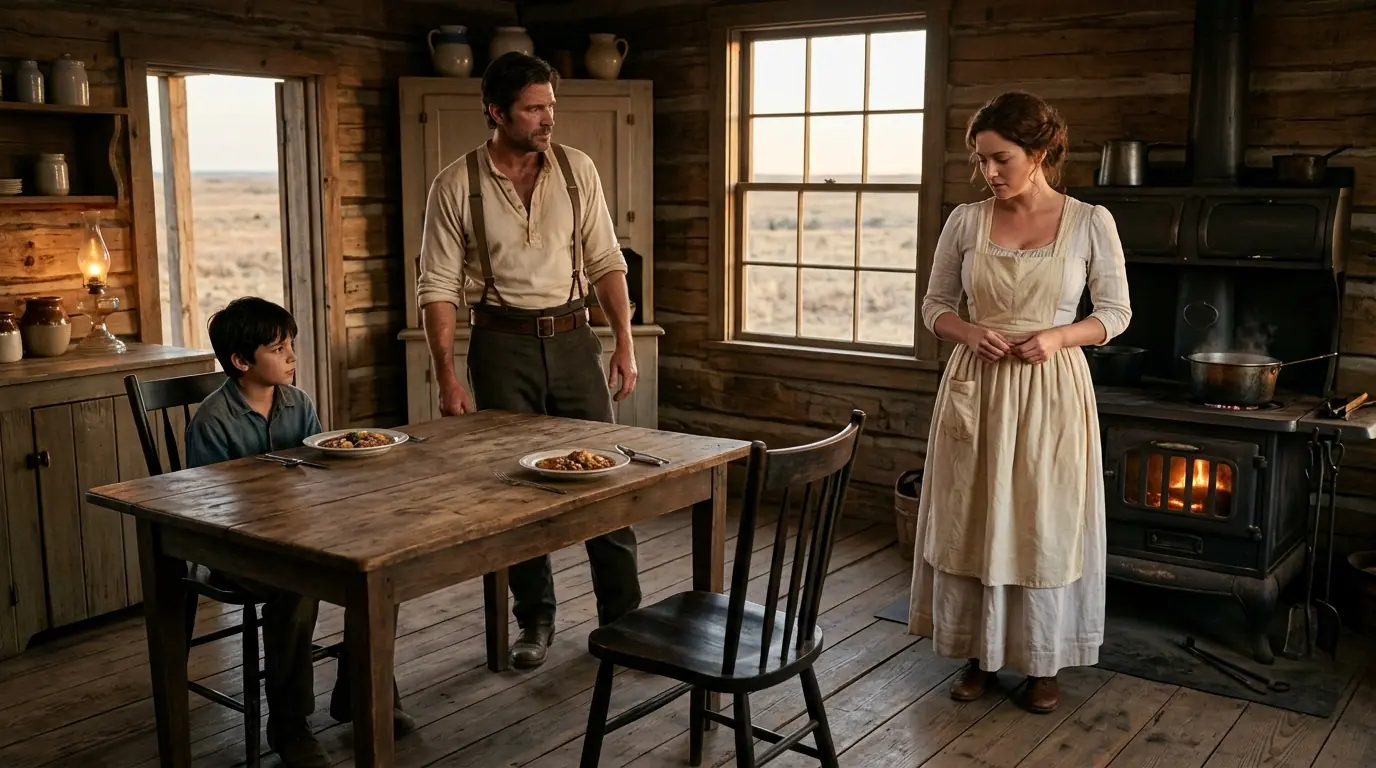
At six, Ada carried food into the dining room. She set one plate at the head of the table for Eli and another on the side nearest the window for Thomas. Then she placed serving dishes between them, added water glasses, folded cloth napkins she found inside a drawer, and returned to the kitchen. Not once did she consider setting a third place.
She had worked in six households since leaving her parents’ home at eighteen. In four, servants ate in the kitchen after the family finished. In another, workers received meals in a separate room near the back porch, and at Cyrus Mott’s house Ada could technically eat at the dining table only when he was traveling. The rule had become so natural that she never thought of it as a rule anymore.
Eli entered from the back porch precisely at six. He had washed at the pump, changed his shirt, and still carried a faint scent of dust and horse sweat into the dining room. Thomas sat quickly. Ada remained beside the kitchen doorway with her hands folded over the apron.
Eli looked at the food first. He looked impressed enough that Ada felt a small, private satisfaction.
Then he counted plates.
His gaze moved toward her. “You’re not eating?”
Ada hesitated. “I’ll eat after.”
Eli looked at the table again. “After what?”
“After you and Thomas finish.” Ada’s fingers tightened around the apron.
Eli frowned as though she had explained something incomprehensible. “Why?”
The question startled her more than the answer she expected. “I thought I would eat in the kitchen.”
Thomas looked at his uncle. Ada lowered her eyes automatically.
Silence filled the room.
For years, Ada had known precisely what came next in moments like this. An employer might nod without thinking, tell her to take whatever remained, or say servants were welcome to eat earlier if they preferred. Kind people often phrased exclusion kindly.
Eli said nothing.
Instead, he pushed his chair backward.
The wooden legs scraped against the floor.
Ada froze.
Eli walked past her toward the cupboard. He opened the door, reached inside, and removed another plate.
Ada stared.
He carried it to the table and placed it beside Thomas. Then he took a glass, knife, fork, and folded napkin.
Thomas watched with growing amusement.
Eli closed one large hand around the back of the empty chair and pulled it away from the table. He looked directly at Ada.
“If you cooked supper,” he said, “you eat it while it’s warm.”
Ada could not answer.
Eli pulled the chair farther out. “Sit down, Miss Voss.”
Her throat tightened. “Mr. Harlo, I don’t want to overstep.”
“You’re not.” Eli nodded toward the chair.
“You live here now.”
The sentence struck deeper than he intended.
Ada crossed the room slowly. Every instinct told her she was breaking a rule someone would punish her for later.
She sat.
Thomas grinned.
Eli passed her the biscuits as though nothing extraordinary had happened.
Ada took one.
For several minutes, conversation remained scarce. Eli ate with the focused appetite of a man who spent his days outdoors, Thomas devoured gravy, and Ada tried to convince her body that nobody was about to tell her she had misunderstood. The chair beneath her felt almost too visible.
Then Eli said, “This is good.”
Ada looked up. “Thank you.”
Thomas answered before she could return to silence. “Better than Uncle Eli’s bacon.”
Eli looked toward the boy. “Careful.”
Thomas laughed.
Ada did too.
The sound surprised her.
After supper, Ada rose automatically to clear the table. Eli gathered his own plate.
She stared. “You don’t need to do that.”
He looked down at the plate. “I know where the kitchen is.”
Thomas carried his dishes too.
Ada stood beside the table holding only her own plate.
Something as simple as three people walking into a kitchen together felt dangerously close to belonging.
She told herself not to mistake courtesy for permanence.
The next morning proved Harlo Ranch was not built entirely from gentle gestures. Eli woke before dawn, Thomas had lessons before chores, and breakfast had to be ready by five because six ranch hands came through the kitchen for coffee before riding out. The men looked surprised to see Ada and even more surprised when they saw actual biscuits instead of whatever Eli had been feeding them.
The foreman introduced himself as Samuel Dwyer. Sam was fifty-three, lean, gray-mustached, and possessed the practical gaze of someone who evaluated people according to whether they complicated work. He shook Ada’s hand, thanked her for breakfast, and asked where she wanted firewood stacked. Ada liked him immediately.
Two younger cowboys were less restrained. Owen Briggs smiled too broadly and said, “Boss finally hired somebody who can keep us from starving.” Another man named Clay Barlow looked Ada over and whispered something to Owen.
Both laughed.
Ada heard only the word bigger.
She kept pouring coffee.
The laughter ended when Sam struck the table once with two knuckles. “Food’s in your mouth, Barlow, so I suggest you use it for chewing.”
Clay looked embarrassed. Owen suddenly became fascinated with his plate.
Eli had not entered yet. Ada was grateful.
She disliked the feeling of needing a man to defend her.
She disliked even more the fact that sometimes defense was useful.
After breakfast, Eli brought the ranch account books to the dining table. There were three ledgers, one stack of receipts, several feed invoices, cattle-sale notes, and enough loose paper to make Ada’s hands itch. Eli sat across from her and said, “This is why the advertisement mentioned accounts.”
Ada opened the oldest ledger. “Who kept these before?”
“My brother mostly.”
“Recently?”
“I tried.”
Ada looked at the pages.
The handwriting changed styles, dates skipped, receipts lacked categories, and several numbers had been crossed out without explanation. Eli watched her expression.
“That bad?”
Ada chose diplomacy. “You have room for improvement.”
Eli almost smiled.
“How much room?”
“Texas.”
He laughed.
It was the first time Ada heard him laugh fully. The sound was low, warm, and so unexpected that she looked up.
Eli shook his head. “Fair.”
Ada spent three hours building order. She created categories for feed, livestock, freight, wages, repairs, household expenses, taxes, veterinary costs, fencing, equipment, and debt service. She separated personal purchases from ranch operations. Then she asked Eli questions until his patience showed visible strain.
“Why is hay from Vane Mercantile listed at three different prices within the same month?” she asked. Eli said freight.
“Why is freight charged again separately?” He frowned.
“I don’t know.”
“Why does the April cattle receipt show one hundred twelve head while your shipment note says one hundred nineteen?” Eli leaned closer.
“Seven died during transport?”
“Is there a mortality report?”
“No.”
Ada wrote a question mark.
Eli watched it as though punctuation itself accused him.
“Miss Voss.”
“Yes?”
“Are you going to mark every thing I don’t know?”
“Yes.”
He leaned back.
“This may have been a mistake.”
Ada looked at him.
“The hiring?”
“The ledger.”
She smiled.
By lunch, Eli had discovered he was paying interest on a feed balance he believed settled the previous autumn. Ada could not determine whether the charge was correct because one payment lacked a corresponding receipt. She asked whether he maintained bank statements.
Eli pointed toward a drawer.
Ada opened it.
Then closed it slowly.
“You put bank statements loose with horseshoe invoices.”
“They’re paper.”
“So is the Bible.”
Eli stared.
Ada returned to the drawer.
Thomas had been listening from the doorway. He began laughing.
Eli pointed at him. “Lessons.”
Thomas disappeared.
Ada spent the next week learning the ranch before attempting major changes. Harlo Ranch covered almost six thousand acres, much of it leased grazing land, and ran roughly nine hundred cattle after losses from two difficult years. A winter freeze had killed calves, summer drought reduced pasture, and weak cattle prices left Eli carrying more merchant credit than he liked. The ranch was not on the edge of immediate foreclosure, but it was closer to danger than the house suggested.
Eli had inherited much of the responsibility after his older brother Nathan died in a riding accident four years earlier. Nathan’s wife, Laura, survived him by only eleven months before pneumonia took her, leaving their son Thomas with Eli. Eli had been a skilled cattleman and dependable foreman under his brother. Becoming guardian, owner, employer, and bookkeeper at the same time stretched abilities he had never needed to combine.
Thomas remembered his parents. That made grief more complicated.
Ada learned this gradually.
The photograph in the parlor showed Nathan, Laura, and Thomas as a baby.
Eli rarely spoke about them.
Thomas sometimes did.
One evening he found Ada sewing a torn curtain and asked whether she had children.
“No.”
“Did you want them?”
Ada’s needle stopped.
“That is a rather large question.”
Thomas looked embarrassed. “Sorry.”
Ada softened. “It’s all right.”
She thought before answering.
“I think I wanted a home where children might belong.”
Thomas considered that.
“Is that different?”
“Yes.”
He nodded as though he understood more than she expected.
Ada’s own childhood had not been unhappy. Her father, Josiah Voss, taught arithmetic at a small school outside San Angelo and kept books for three local businesses during evenings. Her mother Margaret took sewing and laundry work, and together they raised Ada and her younger sister Helen in a house where money was tight but books were plentiful.
Josiah taught Ada double-entry bookkeeping before she turned fifteen. He said numbers behaved better than people because errors usually left tracks. Ada loved the certainty.
Her mother taught her something less comforting.
“People will use what you do well if you let them,” Margaret once said while hemming a dress for a woman who would later complain about the price. “Make sure usefulness does not become permission.”
Ada had not understood then.
She did now.
Both parents died during a typhoid outbreak when Ada was nineteen. Helen married a railway clerk and moved east. Ada entered domestic service because it offered immediate room and board.
The first family employed her as a kitchen maid.
The second discovered she could keep accounts.
They gave her the bookkeeping without increasing her wages.
When she asked why, the mistress said, “Surely you don’t expect to be paid twice for being clever.”
Ada stayed another year.
That decision embarrassed her in retrospect.
The hardest household belonged to a wealthy cattle buyer named Frederick Marsh and his wife Augusta. Ada managed food, household purchases, linen inventories, staff wages, and much of Frederick’s correspondence during busy months. She ate alone in the kitchen after everyone else finished.
One Christmas, Augusta hosted nineteen guests. Ada worked sixteen hours preparing meals and directing hired help.
At ten that night, Frederick found her eating cold potatoes near the stove.
He asked why she had not eaten earlier.
Before Ada could answer, Augusta said, “Because servants do not sit with guests.”
Frederick nodded.
The conversation ended.
Ada remembered staring at an empty chair visible through the dining-room doorway.
The chair became a symbol she never named aloud.
It followed her from house to house.
So when Eli placed a plate beside Thomas every evening, Ada distrusted the feeling it created.
She expected the arrangement to change after novelty wore off.
It did not.
Three weeks passed.
Every supper included three plates.
On Sundays, Sam sometimes joined them if ranch business required discussion.
Eli never announced a policy.
He simply behaved as though excluding Ada had never occurred to him.
That quiet normality began undoing something inside her more effectively than grand kindness could have.
The first serious disagreement came over wages. The advertisement had promised room and board but left salary open for discussion because Eli assumed candidates would negotiate in person. Ada had been at the ranch nearly four weeks when she realized neither of them had settled the amount.
She brought it up after supper. “Mr. Harlo, we need to discuss my wages.”
Eli stopped polishing a harness buckle.
“I thought we did.”
“No.”
He frowned.
“I said twenty-two dollars a month.”
“You said the last housekeeper was paid twenty-two.”
Eli thought.
“That wasn’t an offer?”
“No.”
He looked genuinely surprised.
“What do you want?”
Ada had prepared.
“For housekeeping alone, twenty-two would be fair with room and board.”
Eli nodded.
“For housekeeping plus accounts, inventory, purchasing review, and household management, I want thirty.”
His eyebrows rose.
Ada’s stomach tightened but she continued.
“If you want only cleaning and meals, I’ll accept twenty-two and you can hire someone else for the books.”
Eli stared at her long enough that old humiliation began whispering.
Then he asked, “How’d you get thirty?”
Ada opened the leather ledger.
She showed him wage comparisons from previous jobs, time estimates, savings she had already identified in food purchases, and the work required to reconstruct accounts.
Eli read silently.
“You calculated your own return.”
“Yes.”
He looked toward her.
“Thirty.”
Ada blinked.