Do not laugh at her, Lambert, Duke of Ravenswood, said as Octavia Atherton rose from the pond with the white drake thrashing in her arms.
Mud clung to her skirt. Freezing water dragged at her petticoat. The great white Aylesbury drake beat one frantic wing against her shoulder, and every servant on the bank stared as if no woman with sense would fight a bird in front of a duke who had no heart. Octavia tightened her grip on the cracked tin whistle at her throat and held the drake higher. Explaining the bird would mean explaining the snare wrapped around its leg.
Explaining the snare would mean explaining Cornelius Gresham, and if Gresham's name entered Ravenswood before she was ready, her mother's cottage would be gone by Michaelmas. So she smiled. It was the bright, practical smile that had kept her fed for 3 years after her father's death. Cheerful girls were allowed to mend linen. Cheerful girls were allowed to make themselves useful.
Troublesome girls were sent back to parishes that had no beds and no pity.
"I have him Your Grace", she called, though her teeth had begun to chatter.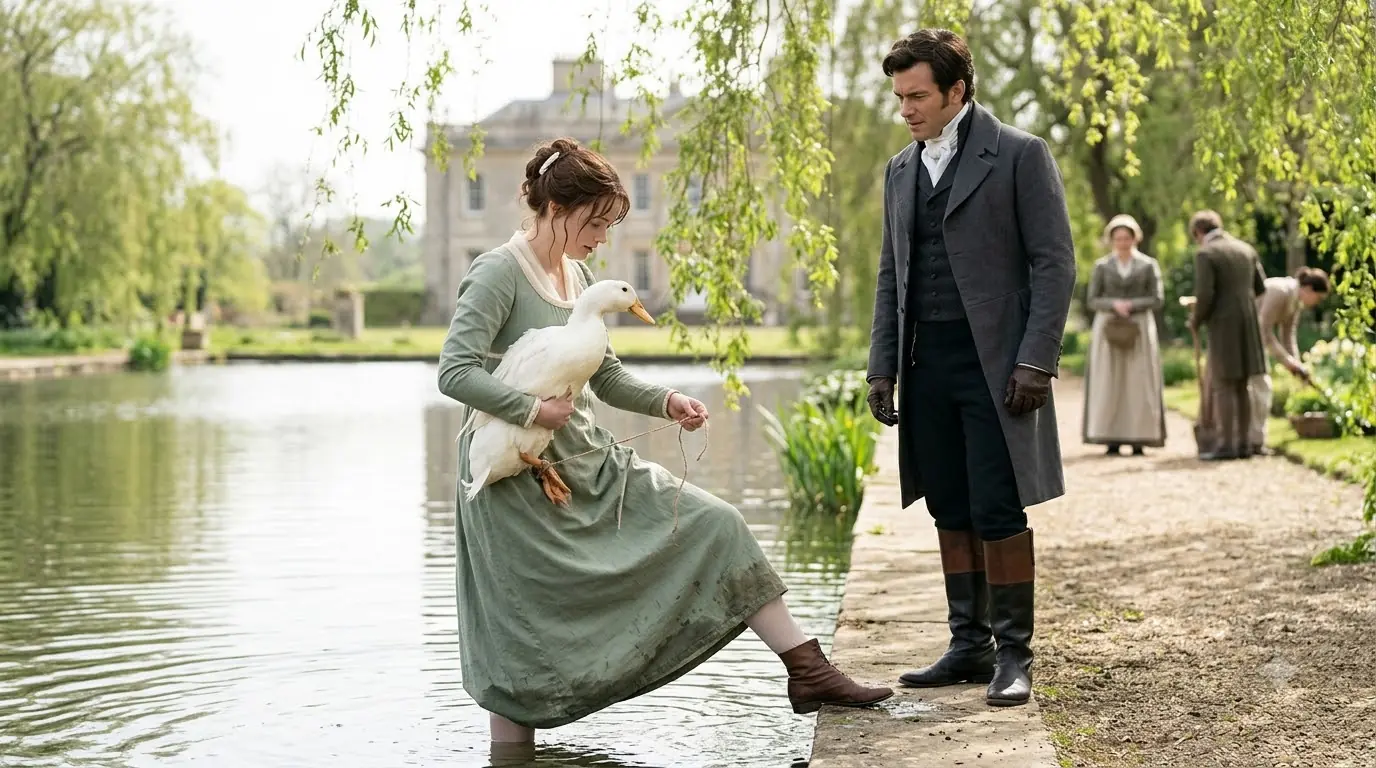
Lambert Ravenswood stood on the grassy bank in a black coat, his hat in one hand, his face as unreadable as a locked iron gate. He governed his Welsh estate like a military post. Fences were inspected. Accounts were balanced. Servants lowered their voices when he passed.
No one had ever accused him of softness. He did not laugh. He did not look away. Under the water, Octavia's numb fingers worked at the severed twine tangled around the drake's scaled foot. It was no stray root.
It had been cut from counting house cord, the sort Gresham used to tie his ledgers and parcels. Where there was one trap, his men were often near. The drake struck her cheek with a wet wing. A footman coughed behind his hand. One of the younger gardeners made a sound that might have been laughter.
Mrs. Pelham, Lambert said, the housekeeper straightened at once.
Your Grace. Blankets, dry stockings, and hot bricks from the laundry hearth. His gaze never left Octavia. The rest of you returned to your duties at once. The laughter died as if cut with a knife.
The bank cleared. Octavia waded toward the edge, the pond sucking at her skirt with every step. She expected the Duke to turn away once the spectacle had ended. She expected a dismissal by dusk. Ruining a serviceable dress, and the morning's order was hardly the mark of a useful dependent.
Instead, Lambert stepped exactly one pace closer. His dark eyes flicked from her mud-streaked face to the drake's dangling leg, then to her white-knuckled grip on the bird's body. He noticed too much. That was the danger in him.
"You entered freezing water", he said.
"For a duck, he is a very good duck, Your Grace". It was not entirely a lie, but it was not the truth. The truth was that she could not afford to let anything helpless drown while she stood on dry land. Lambert's gaze moved to the cracked whistle at her throat. Report to the old poultry yard tomorrow morning, Miss Atherton.
Dawn. Then he turned and walked back toward the manor, his black coat cutting through the gold morning light. He had not dismissed her. Not yet. But when Flora Pelham wrapped a rough wool blanket around Octavia's shoulders, Octavia did not feel safe.
The drake shuddered against her ribs. Her own body shivered harder. All she could think was how many days of wages stood between her and Gresham's next demand. By dawn, the chill had settled deep into Octavia's bones. She was already kneeling in the ruined poultry yard, her hands buried in damp straw, counting cracked troughs and broken latches before the Duke arrived.
The yard had once belonged to her father years ago, before illness thinned him, and debts found every weak seam in their lives. Tobias Atherton had bred the finest white Aylesbury ducks in the county. He had known each line by sound, shape, and temper. He had given Octavia the tin whistle when she was 12 and told her that creatures trusted the hand that came steadily. Now the pens sagged, the ledgers had mildewed.
The old chalk marks on the posts had washed pale as bone. Octavia expected punishment. When the heavy iron latch lifted, she rose too quickly and nearly slipped on the straw. Lambert entered in polished riding boots and a dark coat that absorbed the morning mist. He carried the estate ledger beneath one arm.
Stand up, Miss Atherton. She was already standing, but she straightened further. Good morning, Your Grace. The drake rested through the night. His leg is bruised but not broken.
He was drowning. Ducks float. A small panic flared under her ribs. If he pressed too hard, she would have to lie. Not soften the truth.
Lie outright. She folded her hands in her apron. He is from the last pure Aylesbury line my father bred for this estate. To let him drown would have been a waste of Ravenswood property.
Lambert observed her as though she were a map with a river missing.
He saw the damp hem she had scrubbed clean before sunrise. He saw her red knuckles. He saw the frayed ribbon that held the cracked whistle against her collarbone.
"Waste," he repeated.
It was a word he understood. He opened the ledger. The estate records regarding the waterfowl are severely neglected. The county ball requires reliable kitchen accounts, clean stock, and a yard that does not offend every guest who walks the lower path. You will restore it.
You will prepare the birds, the eggs, and the tallies for inspection before the ball. Octavia blinked. Me, Your Grace. You fought a drake in freezing water to prevent waste of property. I assume you can mend a gate.
A gate? Yes. A rotten sill with help? A ledger? If it is not written in your steward's hand.
The words escaped before she could smooth them. Her smile brightened to cover the impertinence. One corner of Lambert's mouth did not move, but his eyes sharpened. Then you will begin with all three. He handed her a small leather pouch of estate chalk.
It was not praise. It was not kindness. He framed the whole matter as order and economy. Yet when the gate clicked shut behind him, Octavia let out a breath that trembled all the way down her arms. She had not been cast out.
She had been given work no one could call charity. For a woman with a creditor waiting, that was almost mercy. She took a piece of chalk from the pouch and turned back to the pens. The repaired yard would not save her mother's cottage. It would not erase £300 from Gresham's book, but it gave her one more morning in which to stand upright.
One more morning was something. The difference between them became a daily thing. Lambert appeared each morning just after sunrise, walking the perimeter before the estate managers awoke. He wore fine wool and black leather gloves. Octavia knelt in mud straw and feathers.
He gave orders in sentences as neat as musket fire.
She answered with cheer bright enough to pass for obedience.
The yard began to change. Broken slats were replaced. Straw was kept dry. Feed bins were sealed against rats. The white drake, whom Mrs. Pelham had begun calling admiral out of pure household mischief, limped about as if he had survived a battle and expected decorations.
On the third morning, Lambert stopped beside the brooding pens. Octavia was marking the wooden posts with the chalk he had given her. Crosses, circles, short dashes, and a small slanted line that meant a bird was clever enough to escape twice.
"Explain the cipher," he said.
Octavia jumped and dropped the chalk. It is not a cipher Your Grace merely habit. The old ledgers are ruined with damp. A cross means a laying hen. A circle is for the injured drake.
A dash means a bird that eats more than it lays. The slanted mark is for wickedness. Wickedness. Repeated escape, Your Grace. Theft of grain.
Biting without cause. That sort of thing. You are keeping the entire inventory in your head. It is only 52 birds now that the two young ducks have been moved from the wash shed. It is no trouble.
It is inefficient. He walked away. Octavia stood still until the sound of his boots faded. The word pressed harder than it should have. Inefficient meant replaceable.
Replaceable meant unsafe. She picked up the chalk and marked another cross with more force than necessary. An hour later, Flora Pelham marched into the yard carrying thick dry stockings, a hot brick wrapped in flannel, and a shawl that smelled faintly of lavender soap.
"From the house," the housekeeper said, setting them on the bench.
Octavia stared.
"I did not request these."
"The Duke ordered them added to the morning laundry rotation. He noted the damp in the lower yard."
Octavia touched the warm flannel. She did not mistake it for tenderness. A careful master maintained tools that performed well. She was a tool for the estate, like the chalk, the feed bins, and the new hinge on the south gate. Still the warmth sank through her fingers.
When Lambert returned the next morning, she did not thank him for the stockings.
Instead, she asked for extra grain for the ducklings and a strip of clean linen for Admiral's leg.
She could ask for care for every living thing in the yard. She could not yet ask for it for herself. Lambert's gaze moved once to her dry stockings, then back to the feed ledger.
He said nothing, but after that he arrived 10 minutes earlier each day.
Their nearness became a routine. Neither of them named. Lambert claimed he needed to review the lower perimeter. Octavia pretended to believe him. He inspected locks, fences, gates, and drainage ditches.
Yet he lingered longest by the pen, where Admiral sat like a white tyrant near Octavia's skirt. One frost-heavy morning, the drake refused to eat. Octavia knelt in the straw, holding oats in one open palm and making a soft clucking sound.
"Come now, you vain old admiral. You cannot win a war on an empty crop."
"You are frightening him," Lambert said from the yard gate.
"I am perfectly well," Octavia replied brightly.
It was not an answer. She knew it. So did he. Lambert stepped into the yard. His boots stopped close enough that she could see the damp on the leather.
He reached down and touched the cracked tin whistle where it rested against her collarbone. Octavia froze. His knuckles brushed the rough wool of her gown. He did not pull the whistle from her neck. He merely turned it between gloved fingers, inspecting the dent near the mouthpiece.
"It does not sound true," he said.
"It was my father's. It is only worn."
She tried to step back, but the pen wall held her in place. There was no impropriety in the touch, not truly. Yet no gentleman had handled anything so close to her throat since before grief had taken her out of drawing rooms and placed her in servants corridors. Lambert let the whistle fall back against her collarbone. May I borrow it until morning.
The question unsettled her more than an order would have done. He was the Duke. He could have taken it. He waited instead. Slowly, Octavia untied the frayed ribbon and placed the whistle in his gloved palm.
"Show me how to hold the grain," he said.
Octavia stared at him. The Duke of Ravenswood, terror of defaulting tenants, sternest man in Monmouth, wished to feed a duck.
"Your hand must be entirely flat," she said after a moment.
"If you curl your fingers, he will think it is a snare."
The word slipped out before she could catch it. Snare. Lambert's eyes narrowed, but he did not seize on it. He took off one glove and flattened his palm. Octavia poured oats into his hand.
Admiral stretched his neck, suspicious of rank breeding and all mankind. Then the drake waddled forward and began to eat from the Duke's palm. For the first time since Octavia had known him, Lambert Ravenswood looked awkward, not commanding, not terrible, merely a man holding very still because a frightened creature had trusted him by half an inch. The sight made something inside her soften before she could stop it. The next morning, the whistle was waiting on the bench beside the chalk pouch.
The crack had been soldered shut. The old dent remained, but the seam had been carefully mended by the village tinsmith so delicately that her father's thumb mark is still visible on one side. Octavia held it in both hands. The metal was cold, yet it burned her fingers. She thanked Lambert later with a smile too bright to be honest.
She told herself it was a practical repair. A whistle that sounded true would summon birds more easily. It had nothing to do with the fact that he had noticed what no one else had touched for years. Safety was expensive. Cornelius Gresham held the purse.
She could not afford to let a repaired whistle feel like home. Two mornings later, a boy in Gresham's livery stopped at the outer gate. He did not enter the yard. He merely handed Mrs. Pelham a red sealed account and looked past her toward the pens as if counting how many steps lay between Octavia and the road. Mrs. Pelham brought the paper without comment.
Octavia broke the seal behind the feed shed. The message contained only three lines. The sum, the cottage, and the day after the county ball. No threat, no flourish. Gresham had never needed many words to make a room smaller.
Octavia folded the paper and tucked it beneath the ruined poultry ledger.
Then she returned to the yard with her brightest smile and asked the kitchen boy to fetch more oats.
No one saw her hands shake except Admiral. The drake pecked her shoe unimpressed by creditors. The first true crack in Lambert's wall happened in the dark. It was near midnight, 3 days before the county ball. Admiral had taken a turn for the worse and refused water.
Octavia slipped from the servants' quarters with a lantern hidden under her cloak, praying no footmen would wake and no gossip would form before dawn. She sat on an overturned bucket in the freezing yard, the heavy bird in her lap, using a little wooden spoon to drip water into his beak. Her shoulders ached, her hands shook. No one watched her, so the smile was gone. Without it, her face felt naked.
A shadow moved against the stone wall. Lambert stepped into the lantern light. He wore no riding coat, only a white shirt and dark waist coat, as if sleep had failed him, and the house had grown too narrow. His hair was unbrushed. His face, stripped of public severity, looked younger and more tired.
Octavia scrambled to stand. Admiral shifted angrily in her lap. Your Grace. I apologize. I was only The smile snapped back into place.
It was a reflex. It was a lie. Lambert saw it happen. He crossed the yard in three strides, knelt beside her, and took the spoon from her trembling fingers.
"Sit down," he said quietly.
I am perfectly well, Your Grace.
He only needs, I said, sit.
It was not a bark. It was a plea dressed in command. Octavia slowly sat back on the bucket. Lambert dipped the spoon into the cup and tipped it toward the drake. He did it badly.
Water spilled over the bird's feathers. Despite herself, Octavia reached out. Her hand closed over his. Lower, you must let him take it. Lambert froze beneath her touch.
He did not look at the bird. He looked at her hand, small and red with cold resting over his.
In Spain, he said, there was a river after 3 days rain.
The bridge was gone. I sent men across by rope. The order was mine. Octavia stopped breathing. The yard fell utterly still, except for the rustle of straw and the faint scrape of Admiral's beak against the spoon.
Lambert stared at the spilled water. By dawn, nine names had been read.
He said nothing more for several seconds.
That silence told her more than any speech could have done.
Since then, he continued, I count banks, gates, drains, weak places in walls.
I count them because a thing missed by inches may take a life. He lifted his eyes to hers. Do not tell me you are well when your hands are blue, Miss Atherton. I cannot guard a breach I am not permitted to see. It was not a confession made to charm.
It was a truth dragged from a locked place. He was not a cold man, Octavia realized. He was a terrified one. She did not offer pity. Pity would have insulted what he had given her.
She simply adjusted his hand, lowering the spoon until Admiral drank.
"Like that," she whispered.
Lambert nodded once. He stayed until the cup was empty. When Octavia rose at last, he did not offer his arm where a servant might see. He lifted the lantern instead, lighting the path before her without touching her pride. It was the most careful kindness she had ever been given.
The mirror turned the next afternoon under the old stone bridge by the pond. Admiral had wandered from the yard, limping with outrageous confidence down the gravel path. Octavia followed him past the reeds and beneath the arch, scolding him under her breath. The water was low enough to show the muddy roots near the bank. There, half hidden under brown leaves, lay a fresh length of twine tied in a vicious slip knot.
Another snare. Her stomach dropped. She crouched and touched the cord. Counting house twine, clean cut, recently set. Footsteps sounded on the bridge above.
What have you found?
Lambert called.
Octavia kicked mud over the snare. Nothing, Your Grace. Only a root. Silence. Then his voice lower.
Do not lie to me, Octavia. It was the first time he had used her name. He came down the bank, boots sinking into the soft earth. She stepped aside before he could move her. He uncovered the twine with the end of his cane.
His face hardened at once. The officer returned in full. A snare on my estate. He rose to his full height. Who set this?
It does not matter. It matters entirely. I will have the grounds searched. I will send for the magistrate. No one sets traps on Ravenswood land.
No one threatens what is mine. Ordering danger to stand still is not the same as keeping everyone alive. The words rang sharply under the stone arch. Lambert went still.
Octavia heard what she had said only after the echo came back to her.
She had held a mirror to him and to herself. His fear wore command. Hers wore a smile. Neither one saved anyone by hiding the breach. Her hands twisted in her apron.
The bright armor broke.
"If you summon the magistrate," she said, her voice dropping.
Gresham will know I found it and he will call my father's debt. Lambert's expression changed. Cornelius Gresham. Yes. What claim is he on you?
The short question made the truth harder to dodge. Octavia looked at the dark water. My father borrowed £300 and left the cottage deed in Gresham's drawer.
Gresham says another note gives him claim on my wages and on my service until the sum is answered.
I do not know what a fair bench would say. I only know what he can do to my mother before fairness arrives. Lambert's jaw tightened and the snares. A warning. He wants me gone before the ball.
My father's old contracts prove Gresham charged Ravenswood twice for grain, then sold part of the flock under another name. I know the marks. I know the numbers. If I restore the yard, the theft becomes visible. There it was.
The whole ugly thing standing between them in the mud. Octavia swallowed. That is why I smile, Your Grace. That is why I am useful. Houses keep cheerful women.
They send burdens away. I cannot afford to be a burden. Lambert did not offer to pay the debt. He did not pull her into his arms. He stood beside her in the cold mud and let the terrible silence remain honest.
At last he said, "You are not a burden. You are the only person on this estate who knows how to hold the grain."
It should have been a strange compliment. It nearly undid her. Before she could answer, Flora Pelham appeared at the top of the bank holding a sealed letter. Miss Atherton, a rider brought this from Mr. Gresham. He would not wait for the steward.
Octavia climbed the bank and took the letter. The seal was red. The hand was sharp and mean. Gresham demanded she present herself at his counting house the morning after the county ball, or he would seize her mother's cottage and lay claim to every hour of service named in Tobias Atherton's note. The ball was no longer merely a duty.
It had become the place where ruin would either enter by the front door or be turned away before the whole county. Cornelius Gresham did not wait for the ball. He arrived the next afternoon in the servant's courtyard, dressed in fine wool and smelling faintly of cloves, as if expensive scent could make greed respectable. His carriage blocked the kitchen steps. The stable boys stopped moving.
The scullery maids froze by the pump. Octavia stood near the kitchens with a basket of folded linen pressed to her ribs.
"Miss Atherton," Gresham called loudly enough for every servant to hear.
"I am told you have made quite a spectacle of yourself, wrestling ducks in the mud. How enterprising!"
One wonders whether the wet skirt was an accident or a clever way to catch a duke's eye. Heat climbed Octavia's throat. She did not lower her gaze. My employment here is none of your concern, Mr. Gresham. Your employment is my only concern.
He stepped closer, smiling like a hound at the mouth of a burrow. You seem to forget how much of you is already written in my book. His thick fingers grazed the sleeve of her gown. Octavia held still. If she flinched, the courtyard would remember the flinch.
She is written in no man's book. Lambert's voice cut through the courtyard like a whip cracking across stone. He stepped from the shadowed archway. He did not rush. He walked with measured lethal precision until he stood between Octavia and Gresham, his shoulder fully blocking the merchant's view of her.
The servants fell into a silence so complete that Octavia could hear the pump chain creak in the wind.
"Your Grace," Gresham said, color draining and returning in blotches.
"A private debt. The girl is ungrateful."
The lady, Lambert said, is under my roof.
You will remove your hand from her vicinity, or I will have you removed from my land. Gresham's mouth tightened. You cannot shelter her forever, Ravenswood. £300 is £300. The county will hear of the charity you keep. I will see her at your ball.
You will behave at my ball, Lambert said.
Gresham laughed once without humor. We shall see. He turned and stalked to his carriage. Only when the wheels passed beneath the gatehouse did the courtyard breathe again. Lambert turned to Octavia.
His face was still controlled, but his hands were bare and clenched at his sides. My solicitor will go to him within the hour. the debt will be cleared. It was the rescue every frightened part of her wanted. It was also the chain she could not accept. No.
Lambert frowned. It is a matter of funds, Octavia. It can be solved. It is a matter of ownership. Her voice shook, but she held it steady enough to be heard.
If you pay him in secret to keep me out of sight, I merely trade one master for another. I become a purchased thing. I will not be bought Your Grace, not even kindly, not even by you. The words cost her. She saw the hurt move through him, then the discipline that stopped him from answering too quickly.
He wanted to command. She could feel it in the air.
Instead, he asked, "Then what will you do?"
Octavia looked down at the repaired tin whistle in her hand. The scene caught the afternoon light. She could leave before dawn. She could spare herself the ballroom, the laughter, the pointed fans. She could walk away from the only place where her father's work could still speak.
For one sharp second, flight tasted like freedom. Then Admiral let out a honk from the lower yard as if even the duck disapproved of cowardice. Octavia closed her fingers round the whistle.
I will attend the ball, she said, in the servant's line.
Let him look at me. Lambert's eyes did not soften. They steadied. Then I will make certain the room hears you. The Ravenswood ballroom was a sea of silk candlelight, polished floors, and Monmouth's highest manners sharpened into weapons.
It was the reversed image of the muddy pond bank.
Where servants had once stared, county families now murmured behind painted fans.
Where reeds had brushed Octavia's elbows, ostrich plumes trembled above powdered hair. where the drake had beaten one wet wing against her cheek, a string quartet now tried to pretend no one in the room had come hoping for a scandal. Octavia stood at the far edge with Mrs. Pelham and the upper household staff. Her gown was dark, simple, and perfectly clean. Her hair was pinned plainly. The repaired tin whistle rested in her gloved hand.
She had never felt so visible. Lambert stood at the top of the room, receiving magistrates, neighbors, and families who bowed because his rank required it. He looked magnificent, terrifying, distant enough that no one could accuse him of bending the room for a woman in a servant's place. At exactly 10:00, Cornelius Gresham moved to the center of the floor. He had taken too much wine.
Or perhaps he believed cruelty sounded braver beneath chandeliers.
"Ah," he called, turning toward Octavia.
"The poultry girl. I am surprised His Grace permits such entertainment in the ballroom. Tell us, Miss Atherton, did you practice falling into the pond to secure your position, or was the mud a natural talent?"
The music faltered. A ripple of laughter moved through the lesser gentry, not loud enough to be owned, loud enough to wound. Octavia felt the blood leave her face. Lambert stepped down from the dais. The room went silent.
He walked toward Gresham, winter in every line of him. He was about to cut the man down with rank evidence and the full weight of Ravenswood. For half a heartbeat, Octavia let herself want it. Then she remembered the pond, the snare, the way a curled hand could frighten a creature that had already been trapped. She stepped forward first.
Mrs. Pelham's breath caught behind her. A fan snapped shut somewhere near the musicians. Octavia walked past the servants line and onto the polished floor. She did not smile. She did not hurry.
The bright mask was gone, and in its place was the only thing Gresham had never managed to buy from her dignity.
"I entered the pond, Mr. Gresham," she said, her voice clear enough to reach the farthest corner of the vaulted room.
"Because the drake had been caught in a snare. A snare made of counting house twine."
Gresham's face twitched.
"Protecting a living creature from a trap is not a performance. It is a duty, just as it is a duty to ensure that estate ledgers show the true cost of grain rather than the inflated margins of a dishonest creditor."
A gasp passed through the room. Gresham sneered, though his hands shook.
"You are a beggar with a dead father's debt. You owe me your service. You are mine."
Octavia lifted the whistle.
"This was my father's," she said.
He bred the Ravenswood flock for 17 years. He marked every bird honestly, even when sickness took his breath and debt took his sleep. I know his records. I know his marks, and I know the difference between a debt and a chain. She looked straight at Gresham.
A debt may be answered.
A woman cannot be owned. I am a free woman, Mr. Gresham, and I will not be spoken to as property. There was no laughter now. Lambert moved then. He did not take the words from her.
He did not touch her. He stepped to her side, not before her, and turned his back on Gresham for one devastating second before facing the room.
"Miss Atherton is entirely correct," he said.
His voice carried the weight of a ducal decree. As of this morning, the Ravenswood estate has completed a formal audit of its waterfowl contracts. Mr. Gresham's discrepancies have been placed before the magistrate. Copies of the relevant accounts are in the steward's office for any gentleman foolish enough to doubt a woman because she had the misfortune to be poor. Gresham went gray.
Lambert continued, colder still.
Furthermore, the Atherton debt has been removed from Mr. to Gresham's hands. Octavia's breath caught. Your Grace. He turned his head toward her, his voice lowered, meant only for her, though the room strained to hear. It was not paid to him as a purchase.
It was deposited into an account held solely in your name against the estate's recovery from his fraud. You may repay Ravenswood over the next 50 years or not at all. The choice is yours. Choice, not rescue, not ownership. A door unlocked from her side.
Lambert stepped back and bowed with perfect formality.
"Miss Atherton," he said, still waiting in front of the whole county.
"Would you honor me with this dance?"
The room seemed to hold its breath. Octavia looked at him at the man who had repaired her whistle without smoothing away her father's thumb mark. At the man who had spilled water on a duck because he was afraid to lose one more life to a river. At the man who had stood close enough to shield her and far enough back to let her speak.
Her first instinct was still to refuse, not because she did not want him, because the room was watching, and old fear whispered that gifts always hid a price.
Lambert did not reach for her. He waited. That waiting was the answer. Octavia placed her hand in his. I would Your Grace.
The quartet recovered at last. The first notes trembled, then steadied. Lambert led her into the dance as if she had been born beneath chandeliers. No one laughed. No one dared.
When they turned, Octavia saw Mrs. Pelham at the servants' line, wiping one eye with the corner of her apron, and pretending very poorly that she had dust in it. For the first time in years, Octavia smiled without armor, not to be useful, not to be kept, but because she had been seen. Six weeks later, morning mist lifted from the Ravenswood pond in ribbons of pale gold. The snares were gone. The far bank had been cleared of weeds.
New posts stood along the lower yard, straight and trued against the weather. The white Aylesbury drake strutted down the gravel path as if he had personally exposed fraud, saved a cottage, and restored the dignity of an ancient house. Octavia let him believe it. She walked along the water's edge, carrying a heavy woven basket of grain. Her cloak was fine wool, now dark green and warm, but her boots were still sensible.
The repaired tin whistle rested against her collarbone. Sometimes she used it to call the flock. Sometimes she touched it simply to feel the seam. Proof that broken things could be mended without being made unrecognizable. Footsteps crunched behind her.
Lambert fell into step at her side. He did not begin with a command. He rarely did now, though the habit still caught him when roofs leaked or accounts went missing or Admiral threatened the kitchen garden. Without a word, he reached out and took one handle of the heavy basket bearing half the weight. They walked in rhythm.
On the kitchen terrace, Flora Pelham set two cups of tea on the stone wall and made no attempt to pretend the tray had appeared by accident. The younger footman had learned not to laugh at ducks, women in muddy skirts, or dukes who carried grain before breakfast. At the edge of the pens, Octavia stopped. The fence on the far side leaned badly. Winter rot had eaten through the lower rail.
She could drag the posts herself if she must. She knew the weight, the angle, the stubbornness required. She was capable. She was useful. For years, usefulness had been her safest shape.
Lambert looked at the fence, then at her.
He did not step forward before she asked.
He had learned the difference between helping and taking over. Octavia let her fingers rest on the whistle.
"Lambert," she said.
His face softened in the way that still startled her because it belonged to no one else. Yes, the fence is heavy. Her voice did not shake. Will you help me? His smile was small, rare, and entirely hers.
Always. She let go of the basket. The word did not feel like a bargain. It did not feel like a debt. It felt like two hands on the same weight.
Admiral waddled between them, offended by delay. Lambert opened the gate. Octavia lifted the first rail with him, and for the first time in her life, she did not fear the cost of the repair.
Would the woman who once fought a duck alone in freezing water, ever have believed that true safety was not dry land, nor locked gates, nor smiling, until no one called her a burden?
It was someone standing beside her in the water, waiting for her to say where to place his hands.